Disclosure: As an Amazon Associate, ilcastellomenu.com earns from qualifying purchases. Prices and availability change; check Amazon for the latest.
Where to buy
Check the latest price, availability and delivery on Amazon. Orders are placed on Amazon.
- Raise3D Pro3 — prose-only pick, professional dual-extrusion FDM.
- Prusa CORE One — prose-only pick, premium enclosed engineering FDM.
- Bambu Lab P1S — Check on Amazon
- Bambu Lab X1-Carbon — prose-only pick, premium flagship enclosed FDM.
- Formlabs Form 4 — prose-only pick, professional resin system.
- ELEGOO Saturn 4 Ultra — Check on Amazon
Read the full guide ↓
Finding the best 3d printers for industrial use means matching the machine to the work in front of you, not chasing the longest feature list. Design and engineering printing is judged by different rules: tolerances, repeatability, material properties and the cost of a failed iteration measured in project time. The shortlist below spans the realistic desktop tiers for professional work, from fast enclosed machines for iteration to open platforms for labs that need full process control, plus a resin option for the visual and fit-check models that filament cannot render finely enough. Industrial systems appear as context where a keyword honestly points beyond the desktop.
This guide compares six options across the budgets and use cases that 3D printer for design and engineering work buyers actually face, explains the trade-offs in plain language, and finishes with a setup walkthrough, the mistakes that waste the most money, and answers to the questions readers ask before they commit. Where a tier or method has an honest limitation, we say so directly, because a shortlist you can trust is worth more than a longer one padded with poor fits.
Industrial use is where honesty matters most in this series: true industrial printing is a capital purchase with facilities, service contracts and validated materials, and no desktop machine becomes industrial by being printed on a spec sheet. This guide ranks the professional systems that genuinely serve industry first, then the strongest desktop machines for the light-industrial and prototyping work they honestly cover.
In this guide
Quick Picks
| Badge | Pick | Why it stands out | Link |
|---|---|---|---|
| Best Professional Workhorse | Raise3D Pro3 | Dual extrusion with soluble supports unlocks geometries single-nozzle machines cannot finish cleanly | Prose-only pick — see notes below |
| Best Desktop Engineering | Prusa CORE One | Actively controlled chamber temperature is the feature that separates it from passively enclosed rivals for engineering filaments | Prose-only pick — see notes below |
| Best Value Enclosed | Bambu Lab P1S | The enclosure keeps temperature stable, so ABS and ASA parts warp less and layer adhesion improves on functional prints | Check on Amazon |
| Best for Print Farms | Bambu Lab X1-Carbon | LiDAR first-layer inspection and spaghetti detection catch failures that ruin overnight prints on lesser machines | Prose-only pick — see notes below |
| Best Professional Resin | Formlabs Form 4 | Validated resins with published mechanical data are what separate professional resin from hobby resin for client and engineering work | Prose-only pick — see notes below |
| Best for Detail Models | ELEGOO Saturn 4 Ultra | The large 12K plate prints whole miniature armies, statue busts or a day of Etsy orders in one batch instead of five | Check on Amazon |
How These Picks Were Chosen
Every option here was judged against the criteria that decide real-world satisfaction for a 3D printer for design and engineering work, using manufacturer specifications, documented features and the ownership patterns that show up again and again in buyer feedback. Products that looked good in a headline but failed on consumable costs, compatibility or workflow were cut, and the shortlist keeps a genuine spread of budgets and approaches rather than six versions of the same machine.
- Dimensional repeatability across prints, not just one good calibration cube
- Material range matched to the work: PLA for form, PETG and ASA for function, nylons and composites for load
- Chamber control for warp-prone engineering materials
- Slicer and workflow quality: profiles, versioning and team-friendly file handling
- Failure detection and monitoring for long, expensive prints
Two honesty notes apply to the whole list. First, prices move constantly, so this guide never prints a fixed price for a specific product; the keyword’s budget framing is discussed as a tier, and Amazon shows the live figure. Second, where fewer than six linked products honestly fit a specialised lens, we fill the remaining places with clearly marked prose-only alternatives instead of forcing a poor match into the list. You may also find our related reading useful: Best 3d Printers For Making Action Figures and Best 3d Printers For Making Statues.
The 6 Best 3D Printers For Industrial Use
Raise3D Pro3 (Best Professional Workhorse)
Dual extrusion with soluble supports unlocks geometries single-nozzle machines cannot finish cleanly. That is the core of its case as best professional workhorse in this shortlist. It suits buyers whose work matches its design centre: the people described in the verdict below will get their money’s worth, while the trade-offs listed honestly underneath explain who should keep scrolling. In daily use, it is the combination of its professional FDM filament design, its consumable economics and its workflow fit that separates it from machines with similar headline specifications.
This is a prose-only pick in this guide: we describe it so you can compare the approach, and recommend checking current availability and pricing at reputable retailers, since we only link products verified in our research pool.
Strengths
- Dual extrusion with soluble supports unlocks geometries single-nozzle machines cannot finish cleanly
- 300 mm class enclosed volume with professional build quality and support
- A track record in engineering departments where uptime is measured and billed
Trade-offs
- Professional pricing well above the consumer enclosed class
- Size and weight make it a workshop fixture, not a desk accessory
- Sold through professional channels rather than this guide’s linked listings
- Type: professional enclosed FDM 3D printer
- Build volume: 300 x 300 x 300 mm class
- Extrusion: dual extrusion with lifting nozzles
- Ecosystem: ideaMaker slicer and professional support channels
- Use: prototyping departments and small production runs
The Pro3 is the professional FDM reference point in this guide: engineering departments run them for fixtures, prototypes with soluble supports and short production batches. It shows what the professional tier adds — dual extrusion, volume, support — and what it costs. Home makers should read it as context; small engineering firms should read it as a candidate.
Best for: engineering departments and production prototyping with complex geometries / Not suited for: home hobbyists, whose budgets buy more happiness in the consumer class
Prusa CORE One (Best Desktop Engineering)
Actively controlled chamber temperature is the feature that separates it from passively enclosed rivals for engineering filaments. That is the core of its case as best desktop engineering in this shortlist. It suits buyers whose work matches its design centre: the people described in the verdict below will get their money’s worth, while the trade-offs listed honestly underneath explain who should keep scrolling. In daily use, it is the combination of its enclosed FDM filament design, its consumable economics and its workflow fit that separates it from machines with similar headline specifications.
This is a prose-only pick in this guide: we describe it so you can compare the approach, and recommend checking current availability and pricing at reputable retailers, since we only link products verified in our research pool.
Strengths
- Actively controlled chamber temperature is the feature that separates it from passively enclosed rivals for engineering filaments
- Prusa’s open platform, documentation and spare-parts culture applied to a modern enclosed CoreXY design
- Built for the materials engineers actually specify: ASA, PC blends and nylons behave far better in a controlled chamber
Trade-offs
- Priced at the professional end of the desktop class
- Sold through Prusa’s own store rather than this guide’s linked listings, so check their delivery terms
- Multi-colour is not its focus; single-material functional work is
- Type: enclosed CoreXY FDM 3D printer
- Chamber: actively controlled chamber temperature
- Build volume: 250 x 220 x 270 mm
- Ecosystem: open-source Prusa platform with PrusaSlicer
- Filtration: chamber filtration for engineering materials
The CORE One is what engineering teams buy when the part has to survive outdoors, under a bonnet or inside a machine. The controlled chamber is not a marketing line; it is the difference between a nylon bracket that holds and one that delaminates. Prototyping shops that outgrew open-frame machines land here, and the open Prusa ecosystem means the printer stays repairable and documented for years.
Best for: engineers and prototyping shops printing functional parts in demanding materials / Not suited for: casual hobbyists, or buyers whose work is decorative PLA that never needs a chamber

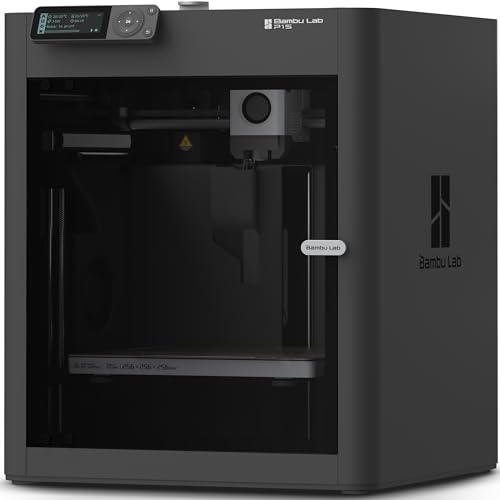
Bambu Lab P1S (Best Value Enclosed)
The enclosure keeps temperature stable, so ABS and ASA parts warp less and layer adhesion improves on functional prints. That is the core of its case as best value enclosed in this shortlist. It suits buyers whose work matches its design centre: the people described in the verdict below will get their money’s worth, while the trade-offs listed honestly underneath explain who should keep scrolling. In daily use, it is the combination of its enclosed FDM filament design, its consumable economics and its workflow fit that separates it from machines with similar headline specifications.
See the current listing for the Bambu Lab P1S on Amazon for full specifications and delivery options.
Strengths
- The enclosure keeps temperature stable, so ABS and ASA parts warp less and layer adhesion improves on functional prints
- CoreXY motion delivers high print speeds without the ringing and ghosting that slow bed-slinger designs show
- Enclosed, filtered and comparatively tidy, so it can live in a study or classroom rather than a garage
Trade-offs
- Control is through a small monochrome screen and the app; there is no full touchscreen on the printer itself
- The built-in camera is a low-frame-rate monitoring view, not a smooth video feed
- The chamber is enclosed but not actively heated, so the most demanding high-temperature engineering filaments remain out of reach
- Type: enclosed CoreXY FDM 3D printer
- Build volume: 256 x 256 x 256 mm
- Enclosure: closed chamber with chamber fan and carbon filter
- Multi-colour: AMS-compatible (AMS unit sold as the Combo or separately)
- Ecosystem: MakerWorld model library, Bambu Studio slicer
- Frame: fully enclosed, ready to use out of the box
The P1S is the pick owners graduate to when prints stop being ornaments and start being brackets, enclosures, jigs and replacement parts. The closed chamber keeps functional materials honest, the speed means a prototype printed after breakfast can be tested before lunch, and the machine tolerates being run daily. Designers and engineers lean on it as a desktop production tool; hobbyists buy it because it makes the temperamental materials behave.
Best for: makers, designers and engineers printing functional parts in ABS, ASA or PETG / Not suited for: buyers who want a big touchscreen interface, or true high-temperature filaments that need a heated chamber
Bambu Lab X1-Carbon (Best for Print Farms)
LiDAR first-layer inspection and spaghetti detection catch failures that ruin overnight prints on lesser machines. That is the core of its case as best for print farms in this shortlist. It suits buyers whose work matches its design centre: the people described in the verdict below will get their money’s worth, while the trade-offs listed honestly underneath explain who should keep scrolling. In daily use, it is the combination of its enclosed FDM filament design, its consumable economics and its workflow fit that separates it from machines with similar headline specifications.
This is a prose-only pick in this guide: we describe it so you can compare the approach, and recommend checking current availability and pricing at reputable retailers, since we only link products verified in our research pool.
Strengths
- LiDAR first-layer inspection and spaghetti detection catch failures that ruin overnight prints on lesser machines
- Hardened extrusion path is built for abrasive carbon-fibre and glass-filled filaments from day one
- The flagship polish: better camera, better screen and the most complete sensor package in the Bambu line
Trade-offs
- Flagship pricing puts it well above the P1S that shares its build volume
- Sold in several bundle forms, so check exactly which AMS configuration a listing includes
- Still a passively heated chamber, so the most extreme engineering polymers remain specialist territory
- Type: enclosed CoreXY FDM 3D printer (flagship class)
- Build volume: 256 x 256 x 256 mm
- Monitoring: chamber camera with spaghetti detection and LiDAR first-layer inspection
- Extrusion: hardened components for abrasive carbon-fibre filaments
- Multi-colour: AMS-compatible
The X1-Carbon is the splurge with a business case: print farms and design studios run them because the failure detection saves real money on long, expensive prints, and the hardened path takes carbon-fibre nylon without eating its own gears. Home users buy it as the one machine that does everything the range offers. If your prints are mostly PLA decorations, its talents are wasted; if your prints are long, valuable or abrasive, they are the point.
Best for: print farms, studios and serious makers running long or abrasive-filament jobs / Not suited for: light hobby use, where the P1S delivers the same build volume for far less commitment
Formlabs Form 4 (Best Professional Resin)
Validated resins with published mechanical data are what separate professional resin from hobby resin for client and engineering work. That is the core of its case as best professional resin in this shortlist. It suits buyers whose work matches its design centre: the people described in the verdict below will get their money’s worth, while the trade-offs listed honestly underneath explain who should keep scrolling. In daily use, it is the combination of its professional resin (SLA) design, its consumable economics and its workflow fit that separates it from machines with similar headline specifications.
This is a prose-only pick in this guide: we describe it so you can compare the approach, and recommend checking current availability and pricing at reputable retailers, since we only link products verified in our research pool.
Strengths
- Validated resins with published mechanical data are what separate professional resin from hobby resin for client and engineering work
- Automated resin handling and a mature software pipeline suit labs that bill for output
- Service and support contracts exist, which hobby brands do not offer
Trade-offs
- Professional pricing for the printer and its proprietary resins alike
- Sold through professional channels rather than this guide’s linked listings
- Complete overkill for tabletop miniatures and hobby statues
- Type: professional desktop SLA resin printer
- Ecosystem: validated engineering and dental resin library
- Workflow: cartridge resin system with automated dispensing
- Channel: manufacturer and authorised resellers, service plans available
The Form 4 represents the professional tier honestly: dental labs, engineering firms and product designers pay for validated materials, documented properties and support contracts, not for resolution numbers. If your resin prints are deliverables with specifications attached, this is the class to investigate; if they are for your own table, the hobby machines above deliver the joy at a fraction of the commitment.
Best for: dental, engineering and product-design professionals with specified material requirements / Not suited for: hobbyists, for whom its cost buys no additional fun

ELEGOO Saturn 4 Ultra (Best for Detail Models)
The large 12K plate prints whole miniature armies, statue busts or a day of Etsy orders in one batch instead of five. That is the core of its case as best for detail models in this shortlist. It suits buyers whose work matches its design centre: the people described in the verdict below will get their money’s worth, while the trade-offs listed honestly underneath explain who should keep scrolling. In daily use, it is the combination of its resin (MSLA) design, its consumable economics and its workflow fit that separates it from machines with similar headline specifications.
See the current listing for the ELEGOO Saturn 4 Ultra on Amazon for full specifications and delivery options.
Strengths
- The large 12K plate prints whole miniature armies, statue busts or a day of Etsy orders in one batch instead of five
- Rated speed and the tilting release design shorten each layer cycle, so big batches finish in hours, not overnight
- AI camera monitoring and Wi-Fi cluster printing suit owners running several machines as a small fleet
Trade-offs
- A full vat holds a lot of resin, so a failed large print wastes more material than on a small machine
- Bigger footprint, more weight and more resin to store, wash and dispose of safely
- Peak speed depends heavily on resin type and settings; standard resins print slower than the headline figure
- Type: MSLA resin 3D printer
- Screen: 12K monochrome LCD
- Build volume: 218.88 x 122.88 x 220 mm
- Rated speed: up to 150 mm/h (manufacturer figure)
- Features: AI camera monitoring, Wi-Fi cluster printing
- Levelling: automatic levelling
The Saturn 4 Ultra is the production resin machine in this list: Etsy sellers batch out product lines, wargamers print entire armies, and statue collectors produce display pieces at a scale the Mars class cannot attempt in one piece. Owners describe the shift as moving from printing miniatures to manufacturing them. It asks for a proper resin workstation, real ventilation and a consumables shelf, and in return it removes batch size as a constraint.
Best for: sellers, wargamers and statue makers who print resin in serious batches / Not suited for: small desks, first-time resin users, or anyone printing only the occasional single miniature
Comparison Table
| Pick | Type | Key specs | Price |
|---|---|---|---|
| Raise3D Pro3 | professional FDM filament | Type: professional enclosed FDM 3D printer; Build volume: 300 x 300 x 300 mm class; Extrusion: dual extrusion with lifting nozzles | Check price on Amazon |
| Prusa CORE One | enclosed FDM filament | Type: enclosed CoreXY FDM 3D printer; Chamber: actively controlled chamber temperature; Build volume: 250 x 220 x 270 mm | Check price on Amazon |
| Bambu Lab P1S | enclosed FDM filament | Type: enclosed CoreXY FDM 3D printer; Build volume: 256 x 256 x 256 mm; Enclosure: closed chamber with chamber fan and carbon filter | Check price on Amazon |
| Bambu Lab X1-Carbon | enclosed FDM filament | Type: enclosed CoreXY FDM 3D printer (flagship class); Build volume: 256 x 256 x 256 mm; Monitoring: chamber camera with spaghetti detection and LiDAR first-layer inspection | Check price on Amazon |
| Formlabs Form 4 | professional resin (SLA) | Type: professional desktop SLA resin printer; Ecosystem: validated engineering and dental resin library; Workflow: cartridge resin system with automated dispensing | Check price on Amazon |
| ELEGOO Saturn 4 Ultra | resin (MSLA) | Type: MSLA resin 3D printer; Screen: 12K monochrome LCD; Build volume: 218.88 x 122.88 x 220 mm | Check price on Amazon |
Read the table as a map, not a ranking: the right row is the one whose type and key specs match your workload, which the buying guide below unpacks. Related comparisons worth reading next include Best 3d Printers For Metal and Best Printers And Scanners For Home Use.
How to Choose the Right 3D printer for design and engineering work
Iteration speed is a design tool
A prototype printed in two hours gets tested the same day and redesigned by evening; the same part in twelve hours becomes tomorrow’s problem. For design work, rated speed at usable quality is a genuine professional feature, not a toy specification.
Chamber control separates toys from tools
Engineering materials warp because layers cool unevenly. Enclosed machines manage this passively; actively controlled chambers manage it properly. Match the machine to the most demanding material your projects actually specify.
Open versus closed ecosystems is a workflow decision
Open platforms let engineers control G-code, slicers and materials completely, at the cost of more process ownership. Closed ecosystems trade that control for reliability and speed of onboarding. Labs usually end up running both.
Resin is the fit-and-finish instrument
For visual models, ergonomic mock-ups and fine fit checks, resin resolution shows what the product will feel like. Engineering teams pair one resin machine with filament workhorses rather than forcing either technology to do both jobs.
Budget framing deserves one direct paragraph. Treat the keyword’s price band, where it has one, as a tier signal rather than a promise: entry tiers buy capability with compromises in speed, capacity or consumable cost, mid tiers are where most buyers should live, and premium tiers buy time, consistency and support. Spend first on the constraint you hit weekly, not the feature you might use yearly. Readers comparing neighbouring topics should also see Best Printers For Giclee Prints.
How Do You Run a Print Like an Engineering Process?
- Define the part’s job first: form study, fit check or functional load, because each justifies different materials and settings.
- Model with printing in mind: wall thicknesses in multiples of your nozzle width, fillets on loaded corners, tolerances on mating faces.
- Slice with the profile saved for that material and machine, and record the profile name on the job note.
- Print a fit-check coupon or the critical interface first when the full part is large or expensive.
- Inspect the first layers, then let monitoring do its job; check the finished part against callipers, not against hope.
- Measure the printed part at its functional dimensions and log the deviation; adjust the model or profile once, deliberately.
- Post-process deliberately: remove supports, anneal or finish only where the application requires it, and photograph the result.
- File the model version, profile and result together so the next iteration starts from evidence.
Problem: the first layer will not stick → fix: clean the build plate, re-run the machine’s levelling or calibration routine, and slow the first layer down. Nine first-layer failures in ten are contamination, offset or speed, in that order; change one at a time.
Problem: stringing and blobs appear on previously clean prints → fix: suspect the material before the machine. Dry the filament or check the resin’s age and temperature, then re-run a small calibration print before touching motion settings.
Problem: a print fails at the same height every time → fix: inspect that exact region of the model and the machine: a support gap, a Z-axis obstruction or a damaged file all repeat at the same layer, while random failures move around.
Common Mistakes
- Specifying a material for its headline strength while ignoring layer-direction weakness in the actual load path.
- Printing a full assembly before checking the one interface that decides whether it fits.
- Treating maximum speed as the professional setting; engineering parts earn their keep at quality profiles.
- Skipping chamber control for nylon and then blaming the material for warping.
- Owning five materials and mastering none; professionals standardise on two or three and know them deeply.
Most of these mistakes share one root: deciding from a headline instead of from your own workload. A ten-minute audit of what you actually produce each week prevents nearly all of them. For a neighbouring angle on the same category, see Best Laser Printers For Photos.
Ownership Notes: Living With Your Choice
Finally, buy for the work you have, not the work you imagine. List the last three months of things you wished you could print, count them, and size the machine to that list with modest headroom. Aspirational purchases fill cupboards; honest ones fill shelves with finished parts. If a bigger need genuinely arrives, a well-chosen first machine becomes the second machine rather than the mistake, and the upgrade decision makes itself with real numbers behind it.
Filament and resin are the real subscription in 3D printing, and the maths differs by technology. A kilogram of decent PLA covers a surprising amount of hobby printing, while resin is bought by the litre and partly lost to supports, washing and the film of material that never leaves the vat. Before choosing a machine, price the consumables for your actual monthly output; the printer is the cheap part of a busy year, and the material shelf is where budgets quietly succeed or fail.
First-layer adhesion decides more prints than every other setting combined. A clean plate, a correct Z offset and a sane first-layer speed will rescue models that no amount of later tuning can save. New owners should learn their machine’s test prints before their dream projects, because the first layer is the foundation every subsequent layer trusts, and its failures are the easiest to prevent and the most demoralising to debug mid-print.
Ventilation and safety deserve the same respect as print quality. Resin printing needs gloves, eye protection, ventilation and disciplined waste curing; filament printing is gentler but still deserves airflow, especially with ABS-class materials. None of this is difficult, and all of it is cheaper than the alternative. Set the workspace up properly on day one, while enthusiasm is high, rather than retrofitting habits after the first skin rash or headache.
Slicing software is the invisible half of every printer. The same model, sliced with a thoughtful profile, prints in half the time with twice the strength of a careless one. Learn supports, infill patterns, wall counts and seam placement as deliberate choices rather than defaults, and save profiles per material and per job type. Owners who keep a small library of proven profiles stop re-solving solved problems, and their machines appear magically more reliable than identical hardware next door.
Supports are a design material, not a necessary evil. Every supported surface carries a small quality tax, so orientation is the first support decision: rotate the model until the fewest visible faces need scaffolding. Tree supports, painted support blockers and split-and-glue strategies all exist to move that tax to places nobody sees. An hour spent learning orientation pays back on every print for the life of the machine.
Moisture is filament’s quiet enemy. PLA tolerates a shelf; PETG, TPU and nylon drink humidity and announce it with popping, stringing and rough surfaces that look like machine faults. A simple dry box or a food dehydrator restores most spools, and storing working filament sealed with desiccant prevents the problem entirely. When a previously good printer starts printing badly for no visible reason, suspect the spool before the hardware.
Maintenance in 3D printing is small, regular and unglamorous: wipe the build plate, check belt tension, lubricate what the manual says to lubricate, replace the FEP film or nozzle when its time comes, and keep firmware current. Machines that receive twenty minutes a month of this attention run for years; machines that receive none fail theatrically on deadline day. Keep a notebook or a notes file with dates, because memory is the least reliable component in the whole system.
Failure is tuition, and every owner pays some. The skill is paying it cheaply: start prints while you are nearby, watch the first layers, use the camera if your machine has one, and treat each failed print as data about temperature, adhesion or supports rather than as a verdict on the machine. The community’s photographed failure libraries exist because everyone has produced the same spaghetti, the same elephant’s foot and the same delaminated bracket, and then learned the one-line fix.
Strength in printed parts comes from geometry more than from material labels. Wall count beats infill percentage for most functional parts, layer direction decides where a bracket will snap, and a fillet added in the model outperforms a stronger filament bought in hope. If you print functional things, spend an evening on design-for-printing principles; it upgrades every machine you will ever own, including the one already on your desk.
Noise, smell and footprint decide whether a printer gets used or exiled. An enclosed machine in a study can run during a work call; an open machine printing ABS in a bedroom will not be run at all. Measure the real working space, including room to open lids, swap spools and stage a wash station for resin, and place the machine where its habits fit your household rather than where the product photos suggest.
Communities are a specification. The popular machines in this guide carry an invisible accessory: thousands of owners who have already documented your exact problem, published the fixed profile and photographed the repair. Obscure machines may match them on paper while leaving you alone with every question. When two picks tie on specifications, the one with the deeper community is the safer purchase, and it is not close.
Real-World Workloads: How These Picks Behave
Consider the shared-household workload. Different people bring different projects and different patience, and the printer becomes infrastructure like the washing machine: expected to work, noticed only when it does not. Infrastructure rewards boring virtues: one-tap model libraries, visible material levels, and controls a guest can understand. The all-rounder picks in this guide exist for this scenario, and they usually outlast cleverer specialist machines in shared spaces.
Consider the weeknight workload, because that is where printer choices are truly tested. A part is needed tomorrow, the print must run while dinner cooks and homework happens, and nobody has an hour to babysit a first layer. Machines that earn their place here wake fast, start reliably and finish unattended. Judge every pick above against your own busiest evening, not your calmest weekend, and favour the one whose defaults you can set once and trust.
Consider the gift deadline: a birthday, a holiday, a friend’s new baby, all with dates that do not negotiate. Gift printing rewards multi-colour machines and ready model libraries, and punishes experimental setups. The defence is rehearsal: print the gift design once, early, at small scale, and keep a shelf of proven models that have already succeeded on your machine. The picks flagged for beginners and families exist precisely for this scenario.
Consider the classroom workload: thirty students, one teacher, a timetable that ends whether the prints finished or not. Here the winning traits are enclosure, automatic everything, and a queue managed by software rather than by hope. Failure rate matters more than peak quality, because a class set with three failures is a lesson plan problem. The education picks in this guide were chosen against exactly this arithmetic.
Consider the small-business workload, where output is sold and every reprint is margin lost. Consumable cost per sellable unit, batch consistency and hands-on minutes per order dominate every other number. Track those three figures from your first week of selling; the right printer is the one that improves them, and it is usually the reliable workhorse rather than the flagship or the bargain. Batch-oriented picks in this list were ranked with a seller’s spreadsheet in mind.
Consider the repair workload: the broken clip, the obsolete knob, the bracket nobody sells anymore. Repair printing rewards measurement skills and PETG more than it rewards speed, and it turns a printer from a toy into the most satisfying tool in the house. Owners who learn basic CAD for repairs report the machine paying for itself in avoided replacements, quite apart from everything else it prints.
Consider the long-print workload: the helmet, the terrain board, the statue that occupies the machine for a day or more. Long prints test reliability, power stability, filament reserves and your nerve. Machines with cameras, resume-after-outage features and proven profiles earn their keep here, and the honest preparation is a full spool, a clean plate and a test of the first hour before you commit the night.
Consider the learning workload, because every owner is a student for the first month. The curve is not about intelligence; it is about small avoidable failures: the wrong temperature, the skipped brim, the support that scarred the show face. A good first machine shortens that month with forgiving defaults and a community that has already made your mistakes publicly. If two picks look equal, choose the one with the deeper pool of tutorials and answered questions.
What Owners Learn After the First Month
Second-hand and refurbished routes deserve an honest mention. For established models with available parts, manufacturer-refurbished units can be excellent value, and the picks above are popular enough that refurb channels exist for many of them. The cautions are warranty length, the state of wear parts on arrival, and, for resin machines, the condition of the screen and vat. Run the full test sequence inside the returns window, not after it.
Document your setup as if a stranger must run it, because one day the stranger is you, tired, in six months. Photograph the material codes and settings that work, save slicer profiles with names that describe jobs rather than numbers, and keep one successful test print as a reference. When quality drifts, that reference tells you whether the machine changed or the material did. Five minutes of documentation outperforms an hour of forum searching.
Environmental choices in this category are mostly about waste avoidance. Print once, correctly: test small, check settings, then commit. Cure and dispose of resin waste responsibly, never pour it down a drain, recycle spools where schemes exist, and prefer designs and settings that succeed first time. None of this requires buying anything marketed as green; it requires running the machine you bought with a little discipline.
If your workload is about to change — a new course, a growing shop, a child discovering the hobby, a business taking its first orders — buy for the workload twelve months out, not the one twelve months back. Equipment in this category is cheapest when bought once at the right size. The picks are tiered deliberately so you can locate your future workload in the list, and the trade-offs state plainly which direction each machine fails in when outgrown.
One final calibration: no printer in this guide, at any tier, does everything. The six picks are six different answers to the same question, each correct for a different owner. The verdict lines exist to match you to your answer quickly, and the final recommendation names the default for the majority. If your workload is unusual, trust the criteria sections over the ranking order; they were written for exactly your situation.
After the first month, owners consistently say the specification they underrated was the unglamorous one: build volume they actually use, the price of the second spool or litre, the noise at midnight, or the quality of the maker’s app. None of those photograph well in a listing, and all of them decide daily satisfaction. If you are choosing between two finalists, spend your last comparison minutes on exactly those unglamorous lines, because that is where your future self will feel the difference every week.
A word about buying timing and channels. Prices for machines in this category move with seasons, sales events and stock cycles, sometimes by a lot within a month. The sensible approach is to choose the model first using this guide, then buy when the live price on the listing is one you are comfortable with, from a seller whose returns window covers your first real workload. A great printer bought in a panic at a bad price still stings; the same printer bought calmly rarely disappoints.
Accessories are where budgets quietly leak. A spare spool or bottle of your main material is a genuine necessity; most other accessories are optional until a specific job demands them. Buy the machine, run your real work for a fortnight, and let that experience write your accessory list. Owners who follow that order spend less and own fewer gadgets in drawers, because every later purchase answers a problem they have actually met.
Setup day deserves more respect than it gets. Ninety unhurried minutes — unboxing, assembly checks, calibration, a test print, defaults configured, material stored properly — prevent the majority of complaints that fill support forums. Rushing setup to save half an hour is the most expensive time-saving in this entire category. The how-to section in this guide is written to be followed in order, once, on that first day.
There is a particular pleasure in a workflow that disappears. When the machine starts reliably, produces the expected part and asks for material with fair warning, printing stops being an event and becomes infrastructure, like hot water. Every pick in this guide was weighed on its ability to reach that state of boring reliability within its class, because boring, in equipment you depend on, is the highest praise available.
Think about who else will use this machine and what they will do wrong. They will load the wrong material, send the huge job twice, ignore the low-filament warning and open the door mid-print. Forgiving machines survive households, classrooms and teams; temperamental precision tools belong with a single careful owner. The trade-off lists above quietly encode this: where a pick demands process discipline, it says so.
Total cost has a time dimension most comparisons miss: your attention. A machine that needs weekly coaxing costs more than its consumables; it costs the mental slot it occupies. When two picks are close, choose the one you will think about least. That principle explains several rankings in this guide that look surprising on specifications alone, and it is the principle experienced owners apply without being able to name it.
Final Recommendation
For most readers, start with the Raise3D Pro3 (Best Professional Workhorse): it covers the widest range of real work for this lens with the fewest compromises. If your priorities lean the way the second pick leans, the Prusa CORE One (Best Desktop Engineering) is the alternative to beat. Budget-focused buyers should weigh the value picks in the table against their consumable costs over a full year, and specialists should choose by the lens that matches their actual output rather than by headline specifications. Every linked pick above leads to its live Amazon listing, where current pricing and availability decide the final timing of the purchase.
Frequently Asked Questions
What tolerance can desktop printers hold?
Well-calibrated machines in this list hold roughly a tenth of a millimetre on external dimensions with the right profile; design clearances for moving fits accordingly and verify with a test coupon.
Which material should an engineer standardise on?
PETG for general functional work, ASA for outdoor and heat, and a carbon-filled nylon for loaded parts covers most desktop engineering. PLA remains the form-study default.
Can these printers replace a machine shop?
For prototypes, jigs, fixtures and low-volume polymer parts, largely yes. For metal, tight-tolerance or certified parts, they complement the shop rather than replace it.
Is multi-colour useful in engineering?
For colour-coded assemblies, labelled fixtures and presentation models, genuinely yes; for pure function, it is neutral. It costs nothing in reliability on the picks that include it.
How do teams share one printer effectively?
Named slicer profiles, a job log, standard materials and a booking habit. The machine is rarely the bottleneck; undocumented settings are.