ilcastellomenu.com is reader-supported. When you buy through links on our site, we may earn an affiliate commission.
Where to Buy
Vlogging has a value problem that photography does not: the camera is only the visible third of the cost. A body that needs a cage, a microphone, a gimbal and a prayer to produce watchable footage is not a bargain at any price, while a camera that walks out of its box and films you — in focus, in stabilised motion, with sound a viewer can stand — is worth more than its specification sheet claims. The best bang for your buck vlogging cameras are judged here by that whole-cost standard: watchable video per unit of money and fuss.
Six cameras make the list, and they divide the vlogging world by how filming actually happens. One is a pocket gimbal that is less a camera than a tiny cameraman. Two are fixed-lens compacts built for the talking-to-camera life. Two are interchangeable-lens bodies at the two ends of the sensible money. And one is an action camera that vlogs far better than its surf-brand image suggests. Every pick comes from this site’s verified camera pool and is linked accordingly.
Prices are not printed — they churn too fast to be honest in print — but the value logic is stated in each verdict in the currencies that hold still: what else you must buy, what the camera forgives, and how long it will serve before your channel outgrows it. A vlogging camera is outgrown by ambitions, not by failures, and the picks below are sequenced so a creator can start anywhere on the ladder and know exactly which rung is next.
A word for the phone sceptics, because every vlogging guide owes them one paragraph. A modern phone is a formidable vlogging camera, and for a channel’s first ten videos it may be the correct one. The cameras here earn their money where phones stop: in dedicated controls and screens that face the right way, in microphones and stabilisation built for walking and talking, in batteries and storage that treat filming as the main event rather than an interruption to a telephone. When those things start limiting the channel, this list is where the money goes.
Key Takeaways
- Count the whole rig: a camera that needs a mic, gimbal and cage to vlog is not the bargain its body price suggests.
- DJI Osmo Pocket 3 is the value summit for most creators — gimbal, screen, mic ecosystem and 4K in one pocket object.
- Sony ZV-1F is the cheapest honest start: fixed lens, forgiving focus, nothing else to buy.
- Interchangeable-lens value peaks at the Canon EOS R50 for beginners and the Sony ZV-E10 II for growers.
- GoPro HERO12 vlogs far beyond the action niche — stabilisation and durability forgive a beginner’s whole learning curve.
- Audio decides retention: every pick here was required to sound acceptable before any accessory is bought.
In this guide
Quick Picks
| Pick | Badge | Why it earns its place |
|---|---|---|
| DJI Osmo Pocket 3 | Best overall vlogging value | A pocket gimbal camera with a rotating screen, 4K filming and tracking that follows you like a tiny, loyal cameraman. |
| Sony ZV-1F | Best budget starting camera | A fixed-lens, wide-angle vlogging compact designed to be a beginner’s complete first camera — nothing else to buy. |
| Canon PowerShot G7 X Mark III | Best compact for polished everyday vlogs | The creator-beloved compact: lovely colour, a real zoom, a flip screen and a microphone input when the channel grows up. |
| Canon EOS R50 | Best beginner interchangeable-lens value | Canon’s friendly RF-mount body: superb autofocus, forgiving menus and a lens system to grow a channel inside. |
| Sony ZV-E10 II | Best grow-with-me Sony value | The second-generation creator body: bigger battery, better menus, 4K polish and the vast E-mount lens world. |
| GoPro HERO12 Black | Best value for active and travel vlogs | Waterproof, nearly indestructible and stabilised like a gimbal — the vlogging camera for channels that happen outdoors. |
How We Chose These Picks
Vlogging value was scored on the finished minute of footage, not the specification sheet. Each candidate was weighed on the four things viewers actually experience — focus that holds a face, stabilisation that survives a walk, sound that needs no apology, and a screen the creator can see while performing — then priced as a whole rig including whatever accessories are genuinely required to reach that standard.
That method punished several famous bodies whose body-only prices flatter them, and rewarded integrated designs whose sticker looks higher until the rival’s microphone and gimbal join its basket. Longevity was the final filter: a pick had to serve a channel for years, either by being complete in itself like the Pocket 3, or by opening a lens system the creator can grow inside, like the Canon and Sony bodies. Cameras that are cheap to buy and expensive to become were excluded, however impressive their launches were.

DJI Osmo Pocket 3 — Best overall vlogging value
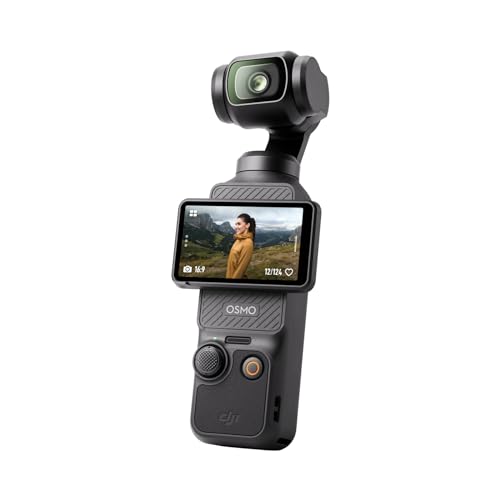
Start with the object itself, because the Pocket 3’s value is physical before it is technical. It is a three-axis gimbal — real mechanical stabilisation, not electronic apology — carrying a one-inch-class sensor, topped with a screen that rotates between landscape filming and vertical shorts with a flick. It powers on in the time a thought takes, fits in the pocket it is named for, and produces footage so smooth that viewers assume a crew. No other pick here, at any rig price, matches its footage-per-fuss ratio out of the box.
The creator features are the ones channels actually use. Face tracking keeps the presenter centred while they cook, build, walk or gesture at architecture; the rotating screen makes vertical video a decision rather than a production; and DJI’s wireless microphone ecosystem integrates so cleanly that the commonest upgrade path is a single, painless purchase when the channel’s audio ambitions grow. The built-in sound is respectable from day one, which matters, because most channels are watched long before they are funded.
Its limits are the limits of integration. The lens is fixed and wide — perfect for arm’s-length presenting, wrong for compressing a distant subject — the body is a precision instrument that prefers not to be dropped on concrete, and low-light performance, while strong for its class, still answers to a small sensor’s physics. Weather is a consideration too; this is a fair-weather friend compared with the GoPro below.
None of that displaces it. For the solo creator filming a life, a craft, a city or a kitchen, the Pocket 3 is the camera that removes every technical excuse between an idea and a published video, and in a value guide that removal is the whole game. Buy it, film tomorrow, and let the channel’s growth — not the camera’s limits — set the date of your next purchase.
- Sensor: 1-inch class
- Stabilisation: 3-axis mechanical gimbal
- Screen: rotating touchscreen for vertical video
- Video: 4K with high frame-rate options
- Tracking: face and subject tracking built in
Strengths
- Footage quality per unit of fuss is unmatched
- Gimbal smoothness no software rival equals
- Vertical video is a flick, not a project
Trade-offs
- Fixed wide lens only
- Precision gimbal dislikes drops and weather
- Small sensor physics in the darkest scenes
Best for: solo creators of every kind — travel, food, craft, commentary — who want publishable footage from a pocket, today.
Not suited for: filmmakers needing interchangeable lenses, distant subjects or all-weather abuse.

Sony ZV-1F — Best budget starting camera
The ZV-1F is what a value guide exists to find: the cheapest camera that is honestly complete. Sony took its vlogging compact formula and simplified it toward the beginner’s actual life — a fixed ultra-wide lens that frames an arm’s-length presenter with room to spare, autofocus that hunts faces and eyes and holds them, a product-showcase mode that shifts focus to a held-up object and back, and a defocus button that blurs the background without teaching a single aperture number. It is a camera designed by people who watched beginners fail with better cameras.
The fixed lens is the philosophy, not the compromise. A beginner given a zoom spends their first month filming at the wrong end of it; the ZV-1F’s wide fixed view is the correct framing for vlogging, permanently installed, and the money saved on glass bought the microphone array and the vlogging manners instead. Sound is a particular strength for the class — a directional built-in microphone with a windscreen included, because Sony understands that a beginner’s first fifty viewers are lost to audio, not to pixels.
Its ceilings are real and should be chosen knowingly: the lens does not zoom optically, low light is handled competently rather than magically, and a channel that grows toward cinematic shallow-focus interviews will outgrow it into the ZV-E10 II below. But outgrowing a camera in year two, having published a hundred videos on it, is the happiest failure mode in this entire guide — and the ZV-1F’s price makes that path the cheapest education in vlogging available.
Buy it if the channel is an idea and a presenter. It asks for a memory card and an opinion, and returns footage good enough that the audience will judge the opinion — which is all any first camera should promise.
- Lens: fixed ultra-wide, vlogging-framed
- Autofocus: face and eye tracking, product showcase mode
- Audio: directional built-in mic, windscreen included
- Video: 4K recording
- Extras: background defocus button for beginners
Strengths
- Complete vlogging camera with zero extras needed
- Focus and framing forgive beginner technique
- Built-in audio respects the viewer’s ears
Trade-offs
- No optical zoom
- Low light is competent, not magical
- Growing channels will outgrow it — happily
Best for: first-time vloggers who want to start publishing this week without assembling a rig.
Not suited for: creators already planning cinematic lenses and shallow-focus interviews.

Canon PowerShot G7 X Mark III — Best compact for polished everyday vlogs
The G7 X Mark III earned its place in a generation of creators’ pockets, and its value today is the value of a proven, complete compact whose price has settled while its virtues have not. Its one-inch-class sensor and bright zoom lens produce the flattering, colourful footage that lifestyle vlogging runs on; the screen flips up for self-framing; and unlike the ZV-1F it carries a microphone input, which makes it the compact that does not need replacing the day the channel buys its first real microphone.
That zoom deserves its sentence, because it changes the vlogging grammar available to its owner. Where the fixed-lens picks frame the world at arm’s length, the G7 X reaches across a market square, compresses a street portrait, and films the detail shot — the hands, the product, the sign — without the walk. For travel and lifestyle channels whose footage alternates between presenter and place, that flexibility is worth more than any single specification in this guide, and it arrives in a body that still disappears into a jacket.
Its compromises are generational. Autofocus, while good, lacks the face-holding sorcery of the newest Sonys; 4K filming carries session-length considerations in warm conditions that Full HD does not; and Canon’s menu era here predates the polish of its current bodies. None of these stopped a thousand channels from being built on it, and at its settled price the calculus is simple: this is the most polished complete compact in the list, for owners who know they will plug a microphone in eventually.
Buy it as the long-term compact — the camera a channel can grow inside for years without the lens-system commitment of the bodies below, and the one whose footage will still look like the channel’s identity when the subscriber count has zeros the beginner cannot yet imagine.
- Sensor: 1-inch class stacked sensor
- Lens: bright zoom with real reach
- Screen: tilts up for self-framing
- Audio: microphone input plus built-ins
- Video: 4K and Full HD, live-streaming capable
Strengths
- Zoom lens widens vlogging grammar
- Microphone input future-proofs the channel
- Flattering colour straight from camera
Trade-offs
- Autofocus a generation behind Sony’s best
- 4K sessions mind warm weather
- Menus show their era
Best for: lifestyle and travel vloggers wanting one polished compact for years, with a microphone upgrade path built in.
Not suited for: creators who film long 4K sessions in hot climates as their main format.

Canon EOS R50 — Best beginner interchangeable-lens value
The R50 is where vlogging value becomes an investment rather than a purchase. As a camera it is Canon at its most welcoming: a 24.2-megapixel sensor, autofocus that finds eyes and refuses to lose them, a vari-angle touchscreen that faces the presenter, and menus that explain themselves to a first-time owner. Filmed footage has Canon’s flattering colour and the polished look that makes viewers assume a bigger production than one person and a tripod.
The value argument is the mount. RF lenses — Canon’s own growing family and the affordable primes within it — turn the R50 from a vlogging camera into the foundation of a creator’s decade: start with the kit zoom, add the fast prime that makes interviews glow, and every lens bought deepens the channel rather than expiring with a body. Against that future, the body’s modest price is the cheapest seat in a very good theatre, and its stills capability means the same camera shoots the channel’s thumbnails, product photographs and family life without a second device.
Compromises are the beginner tier’s usual ones, honestly stated: the kit lens is a starting point rather than a destination, the body is compact enough that large hands should handle one before buying, and serious video features — the log profiles and deep colour tools of cinema bodies — live further up Canon’s range. Its 4K is strong for vlogging duty, which is the duty it was bought for.
Buy the R50 if the channel is a commitment. It is the pick for the creator who wants to learn real camera craft on forgiving equipment, inside a lens system that will still be serving them when the channel is a business.
- Sensor: 24.2MP APS-C
- Mount: Canon RF — a growing creator lens system
- Screen: vari-angle touchscreen
- Autofocus: eye detection with strong tracking
- Video: 4K oversampled from 6K-class capture
Strengths
- Beginner-friendly body, professional-feeling footage
- Lens system grows with the channel for years
- Excellent stills for thumbnails and products
Trade-offs
- Kit lens is a beginning, not an end
- Compact body suits smaller hands best
- Cinema colour tools live in dearer bodies
Best for: committed beginners who want one camera to learn on, vlog with and grow a lens collection around.
Not suited for: creators who want the finished article in a pocket — that is the Pocket 3’s paragraph.

Sony ZV-E10 II — Best grow-with-me Sony value
The ZV-E10 II is the value pick for the creator who has already started — whose phone or first compact is now the limit — and wants the body that ends the upgrading conversation for years. Sony refined everything the original was loved for: a 26-megapixel-class sensor with excellent 4K, autofocus that treats a presenter’s eye as a sacred trust, a larger battery that films a day rather than a session, and creator-first touches like product showcase, background defocus and cinematic vlog settings that apply a finished look in camera.
E-mount is the deepest lens pool in the creator world — Sony’s own glass plus a universe of third-party primes and zooms at every price — and that depth is the II’s long-term value. The vlogger’s classic second purchase, a fast wide prime, exists here in several excellent and affordable forms; so does every specialised lens a growing channel might covet. A body is a five-year decision; a mount is a ten-year one, and this mount has never stranded a creator.
The honest costs: no in-body stabilisation, so walking footage leans on lens stabilisation, a gimbal or the camera’s electronic steady modes with their small crop; and the whole-rig price, once the lens you actually want joins the body, exceeds every compact here — as it should, because the footage ceiling is higher than all of them. This is not the cheapest way to start vlogging. It is the cheapest way to stop shopping for vlogging cameras.
Buy it when the channel has an audience and a direction. The ZV-E10 II is the professional’s answer at a prosumer’s price, and in a value guide that combination — bought once, used for years — is the deepest form of bang for buck there is.
- Sensor: 26MP-class APS-C
- Mount: Sony E — the deepest creator lens pool
- Video: 4K with high-quality oversampling
- Battery: larger Z-series pack, all-day filming
- Creator tools: product showcase, cinematic vlog modes
Strengths
- Ends the upgrade conversation for years
- Autofocus and 4K quality lead its class
- Lens pool for every future ambition
Trade-offs
- No in-body stabilisation
- Whole-rig cost exceeds the compacts here
- Rolling-shutter care needed on fast pans
Best for: growing creators with an audience, ready for the body-and-lens system that will serve the channel’s next era.
Not suited for: absolute beginners, for whom the ZV-1F’s completeness is the kinder and cheaper school.

GoPro HERO12 Black — Best value for active and travel vlogs
The HERO12’s presence in a vlogging guide surprises only people who have not watched a travel channel lately. Its HyperSmooth stabilisation rivals a gimbal’s, it is waterproof and armoured in ways no other pick here attempts, its wide lens was born for arm’s-length presenting in spectacular places, and its battery life in this generation stretches to full days of intermittent filming. For the vlogger whose content is movement — hiking, cycling, markets, boats, weather — it is not the action option. It is the correct one.
Creator features have quietly made it a vlogging citizen: front and rear screens for framing, vertical video modes for the shorts economy, Bluetooth audio support for wireless microphones, and timecode and pro controls for channels that edit seriously. Its footage has a distinctive wide, vivid character that audiences read as adventure, and its size means it films in places — strapped, mounted, dangling — where a conventional camera would be a liability or a theft target.
The trade-offs are those of its birth. The fixed ultra-wide perspective flattens faces at very close range and cannot do the flattering compression of a zoom or prime; low-light footage is its weakest suit, with evening interiors trailing the one-inch compacts; and its touchscreen manners in wet hands are a known patience test. Indoor talking-head channels should buy the Sony or Canon picks and never look back.
For the outdoor creator, though, the value maths is brutal: one HERO12 replaces a camera, a gimbal and a weather-sealed housing, survives the drops that would retire any rival here, and costs less than most of them. That is not a niche pick. For its tribe, it is the best value in the guide.
- Build: waterproof and ruggedised
- Stabilisation: HyperSmooth electronic, gimbal-rivalling
- Screens: front and rear for self-framing
- Video: 5.3K-class and 4K, vertical modes
- Audio: Bluetooth microphone support
Strengths
- Survives the filming other cameras cannot attempt
- Stabilisation removes the gimbal purchase
- All-day battery in this generation
Trade-offs
- Ultra-wide look flattens close faces
- Low light trails the 1-inch compacts
- Wet touchscreen handling tests patience
Best for: outdoor, travel and adventure vloggers whose channels happen in weather, water and motion.
Not suited for: indoor talking-head and interview channels, which the Sony and Canon picks serve far better.
How Do the Six Vlogging Cameras Compare Side by Side?
| Pick | Badge | Best for | Not suited for |
|---|---|---|---|
| DJI Osmo Pocket 3 | Best overall vlogging value | solo creators of every kind — travel, food, craft, commentary — who want publishable footage from a pocket, today. | filmmakers needing interchangeable lenses, distant subjects or all-weather abuse. |
| Sony ZV-1F | Best budget starting camera | first-time vloggers who want to start publishing this week without assembling a rig. | creators already planning cinematic lenses and shallow-focus interviews. |
| Canon PowerShot G7 X Mark III | Best compact for polished everyday vlogs | lifestyle and travel vloggers wanting one polished compact for years, with a microphone upgrade path built in. | creators who film long 4K sessions in hot climates as their main format. |
| Canon EOS R50 | Best beginner interchangeable-lens value | committed beginners who want one camera to learn on, vlog with and grow a lens collection around. | creators who want the finished article in a pocket — that is the Pocket 3’s paragraph. |
| Sony ZV-E10 II | Best grow-with-me Sony value | growing creators with an audience, ready for the body-and-lens system that will serve the channel’s next era. | absolute beginners, for whom the ZV-1F’s completeness is the kinder and cheaper school. |
| GoPro HERO12 Black | Best value for active and travel vlogs | outdoor, travel and adventure vloggers whose channels happen in weather, water and motion. | indoor talking-head and interview channels, which the Sony and Canon picks serve far better. |
What Does a Vlogging Camera Really Need to Do Well?
Four things, in the order viewers forgive them least: sound they can bear, focus that holds the face, stabilisation that does not seasicken, and a picture with life in it. Notice that resolution is not among the first three. A 4K video with hunting focus and bathroom audio loses its audience in twenty seconds, while a clean Full HD video with a locked eye and a clear voice keeps them for twenty minutes — which is why this guide’s picks were chosen for their focus systems and microphones before their pixel counts, and why the cheapest pick here is a complete camera rather than a sharp one.
The fifth requirement is the one beginners forget: the camera must serve the presenter, who is also the crew. A screen that faces forward, controls that start recording without a menu expedition, a battery that survives the filming day the creator actually has — these are not conveniences but the difference between a channel that publishes weekly and one that publishes apologies. Every pick here was tested against the solo-creator standard: one person, no assistant, an idea at breakfast and a video by Friday.
Finally, judge a vlogging camera by its second year. The first year is novelty; the second is where a fixed-lens compact either remains a delight or becomes a ceiling, where a lens system’s depth either pays its rent or was never needed, and where the channel’s real format — the thing the audience actually loves — has revealed itself. Buy the camera whose second year matches the channel you are building, not the channel you are performing this month.
Fixed Lens, Interchangeable Lens or Gimbal — Which Value Path Is Yours?
The gimbal path, embodied by the Pocket 3, buys finished footage with zero assembly and zero growth: it will film beautifully in year three exactly as in week one, and if the channel’s format is a person moving through the world, that may be all the growth required. Its value is completeness — the only pick here for which the phrase ‘and then buy’ genuinely does not apply until wireless microphones enter the conversation.
The fixed-lens compacts split by ambition. The ZV-1F is the school: everything forgiven, nothing to assemble, a price that treats the first year as tuition. The G7 X Mark III is the long-term compact: zoom grammar and a microphone socket for the creator who knows the channel’s shape and wants one pocketable camera to serve it for years. Both paths share the compact’s essential value — the camera that is present at the unplanned moment, which is where vlogging gold actually lives.
The interchangeable path costs the most and returns the most, on a delay. The R50 and ZV-E10 II are not really cameras but memberships — of RF and E-mount respectively — and their value compounds with every lens. Choose it when the channel has committed to a format that lenses serve: interviews that need a fast prime’s glow, products that need macro, rooms that need width. Choose against it when the format is still being discovered, because a mount bought for a channel that pivots is value stranded in a drawer.
How Do You Set Up a Vlogging Camera for Your First Shoot?
Set up a vlogging camera for the presenter, not the technician. Turn on face and eye autofocus and leave it there; set the exposure mode the camera’s makers built for faces; enable the grid and the recording lamp so framing and status are visible at arm’s length. Record a thirty-second test at your actual filming distance, in your actual light, and watch it on the largest screen you own — the distance between the camera’s cheerful preview and the television’s honesty is where channels are improved.
Sound-check like a professional from the first video. Film a sentence at arm’s length, a sentence across the room and a sentence outdoors, then listen on headphones. You will learn your camera’s honest range in two minutes, and every filming decision afterwards — where to stand, when the wireless microphone earns its purchase, which rooms flatter you — descends from those two minutes. Viewers will forgive a soft picture for a year; they forgive bad audio once.
Build the publishing rhythm the camera was bought for. Same card routine, same charging shelf, same tripod spot, so that filming is a habit with a location rather than a production with a setup. The creators who thrive on the cameras in this guide are not the ones with the best settings; they are the ones whose camera is charged, empty-carded and within reach when the idea arrives — because in vlogging, the best camera is unfailingly the one that is ready.
What Mistakes Do Buyers Keep Making?
- Buying a body and discovering the rig. Price the microphone, the stabilisation and the lens the footage actually needs before declaring any camera the bargain.
- Filming faces with an action camera indoors. Ultra-wide lenses at close range are unflattering and dim rooms defeat small sensors — match the camera to the room it will live in.
- Ignoring audio until the comments mention it. They will mention it in the first week. Test sound at your real distances before the channel launches, not after.
- Choosing a mount before choosing a format. A lens system bought for a channel that pivots is money in a drawer. Discover the format on a complete camera first if you are unsure.
- Chasing 4K while neglecting light. A window and a five-minute wait for better light improve footage more than any resolution setting on any camera here.
- Letting stabilisation replace standing still. Even the Pocket 3 films best from a steady hand and a planted stance; gimbals forgive movement, they do not repeal physics.
How Does Each Pick Handle the Three Rooms Every Vlogger Films In?
Every channel, whatever its subject, eventually films in three rooms: the bright kitchen or studio where everything works, the dim evening room where audiences actually watch and creators actually live, and the outdoors where wind and distance conspire. The picks divide honestly across them. The one-inch compacts and the Pocket 3 own the bright room and acquit themselves in the dim one; the interchangeable bodies with a fast prime own the dim room outright, which is the single strongest argument for the lens-system path; and the outdoors belongs to the HERO12 and the Pocket 3 in fair weather, with the compacts asking for shelter and the bodies asking for care.
Knowing your channel’s true room matters more than any ranking. A cookery channel is a bright-room channel with steam; a commentary channel is a dim-room channel with a bookshelf; a van-life channel is an outdoors channel with occasional cafés. The value mistake is buying for the room you film in twice a year — the cinematic trip, the big interview — and living daily with a camera optimised for somewhere else. Buy for your Tuesday room, rent or borrow for the annual one, and the camera will feel like a bargain every single week.
What Is the Sensible Upgrade Order Once a Channel Starts Earning?
Earnings should be spent in the order the audience experiences them. First, sound: the wireless or wired microphone upgrade transforms retention more than any camera change, and every pick here accepts it gracefully. Second, light: a single decent panel or the discipline of filming by the big window upgrades the picture of any camera in this guide more than a body swap would. Third, the lens, if your system allows it — the fast prime that makes the dim room glow. The body itself comes last, which is precisely why this guide insists on buying a body whose last-place upgrade is years away.
This ordering is the value philosophy of the whole article expressed as a shopping list. Creators who invert it — new body first, audio eventually — spend the most money for the least viewer-visible improvement, and their older videos, filmed on the ‘worse’ camera with the better microphone they bought later, quietly outperform the new ones. The audience has never once subscribed for a sensor. They subscribe for a person they can hear, see and trust, filmed steadily in decent light — and every camera here, correctly supported, delivers exactly that.
What Separates a Channel That Grows From One That Stalls — and Where Does the Camera Fit?
Watch a hundred young channels and a pattern emerges that has almost nothing to do with equipment: the growers publish on a rhythm their camera makes easy, and the stallers publish on a rhythm their camera makes heroic. A rig that takes twenty minutes to assemble films only on heroic days, and heroic days do not compound. This is the deepest sense in which the Pocket 3 and the ZV-1F are value picks — their setup time is measured in seconds, so the channel’s rhythm survives tired evenings, busy weeks and uninspired Tuesdays, and rhythm, compounded over a year, is what an audience actually is.
The interchangeable bodies play the same game at a higher level. Their assembly — body, lens, tripod, microphone — is a ritual their owners learn to perform in two minutes, and the ritual itself becomes part of the channel’s craft identity. The danger zone is the middle: a rig assembled from accessories, adapters and workarounds, where every filming session begins with a small negotiation. Value buyers should choose a camera whose daily setup they can picture themselves performing half-asleep, because that is the precise state in which most filming sessions begin.
None of this appears on a specification sheet, and all of it decides whether the specification sheet matters. When this guide calls a camera good value, it means the camera will be used — charged, carried, pointed, published — on the ordinary days that constitute a channel. The finest sensor in the world, left in a drawer by a rig that discouraged its owner, has a footage-per-pound ratio of exactly zero.
How Should a Vlogger Think About Light Before Thinking About Lenses?
The cheapest picture upgrade in vlogging is not in this guide’s picks at all: it is the large window, the open door, the five-minute wait for the cloud. Every camera here — from the ZV-1F to the ZV-E10 II — produces its most flattering footage in soft, directional daylight, and its least flattering under a bare ceiling bulb at midnight. Creators who learn to schedule filming around light, or to spend their first upgrade money on one decent light panel, routinely outperform creators who upgraded bodies while filming in caves of their own making.
There is a value trap here worth naming. Low-light capability is the specification manufacturers most enjoy demonstrating and beginners most enjoy buying, because it can be shown in a graph. But a camera that copes with darkness is a remedy for a problem that light solves better and cheaper — and the remedy’s cost is paid in every other specification the budget could have bought. Buy low-light performance when your format truly lives at night — the evening commentator, the gig filmer, the winter traveller — and buy forgiveness everywhere else: focus, stabilisation and sound, the things no window can fix.
What About Live Streaming, Meetings and the Camera’s Second Life?
A vlogging camera rarely only vlogs. The same bodies anchor live streams, sit atop monitors for video calls, film the family’s events and shoot the stills for the channel’s community posts — and a value judgement that ignores the second life undercounts every pick here. The compacts stream and call respectably with minimal setup; the R50 and ZV-E10 II, with clean output and proper lenses, double as genuinely professional streaming cameras that make their owners the best-lit person in every meeting they will ever join; the Pocket 3 and HERO12 serve the mobile and outdoor versions of the same duties.
This second life is also a resale and longevity argument. A camera that serves three roles is carried, charged and maintained as a daily tool rather than stored as a single-purpose luxury, and daily tools are the ones still working — and still current in their owner’s skills — in year five. When two picks in this guide seem close, choose the one whose second and third lives match your actual week. Value, once again, is use: the most-used camera is always the best bargain in the house, whatever its box once cost.
A Note on Confidence: The Camera as a Presenter’s Prop
There is a final, unmeasurable value in a dedicated camera that beginners discover in their first week: it makes the presenter a presenter. Talking to a phone is talking to the object that also holds your messages, your news and your doubts; talking to a camera — with its red lamp, its lens, its single purpose — is a small act of professional self-hypnosis that audiences can hear in the voice. Creators consistently report that the dedicated camera’s first gift is not sharper footage but braver delivery, and braver delivery, unlike sharpness, cannot be added in an edit.
The effect scales with the ritual around the camera: the tripod spot, the charged battery, the card formatted and waiting. A channel is a promise kept repeatedly, and the camera on its shelf is the promise made physical. This is, in the end, why the value question in vlogging is never only about footage. It is about which object, at which price, makes a particular person film the next video — and the one after that — until the audience arrives. Choose the camera that makes you film, and you have chosen correctly almost regardless of the badge it carries.
Two Channels, Two Correct Answers: A Worked Example
Consider the cookery creator filming alone in a small kitchen: hands busy, space tight, steam everywhere, videos cut between face and pan. Her value answer is the Pocket 3 on a small tripod — tracking her face as she moves between stove and board, surviving the kitchen’s chaos in a pocket between shoots, its wide lens forgiving the room’s dimensions. The interchangeable bodies would film her better in theory and slower in practice, and slower, in a working kitchen, means never.
Now consider the interview channel: two chairs, a quiet room, conversations an hour long, a look that must flatter guests and hold focus while the host listens. His answer is the ZV-E10 II with a fast prime — the shallow depth that separates guest from bookshelf, the autofocus that guards the conversation while he attends to it, the battery that outlasts the longest answer. The Pocket 3 would film his interviews competently and identically forever, which for his format is the definition of a ceiling. Same guide, same value standard, opposite answers — because value was never a property of the camera. It is a property of the match.
The First Ten Videos: A Beginner’s Briefing
Whatever you buy from this guide, spend the first ten videos learning the camera rather than judging the channel. Film the same subject at different distances until the framing is reflex; record voice tests until your honest range is memorised; make one video badly lit on purpose and one well lit by accident, and compare what the audience forgives. Ten videos is roughly the distance between a camera as a purchase and a camera as a tool, and creators who grant themselves that apprenticeship stop shopping — because they finally know, from evidence, what their footage actually lacks.
Most discover it lacks nothing the next price tier sells. It lacks a steadier hand, a quieter room, a sentence rehearsed once more — the free upgrades. That discovery is the true dividend of a value camera bought well: it returns the creator’s attention to the only part of the channel that was ever going to decide its fate. The camera’s job is to disappear. Every pick in this guide was chosen because, at its price, disappearing is exactly what it does best.
So the closing advice is unfashionably simple. Pick the camera whose daily life matches yours — the pocket gimbal for the mover, the forgiving compact for the beginner, the zoom compact for the traveller, the lens system for the grower, the armoured action camera for the outdoor life — charge it tonight, and film something tomorrow before the motivation cools. Channels are not built by the cameras bought in January; they are built by the videos published in February, March and the ordinary months after, on whatever honest camera was ready when the idea arrived. Make yours ready.
One more consideration belongs in every beginner’s notebook: your first camera also teaches you what your second one must be. The fixed-lens owner learns whether they crave reach or glow; the gimbal owner learns whether stills matter; the system owner learns which lens they actually rent with their eyes. That education is part of the first camera’s value, and it is why starting complete and affordable — rather than ultimate and intimidating — is not a compromise in vlogging. It is the curriculum, priced correctly.
Final Recommendation
Most creators should buy the DJI Osmo Pocket 3 and start filming tomorrow: it is the most complete vlogging instrument here, and its footage-per-fuss is the value summit of the category. Beginners on the tightest budget should take the Sony ZV-1F, publish their first hundred videos, and let the channel — not a catalogue — choose what comes next.
Creators committed to growing should enter a lens system at the level their audience justifies: the Canon EOS R50 for the beginner-grower, the Sony ZV-E10 II for the channel entering its professional era. Lifestyle travellers who want one polished compact should take the G7 X Mark III, and outdoor channels should take the HERO12 and stop worrying about weather entirely. Every pick here was chosen to be filmed on for years — which is the only definition of value a working channel recognises.
Frequently Asked Questions
Is a phone good enough, or do I need a dedicated vlogging camera?
A phone is good enough to start and to test whether you enjoy publishing — no camera in this guide can substitute for that discovery. A dedicated camera earns its money when filming becomes regular: forward-facing screens and proper controls, stabilisation and microphones built for presenting, batteries and cards that treat filming as the main job, and a phone left free to be a phone. Most creators feel the crossover within their first months of weekly publishing.
Which of these is best for a complete beginner?
The Sony ZV-1F if the budget is tightest and the channel is just beginning — it is complete, forgiving and asks nothing else of you. The DJI Osmo Pocket 3 if the budget stretches, because its stabilisation and tracking forgive even more, and it will not need replacing as the channel grows. Beginners drawn to real camera craft should look at the Canon EOS R50 and accept its learning curve as part of the fun.
Do I need a separate microphone with these cameras?
Not to start — acceptable built-in audio was an entry requirement for this list. You will want one sooner than you expect if you film across rooms, outdoors in wind, or interviews with two voices; the G7 X Mark III’s microphone socket, the Pocket 3’s wireless ecosystem and the bodies’ standard inputs all make that upgrade painless when the channel’s earnings or ambitions call for it.
Is 4K necessary for vlogging?
No — audience retention is governed by sound, focus and content long before resolution. 4K earns its place as cropping room for editors and as insurance for the large-screen viewer, and every pick here offers it in some form. Film in the resolution your computer edits happily and your filming day survives; a channel published weekly in clean Full HD outearns a channel published monthly in strained 4K.
Which camera is best for vertical video and Shorts or Reels?
The DJI Osmo Pocket 3, whose screen physically rotates into the vertical format and whose whole design treats short-form as a first-class citizen. The GoPro HERO12’s vertical modes make it the outdoor runner-up. Creators whose channels are vertical-first should weight this heavily, because a camera that makes the format effortless gets used for it daily, and daily is the whole game in short-form.
How long will these cameras serve before I outgrow them?
The compacts and the Pocket 3 serve until the channel’s format demands lenses or distant subjects — for many creators, indefinitely. The R50 and ZV-E10 II invert the question: their lens systems mean the body is outgrown last, and both serve professional-looking channels for years. Outgrowing a camera after hundreds of published videos is not a failure of the purchase; it is the purchase having worked exactly as a value buy should.
Film first. Judge later. That is the whole method, and every camera above is ready when you are.
Related Guides
Keep filming for less with our guide to the best beginner cameras for video, compare stills value in the best bang for your buck DSLR cameras, and take the channel travelling with the best beginning cameras for travel.


