ilcastellomenu.com is reader-supported. When you buy through links on our site, we may earn an affiliate commission.
Where to Buy
The first camera is not really a camera purchase; it is the purchase of a teacher. The best cameras for first time photographers are the ones that make a beginner better fastest — that forgive the first thousand mistakes, explain themselves without a manual’s worth of patience, and still have something to teach in month twelve, when the training wheels of automatic mode have come off and the photographer is steering. Buy wrong and the hobby dies of confusion by spring. Buy right and a first body becomes the foundation of a lifelong way of seeing.
This guide is written for the true beginner: the phone photographer who wants more, the parent who wants the family’s pictures to rise above snapshots, the student whose course starts in September, the gift-buyer choosing for someone else’s beginning. It assumes no vocabulary — every technical idea below arrives with its plain meaning attached — and it judges cameras by a beginner’s actual first year: the first walk, the first portrait of a friend, the first trip, the first photograph that makes its maker say, out loud, I did that.
Money honesty belongs at the front. A first camera’s price is not its price: there is a lens, a card, a bag, perhaps a second battery, and the total is the real decision. Every pick below was costed as a working kit, and the ranking respects the beginner’s whole budget rather than the body’s sticker. It also respects the used market’s existence — several of these systems are superb bought second-hand — while recommending new where warranties and simplicity matter most to a first owner.
Growth is the second honesty. Some first cameras are destinations — complete, satisfying, finished — and some are doorways into systems that can carry a photographer for decades. Neither is wrong, but they suit different beginners: the one who wants a beautiful object that takes beautiful pictures now, and the one who already suspects this hobby is about to eat their weekends. The picks below are labelled by which promise they make, so the choice can be honest about the person, not just the pictures.
Finally, the deepest truth in this guide: the first camera’s most important feature is that it gets carried. A camera at home teaches nothing. Size, weight, charm and the simple desire to pick the thing up are therefore ranked here as educational specifications, because they are. The best first camera is the one that is present for the year in which its owner becomes a photographer — and presence, like everything else in photography, is a design decision.
Read the six as six different first teachers, each with a personality: the patient explainer, the video-native friend, the strict but inspiring artist, the playmate, the outdoor companion and the magician with the instant trick. Students thrive under different teachers, and photography is no exception. The most important sentence in this guide is not about any camera — it is the one where you recognise which teacher you would actually spend a year with.
Key Takeaways
- A first camera is a teacher: judge it by how fast it makes you better, not by its spec sheet.
- Cost the whole kit — body, lens, card, bag — because the sticker is only the first instalment.
- Decide honestly: destination camera for now, or doorway into a system for decades.
- Automatic modes should teach, not trap — look for guidance you can graduate from.
- The camera that gets carried is the camera that teaches; size and charm are real specs.
- Your first lens matters as much as your first body; start simple and learn its one voice.
In this guide
Quick Picks
| Pick | Badge | Why it is here |
|---|---|---|
| Canon EOS R50 | Best first doorway into a real system | Friendly guidance, Canon colour and the RF system’s whole future in one small body. |
| Nikon Z30 | Best first camera for video-minded beginners | A creator’s first body: simple, screen-first and at home on a desk or a tripod. |
| Fujifilm X100VI | Best destination camera — one lens, whole education | The fixed-lens legend: dials, a hybrid finder and pictures with a point of view. |
| Sony ZV-1F | Best simplest start for social-first beginners | A pocket vlogging compact that makes the first year feel like play, not study. |
| OM SYSTEM OM-5 Mark II | Best first system for outdoors beginners | Weather-sealed, compact and clever — the first camera for walkers and travellers. |
| Fujifilm Instax Mini 12 | Best first camera for pure joy | Instant prints, zero settings, immediate photographs — the hobby’s friendliest door. |
How Did We Choose Cameras for First Time Photographers?
We ranked by the first ninety days. In that window a beginner needs three things from a camera: success early enough to stay motivated, feedback clear enough to learn from, and controls that reveal themselves gradually rather than all at once or never. Bodies with honest automatic modes, helpful guides and viewfinders or screens that show the effect of a setting before the shot scored heavily — because a beginner learns photography from consequences, and the faster the consequence is visible, the faster the learning compounds.
Second, the graduation test. Every pick had to answer the question: what happens when this photographer gets good? Systems with a lens ladder, bodies with full manual control waiting patiently beneath the assists, and files that reward growing skill in editing all passed. Cameras that are only easy — that wall the beginner inside simplicity — were marked down, however charming, because the second year matters as much as the second week.
Third, the carrying test, conducted rudely and honestly: would a normal person take this on a walk, to a family lunch, on the train to a new city? Weight, size, the desire the object itself inspires — these decided real rankings here, because a first camera’s curriculum is the owner’s life, and it can only teach the lessons of the places it actually goes.
What we refused to rank by: maximum specifications, professional features a beginner cannot yet spend, and the opinions of experienced photographers about what beginners should want. Experienced photographers are the worst guides to a first camera — they have forgotten the confusion they are advising about. This list was built by remembering it.
We also consulted the saddest dataset in photography: the cupboard census. Every household knows the camera that was bought with love and abandoned by March, and we interrogated those failures for their causes. Weight, complexity without guidance, and pictures that looked no better than the phone’s accounted for nearly all of them — which is why this ranking treats carryability, teaching design and immediately pleasing colour as the holy trinity of a first camera, ahead of every specification the brochures lead with.
Which Six Cameras Should a First Photographer Choose Between?
The six split into two families. The doorways — Canon, Nikon and OM mirrorless systems — grow with you for years. The destinations — a legendary fixed-lens compact, a friendly video-first body and an instant camera — perfect a particular joy immediately. Read your own temperament in the descriptions; the right family matters more than the ranking inside it.

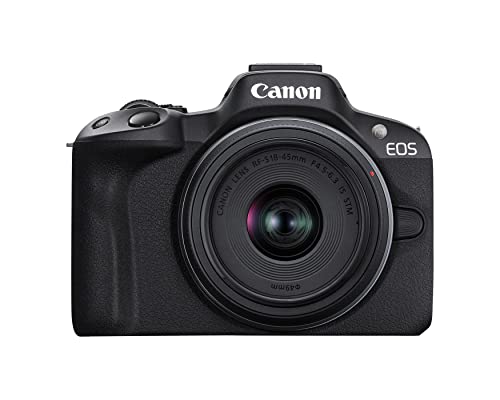
Canon EOS R50 — Best first doorway into a real system
The R50 is the first camera we hand a beginner who asks, because it is engineered around the first year’s emotional arc. Its automatic modes produce genuinely pleasing pictures in week one — Canon’s colour flattering family, friends and food alike — while its guided interfaces explain, in plain language, what the camera is doing and why. That explanation habit is the difference between a camera that takes pictures for you and a camera that teaches you to take them, and the R50 is firmly, deliberately the second kind.
- APS-C mirrorless body on the Canon RF mount
- Guided automatic modes alongside full manual control
- Pleasing colour straight from the camera for early wins
- Compact kit that stays carryable all day
When the lessons land, the doorway opens. Full manual control is present without ceremony, the RF lens range stretches from the kit zoom to professional glass that this same body can mount, and the skills transfer upward unchanged when a bigger Canon eventually arrives. A beginner can honestly spend five years inside this purchase — body, two lenses, a way of seeing — and that longevity makes its price the most defensible on the list for anyone who suspects the hobby will stick.
Its carrying manners complete the case. The R50 kit is small enough for a jacket-side bag and light enough to be forgotten until the light does something interesting, which is the precise mechanical definition of a camera that teaches: present at the moments, absent from the complaints. First cameras are abandoned for weight more often than for quality, and Canon has clearly designed this one to refuse abandonment. Its guided screens deserve one full evening of exploration before the first walk; the syllabus is in there, written plainly.
Strengths
- Teaches while it assists — guidance that explains itself
- Early pictures please immediately, which keeps beginners going
- A lens system that can carry a decade of growth
Trade-offs
- Kit lens is a starting point, not a destination
- Menus reward the beginner who reads the quick guide once
- Serious video ambitions will eventually want a bigger sibling
Best for: beginners who suspect the hobby will stick and want a system to grow in.
Not suited for: buyers wanting a finished, self-contained camera with nothing more to buy.

Nikon Z30 — Best first camera for video-minded beginners
Some first photographers are really first filmmakers, streamers or video diarists who also take stills, and the Z30 is the beginner body honest about that priority. It drops the viewfinder most stills-first beginners are told to want and spends the savings on the screen-first, self-filming friendliness its audience actually uses daily. If your photographic beginning is a desk, a tripod and a face — yours — this is the camera that starts from your real life rather than from tradition.
- APS-C mirrorless body on the Nikon Z mount
- Screen-first design for self-filming and vlogging
- Simple controls with full manual depth beneath
- Compact body that lives happily on small tripods
Its stills are far better than its video-first reputation suggests, because underneath the creator conveniences sits Nikon’s Z system entire: the same mount as the flagship bodies, the same colour character, a lens range that climbs from kit zooms to professional primes. A beginner can grow from desk videos to serious photography without selling a single purchase, which quietly makes the Z30 one of the best-value doorways here for the video-led beginner.
The learning design is gentle in a specific way: it assumes the beginner is filming themselves, alone, and makes that act unembarrassing — clear recording indicators, framing that can be checked at a glance, audio that accepts help gracefully. First cameras should lower the social cost of beginning, and for the generation whose photography starts as self-documentation, no body on this list lowers it further. Record one desk video in the shop if you can — its manners with a face at arm’s length are its whole argument, made live.
Strengths
- Begins from the beginner’s real life: desk, tripod, own face
- Full Nikon Z system waiting beneath the simplicity
- Stills quality that outgrows its video-first label
Trade-offs
- No viewfinder — composing is a screen-only craft here
- Stills-first traditionalists will miss the classic handling
- Small body means small battery — spares are a habit to build
Best for: video-led beginners, streamers and self-documenting creators.
Not suited for: beginners who dream in viewfinders and street photography.

Fujifilm X100VI — Best destination camera — one lens, whole education
The X100VI is the list’s beautiful argument for constraint. One fixed lens — a classic reportage focal length — means the beginner learns photography’s deepest skill first: moving, framing and seeing, instead of shopping. Its film simulations give pictures a finished, intentional look from the first week, and its physical dials make exposure a thing the hands learn, visibly and tactilely, rather than a menu the eyes forget. Photographers who begin here tend to develop a style early, because the camera has one and lends it generously.
- Premium compact with a fixed wide-angle lens
- Hybrid optical and electronic viewfinder
- Physical dials and film simulation colour modes
- Leaf-shutter quiet and a body designed to be carried daily
It is a destination, and honest about it: the lens never changes, the system never grows, and for a certain beginner that finitude is freedom. No lens anxiety, no upgrade path whispering, no bag of options — just a superb instrument that fits a coat pocket and asks to be carried everywhere, which its owners famously do. The waiting lists for this camera are a cultural phenomenon, but the phenomenon rests on a truth: limitation, beautifully engineered, is a pedagogy.
The caveats are the curriculum’s price. A fixed wide lens will frustrate the beginner who falls for wildlife or sport; the camera’s desirability makes it neither cheap nor always findable; and its very completeness can shelter a beginner from learning interchangeable-lens craft. Choose it as you would choose a single great teacher rather than a whole school — deliberately, and because its particular lessons are the ones you most want first. Buy the strap and the case with it; this camera’s natural habitat is a shoulder, not a shelf.
Strengths
- Constraint that teaches seeing faster than any zoom
- Pictures with a finished, film-like character from week one
- An object so carryable it redefines the owner’s daily habits
Trade-offs
- One lens forever — some subjects stay out of reach
- Premium price and scarce availability
- No system to grow into if ambitions change direction
Best for: beginners who value style, simplicity and an everyday carry above all.
Not suited for: beginners whose interests already point at sport, wildlife or macro.

Sony ZV-1F — Best simplest start for social-first beginners
Not every beginning should feel like enrolment. The ZV-1F is the first camera for the beginner whose photography lives in motion and company — days out, friends, food, the city at arm’s length — and who wants pictures and clips that look polished without a course in anything. Its wide lens forgives framing, its blur mode flatters subjects, and its operation is close enough to a phone’s habits that the learning curve is measured in an afternoon.
- Compact vlogging camera with a wide fixed lens
- Product and background-blur modes for instant polish
- Simple, phone-familiar operation
- Pocket size that guarantees it comes along
It teaches by stealth. A beginner shooting happily with the ZV-1F is absorbing composition, light and timing without naming them, and when curiosity about control eventually wakes — it usually does — the concepts arrive pre-experienced. Many serious photographers started on cameras beneath their eventual ambitions; the hobby’s first requirement is photographs you love, in quantity, and this little body manufactures exactly that momentum.
Its limits are real and should be chosen knowingly: the lens is fixed and wide, the files are modest beside the mirrorless picks, and the graduation path leads to another purchase rather than a lens shelf. As a first camera for a social, video-leaning beginner — or as the gift that starts a teenager’s visual life without a system’s complexity — it is the warmest welcome on this list. Its blur mode is a kind teacher — graduate from it to distance and light when the portraits start asking questions.
Strengths
- Zero-intimidation operation for the truly new
- Wide, forgiving lens made for friends, food and days out
- Pocketable enough to be present for the whole first year
Trade-offs
- Fixed wide lens cannot reach distant subjects
- A stepping stone, not a system — graduation means replacing
- Stills are good rather than great beside mirrorless rivals
Best for: social-first beginners, teenagers and video-leaning starters.
Not suited for: beginners already hungry for manual control and lenses.

OM SYSTEM OM-5 Mark II — Best first system for outdoors beginners
If the beginner’s life is lived outdoors — hills, coasts, festivals in fields, travel in all weathers — the first camera should be built for that life rather than insured against it. The OM-5 Mark II is the outdoors doorway: a genuinely compact system whose sealing shrugs off the weather that sends other first cameras back to the bag, and whose stabilisation forgives the beginner’s unsteady hands on a windy ridge at dusk, which is where the year’s best photograph is usually waiting.
- Micro Four Thirds mirrorless body on a deep lens system
- Weather-sealed, compact build for real outdoor use
- Strong stabilisation that forgives beginner hand-hold
- Computational features that assist landscapes and night scenes
Its system’s economics suit a beginner’s real budget beautifully. Micro Four Thirds lenses are smaller, lighter and often kinder in price than their larger-format equivalents, so the second and third lenses — where a photographer’s real education happens — arrive sooner. The computational assists, from night modes to in-camera aids for long exposures, let a beginner produce tripod-class landscape results while still learning why tripods exist, which is the correct order for motivation.
It is also the list’s best answer to the carrying test over years rather than weeks. A kit that fits a small daypack gets taken on the unplanned walks where photography actually happens; the OM system’s size discipline is legendary among travelling photographers for exactly this reason. Begin here if your imagination of photography is mostly outdoors and in motion — the system will keep up with the walking, and the walking will do the teaching. Start with one zoom and the discipline of the small bag; the system’s famous lightness is a habit, not just a specification.
Strengths
- Built and sealed for the outdoor life beginners actually live
- Small, affordable lens ladder accelerates the real education
- Stabilisation and computation forgive a beginner’s technique kindly
Trade-offs
- Smaller sensor trails in the darkest conditions
- Menu depth asks for one patient setup evening
- Less shallow depth of field for portrait romantics
Best for: walkers, travellers and outdoors-first beginners on real budgets.
Not suited for: studio and portrait specialists chasing maximum background blur.

Fujifilm Instax Mini 12 — Best first camera for pure joy
Every photography education should contain at least one lesson in pure delight, and the Instax Mini 12 is that lesson with batteries included. Point, press, and a physical photograph develops in your hand — an object to give away, pin up, write on. For the youngest beginners, the gift market, and anyone whose photographic spark needs joy before it needs technique, there is no faster route from never having made a photograph to having made forty, all of them treasured.
- Instant camera with fully automatic exposure
- Credit-card-sized prints that develop in hand
- Simple, colourful design made for sharing
- Close-up and selfie conveniences built in
Do not mistake its simplicity for absence of teaching. Instant film imposes the oldest disciplines in the craft — every frame costs something, so framing becomes deliberate; there is no deleting, so honesty arrives early; the print is small, so subjects must be chosen close and clear. Beginners raised on instant film often develop a compositional decisiveness that digital abundance delays for years. The Mini 12 is a toy the way a first bicycle is a toy: it is also, unmistakably, the real thing.
Its ongoing cost is the honest caveat — film is a subscription to your own hobby, priced per frame — and its pictures will never satisfy a beginner whose ambitions turn technical. But as a first camera it has started more photographic lives than bodies ten times its price, because it understands the secret this whole guide is built on: people continue doing what delights them, and they learn whatever the delight requires. Budget the film with the camera and the hobby’s true price stays honest from the very first frame.
Strengths
- Photographs as physical objects within a minute of the moment
- Cost-per-frame teaches deliberation digital never does
- The least intimidating first step in all of photography
Trade-offs
- Film cost accumulates with enthusiasm
- No controls to graduate into — technique must move elsewhere
- Print quality is charm, not fidelity
Best for: young beginners, gifts and anyone starting from joy rather than ambition.
Not suited for: beginners who already know they want technical mastery.
What Should a Beginner Actually Learn in the First Ninety Days?
Three things, in this order: where the light is, what the frame excludes, and how to hold the camera like you mean it. Light first, because every photograph is a picture of light wearing a subject as an excuse, and the beginner who starts asking ‘where is it coming from, and is it kind?’ has acquired the master key of the craft. Every camera on this list can teach that lesson; the ones with honest screens and finders teach it fastest, because the student sees the light’s effect before the shutter, not after.
Exclusion second, because beginners photograph subjects and photographers photograph frames. The discipline of the edges — what creeps in at the corners, what the background is doing behind the portrait — separates the year’s first photograph from its fiftieth more reliably than any setting. Fixed-lens picks like the X100VI teach it by force; zooms teach it by temptation resisted. Either way, it is a seeing skill, not a camera skill, which is why this guide keeps insisting the first camera is a teacher: the curriculum is perception.
And the settings can wait their turn. Aperture, shutter and ISO are a week’s study once the eye is hungry for them, and a month’s confusion when taught first. The healthy sequence — automatic success, growing curiosity, one manual concept at a time, usually aperture first because portraits make its effect lovable — is the sequence these cameras’ guided modes were designed to walk. Trust it, and let the camera’s assists retire one by one like training staff whose job is done.
How Much Should a First Camera Really Cost?
Cost the year, not the day. A truthful first-year budget includes the body and kit lens, a card and a spare, a bag that fits the owner’s real life, and — by month six, if the hobby bites — one second lens chosen from experience. Priced that way, the doorway systems on this list cluster closer than their stickers suggest, and the destinations reveal their own honesty: the X100VI is everything, forever, in one number; the Instax is almost nothing now and a gentle toll per frame forever.
The used market deserves a beginner’s respect and a beginner’s caution. Last-generation bodies from these same systems are often the smartest first purchases in photography — the savings buy the second lens immediately — but they should be bought from sellers with returns, with shutter counts asked after, by a beginner who has handled the model or read this guide’s family descriptions twice. A first camera that arrives faulty teaches only one lesson, and it is the wrong one.
Beware the two false economies at either end. The suspiciously cheap camera that frustrates its owner out of the hobby is the most expensive object in this entire subject. And the flagship bought ‘to grow into’ usually grows into a cupboard, its complexity taxing the beginner’s motivation weekly. The middle of this list — capable, friendly, honestly priced — is not a compromise. It is where first cameras have always lived, and the hobby’s survival statistics live there with them.
Which First Lens Teaches the Most?
The kit zoom, used honestly, is a survey course: it lets the beginner discover which focal lengths their eye prefers, and that data — a month of photographs examined for the lengths they kept choosing — is the most valuable specification in photography, because it is personal. Buy the second lens from that evidence, not from a forum’s consensus, and the kit begins to describe its owner rather than its manufacturer.
The first prime lens, when it comes, is the postgraduate seminar. A single fast focal length — the classic portrait-and-street neighbourhood — teaches movement, aperture and anticipation in a way no zoom can, because it removes the standing-still solution. Many beginners find their style in the month they restrict themselves to one prime; the X100VI simply builds that month into the hardware, permanently, which is either its genius or its gamble depending on the owner.
Whatever the lens, learn its one voice before adding another. Every lens has distances and light where it sings; a beginner who knows one lens’s singing places will out-photograph a collector with a bag of strangers for years. Depth of familiarity beats breadth of equipment at every stage of photography, and it beats it most decisively at the first.
How Do You Keep Going When the First Photographs Disappoint?
They will, and the disappointment is data rather than verdict. The gap between the photograph imagined and the one taken is the engine of the entire craft; professionals feel it on every assignment, they have just learned to read it as instructions. The beginner’s discipline is specificity: not ‘my pictures are bad’ but ‘the light was behind her’, ‘the background swallowed him’, ‘I stood too far away’. Each specific sentence is a lesson already half-learned, and a month of them is an education no course sells.
Structure helps where talent is still arriving. One walk, one subject, one constraint — only doorways, only the colour yellow, only photographs taken kneeling — converts a vague practice into a game with edges, and games get played. The cameras here support the structure variously: the Instax makes every frame a small wager, the X100VI is a constraint with a shutter button, the systems let the constraint be a single borrowed prime. Choose the structure that makes you go out again tomorrow.
And keep the first year’s work, all of it, especially the failures. In month twelve, the beginner who reviews their first month’s frames will see progress with a clarity no compliment can match — the eye visibly learning, frame by frame, like a child’s handwriting improving down a schoolbook page. That archive is the first camera’s final gift, and it is why this guide treats the purchase so seriously: you are not buying a device, you are commissioning the record of becoming someone who sees.
What Should a Gift-Buyer Know That a Self-Buyer Does Not?
A gifted camera succeeds or fails on the giver’s knowledge of the person’s life, not the camera’s merits. The teenager living on video and friendship needs the ZV-1F’s welcome or the Z30’s desk fluency; the walking, travelling parent needs the OM’s sealed companionship; the aesthete needs the X100VI’s beauty; the child needs the Instax’s minute of magic. Match the camera to the calendar it must survive in — school runs, hill walks, studio flats — and the gift becomes a habit rather than an object.
Include the invisible parts of the gift: the card, the bag, the first pack of film, and — most valuable of all — the first outing together, where the camera is used in company and its first photographs have people the owner loves in them. A camera whose first frames are a shared afternoon acquires a sentimental momentum that carries it through the solo weeks when hobbies are usually abandoned.
Finally, give the upgrade path as permission rather than pressure. A note that says ‘when you outgrow this, the next lens is on me’ blesses the doorway systems perfectly; a note that says ‘this is the good one, don’t waste it’ burdens any camera past carrying. The best gift-buyers in photography buy the beginning, fund the continuation, and take credit only for having noticed who the person was already becoming.
How Does a Phone Photographer Know They Are Ready for a Camera?
The signs are specific. You have started moving for light instead of filtering for it afterwards. You have felt the phone’s zoom fail a distant subject you genuinely cared about. You have taken one photograph — usually of a person, in difficult light — that made you want the moment to have been done justice. And you have begun to find the phone’s total automation faintly insulting, a suspicion that there is a craft here and you would like to practise it. When two of those are true, the first camera stops being a gadget purchase and becomes what this guide treats it as: enrolment.
The transition’s surprise is how much transfers. Composition, timing and the hunger for the moment are phone-taught already; what the camera adds is control, consequence and a viewfinder’s or screen’s honesty about light. Beginners from phones often progress startlingly fast on the doorway systems, because their seeing is educated and only their hands are new. The cameras above were chosen partly to receive that transfer gracefully — friendly first, deep second, never condescending.
Keep the phone in the kit without shame. It remains the camera of record for a thousand daily moments, and the dedicated body’s role is the deliberate work: the walks taken for photography, the portraits arranged, the trips where seeing is the itinerary. Two instruments, two tempos, one photographer — the mature arrangement that most first-camera buyers grow into, and the one this guide quietly recommends from the first page.
How Do You Photograph People When You Are Just Beginning?
Begin with the willing: family, friends, the dog, in that order of patience. The beginner’s portrait craft is mostly social — putting a person at ease near a window, asking them to turn toward the light you have learned to find, taking ten frames so the eleventh can be relaxed. The cameras here flatter that apprenticeship variously: Canon’s colour is kind to skin from the first frame, the X100VI’s quiet shutter and classic lens make sitters feel photographed rather than processed, and the Instax hands the sitter a print, which remains the most charming transaction in all of photography.
Learn the window before the flash, and the background before the pose. A sitter placed near soft daylight, with an uncluttered depth behind them, will defeat every setting error a beginner can make — and a sitter against a busy background in hard noon sun will defeat every camera on this list. Portraiture’s first year is therefore mostly furniture arrangement and tact, which is excellent news: both are free, and both improve with practice faster than any technique involving dials.
Ask, always, and show the picture. The beginner who shares the frame on the screen, laughs at the misses and takes one more has understood portraiture’s actual mechanism — trust — and will be given the unguarded expressions that no lens can buy. Your first camera’s screen, flipped or shared, is a diplomatic instrument. Use it like one, and your first year’s portraits will have a life in them that technique alone takes years to earn.
What Is the Beginner’s First Project, and Why Does It Matter?
A project is a promise that organises practice: one subject, one boundary, one finish line. The doorway across the seasons. The market every Saturday for a month. Every dog in the park, with permission, in alphabetical order of name. It does not matter what the project is; it matters that next Saturday’s photographing has an appointment to keep, because hobbies die of vagueness long before they die of difficulty. Every camera here can carry a first project; the Instax even prints its own exhibition as it goes.
Choose a project with an audience of one or two — a wall, a partner, a grandparent expecting the Saturday market instalment. Audience, however small, converts practice into communication, and communication is where the lessons hide: the photograph that confused your viewer teaches more than the one that pleased you. The beginner who finishes a small project owns something no tutorial confers — a body of work, with a beginning’s innocence and an ending’s pride both visible in it.
Then do the bravest beginner act of all: show it whole, in order, including the frames that fail. The sequence tells the truth about learning that single images hide, and it gives the second project its syllabus. Photographers are made in the space between projects, in the honest hour of looking at what the first one actually said. Your first camera records that hour too — it is called the archive, and it is the real diploma.
How Should a Beginner Treat Editing and Sharing?
Edit like a beginner, which is to say lightly and honestly. The first year’s editing curriculum is three moves: straighten what leans, crop what distracts, and leave the colours close to the truth the camera’s colour science — Canon’s friendliness, Fujifilm’s simulations — already offered. Sliders pushed to drama are the beginner’s equivalent of shouting; the photograph that needs them usually needed a step closer or a minute’s patience instead, and learning that is worth more than any preset.
Share in a rhythm your life can keep: a small set weekly to the people who encourage accurately, not an audience of strangers with an algorithm’s manners. The encouragement that educates is specific — ‘the light in the doorway one’ — and it comes from viewers who know your subjects. Save the public posting for the second project, when your eye has a small track record to stand on and criticism lands on evidence rather than on hope.
And print something. One frame a month, on paper, on the wall. Printing is photography’s oldest editing tool — it forces size, sequence and commitment — and a first year that ends with twelve prints has a shape that ten thousand files never will. The Instax owner has been printing since minute one, which is its secret curriculum; the system owners should borrow the habit deliberately, because the wall teaches what the screen forgives.
How Do the Six Compare for a First Year?
Choose the family first. Doorways — R50, Z30, OM-5 Mark II — if the hobby will grow and you want purchases to compound. Destinations — X100VI, ZV-1F, Instax Mini 12 — if the joy should be complete immediately and growth can mean a second camera later. Within the family, choose by life: desks and video point to the Z30, hills to the OM, everything else to the R50’s all-round welcome.
| Pick | Badge | Where it earns its place |
|---|---|---|
| Canon EOS R50 | Best first doorway into a real system | The doorway most beginners should walk through: guidance now, a system forever. |
| Nikon Z30 | Best first camera for video-minded beginners | The video-first doorway: desk, vlog and stream manners with Nikon’s system behind it. |
| Fujifilm X100VI | Best destination camera — one lens, whole education | The beautiful constraint: one lens, film-like colour and a complete photographic education. |
| Sony ZV-1F | Best simplest start for social-first beginners | The playful start: pocketable, wide and forgiving for social-first beginners. |
| OM SYSTEM OM-5 Mark II | Best first system for outdoors beginners | The outdoors doorway: sealed, stabilised and sized for a life outside. |
| Fujifilm Instax Mini 12 | Best first camera for pure joy | The joy-first start: physical prints in a minute and nothing to learn but seeing. |
What Mistakes Do First Time Photographers Make When Buying?
Buying the camera an experienced friend recommends for themselves. Experts prescribe their own cures — the body that fixed their frustrations — to patients with entirely different symptoms. A beginner needs forgiveness, guidance and lightness; the expert’s beloved instrument usually offers control, customisation and weight. Honour the friendship, then buy from a list written for beginners, like this one, by criteria the expert has forgotten they once needed.
Spending the whole budget on the body and photographing through the kit lens’s apology forever. The second lens is where a first kit becomes a voice, and it should be planned — and roughly budgeted — from the start. A humbler body with its second lens bought in month three will out-teach and out-photograph a flagship still wearing its starter zoom in year two, and the gap is not subtle.
Learning settings before seeing. Beginners who begin with exposure theory often stall in it, producing technically literate photographs of nothing. Begin with looking — walks, constraints, subjects you love — and let each setting arrive as the answer to a frustration you have actually felt. The cameras’ guided modes exist to protect exactly this order; use them without a shred of embarrassment.
Comparing your first month to a professional’s portfolio. Their work is the end of a decade’s corridor; yours is its entrance, and the entrance always looks draughty. Compare instead against your own last month, keep the archive, and let the corridor do what corridors do when you keep walking.
A fifth mistake is hiding the camera until you feel worthy of it. Beginners wait for the good light, the real trip, the worthy subject — and the camera stays home through the ordinary Tuesdays where seeing is actually learned. Carry it beneath your standards. Photograph the kettle, the commute, the cat’s contempt. The worthy subjects are not insulted by your practice on the unworthy ones; they are made possible by it.
Final Recommendation
For most first time photographers, the answer is the Canon EOS R50: the friendliest teacher with the longest future, at a price that leaves room for the lens that will define year two. Video-led beginners start at the Nikon Z30; outdoor lives at the OM SYSTEM OM-5 Mark II; aesthetes and minimalists at the Fujifilm X100VI; social beginners at the Sony ZV-1F; and the youngest, or the joy-first of any age, at the Instax Mini 12, where photography begins as a gift you hand to someone. The list is deliberately short enough to choose from this week, because a first camera chosen in spring teaches a summer no autumn purchase can recover.
Whichever you choose, make the same three promises: carry it daily for the first month, learn one thing per week rather than everything per weekend, and keep every frame until the year turns. Do that, and the first camera will have done its work — which was never to take your first photographs, but to make you, permanently, a person who takes them.
A last word to the gift-buyer and the self-buyer alike: the first camera will not be the last word in anyone’s photography, and it is not supposed to be. It is the first word — and first words, in any language worth learning, should be chosen for how gladly they are spoken, and how much of the language they quietly promise.
Frequently Asked Questions
Is a mirrorless camera too much for a complete beginner?
No — the mirrorless bodies here were designed for beginners as their first audience, with guided modes that explain themselves and manual depth waiting underneath. What overwhelms beginners is not capability but poor teaching design, and these six were chosen precisely for teaching design. Start in the guided modes without embarrassment; they are the syllabus, not a shortcut. If the menus frighten you in the shop, that is information — but give the guided modes one honest week before concluding anything.
Should my first camera be full-frame?
Almost never. Full-frame bodies cost more, weigh more and demand more expensive lenses, while offering advantages — extreme low light, maximum background blur — that a first year rarely spends. The APS-C and Micro Four Thirds systems here will carry most photographers for years, and the money saved buys the lenses and trips that actually educate. Your phone remains the wide-angle of daily life; the camera is for the photographs you take on purpose.
Can I learn photography on a fixed-lens camera like the X100VI?
Yes — generations learned on exactly such cameras, and the constraint accelerates the core skills of position, framing and anticipation. What you postpone is lens craft and reach. If your interests are people, streets, travel and daily life, the fixed lens may never feel like a postponement at all. Its one risk is appetite: some beginners outgrow the single lens in a season and call that season expensive tuition in taste.
How long before I need a second lens?
When the kit lens’s limits have names. If you can say ‘I need wider for interiors’ or ‘I need faster for portraits’, the second lens has announced itself — usually between month three and month nine. Buy from that sentence, in that order, and the lens will feel less like shopping than like answering a letter. Examine your first month’s files for the focal lengths you kept choosing — the camera has been keeping your diary for you.
Is it better to buy a first camera new or used?
Used, from a reputable seller with returns, is often the smartest money in this guide — last-generation doorway bodies especially. New buys simplicity, warranty and the gift-wrapping of a fresh start. Either is defensible; what is not defensible is used-and-untested from a stranger, for a first owner who cannot yet diagnose a fault. Ask the seller for the shutter count and a returns window, and photograph a plain wall on arrival to check the sensor’s honesty.
What if I lose interest after a few months?
Then the honest, mid-priced picks here will have done their final service: they hold their value, sell easily, and — in the Instax’s and ZV-1F’s cases — pass happily to another beginner. But give the hobby its fair trial first: one full season, one project with edges, one review of your own archive. Most ‘lost interest’ is a first camera that was wrong for the life, which is the mistake this guide exists to prevent. Before selling, lend it for a month — some photographers only discover the hobby when the camera is about to leave.
Related Guides
Keep exploring with our beginner cameras for video guide and the cameras for college photography students roundup and our cameras for 12 year olds guide — each guide applies the same verified-pool, no-invented-specs approach to a neighbouring question.


