ilcastellomenu.com is reader-supported. When you buy through links on our site, we may earn an affiliate commission.
Where to Buy
Wildlife photography is a discipline of almosts — the osprey that dived while the buffer was full, the fox that looked up during the one second the focus wandered — and the best canon cameras for wildlife are the ones that shrink the distance between almost and actually. That distance is measured in specific things: autofocus that finds a bird’s eye through reeds and refuses to let go, frames per second deep enough to cover a whole strike or takeoff, a buffer that does not stutter at the decisive wingbeat, and a sensor that stays clean when dawn light forces the sensitivity up. This guide ranks Canon bodies by those measures first and by everything else second.
Where to buy, favour dealers who understand that the body is only half the system: the telephoto lens you pair it with decides your reach, your light and, honestly, your photographs. Three picks below link to this site’s verified pool. Three further Canon bodies are covered in prose only — the APS-C wildlife specialist and two professional flagships whose roles deserve explanation rather than a bare listing, and whose prices and configurations vary enough that a specialist conversation serves you better than a link.
A word about honesty in a Canon-only list. Canon’s mirrorless range now covers wildlife shooting from a first telephoto zoom bought with saved allowances to bodies that work national-park assignments, but the mount you commit to matters: every pick here is an RF-mount camera, so lenses bought for one body travel upward with you as your ambitions grow. That upgrade path is part of the recommendation.
Key Takeaways
- Autofocus subject detection — birds and animals, eye-first — is the feature that most changes wildlife results in this generation of Canon bodies.
- APS-C bodies give telephoto lenses extra effective reach for free, which is why two of the sharpest wildlife tools here are crop-sensor cameras.
- Frame rate means little without buffer depth; judge bodies by how long the burst lasts, not just how fast it starts.
- The lens budget should exceed the body budget: reach and aperture decide more photographs than any sensor.
- Full-frame bodies win at dawn and dusk; crop bodies win at distance in good light. Most wildlife shooters eventually want both behaviours.
In this guide
Quick Picks
| Camera | Badge | Why it earns its place |
|---|---|---|
| Canon EOS R6 Mark II | Full-frame all-rounder for serious wildlife | Animal eye autofocus, a deep fast burst and low-light files that survive dawn hides and forest shade. |
| Canon EOS R10 | Reach and speed on a sane budget | Crop-sensor reach with flagship-borrowed subject detection, light enough for all-day walks. |
| Canon EOS R50 | First Canon for new wildlife shooters | Guided, forgiving and genuinely capable of bird and animal detection from the first outing. |
| Canon EOS R7 | APS-C wildlife specialist (prose-only) | The crop body Canon aimed at this exact pursuit — high resolution, pro controls, covered in prose below. |
| Canon EOS R5 Mark II | Resolution flagship (prose-only) | Stacked-sensor speed with resolution to crop, for photographers selling large prints of distant subjects. |
| Canon EOS R3 | Professional action body (prose-only) | The working pro’s choice for sports-grade tracking and all-weather assignments, explained in prose. |
How Did We Choose These Picks?
Judging began in the hide, not on the spec sheet. Each body was weighed on the sequence wildlife actually demands: acquire a subject fast, often against a cluttered background of branches or water glare; hold focus on an eye while the animal moves erratically; fire a burst long enough to contain the one frame where wings, light and expression align; and do all of that at the day’s dim edges, when animals are active and sensors are stressed. Canon’s current subject-detection system — which recognises animals and birds and prioritises eyes — was treated as the baseline expectation rather than a luxury, because once you have shot a heron strike with eye detection holding through the reeds, manual focus-point juggling feels like a historical re-enactment.
Ergonomics were scored with gloves on and patience thin: a rear joystick or equivalent for focus-point override, controls that fall to hand without leaving the viewfinder, and weather sealing honest enough for the rain that seems to schedule itself around rare birds. Resolution was judged in context — valuable for cropping distant subjects and for feather detail, wasteful when it merely fills cards faster — and video was treated as a bonus discipline, since many wildlife shooters now film behaviour as seriously as they still it. Finally, each body had to map to a recognisable photographer: the beginner with a first long lens, the walker who covers miles, the hide-based perfectionist, the professional. A list that only serves one of them is a catalogue, not a guide.
Why Does Autofocus Decide Wildlife Photographs Now?
A generation ago, wildlife skill meant focus skill: the photographer’s thumb lived on a joystick, walking a single point across a moving animal while exposure and composition queued behind. Modern Canon detection inverts the labour. Tell the camera you are photographing animals, and it scans the whole frame for bodies, heads and eyes, offering a lock before you have finished raising the camera; keep the subject anywhere sensible in the frame and the system clings to the eye through turns, dips and partial obstruction. The photographer’s attention is liberated for the things that actually make pictures — background, light direction, the moment behaviour peaks — which is why detection quality, not megapixel count, is the first line of every serious wildlife camera conversation now.
Understand its failure modes and you will shoot around them. Detection struggles when the subject is tiny in the frame, when a nearer branch offers the algorithm a more confident shape, and in heat shimmer or heavy rain where the eye itself dissolves. The craft response is layered: start with a focus area small enough to tell the camera which animal you mean in a flock, let detection refine to the eye, and keep a manual override — a joystick nudge or a pre-registered point — ready for the moment the machine guesses wrong. Bodies that make that override instant, without menu travel, are the ones professionals trust, and it is a criterion applied throughout the picks below.
Birds in flight remain the examination everything else is revision for. A swallow over water tests acquisition speed, tracking through direction changes, and the photographer’s panning in one unforgiving package. The bodies in this guide differ honestly here: all of them can do it, the flagships do it with a margin that feels like cheating, and that margin is precisely what their prices buy.
How Much Reach Is Enough, and Who Pays for It?
Reach is wildlife photography’s permanent tax. Most compelling subjects keep a distance — wariness is their survival strategy — so the lens must shrink that distance optically. On a full-frame body, a 100–500mm or 200–800mm class zoom is the working answer; on APS-C, the sensor’s crop multiplies the same lens’s effective field of view by about one and a half, turning a modest 100–400mm into a long tool and a beginner’s budget into genuine capability. That arithmetic is the R10’s and R7’s entire charm, and it is real: for perched birds, mammals at the waterhole and anything in decent light, crop reach is free resolution where it matters.
The bill arrives at the day’s edges. The crop sensor gathers less light per pixel, so dawn and dusk — the golden working hours — push its sensitivity higher and its files noisier than the full-frame body’s at the same settings. Aperture is the other currency: an f/8-class telephoto at full stretch on a dull morning is a slow instrument whatever body hangs behind it, which is why the guide keeps repeating that lenses deserve the larger share of the budget. A mid-range body behind excellent glass out-photographs a flagship behind a dim zoom on almost every outing, and it is not close.
Telec converters complicate the arithmetic usefully. Canon’s RF extenders multiply reach at the cost of light and a little sharpness, and on the brighter lenses they turn a travel kit into a safari kit. Treat them as a planned part of the system — bought for a specific lens and a specific trip — rather than a hopeful accessory, and they repay the planning handsomely.
Which Bodies Are the Best Canon Cameras for Wildlife Right Now?

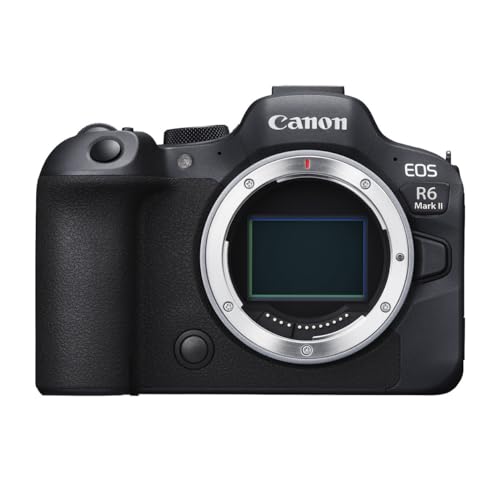
Canon EOS R6 Mark II — Full-frame all-rounder for serious wildlife
If one Canon body had to cover a year of varied wildlife — dawn deer in mist, waders on a bright estuary, owls at last light — the R6 Mark II is the answer this guide gives without hesitation. Its animal and bird detection is the mature version of Canon’s system: quick to offer the eye, stubborn in holding it through grass stems and wingbeats, and paired with a burst that runs at genuinely professional speed while the buffer swallows long sequences without the stutter that makes photographers ration frames at the worst moment. In the field that combination feels like trust. You compose; the camera minds the eye; the burst is there when the kingfisher finally dives.
The full-frame sensor earns its keep precisely when wildlife is most itself. At first light in a woodland hide, sensitivity climbs into territory where lesser files dissolve into mush, and this body’s output stays printable — feather detail intact, noise fine-grained and honest. Twenty-four megapixels sounds modest beside the flagships until you remember what it buys: smaller files, deeper effective bursts, and low-light behaviour that serves the hours animals actually keep. For video-minded shooters it doubles as a serious behaviour camera, stabilised and dependable.
Its compromises are reach and resolution, the twin taxes of full frame. Distant small birds will be cropped hard, and there are mornings a crop body simply frames the subject bigger. Serious bird specialists should read the R7’s prose entry carefully before deciding this is their summit.
- Format: full-frame RF-mount mirrorless, in-body stabilisation, dual card slots
- Field role: dawn-to-dusk all-rounder, mammals and general wildlife
- Detection: animals and birds with eye priority, deep fast burst
- Coverage: verified pool link
Strengths
- Eye detection holds through reeds, grass and erratic flight lines
- Low-light files stay clean at the hours wildlife is most active
- Long bursts without buffer anxiety during behaviour peaks
Trade-offs
- Full-frame framing leaves distant small birds small in the file
- Resolution limits the aggressive cropping specialists rely on
- Serious telephoto glass to match it costs more than the body
Best for: committed wildlife shooters working varied subjects in mixed light. Not suited for: small-bird specialists who live by cropping at extreme range.

Canon EOS R10 — Reach and speed on a sane budget
The R10 is the body that makes beginners dangerous, in the best sense. Mount an affordable telephoto zoom and the crop sensor hands you reach that full-frame shooters pay heavily to match, while Canon’s subject detection — recognisably the same family of animal and bird tracking sold in bodies costing far more — finds the eye and keeps it. At the local reserve, on the estuary path, in the garden with a feeder setup, this camera produces the kind of sharp, eye-lit portraits that hook people on wildlife photography permanently, and it does so at a weight your shoulders forgive after six miles.
Speed is the surprise. Its burst rate embarrasses older enthusiast DSLRs, and for the short, violent moments wildlife offers — a takeoff, a squabble at the feeder, a heron’s strike — a few seconds of fast frames is usually where the keeper lives. The controls, while simpler than the pro bodies’, keep the essentials under your fingers, and the whole package travels in a small bag that encourages the habit that matters most: going out often.
The ceiling is light. Push into a dark wood or a winter dusk and the APS-C sensor’s files grain sooner than the full-frame picks’, and a single card slot plus a shallower buffer mark it as an enthusiast tool rather than an assignment body. Within daylight wildlife, which is most wildlife, those limits rarely bite.
- Format: APS-C RF-mount mirrorless, single card slot, light body
- Field role: reach-first birding and reserve photography on foot
- Detection: animals and birds with eye priority, fast burst
- Coverage: verified pool link
Strengths
- Crop reach turns affordable zooms into serious wildlife tools
- Subject detection performs like bodies from a class above
- Light enough that the camera actually comes on every walk
Trade-offs
- High-sensitivity files soften in dark woods and winter dusk
- Buffer depth suits bursts of seconds, not minutes
- No in-body stabilisation; steady hands and lens IS carry the load
Best for: birders and reserve regulars building a first serious RF kit. Not suited for: professionals shooting crepuscular mammals on commission.

Canon EOS R50 — First Canon for new wildlife shooters
Every wildlife photographer has a first winter: cold hands, wrong settings, a camera whose menus might as well be in another language. The R50 exists to shorten that winter. Its guided interface explains exposure in plain terms, its scene intelligence makes sound decisions while the beginner’s attention is spent on simply finding the bird, and — this is the important part — its animal detection is real Canon subject tracking, not a marketing garnish. A new shooter at a feeder station or a deer park will come home with eye-sharp frames from the very first outing, and early success is the fuel the whole hobby runs on.
Paired with a compact telephoto zoom, the crop sensor again donates reach, and the whole kit fits the small-bag, opportunistic style of wildlife shooting that beginners actually do: the lunch-hour park, the holiday nature reserve, the garden hide made from a chair and a blanket. Its video is simple and clean for the behaviour clips that increasingly accompany a stills outing.
Growth is the honest caveat. Fewer direct controls mean more menu visits as technique develops, the buffer is modest, and the body is not sealed like the professional picks. Treat it as the finest first chapter rather than the whole book, secure in the knowledge that its lenses carry forward to every other body in this guide.
- Format: Canon’s friendliest APS-C RF body — guided menus, featherweight build
- Field role: learning body for feeder, park and reserve wildlife
- Detection: animals and birds with eye priority, beginner-friendly modes
- Coverage: verified pool link
Strengths
- Menus coach instead of punishing, ideal for a first telephoto season
- Genuine eye detection delivers keepers from the first outing
- Small kit encourages the frequent practice that builds skill
Trade-offs
- Sparse direct controls slow advanced technique later
- Modest buffer and single slot cap serious burst sessions
- Minimal sealing; treat heavy weather with respect
Best for: newcomers buying a first wildlife-capable Canon. Not suited for: seasoned shooters who live on dials and dual slots.
Canon EOS R7 — APS-C wildlife specialist (prose-only)
The R7 is covered in prose only, without a purchase link, because it is the body a serious conversation should sell rather than a listing: Canon’s deliberate APS-C flagship for exactly this pursuit. Thirty-two-plus megapixels on a crop sensor means the densest pixel pitch in this guide — distant subjects land on more pixels, crops stay viable further, and a perched warbler at the far side of a reedbed becomes a printable portrait instead of a rumour. Add in-body stabilisation, dual card slots, weather sealing and a mechanical burst that runs deep, and you have the specification bird photographers spent the DSLR era begging for, in a body that still walks all day.
In the hand it behaves like the professional tool it is: a proper joystick for overriding detection the instant a flock confuses it, dials where a practised thumb expects them, and a viewfinder experience that keeps up with flight. Paired with a long zoom it is, for pure birding value, arguably the strongest wildlife system Canon sells at any price — the full-frame flagships only overtake it when the light dies.
That is the honest boundary. Small pixels ask more of lenses and of light; at dawn the R6 Mark II’s files are cleaner, and mediocre glass is exposed ruthlessly by this sensor. Buy it through a dealer who will pair it with the right telephoto, and it may be the last wildlife body you want for years.
- Format: APS-C RF-mount mirrorless, in-body stabilisation, dual slots
- Field role: dedicated birding and long-reach specialist
- Detection: animals and birds with eye priority, pro control layout
- Coverage: prose-only, no pool link
Strengths
- Densest pixels here — distant subjects survive cropping
- Professional controls, sealing and dual slots in a crop body
- Stabilised sensor steadies long lenses on foot
Trade-offs
- High-sensitivity noise arrives earlier than the full-frame picks
- Demanding sensor exposes weak telephoto glass immediately
- Rolling-shutter care needed with the fastest electronic bursts
Best for: dedicated bird photographers who live at long range in decent light. Not suited for: dawn-and-dusk mammal work as the main pursuit.
Canon EOS R5 Mark II — Resolution flagship (prose-only)
Some wildlife work is limited not by reach or light but by what the file must become: a metre-wide print for a gallery wall, a magazine cover cropped vertical from a horizontal frame, a distant raptor that must hold feather detail after losing half its pixels. The R5 Mark II is Canon’s answer to that brief, and it is covered in prose here because a body of this class is chosen with a system plan, not from a roundup link. Its stacked sensor brings the speed and readout discipline of a sports flagship to a high-resolution file, and its detection system adds refinements — including action priority modes developed for fast subjects — that keep the eye pinned during chaos.
Photographers who film wildlife get a second, complete argument: this is a cinema-capable body that happens to shoot stills, and behaviour sequences filmed on it sit comfortably beside dedicated video rigs. The system around it, though, must be budgeted as seriously as the body — fast cards in quantity, storage that swallows enormous files, and glass sharp enough to deserve the sensor.
For many excellent wildlife shooters it is simply more camera than the work requires, and the money difference invested in a longer, brighter lens would improve their photographs more. That is not a criticism; it is the definition of a flagship.
- Format: full-frame RF-mount mirrorless, stacked high-resolution sensor
- Field role: print-driven and video-driven professional wildlife
- Detection: advanced subject and action tracking, very fast readout
- Coverage: prose-only, no pool link
Strengths
- Resolution and speed together — crop freely, burst freely
- Detection refinements hold eyes through fast, messy action
- Video capability serves behaviour filmmakers at pro level
Trade-offs
- System costs — cards, storage, glass — escalate quickly
- More resolution than most portfolios will ever use
- Demands disciplined technique to justify its ceiling
Best for: professionals printing large and filming behaviour seriously. Not suited for: hobbyists whose budget would stretch further in lenses.
Canon EOS R3 — Professional action body (prose-only)
The R3 occupies the oldest professional niche in wildlife: the body for the photographer whose subjects move like athletes and whose deadlines do not care about weather. It is presented in prose only, as befits a tool usually bought on assignment experience rather than comparison shopping. Its stacked sensor delivers very fast readout with minimal rolling-shutter distortion — panning with a diving gannet keeps verticals honest — and its autofocus introduced eye-controlled point selection to Canon’s line, a feature working shooters either adopt as second nature or ignore entirely, with little middle ground. The integrated-grip body is built, sealed and balanced for the longest lenses, all day, in rain that sends everyone else to the café.
Resolution is deliberately moderate, and that is a professional’s trade rather than a shortcoming: files stay fast to edit, bursts stay deep, and the sensor’s low-light behaviour is superb for the crepuscular beats — reserves, safaris, winter wetlands — where staff photographers earn their keep. News and sports crossovers will recognise the logic immediately.
Specialist birders who crop relentlessly will prefer the R7’s pixel density or the R5 Mark II’s resolution. The R3 is for the photographer who must simply never miss, and knows exactly why that is worth more than megapixels.
- Format: full-frame RF-mount mirrorless, integrated grip, stacked sensor
- Field role: assignment-grade action and all-weather wildlife
- Detection: fast subject tracking with eye-control focus option
- Coverage: prose-only, no pool link
Strengths
- Readout speed keeps fast pans and flight lines geometrically honest
- Build, sealing and grip balance the longest lenses all day
- Low-light files suit dawn patrols and winter assignments
Trade-offs
- Moderate resolution limits cropping compared with the R5 line
- Size and weight are a commitment on long walks
- Eye-control focus divides opinion; test before relying on it
Best for: working photographers on wildlife and action assignments. Not suited for: travellers counting grams or croppers counting pixels.
How Do Hides, Stalking and Garden Setups Change the Camera You Need?
Wildlife photography is three crafts wearing one coat, and each loads the camera differently. Hide photography is a siege: you sit for hours at a known address — a waterhole, a feeding station, a nest watch conducted at a legal, ethical distance — and the camera’s job is patience support. Comfort rules here: a body balanced on a tripod gimbal for six hours, silent or near-silent shooting so the shutter never becomes part of the environment, and batteries and cards that outlast the sit. Resolution earns its keep in hides, because the framing is controlled and cropping is a compositional tool rather than an apology, which is why hide regulars gravitate to the R5 Mark II or the R7 with a beanbag and a flask.
Stalking is the opposite contract. You walk, glass, creep and shoot opportunistically, and the camera’s virtues become weight, readiness and stabilisation. A body that wakes instantly, detects an animal the moment it crosses the viewfinder and focuses a handheld long lens in failing light is worth more than any resolution figure; the R10 and R6 Mark II live here, carried for miles without becoming the reason you turned back. Garden and feeder photography, the third craft, is closer to studio work: pre-focused perches, backgrounds arranged by moving the feeder rather than the camera, remote triggers and patient observation of individual birds whose habits you learn by name. Almost any body in this guide excels at it, which makes it the finest training ground a beginner owns — the R50 at a kitchen-window setup will teach more wildlife craft in a month than a flagship in a safari vehicle teaches in a week.
Knowing your craft tells you your camera. Most photographers practise all three across a year, which is why this guide’s all-rounders rank so high — but if your diary is ninety per cent one discipline, weight the picks accordingly and ignore the rest of the argument.
How Should You Handle Backlight, Rain and Heat Shimmer?
The field’s three saboteurs each attack a different assumption. Backlight — the dawn shot toward the sun, the owl rim-lit on a branch — fools exposure meters into silhouettes and challenges autofocus contrast, and the counters are craft classics: expose for the subject and let the background burn gloriously, use the rim light as the picture rather than fighting it, and give detection a clean, contrasty target by choosing your angle a few steps sideways. The full-frame bodies hold shadow detail through this abuse better than the crop picks, one more entry in their dawn ledger.
Rain tests sealing and morale in equal measure. Work within your body’s honest rating, keep a rain cover over the lens barrel whatever the body claims, and remember that autofocus through rain-streaked front elements fails before electronics do — a lens hood and a microfibre cloth in a dry pocket are professional equipment. Some of the finest wildlife images ever made are weather images: animals shaking off water, breath condensing, feathers beaded. The photographers who own them simply stayed.
Heat shimmer is the invisible one, murdering long-range sharpness on warm days as rising air bends the light between you and the subject. No autofocus system fixes physics. Shoot early before the ground heats, shorten the distance, lower the camera toward cooler air over water or grass, and accept that some midday hours are for scouting rather than frames. Recognising shimmer — the boiling, wobbling look in the viewfinder — saves photographers from blaming lenses that were never at fault.
Which Accessories Actually Earn Their Place in the Bag?
After the lens, the hierarchy of useful spending is unglamorous. Support first: a tripod and gimbal head for hide work, a monopod for walking, a beanbag that costs almost nothing and stabilises car windows, fences and hides with equal indifference to fashion. Power second: spare batteries in the plural and cards fast enough to clear the buffer your burst rate promises, because a slow card quietly converts a fast camera into a slow one. Protection third: rain covers, a proper strap or harness that puts the weight on shoulders rather than neck, and lens coats that protect resale value and knuckles in winter.
Then the fieldcraft layer, which outperforms electronics pound for pound: a hide or camouflage netting where permitted, a thermos that makes the fifth hour possible, and clothing quiet enough that your own sleeves stop announcing you. Optics beyond the camera matter too — binoculars find more wildlife photographs than any viewfinder, because you cannot photograph what you never noticed. The accessory industry will happily sell you the fortieth item first; buy in the order above and your bag stays light, your wallet stays shut, and your keeper rate climbs for reasons that have nothing to do with this year’s body.
How Does a Season of Shooting Change Your Settings?
Watch a wildlife photographer across a year and their camera slowly becomes personal property in a way the manual never describes. Spring teaches flight settings — the custom mode dialled for birds crossing bright skies, back-button focus worn smooth. Summer’s hides teach silence and patience: electronic shutter, review displays dimmed, the discipline of the single considered frame. Autumn rut season teaches low-light faith, sensitivities pushed where spring’s caution never went, because the stag at dusk is the photograph and the noise is merely its weather. Winter teaches power management, batteries warmed in inside pockets, and the humility of gloved controls — the season that reveals whether a body’s dials were designed by someone who has worn mittens.
The lesson for a buyer is that settings are a diary, not a destination. Every body in this guide offers custom modes and deep configuration; the differences that matter are whether the controls invite that personalisation or resist it. Professionals praise the R3 and R7 less for their specifications than for how completely the camera disappears once configured — it stops being equipment and becomes habit. Choose the body whose controls your hands like now, and let four seasons finish the education.
Why Do Birds and Mammals Demand Different Things From the Same Camera?
Birds are a problem of distance and velocity. They are small, far away, and liable to convert themselves into a departing blur at the exact moment of commitment, so bird photography taxes reach, acquisition speed and burst depth above all else — the crop bodies’ home ground, where pixel density and multiplied focal lengths turn modest glass into long tools. Flight adds the panning examination, and feather detail at print sizes adds a resolution hunger that explains the R7’s following among specialists who shoot little else.
Mammals reverse the equation. They are larger, nearer and most active when the light is worst — dawn, dusk, the blue hour when a fox crosses the field — so mammal work taxes sensitivity, dynamic range and the photographer’s ability to work quietly at close quarters. Full-frame files earn their premium here frame after frame, and the R6 Mark II’s following among deer, fox and badger photographers is no accident. Behaviour is also longer-form: where a bird strike lasts a second, a mammal encounter unfolds over minutes, rewarding the photographer whose camera stays ready, silent and balanced rather than merely fast. Read this guide’s picks through your own subject list; the birder and the mammal watcher can both be right while choosing opposite bodies, and frequently are.
How Should a Beginner Spend the First Year?
Year one has a curriculum, and it is mostly not shopping. Month by month it runs: learn one local patch completely — its species, light and seasons — until you can predict an encounter before it happens. Master exposure on willing subjects, the garden birds and park deer who forgive experimentation. Build the focus reflexes on gulls and pigeons until acquisition and panning are boring. Then spend money in the order the photographs demand: the longer or brighter lens your logbook keeps asking for, support for the hide work you actually do, and only then a body upgrade, which by now you can specify from experience rather than from reviews — including, possibly, this one.
Keep a ruthless edit habit from the start. A burst of forty frames contains perhaps two photographs; learning to find them, delete the rest and write down why the keepers kept is the fastest photographic education available at any price. Share work with other wildlife photographers, whose critique will be kinder about your feelings and harsher about your horizons than any algorithm. And print the year’s best dozen. Wildlife photography ends on paper or it does not quite end at all, and a wall of your own prints will tell you more about your next purchase than a season of specification tables.
What Happens When Detection Meets a Flock, a Herd or a Hide Full of Hopefuls?
Group scenes are where subject detection’s confidence meets its limits, and experienced shooters plan for the negotiation. In a flock of waders, the system will offer you an eye — possibly not the bird you meant, particularly when a nearer, higher-contrast individual crosses the frame. The craft answer is to constrain the search: a smaller initial focus area centred on your intended subject, a half-press to confirm the lock before the burst, and the joystick ready to drag the point to the right bird when the machine chooses a neighbour. Herds of mammals are kinder — larger eyes, slower motion — but the same discipline applies when calves and adults overlap into a single detected shape.
There is also a compositional dividend to group discipline. A frame of thirty birds with one eye sharp and the rest falling into softness tells the flock’s story better than frantic attempts to render everything crisp, and the bodies here — with apertures and focus placement under quick control — let you choose that depth deliberately. Detection, used this way, is not autopilot. It is a very fast assistant whose guesses you supervise, and the supervision is precisely the skill that separates this generation’s wildlife photographers from the button-pressers the technology was supposed to create.
How Seriously Should Wildlife Shooters Take Video?
More seriously every season. Behaviour is motion, and the clip of the heron striking, the cubs wrestling, the starlings beginning their murmuration carries information no still can hold — which is why broadcast natural history units now recruit from stills photographers who film. Every body in this guide records capable video, and the mirrorless stabilisation systems make handheld behaviour clips genuinely usable from a hide or a shoreline. The discipline differs from stills in one humbling way: duration. A still is an instant judged alone; a clip is thirty seconds in which your panning, your focus choices and your patience are all on the record. Detection tracking helps enormously here, holding the eye while you think about composition, and the R6 Mark II in particular has become a quiet favourite of hybrid shooters for exactly that reliability.
Practicalities decide whether filming becomes a habit or a regret. Record in short, deliberate sequences rather than rolling continuously — cards and batteries are finite, and editing forty unbroken minutes for six good seconds is a punishment you set yourself. Keep a stills-first mindset on rare encounters: the photograph is usually the deliverable, the clip the bonus, and fumbling between modes at the decisive moment loses both. Photographers who pre-configure a custom mode for video, one dial-turn from their stills setup, are the ones who come home with both.
Should You Buy Wildlife Gear New, Used or Refurbished?
Wildlife kit is durable, professionally maintained by many owners, and expensive — a combination that makes the used market a rational part of this guide’s advice. Bodies carry shutter counts the way cars carry mileage, and a dealer’s graded, warranted used body from the enthusiast tier is often the smartest money in the whole system, freeing budget for the lens where it belongs. Lenses hold value and condition well, and a used telephoto zoom from a reputable source, checked for fungus, focus accuracy and stabilisation behaviour, serves exactly as its new twin does. Manufacturer refurbished programmes deserve special mention: inspected, warranted bodies at meaningful savings, and for the budget-conscious wildlife shooter they are frequently the correct first click.
Two cautions keep the strategy honest. Buy used from sellers who accept returns, because a weekend of testing is worth more than a listing’s adjectives; and factor the mount’s future — every lens in this guide’s system is RF-mount, current and travelling upward through Canon’s range, which is precisely the ecosystem in which used purchases stay useful longest. The photographer who buys a used R10 and an excellent used zoom today owns a system that embarrasses many new purchases at twice the outlay.
How Do You Keep a Wildlife Kit Alive in the Field?
Wildlife gear dies of small neglects rather than dramatic accidents. Dust on a sensor announces itself across every bright sky you shoot for a month, so lens changes happen body-down, sheltered from wind, with the cap choreography rehearsed rather than improvised over a marsh. Salt air at the coast corrodes cheerfully; a wipedown with a barely damp cloth at the day’s end is professional habit, not fussiness. Condensation is the seasonal assassin — a cold camera carried into a warm hide or car fogs inside and out — so the kit travels in a sealed bag with the temperature change happening slowly inside it, the way divers protect housings, and patience does what no cloth can.
Batteries and cards get the bookkeeping treatment: batteries rotated and labelled so the flat one never hides among the charged, cards formatted in-camera after confirmed double backups, never deleted piecemeal. And once a season, the whole system earns an honest inspection — mount contacts cleaned, firmware considered, the telephoto’s focus checked against a test target at working distance. Wildlife opportunities are too rare and too early in the morning to be spent discovering maintenance debt; the photographers whose galleries fill steadily are, without exception, the ones whose kit simply always works.
How Do the Six Wildlife Bodies Compare?
| Camera | Badge | Sensor | Choose it when |
|---|---|---|---|
| Canon EOS R6 Mark II | Full-frame all-rounder for serious wildlife | Full frame | Dawn, dusk and mixed subjects dominate your outings |
| Canon EOS R10 | Reach and speed on a sane budget | APS-C | You walk far and shoot birds in daylight |
| Canon EOS R50 | First Canon for new wildlife shooters | APS-C | It is your first season with a telephoto lens |
| Canon EOS R7 | APS-C wildlife specialist (prose-only) | APS-C, high resolution | Birding at range is your main pursuit |
| Canon EOS R5 Mark II | Resolution flagship (prose-only) | Full frame, high resolution | Prints and video justify a flagship system |
| Canon EOS R3 | Professional action body (prose-only) | Full frame, stacked | Assignments demand speed in any weather |
How Do You Set Up a Canon Body for Birds in Flight?
Start from a saved custom mode so the flight configuration is one dial-turn away when the sky suddenly fills. Autofocus: subject detection for animals or birds, eye priority on, and a focus area that begins as a flexible zone — large enough to catch the bird as you acquire it, ready to tighten once the lock is honest. Drive: the fastest continuous burst your light and card can sustain, because flight sequences are won on the frame you did not know you needed. Shutter: begin around 1/2500s for large birds, faster for small ones, and let sensitivity ride upward before you let the shutter sag — a slightly grainy sharp frame prints; a clean blurred one deletes. Stabilisation in its panning-aware mode where the lens offers it, and practise the pan itself on gulls and pigeons, the unpaid models who will teach you smoothness for free.
Then rehearse the override. Detection will occasionally marry the background or the wrong bird in a flock, and the photographers who cope are those whose thumb finds the joystick or the pre-registered centre point without a glance. Shoot the boring birds at the local pond until acquisition, pan and override are one reflex; the rare bird over the marsh will not wait while you remember a menu.
What Fieldcraft Still Matters More Than Gear?
Everything in this guide is subordinate to the oldest truth in wildlife work: the animal must let you be there. Learn the species before the settings — feeding times, favoured perches, the flight line between roost and water — because an hour of knowledge places you closer, more ethically, than any lens can zoom. Dress for stillness, arrive before the light, let subjects approach your position rather than advertising yours, and leave any encounter the moment your presence changes behaviour. The portfolio built that way shows it: relaxed animals, natural behaviour, eye contact that reads as curiosity rather than alarm.
Ethics are not decoration on this craft; they are its licence. No baiting where it harms, no flushing for a flight shot, no nest disturbance for a closer frame, and locations of sensitive species kept vague when shared. The cameras in this guide are extraordinarily capable. The reputation of the people carrying them should be built to match.
What Mistakes Do Wildlife Shooters Keep Making?
First, buying the body and starving the lens, then blaming the sensor for what reach and aperture actually decided. Second, shooting everything at the widest aperture the lens owns, then wondering why depth of field swallows the eye and keeps the shoulder — wildlife portraits live on considered apertures, not maximum ones. Third, centring every subject like a passport photo; the frame needs space in the direction of movement and gaze. Fourth, chimping after every burst while the animal performs the behaviour of the day for an audience of one lowered camera. Fifth, deleting soft frames in the field on a small screen, where genuinely sharp shots look identical to failures — judge at home, on a monitor, with tea. And sixth, the quietest mistake: never printing anything, so the difference between a good file and a great one never becomes physically obvious.
One consideration sits underneath every pick above and deserves saying plainly before the recommendation itself: all six bodies share one lens mount and one menu language, so a photographer can begin at the humble end of this list and climb it over a decade without ever relearning their craft or replacing their glass. Systems, not cameras, are what wildlife photographers actually buy.
Final Recommendation
For most readers, the decision is a fork between light and reach. If your wildlife lives at dawn and dusk — deer, foxes, owls, the crepuscular cast — the EOS R6 Mark II is the body to build around, with lenses bought bright. If your wildlife is birds at distance in honest daylight, the prose-only R7 is the specialist’s summit, and the linked R10 delivers most of its joy at a fraction of the commitment. Beginners should start on the R50 without a flicker of embarrassment; its lenses graduate with you. The R5 Mark II and R3 are professional instruments for defined briefs — resolution and reliability respectively — and choosing either should follow from the work, not precede it.
Related guides
Frequently Asked Questions
Is APS-C or full frame better for wildlife?
Neither, universally. APS-C multiplies your lens’s effective reach and packs pixels onto distant subjects, winning in good light at long range. Full frame gathers light better, winning at dawn, dusk and in dark woodland. The subjects and hours you shoot should cast the deciding vote.
What lens should a beginner pair with these bodies?
A versatile telephoto zoom in the 100–400mm class on APS-C, or the longest zoom your budget reaches honestly on full frame. Buy the lens before upgrading the body, keep it for years, and let one full season of shooting tell you whether your next purchase needs more reach or more aperture.
Do I need a tripod for wildlife photography?
For hide and waterhole work with heavy lenses, yes — or at least a monopod, which many walkers prefer for its speed. For birds in flight and opportunistic walks, modern stabilisation makes hand-holding entirely practical with the bodies here, provided your shutter speeds respect the subject’s motion.
How important is weather sealing for wildlife work?
More than spec sheets suggest, because wildlife schedules itself around weather everyone else avoids. The professional picks here are sealed to work in rain with sensible care; the enthusiast bodies tolerate splashes and drizzle but deserve a rain cover when the sky commits.
Can these Canon bodies really track a bird’s eye?
Yes — that is the defining capability of this generation. Detection finds the bird, prioritises the eye and holds it through movement that would defeat older systems, within honest limits: tiny subjects at extreme range, heavy obstruction and heat shimmer still challenge any camera, which is why the override skills in this guide matter.
Should I use the electronic or mechanical shutter for wildlife?
Electronic shutters are silent — gold in a hide or near a nervous subject — and unlock the fastest burst rates, but they can distort very fast motion and band under some artificial light. Mechanical and electronic-first-curtain modes are the safer default for flight and panning. Most experienced shooters save one custom mode for each and switch by situation rather than by habit.
How many frames per second do I honestly need?
For perched and grazing subjects, even a modest rate suffices, because the moment changes slowly. For flight, strikes and fights, faster is genuinely better — wing positions change completely between frames — but only while the buffer lasts. Judge a body by the burst you can sustain for three full seconds, not the headline number alone.
Related Guides
From the field, continue with which canon bodies survive underwater housings, how to choose a canon camera under a strict budget, and why dslr bodies still hunt wildlife in the mirrorless era.


