Disclosure: As an Amazon Associate, ilcastellomenu.com earns from qualifying purchases. Prices and availability change; check Amazon for the latest.
Where to buy
Check the latest price, availability and delivery on Amazon. Orders are placed on Amazon.
These are the shortlisted picks for the best cpu coolers for intel, ranked by the socket, clearance and capacity checks described in the full guide.
- Thermalright Phantom Spirit 120 SE (Best Overall) — Check on Amazon
- Noctua NH-D15 (Best Premium Air Cooler) — Check on Amazon
- ARCTIC Liquid Freezer III Pro 360 (Best for Heavy Sustained Loads) — Check on Amazon
- be quiet! Dark Rock Pro 4 (Best for Near-Silent Builds) — Check on Amazon
- Cooler Master Hyper 212 Black (Best Budget Tower) — Check on Amazon
- Corsair iCUE H100i Elite Capellix XT (Best 240 mm AIO Overall) — Check on Amazon
Read the full guide ↓
Shopping for the best cpu coolers for intel is really a decision about three numbers: the watts your processor actually sustains, the millimetres your case actually offers, and the socket your motherboard actually has. Get those three right and almost every cooler on this page will serve you well; get one wrong and even the best cooler in the world becomes an expensive paperweight. This guide works through all three for this specific search, then ranks the coolers that survive the checks.
Intel’s current desktop range spans LGA1700 and LGA1851 at the top and a long tail of LGA1200 and LGA115x systems still in service, so an Intel shortlist lives or dies on bracket coverage.
Two filters decided this list before performance was even considered: the cooler must mount on the right socket with hardware in the current retail box, and it must physically fit a realistic case for this kind of build. Only then did cooling capacity, noise and value decide the order. Picks covered without an Amazon link are prose-only recommendations — products outside this site’s verified link pool that are included because excluding them would make the guide worse, and they are labelled as such wherever they appear. If your build is still at the planning stage, it is worth reading Best Cpu Coolers For I7 12700k alongside this guide before you commit to a platform.
Check your socket before anything else: the ARCTIC 360 is the strongest cooler here but supports only LGA1700 and LGA1851, while the air coolers cover older 115x and 1200 boards as well. Every pick lists its Intel sockets in its spec box so you can match it to your board in seconds.
In this guide
Quick Picks
| Badge | Pick | Why it stands out | Link |
|---|---|---|---|
| Best Overall | Thermalright Phantom Spirit 120 SE | Seven heat pipes in a 154 mm frame — the densest air cooling here | Check on Amazon |
| Best Premium Air Cooler | Noctua NH-D15 | Flagship air cooling with dual 140 mm fans and a six-year track record of quiet power | Check on Amazon |
| Best for Heavy Sustained Loads | ARCTIC Liquid Freezer III Pro 360 | Thick 360 mm radiator, high-pressure fans and a VRM fan for sustained loads | Check on Amazon |
| Best for Near-Silent Builds | be quiet! Dark Rock Pro 4 | 250 W-rated dual tower tuned for near-silence under sustained load | Check on Amazon |
| Best Budget Tower | Cooler Master Hyper 212 Black | The classic first upgrade from a stock cooler, in a stealth black finish | Check on Amazon |
| Best 240 mm AIO Overall | Corsair iCUE H100i Elite Capellix XT | The refined 240 mm AIO: quieter AF RGB Elite fans and coolant-based control | Check on Amazon |
How These Picks Were Chosen
Cooling capacity was judged against the processor’s real sustained power draw, not its headline TDP. Marketing TDP and actual watts part company quickly on modern chips, so each pick was matched to the heat load described in this guide’s introduction, with headroom preferred over exact-fit minimalism.
Socket support was verified model by model from manufacturer specifications and current listings — not assumed from a cooler’s age or family. Several famous coolers were excluded from individual lists in this series precisely because their current kits no longer cover the socket in the keyword.
Physical fit was checked in both directions: cooler height against case clearance, and cooler footprint against memory and VRM heatsinks. For liquid coolers, radiator length, thickness and tubing reach were treated as the equivalent constraints. If you want the measurement method in full, see Best Coolers For Cpu.
Noise character mattered as much as peak cooling. A cooler that holds a temperature at an annoying pitch is a worse daily companion than one that runs a degree warmer in near-silence, so fan bearing type, speed range and control method all fed into the ranking.
Finally, value was assessed as a whole-ownership proposition: mounting-kit support for future sockets, warranty culture, and whether the cooler can move to your next platform. A cheap cooler you throw away at the next upgrade is not cheap.
The 6 Best CPU Coolers for Intel

Thermalright Phantom Spirit 120 SE (Best Overall)
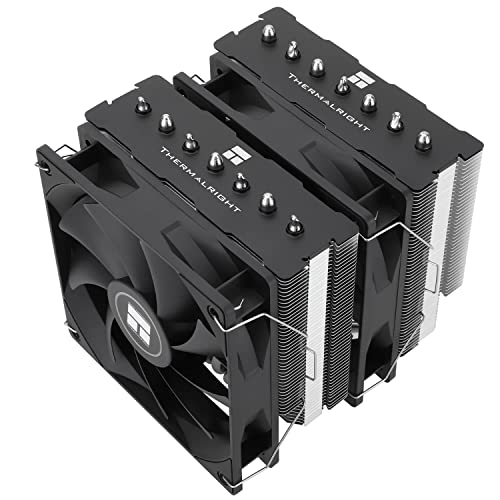
Think of the Phantom Spirit 120 SE as the Peerless Assassin’s more developed sibling: the same dual-tower idea, refined with seven AGHP 4.0 heat pipes instead of six, updated TL-C12B V2 fans on S-FDB bearings, and a frame that is a millimetre shorter at 154 mm. On paper the changes look incremental; in a warm case under a sustained load, the extra heat pipe and denser fin work translate into a cooler that holds boost clocks with less fan speed in reserve being spent.
In a build centred on a current Intel processor, the Thermalright Phantom Spirit 120 SE earns its shortlist place by removing friction. At 154 mm tall it needs a case with at least that much stated cooler clearance, plus a little honesty margin for fan position over tall memory. It is the kind of cooler you install once, tune once, and then forget — which, for a component with no moving parts to admire beyond its fans, is precisely the point.
Thermalright Phantom Spirit 120 SE — Check on Amazon
Strengths
- Seven heat pipes — one more than the Peerless Assassin — in a slightly shorter 154 mm frame, giving it the strongest air-cooling density in this list.
- The S-FDB bearing fans are a refinement over the Peerless Assassin’s units, with smooth automatic PWM control for gaming and idle alike.
- Dual-tower capacity at a mainstream price makes it the natural pick when a 240 mm AIO does not fit or is not wanted.
Trade-offs
- Like its sibling, the front fan can clash with tall memory modules and may need to sit higher, increasing total height.
- Thermalright’s documentation and mounting instructions are functional rather than friendly for first-time builders.
- Availability and exact fan revisions vary by region and production run, so check the listing details before ordering.
- Type: Dual-tower air cooler
- Dimensions: 125 x 135 x 154 mm
- Heat pipes: 7 x 6 mm heat pipes with AGHP 4.0 technology
- Fans: 2 x 120 mm TL-C12B V2 PWM fans, S-FDB bearings
- Socket support: AMD AM5 / AM4; Intel LGA1851 / 1700 / 1200 / 1150 / 1151
In daily use the pattern is predictable: near-silent at the desktop, a controlled rise in fan speed as a game or export loads the processor, and no hunting or pulsing once the curve is set against coolant or CPU temperature with a sensible delay. Dust maintenance is the only recurring chore — a soft brush across the fin stack or radiator every few months keeps the performance you paid for.
One ownership detail worth knowing: tower coolers cool the motherboard less than the old top-down stock designs did, because their fans blow front-to-back instead of down at the VRM area. If your board has modest power delivery and you run long all-core loads, a case fan aimed across the socket area restores that incidental cooling — a small airflow decision that costs nothing and helps everything around the processor live longer.
Best for: performance-per-money builds that need maximum air cooling in a 154 mm frame / Not suited for: cases under 154 mm of clearance, and builders who need legacy FM2-era sockets
Noctua NH-D15 (Best Premium Air Cooler)
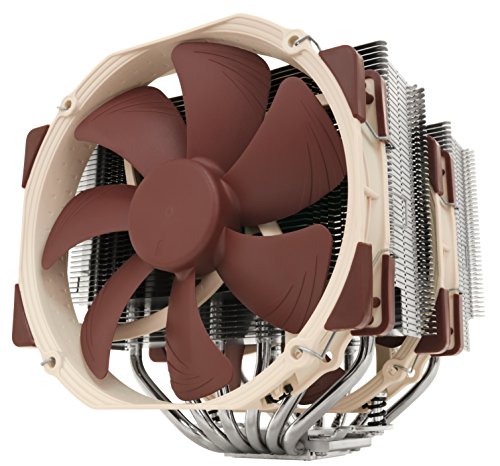
The NH-D15 is Noctua’s long-running flagship: two aluminium fin stacks, six heat pipes and a pair of 140 mm fans tuned for low noise at a given temperature. It built its reputation on consistency rather than novelty — the mounting hardware is precise, the fans are engineered for longevity, and the acoustic character stays smooth instead of developing the rattle or hum that cheaper bearings produce after a year or two of daily use.
Judged specifically for a current Intel processor, the Noctua NH-D15 balances three things that rarely arrive together: documented socket support, a physical footprint that suits realistic cases, and enough thermal reserve that the fan curve can stay civilised. At 165 mm tall it needs a case with at least that much stated cooler clearance, plus a little honesty margin for fan position over tall memory.
Noctua NH-D15 — Check on Amazon
Strengths
- Dual 140 mm fans and a wide fin stack give it cooling headroom that rivals many 240 mm liquid coolers while staying entirely air-based, with no pump to wear out.
- SecuFirm2 mounting is one of the most secure and repeatable systems in the class, and Noctua keeps releasing brackets for new sockets, so the cooler survives platform upgrades.
- Recessed lower fins leave 64 mm of RAM clearance in single-fan mode, which is unusually generous for a cooler of this size.
Trade-offs
- At 165 mm tall with fans it simply does not fit narrower mid-towers, and the front fan may need to be raised over tall memory, adding height again.
- The standard brown-and-beige colour scheme clashes with themed builds; the all-black version is a separate purchase.
- It is a premium-priced air cooler, so the value case only works if you keep it across several builds.
- Type: Dual-tower air cooler
- Height: 165 mm with fans fitted
- Heat pipes: 6 nickel-plated copper heat pipes
- Fans: 2 x NF-A15 140 mm PWM fans
- Mounting: SecuFirm2 multi-socket kit, NT-H1 thermal compound included
- Socket support: Intel LGA1851 / 1700 / 1200 / 115x; AMD AM5 / AM4 and older FM2 / AM3 boards (check kit revision)
Where this cooler quietly scores is in the second year of ownership. Bearings and mounting hardware decide whether a cooler ages gracefully, and the design choices here — quality fan bearings, a rigid mounting system, and standard replaceable fans — are the ones that separate a five-year component from a two-year one. Keep the receipt and the spare brackets; both tend to matter at upgrade time.
One ownership detail worth knowing: tower coolers cool the motherboard less than the old top-down stock designs did, because their fans blow front-to-back instead of down at the VRM area. If your board has modest power delivery and you run long all-core loads, a case fan aimed across the socket area restores that incidental cooling — a small airflow decision that costs nothing and helps everything around the processor live longer.
Best for: high-end gaming and creator builds in cases with 165 mm of clearance, kept across several platform upgrades / Not suited for: narrow cases, and builders who want lighting or a compact footprint

ARCTIC Liquid Freezer III Pro 360 (Best for Heavy Sustained Loads)
ARCTIC’s Liquid Freezer III Pro 360 is engineered around sustained load rather than spec-sheet minimalism: a 360 mm radiator that is 38 mm thick instead of the usual 27, three P12 Pro fans with unusually high static pressure, an offset cold plate for modern CPU hotspots, and a small fan built into the pump housing that blows air over the motherboard’s VRMs. PC Gamer’s review of the Pro generation highlighted exactly this combination — thick radiator, VRM fan and improved pump control.
For a current Intel processor, the ARCTIC Liquid Freezer III Pro 360 makes its case on fit as much as force. Its 360 mm radiator needs a case mount with genuine room for the radiator’s full length and thickness, but the low pump block leaves memory and VRM clearance completely unthreatened. Mounting hardware for the relevant platforms is included in the current retail kit, and the installation follows the standard pattern for its class: prepare the socket, apply compound, seat the cooler evenly, and connect the fan or pump leads before the first boot.
ARCTIC Liquid Freezer III Pro 360 — Check on Amazon
Strengths
- The 38 mm-thick 360 mm radiator and high-pressure P12 Pro fans give it the largest sustained heat-soaking capacity of any cooler in this roundup.
- The pump-mounted VRM fan actively cools the motherboard power delivery around the socket — a real benefit during long all-core runs that air coolers and rival AIOs ignore.
- An Intel contact frame is included in the box, improving mounting pressure on LGA1700 processors without a separate purchase.
Trade-offs
- Socket support is deliberately narrow: LGA1700/1851 and AM4/AM5 only, so older Intel platforms are excluded entirely.
- A 398 mm long, 38 mm thick radiator plus fans needs a case with genuine 360 mm clearance and depth — many mid-towers need not apply.
- The P12 Pro fans can reach 3000 RPM and are audible at full speed; the performance is tuned through PWM curves, not silence by default.
- Type: 360 mm all-in-one liquid cooler
- Radiator: 398 x 120 x 38 mm aluminium — thicker than the usual 27 mm
- Fans: 3 x P12 Pro 120 mm fans, 600-3000 RPM, up to 77 CFM and 6.9 mmH2O static pressure
- Pump: PWM-controlled, 800-2800 RPM, with integrated 40 mm VRM fan (400-2500 RPM)
- Extras: Intel LGA1700 / 1851 contact frame and MX-6 thermal paste included
- Socket support: Intel LGA1851 / 1700; AMD AM5 / AM4 only
Where this cooler quietly scores is in the second year of ownership. Bearings and mounting hardware decide whether a cooler ages gracefully, and the design choices here — quality fan bearings, a rigid mounting system, and standard replaceable fans — are the ones that separate a five-year component from a two-year one. Keep the receipt and the spare brackets; both tend to matter at upgrade time.
One ownership detail worth knowing: an AIO moves the heat to the case edge, which helps the processor but changes the case’s thermal map. Mounted as a front intake, the radiator warms the air the graphics card breathes; mounted as a top exhaust, it breathes the graphics card’s warm air itself. Neither is wrong — but choose consciously for your workload, because the difference shows up exactly where your other components live.
Best for: sustained all-core workloads on LGA1700, LGA1851, AM5 and AM4 in cases with true 360 mm radiator room / Not suited for: older Intel sockets, small cases, and silence-at-all-costs builds
be quiet! Dark Rock Pro 4 (Best for Near-Silent Builds)
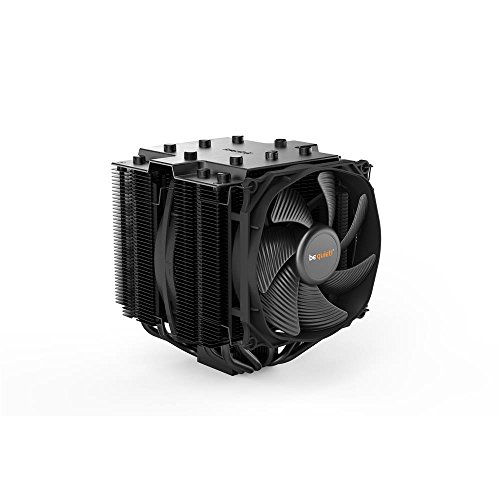
The Dark Rock Pro 4 is be quiet!’s answer to the NH-D15: a dual-tower cooler that prioritises silence without giving up capacity. Seven copper heat pipes feed two fin stacks, a 135 mm fan sits between them and a 120 mm fan at the front, and the whole assembly is finished in black with a brushed top plate. It is rated by its maker for processors up to 250 W TDP, which covers hard all-core workloads when the case airflow is up to the job.
For a current Intel processor, the be quiet! Dark Rock Pro 4 makes its case on fit as much as force. At 163 mm tall it needs a case with at least that much stated cooler clearance, plus a little honesty margin for fan position over tall memory. Mounting hardware for the relevant platforms is included in the current retail kit, and the installation follows the standard pattern for its class: prepare the socket, apply compound, seat the cooler evenly, and connect the fan or pump leads before the first boot.
be quiet! Dark Rock Pro 4 — Check on Amazon
Strengths
- The 250 W TDP rating and seven heat pipes give genuine headroom for sustained all-core loads, not just short gaming bursts.
- Silent Wings fans and decoupled mounting keep the acoustic profile exceptionally low for a dual-tower cooler of this capacity.
- The black ceramic-coated finish and brushed aluminium top cover make it the best-looking large air cooler in this roundup for windowed cases.
Trade-offs
- 162.8 mm of height rules out compact cases, and the front fan limits RAM to roughly 40 mm unless it is raised.
- Installation is a two-screwdriver, top-down process that is noticeably more fiddly than Thermalright’s or Noctua’s systems.
- Older retail stock may predate the LGA1700 and AM5 brackets, so check the box revision before assuming modern socket support.
- Type: Dual-tower air cooler
- Height: 162.8 mm
- Heat pipes: 7 x 6 mm copper heat pipes
- Cooling capacity: Rated up to 250 W TDP by be quiet!
- Fans: Silent Wings 135 mm PWM (middle) + Silent Wings 3 120 mm PWM (front)
- Socket support: Intel LGA1700 / 1200 / 115x / 2066; AMD AM5 / AM4 and older FM2+ / AM3 boards (check kit revision)
Where this cooler quietly scores is in the second year of ownership. Bearings and mounting hardware decide whether a cooler ages gracefully, and the design choices here — quality fan bearings, a rigid mounting system, and standard replaceable fans — are the ones that separate a five-year component from a two-year one. Keep the receipt and the spare brackets; both tend to matter at upgrade time.
One ownership detail worth knowing: tower coolers cool the motherboard less than the old top-down stock designs did, because their fans blow front-to-back instead of down at the VRM area. If your board has modest power delivery and you run long all-core loads, a case fan aimed across the socket area restores that incidental cooling — a small airflow decision that costs nothing and helps everything around the processor live longer.
Best for: silence-focused high-performance builds with tall-case clearance and standard-height memory / Not suited for: compact cases, tall RGB memory kits, and anyone who dreads a fiddly install

Cooler Master Hyper 212 Black (Best Budget Tower)
The Hyper 212 line has been the default first upgrade from a stock cooler for over a decade, and the Black edition keeps the formula: a compact single tower, four heat pipes and one 120 mm PWM fan in a stealth finish. It will not trouble flagship dual-towers on a benchmark chart, but for the processors most people actually own it removes the two real problems of bundled coolers — thermal throttling under load and an annoying high-pitched fan note.
For a current Intel processor, the Cooler Master Hyper 212 Black makes its case on fit as much as force. At 152 mm tall it needs a case with at least that much stated cooler clearance, plus a little honesty margin for fan position over tall memory. Mounting hardware for the relevant platforms is included in the current retail kit, and the installation follows the standard pattern for its class: prepare the socket, apply compound, seat the cooler evenly, and connect the fan or pump leads before the first boot.
Cooler Master Hyper 212 Black — Check on Amazon
Strengths
- Four heat pipes and a 120 mm tower are a decisive step up from any bundled stock cooler, cutting both temperatures and noise on mainstream processors.
- At 152 mm tall it fits the overwhelming majority of mid-tower cases that exclude the big dual-tower models.
- The all-black finish and simple clip-and-bracket mounting make it an easy first cooler for a new builder.
Trade-offs
- A single fan and four heat pipes run out of headroom on flagship chips under sustained all-core loads; it is a mainstream cooler, not an overclocking tool.
- Socket support depends on the retail revision — the current listing names AM5/AM4 and LGA1851/1700, so legacy-socket buyers must confirm the included brackets.
- There is no second fan in the box, and adding one later costs extra and needs the spare clips.
- Type: Single-tower air cooler
- Height: 152 mm (per current listing)
- Heat pipes: 4 heat pipes
- Fan: 1 x 120 mm PWM fan
- Socket support: AMD AM5 / AM4; Intel LGA1851 / 1700 (current listing; older revisions cover LGA1200 / 115x — confirm the box)
Where this cooler quietly scores is in the second year of ownership. Bearings and mounting hardware decide whether a cooler ages gracefully, and the design choices here — quality fan bearings, a rigid mounting system, and standard replaceable fans — are the ones that separate a five-year component from a two-year one. Keep the receipt and the spare brackets; both tend to matter at upgrade time.
One ownership detail worth knowing: tower coolers cool the motherboard less than the old top-down stock designs did, because their fans blow front-to-back instead of down at the VRM area. If your board has modest power delivery and you run long all-core loads, a case fan aimed across the socket area restores that incidental cooling — a small airflow decision that costs nothing and helps everything around the processor live longer.
Best for: mainstream processors at stock settings, and first-time builders upgrading from a stock cooler / Not suited for: sustained overclocks and flagship chips with power limits removed

Corsair iCUE H100i Elite Capellix XT (Best 240 mm AIO Overall)
The Capellix XT is the refined second take on Corsair’s 240 mm formula: the same 277 mm radiator format, but with AF120 RGB Elite fans that trade the old ML fans’ top-end scream for calmer behaviour, a copper cold plate with XTM70 paste pre-applied, and the Commander Core hub in the box. Tom’s Hardware specifically praised this generation for eliminating the bursty fan behaviour of earlier models by tying fan speed to coolant temperature.
In a build centred on a current Intel processor, the Corsair iCUE H100i Elite Capellix XT earns its shortlist place by removing friction. Its 240 mm radiator needs a case mount with genuine room for the radiator’s full length and thickness, but the low pump block leaves memory and VRM clearance completely unthreatened. It is the kind of cooler you install once, tune once, and then forget — which, for a component with no moving parts to admire beyond its fans, is precisely the point.
Corsair iCUE H100i Elite Capellix XT — Check on Amazon
Strengths
- AF120 RGB Elite fans with AirGuide vanes are quieter and better mannered than the older ML fans while moving serious air through the radiator.
- Pre-applied XTM70 paste and modular, largely tool-free brackets make it one of the fastest AIOs to install correctly the first time.
- Zero RPM fan mode in iCUE lets the radiator fans stop entirely at light loads for a genuinely silent desktop.
Trade-offs
- A 240 mm radiator is the ceiling here — sustained flagship overclocks in a hot room will want the 360 mm class instead.
- The Commander Core adds a controller box and cable run that small cases must find room for.
- Premium Corsair pricing applies; the lighting and software are part of what you are buying.
- Type: 240 mm all-in-one liquid cooler
- Radiator: 277 x 120 x 27 mm aluminium
- Fans: 2 x AF120 RGB Elite PWM fans, 550-2100 RPM, up to 65.57 CFM
- Cold plate: Copper, with pre-applied XTM70 thermal paste
- Controller: iCUE Commander Core included
- Socket support: Intel LGA1700 / 1200 / 115x / 2011 / 2066; AMD AM5 / AM4
Thermally, the behaviour to expect is a fast initial response followed by a long, flat plateau: the fin stack or coolant absorbs the burst, the fans settle at a sustainable speed, and temperatures stabilise rather than creeping. That plateau is what you are actually buying, and it is why matching the cooler to sustained watts matters more than any peak number in a headline.
One ownership detail worth knowing: an AIO moves the heat to the case edge, which helps the processor but changes the case’s thermal map. Mounted as a front intake, the radiator warms the air the graphics card breathes; mounted as a top exhaust, it breathes the graphics card’s warm air itself. Neither is wrong — but choose consciously for your workload, because the difference shows up exactly where your other components live.
Best for: quiet, refined 240 mm liquid cooling with simple installation and full iCUE control / Not suited for: extreme sustained overclocks that call for a 360 mm radiator
Comparison Table
| Pick | Type | Size | Fans / Radiator | Lighting | Price |
|---|---|---|---|---|---|
| Thermalright Phantom Spirit 120 SE | Dual-tower air cooler | 154 mm tall | 2 x 120 mm PWM | None | Check price on Amazon |
| Noctua NH-D15 | Dual-tower air cooler | 165 mm tall | 2 x 140 mm PWM | None | Check price on Amazon |
| ARCTIC Liquid Freezer III Pro 360 | 360 mm liquid cooler (AIO) | 360 mm radiator | 3 x 120 mm fans, 360 mm radiator | None | Check price on Amazon |
| be quiet! Dark Rock Pro 4 | Dual-tower air cooler | 163 mm tall | 135 mm + 120 mm PWM | None | Check price on Amazon |
| Cooler Master Hyper 212 Black | Single-tower air cooler | 152 mm tall | 1 x 120 mm PWM | None | Check price on Amazon |
| Corsair iCUE H100i Elite Capellix XT | 240 mm liquid cooler (AIO) | 240 mm radiator | 2 x 120 mm RGB fans, 240 mm radiator | RGB | Check price on Amazon |
Read the table by constraint, not by preference: eliminate any row whose size your case cannot take, then any row whose socket list does not include your board, and only then compare what remains on noise and taste. Two of the most useful background reads for this stage are How To Apply Thermal Paste With A Cpu Cooler and How To Choose A Cpu Cooler.
How to Choose the Right CPU Cooler for an Intel Build
The sections below are the full method behind this shortlist, written for a current Intel processor. Work through them in order and you will be able to judge any cooler — including ones released after this guide — without needing a fresh roundup.
Start with the socket, not the cooler
The socket decides the mounting pattern, the bracket shape and — on newer platforms like LGA1700 — the contact pressure the cooler was designed around. A cooler that lists your socket in its current specifications will include the right hardware; a cooler that merely shares a hole pattern with your socket may still mount with the wrong pressure or height. Check the manufacturer’s current socket list for the exact model, and if you are buying older stock, confirm the bracket for your socket is in that box, because kits are revised silently.
Match capacity to sustained watts, not headline TDP
Processor TDP figures describe a base-clock power class, not the turbo reality. A chip rated at 125 W may sustain 190 W or more in all-core work with motherboard limits raised, and it is that sustained figure your cooler must absorb indefinitely. As a working rule, choose a cooler whose class sits visibly above your processor’s sustained draw: flagship dual-towers and 360 mm liquid for the hungriest chips, value dual-towers for the mainstream, and single towers for efficient parts at stock settings.
Measure the case before you fall in love
For air coolers the governing number is the case maker’s stated CPU cooler clearance, compared against the cooler’s height with fans fitted — and if tall memory forces the front fan upward, the installed height grows again. For liquid coolers, compare the radiator’s true dimensions, including thickness with fans, against the mount position you intend to use. Leave a few millimetres of honesty margin in every direction; published figures assume flat panels and perfect cable behaviour.
Air versus liquid, decided honestly
Air cooling offers permanence: no pump, no coolant permeation, and fans that can be replaced in minutes a decade from now. Liquid cooling offers placement: the heat moves to the case edge, memory clearance becomes a non-issue, and sustained capacity scales with radiator size. On mainstream processors the real-world temperature gap between a flagship air cooler and a 240 mm AIO is small; the deciding factors are case fit, noise preference, aesthetics and how long you intend to keep the cooler.
Noise is a curve, not a number
A cooler’s published maximum noise figure describes a speed you may never use. What you live with is the fan curve: how early the fans rise, how smoothly they get there, and whether the bearing makes a tonal noise at low speed. Larger fans turning slowly are the reliable route to quiet, coolant-temperature control on liquid coolers prevents hunting, and every modern motherboard lets you set a curve — spending ten minutes there is worth more than any single specification.
Memory, graphics card and VRM clearance
Tower coolers overhang the memory slots nearest the socket, so check the cooler’s stated RAM clearance against your modules’ height, especially with RGB kits. Check also that a wide cooler does not crowd the top PCIe slot on your board layout, and remember that tower coolers no longer blow air down at the voltage regulators — boards with weaker VRM cooling appreciate a nearby case fan. Liquid pump blocks sidestep all of this, which is part of their appeal in compact builds.
How Do You Install and Look After Your New Cooler?
Installation follows the same rhythm for almost every cooler in this guide. Allow an unhurried half hour, work on a clear table, and keep the manual open — mounting sequences differ in detail between brands. The worked method in How To Install A Cpu Cooler is a good companion if this is your first build.
- Confirm the socket and unpack the matching bracket set for your platform; every other part can go back in the box.
- If a cooler is already fitted, warm the system briefly, shut down, twist the old cooler gently to break the paste seal, and clean both surfaces with isopropyl alcohol and a lint-free cloth.
- Install the backplate and standoffs (Intel) or prepare the retention frame (AMD) exactly as the manual sequences them, finger-tight plus a final even turn.
- Apply a pea-sized dot of thermal compound at the centre of the heat spreader — or confirm the pre-applied layer is intact on coolers that ship with one.
- Lower the cooler squarely onto the socket, start every screw a few turns before tightening any of them, then work diagonally in small increments to spread mounting pressure evenly.
- Clip the fans in their final position, checking memory clearance before the last clip, and route the fan cable to the CPU_FAN header without it touching a fan blade.
- Connect any splitter or low-noise adaptor you intend to use now, not later — reopening a finished build for a cable is nobody’s idea of fun.
- Boot into the BIOS, confirm the CPU fan is detected and set to PWM mode, apply a sensible curve, then save and check idle temperatures before closing the case.
For the liquid coolers in this list, the differences are at the radiator: mount it first, confirm tubing reach and clearance, connect the pump lead to the header the manual specifies, and set that header so the pump is never starved of power. The pump block itself seats with the same diagonal tightening pattern as an air cooler’s cold plate.
After installation, maintenance is light: keep radiator fins dust-free, confirm the pump header setting survives BIOS updates, and re-check temperatures each season. A loop that slowly gains temperature over a year is almost always asking for a dust clean and a fan-curve check, not a replacement.
Troubleshooting quick list
- Problem: Temperatures are high immediately after installation → fix: re-seat the cooler. The usual causes are a forgotten protective film on the cold plate, one loose mounting corner, or far too much or too little compound.
- Problem: One fan does not spin → fix: check that its lead is fully seated on the splitter or header and that no cable is fouling the blades; then swap fan positions to learn whether the fan or the header is at fault.
- Problem: A gurgling or rattling pump (liquid coolers) → fix: air has collected at the pump. Make sure the radiator’s highest point sits above the pump, run the system under light load for a while, and gently tilt the case to help the air migrate to the radiator.
- Problem: Fans surge up and down at the desktop → fix: the curve is chasing short temperature spikes. Add spin-up delay in the BIOS, or switch liquid coolers to coolant-temperature control, which is naturally steadier.
- Problem: The side panel will not close → fix: the cooler is taller installed than on paper — tall memory has pushed the front fan up. Lower the fan if memory allows, move it to the rear of the tower, or run the cooler in its documented single-fan configuration.
Common Mistakes
Matching the cooler to the wrong wattage. Undersizing a cooler for a chip with raised power limits produces a loud, hot system; oversizing wildly for a 53 W processor wastes money that a graphics card or SSD would have used better. Match the class to the sustained load.
Skipping the fan curve. Left on an aggressive default profile, good coolers sound bad. Ten minutes setting a curve with a delayed ramp transforms daily noise more than any hardware swap at the same price level.
Starving the cooler of case airflow. A flagship cooler inside a sealed, dusty case performs like a budget one. Intakes, exhaust and clean filters are part of the cooling system, and the cheapest temperature improvement is often a vacuum and a filter wash.
Removing the protective film — or rather, not removing it. Cold plates ship with a clear protective film that is nearly invisible once mounted. It is the single most common installation error in the hobby, and it costs more temperature than the difference between the best and worst coolers on this page.
Buying by reputation instead of by socket list. A famous cooler with the wrong bracket is furniture. Socket support is revised silently over a product’s life, so the current manufacturer’s list — not a forum post from three years ago — is the only authority that counts.
Ignoring installed height. Specifications quote cooler height, but tall memory can force a front fan upward and add millimetres you did not budget. Measure the case, measure the memory, and leave margin; a cooler that touches the side panel is not compatible.
Final Recommendation
If you only read one line of this guide: for a current Intel processor, start with the Thermalright Phantom Spirit 120 SE (Best Overall). It earned the top badge because it combines verified support for the platform, genuine thermal headroom and the fewest daily compromises of anything tested against this brief. The Noctua NH-D15 (Best Premium Air Cooler) is the closest alternative and the better choice when its particular strength — covered in its section — matches your build.
Beyond the top two, the list divides by need: the ARCTIC Liquid Freezer III Pro 360 for sustained all-core workloads on LGA1700, LGA1851, AM5 and AM4 in cases with true 360 mm radiator room; the be quiet! Dark Rock Pro 4 for silence-focused high-performance builds with tall-case clearance and standard-height memory. The remaining picks exist for the constraints that dominate real builds — a height ceiling, a legacy socket, a lighting standard, a small case — and their sections say plainly which constraint each one answers. Readers comparing across categories may also find Best Cpu Coolers For I7 8700k useful before ordering.
Whichever pick you choose, do the two unglamorous things that decide satisfaction: verify the bracket and the clearance one final time against your exact case and board, and set a thoughtful fan curve on day one. Do those, and any cooler on this page will feel like the right answer for years.
Frequently Asked Questions
How do I know a cooler will fit my case?
Compare two published numbers: the case maker’s maximum CPU cooler height and the cooler’s height with fans fitted, leaving a few millimetres of margin — and if your memory is tall, assume a tower’s front fan may sit higher and add height. For liquid coolers, check the radiator’s full dimensions (length and thickness with fans) against the specific mount position, not just the nominal 240 or 360 label.
Do I need to buy thermal paste separately?
No. Every cooler in this guide includes compound in the box or arrives with it pre-applied, and included compounds from established makers are entirely fit for purpose. Buy a separate tube only if you plan to remount coolers often, or if a second-hand cooler arrives without any.
What does a cooler’s TDP rating actually mean?
It is the maker’s statement of the heat load the cooler is designed to dissipate continuously, measured under their own conditions — useful for comparing coolers within one brand, unreliable across brands. Treat it as a class indicator (150 W class, 250 W class) rather than a precise promise, and match the class to your processor’s sustained power draw, which on modern chips can exceed the processor’s own headline TDP.
Will a bigger cooler make my PC silent?
It makes silence achievable, not automatic. A larger cooler lets its fans turn slower for the same temperature, which is where quiet comes from — but the fan curve decides whether that potential is used. Set the curve so fans stay slow through your normal workload temperatures, and even a powerful system becomes a quiet one.
Can I move my cooler to a different platform later?
Often, yes — that is one of air cooling’s structural advantages. Makers such as Noctua and be quiet! sell or supply mounting kits for new sockets, and Thermalright’s current kits already span several generations. Keep every bracket and screw from the original box; the cooler itself rarely becomes obsolete before its mounting hardware does.