ilcastellomenu.com is reader-supported. When you buy through links on our site, we may earn an affiliate commission.
Where to Buy a Camera for Less, Without Buying Trouble
Finding the best discount sites for cameras is really a search for trustworthy shortcuts. Nobody needs help locating a suspiciously cheap listing on the internet; those find you. What takes judgement is knowing which channels discount cameras for honest reasons — a manufacturer clearing refurbished stock it has inspected itself, an authorised dealer rotating last season’s demo units, a reputable used marketplace grading a trade-in carefully — and which channels are cheap because the warranty, the charger, the menu language or the legal import duty quietly went missing somewhere between the factory and your door. This guide treats the hunting ground first and the cameras second, because the channel decides what a bargain actually is.
Six cameras anchor the discussion, each chosen because a particular discount channel suits it unusually well. A beginner-friendly mirrorless body is the classic refurbished purchase, since manufacturers renew exactly the models they sell in volume. A scarce fixed-lens favourite behaves oppositely: it almost never gets cheaper, so the skill lies in finding it at the normal price from a seller who actually has one. A previous-generation action camera, meanwhile, is where authorised-dealer sales shine, because the arrival of a newer model pushes honest retailers to clear sealed stock that differs only modestly from the flagship. Matching model to channel, rather than trawling every site for every camera, is the habit this guide teaches.
Patience does most of the work and costs nothing at all. Camera prices move on a calendar that repeats every year: new models are announced, older ones slide, holiday sales clear the shelves, and refurbished stores restock in quiet waves that reward people who check on weekday mornings rather than during the frantic weekend rush. Set up alerts, keep a written ceiling for each model on your shortlist, and let listings come to you. The buyer who can walk away from a merely okay deal for another month almost always ends up owning the better camera.
Key Takeaways
- Manufacturer refurbished stores offer the strongest mix of savings, inspection and warranty cover.
- Authorised dealers are the safest route to sale prices on current models.
- Established used marketplaces suit cameras whose condition you can judge from honest grading.
- Previous-generation models, bought new on clearance, often beat used prices for peace of mind.
- Grey-market imports trade warranty and support for a lower headline figure — rarely worth it.
- Never chase a percentage: judge the final price against the camera’s real street value.
In this guide
Quick Picks
| Pick | Badge | Why it earns its place |
|---|---|---|
| Canon EOS R50 | The refurbished favourite | Canon’s own renewed channel renews exactly this class of popular beginner body. |
| Fujifilm X100VI | The fair-price unicorn | Scarcity makes honest stock at the normal price the only real bargain here. |
| Sony ZV-1F | The seasonal-sale compact | A vlogging compact that authorised dealers discount predictably during big sale events. |
| Canon PowerShot G7 X Mark III | The used-market sweet spot | Graded used examples from careful owners are plentiful and easy to assess. |
| GoPro HERO12 Black | The clearance-generation pick | Superseded by a newer flagship, so sealed stock gets cleared by honest retailers. |
| Nikon Z30 | The bundle-deal hunter | Creator kits and lens bundles are where this small Nikon quietly becomes cheap. |
How Did We Choose Cameras Worth Hunting at a Discount?
Selection started with a blunt question about resale reality: which cameras actually appear in discount channels often enough for advice to be useful? Exotic bodies that surface once a year in a single shop cannot anchor a guide, however lovely they are. Each pick below is a model with genuine circulation — traded in, refurbished, bundled, superseded or restocked regularly — so a reader following the channel advice attached to it stands a realistic chance of acting on that advice within a season rather than a decade.
Condition risk shaped the shortlist just as strongly as availability. Cameras with sealed, weather-resistant builds and few moving parts forgive a previous owner; delicate mechanisms and heavily used video bodies carry hidden hours that grading photographs cannot reveal. We favoured models whose weak points are visible and checkable — shutter counts, screen hinges, lens mounts, battery doors — and treated models known for expensive hidden failures as poor discount candidates even when their used prices look tempting on a listing page late at night.
Running costs completed the picture, because a discounted camera that needs proprietary accessories can quietly return its saving. Memory cards, spare batteries, chargers and the lens you will inevitably want next all belong in the arithmetic before you bid, buy or reserve anything. Several excellent cameras missed this list purely because their ecosystem turns a cheap body into an expensive household, while every pick below can be fed, powered and lensed from a competitive market of accessories.
Which Are the Best Discount Sites for Cameras, Model by Model?

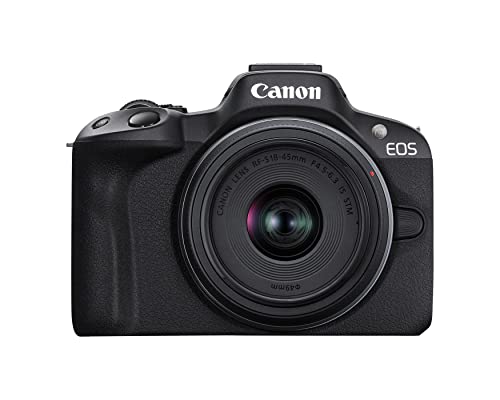
Canon EOS R50 — The refurbished favourite
Canon’s compact mirrorless starter makes the ideal first refurbished purchase because the refurbishment story is so easy to verify. Manufacturer-renewed examples pass through the maker’s own inspection, arrive with the accessories a new buyer expects, and carry cover that a random marketplace seller simply cannot match. The R50 itself suits this channel beautifully: it is a light, friendly APS-C body with strong autofocus, guided menus for genuine beginners and video quality that flatters family films and first vlogs alike. Thousands were sold new, which means the renewed pipeline is fed steadily rather than in rare drips.
Hunting one well is mostly a matter of rhythm and readiness. Refurbished stock appears without ceremony, sells through quietly, and returns weeks later, so the winning move is a saved search, an alert, and a decision made in advance about the kit you want — body only if you already own RF glass, or the standard zoom bundle if this is a first system. Check what the renewed listing includes, because battery and charger inclusion varies by batch and region, and confirm the returns window before the box arrives so an unlucky example can go straight back.
- Format: APS-C mirrorless, compact and beginner-friendly
- Channel to watch: manufacturer refurbished store, restocked in waves
- Check first: included battery, charger and kit lens in the listing
- Strength of the route: maker inspection plus proper warranty cover
- Role: the safest discounted entry into a growing lens system
Strengths
- Renewed examples are inspected by the manufacturer itself
- Autofocus and guided menus forgive a complete beginner
- Steady supply makes waiting for restocks a realistic plan
Trade-offs
- Refurbished batches sell out without any announcement
- Included accessories differ between batches and regions
- The kit zoom is a starter, not a destination lens
Families upgrading from a phone will feel the difference within one birthday party: faces found instantly, eyes held in focus, colours that need no rescuing on a laptop afterwards. That ease is precisely why so many R50s circulate — people buy them, enjoy them, trade up — and why the refurbished shelf keeps refilling with examples that have lived gentle lives.
R50 verdict — Best for: first-time mirrorless buyers who want maker-backed savings. Not suited for: bargain hunters unwilling to wait for a restock wave

Fujifilm X100VI — The fair-price unicorn
Scarcity rewrites the meaning of the word discount for Fujifilm’s fixed-lens favourite. Demand has outrun supply so persistently that resellers routinely ask far above the official price, waiting lists stretch for months, and the genuine bargain — the only one this guide endorses — is a camera bought new, from an authorised dealer, at the price Fujifilm intended. That sounds like no bargain at all until you watch friends pay scalper premiums for the same box. With this model, discipline is the discount, and the discount is large.
Why do people queue at all? The X100VI pairs a high-resolution sensor with a fixed wide lens, film-derived colour simulations, a hybrid viewfinder that shows the world optically or electronically, and controls that put aperture and shutter speed under your fingers as dials rather than menus. It photographs like an heirloom and files like a modern flagship. None of that justifies grey imports with warranties that evaporate at the border, or auction listings from accounts created last Tuesday; the queue at an honest dealer, tedious as it is, remains the cheapest safe road to ownership.
- Format: fixed-lens premium compact, high-resolution sensor
- Channel to watch: authorised dealer waiting lists and restock alerts
- Check first: seller authorisation and full local warranty terms
- Strength of the route: paying the intended price beats every premium
- Role: a lesson in patience disguised as a camera purchase
Strengths
- Film simulations make straight-from-camera colour a joy
- Hybrid viewfinder suits both deliberate and quick shooting
- Resale values stay strong if you later change systems
Trade-offs
- The fixed lens will never zoom, however much you wish
- Waiting lists demand months of genuine patience
- Accessories like conversion lenses add up quickly
Owners describe a camera that changes behaviour rather than specifications: carried daily because it is beautiful, used deliberately because the dials invite it, and forgiven its single focal length because that constraint simplifies every walk into a way of seeing. If that description moves you, join a list today and let time do the negotiating that money should not.
X100VI verdict — Best for: patient photographers who value an honest price over instant delivery. Not suited for: anyone tempted to reward scalpers or grey importers

Sony ZV-1F — The seasonal-sale compact
Sony’s little vlogging compact lives on a completely predictable discount rhythm, which makes it the easiest camera in this guide to buy well. It is a fixed-lens, wide-angle machine built for people who film themselves: a bright lens that keeps faces clear indoors, product-showcase focusing that snaps to whatever you hold up, a microphone arrangement tuned for voices, and controls simplified until a nervous first-time creator can be recording within minutes of unboxing. Retailers treat it as a seasonal staple, so the big authorised sale events reliably bring its price down in public, with receipts and warranties intact.
Buying strategy here is calendar management rather than detective work. Note the normal street price during a quiet month, then watch the major sale windows — the summer event season, the autumn shopping weekend, the new-year clearances — and move when a recognised dealer dips meaningfully below that baseline. Resist bundles stuffed with cards and cases you would never choose yourself; a clean discount on the camera alone usually beats a theatrical bundle whose extras were valued generously by the seller’s imagination.
- Format: fixed-lens compact with a wide, bright lens
- Channel to watch: authorised dealer sales during major events
- Check first: the quiet-month baseline price before any event
- Strength of the route: predictable, public, fully warranted discounts
- Role: the beginner creator’s easiest well-timed purchase
Strengths
- Purpose-built for talking-to-camera video and vlogs
- Sale pricing follows a rhythm you can plan around
- Simple controls lower the barrier for new creators
Trade-offs
- Fixed wide lens limits framing flexibility
- Still photography plays second fiddle to video
- No viewfinder for bright-day composing
Creators who start on phones often stall on the same frustrations — hunting focus, thin sound, faces smeared by digital zoom — and this Sony removes those three in one small box. Bought during a proper sale, it also removes the fourth frustration, which is paying launch money for a tool whose price was always going to settle.
ZV-1F verdict — Best for: new vloggers who can time a purchase to a sale event. Not suited for: stills photographers wanting interchangeable lenses

Canon PowerShot G7 X Mark III — The used-market sweet spot
Premium compacts age gracefully, and Canon’s pocketable favourite proves the point in every graded used listing. Its one-inch sensor, fast zoom lens and pocketable body made it the carry-everywhere camera of a generation of bloggers and travellers, which means the used market is deep, varied and — crucially — gradable. A careful marketplace listing shows the lens, the screen, the dials and the corners where pocket wear gathers, and a compact has no shutter count mystery or mirror mechanism to fear. What you see in honest photographs is very nearly what arrives.
Judging an example takes five disciplined checks. Ask for the lens extended and retracted, since grit in the mechanism is this class’s classic ailment; inspect the screen for the scratches that betray a life spent loose in handbags; confirm the battery holds a charge through a day of shooting; test the pop-up flash and the control dial’s click; and favour sellers who describe faults plainly over sellers whose every camera is mysteriously mint. A dealer-graded example with a short warranty costs a little more than a private gamble and is worth every bit of the difference.
- Format: one-inch sensor compact with a fast zoom
- Channel to watch: established used dealers with written grading
- Check first: lens mechanism, screen wear and battery health
- Strength of the route: deep supply and condition you can verify
- Role: pocket quality at a fraction of its launch cost
Strengths
- Genuinely pocketable without surrendering image quality
- Used grading on compacts is unusually trustworthy
- Fast lens handles restaurants, evenings and travel indoors
Trade-offs
- Batteries in older examples may need replacing soon
- Lens mechanisms dislike sand, grit and pocket lint
- Autofocus trails modern mirrorless bodies noticeably
Travellers who carried one through three summers tend to speak of it the way drivers speak of a faithful small car: not the fastest thing owned, but the thing that was always there when the light turned golden down a side street. Buying that history, graded and guaranteed by a proper dealer, is among the safest pleasures in the used market.
G7 X verdict — Best for: travellers wanting pocket quality from the graded used shelf. Not suited for: buyers who need a long factory warranty

GoPro HERO12 Black — The clearance-generation pick
Action cameras run on an annual heartbeat, and each new flagship quietly turns last year’s into the smartest purchase in the category. The HERO12 Black is exactly that camera now: a rugged, waterproof flagship-class machine with excellent stabilisation, strong battery behaviour for its size and a mature accessory ecosystem, sitting one generation behind the newest model and priced accordingly whenever authorised retailers clear their shelves. The performance gap to its successor is real but narrow; the price gap, during clearance, is neither.
Clearance buying has its own etiquette and its own traps. Sealed stock from a recognised dealer, with the full warranty running from your purchase date, is the prize — chase that. Open-box returns sold as new, marketplace listings with stock photographs, and cameras bundled with unbranded mounts of unknown strength are the traps, because an action camera’s whole life is impacts and immersion, and its history matters more than its cosmetics. Buy the sealed clearance box, register the warranty, and spend the saving on the mounts and spare batteries this sport genuinely consumes.
- Format: waterproof action camera, flagship class
- Channel to watch: authorised clearance of sealed previous-generation stock
- Check first: sealed box, warranty start date and seller status
- Strength of the route: near-flagship performance at a cleared price
- Role: the annual-cycle bargain that repeats every single year
Strengths
- Stabilisation keeps rough sports footage watchable
- Accessory ecosystem is vast, cheap and everywhere
- Clearance pricing arrives on a dependable yearly cycle
Trade-offs
- Low-light footage is merely adequate, as with all small sensors
- Touchscreen use with wet or gloved hands frustrates
- Subscription extras tempt you into ongoing costs
Surfers, riders and skiers who destroy one camera every few seasons understand this pick instantly: the previous flagship survives the same wipeouts, films them nearly as well, and hurts far less when the sea eventually wins. Clearance season is when that arithmetic becomes undeniable, and stock does not linger once the word spreads.
HERO12 verdict — Best for: action shooters happy one generation behind the flagship. Not suited for: buyers who must own the newest model on launch day

Nikon Z30 — The bundle-deal hunter
Nikon’s smallest Z body rarely shouts its discounts, because its savings hide inside boxes rather than on price tags. The Z30 is a compact, viewfinder-free mirrorless camera aimed squarely at creators: clean video, a front-facing screen arrangement via its vari-angle display, simple audio provision and stills quality inherited from Nikon’s APS-C sensors. Sold alone it looks fairly priced; sold as a creator kit — with a small zoom, a microphone, a grip or a second lens folded in — it periodically becomes the cheapest honest route into the entire Z system, and that bundle arithmetic is where hunters should live.
Evaluating a bundle demands itemising it like an accountant. Price each component separately at current street values, count only the items you would genuinely buy, and let the remainder — the bag you will never carry, the card you would never choose — contribute nothing to your decision. Genuine creator kits pass this test easily during sale seasons, because Nikon prices them to recruit creators into the mount. A Z30 acquired this way is also a strategic purchase: every Z lens bought afterwards fits the larger Nikon bodies you may grow into.
- Format: APS-C mirrorless, compact creator-focused body
- Channel to watch: creator kits and lens bundles in sale seasons
- Check first: separate street value of every bundled item
- Strength of the route: kit pricing that undercuts body-only deals
- Role: the quiet, strategic entry into Nikon’s Z system
Strengths
- Small body encourages daily carrying and filming
- Creator kits can undercut the body-only price effectively
- Z mount gives a long, shared upgrade path
- Video features are thoughtfully aimed at solo shooters
Trade-offs
- No viewfinder, which stills purists will miss outdoors
- Bundles may include accessories you would not choose
- In-body stabilisation is absent, so lenses must help
Solo creators filming in bedrooms, workshops and kitchens describe the same relief: a camera that sits on a small tripod without dominating the room, starts recording without ceremony, and produces footage that looks like a decision rather than an accident. Acquired inside a well-judged bundle, it delivers that relief at a price that leaves money for lighting — the upgrade creators actually need next.
Z30 verdict — Best for: creators who evaluate bundles item by item. Not suited for: viewfinder devotees and bundle sceptics
How Do the Six Discount Hunts Compare Side by Side?
| Camera | Best channel | Main risk | Patience needed |
|---|---|---|---|
| Canon EOS R50 | Manufacturer refurbished | Restocks sell through quietly | Weeks of alert-watching |
| Fujifilm X100VI | Authorised dealer list | Scalper premiums everywhere else | Months on a waiting list |
| Sony ZV-1F | Seasonal dealer sales | Inflated bundles masking weak discounts | Until the next sale event |
| Canon PowerShot G7 X Mark III | Graded used dealers | Worn lens mechanisms and batteries | Days of comparing listings |
| GoPro HERO12 Black | Sealed clearance stock | Open-box returns sold as new | Until the annual clearance |
| Nikon Z30 | Creator kit bundles | Padding accessories inflating value | Until a genuine kit deal lands |
Which Discount Channels Can a Camera Buyer Actually Trust?
Four channels earn trust for four different reasons, and ranking them clarifies every purchase. Manufacturer refurbished stores rank first because the maker inspects its own products, replaces worn parts, and stands behind the result with real cover; the discount exists because the box was opened once, not because anything is wrong. Authorised dealers rank second: their sales are the manufacturer’s own promotions in most cases, stock is properly sourced for your region, and the warranty paperwork will be honoured without argument years later.
Established used marketplaces occupy third place, trusted conditionally — their grading systems, return windows and sheer volume make them excellent for cameras whose condition shows on the surface, and riskier for electronics whose wear hides in hours of video use. Previous-generation clearance, the fourth channel, is really a branch of authorised dealing: sealed boxes, full warranties, last year’s model. Understand which channel you are in at any moment, and most discount disasters become impossible, because each disaster belongs to a specific channel confusion — usually a grey import wearing an authorised dealer’s clothes.
How Should You Verify a Deal Before Money Moves?
Verification begins with the seller’s identity rather than the camera’s price. Search the seller’s name alongside the word authorised on the manufacturer’s own dealer locator; a genuine dealer appears there and a dropshipper does not. Read the warranty line in the listing until it names the region whose cover you will receive, and treat phrases like international warranty or seller warranty as translations of the words no warranty. Photographs should show the actual item for anything used, and serial numbers in those photographs should match the box on arrival.
Price history is the second verification, and it deflates more fake bargains than any other habit. A camera advertised at a dramatic percentage off an inflated reference price may sit above its ordinary street price at three rival dealers; the percentage is theatre, the street price is fact. Keep a note of quiet-month prices for your shortlist — a phone note is enough — and let that note, not the banner, tell you whether a deal exists. Finally, pay by a method with buyer protection, keep every message, and photograph the unboxing of anything expensive; these dull rituals are what make a rare problem recoverable.
Why Does the Grey Market Tempt, and Where Does It Bite?
Grey-market cameras are genuine products imported outside the manufacturer’s regional channels, and their lower prices are real — which is exactly why the trap works. The saving comes from things you cannot see in the listing: warranty cover that the regional service network may refuse entirely, firmware and menu languages aimed at another market, chargers with foreign plugs, and resale values that sag once a knowledgeable buyer checks the serial number’s origin. For a cheap accessory those risks are trivial; for a camera body you may own for a decade, one refused repair can erase the saving several times over.
None of this makes every import a scam, and this guide’s position is proportion rather than panic. An experienced photographer who services gear independently, buys knowingly, and prices the risk honestly can shop anywhere. The disaster cases are beginners who believed they were buying from a local authorised dealer — lured by a professional-looking storefront — and discovered the truth inside a service centre two years later. If a price undercuts every authorised rival by a wide margin, ask which ingredient was removed to make that possible. There is always an ingredient.
How Do Refurbished Grades and Warranties Actually Differ?
Refurbished is a word with no legal uniform, so the seller’s identity defines it completely. Manufacturer refurbishment means factory inspection, genuine parts, a reset of wear items where relevant, and cover comparable to new — the gold standard, and the reason the R50 section above points there first. Retailer refurbishment varies from excellent workshop overhauls to a cloth wipe and a prayer, and the only way to tell is the warranty length and the returns policy standing behind the claim. Short cover signals low confidence; a seller who believes in their refurbishment insures it.
Used grading deserves the same scepticism applied in the other direction. Reputable dealers grade conservatively because their returns process punishes optimism, so a dealer-graded excellent compact usually arrives better than feared. Private listings grade emotionally. Wherever you buy used or renewed, the first fortnight is your inspection laboratory: shoot the lens at every aperture, film until the battery dies, pixel-peep the corners, and exercise every dial while the return window stands open. A bargain you have not tested is merely a rumour you paid for.
When Is Last Year’s Model the Smartest Money in Cameras?
Generational clearance is the discount channel with the least risk and the most predictable timing, because manufacturers must empty the pipeline before a successor ships. The pattern repeats across every pick type in this guide: action cameras turn over yearly, mirrorless bodies every few years, compacts irregularly — and each turnover quietly reprices the outgoing model at every authorised dealer simultaneously. The outgoing camera does not become worse on announcement day. Its stabilisation, sensor and menus are identical to the ones reviewers praised at launch; only its fashion status changes, and fashion is the one specification your photographs will never display.
Timing the moment takes one observation: clearance deepens after the successor is actually shipping, not merely announced, because shelf space becomes urgent only when new boxes arrive. Buy too early and you pay the anticipation price; buy too late and the sealed stock is gone, leaving open-box remnants. The HERO12 Black above sits in that window now for action cameras. For bodies with longer cycles, the same window opens around major trade shows and the holiday quarter, and alerts set in advance catch it while your size, colour and kit preference are still in stock.
How Should You Budget Beyond the Bargain Itself?
Total cost of ownership is where discount dreams go to be audited. A body bought cheaply still needs a lens worth its sensor, cards fast enough for its video modes, a second battery because one battery is a deadline, and a bag that will actually be carried. Refurbished and used purchases add small certainties: a replacement battery sooner than planned, perhaps a sensor clean, possibly a strap or charger the previous owner kept. Add these honestly before comparing channels, because the ranking sometimes flips — a slightly dearer refurbished kit with everything included can undercut a bare used body once the missing pieces are bought separately.
Insurance and resale belong in the same ledger, quietly. Cameras hold value in proportion to their paperwork: receipts from authorised sellers, warranty cards, and original boxes all raise the price your camera will command when you eventually trade up, which means today’s channel choice is partly a decision about tomorrow’s discount on its replacement. The photographers who seem to upgrade impossibly cheaply are usually just compounding this — buying right, keeping records, selling well — and there is no secret beyond the compounding.
How Do Trade-In Programmes Quietly Beat Most Sales?
Trade-in shelves rarely advertise themselves as discount sites, yet part-exchanging an old body at an established dealer can outperform a headline sale. Dealers price trade-ins against what they can resell, grade on the spot, and apply the credit instantly to the camera you actually want — no auction fees, no strangers at the door, no parcel lost in transit. The credit offered will sit below a perfect private sale, fairly, because the dealer absorbs the risk, the warranty obligation and the weeks your old camera may spend waiting for its next owner.
Preparing a trade-in like a professional raises the credit meaningfully. Clean the sensor chamber’s surroundings, charge the battery, gather the charger, strap, cap and box if they survive, and factory-reset the settings so the grader handles a camera that presents as cared for. Photograph the serial number and condition before handing anything over, keep the written valuation, and compare it against one rival dealer’s quote; valuations vary, and a polite mention of a competing figure occasionally moves a grader from their first number to their honest one.
Timing can stack the advantages in your favour during promotional windows. Manufacturers periodically add bonus credit on top of dealer valuations when a new body launches, effectively discounting the new camera twice — once through the bonus, once through your old body’s value. Buyers hunting an R50 or a Z30-class upgrade should watch launch seasons for exactly these stacked offers, which are advertised quietly on dealer pages rather than shouted, and which expire while casual shoppers are still reading the announcement headlines.
Which Price-Tracking Habits Separate Hunters From Wishers?
Serious hunters keep records, because memory flatters every price it has ever seen. A simple note — model, configuration, dealer, price, date — updated whenever you check, becomes within two months a private price history more trustworthy than any banner percentage. Patterns emerge from those rows: which dealer moves first, how long a dip lasts, whether a sale price returns monthly or once a year. Armed with your own history, you stop reacting to theatre and start recognising the genuine floor when it appears.
Alerts deserve configuring with unusual care to avoid alert fatigue. Set them for the exact configuration you intend to buy — body with the kit lens, not the body alone — since tracking the wrong bundle produces exciting notifications about a product you never wanted. Cap the number of tracked models at three; beyond that, notifications blur into weather. And decide your trigger price while calm, in writing, because the entire purpose of an alert is to let a past, rational version of you overrule the excited present version holding the phone.
Camel-watching marketplace prices adds one further layer of intelligence about rhythm. Third-party price histories for large online retailers show the sawtooth pattern of modern camera pricing clearly: long plateaus, brief promotional valleys, sudden returns to the plateau. Buying inside a valley is not luck once you can see the teeth. Combine that chart with your own dealer notes and the authorised sale calendar, and the supposedly mysterious art of timing a camera purchase dissolves into ordinary record-keeping that anyone can maintain in five minutes a week.
How Should Students, Teachers and Working Professionals Hunt Differently?
Education pricing is the discount channel hiding in plain sight on manufacturer stores. Students and teachers with verifiable status often qualify for education stores or periodic academic promotions on exactly the beginner and creator bodies this guide recommends, and the verification takes minutes through the usual academic email or enrolment checks. A learner buying an R50 or Z30 for coursework should always check the education route before the public one; the saving, when offered, arrives with full warranty and none of the used market’s uncertainty.
Working professionals possess a different lever: the business account and the invoice. Buying through a registered business can unlock volume pricing, proper tax documentation and, in some regions, the ability to reclaim sales tax on equipment used for work — a saving larger than many sale events, delivered by paperwork rather than luck. Rental houses also sell ex-rental bodies periodically, graded by technicians who maintained them; a creator comfortable assessing condition can find workhorse cameras there whose histories are documented rather than guessed.
Employers, schools and community groups sometimes hold the simplest discount of all: the shared purchase. A photography club buying three identical bodies negotiates differently from three strangers buying separately, and manufacturers’ education and business desks exist precisely for such orders. None of these routes appears in a search for cheap cameras, which is why they remain underused. The lesson generalises beyond any single scheme: discounts follow status, timing and paperwork as often as they follow storefronts, and the hunter who asks what they qualify for usually qualifies for something.
What Does Open-Box Mean at a Big Retailer, and When Is It Safe?
Open-box shelves at large electronics retailers occupy a useful middle ground between new and used. A returned camera — bought in the wrong colour, gifted twice, unboxed for a video and regretted — goes back on sale at a reduction, inspected to a standard that varies by chain and by store. The attraction is immediacy: you can handle the exact unit, check its screen, lens and dials under shop lights, and walk out with it the same afternoon, something no online channel in this guide can offer a hunter in a hurry.
Safety comes from performing the inspection the discount presumes you will do. Power the camera on in the store, take test frames at the lens’s extremes, zoom into them for corner smearing or sensor spots, work every dial and button, and confirm the battery, charger and strap listed on the box are physically inside it. Ask what return period applies to open-box items specifically, because it can differ from the new-goods policy, and keep the receipt with the serial number printed or written on it. Ten minutes of this theatre converts a gamble into a genuinely prudent purchase.
Certain categories suit open-box better than others, and the picks above illustrate the split. Simple compacts like the ZV-1F reveal their whole condition in that ten-minute inspection, making them ideal open-box candidates. Heavily used video bodies and cameras with mechanical shutters carry counters and histories a shop-floor test cannot fully read, so those belong in manufacturer refurbished or dealer-graded channels where inspection runs deeper. Matching the channel’s inspection depth to the camera’s hidden-wear potential is, in one sentence, the entire philosophy of this guide.
How Can You Spot a Fake Discount From Across the Internet?
Fake discounts share a family resemblance once you have seen a few specimens. The reference price inflates to a figure no dealer ever charged; the countdown timer resets when it expires, because urgency is the product being sold; the stock counter hovers permanently at two remaining; and the seller’s name, address and warranty terms dissolve into fog whenever you reach for them. Any one of these is a warning. Three together describe a storefront whose business model is your haste, and the correct response is to close the tab regardless of how beautiful the camera in the photograph looks.
Genuine sales, by contrast, are almost boring in their presentation. Authorised dealers publish start and end dates, honour the price without pleading, state the warranty plainly, and charge the same figure at the till as on the banner. Manufacturers announce refurbished restocks without countdown theatre. Used dealers describe faults in the same font size as virtues. Learn to feel the difference in tone — the calm of a seller who expects scrutiny versus the noise of a seller who fears it — and your eyes will start filtering listings before your brain has finished reading them.
Social-media marketplace bargains deserve a final, specific caution for camera buyers. A current, desirable body offered locally at a startling price, with payment requested in advance and collection discouraged, matches the profile of listings built around stolen serial numbers or simple non-delivery. Meet in public, power the camera on, check the serial against the box, and pay only when the camera is in your hands and working. Cameras are portable, valuable and hard to trace — which is precisely why honest process matters more in this category than in almost any other purchase a household makes.
How Does Region Decide What a Warranty Is Worth?
Regional warranty structures explain most of the price geography in the camera market. A body sold for the North American market carries service arrangements priced into it for that market’s network; the same body sold elsewhere may be cheaper precisely because a different network, or none, stands behind it. Travellers who buy cameras abroad while on holiday meet this at the service counter years later, holding a receipt in another language and a camera their local centre may decline to touch under warranty, however gladly it will repair the camera for a fee.
Holiday purchases can still be rational when made with clear eyes and honest arithmetic. A photographer who saves a large sum abroad, buys from that region’s authorised dealer, keeps the paperwork and accepts fee-paid servicing at home has made a trade, not a mistake. Problems begin when the same purchase is made accidentally — an online listing that concealed the camera’s region until the box arrived. Checking the model suffix, the plug on the charger and the warranty card’s language takes ninety seconds on arrival, inside the return window, and settles the question while settling it is still free.
Resale value quietly enforces the same regional logic years afterwards. Knowledgeable used buyers ask where a camera was originally sold, because they know what its paperwork means for their own future repairs, and they price grey-origin bodies lower without malice. Sellers who bought cheaply abroad sometimes discover that the market claws the saving back at the exit. None of this forbids cross-border buying; it simply insists the saving be counted net — after service risk, after resale discount, after the value of your own peace of mind — rather than gross, off a banner, in a hurry.
Gift purchases carry a gentler version of the same warning for families. A camera given to a student, a parent or a partner should arrive with the least possible future friction, which argues for the most conventional channel available: authorised, regional, receipted, returnable. The recipient will never know what you saved by cleverness, but they will certainly know what it costs them if a fault meets a refused warranty. Among all the bargains in this guide, the kindest is the one that never has to be explained to a service centre.
What Mistakes Do Discount Camera Hunters Keep Making?
- Chasing grey-market prices. Imports without regional warranty cover can lose their entire saving on a single refused repair.
- Believing the percentage. A huge discount off an invented reference price can still sit above the ordinary street price elsewhere.
- Skipping the returns window test. Used and refurbished cameras must be exercised hard in the first fortnight, while returning them is still free.
- Counting bundle padding as value. Bags, cards and filters you would never choose are worth nothing in the arithmetic, however the listing values them.
- Ignoring total ownership cost. Lenses, batteries and missing chargers decide the real price long after the bargain headline fades.
- Buying the deal instead of the camera. A cheap camera that does not suit your photography is the most expensive purchase of all.
Why Should a Shortlist Come Before Any Sale Does?
Writing the shortlist first, during a quiet week with no banners shouting, protects every later decision. Decide which two or three cameras genuinely suit your photography, note their configurations and fair prices, and let that document govern the hunt for as long as it takes. Sales then become a filter applied to a settled question — does this event discount my camera, verifiably, from a seller I trust — rather than an invitation to reconsider your entire photographic life at midnight because something unrelated became briefly cheap.
Households buying together benefit from sharing that document before anyone shops alone. Partners, parents and older children often hunt in parallel, duplicating alerts and occasionally duplicating purchases; one shared note with models, ceilings and channels ends the chaos. It also records who checked which dealer and when, turning a family’s scattered enthusiasm into something resembling a small, competent buying department — the exact spirit in which the best discount hunters, professional or amateur, have always operated.
Final Recommendation
Channels, ranked plainly for anyone who skimmed to the end: buy refurbished from the manufacturer when your model appears there, buy new from authorised dealers during genuine sale seasons, buy graded used from established dealers when condition is checkable, and buy previous-generation clearance whenever fashion has repriced a camera you already wanted. Each route is represented among the picks — the R50 for refurbishment, the ZV-1F and Z30 for sales and bundles, the G7 X Mark III for graded used shelves, the HERO12 Black for clearance, and the X100VI as the standing lesson that sometimes the bravest discount is refusing every premium and waiting for the honest price.
Money saved on a camera should migrate, not evaporate: into the better lens, the second battery, the tripod, the printing of photographs large enough to judge. A discount pursued for its own sake ends in a cupboard of bargains; a discount pursued as funding for the photography itself ends in pictures. Choose your channel, set your ceiling, verify the seller, test the camera hard while returns are free — and then stop shopping, because the cameras above were all chosen to be worth photographing with for years.
One last encouragement belongs to anyone who has read this far without buying anything yet. Restraint of that kind is not indecision; it is the market working in your favour, because cameras keep being announced, restocked, traded in and cleared whether you participate this month or next. Your shortlist will meet its channel eventually — a refurbished wave, a seasonal dip, a graded example with your name effectively on it — and when the meeting happens, the preparation above turns it into a purchase you can enjoy without a single backward glance at the price. Keep the receipt, register the warranty on the day the box arrives, and file both somewhere the future you can find without excavating a decade of email.
Frequently Asked Questions
Is manufacturer refurbished as safe as buying new?
Very nearly, and sometimes better: factory inspection can catch faults that slip through ordinary production, and the cover provided is real. The differences are cosmetic history and a shorter supply — the camera may have lived briefly before, and stock appears in waves.
How can I tell whether a dealer is truly authorised?
Check the manufacturer’s own dealer locator for your region and buy only when the seller appears there. A professional website proves nothing; importers can build beautiful storefronts. The locator, the warranty region and the receipt are the evidence that matters.
Are used cameras from big marketplaces a gamble?
They are a managed risk when grading is written, photographs show the actual item and returns are free. Compacts and simple bodies grade honestly; heavily used video bodies hide their hours. Paying a little more for a dealer grade is usually the wise version of the gamble.
Why is the X100VI listed when it never goes on sale?
Because its discount takes an inverted form: avoiding the scalper premium is worth more than most sale events save on other cameras. An authorised waiting list at the intended price is, for this model, the largest legitimate saving available anywhere.
When do camera sales actually happen each year?
Patterns repeat around major retail events in summer and autumn, the holiday quarter, new-year clearances and the weeks after a successor model ships. Exact dates drift; the rhythm does not. Alerts plus a noted baseline price will catch your window.
Should I ever buy a grey-market camera knowingly?
Only with open eyes: price the missing warranty honestly, confirm menus and chargers suit your region, and accept that resale and service may both be harder. Beginners who believe they found an authorised bargain are the classic victims — the knowing buyer is a different, rarer case.
Related Guides
Discount hunting pairs naturally with knowing what to hunt. Browse the best digital cameras for beginners before committing to a first system at any price, compare the best cameras for vlogging if your bargain will mostly shoot video, and read the best cameras under a set budget to see how far a carefully timed purchase can stretch.


