ilcastellomenu.com is reader-supported. When you buy through links on our site, we may earn an affiliate commission.
Where to Buy a Camera You Are Meant to Finish and Hand Over
Choosing the best disposable cameras for photography begins with accepting what these cardboard-and-plastic time machines are for. A disposable camera is a roll of film wearing a simple lens, a fixed shutter, a flash on the flash models, and no settings worth the name — and that poverty of control is the entire charm. You wind, you point, you press, and the photograph is decided by the light and the moment rather than by you. Weeks later, after a lab has cracked the shell open and scanned the roll, the pictures arrive with the soft grain, forgiving colour and occasional happy accidents that digital perfection edited out of our lives.
Honesty about the category matters before any money changes hands. Genuine disposables are film products made by companies whose cameras live outside this site’s verified product pool, so the four true single-use picks below are written in prose, without links, exactly as they should be. Two further picks — an instant camera from Fujifilm and one from Polaroid — do carry links, and they are labelled relentlessly throughout this guide as what they are: reusable instant cameras, not disposables at all, included because many readers searching this topic actually want the same carefree point-and-shoot feeling with a camera they keep. Confusing the two categories would be easy and profitable; this guide declines.
Occasions explain the enduring demand better than nostalgia alone ever could. Weddings scatter disposables across reception tables so guests become the second photography team. Camps and school trips need cameras that survive being dropped, soaked and forgotten in a way no phone should have to. Festivals, hikes and beach days reward a camera whose loss is a shrug rather than an insurance claim. And film photographers who shoot serious cameras all year still buy disposables for the specific freedom of not caring — the roll becomes a diary nobody edited, including the photographer.
Key Takeaways
- True disposables are film cameras: buy them in prose-guided categories, not by spec sheet.
- Flash models suit indoor parties; waterproof models suit pools, beaches and rain.
- Film and developing are the real cost — the camera itself is only the first instalment.
- Hand the whole camera to the lab; never try to open one yourself.
- Instant cameras in this guide are reusable alternatives, clearly not single-use products.
- Buy fresh stock and check the film’s expiry date before an important event.
In this guide
Quick Picks
| Pick | Badge | Why it earns its place |
|---|---|---|
| Fujifilm QuickSnap Flash 400 | The party standard, in prose | Built-in flash and forgiving film make it the default guest-table camera. |
| Kodak FunSaver | The daylight companion, in prose | A long-running favourite whose flash version handles mixed wedding light well. |
| Fujifilm QuickSnap Waterproof | The pool and beach pick, in prose | Sealed housing shrugs off splashes, sand and snorkelling shallows. |
| Kodak Power Flash | The extra-exposure option, in prose | Generous frame count for trips where the roll must last all week. |
| Fujifilm Instax Mini 12 | The reusable instant alternative — not disposable | Prints in hand within minutes, then loads another pack and goes again. |
| Polaroid Go Generation 2 | The tiny reusable instant — not disposable | Palm-sized instant photography with the classic Polaroid look, refillable forever. |
How Did We Judge Cameras With Almost No Specifications?
Specification sheets abandon you quickly in this category, so judgement moved to the things that actually decide a roll’s fate. Film speed came first: the standard colour film loaded in most disposables is balanced for daylight and flash range, and its grain and latitude decide whether an indoor party produces faces or silhouettes. Flash behaviour followed — how honestly the maker rates its reach, how simply it charges, and whether a child or a wedding guest can operate it after one demonstration. Ergonomics, oddly, mattered too, because a camera passed around a room must explain itself to hands that have never seen it.
Lab reality formed the next layer of the judging, and it is the layer most buying guides skip. A disposable is only as good as the developing pipeline available to its owner: local labs that still process colour film, mail-in services with sensible turnaround, scan quality at a price the household accepts. We favoured the mainstream models above partly because every lab on earth recognises them, their film is the standard colour stock the whole system is calibrated for, and no clerk will frown at the shell when you hand it across the counter.
Freshness completed the criteria, quietly and decisively. Film is a perishable good with an expiry date printed on the box, and a disposable bought from old, hot-stored stock can return washed-out, colour-shifted pictures through no fault of the photographer. The picks below are the models with the fastest retail turnover — the ones most likely to arrive fresh — and the buying advice in this guide repeats one ritual until it becomes reflex: read the date, buy from stock that moves, and shoot the roll reasonably soon after purchase rather than ageing it in a drawer.
Which Are the Best Disposable Cameras for Photography, Occasion by Occasion?
Fujifilm QuickSnap Flash 400 — The party standard, in prose
Fujifilm’s green box is the disposable camera most of the world pictures when the category is mentioned, and its dominance rests on the flash. Parties, receptions, school discos and family gatherings all share the same photographic problem — people you love, standing in light too dim for a fixed-aperture lens — and the QuickSnap Flash answers it with a simple, manually charged flash that reaches across a small room and a film stock forgiving enough to render candlelit skin kindly. Wind the thumbwheel until it stops, slide the flash up, wait for the ready light, and the camera has told you everything it knows.
Results from a well-handled roll have a recognisable house style that guests adore. Colours lean warm and saturated, flash-lit faces pop against gently darkened backgrounds, and the fixed-focus lens keeps everything from arm’s length to the far wall in a democratic, slightly soft focus that flatters groups and forgives the photographer’s third glass of wine. Nobody at a wedding needs a technically perfect file; they need the picture of the best man mid-laugh, grain and all, and this is the camera that has delivered that picture at ten thousand weddings.
Deployment craft separates the hosts who get galleries from the hosts who get twelve frames of the ceiling. Put one camera per table rather than one per guest, attach a small card asking guests to pass it along and use the flash indoors, and collect the cameras before the dancing ends rather than discovering them in the car park. Buy a spare or two beyond your count — one will vanish into a handbag, one will be finished by an enthusiastic child before dinner — and treat those losses as the cost of the candour you were buying in the first place.
- Film: colour negative, daylight-balanced with flash for indoors
- Flash: built in, manually charged, ready light on the body
- Lens: fixed focus, fixed aperture — no settings to learn
- Best setting: receptions, parties and family gatherings indoors
- Role: the default disposable for people-filled rooms
Strengths
- Flash makes indoor group pictures genuinely reliable
- Operation teaches itself to any guest in seconds
- Forgiving colour flatters skin at celebrations
Trade-offs
- Flash reach fades quickly in large halls
- Fixed focus softens anything closer than arm’s length
- Developing costs more than the camera did
Grandparents photographing grandchildren on this Fujifilm produce a particular treasure: slightly soft, warmly lit frames that look exactly like family photographs have always looked. In an age when every phone picture is sharpened within an inch of its life, that gentleness reads as honesty, and it is why the green box survives every prediction of its death.
QuickSnap Flash verdict — Best for: weddings, parties and indoor family events. Not suited for: landscapes, close-ups or anyone wanting to review pictures tonight
Kodak FunSaver — The daylight companion, in prose
Kodak’s yellow camera carries the oldest name in popular photography into the disposable age, and the FunSaver earns its place on range rather than novelty. Sold in flash and non-flash forms over its long life, it is the disposable you hand to a teenager heading for a festival, a grandparent touring a garden, or a class heading for the coast — a camera whose colour film renders summer skies, green fields and sunlit faces with the saturated cheerfulness that made Kodak colour famous. In honest daylight it needs nothing from its owner except the wit to wind on between frames.
Handling differences from its Fujifilm rival are small but real enough to mention for buyers choosing between the two boxes. The FunSaver’s flash charging and frame counter have their own rhythms, its grip suits some hands better, and its film’s rendering leans a touch warmer in sunshine — distinctions that matter far less than availability and freshness on the day you buy. This guide’s honest position is that the two great rivals are separated mainly by which one your local shop stocks freshest, and any guide pretending otherwise is inventing differences to fill a page.
Travel is where this Kodak quietly outshines fancier options in a traveller’s bag. Airport security staff worldwide recognise it, it asks for no charger, cable or adaptor in any country, it works in heat that wilts phone batteries, and its loss to a river, a festival crowd or an over-enthusiastic wave is an anecdote rather than a catastrophe. Photographers walking long trails with a serious camera in the pack often carry a FunSaver in a side pocket for the diary frames — the hostel, the bus window, the stranger who shared lunch — and those frames frequently become the trip’s most loved.
- Film: colour negative with Kodak’s warm daylight rendering
- Forms: flash and daylight versions across its range
- Lens: fixed focus, optimised for scenes beyond arm’s length
- Best setting: festivals, day trips, trails and school journeys
- Role: the sunshine disposable for people on the move
Strengths
- Daylight colour has a beloved, saturated warmth
- No charging, cables or settings for a whole trip
- Recognised and accepted by labs and security everywhere
Trade-offs
- Non-flash versions struggle badly indoors
- Fixed focus punishes selfies and close subjects
- Per-frame cost exceeds any digital alternative
Teachers who issue FunSavers on field trips report the same phenomenon every single year: thirty children, thirty rolls, and a classroom wall of photographs no adult would have thought to take — the underside of bridges, the inside of lunchboxes, friendship documented at knee height. A camera nobody is precious about becomes a camera everybody is honest with, and honesty is a photographic quality no specification can supply.
FunSaver verdict — Best for: daylight adventures, festivals and group trips. Not suited for: dim venues unless you choose the flash version
Fujifilm QuickSnap Waterproof — The pool and beach pick, in prose
Water changes every photographic rule, and Fujifilm’s waterproof disposable is built for the world where cameras go to die. Sealed inside a rugged housing with a large, glove-friendly shutter and controls you operate by feel, it shoots in pools, in rain, in the surf zone and — within its modest depth rating — snorkelling over shallow reefs where the light is bright and the fish are close. The film inside is a faster, more forgiving stock chosen for the dimmer world a few feet under the surface, and the whole camera is designed to be rinsed, not repaired.
Expectations need setting with the same care as with any pick in this guide. Underwater colour drains red first, so scenes render blue-green and dreamy; the fixed-focus lens wants subjects a comfortable distance away, not macro encounters with a single shy fish; and the housing’s big controls trade precision for operability with wet hands. Judged as a snorkelling instrument for scientists it would fail. Judged as the camera that finally photographs the children underwater, the kayak trip, the waterfall swim and the beach day from inside the water rather than from a towel, it has no serious rival at anything like its simplicity.
Sand deserves its own warning, because sand ends more beach cameras than water ever will. The sealed housing shrugs off immersion but the ritual around it matters: rinse the camera in fresh water after salt exposure, dry it before handing it to the lab, and never attempt to open the housing yourself to rescue the film early — the lab has the tools, the darkroom discipline and no interest in fogging your roll. Buy the waterproof model even for merely splash-prone days; the ordinary disposables above tolerate a drizzle, but a dropped-in-the-pool moment is binary, and this is the version that survives it.
- Housing: sealed waterproof case with oversized controls
- Film: faster colour stock chosen for underwater light
- Lens: fixed focus behind a protective port
- Best setting: pools, beaches, kayaks and shallow snorkelling
- Role: the disposable that photographs from inside the water
Strengths
- Survives immersion that would end any other pick here
- Big controls work with wet, cold or gloved hands
- Faster film copes with dim underwater light
Trade-offs
- Underwater colours render blue-green without correction
- Depth rating suits snorkelling, not scuba diving
- Housing bulk makes it the least pocketable pick
Holiday photographs divide into the ones taken near the water and the ones taken in it, and families consistently treasure the second kind out of all proportion to their technical quality. A child surfacing mid-laugh, shot from the water at the child’s own height, carries a joy that no telephoto from the beach can manufacture. This Fujifilm exists to make that frame ordinary, repeatable and safe to attempt.
Waterproof verdict — Best for: beach holidays, pool parties and shallow snorkelling. Not suited for: deep diving, macro subjects or dry-land minimalists
Kodak Power Flash — The extra-exposure option, in prose
Running out of frames is the disposable category’s only unforgivable failure, and Kodak’s Power Flash exists for buyers who refuse to risk it. Built around a generous frame count and a flash with a confident reach for its class, it is the single camera you pack for a week-long trip, a school residential, a festival weekend or a grand tour by train — occasions where resupply is uncertain and the roll must simply last. One camera, carried the whole journey, also gives the finished set a unity that scattered purchases never achieve: one film stock, one lens, one continuous diary.
Flash discipline becomes the owner’s main craft on a long roll, because the battery inside serves the whole life of the camera. Flash drains it; daylight shooting spares it; and the experienced Power Flash carrier develops a simple rule — sunshine needs no flash, shade at midday needs none either, and the flash is saved for faces indoors, evenings and the backlit portraits where it genuinely earns its keep. Follow that rule and the camera reaches the final frame still flashing. Ignore it, and the last days of the trip go unlit exactly when the farewell party happens.
Pacing the frames is the second craft, and it improves photographs beyond mere arithmetic. A roll that must last a week teaches the oldest film lesson of all: look first, wind second. Owners describe returning with fewer, better frames — the market at opening time rather than six shots of the same stall, the one considered portrait rather than a burst nobody will print. When the scans arrive, that restraint shows as a set that feels curated by the trip itself, and many photographers keep the habit long after they return to unlimited digital storage.
- Film: colour negative with a generous frame count
- Flash: built in, battery shared across the camera’s life
- Lens: fixed focus for general scenes and groups
- Best setting: week-long trips and multi-day events
- Role: one camera, one roll, one whole journey
Strengths
- Frame count suits long trips without resupply
- Flash reach handles evenings across a full week
- A single roll gives a trip’s pictures real unity
Trade-offs
- Careless flash use can exhaust the battery early
- Losing this one camera loses the entire trip
- Heavier commitment than buying disposables as you go
Camp leaders and expedition organisers favour this Kodak for a practical reason beyond photography: it simplifies logistics. Issue one camera per group at departure, collect the same cameras at return, send one parcel to the lab, and distribute one coherent set of scans. In an endeavour where every other system sprawls, a camera that is deliberately finite turns out to be an organisational gift as well as a photographic one.
Power Flash verdict — Best for: long trips and organised group expeditions. Not suited for: anyone who cannot ration flash or frames

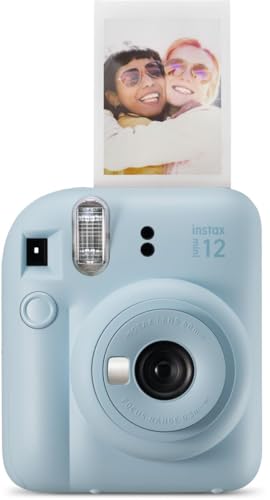
Fujifilm Instax Mini 12 — The reusable instant alternative — not disposable
Read the badge twice, because this Fujifilm is not a disposable camera and this guide will not pretend otherwise. The Instax Mini 12 is a reusable instant camera: you load a film pack, shoot, and watch a small print develop in your hand within minutes, then load another pack next month and shoot again. It belongs in this guide because thousands of readers searching for disposables actually want its exact experience — zero settings, instant gratification, photographs as physical objects passed hand to hand — without throwing a camera away at the end of the roll.
Automation is the Mini 12’s whole personality and its genuine improvement over earlier instant generations. Exposure adjusts itself, the lens twists on and extends itself, a selfie mirror and close-up mode handle the arm’s-length portraits that fixed-focus film cameras fumble, and the prints emerge credit-card sized with the soft, bright look that made Instax the default party camera of the last decade. At a wedding, an Instax print is a favour the guest takes home that night; a disposable’s picture is a promise redeemed in a fortnight, and different events honestly call for different magics.
Running costs deserve the same clear-eyed treatment given to film developing elsewhere in this guide. Instax film is bought pack by pack forever, each frame carries a real cost, and a trigger-happy evening consumes packs the way a disposable consumes its single roll — the difference is that the camera survives to shoot the next event, and the next decade of them. Households that host often, families with children who shoot weekly, and anyone made uneasy by throwing away a working camera will find the arithmetic and the ethics both point here.
- Type: reusable instant camera — not single-use
- Film: Instax Mini packs, loaded and replaced by the user
- Exposure: fully automatic, with close-up and selfie aids
- Best setting: parties where prints are taken home tonight
- Role: the keepable answer to the disposable impulse
Strengths
- Prints appear in minutes, ready to give away
- Automatic exposure removes the guesswork entirely
- The camera itself is never thrown away
Trade-offs
- Film packs are a permanent, per-frame expense
- Prints are small — keepsakes, not enlargements
- It is absolutely not a disposable camera
Children raised on screens find the Mini 12 quietly revolutionary, because a photograph becomes an object with weight, edges and a back you can write on. Guest books fill with prints at weddings, bedroom walls become galleries, and the camera that produced them sits ready in a drawer rather than in a lab’s recycling bin. For many households that permanence, not any specification, settles the choice.
Instax verdict — Best for: hosts and families wanting instant prints from a camera they keep. Not suited for: purists who specifically want a film roll developed by a lab

Polaroid Go Generation 2 — The tiny reusable instant — not disposable
Polaroid’s smallest camera repeats this guide’s necessary warning in miniature: the Go Generation 2 is a reusable instant camera, refillable with its own small film, and not a disposable in any sense. What it offers the disposable-curious is the most portable version of the instant idea ever sold — a camera genuinely sized for a jacket pocket or a small bag, carrying the Polaroid name, the square-format heritage shrunk to a palm-sized print, and a rechargeable battery where the film disposables above would simply be spent and surrendered.
Character, in the Polaroid tradition, means embracing a certain unpredictability with open eyes. Exposure is automatic but the film’s rendering leans dreamy and contrast-sensitive, bright sun can wash a frame, and indoor shots want the flash the camera thoughtfully provides. Devotees call this soul; accountants call it variance; both are describing the same prints. The Go’s double-exposure and selfie features invite play rather than documentation, which suits travellers and diarists better than event photographers who need every frame to land.
Size rewrites the carrying equation that governs so much of this guide’s advice. The disposables above are light but bulky, carried for an occasion and finished; the Go is smaller than most of them while being permanent, so it migrates into daily life — the pocket camera for walks, markets, campus days and city breaks where a phone feels too serious and a film disposable too wasteful for three frames. Its film costs more per shot than Instax in many markets, a fact buyers should price before falling for the format, but for the photographer who shoots instants sparingly and deliberately, the smallest Polaroid is a jewel of a thing.
- Type: reusable instant camera — not single-use
- Film: Polaroid Go film packs, user-loaded
- Battery: rechargeable, unlike any true disposable
- Best setting: daily carry, travel diaries and playful portraits
- Role: the pocketable, permanent instant keepsake maker
Strengths
- Smallest route into genuine Polaroid prints
- Rechargeable and refillable for years of use
- Creative modes encourage playful double exposures
Trade-offs
- Prints are the smallest in this guide
- Film cost per frame is comparatively high
- Exposure can surprise in harsh, contrasty light
- It is not, and never becomes, a disposable camera
Writers and sketchbook keepers have adopted the little Polaroid as a visual notebook, taping prints beside tickets and receipts while the journey is still warm. That immediacy — picture as artefact, minutes after the moment — is the one experience no lab-developed disposable can offer, and the reason this reusable camera earns its labelled place at the end of a disposable guide.
Go verdict — Best for: travellers and diarists wanting the tiniest reusable instant camera. Not suited for: buyers who truly need single-use film simplicity
How Do the Six Picks Compare Side by Side?
| Pick | Type | You see pictures | Watch out for |
|---|---|---|---|
| Fujifilm QuickSnap Flash 400 | Single-use film | After lab developing | Flash range in big rooms |
| Kodak FunSaver | Single-use film | After lab developing | Dim light without flash versions |
| Fujifilm QuickSnap Waterproof | Single-use film, sealed | After lab developing | Blue-green underwater colour |
| Kodak Power Flash | Single-use film, long roll | After lab developing | Battery shared across the roll |
| Fujifilm Instax Mini 12 | Reusable instant | In your hand, in minutes | Ongoing film-pack costs |
| Polaroid Go Generation 2 | Reusable instant | In your hand, in minutes | Smallest prints, priciest frames |
How Does the Lab Develop a Camera You Never Open?
Developing day confuses first-time buyers because the ritual is so unlike everything digital taught them. You hand over the entire camera — do not attempt to open it, extract the film or help in any way, because the shell opens only in darkness with proper tools, and a kitchen-table attempt fogs the roll you were trying to save. The lab’s technician extracts the film in the dark, processes it in the standard colour chemistry every disposable in this guide is built around, and scans or prints the frames. The empty shell goes to recycling streams the manufacturers operate, which is worth knowing for buyers uneasy about the category’s waste.
Choosing between a local lab and a mail-in service is a choice about time, conversation and scan quality. Local labs — the surviving minilabs and film specialists in most cities — offer advice, faster turnaround and the pleasure of collecting prints in person, while mail-in services suit rural buyers and often bundle high-quality scans delivered as downloads. Either way, order scans even if you also order prints: the digital files are your archive, your sharing copy and your insurance against the prints fading in a shoebox, and asking for them later costs more than asking now.
Turnaround expectations protect everyone’s mood around an important event. A wedding’s table cameras collected on Sunday are not a Monday gallery; allow days to a couple of weeks depending on the service, warn the guests who ask, and resist paying panic prices for rush processing unless a genuine deadline exists. The delay, photographers keep rediscovering, is partly the product: pictures that arrive after the event has softened in memory land with a force that same-night phone galleries never achieve.
Why Does Film Grain Flatter People in Ways Digital Rarely Does?
Grain is not merely noise with better public relations; it is a texture that forgives. Skin under a disposable’s flash softens because the film’s grain and gentle highlight roll-off decline to record every pore, and group photographs benefit from a lens that renders everyone at the same democratic sharpness rather than picking favourites. The colour stocks inside these cameras were refined over decades of family photography, tuned by manufacturers who knew exactly which faces, skies and wedding dresses the film would meet.
Restriction does the rest of the flattering, quietly, from behind the camera. Twenty-seven or so frames impose a mercy on photographers: nobody can take forty versions of a group shot, so nobody has to endure being photographed forty times, and the resulting expressions stay spontaneous because the ordeal never begins. Subjects relax around a disposable in a way they never relax around a phone, whose owner might review, judge and reshoot instantly. The camera’s inability to show the picture is, socially, its greatest feature.
How Should You Deploy Disposables at a Wedding or Party?
Logistics begin a week early with arithmetic nobody enjoys and everybody needs. Count tables, add spares, check expiry dates on every box, and write the couple’s names and the lab plan on a card attached to each camera so a guest who takes one home by accident can still return it. A small sign explaining the idea — take pictures, pass it on, leave it on the table at the end — prevents the two classic failures: cameras hoarded by one enthusiastic guest, and cameras departing in handbags before their rolls are finished.
Evening management matters as much as the buying did on day one. Assign one trusted person to collect cameras during the final hour, when rolls are fullest and attention is elsewhere; gather them into one bag, count them against your list, and store them somewhere cool until the lab trip. Couples who skip this ritual spend the honeymoon texting guests about missing cameras. Couples who perform it receive, a fortnight later, a second wedding album — unposed, unrepeatable and frequently more treasured than the official one.
What Should You Check Before Buying Any Disposable?
Expiry date first, always, printed on the box and non-negotiable for an important event. Film ages, heat accelerates the ageing, and a camera that spent two summers in a sunny shop window will tell you so in washed-out colour. Buy from sellers whose stock visibly turns over — busy photo shops, major retailers, the manufacturers’ own channels — and treat a suspiciously cheap multi-pack from an unknown seller as the false economy it usually is, since developing will cost the same whether the film inside was fresh or tired.
Flash specification is the second check, matched honestly to your venue. A garden party at noon needs no flash at all; a barn reception at nine in the evening needs every flash on every table. Read the box for the flash’s presence before assuming it, because daylight and flash versions of similar cameras sit side by side on shelves in near-identical packaging, and discovering the difference at the venue is a disappointment no refund can repair. Finally, count frames against your occasion: a short ceremony suits a standard roll, while a week-long trip argues for the long-roll pick above or for carrying two cameras.
How Do Instant Cameras Differ From Disposables, Honestly?
Mechanics divide the categories more deeply than marketing admits. A disposable is a film transport and a lens sealed around one roll; when the roll ends, the camera’s life ends, and a lab mediates between you and every picture. An instant camera is a durable machine that happens to consume film packs; the print develops inside the camera’s chemistry, in your hand, with no lab involved — and the camera goes home with you to do it again next month. Waste, cost structure, image size and the whole emotional rhythm differ accordingly.
Choosing between them is therefore a values question disguised as a product question. Choose disposables when the camera must be many, cheap, losable and operated by strangers — the wedding table, the school trip, the festival. Choose a reusable instant when one camera serves one owner across years of occasions, when prints must exist tonight, or when throwing away a functioning camera offends you more than paying for film packs forever. This guide links only the two reusable models, and labels them every time, because a reader who buys an Instax believing it disposable — or a disposable believing it instant — has been failed by somebody’s writing.
How Should You Buy Disposables in Bulk for a Big Event?
Bulk buying follows different rules from buying one camera at a chemist’s counter. Event organisers should order from a single reputable source in one transaction, so every camera arrives from the same fresh stock with dates that match, rather than assembling a patchwork of ages from marketplace sellers. Order earlier than feels necessary — a fortnight before the event is comfortable — because that buffer lets you replace a damaged box, test one camera from the batch if you wish, and store the rest somewhere cool and dark until the day itself.
Quantity arithmetic deserves more respect than it usually receives at midnight online. One camera per table of eight to ten guests produces a healthy roll per table across an evening; one per guest produces thirty half-finished rolls and a developing bill that ends the friendship between the couple and their budget. Add roughly a fifth extra for the losses, early finishers and the inevitable camera adopted by the flower girls, and write the total down before shopping so enthusiasm cannot quietly double it in the basket.
Instructions turn a box of cameras into a working photography team on the day. A tent card on each table — inviting guests to shoot, pass the camera along, use flash indoors and leave it behind at the end — raises both the quantity and quality of what comes back, because guests genuinely do not know whether they are allowed to finish a roll or expected to ration it. Couples who brief their guests get candids; couples who assume get centrepieces photographed thirty times and a roll of the ceiling from the one guest who misunderstood everything.
Why Are Teachers and Parents Returning to Film for Children?
Something unexpected has happened in classrooms and kitchens: adults who grew up digital are handing children film on purpose. A disposable gives a child a camera with no screen to stare at, no delete button to hide behind, no messages arriving and no battery anxiety — just a wheel, a button and consequences that arrive by post. Photographers call this constraint; teachers call it attention training; children, interestingly, call it exciting, because a photograph you must wait for becomes an event rather than an emission.
Lessons hide inside the fun with unusual efficiency for a cardboard camera. Composition must happen before the shutter because there is no cropping a frame you cannot see; patience becomes tangible when a roll takes a week to return; and selectivity — the discipline of deciding this moment, not that one — is forced by arithmetic no parent has to enforce. A class set of scans, pinned up a fortnight after the trip, also teaches memory itself: children discover which moments they kept, which they missed, and how differently the same day looked through thirty viewfinders.
Safeguarding and cost, the two adult concerns, both have honest answers in this category. Schools control the entire pipeline because the film never touches a child’s personal device or account — pictures exist only when the lab returns them to the teacher. Costs are real but budgetable: cameras, processing and scans for a class are a known, finite line item, cheaper than repairing one dropped tablet and infinitely cheaper than the attention a class set of phones would consume. Finite, again, turns out to be the feature.
How Do You Archive and Share a Roll Once the Scans Arrive?
Arrival day has its own small ceremony worth performing properly. Download the scans at full resolution before sharing anything, store them in a folder named with the event and date rather than the lab’s serial numbers, and back that folder up in a second location while the enthusiasm lasts. The negatives or the lab’s return envelope should be kept with the same care; film originals outlive file formats, and a rescan in ten years will extract quality that today’s quick download may not include.
Sharing film photographs well means resisting the urge to dump all thirty frames on the group chat at once. Choose the strongest handful for the first share — the pictures that prove the roll was worth it — then send the full set as an album link for the completists and the families hunting for their own faces. Tag nobody without asking, a courtesy that matters more with candid film frames than with posed phone shots, because disposables catch people mid-expression in ways they never consented to publish, however fondly the pictures were taken.
Printing closes the loop that makes this whole category worthwhile in a household. A handful of small prints — for the fridge, the grandparents, the wedding album’s chaotic final pages — converts scans that would have scrolled away into objects that persist. Many families find the disposable’s prints become the event’s official memory precisely because they were selected by scarcity: somebody chose those frames twice, once with the shutter and once with the print order, and double-chosen photographs carry a weight that unlimited galleries rarely achieve.
How Honest Should We Be About a Disposable Camera’s Waste?
Criticism of this category begins with a fair point that defenders should concede immediately: manufacturing a camera to be used for one roll is, on its face, extravagant. Plastic, electronics and a battery are assembled, shipped and sold so that thirty frames can exist, and no amount of nostalgia dissolves that arithmetic. Readers troubled by it are not wrong, and this guide’s inclusion of two reusable instant cameras — labelled, linked and recommended — exists partly so that the uneasy have a genuine alternative rather than a guilty purchase.
Context complicates the verdict in ways worth hearing before judging your own wedding tables. Labs return shells into manufacturer take-back and recycling streams where those operate, recovering batteries and circuit boards rather than landfilling whole cameras. The film revival has also produced refill services and hobbyist reloading for some shells, extending individual cameras beyond a single roll. And the honest comparison is not against zero impact — it is against the realistic alternative for the occasion, which may be a budget digital camera bought for one trip, used briefly and e-wasted within two years, a fate arguably worse per photograph than the disposable’s.
Proportion is the grown-up position this guide recommends to every buyer. A household that shoots two disposables a year at gatherings is not an environmental problem in any ledger that also contains its car, its heating and its phones. An organiser scattering hundreds across a festival should think harder, choose a supplier with a returns scheme, and collect every shell diligently at the end. Buy disposables deliberately, use every frame, recycle through the lab, and let the reusable instants carry the occasions where permanence serves better — that balance respects both the photographs and the planet they depict.
Ceremony can absorb the lesson without spoiling anyone’s afternoon at the event itself. A small note on the table card — asking guests to leave cameras behind for recycling, as many couples already write — turns collection from tidying into participation. Guests comply happily when the reason is stated once, plainly, and the couple receives both their candids and a bag of shells bound for the proper stream. Small systems, honestly described, are how categories like this one earn their continued existence.
What Mistakes Do Disposable Camera Buyers Keep Making?
- Opening the camera to check the film. The shell opens only in lab darkness; a curious peek can fog the whole roll.
- Buying expired or heat-stored stock. Old film returns washed-out colour, and developing costs the same either way.
- Forgetting the flash indoors. Daylight versions at an evening event produce silhouettes, not portraits.
- Standing too close. Fixed-focus lenses need arm’s length at minimum; nearer subjects soften into mush.
- Under-budgeting for developing. Processing and scans are the real price of every roll, every single time.
- Expecting phone-camera sharpness. Softness and grain are the aesthetic you bought; judge the pictures as film, not as failed digital.
Why Does Waiting for Pictures Change How They Feel?
Delay is the ingredient no digital workflow can sell you, and every disposable owner experiences its strange alchemy. A photograph reviewed instantly is judged instantly — deleted, retaken, forgotten by evening — while a photograph that arrives a fortnight later is received as news from a past self. The event has finished becoming memory, so the pictures do not compete with the experience; they annotate it. Faces you have already begun to forget return with their expressions intact, and the roll’s failures — the thumb, the blur, the accidental ceiling — become part of the story rather than errors in a gallery.
Photographers who shoot both ways often keep the two archives for different purposes without ever deciding to. Phone galleries serve proof and logistics: who was there, what the cake looked like, evidence for the group chat. The film roll serves feeling. When an occasion matters enough to deserve both kinds of memory, carrying a disposable alongside the phone is not redundancy — it is the cheapest second perspective in all of photography, bought for the price of developing and the patience to wait for it. Keep one roll permanently in the family camera drawer, dated and ready, and the habit sustains itself: birthdays, visits and small disasters all acquire their grainy witness without anyone planning a purchase in a panic the night before. Rotate that drawer stock as birthdays consume it, so the spare is never the expired one, and write the purchase month on the box in marker — a ten-second habit that has saved more rolls than any buying tip in this entire guide.
Final Recommendation
Match the camera to the occasion and this category becomes beautifully simple. Indoor celebrations belong to the QuickSnap Flash, whose whole design assumes a party; sunshine and movement belong to the FunSaver; water belongs, unopposed, to the waterproof QuickSnap; and a long journey belongs to the Power Flash and its generous roll. Those four are the true disposables, bought in prose-guided confidence from any fresh-stocked seller. The Instax Mini 12 and the Polaroid Go stand beside them as the reusable instant answers — linked, labelled, and recommended only to readers who realise, on reflection, that keeping the camera was what they wanted all along.
Whichever route you take, spend the money the category actually asks for: fresh film, enough cameras, proper developing with scans. The photographs these humble machines produce have a way of outliving their technical betters in family affection — the grainy frame of a grandfather laughing, printed small and kept on a fridge for a decade, is worth more than a thousand flawless files nobody opens. Buy the occasion its camera, wind the wheel, and let the moment do the rest.
Frequently Asked Questions
Can I open a disposable camera and reload it?
Not safely or sensibly. The film is loaded in darkness at the factory, the shell is not designed for user opening, and the flash capacitor inside can bite. Some hobbyists hack reloads from used shells, but for photography rather than electronics experimentation, hand the finished camera to a lab and buy a fresh one.
How long does developing take, and what should I order?
Anything from a few days locally to a couple of weeks by mail, depending on the service and season. Order scans with every roll, plus prints of the frames you love; scans are the archive, the sharing copy and the reprint source, and they cost least when ordered with the original processing.
Why do my indoor disposable pictures come out dark?
Distance and flash discipline explain nearly every case. The small built-in flash reaches only a few metres, so subjects across a hall fall into darkness, and forgetting to charge the flash before each shot leaves even close subjects underlit. Move closer, charge the flash, and let backgrounds go moody — that look is the genre.
Are the instant cameras in this guide disposable?
No, and the distinction is the point of their labelling. The Instax Mini 12 and Polaroid Go are reusable cameras that consume film packs; you keep them for years. They appear here as alternatives for readers whose real wish — carefree shooting, physical prints — is better served by keeping the camera.
Can disposables go through airport scanners?
Modern airport carry-on scanners are generally tolerated by the standard colour films in these cameras, but checked-baggage scanners are stronger and riskier, and rules vary. Carry disposables in hand luggage, mention them at security if asked, and never put an undeveloped roll in a checked suitcase.
What happens to the camera after the lab finishes?
The lab returns your film’s scans and prints, not the camera. Shells enter manufacturer and industry recycling streams where available, with batteries and electronics separated. If waste weighs on you, that lifecycle is a fair reason to choose one of the reusable instant picks instead.
Related Guides
Film curiosity rarely stops at one roll. Continue with the best cameras for parties and events when the occasion outgrows table cameras, explore the best instant cameras for the full reusable-print landscape, or read the best cameras for travel before packing anything more serious than a yellow box.


