The best reusable film cameras bring back the slow, deliberate pleasure of shooting on film without the cost of a vintage body that needs servicing. A reusable film camera takes a standard roll of 35mm film, and when the roll is finished you load another one, so the same camera can shoot hundreds of rolls over its life. That is the whole point of this category: simple cameras that keep working, roll after roll, with no screen to check and no settings to overthink. This guide covers the current Kodak models that dominate the reusable film camera market, including half-frame cameras that squeeze 72 shots from a 36-exposure roll, focus-free models that are ready the moment you raise them, and 2-zone focus models that add a little more control. Every camera here is a current listing, verified against the site product feed, and each one is genuinely reusable rather than a single-use disposable.
Shooting film is also a different pace of photography. Without a screen to check, each frame is a small commitment, and the results arrive days later when the scans come back. That delay is part of the appeal for many shooters, and it is also why the camera itself should be simple: the fewer decisions the camera forces, the more attention goes to the subject. The cameras in this guide are all point-and-shoot style models, which means the photographer composes, presses the shutter, and moves on. Film choice matters as much as the camera, and the guide covers that below, along with the practical details of loading, batteries and developing that first-time film shooters usually learn the hard way.
In this guide
Quick picks: best reusable film cameras
| # | Product | Where to buy |
|---|---|---|
| 1 | KODAK EKTAR H35 Half Frame Film Camera, Sage | Check on Amazon |
| 2 | Kodak EKTAR H35 Half Frame Film Camera, Black | Check on Amazon |
| 3 | KODAK EKTAR H35 Half Frame Film Camera, Brown | Check on Amazon |
| 4 | KODAK EC35 35mm Film Camera | Check on Amazon |
| 5 | KODAK EC35 35mm Film Camera, Avocado Green | Check on Amazon |
| 6 | KODAK Snapic A1 35mm Film Camera, Rhino Grey | Check on Amazon |
| 7 | KODAK Snapic A1 35mm Film Camera, Ivory White | Check on Amazon |
| 8 | Kodak EKTAR H35 Half Frame 35mm Camera | Check on Amazon |
How the picks were chosen
The picks were chosen from current reusable 35mm film cameras in the product feed, with three hard filters. First, the camera must be reusable: it must accept a standard 35mm roll that the owner loads and replaces, which rules out one-time-use cameras entirely. Second, it must be a real film camera rather than a digital camera dressed in retro styling, so screen-free digital models were excluded even when they appeared in the search results. Third, renewed or used-condition listings were excluded, since a film camera with an unknown shutter history is a poor starting point. Within those filters the guide favours distinct models and useful variety: half-frame cameras for shooters who want more frames per roll, focus-free cameras for absolute simplicity, and 2-zone focus cameras for a small step up in control.
Price was not used as a filter, because reusable film cameras in this class are all inexpensive relative to the cost of film itself over a year of shooting. A roll of film plus developing costs more than many buyers expect, so the guide weights frame economy heavily: half-frame cameras earn their place because they halve the film cost per photo. Colour choice was treated as a real difference rather than a cosmetic one, since the finish affects how visible the camera is on the street and how it ages. Finally, every camera here is a current listing with a verifiable product page, so the recommendations point at cameras that can actually be bought now rather than discontinued models.
Quick comparison
| Product | Standout detail |
|---|---|
| KODAK EKTAR H35 Half Frame Film Camera, Sage | Half-frame 35mm, 72 shots per 36-roll, focus-free, sage finish |
| Kodak EKTAR H35 Half Frame Film Camera, Black | Half-frame 35mm, 72 shots per 36-roll, focus-free, black finish |
| KODAK EKTAR H35 Half Frame Film Camera, Brown | Half-frame 35mm, 72 shots per 36-roll, focus-free, brown finish |
| KODAK EC35 35mm Film Camera | Full-frame 35mm, focus-free, built-in flash, slide cover |
| KODAK EC35 35mm Film Camera, Avocado Green | Full-frame 35mm, focus-free, built-in flash, avocado green finish |
| KODAK Snapic A1 35mm Film Camera, Rhino Grey | Full-frame 35mm, 2-zone focus, lightweight and compact, grey |
| KODAK Snapic A1 35mm Film Camera, Ivory White | Full-frame 35mm, 2-zone focus, lightweight and compact, ivory white |
| Kodak EKTAR H35 Half Frame 35mm Camera | Half-frame 35mm, 72 shots per 36-roll, focus-free, AAA battery not included |
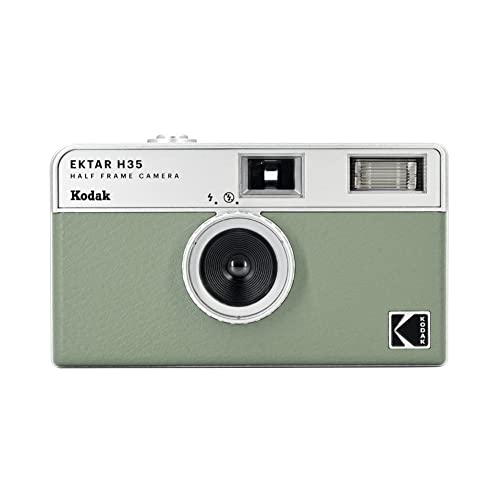
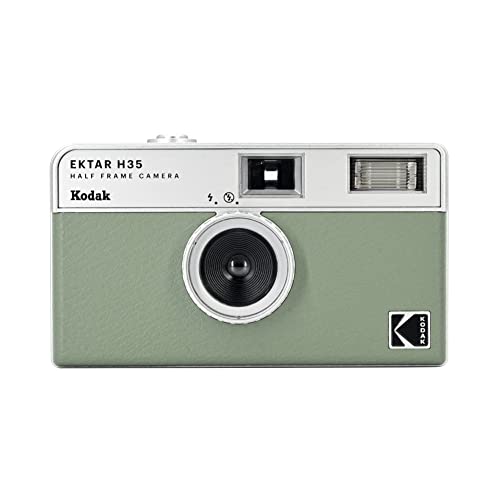
1. KODAK EKTAR H35 Half Frame Film Camera, Sage
Key specs
Half-frame 35mm film camera, reusable, focus-free, lightweight, uses AAA batteries. A half-frame camera exposes two half-size images on each standard frame, so a 36-exposure roll yields about 72 shots.
Strengths
- Half-frame format roughly doubles the number of photos per roll, which keeps the cost per shot low.
- Focus-free operation means there is nothing to adjust before pressing the shutter, so it suits first-time film shooters.
- Lightweight body is easy to carry all day in a jacket pocket or small bag.
Trade-offs
- Half-frame images are smaller than full-frame shots, so enlargements have less detail to work with.
- Focus-free design gives no control over focus distance, so very close subjects can come out soft.
- Runs on AAA batteries, which need to be kept on hand for the flash and metering.
Who it fits
Beginners who want the cheapest possible way into film photography and enjoy the lo-fi half-frame look.
Best for: first-time film shooters and anyone who wants the most shots per roll.
Not suited for: photographers who need large, highly detailed enlargements from every frame.
In daily use
In daily use, the H35 in sage is the camera you grab without a plan. Load a roll, slip it into a coat pocket, and shoot through the day: a coffee, a street corner, a friend laughing. The half-frame format changes how you shoot, because each press of the shutter costs so little that you stop rationing frames and start collecting pairs of images that sit side by side on the roll. The focus-free lens keeps things simple, and the light body means you will actually carry it. Keep a spare set of AAA batteries in the bag, and remember that the flash needs a moment between shots.
Before you buy
Before buying the KODAK EKTAR H35 Half Frame Film Camera, Sage, check two practical things. First, confirm the battery type in the listing and buy a pack of spares with the camera, because a film camera without batteries is a paperweight on the day it arrives. Second, order a roll or two of 35mm film at the same time, ideally 400-speed colour negative film, which is forgiving in mixed light. Without film and batteries in hand, the camera sits on a shelf while the accessories ship separately, and the first roll is what teaches you how the camera actually behaves.
Check price on Amazon: KODAK EKTAR H35 Half Frame Film Camera, Sage

2. Kodak EKTAR H35 Half Frame Film Camera, Black
Key specs
Half-frame 35mm film camera, reusable, focus-free, lightweight, uses AAA batteries. Same H35 half-frame mechanism as the sage version, in a black finish.
Strengths
- Same half-frame economy as the other H35 models, with about 72 shots from a 36-exposure roll.
- Black finish is discreet and shows less wear and scuffing over time than pale colours.
- Focus-free shooting keeps the camera ready for quick, unplanned photos.
Trade-offs
- Half-frame negatives are smaller, so scans and prints lose some fine detail compared with full-frame.
- No focus control, which limits close-up work.
- Flash range is modest, so indoor shots in large rooms can come out dark.
Who it fits
Shooters who want the H35 in a low-key colour that blends in on the street and at events.
Best for: street and travel shooters who want a discreet half-frame camera.
Not suited for: anyone who mainly shoots close-ups or large indoor spaces.
In daily use
In daily use, the black H35 behaves exactly like its siblings: load it, carry it, shoot it. The difference is only the finish, and the black body is the one to pick if you dislike drawing attention to the camera. It disappears against dark clothing and does not catch the eye the way a pale camera can. The half-frame habit is the same: two small images per frame, a roll that lasts for weeks of casual shooting, and a growing stack of paired photos that tell a day in two panels. Store it with the lens covered and keep the battery compartment dry.
Before you buy
Before buying the Kodak EKTAR H35 Half Frame Film Camera, Black, think about where the photos will be developed. Find a local lab or a mail-in service first and check its turnaround time and whether scans are included, since the camera is only half the system. Also check that the listing is for a reusable camera rather than a one-time-use model, and read the included accessories carefully: some listings include a roll of film and batteries, while others include neither, and the difference decides what else needs ordering on day one.
Check price on Amazon: Kodak EKTAR H35 Half Frame Film Camera, Black
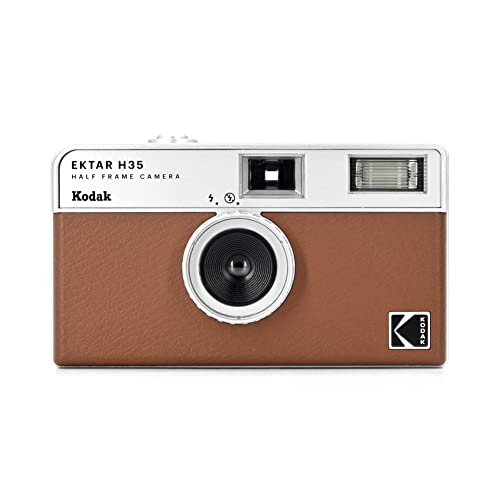
3. KODAK EKTAR H35 Half Frame Film Camera, Brown
Key specs
Half-frame 35mm film camera, reusable, focus-free, lightweight, uses AAA batteries. Same H35 half-frame mechanism, in a brown finish.
Strengths
- Half-frame format gives about 72 exposures per 36-exposure roll, the best frame economy in this guide.
- Brown finish has a warm, retro look that suits the film aesthetic many buyers are after.
- Simple focus-free operation with no settings to learn.
Trade-offs
- Smaller half-frame negatives hold less detail than full-frame negatives.
- Fixed focus means subjects closer than about a metre may look soft.
- Uses AAA batteries, so the camera is dead weight if the batteries run out mid-roll.
Who it fits
Casual shooters who like the retro look and want the lowest cost per photo in this guide.
Best for: gift buyers and hobbyists who want a fun, inexpensive film camera.
Not suited for: photographers who need precise focus control or large prints.
In daily use
In daily use, the brown H35 is a conversation starter as much as a camera. People notice the warm colour and ask about it, which is part of the fun of shooting film in public. Mechanically it is identical to the other H35 models: half-frame exposures, focus-free lens, light body. Shoot a roll over a weekend trip and you will come home with dozens of paired images instead of a handful. The usual care applies: keep it dry, do not force the film advance, and load and unload film away from direct sunlight.
Before you buy
Before buying the KODAK EKTAR H35 Half Frame Film Camera, Brown, consider how it will be carried. A simple pouch or small camera bag protects the lens and the body from keys and coins, and a wrist strap helps on walks and trips. Check the weight and size against the bag it will live in, since a camera that does not fit the daily bag gets left at home. Also decide on a film stock to start with and stick to it for the first few rolls, because changing film every roll makes it impossible to learn what the camera itself is doing.
Check price on Amazon: KODAK EKTAR H35 Half Frame Film Camera, Brown

4. KODAK EC35 35mm Film Camera
Key specs
Full-frame 35mm film camera, reusable, focus-free, built-in flash, slide cover, beginner friendly. Uses standard 35mm film and AA batteries.
Strengths
- Full-frame exposures give larger negatives than half-frame cameras, so scans and prints hold more detail.
- Built-in flash helps with indoor and evening shots without extra gear.
- Slide cover protects the lens when the camera is tossed in a bag.
Trade-offs
- Focus-free lens offers no focus adjustment for close subjects.
- Full-frame shooting means a 36-exposure roll gives 36 shots, not the 72 of a half-frame camera.
- AA batteries add a little weight compared with smaller AAA-powered models.
Who it fits
Beginners who want a straightforward full-frame film camera with a flash and a protected lens.
Best for: everyday shooters who want full-frame quality in a simple body.
Not suited for: anyone counting on maximum shots per roll above all else.
In daily use
In daily use, the EC35 is the set-and-forget option in this guide. Slide the cover open, and the camera is ready; slide it closed, and the lens is protected in a crowded bag. The built-in flash fires when light is low, which covers most indoor situations without thinking about it. A 36-exposure roll lasts a reasonable time for casual shooting, and the full-frame negatives scan cleanly. Keep spare AA batteries handy, and remember to close the slide cover before putting the camera away so the lens stays clean.
Before you buy
Before buying the KODAK EC35 35mm Film Camera, check two practical things. First, confirm the battery type in the listing and buy a pack of spares with the camera, because a film camera without batteries is a paperweight on the day it arrives. Second, order a roll or two of 35mm film at the same time, ideally 400-speed colour negative film, which is forgiving in mixed light. Without film and batteries in hand, the camera sits on a shelf while the accessories ship separately, and the first roll is what teaches you how the camera actually behaves.
Check price on Amazon: KODAK EC35 35mm Film Camera

5. KODAK EC35 35mm Film Camera, Avocado Green
Key specs
Full-frame 35mm film camera, reusable, focus-free, built-in flash, slide cover, beginner friendly, in avocado green. Uses standard 35mm film and AA batteries.
Strengths
- Same full-frame EC35 camera with larger negatives than half-frame models.
- Avocado green finish is distinctive and easy to spot in a bag full of gear.
- Built-in flash and slide cover make it a practical daily carry.
Trade-offs
- Focus-free design cannot handle very close subjects sharply.
- A 36-exposure roll yields 36 photos, half the count of a half-frame camera.
- The bright colour draws attention, which some street shooters may not want.
Who it fits
Shooters who want the EC35 and like a bold, retro colour that is easy to find in a bag.
Best for: colour lovers and gift buyers who want the EC35 in avocado green.
Not suited for: discreet street photographers who prefer a camera that blends in.
In daily use
In daily use, the avocado green EC35 is the same dependable camera as the standard EC35, with a finish that makes it instantly recognisable. That is genuinely useful: in a shared drawer or a crowded camera bag, you find it in seconds. Shooting is identical, with the slide cover, built-in flash and focus-free lens doing the work. The colour does not change the images, but it does change the experience a little, because people smile when they see it. Care is the same as any film camera: keep it dry, keep the lens covered, and load film in the shade.
Before you buy
Before buying the KODAK EC35 35mm Film Camera, Avocado Green, think about where the photos will be developed. Find a local lab or a mail-in service first and check its turnaround time and whether scans are included, since the camera is only half the system. Also check that the listing is for a reusable camera rather than a one-time-use model, and read the included accessories carefully: some listings include a roll of film and batteries, while others include neither, and the difference decides what else needs ordering on day one.
Check price on Amazon: KODAK EC35 35mm Film Camera, Avocado Green

6. KODAK Snapic A1 35mm Film Camera, Rhino Grey
Key specs
Full-frame 35mm film camera, reusable, 2-zone focus, lightweight, compact, uses AAA batteries. Two focus zones give a little more control than focus-free models.
Strengths
- 2-zone focus lets the shooter pick a near or far setting, which improves close and mid-range shots.
- Lightweight and compact body carries easily as an everyday camera.
- Full-frame negatives scan and print with more detail than half-frame.
Trade-offs
- Two focus zones are still limited control compared with a manual-focus camera.
- A 36-exposure roll gives 36 shots, so film costs more per photo than with half-frame.
- AAA batteries are small and easy to forget to pack as spares.
Who it fits
Shooters who want a small step up from focus-free cameras without learning manual focus.
Best for: everyday and travel shooters who want a compact full-frame film camera.
Not suited for: photographers who need precise manual focus or interchangeable lenses.
In daily use
In daily use, the Snapic A1 in rhino grey is the camera for people who want slightly more say in the result. Before a shot, pick the near or far zone, and the camera does the rest. That one small decision is enough to sharpen portraits and close subjects that focus-free cameras would soften. The grey body is neutral and practical, and the compact size means it fits the same pocket as the smaller models. Keep a spare AAA battery in the case, and check the focus zone when the scene changes rather than leaving it on one setting all day.
Before you buy
Before buying the KODAK Snapic A1 35mm Film Camera, Rhino Grey, consider how it will be carried. A simple pouch or small camera bag protects the lens and the body from keys and coins, and a wrist strap helps on walks and trips. Check the weight and size against the bag it will live in, since a camera that does not fit the daily bag gets left at home. Also decide on a film stock to start with and stick to it for the first few rolls, because changing film every roll makes it impossible to learn what the camera itself is doing.
Check price on Amazon: KODAK Snapic A1 35mm Film Camera, Rhino Grey

7. KODAK Snapic A1 35mm Film Camera, Ivory White
Key specs
Full-frame 35mm film camera, reusable, 2-zone focus, lightweight, compact, uses AAA batteries. Same Snapic A1 mechanism as the grey version, in ivory white.
Strengths
- 2-zone focus improves near and mid-range sharpness over focus-free models.
- Ivory white finish looks clean and modern while staying light in the hand.
- Compact, lightweight body suits travel and daily carry.
Trade-offs
- Two zones are not a substitute for full manual focus.
- Pale finish shows dirt and scuffs more readily than dark colours.
- Full-frame shooting costs more per photo than half-frame.
Who it fits
Buyers who want the Snapic A1 in a light, bright finish for travel and everyday photos.
Best for: travel shooters who want the Snapic A1 in ivory white.
Not suited for: anyone who needs manual focus control or shoots mainly in rough conditions.
In daily use
In daily use, the ivory white Snapic A1 is the same capable camera as the grey version, and the light colour makes it easy to find in a dark bag. The 2-zone focus switch becomes second nature after a roll or two: near zone for people and details, far zone for streets and landscapes. Because it is full-frame, each roll gives 36 shots, so it pays to slow down a little and choose frames rather than spraying them. Wipe the pale body down now and then, keep it out of rain, and it stays looking as good as it shoots.
Before you buy
Before buying the KODAK Snapic A1 35mm Film Camera, Ivory White, check two practical things. First, confirm the battery type in the listing and buy a pack of spares with the camera, because a film camera without batteries is a paperweight on the day it arrives. Second, order a roll or two of 35mm film at the same time, ideally 400-speed colour negative film, which is forgiving in mixed light. Without film and batteries in hand, the camera sits on a shelf while the accessories ship separately, and the first roll is what teaches you how the camera actually behaves.
Check price on Amazon: KODAK Snapic A1 35mm Film Camera, Ivory White

8. Kodak EKTAR H35 Half Frame 35mm Camera
Key specs
Half-frame 35mm camera, reusable, focus-free, lightweight, easy to use. AAA battery not included. Another H35 half-frame listing in the same model family.
Strengths
- Half-frame format gives about 72 shots per 36-exposure roll, the best frame economy in this guide.
- Focus-free operation with no settings to learn, so it is ready immediately.
- Lightweight body carries easily all day.
Trade-offs
- Half-frame negatives are smaller, so enlargements hold less detail.
- No focus control for close subjects.
- AAA battery is not included, so batteries must be bought separately.
Who it fits
Buyers who want the H35 half-frame camera and do not mind buying batteries separately.
Best for: first-time film shooters who want the H35 half-frame format.
Not suited for: anyone who needs large prints or precise focus control.
In daily use
In daily use, this H35 listing is the same half-frame camera as the other H35 models, with the one difference that the AAA battery is not included in the box. That is a small detail that matters on day one: order batteries with the camera, or the first roll waits. Once loaded, it shoots exactly like its siblings, with two small images per frame and a roll that lasts for weeks of casual photography. The light body and focus-free lens make it a true pocket camera, and the half-frame habit of collecting paired images becomes addictive quickly.
Before you buy
Before buying the Kodak EKTAR H35 Half Frame 35mm Camera, think about where the photos will be developed. Find a local lab or a mail-in service first and check its turnaround time and whether scans are included, since the camera is only half the system. Also check that the listing is for a reusable camera rather than a one-time-use model, and read the included accessories carefully: some listings include a roll of film and batteries, while others include neither, and the difference decides what else needs ordering on day one.
Check price on Amazon: Kodak EKTAR H35 Half Frame 35mm Camera
Buying guide
Half-frame or full-frame
Half-frame cameras expose two images per standard frame, so a 36-exposure roll gives about 72 photos. That halves the film cost per shot, but each negative is smaller and holds less detail. Full-frame cameras give 36 larger negatives per roll, which scan and print better. Choose half-frame if cost per shot and a lo-fi look matter most, and full-frame if image quality and printing matter more.
Focus-free or 2-zone focus
Focus-free cameras have no focus control at all: point and shoot, and everything beyond about a metre is acceptably sharp. Two-zone focus adds a near and far setting, which helps with portraits and close subjects. Neither replaces manual focus, and neither is the right tool for macro work or very close detail. If you mostly shoot people at arm's length or further, focus-free is fine; if you shoot close subjects often, the 2-zone models earn their place.
Batteries and film
Check which battery the camera uses before you buy, and keep spares. Most models here use AAA or AA batteries for the flash and metering, and a dead battery can end a day of shooting early. For film, standard 35mm colour negative film is the easiest starting point, and 400-speed film is a forgiving choice for mixed light. Load and unload film in shade, never in direct sun.
Flash and light
Built-in flash helps indoors, but its range is short, usually only a few metres. For large rooms or night scenes, move closer or accept that the background will go dark. Outdoors in daylight, the flash is not needed. If a camera has no flash control, the flash may fire automatically in dim light, which is normal behaviour for this class of camera.
Film and developing costs
Budget for film and developing, not just the camera. A roll of 35mm film plus developing and scans costs real money per roll, and a full-frame camera turns each roll into 36 photos while a half-frame camera turns it into about 72. Over a year of regular shooting, film and developing cost far more than the camera, so frame economy is a genuine buying factor rather than a footnote.
Half-frame pairs
Half-frame cameras expose two images per standard frame, and the two images sit side by side. That pairing is part of the charm: a portrait next to a street scene, a morning coffee next to an evening sky. Scans come back as pairs, and some labs cut them into single frames while others keep them paired. Ask the lab how it handles half-frame before sending the first roll, so the scans arrive in the expected form.
Usage and care
Load film in the shade and wind it on correctly before closing the back, because a misloaded roll can slip and give blank frames. Keep the lens clean with a soft cloth, and keep the camera dry: these are simple plastic-bodied cameras, not weather-sealed tools. Store the camera with the lens covered and the batteries removed if it will sit unused for months, since leaking batteries damage the contacts. When a roll is finished, rewind it fully before opening the back, and take exposed rolls to the lab promptly rather than leaving them in a hot car. A small pouch protects the body in a bag, and a notebook or phone note of what you shot on each roll helps when the scans come back weeks later.
Film choice changes the results more than the camera does. A 400-speed colour negative film is forgiving in daylight and shade, while slower films give finer grain in bright light and faster films help indoors. Keep exposed and unexposed rolls in a cool, dry place, and do not leave film in a hot car, since heat fogs film over time. When the scans come back, keep the negatives: they are the originals, and they can be re-scanned at higher quality later. Note the film stock and the camera settings for each roll in a phone note, because months later it is impossible to remember which roll was which, and the notes are what turn a lucky shot into a repeatable result.
Common mistakes
The most common mistake is opening the camera back before the roll is fully rewound, which fogs the exposed frames. Another is forgetting batteries: the shutter may still fire on some models without power, but the flash will not, and the results will be dark. A third is treating a half-frame camera like a full-frame one and expecting large, detailed enlargements from small negatives. Buyers also mix up single-use and reusable cameras: a one-time-use camera cannot be reloaded, so check the listing for the word reusable before ordering. Finally, do not force the film advance lever if it resists; something is wrong, and forcing it can tear the film or break the mechanism.
Another common mistake is shooting the whole first roll in one afternoon and then judging the camera on those frames alone. Film photography rewards patience: shoot a roll over a week in different light, get it developed, and look at the results before changing anything. Buyers also forget that half-frame cameras produce pairs of images, so a scan that looks odd is often just two unrelated photos sharing a frame, which is normal. A further mistake is using expired film of unknown storage for the first roll and blaming the camera for fogged or colour-shifted results. Start with fresh film, learn the camera, and experiment with expired stock later when the baseline is understood.
Final recommendation
For most buyers, the KODAK EKTAR H35 in sage is the best starting point: half-frame economy, focus-free simplicity, and a low cost per shot make it the easiest way to learn film. If image quality matters more than frame count, step up to the KODAK EC35 for full-frame negatives with a built-in flash and a protective slide cover. And if you want a little focus control without complexity, the KODAK Snapic A1 with 2-zone focus is the sensible middle ground. Any of the seven cameras here will get you shooting film this week; the right one is the one whose format and controls match how you actually shoot.
The running cost of film is the real budget to plan for, not the camera. A half-frame camera like the H35 stretches each roll to about 72 shots, which is why it is the best first camera for most people: it keeps the hobby affordable while the skills develop. Buy the camera, a few rolls of fresh 400-speed film, spare batteries, and a developing plan, and the first month of shooting will teach more about photography than a year of reading about it. Start simple, shoot often, and let the scans decide what to try next.
Frequently asked questions
What does reusable mean for a film camera?
A reusable film camera accepts standard 35mm film rolls that you load, shoot, and replace. When a roll is finished, you rewind it, remove it, and load a fresh roll, so the same camera shoots for years. A one-time-use camera is sealed with one roll inside and cannot be reloaded.
How many photos do I get from a roll?
A full-frame camera gives 24 or 36 shots depending on the roll length. A half-frame camera like the EKTAR H35 gives about double that, so a 36-exposure roll yields roughly 72 half-frame photos.
Do I need batteries for a film camera?
Most cameras in this guide need batteries for the flash and light metering, usually AA or AAA. The shutter on simple models may work without power, but the flash will not, so keep spare batteries in your bag.
Can I use any 35mm film?
Yes, these cameras accept standard 35mm film. Colour negative film is the easiest starting point, and 400-speed film handles a wide range of light. Black and white film also works and is developed by most labs.
Where do I get the film developed?
Most photo labs, drugstores with photo services, and mail-in labs develop 35mm film and provide scans. Ask for scans with your development so you can view and share the photos while keeping the negatives for printing.
Is film photography expensive?
The camera itself is inexpensive, but film and developing add up. A roll of 35mm film plus developing and scans is a real cost per roll, and a full-frame camera gives 36 photos per roll while a half-frame camera gives about 72. Half-frame cameras are the economical choice for regular shooting.
What film should a beginner start with?
Start with fresh 400-speed colour negative film, which handles daylight, shade and overcast conditions well. Stick to one film stock for the first few rolls so the results can be compared fairly, and try other stocks once the camera behaviour is understood.