Disclosure: As an Amazon Associate, ilcastellomenu.com earns from qualifying purchases. Links on this page are affiliate links; they cost you nothing extra. Prices and availability change often, so check the current Amazon listing before you buy.
The honest conference speakerphone pros and cons are more balanced than the marketing of any single model suggests. The pros are structural: a speakerphone changes what a room can do on a call, every day, for every participant. The cons are equally structural: the device lives inside your room’s acoustics and your meeting habits, and it cannot rise above either. This article lists both sides in full, explains what the trade-offs mean for different kinds of users, and shows how smart buying and simple setup habits shrink the cons list without pretending it away.
Key Takeaways
- The core pro: groups in one room can finally talk to remote guests naturally.
- The core con: room echo, distance and crosstalk pass straight through to the far end.
- Most cons shrink with placement, connection and mute habits; none shrink with wishful thinking.
- The balance flips by use case: daily group calls make the pros decisive, solo calls make them irrelevant.
- Privacy is manageable but never automatic: hardware mute plus a room convention is the real feature.
Conference Speakerphone Pros And Cons: The Quick Verdict
Quick verdict: buy one if a group regularly gathers on your side of calls, and accept the disciplines that come with a room microphone. Skip it if your calls are solo or private, or if your room is so large that only an installed system will serve it. Best for: huddle-room teams, client-facing professionals, families and small groups who call together. Not suited for: open-plan solo workers and boardrooms. Our conference speakerphone buying guide handles the buying decision once this balance is clear.
A conference speakerphone is a combined microphone and loudspeaker built for group calls rather than for music or for a single voice pressed close to a handset. It sits in the middle of a table, listens in every direction at once, and plays the far end loudly and clearly enough for everyone in the room to follow. The category exists because the microphone and speakers built into a laptop are designed for one person sitting directly in front of the screen, and they fall apart as soon as three or four people spread around a table and start talking at natural distances.
The clearest beneficiaries share a pattern: groups on one side of the call. A team that gathers around one table to meet remote colleagues, a professional who hosts client calls with a partner or assistant present, a family that calls relatives together, a tutor or consultant who works with a small group in the room. For all of them the speakerphone converts a device built for one into a room built for several. The benefit compounds with frequency: a daily group call justifies care in choosing, an occasional one justifies a simpler model, and a purely solo call pattern justifies skipping the category entirely in favour of a good headset.
In this guide
The Pros
Groups Sound Like People, Not Like a Laptop
The gap between a laptop and a dedicated unit is easiest to hear from the far end of the call. Remote participants describe laptop audio as distant, echoing and tiring, because the built-in microphone picks up the room as much as the voices and the tiny speakers push everyone to lean in and repeat themselves. A purpose-built speakerphone attacks both halves of that problem at once: a microphone array that favours voices over room noise, and a speaker voiced for speech clarity rather than for bass. Neither half is magic, but together they change how a meeting feels for the people who are not in the room.
Most modern units listen with an array of several microphones rather than a single capsule. The array lets the electronics work out where a voice is coming from, favour that direction, and play down steady background noise such as air conditioning or a projector fan. In practice this is why a good speakerphone can hold a conversation at a normal desk or table distance without anyone leaning towards the device. The benefit is real but bounded: the array can favour voices, yet it cannot invent clarity that the room itself destroys, and it works best when speakers sit at roughly similar distances from the unit.
Conversation Flows Both Ways
Full-duplex audio means the conversation can flow in both directions at the same time, the way a face-to-face conversation does. Cheaper or older designs behave more like a walkie-talkie, favouring whichever side is louder and muting the other, which produces the familiar frustration of being unable to interject or to laugh along without cutting the speaker off. When you read impressions of any conference speakerphone, the duplex behaviour is one of the most telling details: natural overlap, quick interjections and back-channel responses are the signs that the processing is doing its job without strangling the conversation.
Echo cancellation is the other half of the engineering. On a call, the far end hears its own voice played through your speaker; without cancellation that sound re-enters your microphones and returns to them as a distracting echo. The unit constantly models what it is playing and subtracts that sound from what its microphones hear, which is also what allows both sides to talk at once without the audio cutting out. Good cancellation feels invisible. Weak cancellation shows up as clipped first syllables, a swirling quality when both sides speak together, or the far end asking you to mute whenever you are not talking.
Ears Stay Free All Day
The headset is the speakerphone’s permanent rival, and each wins on different ground. Headsets isolate your voice in noisy, open or shared spaces, keep calls private, and place the microphone at a fixed, ideal distance from your mouth. Speakerphones free your ears across a long day, let several people in the room participate naturally, and sound more like a conversation and less like a call centre. Many hybrid workers sensibly own both and choose per meeting. If you must choose one, choose by your hardest constraint: privacy and noise point to the headset, groups and comfort point to the speakerphone.
The loudspeaker half of the device matters more than first-time buyers expect, because listening fatigue is real. A unit voiced for speech puts its energy where voices live, so consonants stay intelligible at modest volume and nobody asks for repeats. Undersized speakers force the volume up, which stresses the echo cancellation and makes long calls wearing. In a small room almost any reputable unit is loud enough; in a larger or noisier space, the speaker is often the first thing that runs out of headroom, and it is the reason stepping up a tier buys calmer, clearer listening even when the microphones seem similar on paper.
One Device Serves the Whole Room
Huddle rooms and small meeting spaces are the natural habitat of this category. Two to six people around a small table, at conversational distance from a central unit, is precisely the geometry the microphone arrays and echo cancellation were designed around. In that setting a good speakerphone makes remote guests feel present rather than patched in, and it frees everyone from the headset-and-laptop huddle. If most of your meetings look like this, you are in the category’s sweet spot and even a mid-tier unit will feel like a transformation compared with laptop audio. Spend your remaining budget on the room: a rug, soft furnishings, and a door that closes.
Judged purely as value, a speakerphone should be compared with the cost of the meetings it improves rather than with other gadgets. A team that holds several group calls a week, with remote clients or colleagues judging the organisation partly by how those calls feel, recovers the outlay in professionalism quickly, in qualitative terms. A solo worker who mostly takes one-to-one calls in a quiet room recovers it slowly or never, because a headset already solves that problem well. The category is neither a universal essential nor a luxury; it is a tool whose worth is set almost entirely by the shape of your meeting week.
Setup Is Genuinely Simple
Setting up well is mostly a sequence of small, unglamorous decisions made in the right order. Decide where the unit lives before you pair anything, because placement drives both the wiring and the wireless choices. Charge it fully first if it will ever run on battery, so your first tests reflect its normal behaviour rather than a low-battery compromise. Connect by the simplest route that suits the room, confirm the meeting app has selected the unit for both microphone and speaker, and only then start judging sound. Most setup misery comes from evaluating audio before the plumbing is verified, and blaming a good device for a setting buried in an app.
A plain USB cable remains the most reliable connection of all, and it deserves more respect than it gets. Wired, the speakerphone is simply an audio device: no pairing, no battery anxiety, no wireless interference from a crowded office band, and no question about which of three remembered devices it will greet when it wakes. The cost is a cable across the table and a fixed seat for the unit. Many experienced users run a hybrid pattern, keeping the cable connected in the home office where the unit lives, and using wireless only when the speakerphone travels to another room or another building.
The Cons
It Cannot Defeat a Bad Room
No speakerphone defeats a bad room. A large, echoey space with hard floors, bare walls and a high ceiling smears every voice with reflections, and the far end hears that smear no matter how clever the processing is. Distance compounds it: a participant seated far down a long table is simply quieter and more reverberant than one near the unit. The honest fixes for genuinely large rooms are architectural and procedural rather than a more expensive puck: soften the room where you can, seat people closer together, or step up to multiple linked units or a properly installed conference system designed for the space.
When a room is simply too big for one tabletop unit, the realistic ladder of solutions runs like this: first improve the room and the seating, then consider a chained pair of compatible units, then look at dedicated conference systems with separate microphone pods or a soundbar-style unit designed for larger spaces. What does not work is buying the most premium single puck and expecting its processing to repeal the physics of distance and reflection. Sellers rarely volunteer this, but the most satisfied large-room buyers are the ones who matched the system to the room instead of asking one small device to cover it.
Overlapping Speech Stays Tangled
People talking over each other defeats every device in this category, including the best of them. Microphone arrays and noise processing assume, reasonably, that one person speaks at a time; two simultaneous voices from different seats arrive as a tangle that no consumer unit untangles into two clear streams. This is a meeting-discipline problem wearing a technology costume. A chair who invites contributions one at a time, and participants who leave a breath of space before replying, will improve call quality more than any upgrade. Buy the speakerphone to fix distance and echo, not to fix crosstalk, because crosstalk is not fixable at this level.
Noise reduction in these devices targets the steady and the sudden sounds of real rooms: keyboard clatter, paper shuffling, a door closing, traffic through a window. Newer models describe this processing in terms of voice isolation or AI-assisted cleanup, and the honest summary is that it helps most with predictable, continuous noise and least with competing speech. Another voice in the room, a television in the next room, or people talking over each other will still reach the far end, because to the electronics those are voices too, and voices are exactly what the device is trying to preserve.
The Microphone Hears Everything
A speakerphone microphone hears the whole room, and that fact deserves a standing place in any honest discussion of these devices. Side conversations, a colleague entering with a sensitive question, or paperwork discussed before the call officially starts can all reach the far end if the unit is live. Mute discipline is the countermeasure: use the hardware mute button rather than the app control where you can, learn what its indicator light means, and treat the mute check as part of starting and ending every call. Teams that adopt the habit explicitly, the way they adopt camera habits, avoid the classic speakerphone embarrassment entirely.
Physical controls sound like a footnote until you are mid-call. A clear hardware mute with an unmistakable indicator, volume keys you can find without looking, and a call button that behaves predictably are worth more than a long feature list. Touch surfaces look clean and photograph well, but they can be ambiguous under pressure, and a mute you cannot verify at a glance is a privacy risk rather than a style choice. When you compare models, picture the worst moment of your meeting week and ask which set of controls you would rather operate in it. That thought experiment ranks devices more honestly than most specification tables.
Wireless Can Be Fussy
Bluetooth is the connection everyone wants and the one that causes the most quiet frustration. Paired directly to a laptop, a speakerphone depends on the computer’s Bluetooth stack and profile handling, and the result can be a device that connects as headphones but not as a microphone, or that behaves differently after every operating system update. Bluetooth to a phone is usually painless. Bluetooth to a computer is where the included USB dongle earns its place: the dongle presents the unit to the computer as a simple, standard audio device, sidesteps profile negotiations, and tends to reconnect to the same machine in the same way every morning.
Many speakerphones can remember or hold connections to more than one device, which suits the common pattern of a laptop for meetings and a phone for everything else. The convenience is real, and so is the confusion when the unit cheerfully connects to the phone in your bag instead of the laptop in front of you. The fix is procedural: know how your unit announces its connection, learn its button or app control for switching, and keep the list of remembered devices tidy. In shared rooms, a wired default removes the whole class of problem, which is why so many meeting rooms quietly keep a cable in the table even when the device is proudly wireless.
It Is the Wrong Tool for Solo and Private Calls
Deciding whether a speakerphone is personal or shared changes which model makes sense. A personal unit for a home office can optimise for one voice, quick connection to one laptop, and a footprint that suits a desk. A shared unit for a team room must tolerate many laptops, many handling styles and the occasional coffee-adjacent accident, and it benefits from the simplest possible connection story. Buying a delicate personal device for a shared room, or a room-sized unit for a solo desk, are the two classic mismatches in this category, and both are visible before purchase if you name the primary setting honestly.
Doing nothing is also an option, and it is worth pricing honestly. Laptop audio costs nothing, needs no setup, and is adequate for a solo caller close to the screen in a quiet room. Its costs are paid by other people: the remote guests who strain, repeat themselves and quietly downgrade the meeting. If your calls are internal, forgiving and one-to-one, that trade may be acceptable. The moment calls become group-shaped, client-facing or recorded for people who were not there, the built-in option starts charging interest, and a speakerphone becomes less a purchase than a correction.
What the Trade-Offs Mean for You
A speakerphone rewards good meeting habits and exposes bad ones, and a little etiquette multiplies the hardware. Introduce the room at the start so remote guests know who is present. Say names when handing over, because the far end cannot see your glances. Keep papers and cups away from the unit, mute when typing or when the room needs a private word, and leave a beat after a remote speaker finishes, since processing and network delay together shave the natural cues that tell you a sentence has ended. None of this is burdensome, and rooms that practise it get compliments about their audio that are really compliments about their manners.
Naturalness is the quality that separates the units people praise from the units people merely accept. A natural-sounding speakerphone preserves the character of voices, lets quiet speakers stay quiet without vanishing, and does not pump or breathe audibly when nobody is talking. Heavy-handed processing can make every voice loud and clear in a flattened, fatiguing way that tests well in a five-minute demo and wears badly across a working day. When you read or listen to comparisons, weight the comments about long calls and about how the device handles soft-spoken participants; those are the reports that predict whether you will still like the unit in six months.
| Alternative | Where it wins | Where the speakerphone wins |
|---|---|---|
| A good headset | Solo calls, privacy, noisy spaces | Groups in one room, ears-free comfort |
| Laptop audio | Costs nothing, zero setup | Every group call, every client call |
| An installed conference system | Large and boardroom spaces | Simplicity, portability, small rooms |
How to Buy Smart
The recurring buying mistakes in this category are easy to list because they repeat so faithfully. Buying for the biggest room you use twice a year and suffering an oversized, overcomplicated unit the other fifty weeks. Choosing on speaker loudness while ignoring microphone behaviour, when the far end’s experience is the real product. Assuming Bluetooth to a laptop will be seamless because Bluetooth to a phone was. Ignoring the mute control and its indicator until the first privacy scare. And skipping the return-window test in your own room, which is the only review that was ever going to be written about your exact walls, table and voices.
Platform certification, most often for Microsoft Teams or Zoom, signals that a unit has been tested against that platform’s expectations and usually that its buttons speak the platform’s language: answering, ending and muting from the device itself, in step with the app. Certification is a convenience and compatibility signal, not a sound-quality grade. An uncertified unit from a reputable maker generally still works as a standard USB or Bluetooth audio device on any platform. Buy certification when your organisation standardises on one platform and you want the controls and behaviour to feel native; do not pay a premium for a badge if you switch platforms constantly.
The practical difference between a dongle connection and direct Bluetooth shows up on the worst mornings: the call that starts in five minutes, with guests already joining. A dongle-based link is boring in the best sense, because the pairing lives between the dongle and the speakerphone rather than inside the computer’s settings, so swapping laptops or rebooting rarely breaks it. Direct Bluetooth saves a USB port and is fine for a single personal machine you control. For a shared room device that different laptops must use across a week, boring wins, and the dongle is usually the right default.
Two Picks That Show the Balance Clearly
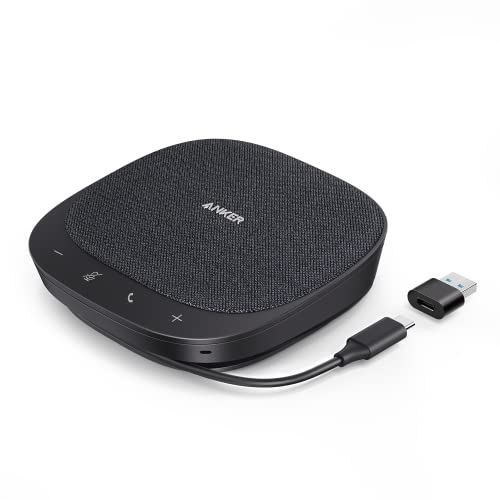
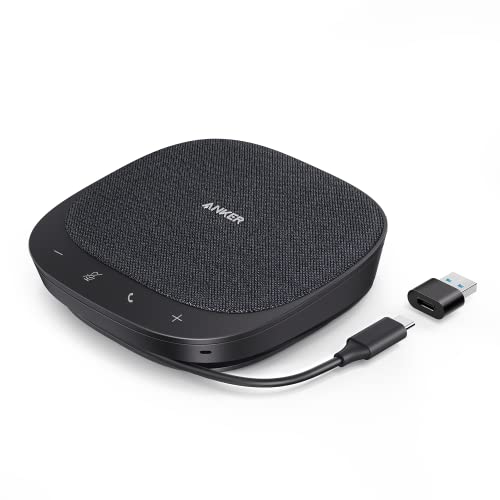
Anker PowerConf — Best for: defined use cases at the mid-tier tier
In roundup after roundup the Anker PowerConf earns its place by covering the fundamentals: voices at table distance come through clearly, the speaker is voiced for speech, and setup is undramatic. Read it as the category’s sensible midpoint: not the most refined sound available, not the cheapest object on the shelf, and very often the right answer for a first purchase. Buyers stepping up from laptop audio will feel the improvement immediately; buyers stepping down from a premium unit will notice the difference mainly on long, demanding calls.
Best for: buyers whose meetings match the brief described above. Not suited for: rooms or habits well outside that brief, where a different class of device will serve better. As a prose-only pick at this stage, treat it as a mid-tier option and check the current Amazon listing before you buy.

EPOS Expand 30 — Best for: defined use cases at the premium tier
The EPOS Expand 30 is the choice that IT-minded buyers tend to shortlist: dependable behaviour, platform-friendly controls, and audio tuned for intelligibility over flattery. In a shared huddle room that predictability is worth real money, because the best room device is the one nobody has to think about. Solo buyers working from a quiet home office may not need its particular strengths, but teams equipping a room that must simply work, every morning, for whoever walks in, will understand the appeal immediately.
Best for: buyers whose meetings match the brief described above. Not suited for: rooms or habits well outside that brief, where a different class of device will serve better. As a prose-only pick at this stage, treat it as a premium option and check the current Amazon listing before you buy.
Setup and Care That Reduce the Cons
Placement is the cheapest performance upgrade available. Put the unit at the centre of the people it serves, on the table rather than on a sideboard or a windowsill, with nothing tall immediately beside it to reflect sound or shadow the microphones. Keep it away from laptop fans, projector exhausts and air-conditioning vents, whose noise it will faithfully transmit. A unit shoved to one end of a long table makes the far seats sound exactly as far away as they are. Thirty seconds of placement thought at the start of a meeting routinely buys more clarity than a tier of product upgrade.
Test a new speakerphone the way the far end will experience it, because that is the product you actually bought. Record a short call or a voice memo through the unit from each seat you expect people to use, then listen back on headphones. Walk through the real agenda: one speaker, two speakers alternating, a question from the far seat, a moment of natural overlap. You will learn more in five minutes of listening than in an afternoon of reading impressions, and you will find the placement and volume habits that suit your room while the stakes are low and no client is on the line.
When the far end reports echo, work through the causes in order of likelihood. Volume too high in a small room lets the speaker overwhelm the cancellation, so reduce it before touching anything else. A unit placed against a wall or beside a monitor reflects sound straight back into its microphones, so re-centre it. Two audio devices live in the same room, such as a laptop microphone left open alongside the speakerphone, create a loop no single device can cancel, so confirm the app is using the speakerphone for both microphone and speaker. Most echo complaints die somewhere in those three checks.
Care for a speakerphone is light but not zero. Keep the microphone openings free of dust and desk debris, wipe the housing with a dry or barely damp cloth, and avoid solvents that attack fabric wraps and finishes. Store a travelling unit in its case so the buttons are not pressed and the grille is not crushed against other gear. Batteries prefer regular, moderate use to being left flat for months. None of this is burdensome, and most neglected units fail socially before they fail mechanically: they get borrowed, unplugged, and left uncharged in a drawer, which is an argument for giving a shared device a labelled home and a labelled cable.
Most cons in this article are at their worst on day one and shrink as habits form, which is why our walkthrough of how to set up conference speakerphone matters as much as the purchase. Buyers still deciding whether the balance favours them should read our verdict on is a conference speakerphone worth it and our method for how to choose a conference speakerphone, then compare models in our conference speakerphone reviews and single-class conference speakerphone review.
Bottom Line
These conference speakerphone pros and cons resolve into a simple sentence: the pros recur daily for the right buyer, and the cons recur daily for the wrong one. Establish which buyer you are, and the category either earns its place on your table or politely excuses itself, with no hard feelings and no wasted money either way.
In Depth: Living With a Conference Speakerphone
How Long a Good Unit Should Last
This is mature technology with no moving parts worth the name, and a well-kept unit should serve for years. The realistic ageing paths are battery wear on heavily travelled units, firmware drift as platforms evolve, and the slow accumulation of shared-room neglect. All three are manageable: keep firmware current, treat the battery kindly, and give the device an owner. Buyers sometimes delay purchasing while waiting for a generational leap in this category; the technology improves incrementally, and the meetings you hold this quarter will not wait for it.
The Etiquette of Being Heard
A room microphone changes the social contract of a meeting. Everyone present is, in a small way, broadcasting, and the courtesies follow from that: announce who is in the room, keep side talk for the mute button or for after the call, and remember that rustling, typing and tapping near the unit are sounds your guests receive at full size. None of this is onerous, and most of it is simply good manners made audible. Rooms that internalise it stop thinking of the speakerphone as equipment and start treating it as the far end’s seat at the table.
Small Rooms Punch Above Their Weight
It is worth saying plainly that modest spaces are this category’s home turf. A small, soft-furnished room with a handful of people at conversational distance is exactly the environment the engineering assumes, and in that environment even mid-tier hardware delivers an experience that impresses guests. If your meetings live in such rooms, you do not need to agonise over the top of the range. Buy competently, place carefully, and enjoy the fact that your setting, not your spending, is doing the heavy lifting that boardrooms pay systems integrators to imitate.
How the Far End Judges You
Remote guests form their impression of your organisation through a narrow channel, and audio is most of it. They cannot see your office, your preparation or your intent; they hear whether voices are clear, whether they must ask for repeats, and whether the room sounds calm or chaotic. That is why experienced teams treat call audio as part of their professional presentation rather than as an IT detail. A speakerphone does not guarantee a good impression, but it removes the most common reasons for a bad one, and it does so for every guest on every call without anyone having to perform.
What Changes After the First Month
The first week with a speakerphone is about novelty and settings. By the end of the first month the device has either become furniture, in the best sense, or it has become an irritation that people route around. The difference is rarely sound quality. It is whether reconnection is uneventful, whether the mute can be trusted without thinking, and whether the unit is simply there, charged and in its place, when a meeting starts. When you evaluate any model, you are really forecasting that thirtieth day: choose the device whose daily behaviour you can picture being boring.
A Note on Voice Levels
Rooms develop a volume culture. With laptop speakers, people shout politely all afternoon because they cannot hear themselves being heard, and they leave calls hoarse and tired. A clear speaker at a sensible level resets that culture within a few meetings: voices drop to conversational level, which in turn gives the microphone array an easier signal and the echo cancellation an easier job. The improvement feeds itself. If your team currently ends call-heavy days vocally exhausted, that fatigue is diagnostic information about your current setup, and it is one of the benefits owners mention most once it is gone.
Guests, Visitors and the Borrowed Laptop
Sooner or later someone outside the usual pattern joins: a visitor with their own laptop, a colleague from another office, a client presenting from your room. Shared speakerphones earn their keep in these moments if, and only if, the connection story is simple enough to explain in one sentence. This is the practical argument for the dongle in a drawer and a cable in the table: the visitor does not care about your usual setup, and the meeting cannot pause for a pairing ritual. Design your setup for the borrowed laptop and the regulars will find it effortless too.
Recording, Transcription and the Written Record
Many meetings are now recorded or transcribed, and the quality of that record is set at the microphone, not in the software. A room captured through a laptop microphone produces transcripts full of gaps and misattributed speakers; the same room captured through a well-placed speakerphone gives the transcription something clean to work with, and gives absent colleagues a recording they can actually follow. If your organisation relies on recordings as its memory, the speakerphone is part of your record-keeping infrastructure, and it should be chosen and placed with that responsibility in mind.
Accessibility Is Part of Audio Quality
Clear call audio is an accessibility feature, not a luxury. Participants who are hard of hearing, colleagues working in a second language, and anyone joining from a less-than-silent environment all depend disproportionately on clean, intelligible speech and on the visual discipline of one speaker at a time. A good speakerphone setup, with its central placement and its intolerance of crosstalk, quietly enforces the habits that make meetings more accessible to everyone on the call. That benefit rarely appears in product comparisons, but for mixed teams it can be the most important one on the list.
The Shared-Room Ownership Problem
Shared technology fails socially before it fails technically. A speakerphone that belongs to everyone belongs to no one: it migrates between rooms, its cable walks away, and it is flat on the morning of the board call. The fix costs nothing. Give the unit a named home room, label the unit and its cable, keep the charger with it, and make one person the informal owner who checks it weekly. Organisations that do this get years of uneventful service from modest hardware; organisations that do not manage to make even premium hardware feel unreliable.
Why Demos Mislead
Showroom and video demonstrations flatter every device in this category. The demo room is quiet, the speaker is close, the script has one voice at a time, and the listener hears a polished recording rather than a live call through a real network. Your room will offer none of those kindnesses. This is why the recurring advice in this cluster of guides is to test in your own space, from your own seats, with your own colleagues interrupting each other at their usual rate. A device that survives your Tuesday team meeting has passed the only demo that was ever relevant.
Meetings That Should Not Use One
Honesty about the category includes naming the meetings where a speakerphone is the wrong tool even for owners. Sensitive one-to-one conversations belong on a headset or handset, because a room microphone is architecturally indiscreet. Calls taken while moving between spaces punish any fixed device. Very large gatherings need a system designed for them. Recognising these cases does not weaken the case for owning a speakerphone; it protects the device from being blamed for jobs it never claimed, and it protects your genuinely private conversations from the wrong microphone.
When the Advantages Flip: Edge Cases and Trade-Offs in Daily Use
The compromise candidate
Many buyers end up choosing neither the strongest nor the cheapest conference speakerphone but the one whose weaknesses fall where they personally care least. That is a rational strategy, not a failure of research. List the cons of your final two candidates side by side and ask which set you would rather live with daily in a home where children, pets and visitors all interact with the setup. The product whose drawbacks sit in your blind spots will feel like the better product for years, even if a comparison table scores the other one higher on paper.
The advantage that depends on your habits
The headline advantage of a conference speakerphone is real, but it is not automatic: it only pays out if your habits match it. Used the way it was designed, in a home where children, pets and visitors all interact with the setup, the strengths described earlier compound quietly — less friction, fewer workarounds, a smoother routine. Used against its grain, the same design choices become the source of the complaints in the cons column. Before deciding, be honest about which user you are on an ordinary tired weekday, not the organised version of yourself you plan to become next month.
Where the drawbacks bite hardest
The disadvantages of a conference speakerphone are not evenly distributed across owners. They concentrate in specific situations: tight spaces, shared rooms, heavy daily loads, or workflows that change direction mid-task. If your routine involves any of those, the cons deserve double weight in your decision, because you will meet them weekly rather than rarely. Conversely, an owner whose setup avoids those situations entirely may never encounter the most-criticised weakness at all, which is why verdicts on the same conference speakerphone can sound like descriptions of two different products.
The maintenance trade-off nobody advertises
Almost every conference speakerphone trades purchase-day simplicity for a small ongoing maintenance obligation: cleaning, recalibrating, replacing a wear part, updating firmware or simply keeping accessories together. The trade is usually worth it, but it is not free, and it scales with how hard you use the product. In a home where children, pets and visitors all interact with the setup, skipped maintenance shows up first as small annoyances — a control that feels off, a result that drifts, a noise that was not there before — long before it causes a real failure. Budget the minutes, not just the money.
When the alternative is genuinely better
There are owners for whom skipping the conference speakerphone altogether is the right call, and naming them is part of an honest pros-and-cons account. If your need is occasional, borrowed or built into something you already own, or if your space cannot give the product the conditions it needs, the alternative route avoids both the cost and the clutter. The pros only outweigh the cons when the problem the conference speakerphone solves is a recurring one in your week. A problem you meet twice a year rarely justifies a permanent new resident in the Sound Cards category.
How the balance shifts over a year of ownership
The pros-and-cons ledger of a conference speakerphone is not static. In the first month, novelty inflates the pros; by the sixth month, the honest picture is about reliability, running costs and whether the product has earned a permanent place in your routine. Wear parts, consumable availability and the maker’s support responsiveness all matter more at month ten than at day ten. When you read owner feedback, weight the long-term reports accordingly: a complaint about a part that failed after a year tells you more than a first-week rave about unboxing.
Frequently Asked Questions
What is the single biggest advantage of a conference speakerphone?
It turns one laptop’s worth of audio into a room’s worth: several people can speak and listen naturally, at normal distances, without headsets or huddling. For groups that meet remote guests regularly, that change in how meetings feel is the whole case for the category. Everything else, the processing, the connections, the controls, exists to support that one transformation, and the pros and cons in this article should be weighed against how often your meetings actually take that group shape.
What is the biggest disadvantage?
The honest headline con is that the device cannot fix its environment. Echoey rooms, distant seats and people talking over each other all pass through to the far end, and the purchase can disappoint buyers who expected electronics to repeal acoustics. Running it well also asks for small disciplines: placement, muting, connection habits. None are hard, but a buyer who wants a zero-effort miracle should recalibrate before spending, because the category rewards a little care and visibly punishes its absence.
Is a speakerphone better than everyone using headsets?
For a group in one room meeting people elsewhere, generally yes: shared audio keeps the room’s conversation natural and lets everyone hear the far end together. For individuals in separate places, headsets win on consistency, privacy and noise isolation. The comparison is really about where the group sits. Mixed setups, a speakerphone in the main room and headsets for solo joiners, are common and sensible, and each side should choose the tool that fits its own setting.
Does a speakerphone compromise privacy?
It changes the privacy shape of a call rather than simply compromising it. While live, the microphone hears the whole room, so side conversations are not private, and anyone entering may not realise they can be heard. Hardware mute controls and a clear room convention manage that risk well. What a speakerphone never does is make a call more private than a headset does, so genuinely sensitive one-to-one conversations still belong on a headset or a handset.
Are the cons worse with cheaper models?
The cons grow at the edges rather than changing kind. Cheaper units tend to have less headroom in the speaker, less graceful processing when voices overlap, and fewer connection options, so big rooms and demanding calls expose them sooner. In a small, quiet room with a few participants, the gap narrows a lot. That is why the pros-and-cons balance in this article is organised by use case: the same device is a delight in its geometry and a disappointment outside it.
Who should accept the trade-offs and buy one?
Anyone whose working week includes regular group calls from one room, and who is willing to observe the small disciplines of placement and muting. For that buyer the pros are structural and recur daily, while the cons are mostly one-time lessons. Buyers with solo, private or highly mobile call patterns will find the cons are the daily experience and the pros are theoretical, and they should spend the same money on an excellent headset instead.
One more practical consideration is the rest of the desk. A speakerphone joins an ecosystem of webcams, hubs, chargers and cables, and small frictions between them are the stuff of daily annoyance: the hub with no free port for the dongle, the cable that is ten centimetres too short for the tidy route, the webcam whose microphone the app prefers. Lay the whole setup out once, deliberately, and photograph it if the room is shared. A considered arrangement, made once, is repaid every single morning, and it costs nothing but the half hour nobody wants to spend.
It is also worth keeping a simple fallback. Technology that a whole room depends on should have a plan B that everyone knows: the laptop’s built-in audio, understood and pre-tested, or a headset kept in the room for the day the speakerphone is borrowed, flat or updated at the wrong moment. A fallback that has been rehearsed once turns a potential meeting failure into a thirty-second shrug. Rooms without one discover their dependence on a single small device at the least convenient possible time, usually in front of the guest they most wanted to impress.
Finally, remember that this is a mature, slow-moving category. The fundamentals of array microphones and echo cancellation improve incrementally rather than in revolutions, which means a well-chosen unit stays satisfying for years and last season’s model at a friendlier tier is often a shrewd purchase. Buy for the room and the meeting pattern you have now, keep the firmware current, and resist the urge to re-shop the category every time a new badge or a new marketing term appears. Stability is a feature in equipment that a whole room depends on.
Consider, too, how the device interacts with the camera side of the meeting. Once a room sounds good, its next weakness is usually visual: a camera that frames half the table, or lighting that silhouettes faces against a window. You do not need to solve those today, but it is worth knowing that audio was the right first investment, because guests forgive a plain picture far more readily than they forgive sound they must strain to follow. Fix hearing first, then seeing, in that order, and each fix will make the other look better than it is.
There is a temptation, after the first successful week, to keep optimising: a different position, a new setting, a firmware beta. Resist it. A meeting room’s audio should become invisible infrastructure, and invisible infrastructure is finished, not perpetually tuned. Note the configuration that works, in a document the room’s users can find, and then leave it alone until something material changes: a new room, a new platform, a new pattern of meetings. Stability is what you bought, even if it was not listed on the box.