Disclosure: As an Amazon Associate, ilcastellomenu.com earns from qualifying purchases. Links on this page are affiliate links; they cost you nothing extra. Prices and availability change often, so check the current Amazon listing before you buy.
A high-end graphics card is the most demanding guest a power supply will ever host: hungry at rest, ravenous in spikes, and utterly unforgiving of a host that cannot keep up. Learning how to choose a power supply for high end gpu is therefore not a matter of matching one wattage number to another, though that is where it starts. It is a discipline of headroom, connector standards, transient behaviour and quiet quality, and it decides whether the flagship you bought performs like one or spends its life tripping protections and resetting drivers. This guide teaches the whole discipline. You will learn how to size wattage against the card’s real behaviour rather than its badge, why the current ATX standard’s revision matters more than another hundred watts, how to count connectors the way the card counts them, and the three verified 1000-watt-class supplies reviewed below that represent the category’s sensible centre. The connector literacy underneath it all lives in the types of GPU power connector explained; this guide is about the box at the other end of those cables.
How To Choose A Power Supply For High End Gpu: Wattage Is the Beginning, Not the Answer
Start with the arithmetic everyone knows and finish it properly. The card maker publishes a recommended system wattage for each card, a figure that assumes a plausible processor and system around it; treat that recommendation as the floor for a typical build, not as a target. Then adjust for your actual machine: a flagship processor under full load, a population of drives and fans, and any overclocking ambition all draw from the same pool, and the honest total is the sum of the parts at their worst simultaneous moment, which for a gaming machine is the game that loads everything at once. Against that total, the supply should hold a margin, and the margin is not waste: a supply loafs most efficiently and quietly in the middle of its range, ages more gracefully when it is not living at its ceiling, and absorbs the card’s transients, the brief spikes far above its rated draw that are the high-end era’s defining electrical behaviour. Those transients are why the simple matching of average wattages fails in practice, and why machines with “enough” watts on paper reset under load in the pattern of black screens and driver resets. Size for the spike and the decade, not for the average and the day. The card’s own power character, its TDP class and limit behaviour, is set out in how TDP frames the cooling and power budget and why GPUs underclock at power limits, and the supply you choose is the silent partner in both stories.
In this guide
The Standard’s Revision: Why ATX 3.x Is the Real Headline
The most important line on a modern supply’s box is not its wattage but its standard. The current ATX revision was written for the high-end card era: it requires the supply to withstand the graphics card’s power excursions, brief multiples of the card’s rated draw, without shutting down, and it standardises the native high-power connector and its cable, so the card is fed by a designed path rather than by a thicket of adapters. A supply built to that revision, in the wattage your arithmetic produced, is the correct default for any current flagship build, and an older or unrated unit of higher nominal wattage is not a substitute, because the excursion requirement is a behaviour, not a capacity, and it is either designed and tested or it is not. The connector side of the standard matters just as much: a native cable from supply to card removes junctions, and every junction removed is a future inspection that does not need to happen, in the spirit of when a GPU power connector works loose. Buy the revision first and the wattage second and you have made the decision the way the engineers who wrote the standard hoped you would.
Three Verified 1000W-Class Supplies

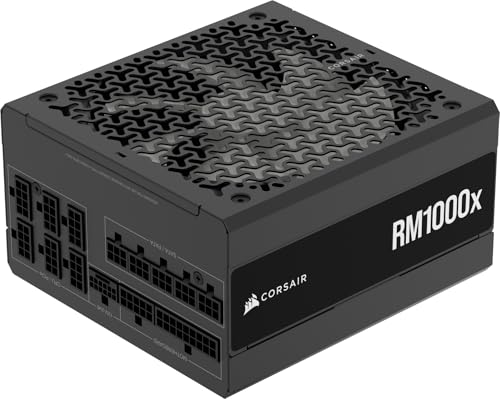
CORSAIR RM1000x (ATX 3.1, 1000W)
The reference choice for a flagship build
| Specification | Detail |
| Standard | ATX 3.1, PCIe 5.1 ready (per API title) |
| Capacity | 1000W (per API title) |
| Connector | Native 12V-2×6 (per API title) |
| Cabling | Fully modular (per API title) |
| Certification noted | Cybenetics Gold (per API title) |
The RM1000x is the supply this guide would hand to a flagship builder who asked for one name: a current-standard, fully modular 1000W unit with the native high-power connector, from the line that has furnished a generation of high-end builds. Its virtues are the category’s virtues executed without drama: the excursion behaviour the standard demands, cables that let a build use exactly what it needs, and a low-noise design brief that keeps the supply out of the machine’s acoustic story. At 1000W it covers the flagship card classes with the margin this guide preaches, alongside a flagship processor, without entering the oversized territory whose only product is expense.
Choose it as the default and spend your deliberation elsewhere, on the card and the case. Its modular cables are its own, as all modular cables are, and the discipline of never mixing them with another supply’s applies here as everywhere in this series.
Strengths
- Current ATX standard with native connector
- Fully modular cabling for clean flagship builds
- Low-noise design from a proven line
Trade-offs
- Premium pricing within its class
- 1000W is more than mid-range cards need
- Side-connector sibling models may tempt case-specific detours
Best for: flagship and high-end builds that want the reference answer. Not suited for: budget builds or small cases with unusual supply formats.

CORSAIR RM1000e (2025, ATX 3.1, 1000W)
The value route to the same standard
| Specification | Detail |
| Standard | ATX 3.1, PCIe 5.1 ready (per API title) |
| Capacity | 1000W (per API title) |
| Connector | Native 12V-2×6 cable included (per API title) |
| Cabling | Fully modular (per API title) |
| Certification noted | Cybenetics Gold (per API title) |
The RM1000e, in its current revision, is the same argument at a lower price: the current standard, the native connector, full modularity and the same 1000W capacity, from the sibling line that trades a measure of refinement for value. For the builder whose budget is being pulled toward the card, which is most builders, it is the intelligent place to economise, because the standard and the connector, the things that protect the card, are not what was economised.
Its listing’s mention of modern standby support will please machines that sleep as hard as they work. As with its sibling, its cables belong to it alone. Between the two Corsair units in this roundup, the choice is a pricing of polish, and either answer is defensible, which is what a good category looks like.
Strengths
- Same standard and connector as the reference
- Fully modular at a friendlier price
- Current revision with standby features
Trade-offs
- Less refined acoustics than its sibling
- Still oversized for mainstream cards
- Value lines invite less generous cable extras
Best for: high-end builds balancing card budget against supply quality. Not suited for: silence absolutists or tiny-format cases.

be quiet! Pure Power 13 M 1000W
The quiet specialist with a decade of warranty
| Specification | Detail |
| Standard | ATX 3.1, PCIe 5.1 (per API title) |
| Capacity | 1000W (per API title) |
| Cabling | Fully modular (per API title) |
| Design notes | Semi-passive fan, single-rail (per API title) |
| Warranty noted | 10 year warranty (per API title) |
The Pure Power 13 M represents the acoustic school of supply design: a current-standard, fully modular 1000W unit whose semi-passive fan stays still until the load earns it, from the maker whose name is its design brief. Its listing speaks the language this guide teaches, naming its topology, its single-rail design and its intended audience of overclocked GPUs without embarrassment, and it backs the unit with a ten-year warranty, the longest promise in this roundup and a real figure in a component bought for a decade.
Choose it where the machine lives in a quiet room and the supply’s voice matters, or where the warranty’s length matches the build’s intended life. Its semi-passive behaviour asks the case for the modest courtesy of not baking the supply in its own corner, a courtesy any good build already pays.
Strengths
- Semi-passive fan for a silent idle and light load
- Ten-year warranty, the roundup’s longest
- Specification written in the open
Trade-offs
- Acoustic premium in the price
- Semi-passive design wants reasonable case airflow
- Brand’s cable ecosystem is its own, as always
Best for: quiet flagship builds and long-life machines. Not suited for: the tightest budgets or sealed, hot supply compartments.
Beyond the Box: Cables, Rails and the Installation Discipline
The supply’s remaining literacy is quickly told. Prefer one native cable per major connector on a demanding card rather than a single cable’s pigtail serving two sockets, because the cable, not the supply’s total, is the unit of delivery at the card’s edge. Treat modular cables as married to their supply for life, labelled and stored with it, because the unit-end pinout is private to the maker and the wrong cable is the most dangerous object in the hobby. Give the supply its own air, intake unblocked and exhaust unreturned into the case’s stream, because a supply is a computer that cools itself and its protections assume it can. And size the case’s side of the bargain honestly: a flagship card’s thickness and length, the subject of how thick a flagship GPU is, decide the case, and the supply’s format and cable lengths must be chosen inside that same case’s geometry, not discovered after it. A high-end build is a set of treaties among expensive components, and the supply is the treaty that underwrites all the others.
Transient Spikes: The Behaviour That Wrote the New Standard
No subject in this guide repays understanding like the transient spike, because it is the reason the modern standard exists and the reason yesterday’s adequate supply fails today’s card. A graphics card’s power draw is not a smooth river but a series of hammer blows: as scenes change, as shaders compile into action, as the boost algorithm lunges, the card’s demand can multiply for periods measured in microseconds to milliseconds, reaching well beyond twice its rated draw in the most aggressive designs. The supply experiences those blows as a demand to deliver enormous current instantly, from its output capacitors first and its conversion stages immediately after, while holding its voltages inside the window the card’s own power stages can accept. A supply designed and tested for the excursions absorbs them as a shrug. A supply designed in the earlier era, however honest its average wattage, may interpret a spike as a short circuit and invoke its protection, shutting the machine down in the middle of the game’s most demanding moment, which is why the symptom of an undersized-by-era supply is so theatrically timed. The current standard’s contribution was to write the spike into the test: a compliant supply has survived, on the bench, the excursion profile the standard prescribes, and that survival, not its wattage figure, is what a flagship card is actually buying.
The spike also explains a pattern that confuses owners of measuring equipment: the wall meter that reports a modest average while the machine crashes. Averages are what meters show and spikes are what protections feel, and the two numbers can disagree by hundreds of watts for the milliseconds that matter. Judge a supply by its standard and its reviews’ transient testing, never by a wall average, and the mystery of the crashing machine with “plenty of watts” dissolves.
Efficiency, Heat and the Supply as a Room Heater
A power supply is a converter, and every conversion pays a tax in heat inside the supply’s own box. The efficiency certification on the label is the tax rate at several loads, and its practical meaning for a high-end build is threefold. The wasted fraction is heat the supply’s fan must move and the case’s corner must tolerate, so a more efficient unit is a quieter and cooler citizen of the same build. The wasted fraction is also electricity bought and not used, which across a flagship machine’s gaming years is a real, if modest, sum that narrows the price gap between efficiency tiers more than the shelf prices suggest. And the certification, because it is independently tested, functions as the market’s most reliable quality signal: a maker who submits to it and publishes results is a maker whose other claims deserve a hearing. None of this makes the highest tier mandatory; the curve of returns flattens, and the middle tiers are the value heartland, as the roundup’s Gold-class units show. It makes efficiency a legitimate line in the choosing, after the standard and the wattage, ahead of lighting and sleeves.
Sizing Worked Examples: Three Flagship-Class Machines
Arithmetic persuades where adjectives argue, so here are three representative machines sized by this guide’s method, in proportions rather than promises. The first is the single-card flagship gaming machine: the card maker’s recommended system wattage for its flagship class, a flagship processor, a normal population of drives and fans. The recommendation already assumes much of the system, the margin for transients is supplied by the standard’s excursion testing, and the honest answer lands in the 850W to 1000W class, with 1000W chosen when the processor is also flagship, when overclocking is planned, or when the supply is expected to serve the next card as well. The second machine adds a workstation’s habits, long full-load renders that hold card and processor at their ceilings simultaneously for hours; here the margin is about sustained operation in the supply’s efficient, cool middle, and the same 1000W class is chosen for its composure rather than its ceiling. The third machine is the compact flagship, a small case where the supply’s format is dictated by the chassis and its wattage classes run smaller; there the discipline is to buy the highest-quality unit the format offers at the card maker’s recommended class, because a small supply has the least thermal room for error and its standard compliance matters most. Three machines, one method: recommendation as floor, system honestly summed, standard as the headline, margin as a class rather than a doubling.
The Old Supply Question: When an Existing Unit May Stay
Not every flagship upgrade needs a new supply, and this guide would be dishonest if it sold one with every card. An existing unit may stay when it meets four tests. It is of the current or immediately previous standard’s design era and quality, from a maker whose units are independently reviewed. Its wattage meets the new card maker’s recommendation for your system, not merely for the card. It can feed the card’s connectors natively or through the card’s own designed adapter with every input fed from separate cables. And it is young enough, or lightly enough used, that its capacitors and fan are not living on borrowed time, a judgement its warranty period helps you make. A unit failing any test is not being insulted; it is being retired at the moment its job became harder, which is the correct moment. The cost asymmetry argues the conservative side: the supply is the cheapest component in the flagship chain and the only one whose failure can take the others with it, so doubt, honestly held, should resolve toward replacement.
Rails, Protections and the Supply’s Safety Net, in Plain Terms
Two pieces of supply literacy protect a flagship build more than any wattage figure. The first is the rail question: how the supply organises its main output. A single-rail design makes the whole capacity available to any combination of devices, which suits the modern graphics card’s habit of drawing its feast through a small number of cables, while older multi-rail designs divide the capacity into individually limited channels that a hungry card can trip even when the total looks ample. For a high-end build, single-rail or a multi-rail design with generous per-rail limits is the correct architecture, and the roundup’s units were chosen with that in mind. The second is the protection suite, the alphabet of circuits that stand between a fault and your components: protection against over-current, over-voltage, short circuits, overheating and their relatives. A quality supply implements them all, coordinates them so that a graphics transient is not mistaken for a short, and treats them as its defining competence, because in the worst minute of a machine’s life the supply is either the firewall or the fire’s accomplice. Neither feature photographs well, which is why they are bought from specification sheets and independent teardowns rather than from galleries, and why this guide keeps returning to certified, reviewed units from makers with reputations.
The Ten-Year View: Buying the Supply as Infrastructure
A power supply is the only component in a gaming machine that is expected to serve three generations of the others, and that expectation should shape its purchase as infrastructure rather than as an accessory. Bought well, it outlives two graphics cards and a platform, amortising its premium into the cheapest component per year in the build. Bought cheaply, it becomes the ceiling on every upgrade, the suspect in every crash investigation, and eventually the reason a flagship card is fed through adapters in a machine whose owner can no longer remember why. The infrastructure view changes three decisions. It raises the warranty from a footnote to a headline, because the warranty is the maker’s own estimate of the service life you are buying. It justifies the current standard even when today’s card could tolerate less, because the next card will not. And it argues for capacity headroom as a deliberate purchase, the class above today’s arithmetic, since the supply is the one component whose headroom every future component will draw on. Owners who buy supplies this way buy them rarely, which is the surest sign the method works.
Reading a Supply Review Like an Engineer, Not a Shopper
Independent supply reviews are written in a dialect worth learning, because the supply is the one component whose quality cannot be judged from its behaviour in your machine until the day it fails to protect it. The measurements that matter are few. Voltage regulation describes how closely the outputs hold their targets from idle to full load; tight regulation is the card’s daily bread. Ripple, the small alternating untidiness riding on the direct current, is measured in millivolts and lower is simply better, because ripple is work the card’s own power stages must clean up forever. Transient response is the review’s reenactment of this guide’s spike story, and a unit that holds its voltages through the prescribed steps has passed the examination the standard sets. Efficiency and acoustics are measured across the load range rather than at a flattering point, and the fan’s behaviour at the loads your machine actually draws is the acoustic figure to carry away. A buyer who reads those four measurements, in two reviews, knows more about a supply than its entire marketing department intended to tell, and the flagship card downstream will live inside that knowledge for a decade.
The Installation as Part of the Specification
A supply’s specification assumes an installation, and several of this guide’s promises are kept or broken by the installer rather than the factory. The unit’s intake must breathe: a supply mounted fan-down over a solid floor, or fan-up beneath a carpet of cables, is a supply whose thermal design has been vetoed by furniture. Its exhaust must leave the machine’s story rather than recirculating into the graphics card’s intake, a routing decision in bottom-mount cases that is made once and lived with for years. Its cables must be run as the connector guides in this series prescribe, native where possible, one per major socket on a demanding card, with the high-power cable given its straight run and its verified click. And its unused modular cables must leave the case entirely, stored with the unit’s box, because a cable in a drawer is inventory and a cable in the case is clutter with a connector’s curiosity. A flagship supply installed this way disappears, which is its ambition; a flagship supply installed carelessly becomes a character in the machine’s troubleshooting stories, which is a waste of a good component.
Failure’s Etiquette: When a Supply Dies
Supplies die in two manners, and the manner is the final evidence of the unit’s quality. The good death is a refusal: the unit detects its own failing, a capacitor’s age, a fan’s seizure, a protection’s trip, and declines to power the machine, or powers it with complaints that send its owner investigating while the components downstream remain unharmed. The bad death is a betrayal, voltages wandering as the unit fails, taking a board or a card with it into the dark. Everything in this guide, the standard, the certifications, the reviewed makers, the protections, is aimed at buying the good death and the long life that precedes it. When a supply does die, the etiquette is simple: do not repeatedly attempt to power a machine through a suspect unit, because each attempt is a fresh exposure; replace the unit as the first diagnostic step, with the machine’s other components treated as witnesses rather than suspects until the new supply has testified. Owners who internalise that order will, across a lifetime of machines, save at least one motherboard with it.
The Supply in the Machine’s Biography: A Decade With One Component
Consider the supply’s timescale against every other component’s, because it reframes the purchase entirely. The graphics card will be replaced in three or four years, the processor’s platform in five or six, the case perhaps never, and the supply, bought at the flagship tier this guide recommends, is designed to serve across all of those successions, feeding cards that do not yet exist through connectors the standard has already defined. That makes the supply the build’s longest contract, and its terms should be read like one: the warranty’s length is the maker’s own estimate of the relationship, the connector population is the contract’s coverage of future citizens, and the capacity headroom is its allowance for appetites that will grow. Buyers who feel the flagship supply’s price as a tax on today’s build are miscounting the years it will be amortised over; divided by its decade, the difference between the adequate supply and the right one is among the smallest figures in the machine’s whole budget, and it purchases the only component whose failure can take the others with it. Long contracts deserve careful reading and good counterparties.
A Pre-Flight Checklist for the Flagship Installation
This series gives its methods documents, and the flagship supply’s installation deserves its checklist in final form. Before the unit enters the case: confirm the model against the order, photograph its label for the record, and inventory its cable set against the manual’s list. During installation: intake path verified against the case’s floor and feet; fan orientation deliberate; every connector the build needs seated with the side-on check this series teaches, at both ends of every modular run; the high-power card cable native, single, and given its straight run; unused cables out of the case and into the labelled box. After first power: the machine’s behaviour at idle and under the standardised load recorded, fan’s manners noted, and the whole entry filed with the build’s other audits. The checklist takes twenty minutes across a decade of service. It is difficult to find a better rate of return anywhere in the build, and impossible to find one on a component whose entire ambition is to be forgotten.
The Supply and the Machine’s Acoustic Budget
The flagship supply has an acoustic life that belongs in its specification, because in a quiet build the supply’s fan is one of the few voices left. Modern flagship units compete on this ground honestly: fan curves that hold the fan still or slow across the machine’s ordinary loads, bearings chosen for a decade of unobtrusive service, and semi-passive modes whose engagement thresholds are published rather than discovered. The buyer’s method is the series’ method, to read the acoustic evidence at the machine’s real loads rather than at the flattering ones, and to remember that the supply’s intake conditions, set at installation, decide which part of its fan curve the machine will live on. A supply that is silent in the review and audible in the build is usually reporting its installation, a starved intake or a carpet of cables, rather than its character. Give the flagship clean air and it will repay the courtesy for a decade, in the currency quiet builders value most: absence.
The Flagship Supply as the Build’s Conscience
It is not too much to say, at this guide’s end, that the power supply is the build’s conscience, the component whose quality expresses what the builder actually believes about the machine. Every other component performs in public; the supply performs in private, in voltages held and protections kept, in a decade of uneventful service that no benchmark will ever celebrate. Builders reveal themselves in this purchase: the one who funds the card by starving the supply has announced a philosophy, and the machine will spend its life annotating it. The flagship card, this guide’s subject, deserves the supply that its own engineering implies, bought by the standard, the measurements and the checklist, installed like a contract and filed like a deed. Do that, and the most powerful component in the machine will be fed by the most trustworthy one, which is the correct relationship, and the only one that lets the whole build be forgotten in the way good machines are forgotten: completely, for years, while they work.
The Supply Question at the Counter: Sentences That Outlast the Sale
The retail form of this guide is a handful of sentences the buyer can complete from documents before the unit leaves the shelf. The unit is certified to this standard, in this revision, whose transient examination my card’s appetite requires. Its protections are these, named rather than implied. Its warranty runs this long, from this maker, with this service history. Its cable set includes this native run for my card’s connector, at this length, for my case. Its measured behaviour, in reviews that publish their methods, holds its voltages and its ripple inside these figures at my machine’s loads. A unit whose documents complete those sentences is the flagship’s proper partner; a unit sold on wattage and lighting alone is a stranger asking to be trusted with the machine’s life. The sentences take ten minutes with the reviews open. Across the decade the unit will serve, those minutes are the highest-paid in the build, and they are the whole guide, compressed to the size of a counter conversation.
The Supply’s Evidence Locker: Keeping the Paperwork of Power
The flagship supply deserves a folder in the machine’s papers, and its contents deserve a list. The invoice and the warranty’s terms, with the registration completed while the box is still open. The label’s photograph, rails and ratings legible, against the day the unit is buried under cables and its own success. The cable inventory, which runs are installed, which are stored, and where they are stored, because the stored modular cable is the fleet’s most losable asset and its absence is always discovered at an upgrade’s worst moment. The certification’s identity, standard and revision, so the transient story can be re-argued without archaeology. And the installation checklist’s completed page from this guide, with the first week’s observations. Five items, one folder, and the supply’s decade is documented at the standard the component itself maintains: quietly, completely, and in advance of need. Paperwork is the owner’s half of reliability. The supply keeps its half in copper and silicon; keep yours in the folder.
Power’s Last Word: The Machine Deserves a Foundation It Never Thinks About
Every guide in this series ends by naming its subject’s true ambition, and the power supply’s is the purest in the library: to be the foundation the machine never thinks about. The card wants to be admired, the processor to be benchmarked, the case to be photographed; the supply wants a decade of silence in the dark at the bottom of the build, its voltages held, its protections unneeded, its fan unheard. Buying it well is therefore an act of faith in an absence, which is why buyers undervalue it and why this guide has spent its length arguing the opposite valuation: that the absence is the most expensive thing in the machine to earn and the cheapest to buy, at the flagship tier, with the standard read and the measurements checked. Pay for the silence. Install it like a contract. File its papers. And then enjoy the reward that only this component can give, which is that for ten years, across three graphics cards and two platforms, you will never have to think about it again. Foundations are not glamorous. Everything else stands on them.
The Foundation’s Final Audit: Five Years On
A foundation should be audited on its own timescale, and the flagship supply’s five-year audit deserves a description, because it is the moment this guide’s purchase proves itself. The audit is gentle: the machine’s behaviour reviewed against the installation week’s records, voltages’ manners inferred from a stability history rather than from instruments most homes do not own; the fan listened to with the ear this series has trained, for the bearing’s first roughness; the intake path inspected and the filters served; the cable set’s stored citizens inventoried against the folder’s list; and the warranty’s remaining term noted, with the machine’s next platform already in view. A supply that passes its fifth year in this condition has kept the contract entire, and its owner has learned the deepest fact about the component: that reliability is not an event but a biography, written by a maker’s design and an owner’s installation together. Audit the foundation as you would have it audited. It is holding everything else up, including, on the evidence of five quiet years, its owner’s complete absence of worry, which was the purchase all along.
The Foundation and the Next Platform: A Handover Protocol
When the platform changes beneath the supply, as it will at least twice in the unit’s life, the handover deserves a protocol, because the supply is the citizen most likely to be carried across unquestioned. The protocol asks the census questions of the new build before the old one is dismantled: the new card’s appetite and connector, the new platform’s draw, the case’s intake story if the case is also moving. It inventories the cable set against the new build’s needs while the stored citizens are still findable. It records the unit’s age and warranty position in the new build’s papers, so the foundation’s remaining term is a known figure in the new machine’s planning rather than a surprise awaiting its own fifth year. And it gives the unit its fresh installation checklist, intake, seating, native runs, as if it were new, because a carried-over component deserves the same ceremony as a purchased one. Platforms are generations; the supply is the dynasty. Hand it over like one, with the records read aloud, and it will serve the new reign as silently as the old.
Standing Orders for the Powered Household
The powered household deserves standing orders in their final form, agreed at the first flagship supply and applied across every platform the unit will ever feed. First, no supply is purchased by wattage alone; the standard, the revision, the protections and the measured behaviour are read from documents, and the unit that cannot produce its documents is not purchased at any discount. Second, every installation follows the checklist entire, intake, seating at both ends, native runs for the hungriest citizens, stored cables inventoried and labelled. Third, the folder is kept with the machine’s papers, label photographed, warranty registered, cable locations written, so the foundation’s biography is never dependent on memory. Fourth, the five-year audit is kept on the calendar, fan listened to, behaviour compared, warranty position noted, because foundations are audited on their own timescale or not at all. Fifth, at every platform change the handover protocol is performed in full, census, inventory and ceremony, as if the unit were new, because to the new machine it is. Five orders, and the machine’s most consequential component is governed by the household’s most deliberate procedure, which is the correct proportion between a foundation’s importance and its paperwork.
The Foundation’s Manifesto: Trust Is a Specification
End with the manifesto the subject has earned. Every other specification in a build is a promise about performance, and performance can be verified in an afternoon; the power supply’s specification is a promise about trust, and trust can only be verified across a decade. That asymmetry explains everything about the component’s market, why its cheap versions are so cheap, why its honest versions cost what they cost, and why experienced builders, who have buried machines that gamblers built, fund it first and photograph it never. The reader of this guide has been given the trust’s verification procedure in advance of the decade: the standard’s examination, the reviewers’ measurements, the warranty’s length as the maker’s own wager, the installation’s ceremony and the audit’s calendar. Apply the procedure and the decade becomes, with high probability, the silence it was purchased to be. There are no guarantees in hardware. There are only wagers, well and badly placed, and this one, placed by the method, is the best wager in the entire build. Place it like it matters, because everything else you own is standing on it.
A Last Exercise: Three Flagships, Fed
Close the guide with the exercise that tests its whole teaching at once, the feeding of three flagships the reader is likely to meet. The first is the showpiece flagship in the glass case, where the supply’s exercise is presentational as well as electrical: native runs dressed as deliberately as the lighting, the intake’s path defended against the carpet of decorative cables, the unit’s own fan curve read for the room the glass will be admired in. The second is the workstation flagship, rendering through the night, where the exercise is endurance: the transient story told at three in the morning as at three in the afternoon, the circuit’s other citizens counted, the warranty’s term matched to the machine’s commercial life. The third is the inherited flagship, a used card of unknown biography arriving in a machine with an ageing supply, where the exercise is suspicion, properly ordered: the supply audited first, its age and manners weighed before the card is allowed to draw at full appetite, because a flagship is only ever as safe as the foundation it stands on. Three feedings, one method: standard, measurements, protections, checklist, folder. A reader who can feed all three without reopening the guide owns the subject, and owns with it the builder’s most transferable conviction, that the component nobody photographs is the one everybody depends on.
One More Feeding: The Reader’s Next Flagship, Provided for in Advance
A guide should end by handing its checklist to the reader in advance, against a flagship that exists so far only as a rumour and a savings goal. When the next card’s appetite is first published, perform the feeding’s opening moves before the desire hardens into a preorder: set the new appetite beside the present supply’s folder, its standard, its revision, its protections and its remaining warranty; trace the native run the new connector will need and confirm the cable set owns it or honestly lacks it; and re-run the whole-machine sum with the new citizen included, circuit and room counted as the guide taught. The exercise takes fifteen minutes and a folder, and it converts the launch from an emergency, card arriving, supply indicted, weekend lost, into an appointment the household has been keeping in its papers for a year. Provision early, in writing, with the foundation’s biography open. The flagship, when it comes, will be fed from the first evening at its full appetite, which is the only welcome a component of its class should ever receive, and the supply, audited and ready, will receive it the way foundations receive everything: silently, and completely.
The Folder’s Last Blank Page
A last page for the supply’s folder, left deliberately blank, offered as the guide’s farewell to the foundation it has spent its length honouring. The blank page stands for the platform not yet built, the card not yet launched, whose appetite will one day be entered against the foundation’s biography in the same plain figures as its predecessors’. Folders that expect their own continuation are consulted at every upgrade; folders that pretend the foundation’s story is finished are abandoned at the first watt that surprises them. Leave the page. When the next flagship’s appetite is published, the household will not need a new philosophy, only the old census, run against a unit whose papers have been kept, in a calm week, by an owner who understood that foundations are not bought once but administered for a decade. That administration, blank page and all, is the supply’s final lesson and the series’ recurring one. The current will keep flowing. The page is where its next chapter goes.
Frequently Asked Questions
How many watts does a high-end GPU build really need?
Start from the card maker’s recommended system wattage, adjust for a flagship processor and your system’s population, and keep a margin for transients and ageing. In practice the current flagship classes land most honest builds in the 850W to 1000W territory on a current-standard supply, which is why this guide’s roundup lives at 1000W: it is the size that ends the argument for a generation of cards.
Is ATX 3.x really necessary, or marketing?
It is a tested behaviour, not a badge: the revision requires the supply to ride through the graphics card’s brief power excursions without shutting down, and it standardises the native high-power cable. Older units of adequate average wattage can and do trip on exactly those excursions. For a new high-end build it is the correct default; for an existing quality supply, the card maker’s guidance on adapters and wattage governs.
Can a power supply be too big?
Only economically. An oversized supply harms nothing electrically, loafing in its range, though extreme oversizing can sit below its efficiency curve’s best region at idle and always costs money that a card or a case could have spent better. The margin this guide preaches is a working margin, a class above the arithmetic, not a doubling of it.
What is the difference between the efficiency ratings?
They certify how much of the wall’s power becomes the machine’s power rather than heat, at several load points, under a named programme’s testing. Higher tiers waste less, run cooler and usually correlate with better components throughout. Treat the rating as a quality signal and a running-cost figure, and prefer independently certified units from makers who publish their results.
Should I use the adapter that came with my graphics card?
It is a designed component and legitimate where a native cable does not exist, provided every one of its inputs is fed, ideally from separate supply cables. But a current-standard supply with the native cable is the better architecture, one junction instead of several, and it is what this guide’s roundup exists to provide. When you next buy a supply, let the adapter retire.
How long should a good power supply last?
Across several builds is the honest expectation for a quality unit, which is why its warranty length, seven to ten years in this roundup’s class, is a real buying figure and why the supply is the component to buy once and well. Its connectors and standards date it eventually, as the current revision dated its predecessors, but electrically a good supply is the machine’s longest-serving citizen.
The Bottom Line
Choose the standard first, the wattage with a working margin second, and the maker’s quality third, and a high-end card gets the host it deserves: invisible, silent and never the reason a game closed. The three supplies here are that decision made three ways, reference, value and quiet. Feed a flagship properly and it will never mention its power supply again, which is the only review a supply should ever want.