Disclosure: As an Amazon Associate, ilcastellomenu.com earns from qualifying purchases. Product examples below link to Amazon, where you can check current availability and specifications; this guide itself lists no fixed prices because printer pricing and bundles change frequently.
The ink tank vs cartridge printer choice is really a question about when you want to pay: cartridge printers are cheaper to buy and costlier to run, while refillable tank printers cost more upfront and then print for a fraction of the cost per page using bottled ink. If you print more than roughly a hundred pages a month, a tank printer usually pays back its premium within the first set of refills; if you print a few pages a month, a cartridge printer’s lower purchase price can still make sense — though a small laser deserves a look in that case too. This guide compares running costs, convenience, print quality and ownership experience in detail.
For the wider technology picture, see Inkjet vs Laser Printer; for current low-cost shortlists, see Best Ink Tank Printers for Home and Best Printers for Refilling Ink.
Quick Verdict: Ink Tank vs Cartridge Printer
Tank printers win on running cost, refill convenience and freedom from ‘out of ink’ emergencies. Cartridge printers win on purchase price, compact size and simplicity for very light use. Print quality between comparable models is essentially equal — both are inkjets using the same basic technology, differing only in how ink is stored and delivered.
Choose a tank printer if…
You print regularly — family homework, home-office documents, photos, craft projects — and you are tired of cartridge prices. The visible ink levels and cheap bottles change the psychology of printing: you stop rationing colour.
Choose a cartridge printer if…
You print genuinely little, the printer must be as cheap and small as possible today, or you are buying for a short, defined period such as one school year in a dorm. Even then, check the cartridge prices before committing.
The break-even idea
Estimate your monthly pages, multiply by the cartridge cost per page, and compare against the tank printer’s price premium. For most regular-printing households the premium is recovered surprisingly fast — often within the first year.
In this guide
How Each System Stores and Delivers Ink
Both systems feed the same kind of printhead. The difference is the reservoir: sealed replaceable cartridges versus built-in tanks you refill from bottles.
Cartridges explained
A cartridge combines an ink reservoir, sometimes the printhead itself, and electronics that report levels. You replace the whole unit when empty. Tri-colour cartridges bundle cyan, magenta and yellow together; individual cartridges separate them. Starter cartridges in the box are usually partially filled, which is why the first replacement arrives sooner than new owners expect.
Tanks explained
A tank printer has permanent reservoirs visible on the front of the machine. Refills come as bottles — often with keyed nozzles that only fit the correct colour tank — and you simply top up. Bottles hold far more ink than cartridges, which is the entire source of the running-cost advantage.
What this means mechanically
Tank systems can draw air into the lines if run below minimum levels, and they need the printer kept level and unmoved while full. Cartridge systems are more forgiving of being moved and stored. Neither difference is decisive for a printer that lives on one desk.
Tank vs cartridge, criterion by criterion
| Criterion | Tank printer | Cartridge printer | Edge |
|---|---|---|---|
| Purchase price | Higher | Lower | Cartridge |
| Cost per page | Very low | High | Tank |
| Refill method | Bottles into built-in tanks | Replace sealed cartridges | Tank (less often) |
| Level visibility | Physical windows | Electronic estimate | Tank |
| Print quality | Depends on model | Depends on model | Tie |
| Moving the printer | Keep level and upright | Casual | Cartridge |
| Best volume | 100+ pages/month | Under ~50 pages/month | Depends |
Running Costs: Where Tanks Pull Away
This is the heart of the comparison. Ink is ink, but the packaging changes its price per page by an order of magnitude.
Cost per page, honestly compared
Divide supply price by rated yield. Cartridge yields are typically a few hundred pages; bottle yields are typically several thousand. Even allowing for real-world printing using more ink than test pages, tank cost per page lands dramatically lower, for colour as well as black. Our Best Printers for Low Cost Ink roundup exists precisely because this gap is so large.
The hidden cartridge costs
Cleaning cycles draw from the same small cartridges, tri-colour units waste two colours when one empties, and a printer that rejects a cartridge at a bad moment costs time as well as money. Subscription ink plans soften cartridge costs for steady users but add conditions — an internet connection, page counting — that tank owners simply do not think about.
When cartridges can still win
If you print twenty pages a month, even expensive pages cost little in absolute terms, and the tank premium may never be recovered before the printer is replaced. Run your own numbers rather than assuming; the arithmetic is quick and it is the whole decision.
Convenience and Day-to-Day Ownership
Beyond money, the two systems feel different to live with. Refill day, level checking and mess all differ.
Refilling and replacing
Modern tank bottles are genuinely mess-resistant: keyed nozzles, automatic stop when full, no squeezing. Most owners describe refilling as easier than they feared. Cartridge swaps are faster — seconds — but happen far more often and always seem to be needed mid-job on a Sunday evening.
Knowing your levels
Tank windows show ink physically; there is no estimation error and no surprise. Cartridge printers estimate levels electronically and can report ’empty’ with usable ink remaining, or fail suddenly when an estimate was optimistic. For deadline printing, the tank’s honesty is worth real money.
Moving and storing
A cartridge printer can be boxed and moved casually. A tank printer should be kept upright and level, with tanks not overfilled, and some manufacturers advise a transport procedure. If the printer will travel between home and dorm twice a year, factor this in — or look at Best Printers for College Students Under 100 for machines chosen for that life.
Print Quality, Speed and Features
Shoppers often assume the pricier system prints better. In practice the ink delivery method has almost nothing to do with output quality.
Quality is about the printhead and ink set
Photo quality depends on droplet size, the number of ink colours and paper — not on whether ink arrived from a tank or a cartridge. Both systems offer everything from basic four-colour document printing to six-colour photo machines like those in Best Inkjet Printers for Photos.
Speed and paper handling
Tank printers are often aimed at higher-volume users, so they frequently include bigger trays, automatic duplexing and document feeders. Cartridge ranges span from tiny single-function models to full office all-in-ones. Compare features model by model rather than by ink system.
Longevity considerations
A tank printer’s printhead must last for many thousands of pages to justify the concept, and reputable models are built accordingly. Ultra-cheap cartridge printers are sometimes built down to their price. In both camps, brand support and supply availability five years out matter more than the ink system.
Which Should You Buy? By Printing Profile
Match the system to the household, and the decision is straightforward in nearly every case.
Families and home offices
Tank, almost without exception. Mixed colour printing at volume is exactly the workload bottles were designed for, and the savings compound every month.
Students
It depends on the course. Essay-heavy students printing weekly should consider a tank or a small laser; light users in shared housing may prefer the cheapest cartridge machine — or the library. Be honest about volume.
Photo and craft hobbyists
Tank photo models cut the cost of experimentation dramatically — test prints stop feeling like burning money. Check that the model supports your media, using guides like Best Printers for Printing Stickers where relevant.
Very occasional printers
Neither inkjet system loves idleness; both can clog, as how to unclog a printer explains. If you print a few pages every couple of months, price a compact monochrome laser before choosing between two ink systems that both prefer regular use.
The Ownership Details Nobody Mentions in the Store
Beyond cost per page, tank and cartridge systems differ in small daily ways that only appear after months of ownership. None is decisive alone; together they shape how the printer feels to live with.
Ink level psychology
Cartridge printers create a low-level anxiety economy: warnings arrive early, estimates are vague, and owners either hoard cartridges or get caught empty. Tank owners glance at a window and know. This sounds trivial until the first time a cartridge printer refuses a deadline document at midnight while claiming a cartridge you installed last month is empty.
Shelf and storage footprint
Tank ink comes in a handful of bottles that store compactly and last for thousands of pages. Cartridge households accumulate spare cartridges, empties awaiting recycling, and the occasional wrong-model purchase. For small homes, the tank system’s tidiness is a genuine, if unglamorous, advantage.
Printer size and design
Tanks need volume, so tank printers are rarely the tiniest models; the smallest dorm-friendly printers are cartridge machines. Conversely, tank printers are designed around their reservoirs, so the tanks are integrated and visible rather than an afterthought. Measure your space before falling for either system.
Resale and hand-me-down value
A tank printer with half-full tanks is an attractive hand-me-down: the next owner inherits thousands of pages. A cartridge printer handed down with near-empty cartridges transfers an immediate shopping trip. Families passing printers between households and students feel this difference concretely.
Myths About Tank and Cartridge Printers
Both systems attract folklore. These four claims circulate constantly, and each deserves a straight answer.
'Tank ink dries up before you can use it'
In a printer used regularly, no — the ink is consumed by printing and routine maintenance long before age matters. In a printer abandoned for a year, ink can thicken, but that is the idle-printer problem common to all inkjets, not a tank-specific flaw. Bottles stored sealed keep well within their dated shelf life.
'Cartridges are a scam; the printer should cost more'
Cartridge pricing is a business model, not a deception: the hardware is subsidised and the supplies carry the margin, disclosed in every yield figure. The model genuinely suits very light users, who get a capable printer cheaply and rarely buy ink. It punishes only those who buy it without matching it to their volume.
'You can refill any cartridge printer with bottles and beat the system'
Refill kits and third-party cartridges exist on a spectrum of quality, and the failure mode — leaks, clogs, rejected cartridges — lands on your printer and your evening. Some owners do it successfully for years with reputable supplies; it is a hobbyist’s optimisation, not a recommendation this guide makes to someone who just wants printing to work.
'Tank printers are only for businesses'
Tank printers were marketed first at high-volume users, but the arithmetic works for any household printing regularly — homework, photos and home admin included. The family printing a few hundred pages a month is precisely the profile the break-even calculation favours most clearly.
Making the Decision With Your Own Numbers
Everything in this comparison reduces to one small calculation. This section walks through it slowly, with the judgement calls named, so your decision rests on your household’s arithmetic rather than on anyone’s marketing — including ours.
Step 1: Count your pages honestly
Estimate monthly pages from evidence: how often you buy paper, how long the last supplies lasted, the printer’s own page counter if it has one. Split the estimate into black and colour if you can. Most households land between fifty and several hundred pages a month; both errors — under- and over-estimating — are common, so sanity-check against the paper pile.
Step 2: Compute both systems' ink cost
For each finalist, divide the high-yield supply price by its rated yield to get cost per page, then multiply by your monthly pages. Treat the ratings as optimistic but comparable — the ratio between systems survives the optimism. Add the two machines’ purchase prices, and project twelve and twenty-four months.
Step 3: Add the intangibles, deliberately
Now weigh what arithmetic cannot: refill convenience, level visibility, printer size, and how much you hate running out of ink. If the numbers are close, these decide, and they should. If the numbers are not close — and at real volumes they usually are not — let them lead, and enjoy the intangibles of the system that wins as a bonus.
Step 4: Revisit only when life changes
A new job, a child starting school, a home business — volume changes reopen the question legitimately. Absent such a change, the decision you made with real numbers stands, and the correct response to a tempting shelf offer is to remember your own arithmetic.
Switching Systems: What Changes When You Move
Many readers of this comparison are not first-time buyers but cartridge owners considering a move to tanks at replacement time. The transition is simple, but three practical points are worth knowing before the old printer leaves.
Your old supplies will not follow you
Cartridges fit specific models; a new tank printer strands whatever stockpile you hold. Run the old printer’s supplies down before replacing it if timing allows, pass unopened cartridges to another owner of the same model, and factor any stranded stock honestly into the switching cost — it is real, and it is one-time.
The first month feels different
New tank owners often report a strange adjustment: printing stops feeling rationed. Test prints, colour drafts and the children’s projects flow freely, and volume creeps up because the marginal cost of a page has collapsed. This is the system working as intended — but set the printer’s defaults thoughtfully in week one, because habits formed in the honeymoon persist.
Keep the old printer's lessons
Whatever frustrated you about cartridges — the midnight empty warning, the rejected cartridge, the tri-colour waste — is data about your household’s printing. Carry it into the new setup: where the printer lives, who orders supplies, what the reorder trigger is. Systems change; households repeat themselves unless someone writes the lesson down.
Gear for This Guide
The examples below come from our verified product pool and illustrate the printer classes discussed in this guide. They are examples, not a ranked list — use the criteria in this article to judge any model, including newer revisions of these machines.

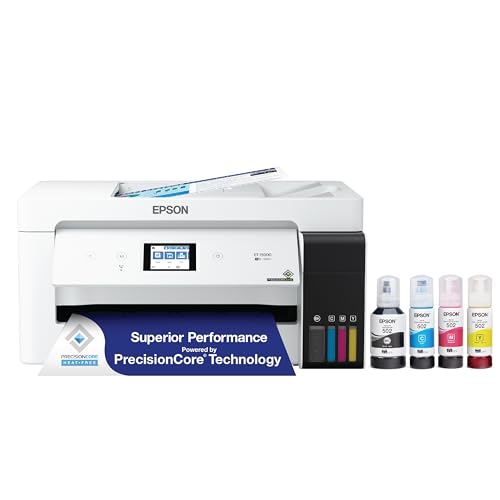
Epson EcoTank ET-15000
A representative wide-format tank all-in-one: bottle refills, big capacity and support for larger paper — the tank proposition at full strength. Epson EcoTank ET-15000 — Check on Amazon

Canon MegaTank G3270
Another tank design worth comparing for its refill system and front-level windows when you shortlist tank models. Canon MegaTank G3270 — Check on Amazon

Brother MFC-J1010DW
A representative cartridge all-in-one: inexpensive to buy, compact and simple — the cartridge proposition, best suited to light printing volumes. Brother MFC-J1010DW — Check on Amazon
Refill Day in Practice: What Tank Ownership Actually Feels Like
Comparisons discuss tank refills in the abstract; owners experience them as a small ceremony, a few times a year, and the details decide whether tank ownership feels liberating or fiddly. Modern refill systems are keyed: each colour’s bottle nozzle physically fits only its own tank, so the classic disaster of pouring magenta into the cyan tank is engineered away on current models from the major brands. The routine itself takes minutes — open the cap, invert the bottle onto the filler neck, let it drain hands-free on the better designs, watch the level through the tank window, stop at the line. Done at a table, unhurried, with a sheet of paper beneath the printer, it is cleaner than changing a cartridge, because the ink travels in a closed path from bottle to tank rather than being handled as an open consumable.
The honest frictions are different ones. Bottles must be stored upright and sealed between refills if a bottle outlasts one filling, and a part-used bottle is an object that demands a sensible cupboard rather than a drawer it can leak across. Ink on fingers is a rite of passage at least once, usually from impatience — removing a bottle before it has finished draining, or overfilling past the line so the cap displaces the excess. Tanks also make ink levels a visible, physical fact: you watch the reservoirs fall, which owners either find satisfying or faintly nagging, and which removes the cartridge world’s sudden cliff-edge of a supply dying mid-document. Cartridge owners trade all of this for a thirty-second swap with clean hands and a higher bill. Neither ritual is objectively better; they suit different temperaments, and since you will perform your chosen ritual for years, temperament is a legitimate decision input alongside the arithmetic.
The Failure Modes Tanks Introduce (and How Owners Prevent Them)
Every technology trades old problems for new ones, and intellectual honesty requires naming the tank’s own. First, airlocks: after a refill, a move, or a long idle stretch, air can enter the feed lines between tank and head, and a colour can vanish even though its tank is visibly full. The cure is the model’s priming or ink-flush routine, found in its maintenance menu and manual — not repeated head cleaning, which does not address air in a tube. Second, sediment and ageing in the tank itself: ink sitting for years in a rarely used machine can thicken at the outlet, which is why tank printers, for all their economy, punish very low usage even more firmly than cartridge models; the ink you bought in bulk still has a working life, whether or not you print it.
Third, transport. A cartridge printer can be tipped into a car boot with modest care; a tank printer full of liquid ink demands upright, level handling, and many manuals advise a transport mode or simply forbid moving the machine with full tanks over distance. Students who relocate each term and families who move house should weigh that seriously. Fourth, the waste-ink question from the ownership section applies with extra force: high-volume tank printing plus the priming routines tanks occasionally need means the maintenance box fills on schedule, so choose a model where that box is user-replaceable and treat its replacement as a planned supply, like the ink itself. None of these faults is common, hidden or fatal — but a buyer who knows them in advance experiences them as maintenance, while a buyer promised a faultless system experiences them as betrayal.
The Break-Even Question, Answered in Pages Rather Than Promises
Strip away prices — which vary by shop and season — and the tank-versus-cartridge decision reduces to a page count and a time horizon. A tank printer costs more to buy and dramatically less to feed; a cartridge printer costs less to buy and more to feed. Somewhere in your printing future lies the page at which the totals cross. The useful exercise is estimating your annual pages honestly — using the counting method of tallying real jobs over a representative two months and multiplying — and then asking how many months it takes your household to reach the volumes the manufacturers quote for a set of tank bottles versus a set of cartridges. If your household prints a few hundred pages a year, the crossing point may sit beyond the printer’s likely life, and the cartridge machine’s lower purchase price is the rational winner however unfashionable that conclusion is. If you print a few hundred pages a month, the crossing arrives within the first year and the tank wins by a margin that grows every month afterwards.
Two refinements keep the exercise honest. Count colour pages separately if your work is colour-heavy, because colour is where the per-page gap between the systems yawns widest, and a household printing mostly colour crosses far sooner than its total page count suggests. And include the starter supplies fairly: many cartridge printers ship with low-capacity starter cartridges, while tank printers typically ship with full bottles, so the first-year comparison should price the first replacement set for the cartridge machine from day one. Readers who want the same logic applied to specific models can compare the running-cost notes in our best printers for ink usage roundup alongside this guide.
Printheads: The Hidden Asset in Every Cartridge, the Fixed Bet in Every Tank
The least-discussed difference between the systems is what happens to the printhead over a lifetime. On many cartridge printers — notably designs where the head is built into the cartridge — every supply change installs a fresh printhead, so the component most prone to clogging and wear is renewed continuously as part of the running cost owners complain about. Part of what a cartridge’s price buys is that renewal. Tank printers, by contrast, almost always use a fixed head designed to last the machine’s life, fed by those inexpensive bottles. That architecture is exactly why tank ink can be sold cheaply: nothing precision-engineered is being thrown away with each refill.
The consequence cuts both ways and should shape who buys what. A cartridge-system owner can neglect the machine, clog it thoroughly, and resurrect it with a fresh cartridge; the system’s forgiveness is built into its economics. A tank owner who neglects the machine risks the one component that cannot be swapped at the kitchen table, so tank ownership pairs naturally with the regular-use habits in this guide — the weekly colour page, the powered sleep, the sensible storage. This is not a warning against tanks; high-volume users exercise their printers constantly by definition, which is why clogged tanks are rare in the wild despite the fixed head. It is a warning against the specific mismatch of a tank printer bought for a household that prints in rare bursts: the cheapest ink in the world is no bargain attached to a head that dies of loneliness.
Sustainability and Waste: Bottles, Cartridges and the Whole Picture
The waste comparison is more nuanced than either camp’s slogans. Cartridge printing generates a steady stream of small plastic consumables, though the picture improves where manufacturers run free return-and-recycle programmes and where the cartridge carries the printhead, since a precision component is being returned into a managed stream rather than binned. Tank printing replaces that stream with a far smaller number of larger bottles over the same page count — unambiguously less plastic per page — but adds the maintenance box as a periodic waste item and concentrates risk in the fixed head: a tank printer scrapped early for a dead head wastes the whole machine, which dwarfs years of cartridge shells.
The genuinely sustainable choice is therefore the system you will keep longest and use fully. A tank printer bought by a high-volume household and run for many years is the lowest-waste way to print at home by a wide margin. A cartridge printer bought by a light user and kept until it truly dies wastes less than a tank printer bought optimistically, underused, and replaced early. Add the unglamorous habits that help either system — returning every spent cartridge through its scheme, replacing maintenance boxes rather than printers, buying the machine whose capacity matches your real volume — and the environmental decision mostly makes itself as a by-product of the economic one.
Profiles Revisited: Four Buyers Who Break the Simple Rules
The photographer who prints weekly
Conventional wisdom sends photographers to cartridge machines for their ink quality and media handling, and for exhibition work that holds. But the photographer who prints drafts, test strips and contact sheets constantly before the final exhibition print burns through ink at tank-flattering volumes, and many now run both: a tank machine for the workshop churn, where cost per experiment decides how freely they iterate, and a dedicated photo printer for finals. The lesson generalises — volume inside a niche can flip the niche’s usual answer.
The small business with seasonal peaks
A business that prints heavily for three months and lightly for nine faces the tank’s idle problem in its quiet season despite genuinely high annual volume. The workable pattern is a tank printer plus a standing weekly test print in the quiet months, diarised like any other business chore; the business that knows it will not keep that diary should honestly consider cartridges or a laser for its text work, because a clogged head in peak season costs more than the ink savings banked all year.
The parent printing for a whole class or team
Some households print far beyond their own walls — worksheets for a class, programmes for a club, newsletters for a congregation. That borrowed volume counts fully in the break-even exercise and usually settles the question for a tank in a single term. It also argues for the tank model’s feeder and paper capacity being sized generously, since borrowed work arrives in batches with deadlines attached.
The second-home printer
The machine that lives at a holiday property, used intensely for a fortnight and ignored for months, is the cartridge system’s strongest case — or, more often, an argument for a laser instead of either. If it must be an inkjet, cartridges at least confine the drying risk to a replaceable supply; a tank left full and idle is the worst of both worlds. Our guide to printers that are easy to refill covers the tank models whose refill systems are kindest to occasional users who do choose that route.
Shared and Semi-Public Settings: Where the Systems Behave Very Differently
Some printers serve a shifting cast rather than one household — a clubhouse, a small office reception, a classroom, a church hall — and sharing changes the comparison in ways the home-focused sections do not capture. Cartridge machines in shared settings suffer a peculiar social problem: nobody owns the supply level, cartridges are discovered empty by the person with the deadline, and well-meaning helpers install the wrong or a dubious refilled cartridge because it was in the cupboard. Tank machines answer part of this beautifully — levels are visible through the window to anyone who glances, and a refill is a bottle anyone can be shown once — while introducing their own shared-setting risk, which is the helpful stranger who tops up a tank with whatever ink was at hand, mixing formulations in a system that cannot be un-mixed.
The deciding factor in shared settings is usually supervision. A setting with one de facto keeper — the person who maintains the machine and whose name is on a note beside it — can run a tank superbly and enjoy the lowest running costs available. A setting with no keeper at all, where the printer is genuinely communal infrastructure, often fares better with the cartridge system’s sealed, foolproof supplies and tolerance of neglect, accepting higher page costs as the price of robustness against chaos. Schools and clubs making this choice should also weigh the cost of downtime differently from a household: a printer that fails before a newsletter deadline imposes costs on dozens of people, which argues for the system whose failure modes the keeper can fix at the table — a cartridge swap, yes; a fixed head, no.
Second-Hand Value and the End of the Story
The systems age into the second-hand market differently, and buyers planning to upgrade in a few years — students, growing businesses — may care. A used cartridge printer is easy to evaluate and easy to sell: fit or inspect the cartridges, print a test page, and the machine’s health is largely known, because its most failure-prone component renews with supplies. A used tank printer carries two unknowns a test page only partly resolves: how the fixed head has been treated across years of unknown habits, and what ink history lives in its tanks and lines. Consequently tank printers, for all their running-cost virtue, tend to be worth less second-hand relative to their purchase price, and buyers of used tanks should discount for head risk exactly as the diagnosis sections advise.
For the original owner, the practical conclusion is gentle: buy the tank for its working life with you, not for its resale, and buy the cartridge machine without expecting its cheap purchase to be offset later either — both are tools consumed by use, and the honest accounting is pages printed per unit of money and trouble across the years you owned them. Judged that way, each system has households in which it is unambiguously the frugal, low-waste, low-drama winner, which is why this comparison refuses to crown one: the crown belongs to the match, not the machine.
Frequently Asked Questions
Can I mix ink brands in a tank printer?
Technically the printer cannot stop you; practically, it is a poor idea. Ink formulations differ in pigment load, viscosity and additives, and mixing brands inside a tank means the mixture — not either ink — is what reaches the head, with colour shifts and, in unlucky combinations, reactions that thicken the ink. Warranty positions also harden when non-manufacturer ink is in the system. The tank bargain already makes ink inexpensive; the further saving from off-brand bottles is small against the risk to a fixed printhead that cannot be swapped at home. If you do switch brands, do it at a natural boundary — run the old ink low, refill with the new, and accept a few transitional prints while the lines clear.
Does tank ink expire, and what happens if I use old bottles?
Yes, bottled ink carries a shelf life, printed on the packaging, and it ages faster once opened. Expired ink risks colour inaccuracy first and consistency problems second — pigment settling that shaking only partially reverses, and thickened ink that feeds poorly and can strain the head. Sealed bottles stored cool, dark and upright keep best; a bottle a year past its date is a judgement call for draft printing, not for photographs. This is the practical reason the ownership advice in this guide caps your stock at roughly the next refill: the tank system’s economy tempts bulk buying, and bulk buying an expiring liquid is how the savings evaporate on a shelf.
Can I move house with a tank printer?
Yes, with more ceremony than a cartridge machine needs. Keep the printer upright and level throughout, secure or remove loose parts as the manual directs, and check whether your model has a transport lock or an ink-system precaution for moving — several manufacturers specify one. Never tip a filled tank printer onto its side or back: the tanks vent by design, and ink will find those vents. After the move, let the machine settle at room temperature, inspect the tank area and feed lines for bubbles introduced by the journey, run the priming routine if a colour has dropped out, and print a nozzle check before the first real job. Cartridge owners moving house should simply remove the cartridges, bag them upright in a sealed bag, and treat the machine as ordinary fragile electronics.
My tank printer’s ink levels fall unevenly. Is something wrong?
Almost certainly not — uneven consumption is the signature of real printing. Black falls fastest in document households; a single colour can plummet in a season of printing one team’s kit, one business’s branded colour, or a run of sunset photographs. The tanks make this visible in a way cartridges never did, which is a feature: you can see a colour approaching its refill and plan accordingly, and a colour that suddenly falls far faster than its history suggests is an early warning worth heeding, pointing to heavy cleaning activity, a priming problem, or a leak to inspect around the tank seals. Judge the levels against your own past pattern, not against each other.
Are tank printers really cheaper to run?
Yes, substantially. Bottled ink yields thousands of pages at a cost per page far below cartridges. The saving is largest for colour printing and high volumes.
Do tank printers print better quality than cartridge printers?
No — quality depends on the printhead, ink colours and paper, not the reservoir. Comparable models from the same brand produce comparable output.
Is refilling a tank messy?
Modern keyed bottles are designed to be drip-resistant and stop automatically when the tank is full. Most owners find refilling cleaner than expected; gloves are still a sensible precaution.
Can I convert a cartridge printer to a tank system?
Third-party conversion kits exist but are unsupported, often unreliable and can damage the printer. If you want tank economics, buy a printer designed for tanks.
How long does bottled ink last in the tank?
Ink in a sealed tank stays usable for a long time, but like all inkjets, tank printers should print regularly to keep nozzles clear. Unopened bottles should be used before their expiry dates.
Which is better for a dorm room?
For light printing, a cheap cartridge printer is smaller and moves easily. Students printing constantly often do better with a compact laser or sharing a tank printer among roommates.
How long does a set of tank ink bottles last?
It depends entirely on your volume, but the scale is different from cartridges: a set of bottles is rated in thousands of pages, so at typical family volumes a refill is an annual event rather than a monthly one. The printer’s app and the tank windows tell you where you stand.
Can I mix ink brands in a tank printer?
Manufacturers formulate ink for their printheads, and mixing brands can change colour behaviour and clog risk. The safe practice is to stay with one ink family — the printer’s own or a reputable ink made specifically for your model — and not to top one brand up with another.
What happens if I overfill a tank?
Modern bottles are designed to stop at the correct level when used as directed, nozzle fully inserted. If ink does spill, blot it immediately, keep it off the printer’s electronics and your desk, and wash hands — printer ink stains enthusiastically. Prevention is simply attention during the two minutes a refill takes.
Do tank printers work with phones and tablets as well as cartridge printers?
Yes. Connectivity is independent of the ink system: tank models offer the same Wi-Fi, AirPrint and app printing as cartridge models in the same range. Choose the ink system on volume and cost; the wireless experience will be equivalent.
What if I print a lot for a few months, then barely at all?
Seasonal printing is hard on any inkjet. If the busy season justifies it, a tank printer still wins on cost during the peak — but plan a weekly test print during the quiet months, or accept a cleaning session when the season restarts. A laser sidesteps the dilemma if colour is not essential.
Are tank printers worth it for a small office that prints invoices all day?
For invoices and office documents at genuine daily volume, the tank’s running-cost advantage is at its largest and the break-even arrives quickly — but ask the prior question first: whether an inkjet of any system is the right engine for the work. Invoice-led offices printing almost entirely text often belong to the laser camp altogether, gaining speed and water-fast output. Where the office’s work mixes documents with colour — branded invoices, handouts, packaging inserts — a business-class tank model with a replaceable maintenance box is a strong answer, provided one named person owns its refills and its weekly rhythm, as the shared-settings section above recommends.
The Bottom Line
Regular printers should buy the tank; rare printers can buy the cartridge — after checking its ink prices. The systems print alike, so let your monthly page count and the break-even arithmetic decide, and enjoy never rationing colour again if the tank wins.
Related Guides
Keep exploring with these guides and roundups from the same printers collection: