Disclosure: As an Amazon Associate, ilcastellomenu.com earns from qualifying purchases. Links on this page are affiliate links; they cost you nothing extra. Prices and availability change often, so check the current Amazon listing before you buy.
So, is a poe switch worth it? Short answer: a poe switch is worth it if you have, or are firmly planning, at least two devices that need power where no outlet exists, such as cameras or a ceiling access point. It is not worth it if every device you own already sits beside a socket, or if your actual problem is a badly placed router. The rest of this page earns that answer properly, profile by profile, cost by cost.
Key Takeaways
- Worth it for: camera systems, ceiling access points, VoIP desks, growing networks.
- Not worth it for: outlet-rich desks, single devices beside sockets, coverage problems caused by router placement.
- The real costs are planning time, cabling care and one box becoming important.
- The payoff compounds: every future powered device becomes a simple cabling job.
- Decide from a written device list, never from a product page.
In this guide
What You Actually Get From a PoE Switch
What you get is not speed and not magic. You get placement: the camera on the corner that has no socket, the access point on the ceiling where coverage actually works, the phone on the desk with one cable instead of two. You get a network that can grow by running cable, which most people can do or buy cheaply, instead of by adding outlets, which most people cannot. And you get tidiness that compounds quietly, one removed adapter at a time. For many buildings those three things are worth a great deal; for some they are worth nothing at all.
The basic idea behind Power over Ethernet is disarmingly simple: one cable carries both the data connection and the electrical power a small network device needs to run. Instead of hunting for a free outlet near every camera, access point or desk phone, you run a single Ethernet cable from the switch and the device wakes up as soon as the cable clicks in. That single-cable convenience is why PoE has moved from enterprise wiring closets into homes, small offices, cafes and workshops. It tidies installations, removes a forest of wall adapters, and makes it realistic to place devices where the network needs them rather than where the builder happened to put a socket.
Wireless access points are the classic PoE success story in homes and small businesses. Ceiling or high-wall placement gives an access point the clear air it needs to cover rooms well, and those are exactly the places builders never put power outlets. Running one cable solves both the data feed and the power in a single trip up the ladder. If you are planning a multi-access-point setup with a controller-based system, a switch from the same ecosystem can make adoption and monitoring feel like one product instead of several. For a single access point, almost any sound PoE port will do the quiet work.
Security cameras are the other headline use, and they reward planning. Sketch camera positions on a simple plan of the building, think about what each camera must actually see, and only then count ports and cable. Outdoor runs deserve cable rated for the conditions and sensible protection where they enter the building. PoE removes the need for an electrician-grade power run to every camera position, which is a large part of why small camera systems have become so practical. Record which port feeds which camera in your network map; relabelling cables at the switch end costs nothing and pays off at every future change.
Start any networking purchase by writing the problem in one sentence. ‘Two cameras and an access point, no outlets where they need to go’ is a problem a PoE switch solves directly. ‘The Wi-Fi is patchy upstairs’ might be solved by a properly placed access point that PoE then powers, or it might be a router placement problem that no switch will fix. Naming the problem first protects you from buying infrastructure in search of a purpose. It also gives you the checklist to test the finished installation against: either the cameras and access point work where they were needed, or something in the plan was wrong.
The Real Costs Beyond Money
The honest costs are an afternoon of planning, some care with cabling, a ventilated home for the switch, and the knowledge that one box now matters to many devices. There is a learning cost too, small but real: you will read two manuals, learn what your ports do, and make a port map. None of these costs recur weekly. They are the entry fee, paid once, and the profiles below are really asking whether your building will collect enough benefit, over years, to make that fee look small.
There is a quiet satisfaction in removing wall adapters from a network. Every adapter is a small heat source, a socket occupied, and a slightly different plug to hunt for when something needs resetting. Centralising power at the switch means one power supply to place well, ventilate properly and, if you ever add battery backup, one place to protect. The trade is concentration: if the switch goes down, its powered devices go down with it. For homes and small offices that trade is usually welcome, because a single quality unit is easier to look after than a dozen anonymous adapters scattered around a building.
Heat and ventilation are easy to overlook because a small switch asks for so little attention. PoE switches do real electrical work, and delivering power to several devices adds warmth on top of the switching itself. Give the unit air: do not bury it under papers, seal it in an unventilated box, or stack other warm equipment directly on top of it. A switch on an open shelf with space around it will live a calmer life than one suffocating in a drawer. If the case feels unusually hot or the unit restarts under load, treat that as information, not background noise.
Before you plug a non-PoE device into a switch port, pause and think about what that port does. A standards-based PoE port is designed to check for a compatible powered device before delivering power, which is reassuring in principle, but principles are not a substitute for checking your specific models. Read the port behaviour in the manual, confirm which ports on your switch actually supply power, and keep a simple written map of which ports feed which devices. That map takes minutes to make and saves real confusion months later when something needs moving, replacing or troubleshooting at short notice.
A switch is a long-lived, boring purchase, and that is a compliment. Networks grow by accretion: a camera this year, an access point next year, a small server or a smart hub after that. Buying a recognised brand with clear documentation, a real support site and a manual you can actually read is worth more than squeezing the last drop of theoretical specification from an obscure alternative. Keep the receipt, note the model and firmware in your network map, and check for firmware updates occasionally. Boring, documented and supported beats clever and mysterious every time in infrastructure.
Who It Pays Off For
The Camera Household
Security cameras are the other headline use, and they reward planning. Sketch camera positions on a simple plan of the building, think about what each camera must actually see, and only then count ports and cable. Outdoor runs deserve cable rated for the conditions and sensible protection where they enter the building. PoE removes the need for an electrician-grade power run to every camera position, which is a large part of why small camera systems have become so practical. Record which port feeds which camera in your network map; relabelling cables at the switch end costs nothing and pays off at every future change.
Firmware and management interfaces reward a light touch. Set an admin password you have recorded safely, note the switch’s address on your network map, and resist changing settings you do not understand one at a time without writing down the original values. Most small networks need almost no configuration at all. The features are there for the day you want separate traffic for guests, a priority lane for calls, or a warning when a port drops. Until that day, a switch left close to its defaults, with its password changed and its firmware reasonably current, is a well-run switch.
The Coverage-Frustrated Household
Wireless access points are the classic PoE success story in homes and small businesses. Ceiling or high-wall placement gives an access point the clear air it needs to cover rooms well, and those are exactly the places builders never put power outlets. Running one cable solves both the data feed and the power in a single trip up the ladder. If you are planning a multi-access-point setup with a controller-based system, a switch from the same ecosystem can make adoption and monitoring feel like one product instead of several. For a single access point, almost any sound PoE port will do the quiet work.
When people ask whether PoE is complicated, the honest answer is that the concept takes five minutes and the discipline takes an afternoon. The afternoon is the planning: listing devices, sketching cable runs, choosing a switch whose documentation matches the job, and labelling everything as it goes in. After that, a PoE network mostly disappears, which is the highest praise infrastructure can earn. Devices simply work where you put them, the adapter drawer stops growing, and adding the next camera or access point becomes a cabling task rather than an electrical project. That disappearance is what you are actually buying.
The Small Office and Home Worker
VoIP phones explain why PoE took over small offices long before it reached homes. A desk phone powered through its network cable keeps working from a single connection, moves desks without an electrician, and centralises backup power at the switch if the building adds it later. Even in a home office, a PoE-powered phone or intercom removes one more adapter from the desk tangle. If call quality matters to you, a switch with basic traffic prioritisation can help voice packets keep their place in the queue, though on a lightly loaded home network the honest difference is often small.
The uplink deserves a sentence of its own. Your switch connects back to the router or the rest of the network through one of its ports, and every device on the switch shares that path. Remember to count it: a switch with every port filled by devices still needs its connection home. On small networks this simply means leaving a port for the router link in your plan. If your switch offers a dedicated uplink arrangement, follow the maker’s guidance; if not, any free port usually serves. Forgetting the uplink is the classic reason a perfectly good switch seems to have one port too few.
Who Should Skip It
The Outlet-Rich Desk Setup
Cameras deserve one more practical note: night is their busiest time. Infrared illumination and heaters in outdoor units mean a camera’s appetite can differ between a bright afternoon test and a cold night in service. This is another reason to respect the maker’s guidance and leave headroom rather than planning to the last drop of capacity. Test a new camera through a full night before declaring the installation finished, and if a unit restarts or drops in the small hours, suspect the power and cable story before suspecting the camera itself. Patient testing beats confident guessing.
If your computer, monitor, printer and console all sit at one desk with a power strip in easy reach, a PoE switch solves a problem you do not have. A standard switch, or the router’s own ports, will serve you until a camera or access point enters the plan.
The Single-Device Household
Small offices get an extra benefit from PoE that homes notice less: tidiness at scale. A row of desks with phones powered through their network cables, a ceiling of access points with no visible power supplies, and a camera system that an installer can extend with cable alone all add up to a workplace that is easier to change. Desks move, teams grow, and the network adapts with patch leads rather than tradespeople. That flexibility is a large part of why the technology became the default in commercial buildings, and the same logic, shrunk down, works in a home office or a small shop.
One access point beside a socket, or one camera above a porch outlet, can be powered perfectly well the ordinary way. Infrastructure for one device is a solution shopping for a problem; revisit the question when the list grows to two or three.
Strengths and Trade-Offs of Owning One
Strengths
- Placement freedom for every powered device, permanently.
- Growth becomes cabling, not electrical work.
- One cared-for power point instead of many forgotten adapters.
Trade-offs
- An afternoon of planning before anything works.
- The switch’s health becomes the network’s health.
- Cabling faults now affect power as well as data.
Alternatives to Consider
The alternatives are a standard switch with adapters where devices sit, single-device power arrangements for a lone camera or access point, and patience: waiting until the device list justifies the step. Each is respectable in its place. The comparison in ethernet switch vs poe switch compared lays the first alternative out in full, and the models worth considering when you do buy are reviewed in the poe switch review.
Port count sounds like a trivial decision until the day every socket is full. Count the devices you actually plan to power today, then count the wired devices that need a plain data connection, then add honest headroom for the camera, access point or phone you have not bought yet but probably will. A switch filled to the last port on day one is a switch you will replace early. Equally, buying far more ports than a small network can use means paying for capacity and desk space that sit idle. The right size is the one that fits your written device list with a little room to breathe.
Documentation is a feature, even though it never appears in a headline. Before buying, find the manual for the exact model online and read the pages about power delivery, port behaviour and operating environment. If the maker cannot explain clearly which ports supply power and what the unit is designed to feed in total, that tells you something about the support you will get later. Established networking brands publish proper manuals, firmware and support notes. In a product category where the device will sit untouched for years, that paper trail is part of what your money buys.
A word about expectations for speed: a PoE switch does not make your internet faster, and it does not improve Wi-Fi by itself. What it does is let you place the devices that do affect those things, access points especially, in the right positions, powered and connected properly. Judge it as infrastructure, not as a performance upgrade. The speed of your network will be set by your internet connection, your router, your Wi-Fi design and your cabling. The switch’s job is to stop being the weak link and to power the team without complaint. Chosen well, you will forget it exists, which is success.
Models Worth Considering If You Buy
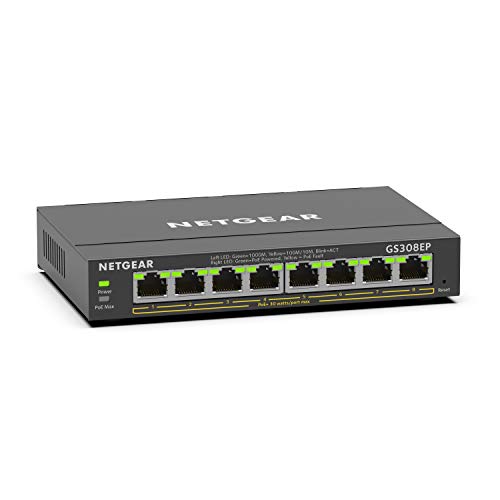
NETGEAR GS308EP PoE Switch
The NETGEAR GS308EP is a smart-managed NETGEAR model aimed at small networks that want some control without enterprise ceremony. In prose terms it sits in the sensible middle of this group: a recognised networking brand, a configuration interface for people who want port-level visibility, and a format intended to sit quietly on a shelf or desk while it feeds cameras, phones or an access point.
VoIP phones explain why PoE took over small offices long before it reached homes. A desk phone powered through its network cable keeps working from a single connection, moves desks without an electrician, and centralises backup power at the switch if the building adds it later. Even in a home office, a PoE-powered phone or intercom removes one more adapter from the desk tangle. If call quality matters to you, a switch with basic traffic prioritisation can help voice packets keep their place in the queue, though on a lightly loaded home network the honest difference is often small.
Troubleshooting a PoE problem is mostly a process of elimination, and it starts with the cable. Swap the patch lead, try a different port, and test the device on a short cable right next to the switch. Those three steps separate device faults, cable faults and port faults without any special equipment. If a device works beside the switch but not at the end of its installed run, the run itself is your suspect. If nothing works on one port but everything works elsewhere, the port is the story. Change one thing at a time and write down what you changed; random unplugging teaches nothing.
Best for: buyers whose written device list matches this model’s role in the group described above. Not suited for: installations whose device count or power needs, checked against the maker’s documentation, clearly call for a larger unit. Check price on Amazon once you have confirmed the exact model against your plan.

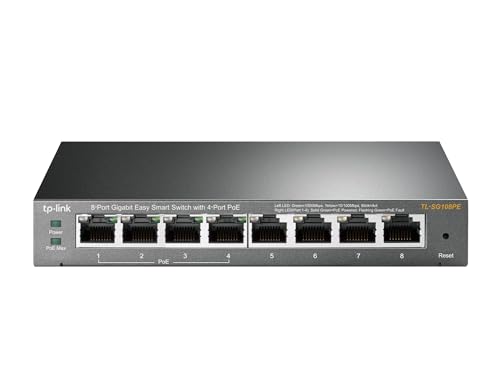
TP-Link TL-SG108PE PoE Switch
The TP-Link TL-SG108PE is an easy smart TP-Link model that has been a familiar sight in small offices and home camera systems for years. Its appeal is approachability: a light management layer for basic traffic settings, a compact metal-cased format, and a brand whose documentation and support material are easy to find when you need to check port behaviour before plugging things in.
Labelling sounds like fussiness until you have stared at eight identical grey cables during an outage. Label both ends of every run with the room and device it serves, and keep the matching list somewhere you will find it under pressure. A label maker, or even tape and a fine pen, turns a future fault from an afternoon of tracing into a five-minute check. This is doubly true for PoE, where a cable is also a power feed: knowing exactly what you are unplugging matters. Future you, standing on a chair at midnight, will be grateful for present you and the labels.
Power budgeting, in the plain sense, means respecting that a switch has a designed overall capacity for the devices it feeds, and that capacity is shared. You do not need to memorise figures to handle this well. You need the maker’s stated guidance for your model, a list of what your powered devices require according to their own manuals, and the discipline not to keep adding devices until something quietly stops working. If several power-hungry devices must run together, that is an argument for choosing a switch model whose documentation clearly supports that load, and for spreading devices thoughtfully across ports as the manual directs.
Best for: buyers whose written device list matches this model’s role in the group described above. Not suited for: installations whose device count or power needs, checked against the maker’s documentation, clearly call for a larger unit. Check price on Amazon once you have confirmed the exact model against your plan.

Ubiquiti UniFi Switch Lite 8 PoE
The Ubiquiti UniFi Switch Lite 8 PoE is the ecosystem choice in this line-up. It is designed to be adopted into the UniFi controller environment alongside UniFi access points, so its natural home is a network that already runs, or plans to run, UniFi wireless. If your access points are UniFi units, having the switch appear in the same management view is a genuine everyday convenience rather than a headline feature.
The uplink deserves a sentence of its own. Your switch connects back to the router or the rest of the network through one of its ports, and every device on the switch shares that path. Remember to count it: a switch with every port filled by devices still needs its connection home. On small networks this simply means leaving a port for the router link in your plan. If your switch offers a dedicated uplink arrangement, follow the maker’s guidance; if not, any free port usually serves. Forgetting the uplink is the classic reason a perfectly good switch seems to have one port too few.
Firmware and management interfaces reward a light touch. Set an admin password you have recorded safely, note the switch’s address on your network map, and resist changing settings you do not understand one at a time without writing down the original values. Most small networks need almost no configuration at all. The features are there for the day you want separate traffic for guests, a priority lane for calls, or a warning when a port drops. Until that day, a switch left close to its defaults, with its password changed and its firmware reasonably current, is a well-run switch.
Best for: buyers whose written device list matches this model’s role in the group described above. Not suited for: installations whose device count or power needs, checked against the maker’s documentation, clearly call for a larger unit. Check price on Amazon once you have confirmed the exact model against your plan.

NETGEAR GS305EP PoE Switch
The NETGEAR GS305EP is the smaller NETGEAR option here, a compact smart-managed model for a short device list: perhaps two cameras and an access point in a flat, a small studio or a home office corner. Choosing the smaller unit when your written list is genuinely short is not settling for less; it is matching the tool to the job and keeping the installation as small as the problem.
Environmental common sense rounds out the practical picture. Keep switches out of steamy bathrooms, dusty workshops without protection, and anywhere condensation or dripping water is plausible. A garage installation should be in a suitable enclosure with ventilation, not loose on a shelf under a leaking roof. Cable entries outdoors should be sealed as the cable and device makers direct. None of this is exotic; it is the same respect you would show any electrical equipment. PoE makes installations flexible, but flexibility is not permission to put electronics where electronics plainly should not live.
When people ask whether PoE is complicated, the honest answer is that the concept takes five minutes and the discipline takes an afternoon. The afternoon is the planning: listing devices, sketching cable runs, choosing a switch whose documentation matches the job, and labelling everything as it goes in. After that, a PoE network mostly disappears, which is the highest praise infrastructure can earn. Devices simply work where you put them, the adapter drawer stops growing, and adding the next camera or access point becomes a cabling task rather than an electrical project. That disappearance is what you are actually buying.
Best for: buyers whose written device list matches this model’s role in the group described above. Not suited for: installations whose device count or power needs, checked against the maker’s documentation, clearly call for a larger unit. Check price on Amazon once you have confirmed the exact model against your plan.

TP-Link TL-SG105PE PoE Switch
The TP-Link TL-SG105PE is the compact TP-Link counterpart, an easy smart model for a handful of powered devices. It suits the classic starter installation: a camera or two and a ceiling access point, with the option to check basic settings through its interface. As with its larger sibling, confirm the exact port behaviour and the maker’s guidance for your devices in the manual before the cables go in.
There is a quiet satisfaction in removing wall adapters from a network. Every adapter is a small heat source, a socket occupied, and a slightly different plug to hunt for when something needs resetting. Centralising power at the switch means one power supply to place well, ventilate properly and, if you ever add battery backup, one place to protect. The trade is concentration: if the switch goes down, its powered devices go down with it. For homes and small offices that trade is usually welcome, because a single quality unit is easier to look after than a dozen anonymous adapters scattered around a building.
Think of the switch as the meeting point of two budgets: the port budget and the power budget. Ports are easy to count. Power requires reading: each powered device states its requirements, and the switch states what it can supply overall and per port in its documentation. Staying comfortably inside both budgets, with headroom, is what a well-planned installation looks like. Running at the ragged edge of either invites the most annoying class of fault, the intermittent one, where a device works until a cold night, a busy hour or an extra camera pushes the system past what it can honestly do.
Best for: buyers whose written device list matches this model’s role in the group described above. Not suited for: installations whose device count or power needs, checked against the maker’s documentation, clearly call for a larger unit. Check price on Amazon once you have confirmed the exact model against your plan.
How to Get the Most Value If You Buy
Value is protected by boring habits: buy the size your list needs with headroom, not the largest box on the page; place and ventilate it properly; label every cable; keep the port map current; and test new devices on a short cable before installing them. Do those things and the switch will pay its fee back in avoided hassle within the first year for most camera or access point owners.
Cabling is the unglamorous half of every PoE success story. The power and the data share the same run, so a damaged, kinked or badly terminated cable undermines both at once. Use sound, well-made Ethernet cable, avoid crushing it under furniture or trapping it in door frames, and keep runs away from obvious heat sources. When you terminate your own ends, test each run before you rely on it. A camera that drops offline at random is very often a cable story rather than a switch story, and swapping in a known-good patch lead is the cheapest diagnostic step you own.
A switch is a long-lived, boring purchase, and that is a compliment. Networks grow by accretion: a camera this year, an access point next year, a small server or a smart hub after that. Buying a recognised brand with clear documentation, a real support site and a manual you can actually read is worth more than squeezing the last drop of theoretical specification from an obscure alternative. Keep the receipt, note the model and firmware in your network map, and check for firmware updates occasionally. Boring, documented and supported beats clever and mysterious every time in infrastructure.
Buying used network gear can look tempting, but PoE adds a wrinkle: you are trusting the unit with power delivery as well as data. If you buy used, buy a recognised model, test every port with a device you can afford to test with, and inspect the power supply and case carefully. For most households and small offices, a new unit from an established networking brand, bought from a reputable seller, is the calmer path: full documentation, a warranty, and no mystery history. Infrastructure is the wrong place to gamble on an unknown past.
There is a small ritual worth adopting on installation day: connect everything, then walk the building and use the network the way its occupants actually will. Stand where the camera stands and check its view on your phone. Take a laptop to the far room and run the call, the stream or the file copy that matters. Infrastructure that is only tested from the switch outward is half tested. The point of the exercise is to discover the weak run, the optimistic access point position or the mislabelled cable while the tools are still out and the ladder is still up, not during the first important week of use.
The Decision Checklist
- Do I have, or firmly plan, two or more devices needing power away from outlets?
- Have I written the full device list, powered and unpowered?
- Do I know where the switch will live, ventilated and reachable?
- Have I read how my candidate model handles power, in its own manual?
- Is my problem actually placement, rather than internet speed or router position?
- Am I prepared to label cables and keep a simple port map?
Four or more honest yeses: buy, using the method in how to choose a poe switch. Two or fewer: wait, and let the device list make the case later.
Practical Notes From Real Installations
Finally, plan the exit as well as the entrance. Networks change: cameras are replaced, access points move to newer standards, and switches eventually retire. Because PoE follows shared standards, a standards-based installation lets you replace one piece at a time without rewiring the building. Keep your cable runs, labels and network map in good order and every future upgrade becomes cheaper and calmer. The cable in the wall is the long-term asset; the switch is a replaceable steward of it. Buy the steward sensibly, treat the asset well, and the system will serve through several generations of devices.
Spare capacity is a form of kindness to your future self. One free port, one spare patch lead in the drawer, one photograph of the finished installation saved with your network map: none of these cost much, and each converts a future emergency into a minor errand. Networks rarely fail at convenient moments. The households and offices that cope calmly are not the ones with the most expensive equipment; they are the ones that can see what they own, reach it, and swap a suspect cable in minutes because the labels and the spares were sorted on a quiet day.
Think about who else has to live with your network decisions. A partner who works from home, a teenager whose classes are online, a small team whose phones must ring: the switch serves all of them, and its placement and reliability are household decisions, not hobby details. That is another argument for the boring virtues in this category: recognised brands, clear manuals, sensible placement and documentation left where anyone can find it. A network only one person understands is a network with a single point of failure that no product can fix.
Weather and seasons test installations in ways a first afternoon cannot. Outdoor cameras work harder on cold nights, lofts and garages swing between hot and cold, and cables routed through sunlit spots age differently from cables in shade. A short re-check after the first serious change of season is a professional habit worth borrowing: look at the switch, feel whether it is running unusually warm, confirm the outdoor devices stayed up through the worst night, and glance at the cable entries. Ten minutes, twice a year, is the entire programme, and it catches small problems while they are still small.
When you expand the network later, expand it in the same style as the original installation. Same labelling scheme, same habit of testing on a short cable first, same line added to the port map before the new device is declared finished. Consistency is what keeps a growing network legible. The temptation to wire the new camera quickly and document it later is understandable and always regretted, because later has a way of arriving during an outage. The standard you set on day one is either maintained at every change or quietly abandoned; there is no third option.
Budget conversations in this category go better when they are framed per solved problem. A switch that powers four cameras and two access points is not one purchase; it is six installations made simple, six adapters never bought, and six positions chosen for usefulness rather than for sockets. Framed that way, the difference between a sound unit and the cheapest available unit usually looks small against the work it saves. Framed as a grey box on a shelf, everything looks expensive. The device list, once again, is what turns a vague purchase into a priced plan.
Indicator lights are the switch’s only conversation with you, so learn its language while everything is healthy. Note which lights mean a link, which mean activity, and what the pattern looks like on a normal evening. Then, on the abnormal evening, you will spot the difference immediately: the dark port, the frantic flicker, the device that never woke up. This tiny fluency costs one minute of observation and pays for itself at the first fault, when it tells you where to start before you have touched a single cable.
Finally, remember that the network map and the manuals are part of the installation, as real as the cables. Keep digital copies of the manuals for the exact models you own, save the map where the household or the team can reach it, and update both when anything changes. People move jobs, houses change hands, and memories fade; paper and files persist. The best compliment a future owner, colleague or family member can pay your installation is that they understood it in ten minutes from your notes alone. Aim for that compliment.
Standards matter here because PoE is not one single thing. Devices and switches that follow the established IEEE PoE standards negotiate with each other: the switch checks what the connected device is and supplies power in an orderly, agreed way. That negotiation is the safety net of modern active PoE. It is also why checking compatibility on paper, before anything is plugged in, is worth five unhurried minutes. A standards-based switch and a standards-based powered device are designed to find each other safely; mixing in equipment that works to a different, informal scheme is where careful reading of manuals stops being optional.
Passive PoE deserves a clear warning of its own. Unlike standards-based PoE, passive approaches can put power on the cable without the polite negotiation step, which means the responsibility for matching voltage and equipment sits entirely with the person plugging things in. The safe rule is simple: only ever connect passive PoE equipment exactly as its maker specifies, with the devices it was designed for, and never assume a cable carrying passive power is harmless to whatever happens to be at the other end. When in doubt, leave it unplugged and check the documentation first.
Never open a switch or its power supply. There is nothing inside that a home or small-office user needs to adjust, and mains electricity does not forgive curiosity. If a unit is damaged, smells of scorching, makes alarming noises or has a frayed power lead, unplug it and replace it rather than attempting a repair. The same caution applies to the cabling side: PoE is low-voltage at the device end in normal standards-based use, but the system as a whole still deserves the respect you would give any electrical installation. Sensible placement and intact cables are the whole safety programme for most people.
Think about which devices genuinely need power from the switch and which merely need data. A desktop computer, a printer or a games console has its own power supply and gains nothing from a PoE port, while cameras, wireless access points, VoIP phones and small IoT hubs are the natural customers. Mixing the two groups on one switch is normal and sensible. What matters is that the powered group stays within what the switch is designed to deliver as a whole, and that you know, from the maker’s documentation rather than from guesswork, how your chosen model shares power across its ports.
Managed and unmanaged switches answer different questions. An unmanaged PoE switch is a quiet appliance: plug it in, connect devices, and it gets on with the job, which is exactly right for a small camera system or a couple of access points. A managed or smart-managed model adds a configuration interface, traffic controls and monitoring for people who want to separate traffic, prioritise calls or see what each port is doing. Neither is automatically better. The unmanaged box wins on simplicity; the managed box wins when you have a specific job for its controls and the patience to learn them.
Placement of the switch itself shapes the whole installation. A central spot shortens cable runs to cameras and access points, keeps the blinking lights somewhere you can actually see them when troubleshooting, and usually sits closer to the router the switch must connect to. People often hide network gear in the least accessible corner of a building and then regret it at the first fault. Choose somewhere dry, ventilated, reachable and close to power for the switch itself. The devices at the far ends of the cables need no outlets at all, which is precisely the freedom PoE was bought for.
Gigabit connections are the sensible default for a new switch today, even if some connected devices are modest. Cameras, access points and file transfers all share the switch, and the uplink to your router carries the sum of them. A faster backbone means the switch itself rarely becomes the bottleneck in a small network, and it leaves room for the access point upgrade or the extra camera you add later. Where an older device only needs a slower link, a modern switch negotiates that automatically. Buying for the network you will have in three years, within reason, is cheaper than buying twice.
Frequently Asked Questions
Do I need a special cable for a PoE switch?
You need sound, properly made Ethernet cable of the kind the switch and device makers recommend for normal networking; PoE does not require exotic cable, but it is less forgiving of damaged or badly terminated runs because the same cable carries power and data. If a run is old or suspect, test it or replace it. Keep runs away from heat and pinch points, label both ends, and remember that a short known-good patch lead beside the switch is the fastest way to prove whether a fault lives in the cable or in the device.
Can I plug a normal computer into a PoE port?
Standards-based PoE is designed to check for a compatible powered device before supplying power, so ordinary equipment is normally connected to such switches every day. In principle, though, you should still confirm the behaviour of your exact switch model in its manual, know which of its ports supply power, and never extend that assumption to passive PoE equipment, which behaves differently. When you are unsure about a specific device and port combination, check the documentation first rather than experimenting with equipment you care about.
What is the difference between active and passive PoE?
Active, standards-based PoE involves a negotiation: the switch and the powered device identify each other and agree the power delivery before it happens. Passive PoE skips that conversation and simply places power on the cable as its designer arranged, which makes matching the exact intended equipment essential. Passive gear should only ever be used exactly as its maker specifies, with the devices it was built for. For a general home or small-office network, standards-based equipment is the calmer and more flexible choice.
How many devices can one PoE switch power?
That depends on the model’s port count and on the overall power capacity its maker states in the documentation, shared across the powered devices. Count the devices you plan to power, read what each device requires in its own manual, and compare the totals with the switch maker’s guidance, leaving headroom rather than planning to the limit. Cameras with night illumination can draw differently after dark, so test through a full night. If the sums look tight on paper, choose a model documented for a larger load.
Where should I put the switch itself?
Choose a dry, ventilated, reachable spot, reasonably central to the devices it feeds and close to the router it connects back to. Leave air around the case, keep it off soft furnishings and out of unventilated boxes, and make sure you can see its indicator lights when troubleshooting. Never open the switch or its power supply. A switch placed well needs almost no attention afterwards; a switch buried in an inaccessible, airless corner turns every small fault into a project.
Does a PoE switch make my internet faster?
No. A PoE switch is infrastructure: it connects wired devices and powers the ones designed for it. Your internet speed is set by your connection and provider, and your Wi-Fi performance is set by access point placement and design. Where PoE helps indirectly is placement, because it lets you put an access point on a ceiling or high wall where coverage is best, with one cable for data and power. Judge a switch on whether it quietly stops being the weak link, not on promises of speed.