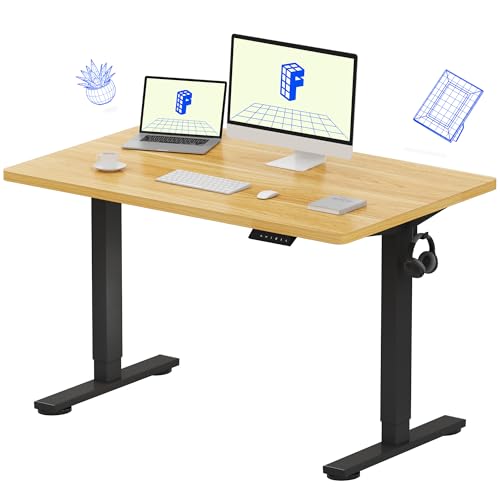
If you are asking what is the ideal desk height, the honest answer is that there is no single magic number — there is an ideal height for your body, and it is easy to find. The standard desk height suits average proportions, which is why it works for many people and quietly fails everyone else. Your ideal is the height at which your forearms rest level while your shoulders stay relaxed and your feet stay supported, and you can derive it in two minutes with a chair and a tape measure.
This explainer covers where the standard height came from, how to calculate your personal number for sitting and standing, how desk height interacts with your chair and screen, and what to do when your desk’s height is not your height.
Disclosure: As an Amazon Associate, ilcastellomenu.com earns from qualifying purchases. Product examples below link to Amazon, where you can check current availability and specifications; this guide itself lists no fixed prices because pricing and bundles change frequently.
What Is the Ideal Desk Height? The Short Answer
For a seated adult of average build, a desk surface around the low-to-mid 70s in centimetres (roughly 28–30 inches) lands near the ideal, which is why manufacturers converged there. But ‘average’ hides a wide spread: a shorter user’s ideal may sit several centimetres lower, a taller user’s several higher, and those few centimetres are the difference between relaxed shoulders and a permanent shrug. Treat the standard as a starting guess and your own elbow measurement as the answer.
In this guide
How to Find Your Ideal Desk Height
Sit in your chair as you would to work: feet flat on the floor, knees at about a right angle, sitting upright against the backrest. Let your upper arms hang vertically and bend your elbows to roughly ninety degrees, forearms level. Measure from the floor to the underside of your elbow. That measurement — give or take a centimetre — is your ideal desk height for seated work, because it is the height at which the surface meets your forearms without lifting your shoulders or dropping your wrists.
The standing version of the same rule
Stand in your work shoes, upper arms hanging, elbows bent to a right angle with forearms level, and measure floor to elbow again. That is your standing desk height. Notice it is a different number from the seated one — a sit-stand desk needs both, which is why memory presets exist. The full setup sequence that uses these numbers, in chair-desk-screen order, is laid out in How to Set Up Ergonomically a Desk.
Why elbow height, specifically?
Because the elbow is where the chain of compromises shows first. A desk above your elbow height forces your shoulders to shrug and your wrists to bend upward to reach the keyboard. A desk below it drops your forearms into a downward slope and encourages slumping toward the surface. Elbow-level is the neutral point where shoulders, elbows, and wrists can all stay unstrained at once.
Where the Standard Height Came From
The familiar standard desk height is a legacy of typewriter-era office furniture, standardised around the proportions of an average adult male of the time and the machinery of the period. It persists because it fits the middle of the population well enough that most people never question it — and because fixed furniture must choose one number. Modern adjustable desks exist largely because that one number serves the middle of the bell curve and underserves both tails.
This history explains a common experience: two colleagues of different heights sharing ‘identical’ workstations, one comfortable and one quietly miserable. Nothing is wrong with either person’s posture habits; the furniture fits one of them. Desks marketed for shorter and taller users — collected in roundups like Best Desks for Tall People — are simply designs that move the fixed number toward the tails, or adjust across the whole range.
Desk Height Is a System, Not a Number
Your ideal height assumes its partners are set correctly. Raise the desk without raising the chair and your feet dangle; raise the chair to match a high desk without supporting your feet and your thighs take the strain; set both and leave the monitor low and your neck pays. Height decisions cascade, which is why ergonomic setup is taught as a sequence rather than a set of independent tips.
Chair height and desk height trade against each other
Within a small range, you can compensate for a fixed desk by moving the chair: raise the chair for a high desk and add a footrest, and the system works. The compensation has limits — a chair raised very high becomes awkward to get in and out of, and seat depth that fit at one height presses differently at another — but for mismatches of a few centimetres it is the standard, sensible fix. The reasoning is developed further in Desk Ergonomics Explained.
Screen height is measured from your eyes, not the desk
A common error is setting monitor height relative to the desk surface. It should be set relative to your seated eye level: top of the visible screen at or slightly below your eyes. Two users at the same desk can need different screen heights, which is precisely the problem monitor arms and risers solve without touching the desk.
What to Do When Your Desk Is the Wrong Height
Work through the options in order of cost and disruption. First, adjust the chair and support your feet — a footrest restores the foundation when the chair must ride high. Second, change the typing surface independently with a keyboard tray (lowers it) or a desk riser platform (raises it). Third, raise the desk itself on riser blocks under the legs if it is uniformly too low — a legitimate fix for fixed desks, provided the result is stable. Fourth, replace or go adjustable, which is the permanent answer when the mismatch is large or the desk is shared.
If you are buying rather than fixing, fold your measured ideal into the selection process in How to Choose a Desk and check candidate desks’ height or height range against your number before anything else. For standing-capable desks, the height ranges of home models are surveyed in Best Height for Standing Desks.
Common Misconceptions
Three myths persist. First, that a taller desk is more ‘executive’ or ergonomic — height is ergonomic only relative to a body. Second, that your desk and your dining table should match; dining posture and typing posture are different activities with different elbow geometry. Third, that children should ‘grow into’ an adult desk; a child at an adult-height desk with feet dangling and shoulders shrugged is the clearest demonstration of why the elbow rule matters, and a footrest plus raised chair is a far better interim answer than waiting for growth.
Ideal Heights for Different Users: A Reality Check
Because bodies vary, the ‘ideal’ lands in different places, and it is worth seeing the spread to understand why one fixed number cannot serve everyone. A petite adult may find their seated elbow height in the low 60s of centimetres; an average adult somewhere around the high 60s to low 70s; a tall adult in the mid-to-high 70s. Standard fixed desks, clustered in the low-to-mid 70s, therefore fit the tall-average user best, ask the average user to adapt slightly with the chair, and fail the petite user by the largest margin — which matches who complains about desk height most.
Standing heights spread similarly, roughly from the high 90s to around 120 cm across the adult population. A sit-stand desk’s adjustment range should be checked against both of your personal numbers, not against the range’s impressiveness in a brochure: a desk whose range starts above your seated ideal has failed you before it starts.
Children, Teenagers, and the Growing User
Young users make the elbow rule vivid, because their measurements change yearly and adult furniture fits them worst of all. A child at a standard desk typically sits with feet dangling, shoulders raised, and chin tilted up at a screen placed for an adult — the full catalogue of faults from one wrong height. The interim fixes are cheap and effective: raise the chair to bring elbows to the surface, support the feet on a box or footrest at the right height, and raise the screen on books or a stand to their eye level. Re-measure each school year; the numbers move.
For a dedicated child’s desk, an adjustable-height model grows with them and outlasts two or three fixed replacements — one of the clearest cases where adjustability pays for itself in furniture rather than in ergonomics alone.
Desk Height for Tasks Beyond Typing
The elbow rule is calibrated for keyboard work, and other tasks shift the ideal by a few centimetres in predictable directions. Handwriting and paperwork often feel better with the surface a touch higher than typing height, because the work is closer to the body and the forearms rest fully on the desk. Reading from a screen wants the desk at typing height but the screen raised — a screen problem, not a desk problem. Precision bench work — model-making, electronics, crafts — traditionally uses a higher surface still, bringing the work toward the eyes rather than bending the neck toward the work.
A mixed-use desk should be set for its dominant task, with accessories absorbing the exceptions: a sloped reading stand for paperwork, a riser for the craft project. Chasing one perfect height for every task is how people end up adjusting an electric desk eleven times a day and enjoying none of them.
Desk Height and Chair Height: The Paired Table in Words
Because the two heights trade against each other, it helps to think in pairs. If your desk sits at the common standard height, your chair’s seat must place your elbows at that surface with your feet supported — for most adults that means a seat height in the mid-40s to low-50s of centimetres, with shorter users at the bottom of that range plus a footrest, and taller users at the top. If your chair is fixed or limited — a dining chair pressed into office service, a stool — then the desk must come to the chair instead, which is the practical argument for adjustable desks in multi-purpose rooms.
When buying a chair and desk together, specify them as a pair: choose the desk height (or range) first from your elbow measurement, then require the chair’s seat range to centre on the height that meets it. Sold separately and chosen independently, two excellent products can still miss each other by the few centimetres this whole article exists to prevent.
Measuring children and mixed households, again in numbers
A household desk serving a ten-year-old and two adults spans an elbow-height range no fixed desk can cover — the child’s seated elbow height may sit 15 cm or more below the taller adult’s. This is the arithmetic behind the earlier advice: shared household desks are where adjustable height stops being a preference. If replacement is not an option, assign the desk to one primary user, set it correctly for them, and give the other users the chair-and-footrest compensation, which handles a few centimetres gracefully and should not be asked to handle fifteen.
Troubleshooting Height: Symptoms and Their Corrections
Height problems announce themselves through specific symptoms, and reading them correctly beats re-measuring blindly. Shoulder and neck tension that builds through the day, with relief when you consciously drop your shoulders: the surface (or the armrests) is too high. Forearm and wrist ache with a sense of pressing down into the work: often the surface is too low or the keyboard too far, making you lean your weight onto your arms. Thigh pressure and restless legs: the chair is compensating for a high desk without foot support. Lower-back ache with everything else correct: check seat depth and lumbar before blaming height at all — not every ache is a height ache.
The one-variable rule for corrections
Correct height problems one variable at a time, in the chain’s order, and live with each change for several days before judging it. Raise the chair two centimetres and add the footrest; if the shoulders settle, stop — the temptation to keep optimising past the point of comfort converts a solved problem into a hobby. Change the desk, the chair, and the screen in the same afternoon and you will never know which change helped, which hurt, and which to undo when a new symptom arrives next week.
Keep a note of your final numbers — desk height, chair seat height, screen height from the floor — somewhere durable. When any component is replaced, those numbers restore your geometry in minutes instead of another season of symptoms.
Heights for standing desks: presets and drift
Owners of adjustable desks should re-verify their presets occasionally, because the numbers drift in practice: a new chair changes the seated ideal, thicker shoes change the standing one, and a monitor arm’s droop quietly lowers the screen while the desk reports the same height. The elbow measurement takes two minutes; run it when the seasons change your footwear or the furniture changes at all. The ideal height is a property of you plus your current equipment, and both terms of that sum move.
Desk Height Myths in Product Listings
Shopping exposes you to height claims that deserve translation. ‘Ergonomic height’ on a fixed desk means only that the desk sits at the standard height — ergonomic for the average body it was standardised on, and for no one in particular. ‘Suitable for users up to X tall’ usually describes the standing range’s top, not the seated fit, and says nothing about whether the range’s bottom suits a shorter seated user. ‘Height-adjustable’ without a stated range is a claim with the number filed off; the range is the product.
Read listings the way this article taught you to measure: find your two numbers first, then admit only desks whose fixed height or range contains them. A listing that cannot tell you its heights in centimetres or inches is asking you to buy geometry blind, and geometry is the one thing a desk cannot be vague about.
A final worked pair of numbers
Make the method concrete one last time. A user measures seated elbow height at 68 cm and standing elbow height at 108 cm. A fixed desk at 72 cm asks their chair to rise 4 cm with feet supported — workable. A sit-stand desk must include both 68 and 108 inside its range with room to spare at both ends; a model ranging 70–115 fails this user at the seated end despite its impressive span, while a plainer model ranging 62–112 fits them completely. That is the whole discipline: your numbers are the specification, and brochures are merely candidates for meeting it.
Two Numbers, Not One: Your Sitting Height and Your Standing Height
Most readers arrive asking for one number, but a sit-stand user owns two, and they are not derived the same way. Your sitting desk height is set by your seated elbow, which is itself set by your chair, which is set by your feet — the chain this guide builds from the floor up. Your standing desk height is set by your standing elbow, and here a subtlety surprises people: standing, your elbow height relative to the floor depends on your footwear in a way sitting height never does. The shoes you stand in — trainers, slippers, bare feet on a mat — can shift your ideal standing surface by a centimetre or more, which is why a memory preset saved in winter boots feels faintly wrong in summer sandals.
The standing number has a second variable the sitting number lacks: the mat. An anti-fatigue mat adds its thickness to you, effectively lowering the desk relative to your elbows, so set your standing preset while standing on the mat in your usual footwear, or the preset will be wrong by exactly the mat’s depth every day. Sitting has its equivalent — the cushion that raises you — and the rule generalises: measure and save every height in the full configuration you will actually use, shoes, mat, cushion and all, because the chain of small thicknesses is precisely what a single ideal number hides.
If your desk is fixed, the standing number still matters — for the kitchen counter you chop at, the workbench you use, the bar table you sometimes work from — because your body carries its ideal heights around the house, and recognising them explains a dozen small mysteries, like why one café’s tables feel made for you and another’s leave your shoulders at your ears.
Getting the Measurement Right: Where Elbow Readings Go Wrong
The seated elbow measurement sounds foolproof and is routinely taken wrong in three ways. The first is posture theatre: asked to sit naturally, people sit as they believe they should — spine straightened, shoulders dropped, chin level — producing the measurements of a person who exists only during measurements. Sit as you actually work, mid-task, and let the helper measure the worker you are at hour three, not the portrait you present at minute one. The second error is the hunched shoulder: elbows measured while the shoulders are raised toward the ears — the universal posture of a person concentrating on being measured — overstate the height your relaxed working body needs, and a desk set to that figure will keep your shoulders raised to meet it all day.
The third error is measuring the wrong elbow position. The reference is the underside of the elbow with the upper arm hanging vertically and the forearm level — not the elbow with the arm reaching forward, which drops the joint, and not the wrist, which is a different and lower landmark. A helper, a hard chair, and a spirit of honesty about your real posture produce a number within a few millimetres of truth; a selfie with a tape measure produces a number within a few centimetres of fiction, and desk height is a game of centimetres.
Record the result with its context: the chair, its height setting, your footwear, the date. Heights measured in one chair transfer imperfectly to another with a different seat depth and back angle, because the chair sets your pelvis and your pelvis sets everything above it. This is why the explainer insists desk height is a system: the number is real, but it is real for a configuration, and the configuration is part of the record.
How Close Is Close Enough: Tolerance, Adaptation, and the Centimetre That Matters
Bodies adapt, and it is worth knowing how much adaptation to ask of yours. A desk within roughly a centimetre of your ideal usually disappears beneath notice within a week — your shoulders and wrists make micro-adjustments you never feel. Two to three centimetres off is the grey zone: tolerable for a season, productive of vague end-of-day tiredness that gets blamed on work itself, and worth correcting with the risers, blocks, and chair adjustments this guide describes. Beyond that, the mismatch stops being background and starts being a symptom generator, and no amount of posture discipline outworks furniture that is simply the wrong size.
Not all centimetres are equal, though. Height errors show up fastest at the wrist: a desk slightly too high extends the wrist upward as the hands climb to the keys, and wrists complain in weeks where shoulders would have grumbled in months. A desk slightly too low rounds the back and drops the head, a slower and more diffuse tax. If you must err while a correction is arranged, err very slightly low with a good chair and a footrest plan, rather than high — and treat either error as a loan to be repaid, not a settlement.
Keyboard trays, thick desk mats, and laptop stands all spend from the same tolerance budget, which is why they must be counted into the final height rather than added innocently afterwards. The surface your hands meet is the desk height that matters; everything between the floor and your palms — frame, top, mat, tray, the keyboard’s own feet — is one sum, and the explainer’s number refers to the sum, never to the furniture alone.
Heights in the Wild: Dining Tables, Kitchen Counters, and Borrowed Surfaces
Life keeps offering you surfaces that are not desks, and knowing their typical relationships to your ideal explains how each will treat you. Dining tables usually sit close to standard desk height, which is why the dining room so often becomes a tolerable office — the mismatch, when it comes, arrives through the chair, since dining chairs are typically lower and less adjustable than office chairs, leaving your elbows below the surface even when the table itself is right. The fix is the chair, or its cushion, not the table.
Kitchen counters stand much higher, near standing-desk territory for many people, which is why laptop-on-the-counter works surprisingly well for short standing bouts — email, a call, a recipe’s worth of reading — and punishes long ones, because the counter’s height is fixed at somebody else’s ideal and its edge is hard and square. Workbenches run higher still, designed for standing work with downward force, and make poor desks for the same reason they make good benches. The pattern to carry away: every horizontal surface in your life has a height, your body has two ideals, and the match or mismatch between them predicts your comfort before you sit or stand down to work. Our ergonomics explainer shows how that height relationship plays out across the whole workstation.
A Short Glossary of Height Terms
Popliteal height
The distance from the floor to the crease behind your knee when seated with feet flat. It sets the highest chair seat your feet can honestly support, and therefore anchors the whole chain that ends at desk height. Measure it in your working shoes; a heel is part of the number.
Elbow rest height
The distance from the seat surface to the underside of your elbow, upper arm hanging relaxed, forearm level. Added to your chair’s seat height, it produces your personal seated desk height — the single most useful derived number in this guide.
Eye height, seated and standing
Floor (or seat) to eye level in your working posture. It sets screen height: the display’s upper portion belongs near this line, with the screen tilted so your gaze falls slightly downward onto its centre, as the screen-position guidance in our ergonomic setup guide details.
Thigh clearance
The vertical space between the top of your thighs and the underside of the desk or its lowest crossbar, tray, or drawer. Too little forces your chair lower than your elbows want; it is the hidden variable in many supposedly correct setups.
Reach envelope
The volume your hands can cover without leaning or stretching, seated or standing. Desk height interacts with it: a surface at elbow height keeps the envelope wide and level, while a too-high surface shrinks it to a narrow shelf in front of your chest.
When the Number Does Not Matter Much — and When It Is the Whole Game
Honesty requires the cases where ideal height is a minor character. If you work at the desk for an hour a day, in varied tasks, with a body that currently files no complaints, a standard desk at standard height will serve you perfectly well, and the energy this guide asks you to spend on centimetres would be better spent on light, air, and getting up occasionally. Short, varied, asymptomatic use forgives almost any furniture, and the enormous middle of the bell curve works at standard heights for a reason: the standard was built from their ancestors’ bodies.
The number becomes the whole game at the edges and under load. At the edges: bodies far from average height, for whom standard is not approximately right but categorically wrong, and for whom an adjustable desk or a corrected fixed one is the difference between working and enduring. Under load: the six-to-ten-hour desk worker, the person with an existing back, neck, or wrist condition, the precision worker — drafter, editor, musician — whose task punishes a centimetre for hours at a time. For these readers the measurement ritual in this guide is not pedantry; it is the cheapest clinical intervention available, purchasable with a tape measure.
Between the cases sits most of the audience, and for them the right ambition is approximate correctness plus adjustability where it is cheap: a chair with real range, a screen that can rise, a footrest in a cupboard. You do not need the perfect number. You need to be within the forgiving zone of yours, with the tools to close the remaining distance when your body files its report.
A Worked Example in Full: Two Partners, One Desk, Two Answers
Take two people sharing one desk across a week. Partner A is tall, with a seated elbow height that puts their ideal surface noticeably above the standard; Partner B is petite, with an ideal surface below it. The standard desk they own sits between their ideals and serves neither — A hunches, B perches — which is the commonest shared-desk outcome and the reason both assumed they simply had bad posture. The measurements take ten minutes and convert the argument into arithmetic: the gap between their ideals is larger than any single fixed height can split, because splitting it leaves both in the grey zone of tolerable discomfort.
Their solution follows the arithmetic. An adjustable desk with memory settings is the clean answer, each partner’s number saved and recalled in seconds, and the chair gets a footrest that lives at B’s setting and swings away at A’s. If the budget refuses the adjustable desk, the honest second-best is to set the fixed desk at B’s height — the lower user is harder to correct upward, since A can raise a chair and still rest feet flat longer than B can dangle — and give A a higher chair plus a raised keyboard position, accepting a compromise that favours the body with fewer options. What the example teaches is the explainer’s whole thesis: there was never a desk height in this story, only two, and the furniture question was really a question about whose number the desk would hold.
Desk Height Through a Working Life: Children, Careers, and Changing Bodies
Your ideal height is not a constant of your identity; it is a property of your current body, and bodies revise it. The growth years revise it fastest — a child’s ideal can climb noticeably within a school year, which is why children’s desks that adjust, or cheap desks replaced without grief, beat one expensive desk bought to be outgrown. The explainer’s earlier section on younger users gives the working method; the principle to add here is that a child’s setup should be re-measured at the start of each school year as routinely as shoes are checked, because children adapt silently to wrong heights and report the cost as fidgeting, slumping, and homework resistance rather than as pain.
Adult revisions are slower and easier to miss. Fitness changes alter the chain — a stronger core holds a posture that a tired one abandons, changing your effective seated elbow position by the end of the day. Injuries and pregnancies revise heights temporarily and sometimes permanently. Age revises them in the other direction, as stature itself slowly reduces and the chair that once fit begins to sit its owner a fraction lower each year. None of this is cause for anxiety; it is cause for the quarterly recheck habit and for treating your saved heights as dated measurements rather than eternal truths.
The practical consequence is a buying preference worth stating plainly: furniture that can follow a changing body — an adjustable desk, a chair with genuine range, a screen on an arm — is worth more over a decade than furniture that is perfect today and fixed forever. The ideal height is a moving target moving slowly, and the best setup is not the one that hits it once but the one that can keep hitting it, year after year, with thirty seconds of adjustment.
Gear for This Guide
Two verified accessories that fix the two most common height mismatches without replacing the desk: foot support for a desk that sits high, and screen height independent of the desk.
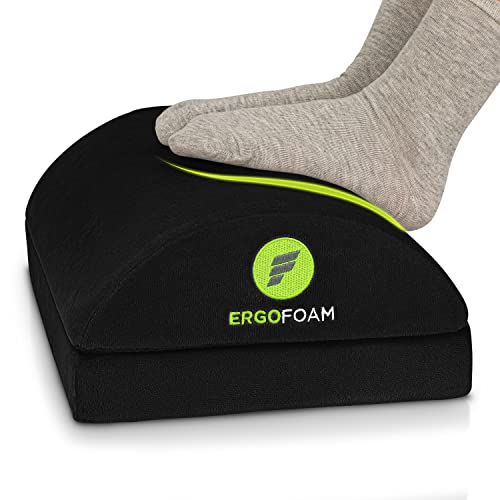
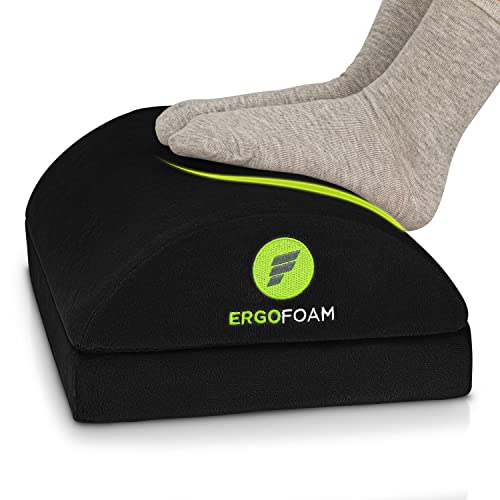
ErgoFoam Foot Rest for Under Desk
An adjustable foam footrest that completes the system when your correct chair height — set to match a higher desk — leaves your feet unsupported. ErgoFoam Foot Rest for Under Desk — Check on Amazon

VIVO Premium Aluminum Single Monitor Desk Mount
A height-adjustable single monitor mount for screens up to 32 inches that sets screen height from your eye level, independent of whatever height your desk happens to be. VIVO Premium Aluminum Single Monitor Desk Mount — Check on Amazon
Frequently Asked Questions
What is the standard desk height?
Most fixed desks cluster in the low-to-mid 70s of centimetres, roughly 28–30 inches, a standard inherited from typewriter-era office furniture. It fits average proportions reasonably and both tails of the height distribution poorly, which is the entire reason adjustable desks exist.
How do I measure my ideal desk height without special equipment?
Sit in your work chair with feet flat and knees at about ninety degrees, bend your elbows to a right angle with forearms level, and measure from the floor to the underside of your elbow. A tape measure and two minutes are all it takes; repeat standing if you use or want a sit-stand desk.
My desk is a few centimetres too high. Must I replace it?
Almost certainly not. Raise your chair until your elbows meet the surface correctly, then support your feet on a footrest so they are not dangling. That combination fully compensates for small mismatches and is the standard ergonomic fix.
Should a standing desk's height equal my seated height plus a fixed amount?
No — measure it directly. Stand in your work shoes with elbows at a right angle and measure floor to elbow. Body proportions vary enough that any fixed offset rule will miss for many people, and the direct measurement takes the same two minutes.
Does ideal desk height change with the task?
Slightly. Writing by hand often feels better a touch higher than typing, and drawing or drafting traditionally uses higher or tilted surfaces. For mixed work, set the desk for your dominant task — usually typing — and let accessories handle the exceptions.
What desk height suits someone around five feet two inches tall?
Below the standard, in almost every case — which is precisely why the standard desk feels like it was built for somebody else. Work the chain from the floor: feet flat, chair at the height your knees dictate, then elbows measured from that seat. Most petite users land on a surface several centimetres under the standard figure, reachable by an adjustable desk at its low end, a lower fixed desk, or a standard desk combined with a raised chair and a footrest — the last being the commonest real-world solution and a perfectly good one when the footrest is firm, angled, and always in place.
Does an anti-fatigue mat change my ideal standing height?
Yes, by exactly its thickness. The mat raises you, so the desk must rise by the same amount to keep your elbows at their angle — or, if the desk is fixed, recognise that the mat has effectively lowered it relative to you. Set standing presets standing on the mat, and if you sometimes work without it, that is what a second memory preset is for. It is a small correction that people feel without ever diagnosing, usually as a faint sense that the standing position is better some days than others.
My desk is the right height but my wrists still ache. What else could it be?
Height is one variable in a system. Wrist ache at a correct height points next to the keyboard’s own slope — many keyboards tilt the wrong way for flat wrists — to a mouse that forces the hand to hover or claw, to a chair whose armrests hold your elbows higher than the desk does, or to workload: unbroken typing hours will tax wrists at any height. Work through the setup in our ergonomic desk setup guide in order, and if ache persists with numbness or tingling, treat it as a medical question rather than a furniture one.
Is the standard desk height ever going to change?
Slowly, if at all. The standard is embedded in a century of furniture, office fit-outs, and manufacturing tooling, and populations change height gradually. What is changing faster is the furniture’s adjustability: as height-adjustable desks spread, the standard matters less, because each desk finds its user’s number instead of the population’s. The standard’s real future is as a starting point — the height a desk ships at, before its owner teaches it the correct one.
Should a treadmill desk be set at the same height as a standing desk?
Slightly differently, because walking changes the geometry: your body bobs gently as you walk, your arms swing and settle, and most walkers prefer the surface a touch higher than their still-standing ideal so the forearms rest securely while the body moves. Set it while walking at your working speed, typing a real paragraph, and judge by whether your shoulders stay down and your wrists stay flat through the bob. Fine-tune in small steps across several sessions; treadmill desks reward patience because the walking itself takes days to stop feeling novel.
My chair will not go low enough for my desk. Which one is wrong?
Possibly neither — they may simply be a mismatched pair, because chair ranges and desk heights are standardised separately and the extremes do not always meet. Work the chain in order: feet flat first, which fixes the chair height your body needs; if the chair cannot reach it, the chair is the problem for you, whatever its brochure says. If the chair reaches your seated height but your elbows then sit below the desk surface, the desk is too high for the pair, and the corrections are the ones this guide details — raise the chair and support the feet, or lower the desk’s effective height. Diagnose by the chain, not by which item cost more.
Should my desk height change between summer and winter?
Only through your footwear and clothing, but those are real: thick-soled winter shoes raise your standing elbow height, and a heavy jumper changes nothing at the elbow but can change how your forearms rest. In practice the differences sit inside the forgiving zone for sitting, and matter mainly for standing presets — which is why adjustable-desk owners often keep a seasonal pair of presets without ever having decided to.
Do I measure desk height to the top of the desk or underneath it?
To the top — the surface your forearms and keyboard rest on is the height your body experiences. The underside measurement matters for a different question, thigh and knee clearance, and listings occasionally quote it instead, which is one reason two desks with the same stated height can feel different. When comparing, confirm which surface each number describes before trusting the comparison.
The Bottom Line
The ideal desk height is your elbow height: forearms level, shoulders relaxed, feet supported. Measure it seated and standing, treat the standard height as a guess that happens to fit the average, and fix mismatches with the chair-and-footrest combination before you think about replacing furniture.
Related Guides
Apply the number in the full ergonomic setup, read the principles behind it, and browse height-focused desk roundups: