Where to buy
These are the three picks from our wifi extender black friday deals shortlist we would check first. Check the latest price, availability and delivery on Amazon. Orders are placed on Amazon, and prices during Black Friday Week can change by the hour, so the figure on the live listing is the one that counts. We may earn a commission from qualifying purchases.
- Best overall: TP-Link AX3000 WiFi 6 Range Extender (RE715X)
- Best Wi-Fi 7: NETGEAR Nighthawk WiFi 7 Extender (EXS27)
- Best value: TP-Link AC1900 WiFi Range Extender (RE550)
Disclosure: As an Amazon Associate, ilcastellomenu.com earns from qualifying purchases. Links to Amazon on this page are affiliate links; they cost you nothing extra. Listing details such as price and availability change often — during this event they can change several times a day — so check the current Amazon listing before you buy.
WiFi Extender Black Friday Deals: Fix the Dead Zone, Not the Whole Network
Amazon Black Friday Week runs from November 19 to November 30, 2026. Black Friday itself is November 27, and Cyber Monday closes the event on November 30. A Wi-Fi extender is the smallest, cheapest network upgrade there is, and it solves the most common home network complaint of all: the router is fine, the broadband is fine, but one room — the back bedroom, the home office over the garage, the far end of a long flat — sits in a dead zone where video calls freeze and pages crawl. These wifi extender black friday deals are the six we would actually spend money on: a Wi-Fi 6 all-rounder that has earned its best-overall slot, two Wi-Fi 7 extenders for households already running the newest routers, a Nighthawk built for people who want a wired port that behaves, a proven AC1900 value pick, and a budget plug that costs less than a takeaway pizza and still fixes a single stubborn room.
Every price in this guide was checked against Amazon’s own catalogue data on November 20, 2026, and every price is written as a dated sighting: “seen at $76.49 on November 20, 2026” means exactly that, no more. Extender prices move hourly during Black Friday Week, and the category is full of inflated list prices designed to make a modest discount look heroic, which is why we only print a percentage where the catalogue returned both a current price and a list price for the same listing. Where no list price came back, we print no percentage at all. Always check the live price on the listing before you buy — and check the model code twice, because extender families reuse near-identical names across three generations of Wi-Fi.
One idea matters more than any single discount here, and it is placement. An extender does not create signal; it repeats the signal it receives. Plugged into a socket in the dead zone itself, it faithfully repeats a weak, slow connection and your speed barely improves. Plugged in halfway between the router and the dead zone, where the router’s signal is still strong, it rebroadcasts a healthy connection into the room that needs it. Every review below is written with that reality in mind: coverage figures are the makers’ figures under ideal conditions, device counts assume a mix of light and heavy clients, and the honest question is never “how fast is this extender” but “how good is the signal where I plan to put it.” If your whole home struggles — not one room but every room — an extender is the wrong tool and a mesh system is the right one; our companion roundup of Wifi 7 Router Black Friday Deals Wifi7routerblackfridaydeals covers the router-and-mesh side of that decision.
It also helps to know which generation you are extending. A Wi-Fi 6 extender paired with a Wi-Fi 6 router preserves the efficiency features — OFDMA, better handling of many small devices — that make modern networks feel responsive. A Wi-Fi 7 extender only shows its advantages alongside a Wi-Fi 7 router; plugged into an older network it still works, politely, at the older network’s speed. The picks below are labelled by generation precisely so you can match extender to router instead of buying a headline.
In this guide
Quick Picks
Short on time? These are the six deals, the buyer each one suits, and the price we verified on November 20, 2026. Every price is a dated sighting — check the live price before you buy.
| Best for | Deal | Spotted price | Link |
|---|---|---|---|
| Best overall | TP-Link AX3000 WiFi 6 Range Extender (RE715X) | seen at $76.49 on November 20, 2026 (list $89.99) | Check on Amazon |
| Best Wi-Fi 7 | NETGEAR Nighthawk WiFi 7 Extender (EXS27) | seen at $99.99 on November 20, 2026 (list $149.99) | Check on Amazon |
| Best Wi-Fi 7 value | TP-Link BE3200 Wi-Fi 7 Range Extender (RE223BE) | seen at $80.69 on November 20, 2026 (list $119.99) | Check on Amazon |
| Best with Ethernet | NETGEAR Nighthawk WiFi Extender (EAX17) | seen at $87.29 on November 20, 2026 (list $129.99) | Check on Amazon |
| Best value | TP-Link AC1900 WiFi Range Extender (RE550) | seen at $34.88 on November 20, 2026 (list $49.99) | Check on Amazon |
| Best budget | TP-Link AC1200 WiFi Extender (RE315) | seen at $19.99 on November 20, 2026 (list $29.99) | Check on Amazon |
How These Deals Were Chosen
We verified every pick in this guide the slow way: by searching Amazon’s own catalogue data for the exact brand and model, matching the returned listing title against the extender we intended to recommend, and recording the price and list price the catalogue returned on November 20, 2026. That process eliminates the two failure modes that fill most Black Friday roundups — links that land on a different hardware revision or a renewed unit than the headline promises, and “deals” whose prices were copied from roundup to roundup until nobody knows which year they belong to. Extenders are especially treacherous here: the same retail name can cover a Wi-Fi 5 plug from 2019 and a Wi-Fi 6 model from last year, and marketplace sellers price both as if they were the new one. Where a search did not return a listing we could match with confidence, the extender did not get a link, however good it looked.
A deal then had to clear three further bars. First, the product had to be a current extender from its maker’s present range, sold as new — renewed and refurbished listings appeared in our searches and were deliberately set aside, because a network device you will troubleshoot at midnight should come with a full warranty and a clean setup history. Second, the specification had to be honest at the price: the Wi-Fi generation, the maker’s coverage figure and the port arrangement stated in the review had to come from the verified listing. Third, the price had to be a price worth printing. Extenders live under permanent “sale” banners, so we favoured listings where the verified price sat meaningfully below the list price returned alongside it — five of the six picks here clear thirty percent on the verified figures, and the sixth is the guide’s best overall on merit rather than discount depth.
We also weighted what an extender is actually for. Raw speed classes — AX3000, BE5000 — describe the link between extender and router under laboratory conditions, not the speed a laptop in the far bedroom will see, which is governed by the signal at the extender’s socket and the hop back to the router. So the reviews give as much weight to placement aids, app setup, mesh compatibility and the humble Ethernet port as to the headline class. A slower extender in the right socket beats a faster one in the wrong socket every single time, and the buying advice in this guide is organised around that truth.
The Six Deals, In Detail

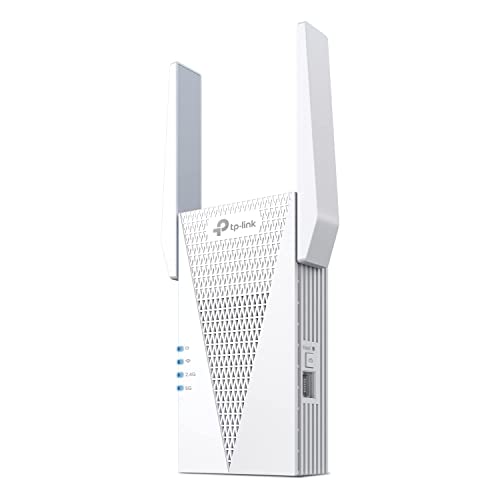
1. TP-Link AX3000 WiFi 6 Range Extender (RE715X) — Best Overall
Badge: Best Overall. If one extender defines the sensible purchase for the typical home in 2026, it is this one. The RE715X is a dual-band Wi-Fi 6 range extender in the AX3000 class, rated by the maker to cover up to 2,400 square feet and serve up to 64 devices per the verified listing, with an Ethernet port for wiring a nearby device and support for TP-Link’s EasyMesh so it can join a compatible TP-Link router as one seamless network rather than a separate network name. It has collected the kind of editorial recognition that budget plugs never get, and the reason is balance: fast enough that the hop back to the router stops being the bottleneck for most broadband connections, modern enough to preserve Wi-Fi 6’s efficiency with dozens of small smart-home clients chatting at once, and priced — at this sighting — in the band where an extender makes more sense than replacing the router. Setup runs through TP-Link’s app, which walks placement with a signal indicator; that indicator, used honestly, is worth more than any speed class printed on the box.
Spec snapshot: Dual-band Wi-Fi 6, AX3000 class; up to 2,400 sq. ft. and 64 devices (maker’s figures); Ethernet port; EasyMesh compatible; app setup.
Who it suits: Households with a Wi-Fi 6 router and one or two problem rooms; home workers whose office sits at the far end of the house; anyone who wants the extender decision finished in one purchase.
Deal details: Seen at $76.49 on November 20, 2026, against an $89.99 list price returned by the same catalogue check — 15% below list on the verified figures, the shallowest percentage in this guide. We keep it at pick one anyway, because the comparison that matters is what the money buys: the strongest all-round specification here, at an absolute price below both Wi-Fi 7 picks and the Nighthawk. A shallow discount on the right product beats a deep discount on the wrong one, and this guide exists to say so. Check the live price before you buy.
Strengths
- Wi-Fi 6 AX3000 link keeps the extender hop from bottlenecking typical broadband.
- EasyMesh support means one network name and clean roaming with TP-Link routers.
- Ethernet port doubles as a wired bridge for a TV, console or desktop.
Trade-offs
- Shallowest discount here — 15% below list on the verified figures.
- No 6 GHz band; Wi-Fi 7 households should look at picks two and three.
- Full speed still depends on placing it where the router signal is strong.
Verdict — Best for: Wi-Fi 6 homes fixing one or two dead zones properly. Not suited for: whole-home coverage problems, which need mesh, or Wi-Fi 7 networks chasing the newest band. Check on Amazon · See the RE715X listing · View full specs and the live price
2. NETGEAR Nighthawk WiFi 7 Extender (EXS27) — Best Wi-Fi 7
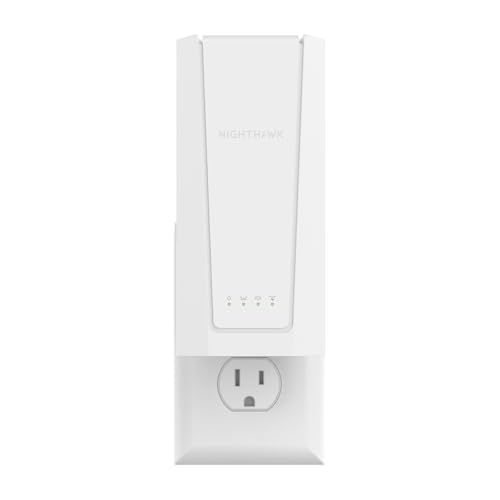
Badge: Best Wi-Fi 7. The newest generation of extending belongs to NETGEAR’s Nighthawk line, and the EXS27 is its sensible face: a Wi-Fi 7 extender in the BE5000 class, rated by the maker for up to 1,500 square feet and up to 45 devices per the verified listing, with a 2.5-gigabit Ethernet port — a detail that matters, because it lets the extender feed a wired device, or act as a fast access point on a wired backhaul, without the port becoming the ceiling. It works with any router, which makes it the natural partner for an ISP-supplied Wi-Fi 7 gateway you are not allowed to replace, or a premium Wi-Fi 7 router whose coverage stops one room short. Wi-Fi 7’s multi-link operation only engages with a Wi-Fi 7 router, and the review would be dishonest not to say so plainly: pair this with an older router and you have bought an expensive Wi-Fi 6-class extender. Paired correctly, it is the most future-proof plug in this guide.
Spec snapshot: Wi-Fi 7, BE5000 class (up to 5 Gbps per maker); up to 1,500 sq. ft. and 45 devices (maker’s figures); 2.5G Ethernet port; works with any router.
Who it suits: Wi-Fi 7 router owners with a single dead zone; households with fast fibre whose far rooms waste it; anyone who wants the wired port to be genuinely fast.
Deal details: Seen at $99.99 on November 20, 2026, against a $149.99 list price returned by the same catalogue check — 33% below list on the verified figures, and a round-figure sighting that puts the newest generation under a hundred dollars for the first time in this category’s sale history. That is the story of this pick: not the percentage, but the threshold. Check the live price before you buy, and check your router’s generation before you buy at all.
Strengths
- Genuine Wi-Fi 7 with MLO headroom when paired with a Wi-Fi 7 router.
- 2.5G Ethernet port — the fastest wired option in this guide.
- Router-agnostic: works with any brand, including ISP gateways.
Trade-offs
- Wi-Fi 7 advantages need a Wi-Fi 7 router; otherwise it runs as a lesser extender.
- Maker’s coverage figure (1,500 sq. ft.) is the smallest here — it is a one-room tool.
- The guide’s highest extender price, however good the sighting.
Verdict — Best for: Wi-Fi 7 households with one room to fix and fast broadband to protect. Not suited for: Wi-Fi 5 or Wi-Fi 6 networks, where pick one does the same job for less. Check on Amazon · See the EXS27 listing · View full specs and the live price

3. TP-Link BE3200 Wi-Fi 7 Range Extender (RE223BE) — Best Wi-Fi 7 Value
Badge: Best Wi-Fi 7 Value. TP-Link’s answer to the Nighthawk above trades headline class for coverage and price, and for many homes it is the smarter trade. The RE223BE is a dual-band Wi-Fi 7 extender in the BE3200 class — 3.2 Gbps in the maker’s framing — rated for up to 2,400 square feet and 64 devices per the verified listing, with an Ethernet port, multi-link operation and EasyMesh support. One specification must be read exactly as the listing states it: there is no 6 GHz band. This is dual-band Wi-Fi 7, which still brings MLO and the generation’s efficiency gains on the 5 GHz and 2.4 GHz bands, but buyers dreaming of a dedicated 6 GHz backhaul should choose pick two or step up to a mesh system. Judged as what it is — the cheapest route into Wi-Fi 7 extending, with the joint-largest coverage claim in this guide — it earns its slot comfortably.
Spec snapshot: Dual-band Wi-Fi 7, BE3200 class (3.2 Gbps per maker); up to 2,400 sq. ft. and 64 devices (maker’s figures); Ethernet port; MLO; EasyMesh; no 6 GHz band.
Who it suits: TP-Link Wi-Fi 7 households; larger flats where coverage area matters more than peak class; buyers who want Wi-Fi 7 features without the Nighthawk’s price.
Deal details: Seen at $80.69 on November 20, 2026, against a $119.99 list price returned by the same catalogue check — 33% below list on the verified figures. The comparison that flatters it most is against pick one: for a few dollars more than the Wi-Fi 6 best-overall at its sighting, this pick adds a newer generation and the same coverage claim. If your router is Wi-Fi 7 and TP-Link, this is arguably the guide’s best-matched buy. Check the live price before you buy.
Strengths
- Wi-Fi 7 with MLO at a Wi-Fi 6-class price at this sighting.
- Up to 2,400 sq. ft. maker coverage — joint-largest claim in the guide.
- EasyMesh pairing makes it a true single-network extension for TP-Link homes.
Trade-offs
- No 6 GHz band — read the listing’s own wording before expecting tri-band behaviour.
- BE3200 class trails pick two’s BE5000 on the router hop.
- Like all extenders, real coverage depends entirely on socket placement.
Verdict — Best for: Wi-Fi 7 TP-Link homes wanting coverage per dollar. Not suited for: buyers who specifically need a 6 GHz backhaul — that is pick two or a mesh kit. Check on Amazon · See the RE223BE listing · View full specs and the live price

4. NETGEAR Nighthawk WiFi Extender (EAX17) — Best With Ethernet
Badge: Best With Ethernet. Some dead zones contain a desk, and a desk changes what “fixed” means: the laptop, dock or desktop in that room does not merely want stronger Wi-Fi, it wants a wire. The EAX17 is NETGEAR’s Wi-Fi 6 answer in the AX3000 class, rated by the maker for up to 1,500 square feet and up to 20 devices per the verified listing, with a gigabit Ethernet port that turns the extender into a wireless bridge — place it where the router’s signal is still strong, then run a short cable from extender to desk, and the room’s main machine gets a wired connection without a wired house. The device count in the listing is the honest tell about its role: twenty devices is a room, not a floor of a house. Within that role it is excellent, and Nighthawk build and setup polish justify its price over the no-name bridges that crowd this niche. Buyers whose dead zone is a living-room TV corner can use the same trick for a streaming box that hates buffering.
Spec snapshot: Wi-Fi 6, AX3000 class (up to 3 Gbps per maker); up to 1,500 sq. ft. and 20 devices (maker’s figures); 1G Ethernet port; works with any router.
Who it suits: Home offices in dead zones; gamers who want a wired-feeling connection without running cable through walls; anyone bridging one desk or one media corner.
Deal details: Seen at $87.29 on November 20, 2026, against a $129.99 list price returned by the same catalogue check — 33% below list on the verified figures. It costs more than pick one for a narrower job, and the review will not pretend otherwise; what the premium buys is NETGEAR’s implementation of the bridge role and a port arrangement aimed at exactly the desk scenario. If your dead zone has no desk in it, pick one is the better spend. Check the live price before you buy.
Strengths
- Gigabit port makes it a proper wireless bridge for a desk or console.
- AX3000 Wi-Fi 6 hop keeps bridged speeds high on typical broadband.
- Works with any router brand — no ecosystem lock-in.
Trade-offs
- Maker’s 20-device figure marks it as a one-room tool, not a floor-wide fix.
- Costs more than pick one while covering a smaller claimed area.
- Wi-Fi 6 generation — Wi-Fi 7 homes should start at picks two and three.
Verdict — Best for: dead-zone desks and wired-bridge duties. Not suited for: spreading coverage across several rooms — that is pick one’s job, or mesh. Check on Amazon · See the EAX17 listing · View full specs and the live price

5. TP-Link AC1900 WiFi Range Extender (RE550) — Best Value
Badge: Best Value. Not every network needs the newest generation; some need a reliable plug that lifts a Wi-Fi 5 router’s signal into the spare room and then disappears from your life. The RE550 is that plug, matured: a dual-band AC1900 extender rated by the maker for up to 2,200 square feet and 32 devices per the verified listing, with a gigabit Ethernet port, app setup and EasyMesh compatibility. Its Wi-Fi 5 radio is the honest limitation — paired with a Wi-Fi 6 or 7 router it becomes the slow hop in the chain — but in the millions of homes still running the router their ISP gave them two generations ago, it matches the network it extends, and matching is what extending is about. The three-antenna design and the mature firmware of a model that has been refined rather than replaced make it the lowest-risk purchase in this guide: everything about it is known.
Spec snapshot: Dual-band Wi-Fi 5, AC1900 class; up to 2,200 sq. ft. and 32 devices (maker’s figures); gigabit Ethernet port; app setup; EasyMesh compatible.
Who it suits: Wi-Fi 5 households; renters fixing one room without touching the router; anyone extending to a TV, printer or smart-home cluster rather than a gaming desk.
Deal details: Seen at $34.88 on November 20, 2026, against a $49.99 list price returned by the same catalogue check — 30% below list on the verified figures. The framing that matters: this is gigabit-port, 2,200-square-foot-claim extending for roughly half the sighting price of pick one. If your router predates Wi-Fi 6, the money saved here is better spent later on the router upgrade itself. Check the live price before you buy.
Strengths
- Proven, refined design — the lowest-risk purchase in the guide.
- Gigabit Ethernet port at a budget-adjacent price.
- Large maker coverage claim (2,200 sq. ft.) for a value pick.
Trade-offs
- Wi-Fi 5 radio bottlenecks a Wi-Fi 6 or 7 router’s faster clients.
- No mesh-band sophistication of the newer picks; placement matters even more.
- Buying it today for a router you plan to replace this year is false economy.
Verdict — Best for: Wi-Fi 5 homes and renters fixing one room cheaply and reliably. Not suited for: Wi-Fi 6/7 networks, where it becomes the slow hop. Check on Amazon · See the RE550 listing · View full specs and the live price
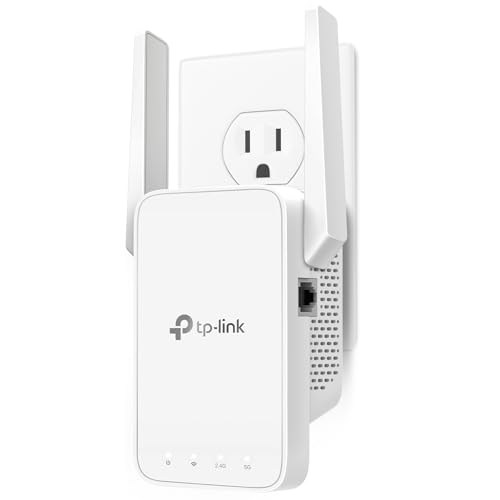
6. TP-Link AC1200 WiFi Extender (RE315) — Best Budget
Badge: Best Budget. Every guide needs the pick that proves the floor has risen, and this is it: a dual-band AC1200 extender rated by the maker for up to 1,600 square feet and 32 devices per the verified listing, with one Ethernet port and EasyMesh compatibility, at the lowest verified price here. The RE315 will not thrill a speed test — AC1200 is a modest class, and its single Ethernet port serves one wired device at a time — but most dead zones are not speed problems. They are presence problems: the smart TV that will not hold a connection, the bedroom where a phone drops to one bar, the hallway camera that goes offline at night. For presence, a correctly placed budget extender is not a compromise at all; it is the whole solution, and the money left over buys the next upgrade somewhere it will actually be felt. Judge it as what it is — the cheapest credible way to make a forgotten room usable — and it has no weak point.
Spec snapshot: Dual-band Wi-Fi 5, AC1200 class (1.2 Gbps per maker); up to 1,600 sq. ft. and 32 devices (maker’s figures); one Ethernet port; EasyMesh compatible.
Who it suits: Single-room presence problems; smart TVs, cameras and casual browsing in a far room; first-time extender buyers testing whether extending solves their problem at all.
Deal details: Seen at $19.99 on November 20, 2026, against a $29.99 list price returned by the same catalogue check — 33% below list on the verified figures. Under twenty dollars for a named-brand dual-band extender with mesh compatibility is the kind of sighting this event exists for. One honest caution: if your dead zone contains a working-from-home desk, stretch to pick one or four instead — the saving is small against a week of frozen calls. Check the live price before you buy; budget listings are among the most volatile of the event.
Strengths
- Dual-band extending under $20 at this sighting — the guide’s lowest price.
- EasyMesh compatibility at a budget price is genuinely unusual.
- Perfectly matched to presence problems: TVs, cameras, casual browsing.
Trade-offs
- AC1200 class caps speeds well below the Wi-Fi 6 picks.
- Single Ethernet port, and modest hardware for many simultaneous heavy clients.
- Not a work-from-home desk solution — picks one and four exist for that.
Verdict — Best for: one stubborn room and a strict budget. Not suited for: home-office desks or speed-hungry streaming over distance. Check on Amazon · See the RE315 listing · View budget specs and the live price
Deals We Left Out, and Why
A guide is defined as much by what it excludes. Our catalogue checks surfaced plenty of other extender listings on November 20, 2026, and several tempting ones did not make the cut. Single-band 2.4 GHz-only plugs — the cheapest listings in the category — were passed over on arithmetic: a single-band extender repeats on the same channel it receives, halving an already slow band, and dual-band picks now sit within a few dollars of them at sale prices. Renewed and refurbished versions of good extenders appeared at small discounts and were set aside deliberately; a network device belongs on a full warranty, and the saving rarely survives one troubleshooting evening. No-name extenders advertising enormous coverage figures with no verifiable maker behind them were excluded entirely — coverage claims are soft enough from established brands. Finally, several listings carried prices identical to the figures those same models wear outside the event. A Black Friday banner on an everyday price is marketing, not a deal, and this guide exists to tell the two apart.
Comparison Table
| Pick | Generation / class | Maker’s coverage | Seen Nov 20, 2026 | Watch out for |
|---|---|---|---|---|
| TP-Link RE715X | Wi-Fi 6, AX3000 | Up to 2,400 sq. ft. | $76.49 (list $89.99) | Shallow discount; no 6 GHz |
| NETGEAR EXS27 | Wi-Fi 7, BE5000 | Up to 1,500 sq. ft. | $99.99 (list $149.99) | Needs a Wi-Fi 7 router |
| TP-Link RE223BE | Wi-Fi 7, BE3200 | Up to 2,400 sq. ft. | $80.69 (list $119.99) | No 6 GHz band |
| NETGEAR EAX17 | Wi-Fi 6, AX3000 | Up to 1,500 sq. ft. | $87.29 (list $129.99) | One-room, 20-device role |
| TP-Link RE550 | Wi-Fi 5, AC1900 | Up to 2,200 sq. ft. | $34.88 (list $49.99) | Wi-Fi 5 radio |
| TP-Link RE315 | Wi-Fi 5, AC1200 | Up to 1,600 sq. ft. | $19.99 (list $29.99) | Modest speed class |
Extender, Mesh or New Router: Which Problem Do You Actually Have?
Three products get confused because they all promise “better Wi-Fi,” and choosing between them honestly saves more money than any discount. An extender repeats one router’s signal into one area. It is the right tool when the network is healthy in most of the home and fails in one or two specific places — a bedroom, an office, a garden room. A mesh system replaces the router with two or three cooperating nodes and is the right tool when the network fails in several places, when the home is large or built from signal-eating materials, or when people roam between rooms on calls all day and feel every handover. A new router is the right tool when the network is slow everywhere, when the current router predates Wi-Fi 6, or when the device count has outgrown an ISP box — no extender fixes a router that is itself the bottleneck, because the extender can only repeat what the router provides.
The practical test takes five minutes. Stand beside the router and run a speed test; then run the same test in the problem room. If the beside-router result is close to the speed you pay your ISP for and the problem-room result collapses, you have a coverage problem and this guide applies. If the beside-router result is already far below your plan, you have a router or line problem, and an extender will faithfully extend a bad connection. In that case the money belongs in a router first, and only then, if one room still lags, in an extender from this page.
How to Choose the Right Extender for Your Home
Match the generation to your router. Wi-Fi 7 router: picks two or three. Wi-Fi 6 router: pick one, or pick four if the room holds a desk. Wi-Fi 5 router: pick five, or pick six for a single casual room. An extender one generation above the router still works but spends money on capability the router cannot feed.
Count rooms, not square feet. Makers’ coverage figures assume open space; walls, floors and metal appliances tax every hop. One problem room: any pick here, sized by the work done in it. Two adjacent problem rooms: pick one or three, placed centrally to both. Problem rooms at opposite ends of the house: that is two extenders, or — usually better — the mesh conversation above.
Decide whether the room needs a wire. Desks, consoles and streaming boxes all behave better wired. If the room holds any of them, insist on an Ethernet port — every pick here has one, but picks two and four make the port itself a feature, at 2.5-gigabit and gigabit grade respectively.
Three example shopping lists. For a Wi-Fi 6 flat with a bedroom dead zone: pick one. For a Wi-Fi 7 house with fast fibre and a far office: pick two, wired to the desk. For an ISP-router rental with one stubborn TV room: pick six, and keep the change.
How to Check an Extender Deal Is Real — and Place It Right
Compare the sale price with the model’s own history. Extenders live under permanent discount banners, so the useful habit is checking what a model sold for before the event. Free price-history trackers keep years of Amazon data for most listings; thirty seconds there tells you whether a discount is a genuine event low or a list price nobody has paid since spring. Every pick in this guide was verified against live catalogue data on November 20, 2026 — do the same check on anything else you add to the cart.
Read the model code letter by letter. Extender families span generations under near-identical names: the difference between a Wi-Fi 5 plug and its Wi-Fi 6 successor is a suffix, and listings during big events are where old stock goes to be mistaken for new. The model code and the Wi-Fi generation are the product — check both before you pay.
Check the price at checkout, not just on the page. Prices move hourly during Black Friday Week, and the price in the cart is the price you pay. If a figure jumps between the deal page and checkout, back out and re-check the listing — either the deal ended, or a marketplace seller’s offer has replaced the one you chose.
Place it like you mean it. Start halfway between router and dead zone, in a socket where your phone still shows a strong router signal — then test, move one room closer or further, and test again. Keep the extender off the floor, away from metal cabinets and microwave ovens, and give it a day of real use before judging: roaming behaviour and band steering settle with real traffic. If the app offers a signal-strength readout for the extender’s own connection, that number — not the speed in the far room — is the one to optimise first. Save the order confirmation and the box until the return window closes; holiday windows are longer than usual, which quietly makes this the safest week of the year to experiment with placement.
Running Two Extenders, Guest Networks and Other Edge Cases
A few situations sit outside the standard one-router, one-extender story, and they are worth a clear pass before you buy. Running two extenders is legitimate when dead zones sit at opposite ends of a long home — but daisy-chaining one extender off another is not: each hop repeats an already-repeated signal, latency climbs and speeds collapse. Place both extenders within honest reach of the router itself, each serving its own end of the house, or accept that the layout is asking for mesh. Guest networks deserve a thought, too: most extenders rebroadcast your main network, and not all of them carry a separate guest SSID cleanly, so if visitors must be kept off your main network, check the listing’s wording or let guests connect to the router’s own guest band within its range. Smart-home devices add a third wrinkle — many only speak 2.4 GHz, and an extender that merges bands under one name can confuse their setup apps; the fix is usually a temporary separate 2.4 GHz name during pairing, which both TP-Link’s and NETGEAR’s apps allow. Finally, outdoor coverage — a garden office, a driveway camera — is where indoor extenders meet their limit: a unit placed inside by the nearest window often does the job, but no pick in this guide is weather-rated, and none should live outside. Treat these cases honestly and the extender you buy will behave the way the reviews above promise.
Common Mistakes
Plugging the extender into the dead zone. The classic error. An extender in the room with no signal repeats no signal. Halfway is the rule; the app’s signal indicator is the referee.
Buying an extender for a router problem. If speeds are poor beside the router, extending spreads the problem rather than solving it. Test beside the router first.
Mismatching generations. A Wi-Fi 7 extender on a Wi-Fi 5 router is money spent on a conversation only one side can have. Match the extender to the router you own, not the one you admire.
Expecting one extender to fix a whole large home. Coverage figures are ideal-condition claims. Several failing rooms means mesh, and forcing an extender into that role produces the reviews that say extenders do not work.
Waiting for Black Friday itself. The event runs November 19–30, and the early days carry full stock at full discount. Waiting for November 27 out of tradition mostly buys sold-out listings and marketplace markups. If the price is at its low today, today is the day — especially when the desk you are fixing is the one you will work from on Monday.
Final Recommendation
If you buy one extender this Black Friday Week and your router is Wi-Fi 6 — most are — make it the TP-Link RE715X, seen at $76.49 on November 20, 2026: the balanced specification, the mesh compatibility and the Ethernet port suit more homes than any other pick. Wi-Fi 7 households should choose between the NETGEAR EXS27 at a seen $99.99 for its 2.5-gigabit port and peak class, and the TP-Link RE223BE at a seen $80.69 for coverage per dollar. Desk-bound dead zones belong to the EAX17 at a seen $87.29, Wi-Fi 5 homes to the RE550 at a seen $34.88, and single stubborn rooms to the RE315 at a seen $19.99. And if your five-minute test says the router itself is the problem, spend the money there instead — and check the live price before you buy, because during this event the listing is the only price that is real.
Frequently Asked Questions
When do Wi-Fi extender deals run on Amazon in 2026?
Amazon Black Friday Week runs November 19–30, 2026, with Black Friday on November 27 and Cyber Monday on November 30. Networking deals appear throughout the window rather than all at once, and popular models can sell through early — the prices in this guide were verified on November 20, 2026.
Are the prices in this guide guaranteed?
No. Every price here is a dated sighting verified against Amazon catalogue data on November 20, 2026, and prices move hourly during the event. Treat a sighting as evidence of what the deal has cost, then check the live price on the listing before you buy.
Will an extender slow down my Wi-Fi?
An extender adds a hop, and a poorly placed one can halve the speed it delivers. A well-placed dual-band extender — strong router signal at its socket, clients connecting on the cleaner band — delivers most of the router’s speed to a room that previously had almost none. The relevant comparison is never extender versus router-side speed; it is extender versus the dead zone you have now.
What is the difference between an extender and a mesh system?
An extender repeats one router’s signal into one area, cheaply and simply. A mesh system replaces the router with cooperating nodes that blanket the whole home and hand devices between them seamlessly. One or two bad rooms: extender. A whole home that struggles: mesh — our router and mesh coverage sits alongside this guide for exactly that decision.
Where exactly should I plug in an extender?
Halfway between the router and the dead zone, where the router’s signal is still strong — typically strong enough that your phone shows near-full bars and a speed test there returns most of your plan speed. Use the maker’s app signal indicator, test the far room, then adjust by one room in either direction. Never place it inside the dead zone itself.
Should I wait for Cyber Monday instead?
Cyber Monday (November 30, 2026) usually repeats some Black Friday pricing and adds a few fresh offers, but stock is the risk: models that sell out during Black Friday Week do not reliably come back for Monday. If a price matches the level you were waiting for now, buying now is the safer play.
Related Guides
- Wifi 7 Router Black Friday Deals Wifi7routerblackfridaydeals
- Black Friday Monitor Deals 2026 Blackfridaymonitordeals2026
- Nvme Ssd Black Friday Deals Nvmessdblackfridaydeals
- Computer Desk Black Friday Deals Computerdeskblackfridaydeals
- Motherboard Black Friday Deals Motherboardblackfridaydeals