Disclosure: As an Amazon Associate, ilcastellomenu.com earns from qualifying purchases. Links on this page are affiliate links; they cost you nothing extra. Prices and availability change often, so check the current Amazon listing before you buy.
These wireless presenter remote reviews gather the five models that define the category and judge them the way presenters actually use them: in the hand, in a hurry, in a room that is not theirs. A wireless presenter remote lives or dies on trust, so each review below weighs connection reliability, button confidence, pointing method, and the small design decisions that matter at minute forty of a lecture. Whether you land on the Logitech Spotlight, the Logitech R500s, the Kensington Expert Wireless Presenter, the Canon PR1100-R, or the DinoFire Wireless Presenter, you will know exactly what you are choosing and what you are giving up.
Key Takeaways
- The Logitech Spotlight is the pick for modern screens and streamed talks, thanks to its digital highlight and magnification.
- The Logitech R500s is the safest all-round recommendation for everyday presenting on any computer.
- The Kensington Expert Wireless Presenter serves lecturers who need real cursor control from the floor.
- The Canon PR1100-R is the boardroom-friendly clicker a whole team can share without a learning curve.
- The DinoFire Wireless Presenter covers the essentials at the entry tier for occasional presenters.
In this guide
How These Wireless Presenter Remote Reviews Were Judged
Every model here was assessed against the same five questions. First, does it connect instantly and stay connected at the back of a normal room? Second, can you operate it entirely by feel, eyes on the audience? Third, does its pointing method suit the screens presenters actually face today, from ageing projectors to bright video walls? Fourth, what happens when something goes wrong: a flat battery, a lost receiver, a borrowed laptop? Fifth, does the design respect the safety duties that come with a laser, or avoid the laser entirely? A model does not need to win every question; it needs to win the questions your presenting asks most often. The companion the single-product review explores the category itself in depth, while this page concentrates on the individual models.
The Models in Detail
Logitech Spotlight — premium tier
The Logitech Spotlight takes a different approach from a classic clicker: instead of a laser dot, it places a digital highlight on the screen that you can resize, magnify with, and use to spotlight a figure or a sentence while the rest of the slide dims. Because the highlight is software, it works on video walls, on large LED displays where a laser dot washes out, and in recorded or streamed presentations where a physical beam would never appear on camera. The metal body feels dense and deliberate, the three buttons are easy to tell apart by touch, and the motion sensing lets you move a cursor and click links or play videos without walking back to the laptop. It suits presenters who speak on modern displays, who present over video calls as often as in person, and who want one device that behaves the same in both settings. It asks more of you up front: the companion software needs installing, the highlight size and speed are worth tuning before a big talk, and the rechargeable battery means remembering a cable rather than swapping a cell. For a presenter whose slides live on screens rather than projection, though, it is the most forward-looking design in this group.
Best for: presenters whose needs match the strengths described above. Not suited for: anyone whose main requirement is a feature this model deliberately leaves out, as covered in the trade-offs. Check price on Amazon for the current listing before you buy.
Logitech R500s — mid-range tier
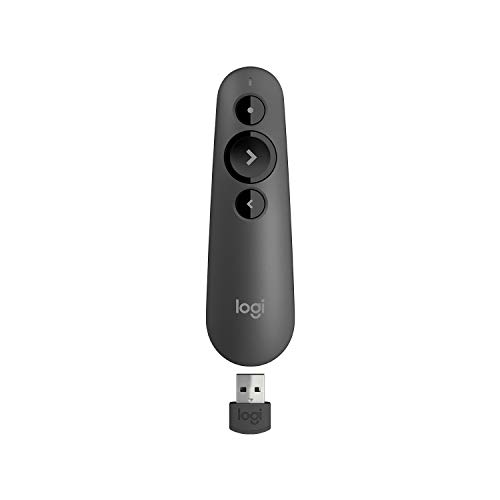
The Logitech R500s is the dependable middle of the presenter market: a comfortable, rubberised clicker with forward and back buttons you can find without looking, a red laser pointer for indicating points on a projected screen, and a plug-and-play USB receiver that stores inside the body so it does not get lost in a laptop bag. It connects over the receiver or over Bluetooth, which matters when every USB port on a thin laptop is already spoken for, and it is recognised by the usual presentation programs without drivers or pairing rituals. The shape fills the hand without bulk, the buttons give a clear click you can feel through a nervous grip, and the whole thing disappears into a jacket pocket between sessions. It suits teachers, trainers, and office presenters who move between rooms and computers and want the remote to simply work on whichever machine is waiting. It is not the choice for presenters who need a timer display, air-mouse control, or a digital highlight for streamed talks, and its laser should only ever be aimed at the screen or board in the presentation room, never at people, animals, aircraft, or vehicles.
Best for: presenters whose needs match the strengths described above. Not suited for: anyone whose main requirement is a feature this model deliberately leaves out, as covered in the trade-offs. Check price on Amazon for the current listing before you buy.

Kensington Expert Wireless Presenter — mid-range tier
The Kensington Expert Wireless Presenter is built around a joystick-style cursor control, which gives it a different feel from button-only clickers: you can nudge a pointer around the screen, open a link, or scroll a document without returning to the desk. It carries a green laser pointer, a colour many presenters find easier to follow on bright slides than a red dot, and it includes backlit buttons that help in darkened lecture halls and theatre-style rooms. The receiver stores in the body, the controls fall under the thumb in a ring layout, and the whole remote has the slightly larger, grippier build of a device designed to be held for a full lecture rather than a five-minute update. It suits lecturers, demonstrators, and anyone who interacts with the screen rather than simply advancing through it. The joystick takes a short learning period, the larger body is less pocket-friendly than the slimmest clickers, and as with every laser model here, the beam belongs on the screen or board only, kept away from eyes, animals, aircraft, and vehicles, and stored away from children when class ends.
Best for: presenters whose needs match the strengths described above. Not suited for: anyone whose main requirement is a feature this model deliberately leaves out, as covered in the trade-offs. Check price on Amazon for the current listing before you buy.
Canon PR1100-R — mid-range tier
Canon brings a camera maker’s neatness to the Canon PR1100-R: a clean, professional clicker with a red laser pointer, clearly separated slide controls, and a shape that looks at home in a boardroom rather than a gadget bag. The button layout is deliberately plain, which is a genuine virtue when a colleague hands you the remote thirty seconds before you start and there is no time to learn anyone’s clever shortcuts. It connects through its USB receiver with the usual plug-and-play behaviour, works with the standard presentation programs, and keeps its controls to the essentials so a guest presenter can run it confidently. It suits corporate presenters, visiting speakers, and teams that share one remote across many hands and many laptops. It does not offer the digital highlighting of the Spotlight or the cursor control of the Kensington, and it should be treated with the same laser discipline as every pointer here: aimed only at the screen or board, never at people, animals, aircraft, or vehicles, and stored out of children’s reach between meetings.
Best for: presenters whose needs match the strengths described above. Not suited for: anyone whose main requirement is a feature this model deliberately leaves out, as covered in the trade-offs. Check price on Amazon for the current listing before you buy.

DinoFire Wireless Presenter — entry-level tier
The DinoFire Wireless Presenter covers the essentials at the entry end of the range: slide forward and back, a red laser pointer, volume and screen controls on some layouts, and a USB receiver that plugs in and works without software. For a student, a community speaker, or a teacher equipping a classroom on a tight budget, that simple formula is often exactly enough, and the light body is easy to hold through a long lesson. The trade-offs are the expected ones for the tier: the plastics feel lighter, the button feel is less refined than the Logitech and Kensington models, and you should check the exact button layout of the version you order because entry-level presenters vary more between listings. It suits occasional presenters who need a working clicker without paying for cursor control, timers, or digital highlighting. Keep the same safety habits as with any laser model: point only at the screen or board, never at eyes, animals, aircraft, or vehicles, and keep it stored away from children.
Best for: presenters whose needs match the strengths described above. Not suited for: anyone whose main requirement is a feature this model deliberately leaves out, as covered in the trade-offs. Check price on Amazon for the current listing before you buy.
Comparing the Five Side by Side
| Model | Pointing | Cursor control | Software needed | Tier |
|---|---|---|---|---|
| Logitech Spotlight | Digital highlight | Yes, motion-based | Companion app for full features | Premium |
| Logitech R500s | Red laser | No | No | Mid-range |
| Kensington Expert Wireless Presenter | Green laser | Yes, joystick | No | Mid-range |
| Canon PR1100-R | Red laser | No | No | Mid-range |
| DinoFire Wireless Presenter | Red laser | No | No | Entry-level |
Read the table as a map of philosophies rather than a league ladder. The Spotlight trades plug-and-play purity for capabilities nothing else here offers. The R500s and PR1100-R trade capabilities for purity, and many presenters will call that the right trade. The Kensington splits the difference with hardware cursor control and no software. The DinoFire trades refinement for accessibility at the entry tier. Your room, your screens, and your computer pattern decide which trade is wise, and how to choose a wireless presenter remote walks through that decision step by step.
Laser Safety Rules That Apply to Every Presenter
A presenter with a laser pointer is a tool for pointing at a screen or a board in a presentation room, and nothing else. Never shine the laser into the eyes of a person or an animal, even briefly and even as a joke, because a direct beam can injure eyesight before the person has time to blink or look away. Never aim the beam at aircraft, at vehicles, or through windows toward traffic, where a flash of light can distract a pilot or a driver at the worst possible moment. Keep the remote stored out of the reach of children, treat it as you would any laser device, and switch the pointer off the moment you stop presenting.
Use the pointer only to indicate a chart, a diagram, or a line of text on the screen or board in front of your audience, then let go of the button. Sweeping the beam around a room, bouncing it off mirrors or glass, or handing the remote to a child to play with are all outside what the tool is for. If your venue, school, or employer bans laser pointers outright, choose a model that highlights digitally on screen instead, such as the Logitech Spotlight, which moves a software highlight rather than a beam and is the safer choice wherever lasers are restricted.
Which Presenter Suits Which Presenter
The Travelling Speaker
If you present from borrowed machines in other people’s rooms, prioritise plug-and-play connection and a receiver that stores in the body. The R500s and PR1100-R fit this life, and the Spotlight fits it too when the talks run from your own laptop, which most travelling speakers eventually insist on. Whatever you choose, rehearse the first sixty seconds: receiver in, deck open, first click. That minute is where travelling talks are won.
The Lecturer and Trainer
Long sessions reward comfort and interaction. The Kensington Expert’s cursor control lets you demonstrate software and open resources from the floor, and its backlit buttons help in darkened halls. The Spotlight’s highlight and magnifier serve detailed material beautifully, enlarging the table or code sample the question is actually about. For slide-only lectures, the R500s remains the calm, forgettable tool that never interrupts your train of thought.
The Boardroom Presenter
Boardrooms value polish and instant sharing. The Canon PR1100-R looks the part and can be handed to a colleague without instructions. The Spotlight suits the executive who presents results on the big wall display and wants figures highlighted crisply for the room and the video call at once. In both cases the winning trait is the same: the device never becomes the topic of the meeting.
The Occasional Presenter
If you present a handful of times a year, the DinoFire covers the honest essentials, and the money saved is real. Keep expectations matched to the tier, keep fresh batteries in the pouch, and the simple clicker will carry a quarterly update or a community talk without drama. If presenting becomes a bigger part of your work, the step up to the R500s is the natural first upgrade.
Strengths and Trade-Offs Across the Line-Up
Strengths
- Real choice of pointing methods: laser for projectors, green laser for bright slides, digital highlight for screens and streams.
- Mature connection behaviour: the leading models connect in seconds and hold their link across normal rooms.
- Designs for every pattern: shared-room simple, personally tuned, or interaction-heavy, there is a model shaped for each.
Trade-Offs
- Capability costs simplicity: every added feature, from software to joysticks, adds something to learn or maintain.
- Laser duties are absolute: beam models must be pointed only at the screen or board, never at people, animals, aircraft, or vehicles, and kept from children.
- Tier differences are tactile: entry models work, but button feel, finish, and receiver storage show where the money went.
Buying Smart: Checks Before You Order
Confirm the connection your computers can accept: a free USB port for a receiver, or Bluetooth if ports are scarce. Confirm your venue’s stance on laser pointers before choosing a beam model. Read the exact button layout of the listing you order, especially at the entry tier where layouts vary. Decide your power plan, rechargeable or replaceable cells, and buy the spare or cable at the same time. Finally, weigh the the pros and cons breakdown and the value question in whether a presenter remote is worth it before committing.
Setup and First-Week Routine
Unbox, connect, and immediately run a full practice deck, including any video, link, or build sequence your talks rely on. Tune software settings on software models. Put the receiver back inside the body and the remote in its pouch, in the bag you actually carry. Then present once to an empty room, standing where you will stand, clicking what you will click. That small ceremony converts a new gadget into a trusted tool, and it is the difference between the presenters who glance at their remote and the ones who never think about it again.
Final Verdict
There is no single winner in these wireless presenter remote reviews, and that is the honest result. The Spotlight wins the future-facing brief, the R500s wins the everyday brief, the Kensington wins the interactive brief, the Canon wins the shared boardroom brief, and the DinoFire wins the occasional brief. Match the model to the brief you actually live, observe the laser safety rules with the beam models, and any of these five will make your next talk calmer than your last.
The Second-Pass Review: Consistency, Fit and Fine Print
Reading the assessments against your own routine
These reviews were written against a general routine, and your routine is the final filter. Map each pick’s stated strengths onto your busiest realistic day with a wireless presenter remote: if a pick’s best quality serves a task you do rarely, it is not the pick for you, however strong the assessment. If a pick’s noted limitation sits in a corner of the workflow you never visit, discount it. This translation step — from review conditions to your conditions in a workspace that gets packed away and rebuilt more often than it stays in place — is where a good review becomes a good decision rather than a borrowed opinion.
Verify the listing, not just the product
A review can only judge the wireless presenter remote in front of it, but what arrives at your door depends on the listing you order from. Before choosing, confirm that the listing names the exact model, generation and bundle contents you think you are buying, because Gaming Mouse listings often group variants under one page. When picks such as Canon PR1100-R, DinoFire Wireless Presenter and Logitech Spotlight are on your shortlist, run this check against each listing in turn. Check which accessories are in the box and which are sold separately, and note the seller’s returns terms while you are there. Ten minutes of listing hygiene prevents the most common review-versus-reality mismatch: a good product judged by the wrong variant.
Consistency is the quiet test
Single impressive results are easy; a good wireless presenter remote repeats them on an ordinary day, with ordinary materials, when you are in a hurry. Across the picks in this review, the models that earned their place did so by being predictable: the same setup producing the same outcome, with controls that behave identically every time. In a workspace that gets packed away and rebuilt more often than it stays in place, predictability is worth more than a peak performance figure you will rarely reach. When you read the individual assessments above, treat consistency comments as the highest-value signal in each one.
Fit and feel, judged honestly
Specifications can tell you a wireless presenter remote will fit; only handling tells you whether it feels right doing it. Weight distribution, control placement, surface finish and the force needed for routine adjustments all shape whether you reach for the product gladly or work around it. When picks such as Canon PR1100-R, DinoFire Wireless Presenter and Logitech Spotlight are on your shortlist, run this check against each listing in turn. If your shortlist comes down to two similar models, this tactile layer is usually the honest tie-breaker, and it is personal: a control layout one reviewer calls cramped, a smaller-handed owner may call perfect. Where possible, judge fit against your own hands, desk and habits, not the reviewer’s.
The detail that dates a design
Every Gaming Mouse generation has a detail that quietly dates it: a port standard on its way out, a control app that has stopped receiving updates, a consumable format being phased away. When reviewing a wireless presenter remote, that detail matters because it decides how gracefully the product ages. A model built on current standards and widely stocked consumables will still be serviceable when a flashier rival is orphaned by its own ecosystem. Check the age of the design, not just its feature list, and favour the product whose supporting ecosystem is still actively maintained.
What the box should contain — and what it should not need
Unboxing is a small but telling review checkpoint for a wireless presenter remote: the essentials for the first session should be in the box, the instructions should match the actual unit, and nothing vital should depend on an immediate second purchase. If a pick requires an accessory to perform its core job, that dependency is flagged in its assessment above, because it changes both the real cost and the first-day experience. Equally, beware bundles padded with extras you will never use; in a workspace that gets packed away and rebuilt more often than it stays in place, unused bundle clutter is a cost paid in storage, not a bonus.
Frequently Asked Questions
Which wireless presenter remote is best overall?
For most presenters, the Logitech R500s is the easiest recommendation: it connects instantly, feels secure in the hand, and works on almost any computer without software. Presenters on modern displays or streamed talks should look at the Logitech Spotlight instead, and lecturers who need cursor control should look at the Kensington Expert Wireless Presenter. Best overall always means best for your rooms, screens, and computers.
Are expensive presenter remotes worth the extra cost?
They are worth it when their specific strengths match your work: digital highlighting for screens and streams, cursor control for demonstrations, or premium build for daily use. They are not worth it for occasional slide advancing, where an entry or mid-range clicker does the same core job reliably. The honest test is how often you will use the extra capability, not whether the capability is impressive in a demonstration.
Red laser or green laser: which is easier to see?
Many audiences find a green dot easier to follow on bright, white-heavy slides, while a red dot is the long-standing standard and works well on typical projected material in dimmer rooms. Both disappear on bright televisions and video walls, where a digital highlight is the better tool. Whichever colour you choose, the safety rules are identical: screen or board only, never eyes, animals, aircraft, or vehicles.
Do presenter remotes work with video conferencing?
Yes. The remote drives the slides on your computer, and the conferencing software shares whatever your screen shows, so the audience sees the same advances. Digital highlighting has an extra advantage here because remote viewers see the highlight exactly as the room does, whereas a laser dot never appears on a shared screen at all. Test your combination of presenter, slide software, and meeting software before an important call.
How do I stop the receiver getting lost?
Choose a model whose receiver stores inside the body, and build the habit of returning it there the moment you finish, every time. Keep the remote in a dedicated pouch in your presenting bag rather than loose among cables. If your model supports Bluetooth as well, pairing it gives you a working fallback for the day the receiver genuinely goes missing.
What is the best presenter remote for a teacher?
Teachers usually do best with a simple, rugged clicker they can operate by feel while watching the class, which points to the Logitech R500s or, on a tight classroom budget, the DinoFire. Teachers who demonstrate software from the front should consider the Kensington Expert’s cursor control. Whichever model a school chooses, laser discipline must be taught with it: the beam points at the screen or board only, and the remote is stored away from students between lessons.
Related Reading
- the single-product review
- the pros and cons breakdown
- whether a presenter remote is worth it
- how to choose a wireless presenter remote
- wireless mouse picks for PC gaming
- wireless keyboard and mouse combos for couch use
- wireless gaming mouse options on a budget
Think about the room before you think about the remote. A small meeting room with a bright television rewards a digital highlight or a confident clicker, while a long lecture hall with a washed-out projector rewards a visible pointer and buttons you can operate without looking down. Presenters who rehearse with the actual room in mind rarely blame their tools, because they have already matched the tool to the throw distance, the lighting, and the screen they will really face.
Rehearsal is where a presenter remote earns its place. Run the full deck once with the remote in your hand, including the video clip, the link you plan to open, and the slide you always forget is a slow build. Note where you naturally stand, whether the receiver stays in range at that spot, and whether you can reach the black-screen button without hunting for it. Ten quiet minutes of this saves the public fumbling that audiences remember longer than the content.
Keep a simple backup plan. A spare battery or a charged cable in the bag, the deck also saved on the presentation computer itself, and the knowledge that the arrow keys advance slides will carry you through almost any failure. The presenters who look unflappable are rarely the ones whose equipment never fails; they are the ones whose failure drill is so practised that the audience barely notices the switch.
Button discipline matters more than button count. The best presenters advance slides decisively, use the blank-screen control when the audience should be looking at them rather than the slide, and resist clicking ahead to peek at what is coming. A remote with fewer, clearer buttons often produces a calmer delivery than a feature-packed one, because every control you might press by accident is a small risk carried through the whole talk.
Consider who else will use the device. A remote that lives in a shared training room should favour instant recognition, a receiver that stores inside the body, and controls a guest can understand in seconds. A remote that is personally yours can justify a learning curve, companion software, and tuned settings, because you will amortise that setup across hundreds of talks.
Wireless reliability is mostly about line of sight and distance. Receivers tucked behind a metal podium or a thick desktop case lose range; a receiver on a short extension lead, placed where it can see the room, transforms a flaky connection into a solid one. Bluetooth models sidestep the receiver entirely but depend on the host computer keeping its radio awake and paired, which is worth testing in the room rather than assuming.
Your voice and your slides should not compete. Use the remote to give the audience permission to look where you want: advance, point once at the screen or board to anchor the key figure, then step out of the beam’s story and talk to the people. The pointer is punctuation, not narration, and the talks that land hardest use it sparingly.
Travel changes the equation. A presenter who flies to speak should think about what survives a bag search and a borrowed laptop: plug-and-play connection, no dependence on admin rights to install software, and a receiver that cannot snap off because it lives inside the remote. Venue rules on laser pointers also vary, which is one more reason a digital-highlight model earns its place in a frequent traveller’s kit.
Accessibility deserves a mention. Large, tactile buttons help presenters with limited grip strength or gloves; backlit controls help in darkened halls; a remote that can be operated entirely by feel helps a speaker who uses a screen reader or who cannot glance down. Trying the device in your own hand, under your own conditions, tells you more than any feature list.
Finally, treat the remote as part of the talk’s choreography. Decide where it lives when you are not holding it, how you will pick it up without breaking eye contact, and what your hands do during questions. These small physical decisions are invisible when they go well and glaring when they do not, and they are entirely within your control before the audience arrives.
Think about the room before you think about the remote. A small meeting room with a bright television rewards a digital highlight or a confident clicker, while a long lecture hall with a washed-out projector rewards a visible pointer and buttons you can operate without looking down. Presenters who rehearse with the actual room in mind rarely blame their tools, because they have already matched the tool to the throw distance, the lighting, and the screen they will really face.
Rehearsal is where a presenter remote earns its place. Run the full deck once with the remote in your hand, including the video clip, the link you plan to open, and the slide you always forget is a slow build. Note where you naturally stand, whether the receiver stays in range at that spot, and whether you can reach the black-screen button without hunting for it. Ten quiet minutes of this saves the public fumbling that audiences remember longer than the content.
Keep a simple backup plan. A spare battery or a charged cable in the bag, the deck also saved on the presentation computer itself, and the knowledge that the arrow keys advance slides will carry you through almost any failure. The presenters who look unflappable are rarely the ones whose equipment never fails; they are the ones whose failure drill is so practised that the audience barely notices the switch.
Button discipline matters more than button count. The best presenters advance slides decisively, use the blank-screen control when the audience should be looking at them rather than the slide, and resist clicking ahead to peek at what is coming. A remote with fewer, clearer buttons often produces a calmer delivery than a feature-packed one, because every control you might press by accident is a small risk carried through the whole talk.
Consider who else will use the device. A remote that lives in a shared training room should favour instant recognition, a receiver that stores inside the body, and controls a guest can understand in seconds. A remote that is personally yours can justify a learning curve, companion software, and tuned settings, because you will amortise that setup across hundreds of talks.
Wireless reliability is mostly about line of sight and distance. Receivers tucked behind a metal podium or a thick desktop case lose range; a receiver on a short extension lead, placed where it can see the room, transforms a flaky connection into a solid one. Bluetooth models sidestep the receiver entirely but depend on the host computer keeping its radio awake and paired, which is worth testing in the room rather than assuming.