ilcastellomenu.com is reader-supported. When you buy through links on our site, we may earn an affiliate commission.
Where to Buy
Amazon is the natural home of this entire category — budget action cameras live there, are reviewed there in the thousands, and are discounted there so regularly that patience is a feature. If you are shopping for the best budget action cameras under 100 (yes, the keyword that brought you here misspells it “budet,” and no, the cameras do not mind), the first thing to know is that this price tier is the most honest in the action camera world, because it cannot afford theatre. Below the hundred mark, a camera succeeds by doing four things competently — recording watchable video, surviving water and knocks, stabilising a shaky world tolerably, and not dying at lunchtime — and every claim beyond those four should be read with a raised eyebrow.
The second thing to know is what the money is really buying compared with the famous names. A premium action camera buys you dynamic range in harsh light, stabilisation that borders on sorcery, and a sensor that behaves after sunset. A budget camera buys you the daylight core of that experience — the beach day, the bike ride, the snorkel, the dog’s-eye view of the park — at a price where losing it overboard is a story rather than a tragedy. For a great many buyers, especially parents, travellers, and the chronically butter-fingered, that trade is not a compromise at all. It is the correct engineering of risk.
The six cameras below were chosen from the crowd of near-identical budget models by the traits that separate a bargain from a booby trap: real electronic stabilisation rather than a menu item that does nothing, waterproofing that is either built in or honestly provided by an included case, batteries you can actually buy spares for, and mounts compatible with the vast ecosystem of standard action camera accessories. Each review names the camera’s ceiling as plainly as its virtues, because the way to be happy in this tier is to buy the camera whose ceiling is above your ambitions.
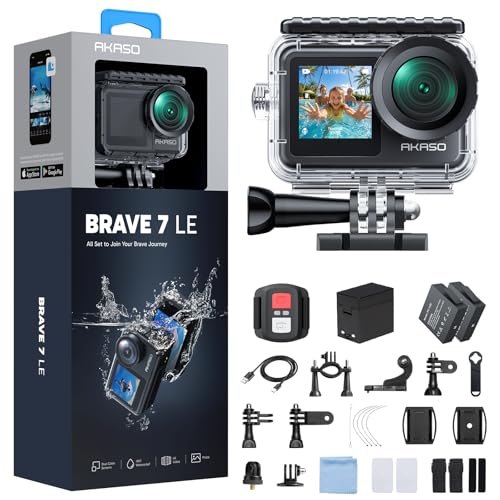
One structural note: exactly one camera in this guide, the AKASO Brave 7 LE, appears in this site’s verified product pool, so it carries a purchase link; the other five are prose-only recommendations, chosen freely on merit. Prices are not quoted for any individual product, in line with this site’s policy — the “under 100” framing is the keyword’s own budget line, and street prices in this tier move too often for a printed figure to stay honest.
Key Takeaways
- The best budget action cameras under 100 are daylight cameras: buy them for sun, water, and motion, not for dusk.
- The AKASO Brave 7 LE is the standout — real stabilisation, a front screen, and a remote in the box.
- Stabilisation and battery ecosystem matter more than headline resolution, which is often interpolated in this tier.
- Check whether waterproofing is built into the body or depends on the included case — both work, differently.
- Standard mounts mean the accessory world is open to every camera here.
- Five of the six picks are prose-only; only the pool-verified Brave 7 LE carries a link.
In this guide
Quick Picks
| Pick | Badge | Why budget shooters reach for it |
|---|---|---|
| AKASO Brave 7 LE | Best Overall | Front and rear screens, electronic stabilisation, and a wrist remote — the complete budget package. |
| AKASO EK7000 Pro | Best Ultra-Budget | The famous starter action camera, cheaper still, with the accessory bundle beginners actually need. |
| AKASO V50X | Best Stabilisation for the Money | Smooth footage and a touchscreen, from the same stable as the class leader. |
| Dragon Touch Vision 3 Pro | Best for Families | Simple, tough, and cheap enough to hand to a child without a speech about being careful. |
| Crosstour CT9500 | Best Battery Value | Generous in-box extras and honest performance for long days out. |
| Surfola Action Camera | Best for Water Play | A snorkel-and-pool specialist whose case and mounts suit a wet holiday. |
How Did We Choose These Picks?
We began by ignoring the numbers printed largest on the boxes. In this tier, resolution claims are routinely interpolated — a sensor’s honest output enlarged by arithmetic — so we weighted what cannot be faked in the footage itself: stabilisation that visibly works, colours that stay plausible in mixed light, and audio that survives a breeze. Cameras whose stabilisation existed only in the menu were cut, however impressive their paper specifications, because a shaky 4K claim is worth less than a steady honest picture.
Waterproofing was audited as a system. Some of these cameras are sealed bodies; most rely on the included housing, which is a perfectly good answer provided the housing is actually in the box, its latches feel like they will survive a season, and the camera remains usable — buttons pressable, screen viewable — once sealed. We also checked the battery question that budget buyers forget until the second holiday: whether spare batteries and chargers are cheap and findable, because an action camera with one tired battery is a paperweight with a lens.
We also set a floor for dignity: a camera had to be pleasant to operate. Buttons that respond through a housing, a screen readable in sunlight, a menu that a tired traveller can navigate at midnight — these are not luxuries in a category bought for holidays, and models that failed them were cut regardless of their footage. The six survivors are the ones we would hand to a friend departing tomorrow, with the honest briefing that daylight is their country and the spare battery is already in the case.
Finally, we favoured cameras from lines with a track record — makers whose previous budget models are still supported, whose apps still connect, and whose mount compatibility follows the industry standard so that the chest harness, bike mount, and floating grip you buy this year fit next year’s camera too. In a tier this crowded, longevity of support is the rarest specification of all.
Which Budget Action Cameras Are Actually Worth Buying?

AKASO Brave 7 LE — Best Overall
The Brave 7 LE is what happens when a budget maker studies the premium cameras’ feature list and steals the items that matter. Two screens — a rear touchscreen and a front-facing display — mean the self-filmer can frame a shot without the traditional budget-camera ritual of recording, reviewing, and discovering a forehead. Electronic stabilisation is genuinely effective at the level this tier can achieve: walking footage settles, cycling footage becomes watchable, and the camera’s weather sealing means the included housing is for dives rather than for rain. A wrist remote in the box completes a package that feels engineered rather than assembled.
In daylight, which is this category’s native country, the footage is colourful and detailed enough for the screens it will actually be watched on. The camera handles the classic budget torture tests — the dashboard mount, the helmet on a trail ride, the snorkel over a reef — with a composure that embarrasses cheaper rivals. Battery life is respectable, spares are cheap and plentiful, and the app connection works for framing and transfers without becoming the main event of your afternoon.
The ceilings are the tier’s ceilings: low light softens the picture, and the stabilisation, good as it is, will not match the flagship smoothness of cameras costing several times more. But those are comparisons against a different budget. Against its actual rivals, the Brave 7 LE is the camera we would buy, lend, and — this is the budget tier’s secret test — not grieve excessively if the sea kept it.
- Screens: rear touchscreen plus front selfie display
- Stabilisation: electronic image stabilisation
- Water resistance: weather-sealed body; housing for diving
- Extras: wrist remote control included
- Batteries: spares widely available
Strengths
- The most complete feature set in the budget tier.
- Front screen transforms self-filming and vlogging.
- Real stabilisation that survives a bike ride.
Trade-offs
- Dusk and indoor footage softens noticeably.
- Sits at the top of the under-100 budget line.
- App is serviceable rather than slick.
Best for: buyers who want one budget camera that does everything the tier can do.
Not suited for: night riders and anyone expecting flagship low-light performance.
AKASO EK7000 Pro — Best Ultra-Budget
The EK7000 line is the action camera equivalent of a folk song: everyone knows it, it has been passed around for years, and it persists because it works. The Pro version adds a touchscreen and electronic stabilisation to a formula that has introduced more people to action cameras than any premium launch — a small, tough box, a waterproof housing, a bundle of mounts, and footage that in good light is perfectly cheerful. It is the camera schools buy for field trips and parents buy for the holiday they refuse to risk the good camera on.
Its virtues are the virtues of maturity. Every accessory ever made for the standard mount fits it. Every problem it has is documented somewhere by an owner who solved it. Batteries cost very little and are sold everywhere. The footage will not win festivals, the audio wants the housing off to breathe, and low light is a rumour to it — but at its price, which sits comfortably below the class leader’s, those are not flaws so much as the definition of the tier’s floor done properly.
Buy the EK7000 Pro as a first action camera, a second angle, or a gift, and it will do what it has done for a generation of buyers: record the day, survive the day, and be ready for the next one.
- Screens: rear touchscreen
- Stabilisation: electronic
- Waterproofing: via included housing
- Bundle: generous mount selection included
- Batteries: inexpensive and universal in this class
Strengths
- The proven starter camera, refined over many versions.
- Accessory bundle covers the first year’s needs.
- Cheap spares and universal mount compatibility.
Trade-offs
- Footage quality is cheerful rather than refined.
- Audio is muffled inside the waterproof housing.
- No front screen for self-framing.
Best for: first-time buyers, schools, and anyone needing a capable camera at the lowest sensible price.
Not suited for: vloggers who film themselves constantly.
AKASO V50X — Best Stabilisation for the Money
The V50X is the connoisseur’s budget pick — the one recommended in forums by people who have owned three cameras in this tier and kept this one. Its calling card is stabilisation that owners consistently rate as the smoothest available without leaving the budget class, paired with a responsive touchscreen and a build that feels a grade denser than its price suggests. For cycling, trail running, and any footage where the camera is bolted to something that vibrates, that smoothness is the difference between footage you watch and footage you delete.
Video quality in daylight is strong, with a natural colour balance that flatters landscapes, and the camera’s higher frame-rate options serve the slow-motion experiments every action camera owner eventually attempts. It lacks the Brave 7 LE’s front screen, and its waterproofing is housing-based, which keeps it a half-step behind as an all-rounder — but as a pure recording instrument at its price, it is arguably the most talented camera in this guide.
Think of the AKASO stable as offering a choice of emphases: the Brave for features, the EK7000 for price, and the V50X for the footage itself. Riders and runners should choose by that third emphasis without much hesitation.
- Screens: rear touchscreen
- Stabilisation: electronic, notably smooth in this class
- Waterproofing: via included housing
- Video: high frame-rate options for slow motion
- Mounts: standard ecosystem compatible
Strengths
- Smoothest stabilised footage for the money.
- Natural colours and strong daylight detail.
- Feels a grade tougher than its price.
Trade-offs
- No front-facing screen.
- Housing required for water use.
- Shares the tier’s low-light ceiling.
Best for: cyclists, runners, and riders whose footage lives or dies by smoothness.
Not suited for: selfie-first vloggers.
Dragon Touch Vision 3 Pro — Best for Families
Some cameras are bought to be precious; the Vision 3 Pro is bought to be handed over. Its natural habitat is the family holiday, where it will be operated by a nine-year-old in a pool, dropped by a teenager on a trail, and borrowed by a parent who has not read any manual and does not intend to start. It survives this life through simplicity — big obvious controls, a forgiving menu, a waterproof housing that turns it into a submarine toy with a recording habit — and through a price that keeps every adult’s blood pressure where it belongs.
Footage is honest daylight footage: bright, stable enough, and entirely adequate for the family archive, which is judged by the laughter it preserves rather than the dynamic range of the sky. The included remote and mount bundle mean the camera can be a dashboard witness, a bike companion, and a pool camera in the same week without extra purchases. Battery swaps are simple enough for the aforementioned nine-year-old to perform, which in family logistics is a genuine feature.
It will not satisfy the enthusiast, and it is not trying to. Its competition is not the Brave 7 LE; it is the disposable camera of holidays past, and against that standard it is a marvel — reusable, waterproof, and already paid for by the second trip.
- Screens: rear display, simple interface
- Stabilisation: electronic
- Waterproofing: via included housing
- Extras: remote control and mount bundle
- Operation: deliberately simple menus
Strengths
- Cheap enough to hand to children without anxiety.
- Simple enough for the manual-free relative.
- Bundle covers pool, bike, and car in one box.
Trade-offs
- Footage is adequate rather than impressive.
- Low light is beyond its brief.
- Enthusiasts will outgrow it within a season.
Best for: family holidays, pool days, and first cameras for younger users.
Not suited for: anyone building a channel or a portfolio.
Crosstour CT9500 — Best Battery Value
The CT9500’s argument is endurance and generosity. Budget action cameras are notorious for arriving with one battery and a charger cable, which is why so many of them spend holidays plugged into hotel sockets instead of mounted on handlebars. Crosstour’s package has historically been the generous one — the extras in the box, the sense that the maker understood a camera’s day is longer than a single charge — and for buyers whose adventures are all-day affairs, that generosity is worth more than a spec-sheet increment elsewhere.
The camera itself is a solid citizen of the tier: stabilised daylight video, housing-based waterproofing, a touchscreen, and the standard mount that opens the accessory world. Its footage sits in the class’s honest middle — better than the ultra-budget floor, a shade behind the AKASO pair — and its app and menus are workmanlike. Nothing about it will start an argument in a forum, which for many buyers is the highest available praise.
Choose it when the day is long, the outlets are few, and the plan involves the camera working from breakfast to the ride home. In that specific and common life, the CT9500’s box contents beat its rivals’ spec sheets.
- Screens: rear touchscreen
- Stabilisation: electronic
- Waterproofing: via included housing
- Package: generous extras oriented to all-day use
- Mounts: standard ecosystem
Strengths
- In-box generosity suits long days away from power.
- Dependable mid-tier footage in daylight.
- Everything a beginner needs arrives together.
Trade-offs
- Image quality trails the AKASO V50X slightly.
- No front screen.
- Menus and app are functional, not polished.
Best for: all-day adventurers who hate battery anxiety.
Not suited for: buyers who prioritise the finest footage above endurance.
Surfola Action Camera — Best for Water Play
Surfola built its name in the wet corner of the budget market, and its cameras are at their best exactly where this one’s badge says: in the water, on the water, and under the water at snorkelling depth. The housing is the centrepiece — a proper diving-style case rather than a splash guard — and the bundle leans into aquatic life with the grips and mounts that keep a camera attached to a wrist, a board, or a mask while the ocean expresses opinions.
Underwater, the budget tier’s usual weaknesses recede: the light is bright near the surface, the subjects are close, and colour that would look merely cheerful on land looks vivid through clear water. The Surfola’s footage in its element is genuinely enjoyable, and its simplicity — few modes, obvious controls, buttons that work through the housing — suits an operator whose other hand is holding a snorkel. On land it is a competent member of the class rather than a leader, which is the correct allocation of its talents.
For the buyer whose action camera exists because of a reef trip, a surf habit, or children who live in the pool from June to September, specialisation beats generality. This is the specialist.
- Screens: rear display
- Stabilisation: electronic
- Waterproofing: diving-style housing as the centrepiece
- Bundle: water-oriented mounts and grips
- Controls: housing-friendly buttons
Strengths
- The most water-committed package in this guide.
- Bright underwater footage at snorkelling depths.
- Simple controls that work through the housing.
Trade-offs
- Land footage is mid-class rather than leading.
- Housing muffles audio, as all housings do.
- Less versatile for vlogging and low light.
Best for: snorkellers, surfers, and pool-owning families.
Not suited for: land-first creators who rarely get wet.
How Do the Six Picks Compare?
| Pick | Front screen | Waterproof style | Strongest suit |
|---|---|---|---|
| AKASO Brave 7 LE | Yes | Sealed body + housing | Complete all-rounder |
| AKASO EK7000 Pro | No | Housing | Lowest sensible price |
| AKASO V50X | No | Housing | Smoothest footage |
| Dragon Touch Vision 3 Pro | No | Housing | Family-proof simplicity |
| Crosstour CT9500 | No | Housing | All-day package value |
| Surfola Action Camera | No | Diving housing | Water specialisation |
The table hides the tier’s real divide, which is not between brands but between daylight and everything else. All six are daylight cameras of varying polish; none is a night camera at any price of cleverness. Buy within that truth and every pick here can make its owner happy. Buy against it and no badge in the table will save the purchase.
What Should You Look for in an Action Camera Under 100?
Stabilisation first, and verified rather than advertised. The test is walking footage: a budget camera with working electronic stabilisation turns a hike into a watchable film, while one without it turns the same hike into evidence for a medical claim. Every pick here stabilises genuinely. Second, the waterproofing arrangement — a sealed body like the Brave 7 LE’s is more convenient for rain and splashes, while a housing gives deeper water protection and muffled audio; neither is wrong, but you should know which you are buying before the boat leaves.
Third, the battery ecosystem. This tier’s cameras use small batteries with working lives measured in the low hours; the question is whether spares are cheap, whether a dual charger exists, and whether the camera can record while charging from a power bank on a long ride. Fourth, mounts: insist on the standard fitting, because the accessory ecosystem — chest straps, suction cups, floating grips, helmet mounts — is the real product in action cameras, and a proprietary fitting is a tax on every future idea.
Finally, read the resolution claims like a lawyer. In this tier the honest measure is the footage’s look at the size you will watch it, which for most buyers is a phone or a television across a room. Cameras here deliver that comfortably in daylight. Spend your discrimination on stabilisation, batteries, and waterproofing, where the differences are real, and let the megapixel theatre play to an empty house.
How Do You Get the Best From a Budget Action Camera?
Light is the whole technique. Schedule the camera’s work for the bright hours, keep the sun behind the camera rather than in the frame where possible, and your budget footage will pass for footage from cameras costing far more — because in good light, the gap between tiers genuinely narrows. Clean the lens or the housing’s port before every outing; a fingerprint that a phone would forgive becomes, on a wide action lens in sunshine, a fog across half the world.
Mount with intention. The standard ecosystem invites experimentation — the chest mount for the ride, the floating grip for the water, the suction cup for the car — and each mount is a different film language. Short clips beat long ones: record the moment in twenty-second pieces rather than an hour of handlebar, and your future self, editing, will send thanks backwards in time. Carry the spare battery in the same pocket every time, format the card in the camera, and rinse the housing in fresh water after the sea — the four habits that separate owners with archives from owners with anecdotes about the one that got away.
What Mistakes Do Budget Action Camera Buyers Make?
The first is buying by resolution arithmetic — choosing the box with the largest numbers over the camera with working stabilisation, then discovering that arithmetic does not hold a horizon steady. The second is testing waterproofing at depth on the first day: housings should be tested empty, in a sink, before a camera and a holiday depend on them, and seals should be checked for the hair or grain of sand that defeats them. The third is forgetting audio’s fragility — inside a sealed housing every camera here is half-deaf, so the moments where voices matter should be filmed unhoused, in the dry, by design rather than by accident.
Fourth, and quietly commonest, is leaving the camera in a drawer between holidays because the footage transfer feels like homework. Use the app, transfer on the day, and clear the card while the trip is still the present tense. A budget camera’s footage has the same half-life as a premium one’s: watched this week, it is a film; watched next year, it is an archaeology project.
Final Recommendation
It is worth pausing on how remarkable this tier’s existence is. A generation ago, a waterproof camera that filmed moving pictures and survived a drop cost a month’s wages and lived in a rental shop. Today the capability sits below a hundred in six competing forms, each with its own honest virtues, and the buyer’s problem has inverted from scarcity to discrimination — which is a much better problem, and the one this guide exists to solve. Discriminate by stabilisation, by battery, by waterproofing style, and by the support behind the name, and the tier will reward you with the only specification that ever mattered: footage of the day, kept.
Buy the AKASO Brave 7 LE if the budget stretches to the top of the tier — it is the only camera here that feels like a product from the class above wearing a budget badge, and its front screen and remote make it the one we would pack for a trip where reshoots are impossible. Buy the V50X if your footage is mostly motion, the EK7000 Pro if the price must be the floor, and the Surfola if the trip is mostly water. The Dragon Touch and the Crosstour serve families and long days respectively, with honour. What none of them requires is apology: in daylight, on the move, in the water, these are real cameras, and the memories they are bought to keep do not check receipts.
Which Budget Action Camera Suits Which Adventure?
Match the camera to the trip and the tier stops feeling like a compromise. The beach-and-boat holiday, all brightness and water, is the Surfola’s native country and the Brave 7 LE’s second home; either will return footage that looks like the brochure. The cycling and trail life belongs to the V50X, whose stabilisation was built by long forum arguments among riders about exactly this use. The family expedition — theme parks, pools, grandparents, chaos — belongs to the Dragon Touch, because the best family camera is the one nobody is afraid to use, and fearlessness is a specification too.
The road trip is the Crosstour’s argument: long days, dashboard mounts, a camera that must work from the morning’s departure to the evening’s arrival without a charging drama in between. The school, club, and team purchase — several cameras, one budget, operators of varying care — is the EK7000 Pro’s institutional role, and its mountain of compatible cheap accessories is why kit managers keep ordering it. And the aspiring creator, filming a first channel from a bedroom and a bike, should stretch to the Brave 7 LE and its front screen, because self-framing is the creator’s daily bread and the screen is the only one in this guide that serves it properly.
Notice that none of these matches required leaving the budget tier. The tier’s real limitation appears only when the adventure moves into darkness, speed at dusk, or professional delivery — and for those adventures, this guide’s honest advice is to rent the flagship for the weekend rather than buy the wrong camera for the year.
How Does the Budget Tier Compare With a Flagship Action Camera?
The flagship’s advantages are real and specific: stabilisation that holds a horizon through violence, dynamic range that keeps detail in a sunset’s sky and a forest’s shade simultaneously, low-light footage that remains footage, slow-motion modes at resolutions the budget tier cannot touch, and a build that treats crashes as weather. If your filming lives in those conditions — mountain biking at dusk, surfing into the evening, professional content — the flagship is not a luxury; it is the tool, and no honest guide should pretend otherwise.
But the comparison cuts the other way in the conditions where most action cameras actually work. In bright daylight, on a chest mount, in clear water, the visible gap between a Brave 7 LE and a flagship narrows to a margin that most viewers, watching on phones, will never identify. The budget camera also changes its owner’s behaviour in a way the flagship cannot: it gets taken. It goes on the kayak, into the pool with the children, onto the rental bike in a foreign city — the places where a costly camera is left in the hotel safe, recording nothing beautifully. An archive of real adventures filmed competently beats a theoretical archive of masterpieces never risked, and that is the budget tier’s deepest argument.
The mature position, which many experienced owners arrive at, is both: the budget camera as the daily risk-taker and the eventual second angle, the flagship — bought later, or rented — for the occasions that justify it. Starting in this tier wastes nothing, because every mount, habit, and spare battery carries upward.
What Should You Check in the First Week of Ownership?
Budget cameras reward an early shakedown, because their quality control is the tier’s known variable and the return window is the remedy. On day one, record a walking circuit in daylight and watch it on the largest screen you own: you are checking stabilisation, focus across the frame, and whether colours please you, while the purchase can still be undone. Test the housing empty in a sink of water for an hour. Charge every battery fully and time one to exhaustion in ordinary recording, so your day-planning arithmetic is based on your camera rather than a forum’s.
Connect the app, transfer a clip, and confirm the workflow you will actually use on holiday — discovering an app’s quirks at home is a chore; discovering them on a boat is a story you will tell angrily. Fit every mount in the bundle once, on the helmet, bike, or board it will serve, because a mount that does not suit your particular helmet is a fact worth knowing in the kitchen. Register the warranty if the maker offers one, keep the receipt with the camera’s box until the window closes, and then throw the box away and go filming — the shakedown complete, the camera stops being a purchase and becomes equipment.
How Long Do Budget Action Cameras Last?
Physically, longer than their owners expect: the bodies are simple, the lenses are fixed and protected, and there is little to wear out beyond batteries and housing seals. The realistic lifespan limits are consumable and digital rather than mechanical. Batteries tire after a few seasons of heavy use and are cheap to replace on every model here. Housing seals age and should be inspected each season and replaced when they flatten or crack. The app’s compatibility with future phones is the genuinely uncertain frontier, which is another argument for cameras whose essential functions live on the camera itself rather than in a phone’s pocket.
Treat the camera as the outdoor tool it is — rinse salt water off it, keep it out of a hot car’s glovebox in summer, store it with the battery neither full nor empty for long winters — and a budget action camera will serve for years of holidays. Owners regularly report the EK7000-generation cameras still working half a decade on, which at this tier’s prices represents a cost per adventure that no flagship can approach. Longevity, in the end, is another form of value, and this tier is quietly good at it.
What About Sound, and Filming People Rather Than Scenery?
Action cameras are bought for landscapes and end up filming birthdays, and the transition exposes the tier’s most honest weakness: audio. Out of the housing, in calm air, these cameras record voices recognisably and laughter perfectly — which, for the family archive, is most of the requirement. In wind, or sealed in a housing, the soundtrack thins to atmosphere. The working solutions are behavioural rather than technical: film the talking unhoused and sheltered, get closer than feels natural (the wide lens forgives closeness), and let the action sequences carry music or natural sound while the conversations happen in the calm between activities.
People also change the framing calculus. The action camera’s wide view is merciless to faces at arm’s length — features stretch at the edges — so film people from a little further back and centred, and let the Brave 7 LE’s front screen, where fitted, confirm the composition rather than discovering it at the hotel. Children, the tier’s most filmed subjects, are best caught by the camera’s great social virtue: it is unintimidating. A small tough box on a floating grip reads as a toy, and children perform for it with a naturalness that a large camera’s ceremony would crush. That, as much as any specification, is why the Dragon Touch earns its family badge.
How Do You Choose Between Two Cameras That Look Identical on Paper?
The budget tier is full of twins — same headline numbers, same shape, different souls — and the tie-breakers are knowable. Footage first: find sample clips of walking and cycling, the stabilisation examinations, and trust your eyes over any chart. Support second: a maker with several generations of models, a living app, and batteries you can buy today from three different sellers will still be serving you when the anonymous twin’s app vanishes from the store. Bundle third: count the mounts and batteries you will actually use, because a cheaper camera plus the mounts it omitted is often the more expensive purchase wearing a disguise.
Fourth, the return policy of the seller is itself a tie-breaker in a tier with variable quality control; buy where the window is generous, run the first-week shakedown described above, and let the camera audition for its job. And fifth, community: a model with thousands of owners has every quirk documented and every accessory tested, while an unknown model makes you the entire research department. In a category built on sameness, the crowd’s accumulated knowledge is a real feature, and it is priced into the famous names in this guide for good reason.
What Is the Sensible Upgrade Path From a Budget Action Camera?
The beautiful fact about starting here is that almost nothing is wasted. The mounts transfer to every serious action camera. The spare batteries do not, but they cost little and served their term. The habits — light discipline, mount literacy, the transfer-on-the-day routine — transfer completely, and they are worth more than any single camera. When the upgrade moment arrives, it announces itself specifically: dusk footage that keeps failing, a channel whose audience has outgrown the audio, a sport whose violence defeats the stabilisation. Upgrade against a named limitation and the flagship purchase is a tool decision; upgrade from vague dissatisfaction and it is merely shopping.
Keep the budget camera afterwards. It becomes the second angle, the risky mount, the one lent to a child or bolted somewhere the flagship would never be allowed — roles it will fill for years. Many two-camera action setups in the wild are exactly this: a flagship’s eye and a budget camera’s courage, and the footage from the courage is frequently the footage that gets watched.
How Do Weather and Temperature Treat Budget Action Cameras?
Cold is the budget camera’s quiet enemy, working through the battery rather than the body. Small batteries lose their enthusiasm in frost, and a camera that records for ninety minutes in June may manage half that on a January ski slope. The countermeasures are old and effective: keep the camera and its spares in an inside pocket until the moment of use, rotate batteries so a warm one is always working, and accept shorter clips as the price of winter. The cameras themselves, sealed in housings or weather-resistant like the Brave 7 LE, tolerate the cold’s moisture and the inevitable snow contact without complaint — it is only the chemistry that sulks.
Heat is the second front. A budget camera recording on a dashboard in summer sun is being slow-cooked, and the tier’s thermal management is basic; shade the camera where you can, and do not leave it recording unattended in a parked car, a rule that protects the footage as much as the hardware. Water, paradoxically, is the friendly element: it cools the camera, the housings are built for it, and the only discipline required is the freshwater rinse afterwards and a seal check before the next immersion. Judge your own climate against these three fronts and the tier’s limits become a plan rather than a surprise.
Why Do So Many Budget Action Cameras Look the Same?
Because the category converged, years ago, on a shape that works — a small brick with a wide lens, a screen on the back, and mounting fingers underneath — and because a shared ecosystem of factories and components supplies much of the tier. This is less sinister than it sounds. Convergence means the mounts fit, the batteries are findable, the cases interchange, and the differences that remain are the ones that matter: stabilisation quality, sensor honesty, app maintenance, and quality control. The famous budget names in this guide are famous because they competed on exactly those invisible virtues while wearing the same visible shape as everyone else.
For the buyer, the sameness is a gift: it makes the category legible. Ignore the silhouette, interrogate the footage, the support, and the bundle, and the right camera identifies itself. The six in this guide were separated from dozens of lookalikes by precisely that interrogation — which is why the guide can be short, honest, and confident in a category whose listings run to the thousands.
What Does a Sensible Budget Accessory Kit Look Like?
The camera is the beginning of the spending, not the end, and the honest kit is short. Two spare batteries and a dual charger, bought with the camera, are non-negotiable for anyone filming away from home. A floating grip is the water kit’s essential — it turns a dropped camera from a loss into a bobbing retrieval — and a chest mount is the land kit’s, because chest footage is the most watchable perspective the tier produces. One good case to hold the camera, its housing, and its spares ends the list of necessities. Everything else — the suction cups, the dog harnesses, the elaborate aluminium cages — should be bought against a specific planned shot, because accessory drawers fill with intentions and empty of money.
Buy accessories in the standard fitting and they outlive the camera; buy the known makers’ versions of the critical items — the housing seals, the batteries — and the no-name versions of the inert ones, like straps and grips, where failure costs nothing. That allocation, camera money on the camera and care money on the failure points, is the budget tier’s whole philosophy in miniature.
A Word About Gifts, Schools, and Second Cameras
A disproportionate share of this tier is bought for someone else, and the giving has its own logic. For a child or teenager, the Dragon Touch or EK7000 Pro plus a spare battery is a complete gift — add nothing, because the bundle is the point and the recipient’s first need is to start, not to accessorise. For a travelling friend, the Brave 7 LE says you thought about their trip rather than your budget. For schools and clubs buying in quantity, the EK7000 generation’s uniformity — one battery type, one mount, one manual for every unit — is worth more than any single camera’s edge, and the spares drawer stays simple for years. And for the enthusiast buying a second camera to risk where the flagship cannot go, the V50X’s footage quality makes the B-roll cut without apology. The tier serves all four givers well, which is why it outsells the flagships it supposedly envies.
How Do You Edit and Share Budget Action Camera Footage?
The footage’s journey home matters as much as its capture, and the budget tier’s workflow is pleasantly undemanding. Transfer on the day, by app or by card reader — the card reader is faster and is the professional’s quiet preference — and keep the original files in a dated folder before any editing touches them. The free editors on phones and computers handle this tier’s files without strain, and the edits that transform action footage are few and learnable: trim the beginnings and endings where the camera was being mounted and retrieved, cut on movement, keep clips short, and let one piece of music or the natural sound carry a sequence rather than narrating every second.
Share at the resolution the audience’s screens deserve rather than the maximum the file allows, and your uploads stay quick and your storage stays sane. The families and friends who receive these films will never ask what the camera cost; they will ask to see the pool jump again. That is the metric the whole tier is engineered for, and by that metric, honestly measured, every camera in this guide is a success waiting for its first holiday.
Related guides
- Best Cameras for Facebook Live: 6 Picks for Streaming That Holds an Audience
- Best Cameras for Bowfishing: 6 Waterproof Cameras for the Night Deck
Frequently Asked Questions
Are budget action cameras really waterproof?
Yes, within their design: sealed bodies resist rain and splashes and shallow immersion, while the included housings extend protection to snorkelling and recreational diving depths. The discipline is in the seals — check them for grit, close the latches fully, and test a housing empty before trusting it with the camera.
Is 4K on a budget action camera real?
Sometimes, and it matters less than you think. Some models record genuinely at that resolution; others interpolate. Either way, the footage’s watchability is decided by stabilisation, light, and lens quality far more than by the pixel count — judge sample footage of walking and cycling, not the number on the box.
How long does a budget action camera battery last?
Plan around roughly an hour to ninety minutes of recording per battery in typical use, less in cold weather or with Wi-Fi and screens working hard. Every camera here accepts inexpensive spares, and carrying two spares is the standard practice that turns battery life from a limit into a footnote.
Can I use a budget action camera for vlogging?
Yes, with the right pick: the Brave 7 LE’s front screen exists precisely for self-framing, and in daylight its footage serves a channel’s early life perfectly well. Add an external microphone where the model allows, film unhoused for the talking pieces so the audio breathes, and upgrade the camera when the channel’s income argues for it — not before.
Do budget action cameras fit GoPro mounts?
The cameras in this guide use the industry-standard mounting fingers and adapters, so the vast majority of mounts and accessories designed for the famous name fit them as well. It is one of the strongest reasons to buy within this established tier rather than an unknown proprietary design.
Should I buy the previous generation to save more?
Often, yes. Budget action cameras improve incrementally, and last year’s model at a clearance price frequently beats this year’s at full price on pure value — the EK7000 line’s whole career demonstrates the point. The checks are support and batteries: confirm the app still serves the older model and that its batteries remain on sale, and the saving is real rather than a trap.
What memory card should I buy for one of these cameras?
A reputable high-endurance card of moderate-to-large capacity, rated for the camera’s top video mode. Budget cameras are unforgiving of bargain cards — the failure mode is corrupted footage discovered at home — so the card is the one accessory where buying the known brand is the economy option.
Related Guides
Whichever camera you choose, buy it a week before the trip rather than the night before. A budget action camera rewards the owner who has already made its mistakes at home — the loose mount, the full card, the untested housing — and the holiday itself deserves a camera that has already been forgiven its learning curve. That week of shakedown is the cheapest upgrade in this entire guide, and it is available for every pick in it.
And when the trip ends, rinse the housing, dry the camera, charge the batteries back to a storage-friendly level, and put the whole kit away together — the budget camera that is maintained like a flagship will outlive, in working order, many flagships that were maintained like toys.
Budget action cameras are one doorway into filming everything. See also our guide to the best action cameras for vlogging, the best action cameras for surfing, and our roundup of the best affordable 4K cameras for YouTube.


