Disclosure: As an Amazon Associate, ilcastellomenu.com earns from qualifying purchases. Links on this page are affiliate links; they cost you nothing extra. Prices and availability change often, so check the current Amazon listing before you buy.
This laptop cooling pad review starts with the sentence the category usually buries: a cooling pad is a modest accessory, and the honest version of this laptop cooling pad review is about margins, not miracles. A good pad lifts a laptop, feeds the intakes on its underside and helps its own fans breathe a little easier. A great outcome is calmer fans and steadier long sessions. Anyone promising a transformation is selling you weather, and this review will keep returning to what pads can and cannot do for the laptop you already own.
Key Takeaways
- Elevation first: a plain riser delivers much of the benefit, and a pad should be judged against it.
- Pads help bottom-intake laptops; a sealed base or side intakes mean a stand is the smarter buy.
- Sealed high-pressure pads are the exception category — stronger, louder and bulkier than mesh trays.
- Never block the exhaust, and never ask a pad to fix shutdowns: that is a service problem.
- Clean vents and a cooler room come before shopping, every time.
Our verdict in short: a cooling pad suits the owner of a bottom-intake laptop — above all a gaming or performance machine — who has already elevated it, cleaned its vents and given it a reasonably cool room, and who still wants a further margin. The sealed high-pressure designs earn the strongest recommendation in that narrow case. A pad does not suit fanless or side-intake machines, anyone expecting silence from a strong blower, or anyone whose laptop shuts down from heat, because that machine needs a technician rather than an accessory.
In this guide
Laptop Cooling Pad Review: What a Laptop Cooling Pad Is and Where It Fits
A laptop cooling pad is a powered deck that sits beneath a laptop and moves air toward its underside. The category divides into two families that share a name and little else. Open pads are mesh or metal trays with fans under the deck; they elevate the machine and add a gentle upward breeze. Sealed pads close a foam frame against the base and use a stronger blower to pressurise air into the underside intakes themselves. Everything else — lights, extra ports, elaborate tilt mechanisms — is garnish on those two ideas. Understanding which family you are looking at matters more than comparing fan counts inside a family, because the families answer different levels of need.
Where a pad fits in a desk setup is equally specific. It belongs under a laptop that works hard in one place: gaming sessions, long renders, a home office day that never really pauses. It fits less naturally into bags, boardrooms and beds, and it fits not at all into the life of a laptop that is already cool and quiet. The owners who love their pads tend to have a fixed desk, a warm-running machine and realistic expectations. The owners who return them tend to have bought refrigeration and received a stand with fans. This review is written so that you finish it in the first group or happily unpersuaded, rather than in the second group with a parcel to post.
The Pads Worth Knowing, in Prose
The models below are named so you can recognise the real designs on sale and understand what each approach actually is. They are presented in prose only, in words rather than figures, because the right choice depends on your laptop’s intake layout and your tolerance for noise far more than on any headline claim. Treat each entry as a description of a type as much as a single product, check the current listing carefully before you buy, and remember that no pad on this page can rescue a laptop whose own fans and thermal paste are failing inside.
IETS GT500 — premium tier
The IETS GT500 is the sealed-foam, high-pressure representative: a foam frame seals against the underside of a bottom-intake laptop while a strong blower pushes air into the chassis intakes rather than past them. It is the design to study if a gaming laptop still runs hot after elevation and cleaning, and the one whose noise and bulk you must accept with open eyes.
Best for: owners whose laptop matches what the IETS GT500 was designed to do, who have already tried elevation and cleaning, and who value its particular balance of airflow, noise and desk presence. Not suited for: laptops that do not intake from underneath, buyers expecting a silent or invisible accessory, or anyone hoping an external fan will substitute for an internal repair their machine is plainly asking for. As with every pick here, the tier is described in words — this one sits in the premium tier — and the current listing is where you check price on Amazon when a linked edition becomes available.

Llano laptop cooling pad — premium tier
The Llano laptop cooling pad is another entry in the sealed, high-pressure school, built around a foam-sealed deck and a powerful blower for gaming laptops that intake from underneath. It belongs on the shortlist beside the IETS approach rather than beside gentle mesh trays, and it deserves the same fit check: the seal must match your chassis and clear every exhaust.
Best for: owners whose laptop matches what the Llano laptop cooling pad was designed to do, who have already tried elevation and cleaning, and who value its particular balance of airflow, noise and desk presence. Not suited for: laptops that do not intake from underneath, buyers expecting a silent or invisible accessory, or anyone hoping an external fan will substitute for an internal repair their machine is plainly asking for. As with every pick here, the tier is described in words — this one sits in the premium tier — and the current listing is where you check price on Amazon when a linked edition becomes available.
Klim Ultimate — mid tier
The Klim Ultimate is a large-fan open mesh design in the classic mould: a broad deck, a big central fan and a quiet manner suited to desks where the laptop works long hours. It will not pressurise a chassis, and it does not pretend to; judged as assisted elevation with a steady breeze, it is a sensible, established example of the type.
Best for: owners whose laptop matches what the Klim Ultimate was designed to do, who have already tried elevation and cleaning, and who value its particular balance of airflow, noise and desk presence. Not suited for: laptops that do not intake from underneath, buyers expecting a silent or invisible accessory, or anyone hoping an external fan will substitute for an internal repair their machine is plainly asking for. As with every pick here, the tier is described in words — this one sits in the mid tier — and the current listing is where you check price on Amazon when a linked edition becomes available.
Cooler Master NotePal — mid tier
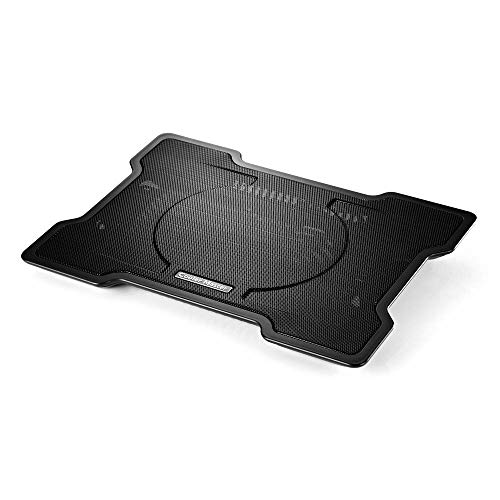
The Cooler Master NotePal is a long-running open mesh line from a maker that has sold laptop cooling for years, typically with a metal mesh deck, movable or fixed fan layouts depending on the version, and an emphasis on everyday ergonomics. Check the current version’s fan position against your own intakes, because the family name covers more than one layout.
Best for: owners whose laptop matches what the Cooler Master NotePal was designed to do, who have already tried elevation and cleaning, and who value its particular balance of airflow, noise and desk presence. Not suited for: laptops that do not intake from underneath, buyers expecting a silent or invisible accessory, or anyone hoping an external fan will substitute for an internal repair their machine is plainly asking for. As with every pick here, the tier is described in words — this one sits in the mid tier — and the current listing is where you check price on Amazon when a linked edition becomes available.

TopMate laptop cooling pad — entry tier
The TopMate laptop cooling pad is a multi-fan open pad in the accessible tier, spreading several smaller fans across the deck to cover a wide base. The spread suits laptops whose intakes are scattered rather than centred, while the cooling effect stays in the honest mesh-pad range: helpful elevation and airflow, not transformation.
Best for: owners whose laptop matches what the TopMate laptop cooling pad was designed to do, who have already tried elevation and cleaning, and who value its particular balance of airflow, noise and desk presence. Not suited for: laptops that do not intake from underneath, buyers expecting a silent or invisible accessory, or anyone hoping an external fan will substitute for an internal repair their machine is plainly asking for. As with every pick here, the tier is described in words — this one sits in the entry tier — and the current listing is where you check price on Amazon when a linked edition becomes available.
Design, Build and Setup
Judge a pad’s design by the path its air takes and the honesty of its structure. On an open pad, look for a deck that stays rigid under the laptop, fan positions that plausibly meet your intakes, stops that hold the machine at tilt, and controls you can reach without lifting the whole arrangement. On a sealed pad, examine the foam frame: it should be even and resilient, sized to your chassis, and shaped to clear every exhaust and side vent when it settles against the base. Setup for either family is minutes of work — position, align, connect the power, choose a starting speed — and the real craft is the checking that follows: exhaust clear, laptop stable, cable routed away from vents, tilt kind to your wrists.
Specifications deserve a cold eye in this category. Airflow figures are measured in conditions that flatter them, fan counts say nothing about where the air lands, and no figure on a box knows the shape of your laptop’s underside. The specifications worth reading are the physical ones you can verify against your own machine: deck size against footprint, stated laptop size range against your actual chassis, how the pad is powered, and what its controls actually adjust. Everything else is best treated as a rough indication of class — a sealed blower is a stronger instrument than a slim mesh tray — rather than as a promise about your temperatures, which no maker can honestly make.
Performance in Real Use
Gaming Sessions
Under sustained gaming load, the pattern repeats across machines: elevation helps first, sealed pressure helps further on the right chassis, and gentle mesh airflow takes the edge off without changing the story. The fairest sign of success is not a dramatic moment but a steadier one — fans that stay a notch calmer late in a session and performance that feels consistent rather than fading. If a pad produces none of that on a clean, bottom-intake machine, believe the result and look inward at the laptop, not upward at a bigger pad.
Work, Study and Creative Loads
Through ordinary work the stakes and the rewards both shrink. A slim mesh pad under a laptop doing documents, calls and browsing is mostly an ergonomic stand with a pleasant breeze, and there is nothing wrong with buying it as exactly that. Long creative loads — exports, builds and batches — sit between the extremes and are where a mid-priced pad quietly justifies itself in warm rooms. Match the strength of the pad to the length and weight of your typical load, and you will rarely overspend or underbuy by much.
Noise at the Desk
Performance includes what the pad does to the room. A pad that moves the noise from the laptop’s fans to its own has rearranged the problem, and sealed blowers at full effort are plainly audible instruments. The practical test is your own: headphones on for games, speakers and calls for work, silence for a bedroom desk at night. Speed controls earn their place here, letting one pad be two products — gentle through the day, committed during a session — and any pad you keep at its lowest setting forever was probably the wrong strength to buy.
Comfort Over a Long Day
The least discussed performance measure is how the setup feels at hour six. Tilt that helped at breakfast can ache by evening, a deck edge can press a wrist, and a laptop that creeps forward a fraction every hour becomes a background irritation that colours your judgement of the whole product. Build in the external keyboard option, revisit the tilt, and let comfort vote alongside temperature. A pad is furniture as much as machinery, and furniture is judged by the body over time.
Strengths and Trade-Offs
Strengths
- Real, if modest, help for bottom-intake laptops under sustained load, especially from sealed designs.
- Elevation improves airflow, screen height and desk ergonomics in one move.
- Simple, reversible and safe: no opening the laptop, no software, no permanent change.
Trade-Offs
- Open mesh pads offer gentle gains that marketing routinely overstates.
- Stronger sealed pads bring noise, bulk and a fit that must match the chassis.
- A pad cannot repair clogged internal cooling, failing fans or dried thermal paste.
How It Compares
Against a plain stand, a pad adds moving air and cost; the stand wins on simplicity, silence and price of entry, and for many laptops it captures most of the benefit, which is why it remains the first recommendation in this review. Against doing nothing, any well-fitted pad wins on a warm-running machine, provided the exhaust stays clear. Against internal maintenance, a pad is not a competitor at all: cleaning and service fix causes, while a pad manages conditions. The sealed designs sit closest to a genuine cooling upgrade, the mesh designs closest to a stand with benefits, and your laptop’s underside decides which comparison is even relevant. Choose the family first, the model second, and the decoration never.
Who Should Buy It and Who Should Skip It
Buy a pad if your laptop intakes from underneath, works long and warm at a fixed desk, and still runs hotter or louder than you like after elevation, cleaning and a sensible room — with a sealed design at the top of the list for gaming machines. Buy a gentle mesh pad if you mainly want elevation with a breeze for work and study. Skip the category if your laptop is fanless or side-intaking, if it shuts down or crashes from heat and therefore needs service, or if a simple stand trial already gave you the calm you wanted. That checklist, honestly answered, is worth more than any single model’s reputation.
Setup, Care and Maintenance Essentials
Set the pad on a firm desk, centre the laptop, align fans or seal to the intakes, confirm the exhaust is completely clear, route the cable away from vents, and start at a moderate speed before judging anything. Clean the pad whenever you clear the laptop’s vents: power off, brush the deck and fan areas, wipe foam seals gently, and inspect the cable. Recheck the fit after any move, because a pad nudged against an exhaust quietly converts from cooler to blanket. Kept clean, clear and correctly placed, a pad asks almost nothing of you — which is precisely the standard an accessory should meet.
Reading Cooling Pads Like a Reviewer
Room Temperature Sets the Ceiling
Every laptop cooler works with the air the room gives it, and that simple fact explains a lot of confusing results. A pad cannot manufacture cold; it can only move room air across and through the chassis more effectively. In a cool room, that exchange works in your favour and even a modest mesh pad may feel worthwhile. In a hot room with the sun on the desk, the same pad moves warm air and the gains shrink, sometimes to the point of vanishing. Before judging any cooling accessory, notice the room: shade the desk, move the laptop away from a radiator or a sunlit window, and avoid stacking it above other warm equipment like docks, drives and consoles. Air conditioning, a shaded corner and sensible placement are unglamorous, but they lower the starting point for everything the laptop’s own fans then do. Owners who fix the room first often find a basic pad is suddenly enough, while owners who ignore it can buy the strongest pad available and still feel underwhelmed.
Never Block the Exhaust
If there is one rule that outranks every other in this subject, it is this: never block the exhaust. Hot air leaving the laptop has to go somewhere, and a pad, a book, a cable or a desk lip parked against the rear or side vents traps that heat inside the chassis. Check the fit of any pad with this in mind. The laptop should sit fully supported, its exhaust path clear on every side, with nothing in the raised rear edge pressing against a vent. Sealed foam designs deserve a special check here, because the foam frame that makes them effective must seal around the underside without creeping over an exhaust outlet or a side intake. When you change pads, change height settings or move the setup to a new desk, repeat the check. It takes seconds, and it prevents the one configuration that can make a laptop hotter with a cooler attached than it ever was without one — a mistake that is easy to make and entirely avoidable.
What Sealed High-Pressure Pads Do Differently
Most cooling pads are open trays: fans under a mesh deck push air generally upward, and much of it escapes sideways before it ever enters the laptop. Sealed designs take a different approach. A foam frame presses gently around the underside of the chassis, and a stronger blower pressurises that enclosed space so air has essentially one way to go — through the laptop’s own bottom intakes. That is why models in the style of the IETS GT500 are the recognised exception in a category famous for modest results: they cooperate with the internal fans instead of merely breezing at the base. The trade-offs are equally real. The seal has to fit your chassis, the blower is typically louder than open mesh fans, the pad is bulkier on the desk, and the whole idea only works on laptops that genuinely intake from underneath. Treat sealed pads as a targeted tool for hot-running, bottom-intake gaming machines, not as a universal upgrade, and their reputation makes sense.
Open Mesh Pads and Modest Expectations
The classic cooling pad — a mesh or metal deck with one large fan or several smaller ones — is best understood as assisted elevation. It lifts the laptop, keeps the underside off the desk, and adds a gentle flow of air where the intakes can use some of it. For office work, study, browsing and moderate creative tasks, that combination can make the base feel cooler and the internal fans a little less busy. What it will not do is transform a struggling gaming laptop under sustained load, because most of the air it moves never enters the chassis at all. Judged as a stand with a breeze, many mesh pads are perfectly pleasant. Judged as refrigeration, all of them disappoint. Brands such as Klim and Cooler Master have sold this style for years precisely because the formula is simple, slim and quiet enough for everyday desks. Set the expectation at modest, match the fan position to your intakes where you can, and this category delivers roughly what it honestly promises.
Noise Is Part of the Deal
Every powered pad trades heat for sound, and the exchange rate matters. A pad that calms the laptop’s own fans but adds a louder whine of its own has not improved your room; it has only changed who is making the noise. Open mesh pads with larger, slower fans tend to be the gentlest, while sealed high-pressure blowers are usually the most audible, especially at the settings where they do their best work. Think about where the machine lives. In a shared office, a bedroom or a recording corner, a modest quiet pad may be worth more than a stronger loud one you will keep switching off. During gaming with headphones, the balance flips and stronger airflow earns its sound. Speed controls help because they let you match the pad to the moment instead of living at one setting. Judge noise at your desk, with your ears, under your workload — a pad returned for noise is a far more common story than a pad returned for doing nothing at all.
Power Draw, in Plain Terms
Pad fans have to be powered somehow, and the honest summary is qualitative: small mesh-pad fans sip power, typically through a laptop USB port, while stronger sealed blowers ask for more and are commonly fed by their own supply rather than the laptop. Drawing from the laptop is convenient and keeps the desk simple, but it occupies a port and adds a small extra load and a little extra warmth to the machine you are trying to cool. A pass-through connector on the pad’s plug softens the port problem on some designs. Drawing from the wall keeps the laptop out of it entirely, at the cost of another cable and another thing to pack. None of this should dominate the decision, but it shapes daily friction: how many ports you have free, whether the pad travels, and whether you mind the laptop powering its own cooler. Check how a specific model is powered before buying, and plan the cable run once instead of fighting it daily.
When Heat Means Service, Not Shopping
A cooling pad is an accessory, not a repair. If a laptop shuts down from heat, crashes under loads it once handled, or shows a fan that grinds, stalls or never spins, the problem lives inside the machine and belongs with a service bench. Ageing thermal paste dries out, internal fans wear, and heatsink fins clog beyond anything external airflow can fix. Blowing harder at the underside of a laptop with a failing fan is like opening a window for a car with a broken radiator: the gesture is understandable and the diagnosis is wrong. Use a pad trial as information, not as a verdict. If a well-fitted pad on a clean, elevated, bottom-intake laptop changes almost nothing, that absence of response is itself a clue pointing inward. At that point the money earmarked for a stronger pad is better spent on inspection, cleaning and, where a technician advises it, fresh thermal interface work.
Soft Surfaces Undo Everything
Beds, sofas and laps are where laptop cooling goes to die. A soft surface swallows the underside, seals the intakes against fabric, and insulates exactly the panel that needs to breathe. The laptop responds by running its fans harder into a blocked space, which is why machines feel hottest precisely where people use them most casually. A pad can help here only if it provides a firm, flat deck that keeps the chassis and its intakes clear of the bedding — and many slim pads flex too much to do even that well. A rigid lap desk is often the better tool for bed and sofa use, with a pad reserved for the desk. If you do use a pad away from a desk, place it on a firm board or tray, keep blankets out of the intake zone, and never leave a loaded machine buried in soft furnishings. Comfort for the user and airflow for the machine pull in opposite directions, and the machine’s need is the non-negotiable one.
Fit, Footprint and the Sliding Laptop
A pad that is too small is worse than no pad: the laptop overhangs, rocks on its feet, and its intakes may sit partly over the deck edge where no fan reaches. A pad that is far too large wastes desk, invites the machine to wander, and can leave the fans centred under solid parts of the base. Aim for a deck that supports the whole footprint with a modest margin, then check the details that decide daily satisfaction. Rubber stops or a front lip should hold the laptop at the tilt you choose without it creeping forward through a long session. The pad’s own feet should grip the desk rather than skate on it. Cables should exit where your ports actually are. These sound like small things until you have corrected a sliding laptop for the hundredth time in a week. Cooling performance gets a pad onto a shortlist; fit and stability are what keep it on the desk a year later.
Align the Fans With the Intakes
On an open pad, position is performance. The fans do the most good when they sit under the laptop’s intake grilles rather than under the battery, the memory cover or a solid stretch of base panel. Some pads let you move a fan or choose between fan positions; most fix the layout, which makes your pre-purchase homework simple: compare the pad’s fan map with a photograph of your laptop’s underside. A large central fan suits centred intakes, while multiple smaller fans spread their bets across a wider base. Where alignment is impossible, elevation still helps, but expectations should fall accordingly. Sealed pads sidestep much of this by pressurising the whole underside, which is one reason they suit owners who do not want to fuss. For everyone else, five minutes with the laptop turned over tells you more than a page of airflow marketing, and it is the step most often skipped by buyers who later conclude, unfairly or not, that pads simply do not work.
Related reading on this site: our laptop cooling pad reviews guide, our laptop cooling pad buying guide guide, our laptop cooling pad pros and cons guide, our is a laptop cooling pad worth it guide, our how to choose a laptop cooling pad guide. For the wider desk setup, see our how to use laptop cooling pad guide, our guide to cooling lap desks for gaming laptops, our notes on a two-monitor laptop setup, our docking station guide for dual monitors, our roundup of laptop desks for bed.
Final Verdict
A laptop cooling pad is a small tool with a narrow, genuine job. On the right laptop, fitted with care and judged over sustained work, it earns its desk space — most convincingly in its sealed, high-pressure form, and most cheaply in its role as an elevating stand with a breeze. On the wrong laptop, or as a substitute for cleaning and repair, it is money spent avoiding the real answer. Know your intakes, respect your exhaust, try elevation first, and let a fair trial at your own desk have the final word.
More Detail Worth Having
Start With Where Your Laptop Breathes
Before any pad can help, you have to know where your laptop actually breathes. Many gaming and performance laptops draw cool air in through grilles on the underside and push hot air out through vents at the back or sides. For those machines, lifting the base and moving air underneath speaks directly to how the cooling system was designed. Other designs draw air from the keyboard deck, from the sides, or from a narrow slot near the hinge, and some thin machines are entirely fanless. A pad blowing at a solid underside panel does almost nothing for those laptops, however powerful its fans feel on your palm. Turn the machine over while it is off, look for the intake grilles, and feel for where warm air leaves during a heavy task. That two-minute check predicts pad success better than any marketing claim, and it costs nothing. If the underside is mostly solid, spend your effort on a simple stand and a clean desk instead, and treat any pad as an ergonomic accessory rather than a cooling device.
The Humble Riser Is the Benchmark
The most useful comparison for any cooling pad is not another pad. It is a plain riser, a small stand, or even a pair of stable props that lift the back of the laptop off the desk. Raising the chassis opens the gap the internal fans need to draw air, and for a great many laptops that single change delivers most of the benefit people later credit to a powered pad. A stand also improves the screen height and, with an external keyboard, the whole posture of a desk setup. This is why honest advice starts with elevation: try the free or nearly free version first, use the laptop under your normal workload for a few days, and notice whether the fans settle and the base feels less trapped. If elevation alone solves the discomfort, a powered pad is an optional refinement. If the laptop still runs hot and loud with clear space underneath, you have learned something real, and a pad — particularly a sealed, high-pressure design — becomes a much more defensible next step.
Clean Vents Beat New Accessories
Dust is the quiet saboteur of laptop cooling. Intake grilles clog, the fine fins of internal heatsinks felt over with lint, and fan blades carry a film that dulls their work. A laptop that was comfortable in its first year and now roars through light tasks is often simply dirty inside, and no pad blowing at a blocked grille will restore it. Start outside: with the machine off, clear the visible vents gently and keep the desk surface itself free of the dust that the intakes will otherwise inhale. Deeper internal cleaning is a service task for many owners, especially where opening the chassis risks clips, cables or warranty terms. The point for a pad buyer is sequencing. Clean first, elevate second, and only then judge whether moving more air underneath adds anything. Buying a pad to compensate for clogged vents treats the symptom at the wrong end, and the disappointment that follows is usually blamed on the pad when the real fault was maintenance deferred for years.
Tilt, Wrists and the External Keyboard Question
Most pads tilt the laptop, and that tilt cuts both ways. Raising the rear improves the screen angle and opens the underside, but it also slopes the built-in keyboard and trackpad, which some wrists love and others quickly hate. Short sessions forgive almost any angle. Long workdays do not, and the classic resolution is to treat the pad as a stand: raise the laptop properly, then type on a separate keyboard with the screen at a healthier height. That arrangement also frees you to choose the pad purely for airflow and stability rather than typing feel. If you rely on the built-in keyboard, favour pads with gentle or adjustable tilt and test your typing at each setting before settling. Height steps that feel clever in a listing can feel arbitrary at a desk, so simple, repeatable positions beat elaborate mechanisms. The best pad setup is the one your shoulders, wrists and neck stop noticing, because a cool laptop under an aching typist is only half a solution.
Gaming Loads Are the Honest Test
Games expose cooling truth because they load the processor and the graphics hardware together, hard, for a long time. A laptop that feels fine through documents and video may saturate its cooling within a long gaming session, at which point clock speeds, frame pacing and fan noise all tell you the system has reached its limit. This is the scenario where pads earn or lose their reputation. Elevation and clean intakes help first; a sealed pad can add a further, genuine margin on a bottom-intake machine; a gentle mesh pad mostly takes the edge off. Judge any pad in the scenario you actually care about, using a repeatable session: the same game, the same settings, the same room, with and without the pad, after the machine has fully warmed up. Short tests flatter everything, because a cool laptop coasts on its own thermal mass. Sustained load is the audit no marketing survives, and it is the fairest way to decide whether your pad was money well spent.
Creative and Office Loads Behave Differently
Not every hot laptop is a gaming laptop. Video exports, photo batches, code builds, virtual machines and large spreadsheets create their own patterns: short fierce bursts, long steady renders, or a warm simmer through a day of many windows. Burst loads rarely justify a strong pad, because the internal fans spin up and settle before external airflow matters much. Long steady loads are where a pad’s contribution accumulates, especially in warm rooms and on desks where the laptop never moves. Office users also weigh noise and appearance differently from gamers; a pad that belongs in a meeting room is slim, quiet and forgettable. Match the pad to the load shape rather than to a generic idea of heat. The creator rendering for hours and the analyst living in spreadsheets may sit at identical desks with identical laptops and need genuinely different answers, and both are poorly served by advice written only for players of games.
Measure Like an Adult: One Change at a Time
You do not need laboratory habits to judge a pad honestly, but you do need a little discipline. Change one thing at a time. Note how the laptop behaves in a familiar task — how soon the fans become intrusive, how the base feels, whether performance stays consistent late in a session — then add the pad and repeat the same task in the same room. Built-in system monitors can show you temperatures and fan behaviour if you enjoy watching them, but treat any single reading as a snapshot, not a verdict, and be suspicious of anyone quoting dramatic improvements as if they were guaranteed for your machine. Bodies of the same laptop model vary, rooms vary, and dust varies. What transfers from another owner’s experience is the direction and rough scale of the effect, not a promise. A pad that makes your fans calmer and your long sessions steadier has done its job, whatever the numbers on someone else’s screen appeared to say.
Checking a Laptop Cooling Pad Listing Against Reality: Variant, Contents and First Use
When you check a single laptop cooling pad closely, work from the outside in: condition and finish first, then controls and connections, then behaviour during a real task from start to finish. Keep the packaging and any small adapters, feet, brackets or fasteners together until the laptop cooling pad has survived a full week of ordinary use in its final position. When you compare notes with other owners, match their comments to setups like yours, because advice from a very different room, workload or routine can mislead. Take a quick photo of the working setup before you change anything, so cable routes, positions and settings can be restored exactly if the new arrangement disappoints.
As a concrete listing check, take the IETS GT500 and the Llano laptop cooling pad named earlier in this article and confirm, line by line, that each variant offered matches the size, connection and contents described for it here. Decide in advance what good enough looks like for your use, so a minor cosmetic flaw does not distract you from performance that genuinely meets the brief. Notice how the laptop cooling pad behaves when you are tired or in a hurry, since products that demand perfect technique tend to fail exactly when you have least patience. Separate the features you will use in the first month from the ones that only sound reassuring, and let the first group carry far more weight in the decision. A fair test repeats the same task at least twice, once while you are paying attention and once while you work normally, because concentration can hide clumsy design.
Keep liquids, loose papers and anything that sheds dust or fibres at a sensible distance, unless the laptop cooling pad was clearly designed to work right beside them. Look for the failure you would notice first if you chose badly: a port you cannot reach, a part that will not fit, a control you cannot see, or a routine that becomes slower instead of easier. Notice the small sounds, lights and movements during normal use, because those everyday details decide whether a laptop cooling pad feels settled or constantly demands attention. Keep a short note of what worked, what annoyed you and what you adjusted, because that note is more useful than memory when you later replace or add another laptop cooling pad.
Recheck the return window and the condition requirements before you discard any packaging, especially for a laptop cooling pad whose fit only becomes clear after several real sessions. Ask whether the benefit you want survives your least favourite conditions, such as low light, a crowded desk, a warm room or a rushed start to the day. The strongest sign in a hands-on check is consistency: the same input should produce the same result on the first attempt and on the twentieth. Avoid forcing a connector, bracket or moving part that resists you, because resistance is usually information about alignment or fit rather than an invitation to push harder. Allow a short settling period for your own habits to adapt, but set a firm date to decide, well inside the return window, whether this laptop cooling pad has earned its place.
Leave a little headroom in every direction that matters, whether that means physical space, connection capacity, adjustment range or simply time to do a task properly. Treat any accessory bundled in the box as a starting point, and check whether it suits your setup before assuming the maker has solved that part for you. Test in the order you actually work: power on, connect, adjust, run a real task, then tidy up, rather than judging the laptop cooling pad on a single impressive first impression.
Keep the area underneath and behind the laptop cooling pad reachable for cleaning, since the spots you cannot reach become the spots where dust and lost small parts collect. Note the moment you first had to think about the laptop cooling pad instead of your work, since that moment usually reveals more than any summary of features can. Run one deliberately awkward task early on, the kind you usually avoid, and see whether this laptop cooling pad handles your edge cases or only your easiest work. Check the underside, back or hidden face of the laptop cooling pad as part of your inspection, because labels, vents, switches and fasteners often live where first impressions never look. Give a new laptop cooling pad a fair trial in the position it was bought for before improvising workarounds, since many early complaints disappear once placement is corrected.
Frequently Asked Questions
Will a cooling pad make a big difference to my laptop?
For most laptops, expect a modest difference rather than a dramatic one. A pad lifts the chassis, feeds the underside intakes and helps the internal fans work with less resistance, so the base often feels cooler and the fans may run calmer during long sessions. The largest gains usually come from the simplest steps — elevation, clean vents and a cooler room. Sealed high-pressure pads are the exception that can do noticeably more on a bottom-intake gaming laptop, but even they cannot repair failing internal fans or dried-out thermal paste inside the machine.
Do all laptops benefit from a cooling pad?
No, and checking first saves money. Pads help laptops that draw air in through grilles on the underside, which includes many gaming and performance models. Laptops that intake from the sides or the keyboard deck gain little from air blown at the base, and fanless designs gain essentially nothing, since they shed heat through the chassis itself. Turn your laptop over while it is off and look for underside intakes. If the base is mostly solid, choose a simple stand for posture and exhaust clearance instead of a powered pad.
Is a sealed pad better than a mesh pad?
It is stronger, not simply better. A sealed pad uses a foam frame and a more powerful blower to pressurise air into the laptop’s underside intakes, which suits hot-running gaming laptops that genuinely intake from below. The costs are more noise, more bulk and a fit that must match your chassis. A mesh pad is slimmer, quieter and cheaper in spirit — an elevated deck with a gentle breeze — and for office, study and moderate creative work that is often exactly enough. Match the tool to the heat, not to the specification sheet.
Can a cooling pad fix a laptop that shuts down from heat?
No. A shutdown is the laptop protecting itself, and it points to an internal problem: a failing or clogged fan, blocked internal fins, or thermal paste that has dried with age. A pad might delay the moment slightly, but it cannot repair the cause, and relying on it risks worse damage. Treat shutdowns, grinding fans and sudden crashes under familiar loads as a service issue. Once the machine is cleaned and repaired, a pad can help it stay comfortable — but shopping comes after the repair, not instead of it.
How should I position a laptop on a cooling pad?
Centre the laptop so the whole footprint is supported, align the pad’s fans under the underside intake grilles where the design allows it, and make certain nothing blocks the exhaust vents at the back or sides. The foam frame of a sealed pad should meet the base evenly without covering any vent. Raise the tilt only as far as your wrists — or your external keyboard arrangement — comfortably allow, and confirm the laptop does not creep forward on its stops during a long session. Recheck the position whenever you move the setup.
Does a cooling pad use a lot of power?
In qualitative terms, very little for a simple mesh pad, which is why so many run happily from a laptop USB port, and noticeably more for a sealed high-pressure blower, which is commonly powered from the wall instead. Drawing power from the laptop is convenient but occupies a port and adds a small load to the machine being cooled. Drawing it from the wall keeps the laptop out of the arrangement at the cost of an extra cable. Either way, the draw is a minor practical consideration rather than a running-cost concern.