Disclosure: As an Amazon Associate, ilcastellomenu.com earns from qualifying purchases. Links on this page are affiliate links; they cost you nothing extra. Prices and availability change often, so check the current Amazon listing before you buy.
This wireless presenter remote review looks at the whole category through the eyes of someone who has to stand up, click, and be believed. A wireless presenter remote is a small handheld controller that advances slides, often adds a pointer, and frees you from hovering over a laptop. Below we test the idea of the category against the models that define it, from the digital highlighting of the Logitech Spotlight to the entry-level simplicity of the DinoFire Wireless Presenter, so you can see which design philosophy matches the way you actually present.
Key Takeaways
- A wireless presenter remote earns its keep by making slide changes invisible, so the audience watches you instead of your hands.
- Digital highlighting, as on the Logitech Spotlight, works on modern screens and streamed talks where a laser dot disappears.
- Classic clickers such as the Logitech R500s and Canon PR1100-R win on instant, driver-free reliability in shared rooms.
- Cursor control, as on the Kensington Expert Wireless Presenter, suits lecturers who interact with the screen rather than just advancing it.
- Laser models demand strict safety habits: screen or board only, never eyes, animals, aircraft, or vehicles, and stored away from children.
Verdict in brief: a wireless presenter remote suits anyone who presents more than a few times a year and wants to move, gesture, and hold eye contact. It does not suit someone who presents only from a desk on video calls, where keyboard shortcuts already do the job. See how the category breaks down in the companion reviews roundup and in the full buying guide.
In this guide
What a Wireless Presenter Remote Is and Where It Fits
At its simplest, a wireless presenter remote is a radio link between your hand and your slides. A small receiver plugs into the computer, or the remote pairs over Bluetooth, and each button press becomes a keystroke the presentation software already understands: next slide, previous slide, blank the screen, start the show. That simplicity is the point. Nothing about the deck changes, nothing about the computer changes, and a presenter can walk into an unfamiliar room and be in control within a minute.
From that base, the category splits into three families. The classic clicker adds a laser pointer and little else, and it is the family of the Logitech R500s and the Canon PR1100-R. The interactive presenter adds cursor control, either through a joystick as on the Kensington Expert Wireless Presenter or through motion sensing as on the Logitech Spotlight, so you can open links, play media, and scroll without returning to the desk. The digital presenter replaces the physical beam entirely with an on-screen highlight, which is the Spotlight’s signature move and the direction the category is travelling as screens replace projectors.
Where the remote fits in your working life depends on how you present. Teachers moving around a classroom, trainers working a workshop room, salespeople presenting in a client’s office, lecturers in a tiered hall, and executives who present standing rather than seated all feel the same constraint: the laptop is in the wrong place. A wireless presenter remote moves the control to where the presenter actually is. If your presenting is seated, solo, and screen-shared, the fit is weaker, and the honest answer may be that you do not need one at all.
The category also fits differently depending on how often the computer changes. Freelance speakers and visiting lecturers meet a new machine every week, which rewards plug-and-play designs. In-house presenters with a fixed podium computer can invest in software-tuned devices. Neither is better in the abstract; the fit is about the pattern of your presenting, and this review keeps returning to that pattern because it predicts satisfaction better than any feature list.
Design, Build and Setup of a Typical Wireless Presenter Remote
Pick up the leading models and the design priorities become obvious. The Logitech R500s is shaped to disappear into a palm, with a soft-touch finish and two large slide buttons separated so your thumb cannot confuse them. The Canon PR1100-R takes a straighter, more formal line, the kind of object that looks correct next to a boardroom notebook. The Kensington Expert is larger and more sculpted, built around its central cursor control. The Logitech Spotlight is a slim metal wand, the most minimal of the group, because its intelligence lives in software rather than in buttons.
Setup follows the same philosophy split. The clickers are genuinely plug-and-play: receiver in, presentation open, first click works. The Spotlight asks for its companion application, a few minutes of pairing, and a short tour of its highlight, magnifier, and cursor settings, after which it remembers your preferences. The Kensington sits between the two, working immediately for slide control while rewarding a little familiarisation with its joystick. None of this is difficult, but the difference matters at 8:55 in the morning with an audience filing in.
Build quality shows in the small things: whether the receiver stores inside the body or rattles loose in a bag, whether the battery door feels like it will survive a hundred openings, whether the buttons click with a sound the front row can hear. The premium and mid-range models here all store their receivers internally, which is the single most practical design decision in the category, because a lost receiver turns a presenter into a paperweight. Entry-level models such as the DinoFire cover the basics honestly, with lighter materials as the visible compromise.
Laser Safety Rules That Apply to Every Presenter
A presenter with a laser pointer is a tool for pointing at a screen or a board in a presentation room, and nothing else. Never shine the laser into the eyes of a person or an animal, even briefly and even as a joke, because a direct beam can injure eyesight before the person has time to blink or look away. Never aim the beam at aircraft, at vehicles, or through windows toward traffic, where a flash of light can distract a pilot or a driver at the worst possible moment. Keep the remote stored out of the reach of children, treat it as you would any laser device, and switch the pointer off the moment you stop presenting.
Use the pointer only to indicate a chart, a diagram, or a line of text on the screen or board in front of your audience, then let go of the button. Sweeping the beam around a room, bouncing it off mirrors or glass, or handing the remote to a child to play with are all outside what the tool is for. If your venue, school, or employer bans laser pointers outright, choose a model that highlights digitally on screen instead, such as the Logitech Spotlight, which moves a software highlight rather than a beam and is the safer choice wherever lasers are restricted.
Performance in Real Use
Advancing Slides Under Pressure
The core job is advancing slides, and it is a job measured in failures avoided rather than features listed. In a real talk, the click that matters is the one during the question you did not expect, while you are looking at the audience and your thumb works alone. Large, separated, tactile buttons are what make that click safe. The R500s and the PR1100-R are strongest here precisely because they ask so little of you, while the Spotlight’s minimal button set rewards the presenter who has rehearsed with it. Every model in this group handles the basic advance-and-return rhythm reliably at normal room distances, provided the receiver has a sensible line to the remote.
Pointing at What Matters
Pointing is where the families diverge. A red laser dot, as on the R500s, PR1100-R, and DinoFire, is immediate and universal on projected screens, and a green dot, as on the Kensington Expert, many audiences find easier to track on bright slides. Both share the same limits: the dot shrinks on large televisions, vanishes on video walls, and never appears in a recording or a stream. The Spotlight’s digital highlight was designed for exactly those cases, ringing a figure or enlarging a detail while the rest of the slide dims, and it looks as good to the viewer at home as to the viewer in row three. Whichever pointing method you use, the discipline is identical: indicate the screen or board, make the point, and release.
Working a Room You Do Not Own
Guest presenting is the category’s stress test. Borrowed laptops, locked-down machines without install permissions, presentation software in a language of menus you did not expect: this is where plug-and-play clickers justify their existence, because they present themselves to the computer as a simple keyboard and need nothing installed. Software-dependent models can still shine if you present from your own laptop, which is the arrangement most regular speakers settle into. The practical rule is to match the remote to the machine pattern: your own computer, most models work; a stranger’s computer every week, choose the simplest connection you can find.
Hybrid and Recorded Presentations
The modern talk is often hybrid, with a room audience and a remote audience watching the same deck. Here the digital approach pulls ahead, because the remote viewers see exactly the highlight the room sees, and the presenter can click links and play embedded video from the floor. A laser pointer, by contrast, exists only for the people physically present. Presenters whose work is mostly streamed should weight this heavily; presenters in traditional lecture halls can safely ignore it. Either way, test the full setup with the actual streaming arrangement before the day, because the interaction between presenter software, screen sharing, and slide software is where surprises live.
Strengths and Trade-Offs of the Category
Strengths
- Freedom of movement: you present from the audience’s space, not from behind a laptop screen.
- Calmer delivery: decisive clicks and a blank-screen button give you control of attention without breaking your sentence.
- Instant familiarity: the leading clickers work on almost any computer within a minute, with nothing to install.
Trade-Offs
- Another device to charge or feed: batteries and cables join the pre-talk checklist, and a flat remote is a real failure mode.
- Laser limits and rules: beams wash out on modern screens and are banned in some venues, and they carry non-negotiable safety duties.
- Feature learning curves: cursor control and digital highlighting repay practice but punish first-time use in front of a crowd.
How the Leading Models Compare
The table below summarises the five reference models for this category in qualitative terms. Each is then covered in its own mini-review, and the cluster’s how to choose a wireless presenter remote guide turns these differences into a step-by-step decision.
| Model | Pointing style | Connection style | Tier | Best suited to |
|---|---|---|---|---|
| Logitech Spotlight | Digital highlight and magnification | Receiver or Bluetooth, with companion software | Premium | Modern screens, hybrid and streamed talks |
| Logitech R500s | Red laser pointer | Receiver or Bluetooth, plug-and-play | Mid-range | Everyday office and classroom presenting |
| Kensington Expert Wireless Presenter | Green laser pointer plus cursor control | Receiver, plug-and-play | Mid-range | Lecturers who interact with the screen |
| Canon PR1100-R | Red laser pointer | Receiver, plug-and-play | Mid-range | Boardrooms and shared team use |
| DinoFire Wireless Presenter | Red laser pointer | Receiver, plug-and-play | Entry-level | Occasional presenters and tight budgets |
Logitech Spotlight — premium tier
The Logitech Spotlight takes a different approach from a classic clicker: instead of a laser dot, it places a digital highlight on the screen that you can resize, magnify with, and use to spotlight a figure or a sentence while the rest of the slide dims. Because the highlight is software, it works on video walls, on large LED displays where a laser dot washes out, and in recorded or streamed presentations where a physical beam would never appear on camera. The metal body feels dense and deliberate, the three buttons are easy to tell apart by touch, and the motion sensing lets you move a cursor and click links or play videos without walking back to the laptop. It suits presenters who speak on modern displays, who present over video calls as often as in person, and who want one device that behaves the same in both settings. It asks more of you up front: the companion software needs installing, the highlight size and speed are worth tuning before a big talk, and the rechargeable battery means remembering a cable rather than swapping a cell. For a presenter whose slides live on screens rather than projection, though, it is the most forward-looking design in this group.
Best for: presenters whose needs match the strengths described above. Not suited for: anyone whose main requirement is a feature this model deliberately leaves out, as covered in the trade-offs. Check price on Amazon for the current listing before you buy.
Logitech R500s — mid-range tier
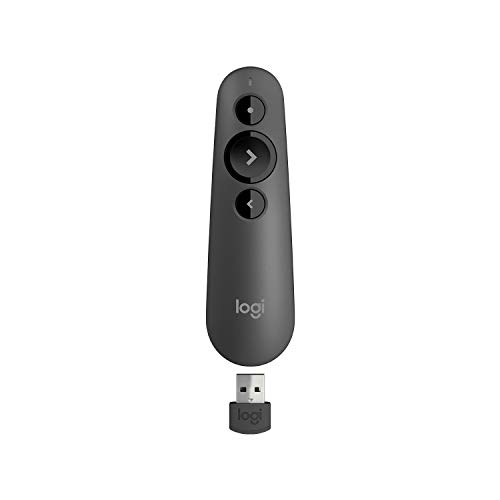
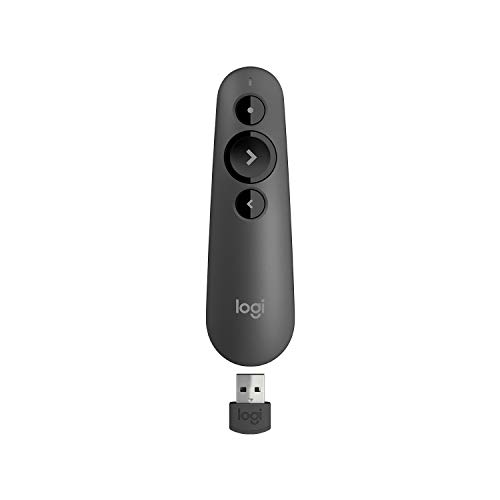
The Logitech R500s is the dependable middle of the presenter market: a comfortable, rubberised clicker with forward and back buttons you can find without looking, a red laser pointer for indicating points on a projected screen, and a plug-and-play USB receiver that stores inside the body so it does not get lost in a laptop bag. It connects over the receiver or over Bluetooth, which matters when every USB port on a thin laptop is already spoken for, and it is recognised by the usual presentation programs without drivers or pairing rituals. The shape fills the hand without bulk, the buttons give a clear click you can feel through a nervous grip, and the whole thing disappears into a jacket pocket between sessions. It suits teachers, trainers, and office presenters who move between rooms and computers and want the remote to simply work on whichever machine is waiting. It is not the choice for presenters who need a timer display, air-mouse control, or a digital highlight for streamed talks, and its laser should only ever be aimed at the screen or board in the presentation room, never at people, animals, aircraft, or vehicles.
Best for: presenters whose needs match the strengths described above. Not suited for: anyone whose main requirement is a feature this model deliberately leaves out, as covered in the trade-offs. Check price on Amazon for the current listing before you buy.

Kensington Expert Wireless Presenter — mid-range tier
The Kensington Expert Wireless Presenter is built around a joystick-style cursor control, which gives it a different feel from button-only clickers: you can nudge a pointer around the screen, open a link, or scroll a document without returning to the desk. It carries a green laser pointer, a colour many presenters find easier to follow on bright slides than a red dot, and it includes backlit buttons that help in darkened lecture halls and theatre-style rooms. The receiver stores in the body, the controls fall under the thumb in a ring layout, and the whole remote has the slightly larger, grippier build of a device designed to be held for a full lecture rather than a five-minute update. It suits lecturers, demonstrators, and anyone who interacts with the screen rather than simply advancing through it. The joystick takes a short learning period, the larger body is less pocket-friendly than the slimmest clickers, and as with every laser model here, the beam belongs on the screen or board only, kept away from eyes, animals, aircraft, and vehicles, and stored away from children when class ends.
Best for: presenters whose needs match the strengths described above. Not suited for: anyone whose main requirement is a feature this model deliberately leaves out, as covered in the trade-offs. Check price on Amazon for the current listing before you buy.
Canon PR1100-R — mid-range tier
Canon brings a camera maker’s neatness to the Canon PR1100-R: a clean, professional clicker with a red laser pointer, clearly separated slide controls, and a shape that looks at home in a boardroom rather than a gadget bag. The button layout is deliberately plain, which is a genuine virtue when a colleague hands you the remote thirty seconds before you start and there is no time to learn anyone’s clever shortcuts. It connects through its USB receiver with the usual plug-and-play behaviour, works with the standard presentation programs, and keeps its controls to the essentials so a guest presenter can run it confidently. It suits corporate presenters, visiting speakers, and teams that share one remote across many hands and many laptops. It does not offer the digital highlighting of the Spotlight or the cursor control of the Kensington, and it should be treated with the same laser discipline as every pointer here: aimed only at the screen or board, never at people, animals, aircraft, or vehicles, and stored out of children’s reach between meetings.
Best for: presenters whose needs match the strengths described above. Not suited for: anyone whose main requirement is a feature this model deliberately leaves out, as covered in the trade-offs. Check price on Amazon for the current listing before you buy.

DinoFire Wireless Presenter — entry-level tier
The DinoFire Wireless Presenter covers the essentials at the entry end of the range: slide forward and back, a red laser pointer, volume and screen controls on some layouts, and a USB receiver that plugs in and works without software. For a student, a community speaker, or a teacher equipping a classroom on a tight budget, that simple formula is often exactly enough, and the light body is easy to hold through a long lesson. The trade-offs are the expected ones for the tier: the plastics feel lighter, the button feel is less refined than the Logitech and Kensington models, and you should check the exact button layout of the version you order because entry-level presenters vary more between listings. It suits occasional presenters who need a working clicker without paying for cursor control, timers, or digital highlighting. Keep the same safety habits as with any laser model: point only at the screen or board, never at eyes, animals, aircraft, or vehicles, and keep it stored away from children.
Best for: presenters whose needs match the strengths described above. Not suited for: anyone whose main requirement is a feature this model deliberately leaves out, as covered in the trade-offs. Check price on Amazon for the current listing before you buy.
Who Should Buy a Wireless Presenter Remote, and Who Should Skip It
Buy one if you present standing, teach in a room you move around, sell in other people’s offices, or lecture to halls where the podium is a suggestion rather than a seat. Buy one if your talks include questions taken from the floor, demonstrations that happen away from the desk, or slides you need to annotate by pointing while you talk. The purchase pays for itself the first time a discussion starts and you are already standing where the discussion is.
Skip it, for now, if every presentation you give is a screen-share from your desk, if your employer’s rooms all have a presenter at the podium already, or if you present so rarely that the device would live in a drawer losing charge between outings. In those cases the keyboard, or the presentation app’s phone remote feature, covers the need without another object to maintain. The how to use a wireless presenter remote walkthrough in this cluster shows the full working routine, which is a good way to judge whether that routine fits your talks.
Pre-Purchase Checklist
- Which screens do you present on: projector, television, video wall, or laptop only?
- Whose computer do you present from: yours, or a different one each time?
- Do you need to click links, play video, or scroll, or only advance slides?
- Are laser pointers allowed in your venues, or do you need a digital highlight instead?
- How will the remote be powered, and what is your backup when it is flat?
Setup, Care and Maintenance Essentials
Set the remote up once, properly, and it will ask little of you afterwards. Pair or plug in the receiver, open your presentation software, and click through a test deck that includes a video and a link if your real talks use them. If the model has companion software, set the highlight size, pointer speed, and any timer features now, not during a talk. Store the receiver inside the body every single time; make it a ritual on the same level as saving the file.
Care is mostly battery care and bag care. Rechargeable models want a regular top-up rather than deep neglect, and replaceable-battery models want fresh cells before a big day and the spares kept in the same pouch. Keep the remote in its own pocket or pouch so keys and coins do not mark it, wipe the lens of a laser model gently if the dot looks fuzzy, and store laser models out of children’s reach as a matter of household routine. A remote treated this way lasts for years of talks.
Final Verdict
A wireless presenter remote is one of the few presentation purchases that changes how a talk feels rather than how it looks. The category’s best designs, from the Spotlight’s digital highlight to the R500s’ honest simplicity, all serve the same goal: the technology disappears, and the presenter is simply present. Choose the family that matches your screens and your computers, respect the laser safety rules without exception, and rehearse once with the device in your hand. For side-by-side thinking, continue with keyboards that suit Microsoft PowerPoint work and the rest of the related reading below.
The Second-Pass Review: Consistency, Fit and Fine Print
What the box should contain — and what it should not need
Unboxing is a small but telling review checkpoint for a wireless presenter remote: the essentials for the first session should be in the box, the instructions should match the actual unit, and nothing vital should depend on an immediate second purchase. If a pick requires an accessory to perform its core job, that dependency is flagged in its assessment above, because it changes both the real cost and the first-day experience. Equally, beware bundles padded with extras you will never use; in a small rented room where drilling, permanent fixings and bulky extras are off the table, unused bundle clutter is a cost paid in storage, not a bonus.
Reading the assessments against your own routine
These reviews were written against a general routine, and your routine is the final filter. Map each pick’s stated strengths onto your busiest realistic day with a wireless presenter remote: if a pick’s best quality serves a task you do rarely, it is not the pick for you, however strong the assessment. If a pick’s noted limitation sits in a corner of the workflow you never visit, discount it. This translation step — from review conditions to your conditions in a small rented room where drilling, permanent fixings and bulky extras are off the table — is where a good review becomes a good decision rather than a borrowed opinion.
Verify the listing, not just the product
A review can only judge the wireless presenter remote in front of it, but what arrives at your door depends on the listing you order from. Before choosing, confirm that the listing names the exact model, generation and bundle contents you think you are buying, because Gaming Mouse listings often group variants under one page. When picks such as DinoFire Wireless Presenter, Logitech Spotlight and Logitech R500s are on your shortlist, run this check against each listing in turn. Check which accessories are in the box and which are sold separately, and note the seller’s returns terms while you are there. Ten minutes of listing hygiene prevents the most common review-versus-reality mismatch: a good product judged by the wrong variant.
Consistency is the quiet test
Single impressive results are easy; a good wireless presenter remote repeats them on an ordinary day, with ordinary materials, when you are in a hurry. Across the picks in this review, the models that earned their place did so by being predictable: the same setup producing the same outcome, with controls that behave identically every time. In a small rented room where drilling, permanent fixings and bulky extras are off the table, predictability is worth more than a peak performance figure you will rarely reach. When you read the individual assessments above, treat consistency comments as the highest-value signal in each one.
Fit and feel, judged honestly
Specifications can tell you a wireless presenter remote will fit; only handling tells you whether it feels right doing it. Weight distribution, control placement, surface finish and the force needed for routine adjustments all shape whether you reach for the product gladly or work around it. When picks such as DinoFire Wireless Presenter, Logitech Spotlight and Logitech R500s are on your shortlist, run this check against each listing in turn. If your shortlist comes down to two similar models, this tactile layer is usually the honest tie-breaker, and it is personal: a control layout one reviewer calls cramped, a smaller-handed owner may call perfect. Where possible, judge fit against your own hands, desk and habits, not the reviewer’s.
Write the conclusion of that check down before you order, so the decision survives contact with a tempting listing.
That single habit separates owners who stay pleased with their choice from owners who quietly start shopping again within a season.
Treat it as part of the purchase itself, not as homework to do after the box arrives.
Frequently Asked Questions
What does a wireless presenter remote actually do?
It sends slide commands to your computer from across the room: advance, go back, blank the screen, and start or end the show. Most models add a way to point, either a laser dot for projected screens or a digital highlight for modern displays. Some add cursor control so you can open links and play videos. It presents itself to the computer as a simple input device, which is why the leading clickers work on almost any machine without installed software.
Is a laser pointer or a digital highlight better?
It depends on your screen. On a traditional projector in a darkened room, a laser dot is immediate and easy to follow. On bright televisions, LED video walls, and in streamed or recorded talks, a laser dot washes out or never appears at all, and a digital highlight such as the Logitech Spotlight’s is clearly better. Digital highlighting is also the safer choice in venues that restrict laser pointers, because no beam is involved.
How far from the computer can I present?
Presenter remotes are designed for normal rooms: classrooms, meeting rooms, and lecture spaces where you stay within a sensible distance of the receiver with a reasonably clear path. Range shrinks when the receiver hides behind metal furniture or a thick computer case, so placing the receiver where it can see the room, sometimes on a short extension lead, makes a real difference. Test your furthest standing spot during rehearsal rather than discovering the limit mid-talk.
Can I use a presenter remote with any presentation software?
In practice, yes for the mainstream programs. Because clickers send standard keyboard commands, they work with the usual slide applications on both major desktop platforms, and most also drive PDF viewers in presentation mode. Models with companion software add features inside that software’s reach. If you present from an unusual platform, such as a signage player or a locked-down conference system, test the exact combination in advance.
What are the safety rules for the laser on a presenter remote?
Never shine the laser into the eyes of a person or an animal, and never aim it at aircraft, vehicles, or through windows toward traffic. Use it only to point at the screen or board in the presentation room, release the button as soon as you have made the point, and store the remote out of the reach of children. Where lasers are banned, choose a digital-highlight model instead, which points without any beam at all.
What should I do if the remote stops responding during a talk?
Stay calm and keep talking; the audience takes its cue from you. Glance at the receiver connection, move a step closer, and try again once. If it stays dead, walk to the laptop and finish with the arrow keys, which is why your backup plan should always include knowing the keyboard commands and having fresh batteries or a charged spare within reach. Practising this drill once in rehearsal turns a potential derailment into a shrug.
Related Reading
- the companion reviews roundup
- the full buying guide
- how to choose a wireless presenter remote
- how to use a wireless presenter remote
- keyboards that suit Microsoft PowerPoint work
- wireless mouse picks for PC gaming
- wireless keyboard and mouse combos for couch use
Think about the room before you think about the remote. A small meeting room with a bright television rewards a digital highlight or a confident clicker, while a long lecture hall with a washed-out projector rewards a visible pointer and buttons you can operate without looking down. Presenters who rehearse with the actual room in mind rarely blame their tools, because they have already matched the tool to the throw distance, the lighting, and the screen they will really face.
Rehearsal is where a presenter remote earns its place. Run the full deck once with the remote in your hand, including the video clip, the link you plan to open, and the slide you always forget is a slow build. Note where you naturally stand, whether the receiver stays in range at that spot, and whether you can reach the black-screen button without hunting for it. Ten quiet minutes of this saves the public fumbling that audiences remember longer than the content.
Keep a simple backup plan. A spare battery or a charged cable in the bag, the deck also saved on the presentation computer itself, and the knowledge that the arrow keys advance slides will carry you through almost any failure. The presenters who look unflappable are rarely the ones whose equipment never fails; they are the ones whose failure drill is so practised that the audience barely notices the switch.
Button discipline matters more than button count. The best presenters advance slides decisively, use the blank-screen control when the audience should be looking at them rather than the slide, and resist clicking ahead to peek at what is coming. A remote with fewer, clearer buttons often produces a calmer delivery than a feature-packed one, because every control you might press by accident is a small risk carried through the whole talk.
Consider who else will use the device. A remote that lives in a shared training room should favour instant recognition, a receiver that stores inside the body, and controls a guest can understand in seconds. A remote that is personally yours can justify a learning curve, companion software, and tuned settings, because you will amortise that setup across hundreds of talks.
Wireless reliability is mostly about line of sight and distance. Receivers tucked behind a metal podium or a thick desktop case lose range; a receiver on a short extension lead, placed where it can see the room, transforms a flaky connection into a solid one. Bluetooth models sidestep the receiver entirely but depend on the host computer keeping its radio awake and paired, which is worth testing in the room rather than assuming.
Your voice and your slides should not compete. Use the remote to give the audience permission to look where you want: advance, point once at the screen or board to anchor the key figure, then step out of the beam’s story and talk to the people. The pointer is punctuation, not narration, and the talks that land hardest use it sparingly.
Travel changes the equation. A presenter who flies to speak should think about what survives a bag search and a borrowed laptop: plug-and-play connection, no dependence on admin rights to install software, and a receiver that cannot snap off because it lives inside the remote. Venue rules on laser pointers also vary, which is one more reason a digital-highlight model earns its place in a frequent traveller’s kit.
Accessibility deserves a mention. Large, tactile buttons help presenters with limited grip strength or gloves; backlit controls help in darkened halls; a remote that can be operated entirely by feel helps a speaker who uses a screen reader or who cannot glance down. Trying the device in your own hand, under your own conditions, tells you more than any feature list.
Finally, treat the remote as part of the talk’s choreography. Decide where it lives when you are not holding it, how you will pick it up without breaking eye contact, and what your hands do during questions. These small physical decisions are invisible when they go well and glaring when they do not, and they are entirely within your control before the audience arrives.
Think about the room before you think about the remote. A small meeting room with a bright television rewards a digital highlight or a confident clicker, while a long lecture hall with a washed-out projector rewards a visible pointer and buttons you can operate without looking down. Presenters who rehearse with the actual room in mind rarely blame their tools, because they have already matched the tool to the throw distance, the lighting, and the screen they will really face.