ilcastellomenu.com is reader-supported. When you buy through links on our site, we may earn an affiliate commission.
Where to Buy
Honesty first, because this keyword deserves it: the best cameras for drone videos would normally be drones, and our verified camera pool for this guide contains no drone at all. Rather than invent listings or pretend a webcam flies, this guide does the useful thing instead. It covers the cameras that genuinely serve drone-style videography from the ground and from mounts — action cameras light and tough enough to ride on capable third-party drones and FPV frames, a 360 camera whose footage can be reframed into sweeping aerial-feeling shots, and the cameras creators pair with aerial footage on the ground.
If you arrived hoping to choose a flying camera itself, the truthful advice is short: buy the drone as a complete system from a maker who supports it, judge it on flight time, obstacle sensing, transmission range and your local regulations, and treat any camera-only recommendation — including this one — as a companion purchase, not a substitute. What follows is for the large group of readers whose real project is the video, not the aircraft: the travel film that needs an aerial chapter, the property tour that needs a rising reveal, the action edit that needs a camera willing to be strapped to something fast.
Every pick below is therefore judged on the aerial-adjacent virtues: weight, toughness, stabilisation that survives vibration, image quality that can sit beside true drone footage in an edit without apologising, and mounting ecosystems that make the shot physically possible. Read the limits in each verdict as carefully as the praise. This guide would rather lose a sale than send a reader up a mountain with the wrong tool and a vague promise.
One more framing note before the picks themselves. Aerial-style videography has quietly become a genre of its own, with its own festivals of technique — the pole reveal, the cinewhoop interior, the 360 reframe — and its own audience that no longer asks how a shot was achieved before enjoying it. The cameras below are the genre’s current working instruments, chosen from what could be verified rather than from what could be wished for, and each has a community of practitioners whose published work you can study before spending anything at all.
Key Takeaways
- No camera in this guide flies by itself; each earns its place as a mountable, wearable or reframing tool for aerial-style footage.
- Weight is the first aerial specification, because every gram a drone carries is paid for in flight time.
- Stabilisation must defeat vibration, not just footsteps, when a camera rides on a frame or a vehicle.
- Footage meant to sit beside true drone clips needs dynamic range and colour that can be matched in the edit.
- Regulations govern drones, not these cameras — one more reason ground-based aerial tricks remain popular.
- The most convincing fake aerial shot is usually a high viewpoint, a slow move and patience, in that order.
In this guide
Quick Picks
| Pick | Badge | Why it is here |
|---|---|---|
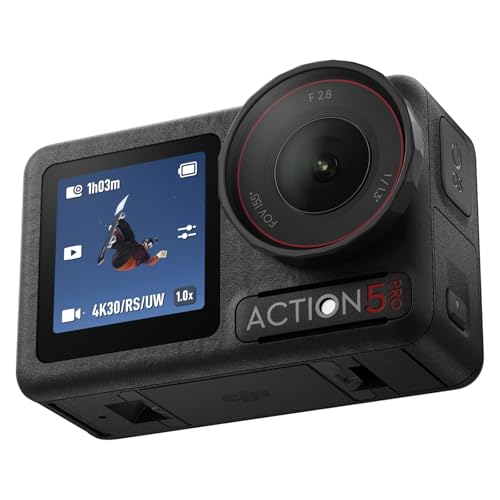
| DJI Osmo Action 5 Pro | Best mountable camera for aerial-style work | DJI’s action flagship shares the colour language of DJI’s drones, stabilises through vibration, and is light and sealed enough to ride FPV frames and vehicles. |
| GoPro HERO13 Black | Best ecosystem for carried cameras | The deepest mount and lens-mod ecosystem in the class, magnetic mounting, and an image pipeline that has defined action footage for a decade. |
| Insta360 X4 | Best for reframing the sky afterwards | Captures everything in 360 degrees, so the aerial move — the pan, the sweep, the impossible crane — is chosen in the edit rather than flown on the day. |
| Insta360 Ace Pro 2 | Best image quality in a mountable body | A large-sensor action camera with low-light ability unusual in the class, for carried and mounted footage that must survive dusk and interiors. |
| AKASO Brave 7 LE | Best budget camera to risk on a mount | A genuinely inexpensive, weather-sealed action camera with dual screens — the camera you can afford to strap somewhere brave and learn the craft. |
| GoPro HERO12 Black | Best value carried camera for long days | The previous flagship, now friendlier priced, with endurance-focused recording and the full GoPro ecosystem — a workhorse for mounted and FPV use. |
How Did We Choose Cameras for Drone-Style Video Without a Drone?
The constraint shaped the method. Since no pick could be a drone, we asked what aerial videography actually consists of once the aircraft is removed: cameras carried by drones and FPV frames built by hobbyists, cameras on poles, cable cams, vehicles and helmets that imitate the aerial viewpoint, and 360 capture that lets an editor choose the viewpoint afterwards. Cameras serving those real practices — light, sealed, stabilised, mountable — formed the shortlist; studio bodies and webcams, however excellent elsewhere, did not.
Image character was judged for intercutting. Aerial footage has a signature: high, smooth, wide and bright, often shot into difficult light. A companion camera whose footage is noisy, shaky or colour-poor will betray every cut it appears in, so we favoured sensors and stabilisation systems that hold highlights and horizons gracefully, and colour that can be flattened for matching or used finished for fast turnarounds.
Finally, we priced honesty into every verdict. Each pick states plainly what it cannot do — it cannot hover, it cannot see over the ridge by itself, it cannot replace the aircraft — because readers building an aerial look on a budget deserve a map of the workaround’s edges. Within those edges, the six below are genuinely capable, and several appear in the kits of creators whose aerial chapters you have probably already admired without knowing how they were made.
We should also record what we excluded and why, since exclusion is half of any honest guide. Pure webcams and indoor security cameras appear in our wider pool and were set aside without regret: a camera that must face a desk cannot chase an aerial viewpoint, whatever its resolution. Likewise the fine stills cameras in the pool were passed over for this keyword — their footage is beautiful, but beauty that cannot be mounted, weather-sealed or risked is the wrong beauty for a genre defined by where the camera has to go.
Readers comparing this guide with a conventional drone roundup should know the two documents answer different questions on purpose. The roundup chooses aircraft; this page chooses the cameras that surround, accompany and occasionally impersonate aircraft, and it was written because the pool behind it could verify these cameras and no others. Where the two guides overlap — the creator who owns both a drone and a mounted camera — they agree completely: buy the aircraft for altitude, and buy from this page for everything altitude cannot do.
Which Six Cameras Serve Aerial-Style Video Best?
Three are action cameras built to be mounted on almost anything that moves, including the FPV and cinewhoop frames hobbyists fly. One is a 360 camera that reframes the sky after the fact. One is a flagship action camera whose image quality leads the class, and one is a budget mountable that makes experimentation cheap enough to be brave. None of them is a drone; all of them have shot footage that audiences assumed was.

DJI Osmo Action 5 Pro — Best mountable camera for aerial-style work
The Osmo Action 5 Pro earns the top row through a coincidence of breeding: it comes from the company whose drones define the aerial look, and its colour science speaks the same language. Footage from this camera cuts against true DJI drone material with less grading friction than any rival here, which matters enormously when the aerial chapter and the mounted chapter must feel like one film. For creators building a drone-style video around a real drone’s establishing shots, that continuity alone justifies its place.
As a carried camera it is properly equipped for the indignities of flight-adjacent work. It is light enough for the FPV frames and cinewhoops that hobbyists build to carry action cameras through gaps and interiors, sealed against the weather it will meet on vehicles and poles, and stabilised by a system that treats vibration — the signature enemy of mounted footage — as its home territory. Battery endurance across a shooting day is a further, unglamorous excellence that production work rewards.
The limits are the category’s limits, stated once here for all its rivals: the fixed wide lens dictates the look, the sky must be visited rather than hovered in, and low light, while improved in this generation, still belongs to larger sensors. Within the honest brief of this guide — the best camera to mount, carry and cut against aerial footage — the Action 5 Pro is the most complete answer we can give, and the one working creators reach for first.
One working habit separates its best users from its owners: they shoot the mounted chapter with the drone chapter’s settings already dialled in — same frame rate, same shutter logic, a colour profile chosen for the marriage rather than the moment. The discipline costs thirty seconds at the start of the day and saves an evening in the edit, which is the exchange rate at which professional habits always trade. If you buy only one idea from this entire guide, buy that one.
- Compact, sealed action camera body
- Advanced stabilisation for vibration-heavy mounts
- Colour designed to sit beside DJI drone footage
- Long recording endurance for production days
- Extensive mount compatibility
Strengths
- Cuts seamlessly against DJI aerial material
- Light enough for hobbyist FPV frames
- Stabilisation shrugs at vibration and weather
Trade-offs
- Fixed wide lens sets the visual terms
- Cannot fly, hover or frame from altitude alone
- Low light trails larger-sensor cameras
Best for: creators pairing mounted and FPV shots with real drone footage.
Not suited for: anyone expecting the camera itself to take off.

GoPro HERO13 Black — Best ecosystem for carried cameras
If the shot requires a camera to be attached to something unusual — a wing strut where regulations allow, a racing hull, a helmet, a dog, a drone frame built for the purpose — the HERO13 Black is usually the camera that can be attached, because GoPro’s decade of dominance built the mount ecosystem everyone else rents space in. Magnetic quick-release mounting in this generation makes repositioning a seconds-long act rather than a tools-out negotiation, which changes how experimentally a creator can work across a shooting day.
The image pipeline remains the class reference for a reason: punchy, detailed footage with stabilisation that has been refined against every vibration profile the action world produces, and lens accessories that widen or de-fisheye the view for particular aerial-feeling shots. For FPV pilots, the stripped-down culture around GoPro — the naked builds that shed the case to save grams — is deeper here than anywhere, a whole hobbyist literature of carried-camera craft.
Against it stand the familiar action-camera taxes: battery appetite on the longest settings, heat management on still hot days, and a fixed lens whose character must be embraced or corrected. Its colour, while excellent, needs a touch more work than the DJI’s to sit beside DJI drone footage specifically. None of that displaces it as the carried camera of maximum possibility — the one whose accessories shelf means the answer to ‘can it be mounted there’ is almost always yes.
Its accessory shelf deserves a strategy rather than a spree. Buy the mounts your shot list actually names — the clamp, the suction base rated for your vehicle work, the chest and helmet rigs — and resist the drawer of speculative attachments that every action-camera owner accumulates. The lens accessories earn their place selectively: the ultra-wide option for interiors and FPV frames where space is the story, the anamorphic experiment for the creator chasing a cinema texture. Everything else can wait until a real shot demands it by name.
- Magnetic quick-release mounting system
- Class-defining stabilisation and image pipeline
- Lens accessories for different fields of view
- Waterproof, impact-tolerant body
- Deepest third-party mount ecosystem available
Strengths
- Mounts on virtually anything, quickly
- Hobbyist FPV knowledge base is unmatched
- Footage quality sets the class standard
Trade-offs
- Battery and heat need managing on long days
- Colour matching to DJI drones takes grading
- Fixed lens character is ever-present
Best for: FPV builders, vehicle shooters and creators with unusual mounting problems.
Not suited for: set-and-forget users who dislike managing batteries and settings.

Insta360 X4 — Best for reframing the sky afterwards
The X4 attacks the aerial problem from the future: if the camera records every direction at once, the viewpoint becomes an editing decision. Mounted on a pole above a viewpoint, carried on an invisible selfie stick through a scene, or fixed high while action unfolds below, it gathers a sphere of footage from which the editor later extracts pans, tilts, sweeps and reveals that feel uncannily like drone moves — including the famous shot where the camera appears to fly through the scene while the stick vanishes from the frame entirely.
For drone-style work specifically, its gift is insurance. A true aerial shot that misses its framing is a reflight; an X4 capture reframes endlessly, so the rising reveal over the property, the orbit around the monument and the chase down the trail can all be mined from the same take. The footage quality in this generation supports that ambition, with resolution high enough that the reframed crops remain presentable and stabilisation that keeps horizons eerily level.
Its costs are workflow and physics. The files are large, the reframing is an editing stage that must be learned and enjoyed rather than endured, and the image, however good, is extracted from a sphere rather than captured by a dedicated forward lens, so pixel-level scrutiny finds the compromise. Low light asks similar respect. Creators who love the edit will find the X4 the most creatively liberating tool in this guide; creators who hate post-production should admire it from a distance and choose a forward-facing rival.
Protect the lenses like the whole budget depends on them, because it does: the twin bulging optics that gather the sphere are also the first surfaces to meet the world when a pole tips or a mount slips. Guards for transport, a case that lives on the belt rather than in the car, and a ritual of checking both domes before every capture will save the footage that scratches would quietly ruin. Owners who build that ritual find the camera’s creative freedom survives contact with real locations; owners who do not tend to own a very educational paperweight.
- Full 360-degree capture in high resolution
- Reframing software for post-shot camera moves
- Invisible selfie-stick effect for flying illusions
- Flow-state stabilisation and horizon lock
- Waterproof body for outdoor viewpoints
Strengths
- One capture yields many aerial-feeling shots
- Missed framing can be rescued in the edit
- Flying-through scenes without any aircraft
Trade-offs
- Reframing workflow adds real editing time
- Large files demand storage and patience
- Extracted views trail dedicated lenses for detail
Best for: editors and creators who want aerial moves from safe, legal viewpoints.
Not suited for: shooters who want finished footage straight from the camera.

Insta360 Ace Pro 2 — Best image quality in a mountable body
Most mounted footage fails at the edges of the day — the FPV run at dusk, the interior fly-through, the vehicle shot under trees — where small sensors smear and stabilisation gives up. The Ace Pro 2 was built for exactly those edges, with a larger sensor than action cameras traditionally carry and low-light processing that keeps carried footage clean when rivals have turned to noise. For the creator whose aerial-style work happens at golden hour because that is when locations look like cinema, that headroom is the difference between a shot and an apology.
The rest of the package respects the brief: a flip screen for framing at odd mounting angles, strong stabilisation, magnetic mounting for fast repositioning, and colour that grades gracefully beside bigger cameras. It rides the same vehicles, poles and frames as its rivals while asking less forgiveness from the light, and its stills are strong enough to serve as the production’s photographs too.
The ecosystem is younger than GoPro’s, so the exotic mount for the exotic problem may need adapting rather than buying, and the body is a touch larger than the lightest rivals — a consideration on the smallest FPV frames where grams are audited. Battery behaviour on the longest days similarly rewards carrying a spare. Judged on image quality per mounted gram in difficult light, though, the Ace Pro 2 leads this guide, and difficult light is where aerial-style footage earns its drama.
Its flip screen changes mounted work in a way spec sheets undersell: the camera can live at the end of the pole, under the vehicle or inside the set piece, and still be framed by a human being rather than by hope. That framability, combined with the low-light headroom, makes it the pick we would send into the trickiest single location — the barn at dusk, the forest road, the workshop interior — where the shot must be composed in a place no operator can stand. Compose carefully there; the footage rewards it out of proportion to the effort.
- Larger sensor than typical action cameras
- Low-light processing for dusk and interiors
- Flip screen for awkward mounting angles
- Magnetic mounting and strong stabilisation
- Colour that grades well beside larger cameras
Strengths
- Dusk and interior footage rivals fear
- Framing screen suits poles and vehicles
- Image quality flatters intercutting
Trade-offs
- Mount ecosystem still maturing
- Slightly larger for the smallest frames
- Spare battery wise on long shoots
Best for: golden-hour creators, interior fly-throughs and vehicle work in shade.
Not suited for: FPV builders counting every gram on micro frames.

AKASO Brave 7 LE — Best budget camera to risk on a mount
Every carried-camera craft has a tuition phase, paid in crashed frames, drowned housings and mounts that failed at speed. The Brave 7 LE exists to make that tuition affordable. It is a weather-sealed action camera with front and rear screens, respectable stabilisation and footage that, in good light, sits happily in the social and travel edits most beginners are actually making — at a price that lets a mistake be a lesson instead of a catastrophe. For the student building a first FPV frame or the creator testing whether pole shots suit their channel, that economics is a creative feature.
It also serves honourably as the second or third angle on bigger shoots: the camera under the vehicle, at the far corner, on the spare helmet, where a flagship would be an anxious extravagance. Dual screens help framing in those odd positions, the waterproofing survives the splash zone, and the accessory bundle culture around the brand means mounts arrive in the box rather than on a wishlist.
No honest review can promote it beyond its station. Low light softens it quickly, stabilisation trails the leaders over the roughest vibration, colours need more help in the edit, and the app experience is functional rather than delightful. But the question this row answers is real — what should I learn carried-camera craft on, and risk while learning — and the Brave 7 LE answers it better than any camera here. Buy it to be brave; graduate when your footage, not your fear, says so.
Treat its limitations as a curriculum. The good-light competence teaches you to schedule mounted shots for the hours that flatter them; the modest stabilisation teaches rigid mounting and slow moves; the colours teach basic grading on footage that needs it honestly rather than optionally. A creator who completes that curriculum on the Brave and then graduates to a flagship will outperform, for a year at least, the creator who bought the flagship first and learned none of it. Cheap cameras with honest limits are underrated teachers.
- Weather-sealed body with waterproof case options
- Front and rear screens for framing
- Electronic stabilisation for mounted work
- Generous accessory bundles commonly included
- Footage suited to social and travel edits
Strengths
- Cheap enough to mount bravely
- Dual screens help at odd angles
- Good-light footage exceeds its price
Trade-offs
- Low light and rough vibration expose its class
- Colours need editing assistance
- App and polish trail the leaders
Best for: students, experimenters and multi-angle shoots needing a risk camera.
Not suited for: professionals whose mounted footage must carry the whole film.

GoPro HERO12 Black — Best value carried camera for long days
The HERO12 Black is the connoisseur’s answer to a budget question: yesterday’s flagship, with the ecosystem, image pipeline and mount compatibility of the flagship class, at the friendlier price that yesterday confers. For carried and aerial-style work its particular virtue is endurance — this generation was tuned for longer recording on a charge, and mounted cameras, which are started and then left to witness, benefit from that tuning more than any handheld user does. Set it on the pole, the vehicle or the frame, and it simply outlasts.
Its footage needs no apology anywhere: the stabilisation generation it carries remains superb, its colour and log options grade into serious edits, and the entire GoPro accessory universe — mounts, lens mods, media mods — fits it without adaptation. FPV builders know its weight, its naked-build options and its failure modes the way mechanics know a classic engine, and that communal knowledge is a genuine production asset when something misbehaves far from home.
What it lacks is only the newest generation’s refinements: the magnetic mounting convenience of its successor, the latest low-light polish, and the indefinable reassurance of buying the current model. Heat on the longest, stillest, hottest recordings still deserves respect and airflow. For the working creator who values endurance and ecosystem over novelty — and whose aerial-style chapters are shot weekly rather than yearly — the HERO12 remains one of the most rational purchases in this entire guide.
Its endurance tuning rewards one particular production pattern: the long witness. Plant it before the event, start it early, and let it gather the whole arc — the regatta from the committee boat, the build from the workshop corner, the festival from the pole above the square — while you work the day with a second camera. Reviewing that unbroken witness footage is where editors find the transitions and reactions the directed shots missed, and few cameras at its price can be trusted to still be recording when the arc completes.
- Endurance-tuned recording for mounted witness work
- Flagship-class stabilisation and image pipeline
- Full compatibility with GoPro mounts and mods
- Log colour option for graded edits
- Waterproof, ruggedised body
Strengths
- Long recording suits set-and-witness shooting
- Entire GoPro ecosystem fits without fuss
- Flagship footage at a yesterday price
Trade-offs
- Lacks the newest magnetic mounting
- Low-light polish a generation behind
- Needs airflow on hot, still, long recordings
Best for: working creators mounting cameras weekly on a sane budget.
Not suited for: buyers who always want the current flagship generation.
How Do You Fake Convincing Aerial Shots From the Ground?
Start with height, however humble. A camera on a fully extended pole, a rooftop parapet, a hillside above the subject or a lifeguard’s chair already owns the aerial viewpoint’s essence — the world arranged as pattern rather than as eye-level clutter — and a slow, steady move from that height reads as flight to an audience that has no altimeter. The X4’s invisible-stick work is the famous version of this trick, but every camera here on a pole, moved slowly and stabilised well, performs a respectable dialect of it.
Then mind the aerial grammar. Real drone shots move at constant speed, begin before the subject and end after it, and keep the horizon level with a discipline that handheld work must imitate deliberately. Shoot the move at a slightly higher frame rate if your camera offers it and slow it in the edit; the resulting smoothness is the cheapest production value in this entire article. Wide lenses help, because aerial footage is wide by nature, and so does altitude’s colour — bright, high-contrast light that the ground camera should seek rather than avoid for these particular shots.
Finally, edit like an aircraft. Cut on movement, let aerial-feeling shots breathe longer than ground shots, and resist explaining the trick with a visible pole shadow or a jerky start. Audiences grant the aerial illusion generously when the movement is confident; they revoke it instantly when the camera hesitates. Confidence, practised at walking pace with a pole on a quiet morning, is a learnable substitute for a great deal of expensive altitude.
What Are the Rules and Risks of Carrying Cameras on Drones?
The legal position must be stated plainly: the moment any camera leaves the ground on an aircraft, drone law applies to the whole combination — registration, pilot rules, airspace restrictions, privacy and insurance — and those rules vary by country and change often enough that this guide will not summarise them into a false sense of security. Check your national aviation authority’s current rules before any flight, and treat flying a camera-carrying frame near people, property or airports as the serious undertaking it legally is.
The physical risks deserve equal clarity. A carried camera adds weight that shortens flight time, shifts balance, and can detach if the mount is improvised; every gram and every strap must be audited as if the combination will be shaken violently at altitude, because it may be. Purpose-built frames, rated mounts and pre-flight checks are not bureaucratic fuss but the difference between a hobby and an incident, and the budget pick in this guide exists partly so that the tuition phase of this craft is paid in affordable hardware.
Insurance and permission complete the triad. Landowners, venues and events can forbid flight regardless of national law, and a creator who asks, explains and accepts refusal gracefully builds the relationships that make a career of aerial work possible. The ground-based techniques in the previous section exist in this guide precisely because so many beautiful locations are, quite properly, closed to aircraft — the pole and the 360 camera are not consolation prizes but the professional’s answer to a restricted world.
How Do You Match Mounted Footage to Real Drone Footage in the Edit?
Matching begins on the shoot, not in the software. Set the mounted camera’s colour to its flattest available profile when the drone footage will be graded, match frame rates and shutter conventions between the two cameras, and shoot a few seconds of the same scene with both cameras side by side — that overlap is the colourist’s Rosetta stone, worth more than any preset. The DJI pairing in this guide minimises the work, but even mixed brands converge quickly when the profiles and settings were chosen with the marriage in mind.
In the edit, correct the drone footage to honesty first, then bring the mounted footage to it, judging on a calibrated screen in that order; chasing both simultaneously produces two compromises instead of one truth. Watch for the three usual betrayals — horizon wobble the stabilisation missed, sharpening differences that make one camera look crunchy beside the other, and highlight roll-off that reveals which sensor was smaller — and soften each with the gentlest tool that works, because heavy correction advertises itself.
Sound finishes the match in a way beginners underestimate. True aerial footage is effectively silent — the aircraft’s buzz is unusable — so mounted footage with rich location sound actually grounds the sequence pleasantly when mixed low beneath music or narration. Let the aerial chapters breathe in that near-silence, bring the world’s sound up as the camera descends to its mounted and ground positions, and the audience will feel the geography of the film without ever being told how it was made.
What Ground Kit Completes an Aerial-Style Production?
The pole is the first citizen of the ground kit: a sturdy, extendable monopod or dedicated camera pole that reaches well above head height, with a mount you trust at full extension and a safety lanyard for the camera, because height multiplies the cost of every dropped gram. Add a small gimbal or the best-stabilised camera you own for the moving shots, and a clamp mount for railings, branches and vehicle points — between pole, gimbal and clamp, most aerial-feeling viewpoints in most locations become available without a single propeller turning.
Power and storage follow the usual professional pattern, doubled: mounted cameras are started early and reviewed late, so they consume batteries and cards at a rate handheld discipline never teaches. Label cards by position rather than by time — ‘pole’, ‘vehicle’, ‘360’ — and the edit will thank you at midnight. A small field monitor or a phone running the camera’s app helps frame pole shots without guesswork, though the X4’s reframe-later nature forgives framing sins the others cannot.
Pack finally for the location’s rules and weather: the permission email printed, the landowner’s conditions noted, rain covers for the mounted cameras that will sit exposed while you shelter, and a plan B shot list for the day flight — real or faked — is refused by wind or authority. Aerial-style production rewards the prepared disproportionately, because its best shots are appointments with light and viewpoint that do not repeat; the kit above exists to make sure you keep those appointments.
How Do FPV and Cinewhoop Carried Cameras Actually Work?
The hobbyist world that carries these cameras deserves a plain explanation for readers meeting it here. FPV — first-person view — pilots fly small, agile frames while watching through goggles fed by a separate tiny camera, while the camera in this guide rides along purely to record the beautiful version of the flight. Cinewhoops are the gentle branch of the family: small frames with ducted propellers, built to move slowly and safely through interiors and near people, carrying an action camera to gather the now-famous indoor fly-through shot in a single unbroken take.
The craft’s economics explain this guide’s shape. The recording camera is usually the most expensive single component aboard, it is the component most at risk in a crash, and its weight dictates the frame’s whole design — which is why the class’s cameras compete so fiercely on grams, toughness and stabilisation, and why the budget pick earns its row as the frame-builder’s training partner. Pilots speak of their carried cameras the way cinematographers speak of lenses: as creative instruments with failure modes to be respected, not as cargo.
For the reader tempted by this world, the honest pathway runs through simulation and small frames before any camera is carried aloft: hours in a flight simulator, a beginner frame flown line-of-sight in open space, the law learned before the first real flight rather than after the first complaint. The cameras above will wait patiently on the shelf during that apprenticeship, and the footage they eventually gather will be better for every hour of it — FPV film craft is piloting first and photography second, in that order, always.
What Does an Aerial-Style Shooting Day Look Like in Practice?
It begins lower than anyone expects: with a walk. The creator scouts viewpoints at ground level, noting where a pole can rise unseen, where a railing offers a clamp its horizon, where the sun will stand at the appointed hour and which permissions govern each patch of ground. Shot lists for aerial-style work are really viewpoint lists, and the day’s success is usually decided on that walk, before a single battery leaves the bag. The cameras matter from the second hour onward; the first hour belongs to geography.
The shoot itself alternates patience and opportunism. Pole and 360 positions are set early for the establishing chapters, mounted cameras are started and left to witness, and the operator works the middle distance with a handheld camera while the high tools gather their material unattended. Light is the schedule’s true author: the aerial-feeling shots cluster at the day’s bright, high-contrast edges or in golden hour’s long modelling, and a wise plan puts the viewpoints where those hours will find them rather than discovering the geometry afterwards.
The evening brings the genre’s distinctive homework: reframing the 360 material while the day’s intentions are still remembered, backing up cards labelled by position, and reviewing the witness footage for the unplanned gold it so often contains. Creators who keep that rhythm — scout, plant, work, reframe, review — find their aerial chapters improving at a rate that pure equipment spending has never matched, which is the closest thing this workaround genre has to a founding promise.
How Do the Six Compare for Aerial-Style Work?
The honest comparison is about roles: the DJI and the two GoPros are carried cameras of different generations and ecosystems, the Ace Pro 2 is the low-light mountable, the X4 is a viewpoint you decide later, and the AKASO is the brave beginner. None replaces an aircraft; together they cover nearly everything an aircraft’s camera would be asked to feel like.
| Pick | Badge | At a glance |
|---|---|---|
| DJI Osmo Action 5 Pro | Best mountable camera for aerial-style work | Action flagship whose colour matches DJI drone footage unusually well. |
| GoPro HERO13 Black | Best ecosystem for carried cameras | Mount ecosystem leader; the carried camera other cameras are judged against. |
| Insta360 X4 | Best for reframing the sky afterwards | 360 capture that turns one high viewpoint into many aerial-feeling shots. |
| Insta360 Ace Pro 2 | Best image quality in a mountable body | Large-sensor action camera; dusk and interior mounted footage lead the class. |
| AKASO Brave 7 LE | Best budget camera to risk on a mount | Budget mountable; cheap enough to risk, good enough to learn on. |
| GoPro HERO12 Black | Best value carried camera for long days | Previous flagship value; endurance and ecosystem for working shooters. |
What Mistakes Ruin Drone-Style Video Projects?
The founding mistake is buying a camera from a guide like this one while secretly expecting it to fly. Every pick here is a tool for aerial-style footage, mounted footage or reframed footage — not an aircraft — and the reader who skips the introductions to reach the products will be disappointed in proportion to their hurry. If your project truly needs altitude, buy the drone system, learn its law, and return here for the companion cameras that complete the kit.
The second mistake is mounting carelessly: a flagship on an unrated strap, a pole extended over a crowd, a vehicle mount trusted to hope. Carried cameras fall, and falling cameras endanger people before they endanger budgets. Rated mounts, safety tethers, pre-flight and pre-drive checks, and a refusal to position any camera where its failure could hurt someone are the non-negotiable craft of this genre — the AKASO’s low price is an invitation to learn that craft, not an exemption from it.
The third mistake is visual: shooting aerial-style footage with ground habits. Jerky starts, horizons that wander, moves that change speed mid-shot and cuts that explain the trick all collapse the illusion the project exists to create. Slow everything down, level everything twice, and let the shots run longer than feels natural. The aerial look is a discipline of calm imposed on ordinary equipment — which is precisely why it remains available to creators who own no aircraft at all.
A fourth mistake is subtler and purely editorial: intercutting the imitation with the real thing carelessly. A sequence that opens with a genuine high-altitude drone shot and then cuts to a pole shot at the same location invites the audience to notice the altitude’s disappearance, while the same two shots separated by ground-level material pass as chapters of one geography. Structure the edit so each viewpoint earns its own passage — aerial, mounted, ground — and the audience reads production design where a careless cut would have shown them the seams of the workaround.
Do not neglect the rehearsal either. A pole move or a mounted sequence performed for the first time in front of the real subject will wobble, drift and betray its mechanics in ways a quiet practice session exposes for free. Walk the move twice without recording, once with, and review the practice take at full size before the moment that matters arrives. Aerial confidence is a performed calm, and like every performance it improves with rehearsals the audience never sees — which is, of course, rather the point of the entire illusion.
Final Recommendation
If your aerial chapters will cut against real DJI drone footage, the Osmo Action 5 Pro is the companion to buy first: its colour kinship and stabilisation make the marriage easiest. FPV builders and mount experimentalists should take the HERO13 Black for its ecosystem, or the HERO12 Black when endurance and value outrank novelty, while editors who love post-production will extract the most aerial magic from the Insta360 X4’s reframing.
The Ace Pro 2 owns the dusk and interior work, and the AKASO Brave 7 LE owns the learning phase — a complete aerial-style toolkit can be assembled from this list at several budgets without a single dishonest purchase. And the closing advice remains the opening one: if you need to fly, buy the aircraft and learn its rules properly. These cameras will be waiting, ready to go everywhere the drone cannot, when you come back down.
There is also a creative consolation worth naming before you go: some of the most imitated aerial-feeling shots of the last decade were made by exactly these workarounds, by creators who could not fly where they stood and refused to let that be the end of the idea. Constraints of law, budget and geography have always been cinematography’s secret collaborators. The pole, the clamp, the 360 sphere and the patient walk are not admissions of defeat; they are a respectable tradition with excellent footage to show for itself.
So scout the viewpoint first, mount the camera like it matters, move like an aircraft and edit like a geographer. The sky, it turns out, was only ever one of the ingredients — and it is the one this guide has honestly taught you to live without, or to complement, depending on the film you are actually making.
Start with one viewpoint this week — a bridge, a balcony, a quiet hill above a familiar road — and make the slowest, steadiest rising shot your current camera and a borrowed pole can manage. Watch it honestly, fix the worst wobble, and make it again. That small loop, repeated, is the entire genre in miniature, and it will tell you more about which pick above belongs in your bag than another hour of comparison ever could.
Height is a habit before it is a purchase, and habits are the part of filmmaking nobody can sell you.
Practise it once this week, and every viewpoint you pass afterwards will already look like the opening of a shot worth making.
Related guides
Frequently Asked Questions
Can any of these cameras actually replace a drone?
No — and this guide has tried to be the one that tells you so plainly. These cameras imitate the aerial viewpoint from poles, vehicles, helmets and high places, ride on hobbyist-built flying frames, or reframe a high capture into drone-like moves. A true drone adds genuine altitude, distance and flight paths none of them can achieve. Decide which your project actually needs: many travel, property and action films discover the imitation covers their real shot list entirely.
Is it legal to strap an action camera to a drone?
It can be, on frames designed to carry one and flown under your country’s drone rules — which govern the whole combination’s weight, airspace, pilot requirements and insurance. Those rules vary by jurisdiction and change over time, so consult your national aviation authority’s current guidance rather than any buying guide, and never fly a camera-carrying combination over people or near airports without the specific permissions the law requires.
Why does mounted footage vibrate when the camera has stabilisation?
Because vehicle and frame vibration includes high-frequency buzz and physical translation that electronic stabilisation only partly corrects. Improve it mechanically first — rigid rated mounts, vibration-damping plates where the FPV community uses them, and mounting points away from engines and prop wash — then let the stabilisation finish the job. The cameras in this guide are the class leaders at that finishing work, but none repeals physics.
What is the cheapest convincing aerial shot I can make today?
A slow pole shot at golden hour, most likely with equipment you nearly own already. Raise any camera here above head height on a sturdy pole, move at a constant walking pace or slower, keep the horizon level, and hold the shot longer than instinct suggests. Add the X4 later if you want the move designed in the edit. The ingredients are height, slowness and light — altitude is merely the expensive way to buy the first of the three.
Which of these cuts best with footage from a real drone?
The DJI Osmo Action 5 Pro, by breeding: its colour science is designed in the same house as the dominant drones, so mixed sequences need the least grading diplomacy. The GoPros and the Ace Pro 2 match well when shot in their flatter profiles with matched frame rates, and the X4’s reframed shots intercut happily as reveals and transitions, where its slightly different texture reads as a change of lens rather than a change of world.
Do I need special insurance for aerial-style work?
For pure ground-based work — poles, clamps, helmets — ordinary creator or business cover usually addresses the risks, though public liability becomes relevant the moment equipment is raised over places people walk. The moment any camera flies on any frame, aviation-related rules and insurance expectations change completely. Read your policy, ask your insurer about the specific activity, and never let a shot’s ambition outrun the cover and permissions standing behind it.
Related Guides
Our companion guides cover the true aircraft cameras and neighbouring moving-image crafts: best action cameras for drones best cameras for travel videos best cameras for fast pans


