ilcastellomenu.com is reader-supported. When you buy through links on our site, we may earn an affiliate commission.
Where to Buy
Every camera below is available on Amazon, where the multi-camera bundles are worth pricing before you buy singles. The best cameras for night time solve a specific problem: almost everything a home camera exists to catch happens between dusk and dawn, in light too thin for ordinary sensors, at distances that turn cheap footage into grey theatre. A daytime camera with a night mode is not the same instrument as a camera designed for the dark — the difference shows in whether the 3 a.m. clip identifies the person at your gate or merely confirms that a person-shaped rumour passed by. This guide is about cameras whose night work is their main work.
Night vision comes in two philosophies, and the choice between them shapes everything else. Infrared cameras illuminate the scene with invisible light and record in monochrome: far-reaching, discreet, and blind to colour — the blue jacket and the red car render as the same grey. Colour night vision uses highly sensitive sensors to work with whatever light exists — street lamps, moonlight, a neighbour’s porch — and increasingly adds a small spotlight to complete the picture. Colour footage identifies; infrared footage detects at distance. Most homes, honestly assessed, need identification at their doors and detection at their boundaries, and this guide’s picks divide that labour deliberately.
Weather writes the night’s footnotes, and a serious night camera must read them: fog that halves infrared’s reach, rain that sparkles in every beam, frost that clouds an unwiped lens by morning. The picks below were chosen with climates in mind — sealed where the weather is a season, honest about their limits where it is an event — and the placement section that follows treats weather as a design input rather than an afterthought, because the night an incident happens is statistically likely to be a filthy one.
Power is the night’s other dividing line. Wired cameras watch all night without rationing themselves; battery cameras must sip, sleeping between motion events, and their night vision range and spotlight use are budgeted against the cell. Neither is wrong — the wired camera guards the door it can reach, the battery camera guards the gate it cannot — but confusing their roles is how households end up with a dead camera at the decisive hour or a cable trench across the garden.
There is a temptation to buy the night watch the way one buys a television — biggest screen of specifications, most impressive demonstration. Resist it in favour of the theatre method used throughout this guide: name the exact darkness each camera must own — the porch’s pool of lamplight, the drive’s long grey, the hallway’s total black — and buy for those named darknesses. A system assembled that way has no redundant brilliance and no uncovered corner, which is more than can be said for most specification-led purchases.
A final framing before the picks: a night camera’s job is not to film your property beautifully. It is to answer, at the worst hour, three questions — was someone there, who were they, and what did they do — with enough clarity that a police officer, an insurer, or a neighbour can act on the answer. The six below earned their places against those three questions — tested in the dark, at realistic distances.
Key Takeaways
- Colour night vision identifies; infrared detects at distance — most homes need the first at doors, the second at boundaries.
- The Wyze Cam v4 is the night-value champion: colour night pictures and local recording with no subscription.
- The REOLINK Argus PT Ultra brings a spotlight, pan-and-tilt, and solar-friendly battery power to the dark end of the garden.
- The Blink Outdoor 4 watches for seasons on a battery set, with infrared range for gates and drives.
- The eufy E30 is the sharpest indoor night eye here — 4K detail that survives zooming into a clip.
- Placement beats specifications at night: a modest camera at head height out-identifies a flagship under the eaves.
In this guide
Quick Picks
| Camera | Badge | Why it earns the night shift |
|---|---|---|
| Wyze Cam v4 | Best night value | Colour night vision from ambient light, a spotlight for the rest, and microSD recording with no plan. |
| REOLINK Argus PT Ultra | Best for the far gate | Pan-and-tilt coverage, spotlight colour at night, and battery power that pairs with a solar panel. |
| Blink Outdoor 4 | Longest watch | Infrared night vision and battery life measured in seasons for drives, sheds, and boundaries. |
| eufy 4K Indoor Camera E30 | Sharpest indoor night eye | 4K detail and tracking that follows movement across a dark room, recorded locally. |
| Ring Indoor Cam (2nd Gen) | Best with a Ring doorbell | Colour night vision indoors, sharing one app and timeline with the door’s own night watch. |
| TP-Link Tapo C210 | Best budget night coverage | Infrared clarity and a panning head that covers a whole room’s darkness for very little money. |
How We Chose These Picks
A word about how this guide treats manufacturers’ night-vision distances, because readers will meet numbers elsewhere that dwarf ours. Those figures describe the range at which a sensor can register that something warm moved — detection under ideal darkness, with a cooperative subject and no weather. Identification is a different and shorter distance, and it is the only one with consequences. Every range implied in this guide is an identification range, walked and read as footage, and readers should translate all other night claims through that scepticism.
We weighted one test above all: the identification test, run at realistic night distances. A camera earned its place if a person crossing its view at the distance its owners will actually mount it — three metres for a door, eight for a drive — produced a clip from which a stranger could be described: build, clothing colour where the technology allows, direction, and what they carried. Cameras whose night footage dissolved into silver fog at those distances were cut, whatever their daytime charms.
Night-vision type was the second filter, applied as a portfolio decision. The guide deliberately carries both philosophies — sensitive-sensor colour, spotlight-assisted colour, and honest infrared — because homes contain all three theatres: the lit porch, the lamp-shadowed side path, and the genuinely dark boundary. Each pick is labelled with its night method in plain terms, so a reader can assign cameras to theatres rather than buying six of the same compromise.
We then audited the night economy: what does this camera’s vigilance cost per year? Local-recording picks were credited with their freedom from plans; cloud picks were debited honestly, including the fact that some reserve their best night alerts for subscribers. A camera that watches free for five years can be the better buy than a sharper camera rented monthly, and the guide says which is which.
We should admit the bias the testing produced: toward cameras whose night claims are modest and kept. The category’s marketing measures night vision in heroic metres under laboratory darkness; the field measures it in identified faces at real gates in real rain. Every pick here was chosen from the field’s side of that argument, and readers comparing our enthusiasm with a rival’s bigger numbers should know which ruler each was measured with.
Finally, false-alarm behaviour after dark. Night is when spiders build across lenses, moths orbit lights, and rain sparkles in infrared — a badly tuned camera generates a hundred clips of weather and insects, and its owner mutes it by the second week. Picks with person detection, sane motion zoning, or adjustable sensitivity scored heavily, because a night camera’s credibility is its real range.
Colour Night Vision or Infrared: Which Does Your Home Need?
A note on the moon, because it is the night watch’s silent partner: sensitive-sensor colour cameras gain a free upgrade for a week each month, when moonlight lifts gardens and drives into genuine colour visibility, and lose it in the new moon’s true dark, when the spotlights and infrared take the shift. Households comparing cameras from a single night’s test footage should know which moon they tested under — the same camera can look like two different products a fortnight apart, and both impressions are honest.
Start at the front door, because that is where identification matters most and where colour earns its keep. A colour clip distinguishes the neighbour’s teenager from the stranger, the delivery uniform from the hoodie, the red car that stopped from the silver one that passed. If any light exists at all — a porch lamp, a street light, the moon — the sensitive-sensor cameras in this guide will use it; where the doorway is truly dark, the spotlight models manufacture a small pool of honest light exactly when motion arrives.
Infrared owns the far field. At a gate, a long drive, or a boundary fence, distances stretch beyond any spotlight’s manners, and infrared’s invisible illumination reaches further while announcing nothing. Its monochrome footage will not name a jacket’s colour, but it will establish presence, number, direction, and timing — which, for a boundary, is usually the actionable intelligence. Infrared also behaves better in fog and rain sparkle than a spotlight fighting its own weather.
One more variable hides inside the choice: your own light discipline. A household that leaves a porch lamp burning all night has already bought colour night vision’s fuel, and a sensitive-sensor camera will reward the habit with identification-grade footage for the price of a bulb. A household that prizes a dark garden — for sleep, for wildlife, for the stars — should let infrared do the watching invisibly and keep the darkness for themselves. The camera decision and the lighting decision are the same decision, made once.
The hybrid truth is that most properties want both, assigned by theatre: colour at the doors and the patio where people come close, infrared at the perimeter where they merely pass. The picks below are organised so a household can build exactly that — and the comparison table states each camera’s night method in one line, because that line, more than resolution, decides what the 3 a.m. clip will actually tell you.
Which of the Best Cameras for Night Time Should Guard Your Dark?

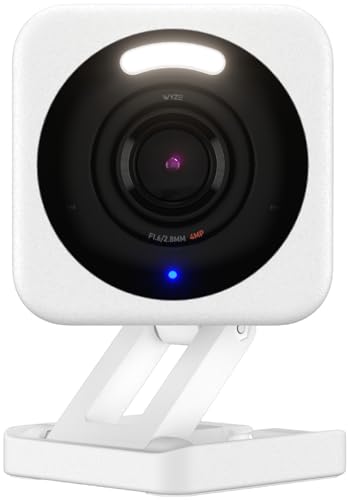
Wyze Cam v4 — Best night value
The Wyze Cam v4 built its reputation on a single after-dark trick that still startles first-time viewers: it sees in colour where other budget cameras see in grey. Its sensitive sensor drinks the ambient light other cameras ignore — the street lamp half a block away, the moon, the glow of the house itself — and returns a night picture in which clothing has colour and faces have features. Add the small built-in spotlight for the truly lightless corner, and the v4 covers both night theatres at a price that lets a household buy the second camera for the back door without a meeting.
The recording economics suit the night watch perfectly. Footage writes to a microSD card in the camera, so the archive costs nothing monthly and survives internet outages — the storm that knocks out the connection is often the night something happens, and local recording does not care. Motion events are flagged on a timeline the app makes easy to scrub at 3 a.m., half-awake, which is the actual user experience this category should be designed around.
The body is a small weather-rated cube on a magnetic base: under the porch eave, on the garage’s metal frame, inside the hallway window nook (with its infrared off, as our placement section explains). Two-way talk lets you address the doorstep from bed; a siren exists for the night you hope never comes. Person detection is a paid extra, and the app will suggest it — the camera’s one recurring nudge — but the core night watch needs no plan at all.
Its night limits are honest: colour vision needs some light to work with, and at the far end of a long, unlit drive its picture thins like every small sensor’s. Assign it the doors, the patio, the drive’s near half — the identification theatres — and it is, dollar for dollar, the strongest night camera in this guide.
- Night vision: colour from ambient light, plus spotlight
- Resolution: 2.5K
- Storage: microSD local recording; optional cloud plan
- Power: USB mains — watches all night without rationing
- Body: weather-rated, magnetic mount
Strengths
- Colour identification at doors and patios
- No subscription required for the full night watch
- Local recording survives internet outages
Trade-offs
- Colour vision fades in truly lightless distance
- Person detection sits behind the optional plan
- Fixed lens — no panning to follow movement
Apartment dwellers adopt it for the balcony door and the hallway with equal success, because its weather rating forgives the semi-outdoor posts renters actually have. One camera, moved between posts as the household’s worries migrate — parcels in December, the balcony in summer — is a flexibility the fixed infrastructure cameras cannot imitate, and it is why the v4 so often becomes a household’s first and second camera simultaneously.
Its siren and spotlight together make a small theatre of deterrence at the door: motion, light, a voice if you choose, and the visitor’s calculation changes. Most doorstep crime is opportunistic arithmetic, and a camera that visibly raises the cost side of the sum — at the moment of decision, in colour — wins incidents that never become clips at all.
Best for: doors, patios, and near-drive identification on a budget. Not suited for: long, unlit boundaries — that is infrared territory.

REOLINK Argus PT Ultra — Best for the far gate
The Argus PT Ultra is the camera for the part of the property the house’s light never reaches: the far gate, the barn, the boat at the end of the garden. It runs on battery — pairable with a small solar panel that keeps it charged through the seasons — and it watches with a motorised head that pans and tilts across a wide arc, so one camera patrols a boundary that would otherwise need two. When motion arrives, its spotlights wake and the night picture turns to colour at exactly the range where a person at a gate can be identified.
Reolink’s philosophy flatters off-grid vigilance: recording stays local on a memory card, no subscription mediates between the camera and its owner, and the app is a tool rather than a shopfront. Person and vehicle detection run on the camera, filtering the moth-and-fox traffic that makes lesser battery cameras cry wolf nightly. For rural properties and long drives, that filtering is the difference between a guard and a nuisance.
The 4K-class detail matters at boundary distances: a face at the gate, a plate on the drive, the object in a hand — the clip survives the pinch-zoom that evidence demands. Two-way talk across the dark has a particular authority; a voice from the gate camera, in the small hours, resolves most visits without anyone leaving the house.
Battery discipline is the owner’s side of the bargain: a busy boundary in winter will ask for the solar panel or a mid-season charge, and the spotlights’ brightness is a setting to tune — full glare for the gate, gentler for the garden where neighbours’ windows share the dark. Set up with that care, the Argus PT Ultra is the most complete far-field night watch in this guide.
- Night vision: spotlight colour, plus infrared
- Resolution: 4K-class detail
- Movement: motorised pan and tilt patrol
- Power: battery, solar-panel compatible
- Storage: local card recording, no plan required
Strengths
- Guards places no cable reaches, in colour
- On-camera person and vehicle filtering
- Pan-and-tilt covers a whole boundary arc
Trade-offs
- Battery needs solar help on busy boundaries
- Larger body — less discreet than indoor picks
- Spotlight settings need tuning for neighbours
Farm and smallholding users add a use the suburbs never meet: livestock at night. The pan-and-tilt patrol that checks the lambing shed and the hen run from the farmhouse kitchen saves the cold walks that used to be the night’s routine, and the spotlight’s colour distinguishes the fox’s visit from the dog’s patrol — the exact identification the boundary exists for.
Winter is its examination and it passes with the panel’s help: short days starve solar charging, so owners angle the panel for the low sun and accept a mid-winter top-up charge in the darkest weeks as the system’s honest rent. Budgeted so, the camera’s watch is genuinely perennial — a boundary that reports in February with the same fidelity it promised in June.
Best for: gates, barns, long drives, and rural boundaries. Not suited for: indoor rooms or renters avoiding outdoor mounting.

Blink Outdoor 4 — Longest watch
The Blink Outdoor 4 is the night watchman who never sleeps in. Its infrared night vision covers the drive and the boundary in clear monochrome, and its battery — a pair of lithium AAs — lasts not weeks but seasons, because the camera’s whole design is an exercise in sleeping until it matters. For the shed, the side gate, the parking court, and the far fence, it offers the rarest commodity in home security: a camera you can genuinely forget until it speaks.
Infrared is the right technology for its theatres. At boundary distances, colour is a rumour anyway; what the household needs is the alert and the monochrome evidence — two figures at the fence at 2:40, gone by 2:44, direction noted. The Blink delivers that with a wide view and motion detection that can be zoned to ignore the road’s passing sparkle. Person detection exists for subscribers, and improves the alert’s wording from “motion” to something more actionable.
Its ecosystem is the honest caveat: clips live in Blink’s cloud under its subscription, with a sync module offering a local alternative for the plan-averse. In a mixed night system — Wyze at the doors, Blink at the boundaries — that second app is a small tax on a long watch, and most households pay it without resentment because the alternative is trenching cable to a fence.
Placement makes or breaks it, as our field section insists: chest height at the choke point, not under the eaves. Mounted so, its infrared portraits at conversational distance are identification-grade; mounted high and hopeful, it becomes a weather station with a lens. The camera rewards the ten minutes of placement thought more than any other pick here.
- Night vision: infrared, monochrome
- Resolution: 1080p HD
- Power: AA lithium batteries, up to two years typical
- Storage: cloud plan, or local via sync module
- Body: weather-resistant, wire-free anywhere
Strengths
- Seasons of watch on one set of batteries
- Infrared reach suited to boundaries and drives
- Truly wire-free placement at any choke point
Trade-offs
- Monochrome night footage — no colour evidence
- Cloud clips need the plan or a sync module
- Identification range is conversational, not distant
Second homes and seasonal properties are its other parish: a cabin or a caravan watched through the closed months, reporting its quiet weeks and its one interesting night with equal fidelity, on batteries that outlast the season. Owners describe the relief precisely — the property stops being a worry with a roof and becomes a place that sends postcards.
Its two-way talk is the feature owners did not expect to use and then use monthly: the delivery driver at the wrong gate, the neighbour’s child retrieving a ball, the voice that says the house is awake and watching. A boundary camera that can hold a conversation converts detection into resolution, which is the whole point of watching in the first place.
Best for: boundaries, sheds, gates, and long drives. Not suited for: colour identification at the front door.
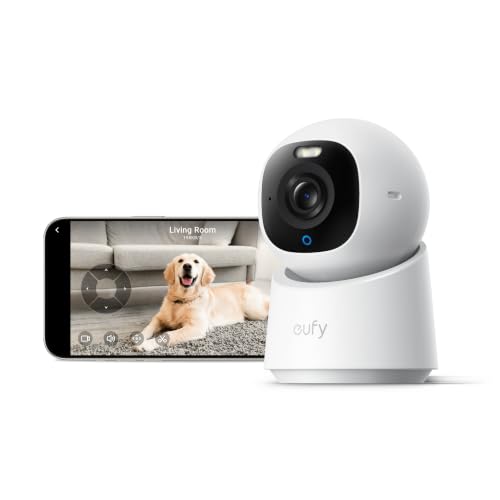
eufy 4K Indoor Camera E30 — Sharpest indoor night eye
Indoors, the night has different rules: distances are short, the darkness is total when the house sleeps, and the intruder — or the toddler, or the dog at the bin — moves across rooms rather than standing at a boundary. The eufy E30 answers with the sharpest indoor night picture in this guide: a 4K sensor behind a pan-and-tilt head that follows movement from doorway to window, recording everything to a local card with no subscription standing between the household and its own footage.
The detail is the argument. When a night clip must answer “what exactly happened in the kitchen,” 4K footage survives the zoom that turns a shape into a person and a gesture into evidence. On-device person and pet detection keeps the alerts honest — the camera reports the dog’s patrol as the dog’s patrol — and its night vision holds faces together across a living room’s width, the distance indoor incidents actually happen at.
eufy’s local philosophy completes the indoor case: the archive lives in the house, the processing happens on the device, and a power cut or an internet outage does not blind the record. For nurseries, elder care check-ins, and the room where valuables live, that independence is a feature with a weight beyond convenience.
The E30’s demands are modest: a shelf with swing room for its head, a generously sized card for its 4K appetite, and an owner who accepts a second app beside any doorbell ecosystem. In exchange it is the indoor night watch we would choose for our own hallway — sharp, following, and beholden to nobody’s cloud.
- Night vision: infrared with detailed 4K capture
- Resolution: 4K
- Movement: pan-and-tilt with motion tracking
- Storage: microSD or hub — no plan required
- Detection: on-device person and pet alerts
Strengths
- Night detail that survives zooming into evidence
- Tracking keeps the whole room’s story in frame
- Fully local archive, no monthly cost
Trade-offs
- Indoor only — no weather rating
- 4K files consume card space quickly
- Monochrome infrared at night, not colour
Elder-care households use it with a tenderness worth naming: a parent living alone, a camera in the hallway — agreed, consented, its presence negotiated — that lets family confirm the morning’s movement without a anxious phone call. The tracking and the local archive serve dignity as much as security in that deployment, because the footage never leaves the family’s hands.
Its pan-and-tilt patrol can be scheduled — the camera turning itself to the windows at midnight, to the door at three — a small automation that makes one camera behave like a rota. Households that use the patrol describe the psychological shift honestly: the house feels attended, and the feeling, within reason, is part of what a night watch is for.
Best for: hallways, nurseries, and the valuables room. Not suited for: outdoor posts or colour night evidence.
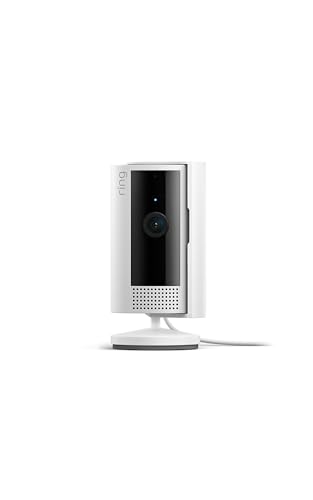
Ring Indoor Cam (2nd Gen) — Best with a Ring doorbell
A home’s night watch is only as good as its continuity: the doorbell sees the approach, and something must see the entry. For Ring households, the Indoor Cam (2nd Gen) is that second act — colour night vision for the hallway and living room, sharing the doorbell’s app, alerts, and timeline, so the night’s story plays in one place from pavement to sofa. When the door camera reports a figure at midnight, the indoor camera’s clip is one tap away, and that continuity is worth more than any single specification.
Its colour night vision repairs the first generation’s weakest hour: dim rooms now record in usable colour rather than infrared grey, so the clip can say what the intruder wore. The physical privacy shutter matters at night in a subtler way — households arm the camera as part of the bedtime routine, clicking the shutter open on the way to bed and closed at breakfast, a ritual that keeps the camera’s presence negotiated rather than ambient.
Ring’s modes complete the night system: one toggle arms door and rooms together when the house sleeps or empties, and person alerts arrive with the ecosystem’s polish. For a household already paying for the doorbell’s plan, the indoor camera joins the same archive — the marginal cost of the second witness is the hardware alone.
The familiar Ring terms apply, stated once more for the night buyer: no local storage, recorded history behind the plan, and no life outside Ring’s app. A household building its night watch from zero should compare that against the Wyze and eufy locals above before committing; a household already Ring at the door will find this the obvious, satisfying completion.
- Night vision: colour, indoors
- Resolution: 1080p HD
- Storage: cloud recording with Ring Protect plan
- Privacy: physical shutter for the daytime hours
- Integration: Ring app, shared timeline with doorbells
Strengths
- One timeline from doorstep to living room
- Colour night clips that describe clothing
- Shutter ritual suits family privacy rhythms
Trade-offs
- No local recording at any price
- History requires the subscription
- 1080p detail trails the eufy’s 4K
Pet households running Ring at the door find a smaller nightly dividend: the indoor camera’s colour clips of the cat’s 4 a.m. parliament and the dog’s sofa negotiations become the family’s favourite channel. Security that also entertains gets maintained, charged, and checked — and a maintained camera is, by the logic of this whole guide, a better camera.
Setup continuity is its final quiet virtue: a household that has learned the Ring app at the door already knows this camera entirely — the same zones, the same modes, the same alert grammar at 3 a.m. when nobody is in a learning mood. In the night category, familiarity is a safety feature, and ecosystems earn their keep exactly there.
Best for: Ring doorbell households completing the night watch. Not suited for: subscription-free builds or non-Ring homes.

TP-Link Tapo C210 — Best budget night coverage
The Tapo C210 is the camera that lets a household cover the whole night indoors for the price of one premium unit elsewhere. Its infrared night vision is clear and honest across a room, its motorised head pans the darkness corner to corner, and its local card recording holds weeks of motion clips without a subscription whisper. Two of them — hallway and living room — build a complete indoor night watch for less than many single cameras in this guide.
Tapo’s app respects the 3 a.m. use case: the live view loads fast, the night’s events sit on a readable timeline, and privacy mode parks the lens when the house wakes. Motion, person, and baby-cry detection cover the household’s real night concerns, and the alerts arrive without an upsell garnish — a small mercy that owners mention with feeling.
Its night picture is monochrome infrared, and the guide will not pretend otherwise: the C210 tells you who in outline and detail, not in colour. At indoor distances that is usually sufficient — the household knows its own members’ silhouettes, and a stranger’s presence is the fact that matters. Where colour evidence is the requirement, the Wyze above is the budget answer instead.
As with the Blink, placement is destiny: a corner shelf at the room’s long axis, the pan arc unobstructed, the motion zone drawn around the doors rather than the curtains. Set up so, the C210 is the night watch of rental flats, first homes, and grandparents’ houses — the camera whose price removes every excuse for an unwatched hallway.
- Night vision: infrared, clear across a room
- Resolution: 2K
- Movement: pan and tilt from the app
- Storage: microSD local recording, large capacities
- Detection: motion, person, and baby-cry alerts
Strengths
- Whole-room night coverage at a two-for-one price
- Local recording with no plan attached
- Fast, unfussy app for middle-of-night checks
Trade-offs
- Monochrome night footage only
- Design is functional rather than handsome
- Cloud option, if wanted, is a paid extra
Student houses and first rentals adopt it for a reason beyond price: it asks nothing of the building. No drilling beyond a shelf, no ecosystem commitment, no plan — the camera arrives, watches the hallway’s night, and leaves with the tenant at the lease’s end, its card holding nothing the next household needs to know. Proportionality is a security virtue, and the C210 is its budget ambassador.
Its baby-cry detection gives it a second career in the nursery years, after which it retires gracefully to the hallway — a lifecycle that suits family budgets, where a camera that serves two life stages costs half as much in the only arithmetic that matters. TP-Link’s steady firmware support keeps those years secure, which in a networked camera is not a detail but a duty.
Best for: budget indoor night coverage across two rooms. Not suited for: colour evidence or outdoor mounting.
How Do You Place Cameras So the Night Footage Identifies People?
Before the laws, a sentence about permission and proportion, because night cameras look outward more than any other kind. Your gate camera will incidentally record the street, the neighbours’ comings, the dog-walkers’ midnight rounds. Keep its view tight to your own ground, tell the neighbours it exists, and let its spotlight mind its manners — a night watch that respects the street it watches is one the street will not resent, disable, or legislate against.
Height is the first law: mount for faces, not for coverage maps. A camera under the eaves photographs the tops of heads and the crowns of hoods; a camera at head height, or angled down modestly from just above it, photographs the face the clip exists for. At doors, that means beside the door at a tall person’s shoulder, not above the lintel. Every metre of extra height is paid for in identification, nightly.
Before the laws, a rehearsal that costs one evening and pays all year: the household walk-through. After dark, one person plays the visitor — door, side path, gate, shed — while the other watches the live feeds from the sofa and narrates what the cameras actually see. Every blind corner, every blown-out porch light, every camera watching a wall will announce itself in ten minutes. Professionals call this commissioning; households that do it call it the night their system started working.
Light is the second law: never let the camera stare into its own flood. A porch light inside the frame blows the exposure and silhouettes the visitor; a light beside or behind the camera’s position illuminates the face instead. For infrared cameras, keep the lens away from walls and foliage that bounce the IR back as white fog, and remember that glass defeats infrared entirely — a camera behind a window is a daytime camera, whatever its box promises.
Angle is the unlisted fourth law, and it is about hats. Night visitors wear them; a camera looking steeply down sees a brim and shoulders, while a camera near level sees under the brim to the face. Where a door camera cannot be lowered, a second angle — even a modest camera at the side path — covers the brim’s blind spot. Professional installers think in pairs of angles for exactly this reason, and a household can borrow the habit for the price of the budget pick.
Distance is the third law: know each camera’s honest identification range and place choke points inside it — the gate’s swing, the path’s bend, the stair’s turn — where a person must pass close and slow. Test it the first night: walk the route yourself at midnight, then read the footage at breakfast with a stranger’s eyes. If you cannot describe the walker, move the camera before you buy another one. Placement is the cheapest resolution upgrade in this entire guide.
What Does a Night Camera Cost Across a Whole Year?
Start the year’s accounting with the household’s scarcest resource, which is not money but the willingness to keep caring. Every recurring charge, battery swap, and false alarm draws on that willingness; the systems that survive are the ones whose total draw stays modest. This is why the guide keeps returning to local recording, long batteries, and honest alerts — not as features, but as the economics of a watch that is still being kept in year three.
The shelf price is the smallest honest number in this category. The true figure adds the plan, if any; the cards; the batteries; the solar panel that a busy boundary eventually demands; and the electricity a wired camera sips all night, which is pennies and can stay pennies in the accounting. Run the sum across three years — a fair tenancy for security hardware — and the ranking of this guide reshuffles itself in instructive ways: the local-recording picks pull ahead relentlessly, while the cloud picks must justify a gap that has quietly grown to the price of another camera.
That is not an argument that plans are theft. A cloud archive survives the theft of the camera itself, which is precisely the incident a front-door camera exists for, and off-site copies have settled real insurance claims. It is an argument for choosing the plan the way you choose insurance: for the viewpoint whose loss would hurt, not as a default applied to every lens in the house. The garage does not need the door’s policy.
There is also the cost nobody invoices: attention. A system that generates forty clips a night taxes its owner nightly until the tax is refused and the app is muted. Person detection, zoning, and sane sensitivity are therefore budget items in disguise — the picks that include them free, or free-ish, are cheaper in the currency that actually runs out.
Renters should run a version of this arithmetic with the lease in view: a wired camera’s cable and a plan’s contract both assume a tenancy, and the household that moves yearly should weight the battery and local picks — the Blink, the Reolink, the Wyze on its magnetic base — whose entire value travels in the removal van. Security that cannot move house is a deposit-risk with a lens.
Buy, then, with the three-year number in view and the attention budget in mind. The households that do this arithmetic once, on paper, are the ones still watching — calmly, selectively — in year three.
How Do the Six Night-Time Cameras Compare?
| Camera | Night method | Power | Recording | Best theatre |
|---|---|---|---|---|
| Wyze Cam v4 | Colour + spotlight | Wired | Local card | Doors and patio |
| REOLINK Argus PT Ultra | Spotlight colour + IR | Battery/solar | Local card | Far gate and barn |
| Blink Outdoor 4 | Infrared | Battery, seasons | Cloud or sync module | Boundary and drive |
| eufy 4K Indoor Camera E30 | Infrared, 4K | Wired | Local card/hub | Rooms and hallway |
| Ring Indoor Cam (2nd Gen) | Colour | Wired | Cloud with plan | Ring homes, indoors |
| TP-Link Tapo C210 | Infrared | Wired | Local card | Budget room coverage |
What Mistakes Leave Night Footage Useless?
Before the champion, a mistake of timing: installing in daylight and never returning after dark to aim. A camera’s daytime frame and its night frame are different photographs — the infrared’s reach, the spotlight’s pool, and the porch light’s glare all redraw the scene at dusk. The ten minutes of night aiming, ladder out under the stars, is the highest-value ten minutes in the whole installation, and it is the one most often skipped.
The eaves mistake, already named, is the champion: cameras mounted for a pleasing wide view, producing a pleasing wide view of nobody identifiable. The second is the spider tenancy — infrared lenses are warm, flat, and attractive to spiders, whose webs turn night footage into white lace within a fortnight. A monthly wipe with a soft cloth is not housekeeping; it is the maintenance the night watch runs on, and cameras near lights need it most.
There is also the archive illusion: believing that because the camera records, the incident is preserved. Cards overwrite, trials expire, clouds retain on their own schedules — the clip of the one important night must be exported by a human, promptly, or it joins the overwritten majority. Make the export part of the incident itself, the way the phone call to the insurer is: same morning, same checklist.
Third, the spotlight argument with the neighbours. A badly aimed spotlight camera lights the street’s windows at every cat, and the household’s security becomes the street’s grievance. Aim down, tune sensitivity, use the infrared mode where colour is not needed — the goal is a clip, not a lighthouse. Fourth, notification settings left at factory enthusiasm, so the camera reports every moth until its owner mutes it into furniture. Person detection and drawn zones exist precisely for the night; use them in the first week.
A sixth mistake concerns the morning after a real incident: discovering the clip exists but cannot be shared — locked in an app, expired from a trial plan, or trapped in a format nobody can open. Practise the export once, in peacetime: find a clip, save it to the phone, send it to yourself. The thirty seconds that takes is the rehearsal for the one morning the footage actually matters, and households that have rehearsed describe a calm the others envy.
And the quiet fifth: never testing the footage. Households discover their night camera’s blind spot, fogged lens, or full card on the morning after the one night that mattered. Walk the route monthly, read one clip, check the archive’s newest timestamp. Thirty seconds of scepticism is the difference between a security system and a security belief.
Final Recommendation
Assign by theatre and the system builds itself. Colour at the doors: the Wyze Cam v4 for value and freedom from plans, or the Ring Indoor Cam where a Ring doorbell already stands. Detail indoors: the eufy E30 for the rooms, the Tapo C210 where two rooms must be covered cheaply. Reach at the boundary: the REOLINK Argus PT Ultra where the gate is far and the nights are dark, the Blink Outdoor 4 where the watch must run for seasons unattended. Every combination of those is a coherent night watch; the only incoherent choice is six cameras bought without asking which darkness each one owns. Build it one theatre at a time, test each with the midnight walk, and let the footage — not the catalogue — approve the next purchase. A household that builds its night watch that way ends with something rarer than coverage: a system every member understands, trusts, and actually checks — which is the whole difference between owning cameras and being watched over.
Related guides
Frequently Asked Questions
Is colour night vision always better than infrared?
No — it is better at identification range, in some light, at doors. Infrared reaches further, costs less power, and stays discreet at boundaries. The mature setup uses colour where faces must be named and infrared where presence must be proven, which is why this guide carries both and labels each pick’s method plainly. If a single camera must do both jobs — the flat’s one window over the parking court, the small house’s single post — choose the spotlight colour models, which fall back to infrared when their light is off and give the household the choice nightly.
How far can a night camera identify a face?
Honestly: a few metres for the indoor and budget picks, somewhat further for the 4K and spotlight models at their choke points — and always less than the box’s night-vision range suggests, because that figure describes detection, not identification. Place cameras so subjects must pass within the honest range, and test with your own midnight walk before trusting the number.
Do spotlights disturb neighbours?
They can, when aimed level or left at full sensitivity. Aimed down at your own path, zoned to your own ground, and paired with person detection, a spotlight reads as a porch light with opinions — brief, local, and defensible. The Argus PT Ultra and Wyze v4 both let you tune brightness and triggers; spend the ten minutes. A word with the neighbours before installation completes the diplomacy: households that announce a camera and offer to adjust its aim rarely receive complaints about it later, because the conversation converted surveillance into a shared streetlight.
Can a battery camera really watch all night?
It watches by sleeping intelligently: motion wakes it, it records the event, it sleeps again. On a quiet boundary that rhythm runs for seasons; on a busy road-facing fence it drains far faster, which is why placement and zoning are battery features as much as picture features. The solar option on the Reolink removes the question for sunny boundaries.
What happens to night recording in a power cut?
Wired cameras stop with the house, though local-recording models keep everything up to the cut. Battery cameras — the Blink and the Reolink — keep watching through it, which is a genuine argument for having at least one battery unit on the perimeter of any serious night watch. When power returns, check every camera’s clock and archive before the next night — a camera whose clock drifted during the outage will file its clips under the wrong hour, and an archive you cannot search is a story you cannot tell.
How many night cameras does a house need?
One per theatre, not one per wall: a colour camera at the main door, a watcher for the back approach, an infrared eye on the boundary’s choke point, and an indoor camera for the hallway covers the overwhelming majority of real homes and real incidents. Add cameras when a specific darkness proves unwatched — the side path the footage keeps missing — rather than carpeting the property in advance. Coverage bought against evidence stays useful; coverage bought against anxiety multiplies clips nobody reads.
Should I record audio at night as well?
Only where a conversation is the point — the doorstep exchange, the intercom moment. Elsewhere, microphones mostly collect the street’s and the neighbours’ lives, which raises legal and courtesy problems out of proportion to any security gain. Most households in this guide’s research run video everywhere they have placed cameras and audio at the door alone.
Related Guides
Build the rest of the system with our Nest-centred security camera guide and our apartment camera guide for renters. If your nights are for art rather than watchfulness, see our guide to cameras for night pictures instead. And whichever system you build, schedule the walk-through from this guide for the first dark evening after installation — the ten minutes that turn a pile of cameras into a night watch. Repeat it at the season’s turn, when the light changes its hours and the garden changes its shape — the watch that is re-aimed twice a year is the watch that is still honest in its third winter. Keep the ritual short, keep it after dark, and keep the household’s sceptic on the walk — every system improves when somebody present is determined to find its blind spot before a stranger does. Do that, and the cameras in this guide will do the rest — quietly, nightly, in the dark they were chosen for, asking nothing but a charged battery and an honest aim.


