The best budget binoculars for astronomy prove that you do not need a telescope to start exploring the night sky. A good pair of astronomy binoculars gathers far more light than the naked eye, turns the Moon into a landscape of craters, resolves star clusters into individual points, and shows the Milky Way as a river of stars instead of a faint haze. Because binoculars use both eyes, the view feels natural and three-dimensional in a way a single-eyepiece telescope never quite matches, and because there is no mount to align and no power supply to charge, you can be observing within a minute of stepping outside. That immediacy is the real advantage for a beginner. A telescope demands setup, alignment, and patience before it shows anything at all, while binoculars reward the first minute you spend under the stars, which is why so many experienced observers keep a pair beside their telescope even after decades in the hobby. This roundup covers eight affordable astronomy binoculars, from a light handheld 7×50 that suits a complete beginner to giant 25×100 tripod binoculars built for deep-sky viewing. Every model here was checked against its current listing for its exact brand and model, and the notes below stick to what the listing itself states about magnification, objective size, prisms, and coatings, so you can match the binoculars to the way you actually observe, whether that means quick looks from the backyard or long sessions under a dark sky.
In this guide
Quick picks: best budget binoculars for astronomy
| # | Product | Where to buy |
|---|---|---|
| 1 | Celestron Cometron 7×50 | Check on Amazon |
| 2 | Celestron SkyMaster 25×70 | Check on Amazon |
| 3 | Celestron SkyMaster 20×80 | Check on Amazon |
| 4 | Celestron SkyMaster 12×60 | Check on Amazon |
| 5 | Celestron SkyMaster 15×70 | Check on Amazon |
| 6 | Celestron SkyMaster Pro 20×80 | Check on Amazon |
| 7 | Sogries 25×100 | Check on Amazon |
| 8 | Sogries 18×70 | Check on Amazon |
How the picks were chosen
Each pair below was judged on the points that matter when the target is the night sky rather than a daytime landscape. First, light gathering: astronomy is mostly a battle against darkness, so objective lens size matters more than it does for birdwatching, and the listing must state it clearly. Second, magnification against steadiness: high power shows more detail but also magnifies every tremor of your hands, so the strongest models here are the ones meant for a tripod, and the handheld models are the ones whose power stays low enough to hold still. Third, glass and coatings: BaK-4 prisms and multi-coated optics keep the view bright and sharp at the edges, which is where cheap binoculars usually fall apart, and a listing that says nothing about prisms or coatings was treated as a warning sign. Fourth, weight and mounting: a pair you cannot hold still or mount is a pair you will not use, so the weight and the tripod adapter matter as much as the optics. Fifth, the field of view: a wide field makes finding objects easy, while a narrow field rewards patience and a good star chart. Finally, the budget test: every pick had to be an astronomy binocular by design, not a daytime binocular relabeled for the stars, and each one had to earn its place on what its own listing states, not on reputation alone. The result is a set of eight pairs that cover every way a beginner or a budget-minded observer actually uses binoculars at night.
Quick comparison
| Product | Best for |
|---|---|
| Celestron Cometron 7×50 | Beginners, wide-field scanning |
| Celestron SkyMaster 25×70 | High-power tripod viewing |
| Celestron SkyMaster 20×80 | Bright deep-sky views |
| Celestron SkyMaster 12×60 | Versatile handheld and mounted use |
| Celestron SkyMaster 15×70 | Balanced power and brightness |
| Celestron SkyMaster Pro 20×80 | Best optics, all-weather build |
| Sogries 25×100 | Maximum light gathering |
| Sogries 18×70 | High power without the giant weight |

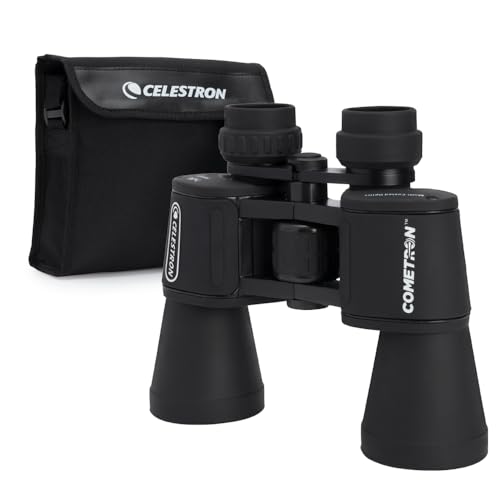
1. Celestron Cometron 7×50
7x magnification with 50mm objective lenses, Porro prism design, and multi-coated optics. The listing describes it as a beginner astronomy binocular with a wide field of view, a comfortable handheld design, a tripod adapter fitting, and a carrying case included. The Porro prism layout gives the classic wide-bodied binocular shape, and the 50mm objectives gather far more light than the naked eye, which is what makes faint star fields and the Milky Way visible at all.
Strengths
- Wide field of view makes it easy to find constellations and sweep across the Milky Way without a star chart
- Light enough to hold steady by hand for a full observing session without arm fatigue
- 50mm objectives gather plenty of light for the Moon, bright clusters, and comets
Trade-offs
- Only 7x magnification, so small deep-sky objects stay small and lack detail
- Porro prism body is bulkier than a roof prism design of the same power
- Serious deep-sky observers will outgrow it and want more aperture within a year or two
Who it fits
Someone buying their first astronomy binoculars, or a parent introducing a child to the night sky, who wants an easy, forgiving instrument rather than a project. It also suits an experienced observer who wants a quick-look pair for nights when setting up a telescope feels like too much work.
Best for: first-time stargazers and casual constellation hunters
Not suited for: observers chasing faint galaxies that need large objectives and high power
In daily use
On a clear night, point it at the Moon first: the terminator line between light and shadow shows craters in sharp relief even at 7x, and the whole lunar disk fits comfortably in the wide field. Then sweep along the Milky Way and watch star fields resolve into dozens of points the naked eye misses. A bright comet, when one appears, is the perfect target for this pair, since the wide field shows the tail in full. Keep your elbows braced against your body or rest the binoculars on a fence post when your arms tire, and take breaks rather than fighting the shake.
Before you buy
Check the eye relief if you wear glasses, and confirm the tripod adapter thread fits the tripod you already own before you plan a mounted session. Keep the carrying case by the door so the binoculars are easy to grab on a clear night, because a pair that is hard to reach is a pair that stays indoors.
Check price on Amazon: Celestron Cometron 7×50

2. Celestron SkyMaster 25×70
25x magnification with 70mm objective lenses and multi-coated BaK-4 optics. The listing states a tripod adapter is included, and the built-in quarter-inch-20 adapter attaches to most photo tripods in seconds. Designed for astronomy and long-range viewing, with the large objectives and high power aimed squarely at observers who want to see real detail on the Moon and in bright star clusters rather than just bright points of light.
Strengths
- 25x power pulls in lunar detail and tight star clusters that smaller binoculars cannot resolve
- 70mm objectives gather enough light for satisfying deep-sky views under dark skies
- Tripod adapter included, so it is ready to mount out of the box with no extra purchase
Trade-offs
- Too heavy and too powerful to hold steady by hand for more than a few seconds
- Narrower field of view makes finding targets harder than with a 7×50
- Needs a sturdy tripod, which adds to the total setup if you do not already own one
Who it fits
An observer who already owns a photo tripod and wants a big step up in power for the Moon, planets, and bright deep-sky objects. It also suits a daytime long-range viewer who wants one pair for astronomy at night and distant landscapes by day.
Best for: tripod-mounted lunar and deep-sky observing
Not suited for: handheld scanning or quick grab-and-go sessions
In daily use
Mount it, aim at the Moon, and let the 25x magnification do the work: craters, mountain ranges, and the dark lunar seas stand out clearly, and the terminator shows shadows stretching across the surface. For star clusters, use the lowest comfortable magnification first to center the target, then enjoy the tighter view as individual stars separate from the glow. A slow, deliberate sweep beats fast panning at this power, and a fluid tripod head makes the difference between a frustrating night and a great one.
Before you buy
Buy or borrow a tripod rated for the weight before your first session, and practice aiming during the day so you are not fumbling in the dark. Learn to find two or three bright guide stars first, since star-hopping at 25x is a skill that improves quickly with practice.
Check price on Amazon: Celestron SkyMaster 25×70

3. Celestron SkyMaster 20×80
20x magnification with 80mm objective lenses and multi-coated BaK-4 optics. The listing describes large 80mm objectives for bright deep-sky views, a tripod-adaptable design, and ultra-stable mounting for long sessions. The 80mm objectives collect roughly two and a half times the light of a 50mm pair, which is the difference between a faint smudge and a resolved cluster on many deep-sky targets.
Strengths
- 80mm objectives collect a lot of light, so faint objects look brighter and more detailed
- 20x magnification is a good middle ground between power and a usable field of view
- BaK-4 prisms keep the image bright right to the edges of the field
Trade-offs
- Heavy enough that a tripod is effectively required, not optional
- Narrow field makes star-hopping to faint targets a learned skill
- Large size makes it awkward to pack for travel or carry far from the car
Who it fits
A dedicated deep-sky observer who wants the brightest possible view on a budget and is happy to set up a tripod every time. It also suits someone observing from a dark rural site, where the large objectives can show their full advantage.
Best for: deep-sky objects such as nebulae and clusters from a dark site
Not suited for: travelers or anyone who needs a compact pair that fits in a day pack
In daily use
Set up under dark skies and give your eyes fifteen minutes to adapt before judging what you can see. The 80mm objectives reward patience: faint smudges resolve into clusters, the Milky Way gains texture, and bright nebulae show shape instead of just glow. Keep the tripod head movements slow and smooth, since small shakes look large at 20x, and use averted vision, looking slightly to the side of a faint object, to catch details your direct gaze misses.
Before you buy
Check the tripod adapter thread and the tripod's load rating together, and store the lens caps where you will find them in the dark. Plan your targets before the session, because the narrow field makes blind searching slow.
Check price on Amazon: Celestron SkyMaster 20×80

4. Celestron SkyMaster 12×60
12x magnification with 60mm objective lenses and multi-coated BaK-4 optics. The listing describes wide-field astronomy viewing, comfortable handheld use, tripod mounting for long sessions, and a soft carrying case included. At 12x with 60mm objectives, the exit pupil is a generous 5mm, which suits night observing well, since it delivers a bright image to dark-adapted eyes.
Strengths
- 12x power is strong enough for lunar detail while still hand-holdable in short bursts
- 60mm objectives gather noticeably more light than a compact 42mm pair
- Soft carrying case included, so it travels well and stays protected
Trade-offs
- At 12x, hand shake shows up quickly during long looks at one object
- Less light gathering than the 70mm and 80mm models in this roundup
- Heavier than a standard 8×42, so it is not an all-day carry
Who it fits
An observer who wants one pair that works both handheld for quick looks and mounted for longer sessions. It is the most flexible pick here for someone who has not yet decided whether they prefer handheld or tripod observing.
Best for: versatile observing, from the Moon to wide star fields
Not suited for: faint deep-sky targets that need 80mm-class objectives
In daily use
Start handheld: brace your elbows on a chair back or a car roof and the 12x view steadies nicely for the Moon and bright clusters. When you want to linger on one object, thread it onto a tripod and the view sharpens further, since the shake disappears entirely. The wide field makes it forgiving when you are learning to star-hop, and the Pleiades cluster is a perfect first target, filling the view with blue-white stars. The soft case makes it easy to toss in the car for a dark-sky trip.
Before you buy
If you wear glasses, fold the eyecups down before your first session, and keep the soft case zipped so dust stays off the objectives. Try both handheld and mounted use in the first week to learn which style suits you.
Check price on Amazon: Celestron SkyMaster 12×60

5. Celestron SkyMaster 15×70
15x magnification with 70mm objective lenses and multi-coated BaK-4 optics. The listing states a tripod adapter and carry case are included, and describes an ideal balance of power and brightness for night sky and deep-sky viewing. That balance is the point of this model: 15x is strong enough to show real detail, while 70mm objectives keep the image bright, and the combination is easier to aim than the 20x and 25x models.
Strengths
- 15x magnification with 70mm objectives hits a sweet spot of power and brightness
- Tripod adapter and carry case included in the box, so nothing extra is needed to start
- Wide enough field to find targets without a finder scope
Trade-offs
- Still heavy for extended handheld use, so a tripod helps for long sessions
- Less raw power than the 20x and 25x models for small lunar features
- The large body needs a bag of its own rather than a jacket pocket
Who it fits
An observer who wants one serious pair for both the Moon and deep-sky objects without jumping to the biggest, heaviest models. It is the best single-pair choice in this roundup for someone who will observe mostly from a tripod in the backyard.
Best for: balanced deep-sky and lunar observing from a tripod
Not suited for: ultra-compact travel or one-handed use
In daily use
Aim at a bright star cluster first and let the 15x view show how individual stars separate from the glow. The 70mm objectives make the Pleiades and similar clusters genuinely impressive, and the Moon fills the view with detail along the terminator, where long shadows outline craters and ridges. Short sessions work handheld if you brace yourself against something solid; longer ones belong on a tripod, where the view becomes rock steady and faint objects emerge. Try the Orion Nebula on a winter night for a good test of what 70mm can do.
Before you buy
Confirm the included tripod adapter matches your tripod's thread, and let the binoculars reach outdoor temperature before observing to avoid fogged lenses. Keep the carry case packed and ready, since this is the pair you will reach for most often.
Check price on Amazon: Celestron SkyMaster 15×70

6. Celestron SkyMaster Pro 20×80
20x magnification with 80mm objective lenses, BaK-4 prisms, and fully multi-coated optics using Celestron's XLT coatings. The listing states it is waterproof and fogproof, rubber armored, includes a tripod adapter, and has a detachable RSR rail for mounting an optional red-dot finder. The XLT coatings are the upgrade over the standard SkyMaster line: every lens surface is coated multiple times, which raises contrast on faint objects.
Strengths
- XLT fully multi-coated optics give the brightest, sharpest view in this roundup
- Waterproof and fogproof build with rubber armor survives dew and rough handling
- RSR rail lets you add a red-dot finder, which makes aiming at 20x far easier
Trade-offs
- The most expensive pick here, though still a budget astronomy binocular
- Heavy and tripod-bound, like every 80mm model in this roundup
- The red-dot finder is optional and sold separately
Who it fits
A committed observer who wants the best optical quality in this budget range and plans to observe often, in all weather. It also suits someone who has already owned a cheaper pair and knows they want to stay in the hobby.
Best for: serious deep-sky observing with the sharpest budget optics
Not suited for: casual buyers who only observe a few times a year
In daily use
Use the RSR rail: mount a small red-dot finder and aiming becomes a matter of pointing a dot instead of guessing through a narrow field, which transforms the experience at 20x. The XLT coatings show their worth on faint objects, where contrast matters more than raw brightness, so dim clusters gain definition rather than just glow. Wipe dew off the armor, not the lenses, and let the binoculars dry before casing them. The waterproof build means a damp night is no reason to stay inside.
Before you buy
Budget for a red-dot finder and a solid tripod as part of the purchase, since both make the 20x view far more usable. Check that the finder you choose fits the RSR rail before ordering.
Check price on Amazon: Celestron SkyMaster Pro 20×80

7. Sogries 25×100
25x magnification with 100mm objective lenses. The listing states a weight of 8.8 pounds, a waterproof build, and that a tripod (not included) is needed for these giant binoculars. Designed for stargazing, moon observation, and long-distance viewing, with the 100mm objectives collecting more light than any other pair in this roundup.
Strengths
- 100mm objectives gather more light than any other pair in this roundup
- 25x magnification shows fine lunar detail and tight clusters
- Waterproof build handles dew and damp night air without worry
Trade-offs
- At 8.8 pounds it is strictly a tripod instrument, never handheld
- Tripod is not included, so the total cost includes a heavy-duty mount
- Very narrow field of view, so finding targets takes practice and patience
Who it fits
An observer with a heavy-duty tripod who wants the biggest possible light bucket on a budget and observes from a fixed spot, such as a backyard observatory corner or a regular dark-sky site.
Best for: maximum light gathering for the Moon and deep-sky objects
Not suited for: anyone without a sturdy tripod, or anyone who observes on the move
In daily use
Set it on a tripod rated well above its weight and align the mount during daylight, so the first night is spent observing rather than assembling. At 25x with 100mm objectives, the Moon looks close enough to touch and bright clusters break into dozens of stars, while the Milky Way resolves into texture rather than haze. Plan your targets in advance, because sweeping blindly at this power is slow work, and use a star chart app with the screen dimmed to red so your night vision survives.
Before you buy
Do not buy this pair without a tripod that can hold it steady, and test the mount's balance before your first night out. A mount that creeps under the weight will ruin every view.
Check price on Amazon: Sogries 25×100

8. Sogries 18×70
18x magnification with 70mm objective lenses. The listing describes a large 70mm aperture that gathers substantially more light than standard 42mm models, BaK-4 prisms, fully multi-coated optics, and a design suited to astronomy, stargazing, and low-light viewing. At 18x, it sits between the easy-to-aim 15x models and the demanding 25x giants, which makes it a sensible middle step.
Strengths
- 18x power with 70mm objectives is strong for both the Moon and deep-sky objects
- Large aperture keeps faint objects brighter than compact binoculars can manage
- A steadier view than the 25x models, with less shake at high power
Trade-offs
- Still needs a tripod for comfortable long sessions
- Heavier than the handheld-friendly 7×50 and 12×60 picks
- Less light gathering than the 80mm and 100mm giants in this roundup
Who it fits
An observer who wants high power without the extreme weight and narrow field of the biggest models. It suits someone stepping up from a handheld pair who already owns a tripod and wants a clear jump in performance.
Best for: high-power lunar and cluster observing on a budget
Not suited for: quick handheld scans of the sky
In daily use
The 18x view rewards a tripod: craters along the Moon's terminator stand out in sharp relief, and star clusters gain depth as individual stars separate from the background glow. Use it to compare the same object at 18x and at lower power in another pair, and you will see exactly what the extra magnification buys and what it costs in field of view. Keep sessions short at first while you learn to aim it smoothly, and let the fully multi-coated optics do their work on faint targets by giving your eyes time to adapt.
Before you buy
Check that your tripod's head moves smoothly under load, since jerky movement ruins the view at 18x. Start each session on a bright, easy target before moving to fainter ones.
Check price on Amazon: Sogries 18×70
Buying guide: best budget binoculars for astronomy
Aperture first, magnification second
In astronomy, the objective lens diameter decides how much light reaches your eyes, and light is what makes faint objects visible. A 7×50 gathers far more light than a 10×25, even though the magnification is lower, because the 50mm objectives collect roughly four times the light of 25mm ones. As a rule, start with the largest objective you can carry and mount comfortably, then choose magnification to match. For handheld use that usually means 50mm to 60mm; for tripod use, 70mm to 100mm is where the deep-sky views get exciting. The exit pupil, which is the objective size divided by the magnification, is a useful check: a 7×50 gives a 7mm exit pupil that suits dark-adapted eyes, while a 20×80 gives 4mm, which is still bright under dark skies.
Magnification and steadiness
Every extra multiple of magnification also multiplies the shake in your hands. Most people can hold 7x steady, manage 10x to 12x in short bursts, and need a tripod beyond that. There is no point buying 25x binoculars if you have no tripod, because the view will shiver too much to enjoy, and no amount of optical quality fixes a shaking image. Match the power to the mount you actually own, not the mount you plan to buy someday, and remember that a lower-power pair you use often beats a high-power pair that stays in its case.
Prisms and coatings
BaK-4 prisms and multi-coated optics are the two features worth paying attention to in a budget listing. BaK-4 glass keeps the image round and bright to the edges, while coatings cut reflections and raise contrast, which matters most when the target is faint. Fully multi-coated optics cost a little more and repay it on every dim object, which is why the SkyMaster Pro earns its place at the top of this range. Avoid pairs whose listings say nothing about prisms or coatings at all, since silence usually means the cheapest glass.
Tripods and mounting
Any binocular over about 12x, and any pair with objectives over 60mm, belongs on a tripod for serious observing. Look for a built-in quarter-inch-20 adapter thread, which fits most photo tripods, and check the tripod's load rating against the binocular's weight: a tripod rated for a small camera will creep and sag under an 8.8-pound pair. A wobbly tripod is worse than no tripod, because it adds vibration. A simple pan-and-tilt head works well for astronomy if it moves smoothly, and a trigger-grip head makes aiming faster.
Where to observe
Dark skies matter more than equipment. A budget pair under a dark sky will show more than an expensive pair under city lights, because light pollution washes out exactly the faint objects that large objectives are meant to reveal. Get away from streetlights, give your eyes fifteen to twenty minutes to adapt, and avoid looking at phone screens during a session. Even a suburban backyard with the porch light off is a big improvement over a lit driveway, and a short drive to a darker site is the cheapest upgrade in astronomy.
Handheld or tripod: deciding how you will observe
Be honest about how you actually observe before you buy. If your sessions are ten-minute looks from the back step, a handheld pair like the Cometron 7×50 or the SkyMaster 12×60 is the right choice, because a tripod pair would stay in its case. If you plan hour-long sessions under dark skies, a tripod pair like the SkyMaster 15×70 or 20×80 will show you far more, and the tripod is part of the instrument, not an accessory. Many observers end up with both: a light pair by the door for quick looks and a big pair on a tripod for planned sessions. If you can only buy one, choose the style that matches the sessions you already have, not the sessions you imagine having.
Using and caring for your pick
Store astronomy binoculars in their case with the lens caps on, in a dry place away from direct heat. Let them reach outdoor temperature before a session so the lenses do not fog, and if dew forms, let it evaporate naturally rather than wiping the glass. Clean lenses only with a soft blower and a lens cloth, never with a shirt sleeve or paper tissue, and blow dust off before any cloth touches the glass. Check the tripod adapter thread and the hinge tension every few months, keep the carrying case zipped so dust stays out, and never leave binoculars in a hot car, since heat can damage the prism cement and the coatings over time.
Common mistakes to avoid
The most common mistake is buying the highest magnification available and then discovering it cannot be held steady, which turns every view into a shivering blur. The second is observing from a brightly lit yard and concluding the binoculars are at fault, when the real problem is light pollution and unadapted eyes. A third is cleaning the lenses too often or with the wrong cloth, which scratches coatings over time and permanently dims the view. A fourth is skipping the tripod: a budget pair on a decent tripod will outperform a better pair held in tired hands. And a fifth is checking a phone screen mid-session, which resets twenty minutes of dark adaptation in seconds.
Final recommendation
For a first pair, the Celestron Cometron 7×50 is the easy recommendation: light, wide, forgiving, and genuinely useful from the first night, with a price that makes it a low-risk way to find out whether you love the hobby. If you own a tripod and want a real step up, the Celestron SkyMaster 15×70 balances power and brightness better than anything else here, and its included adapter and case mean there is nothing else to buy. Observers chasing the brightest deep-sky views should look at the SkyMaster Pro 20×80, whose coatings and weatherproofing justify its place at the top of this budget range, while the Sogries 25×100 is the choice for anyone who wants the most light possible and already owns a heavy-duty mount. Whichever you choose, remember that the best budget binoculars for astronomy are the ones you actually take outside, so pick the pair that matches your tripod, your skies, and your patience, and then get out under the stars.
Frequently asked questions
What magnification is best for astronomy binoculars?
For handheld observing, 7x to 10x works well because the view stays steady and the field is wide enough to find objects easily. For tripod observing, 12x to 25x shows more detail on the Moon and deep-sky objects, with 15x as a good middle ground. Higher magnification always needs a mount, so choose the power to match how you plan to observe rather than buying the biggest number available. A good rule is to buy the lowest power that shows the objects you want to see, since lower power also means a wider field and a steadier view.
Are 70mm or 80mm binoculars worth it for stargazing?
Yes, if you use a tripod. Larger objectives gather more light, which is what makes faint clusters and nebulae visible, and the difference between 50mm and 80mm is obvious on the first night under dark skies. The trade-off is weight and size, so budget binoculars with 70mm or 80mm objectives are tripod instruments, not handheld ones, and the tripod should be part of the budget.
Can I use astronomy binoculars without a tripod?
Up to about 10x to 12x, yes, in short sessions with your elbows braced on something solid. Above that, a tripod is effectively required, because hand shake grows with magnification. Even a 12×60 benefits from a mount during long looks at one object, and a tripod turns a good pair into a great one.
What can I actually see with budget astronomy binoculars?
The Moon's craters and mountain ranges, the phases of Venus, Jupiter's four bright moons, bright star clusters such as the Pleiades, and the band of the Milky Way resolved into stars. The Orion Nebula shows shape and glow, and bright comets show their tails. Faint galaxies appear as small smudges rather than detailed spirals, which is normal at this level and still worth seeing.
Do I need BaK-4 prisms and multi-coated optics?
They help a lot at night. BaK-4 prisms keep the image bright to the edges of the field instead of dimming at the rim, and multi-coated optics cut reflections and improve contrast on faint objects. When two pairs cost nearly the same, the one that states both features is usually the better buy, and fully multi-coated optics are worth a small premium.