ilcastellomenu.com is reader-supported. When you buy through links on our site, we may earn an affiliate commission.
Where to Buy
A battery operated security camera is a promise of freedom with a meter running. Freedom, because it mounts where the threat actually is — the gate, the tree, the far corner of the garden — rather than where a socket happens to be. A meter, because every photograph it takes and every alert it sends is paid for from a finite cell, and the art of owning one is the art of spending that cell slowly. The best battery operated cameras for security are the ones that make the freedom feel unlimited and the meter easy to forget.
Six cameras make this list, chosen from the two tribes the category has settled into. The replaceable-battery tribe, led by Blink, treats power as a handful of AAs swapped in a minute, twice a year. The rechargeable tribe — Reolink, eufy, Ring, Wyze and Arlo here — treats it as a built-in or removable pack, topped up by cable or by an optional solar panel that can stretch a season into something approaching permanence. Two picks come from this site’s verified camera pool and are linked; the other four are prose recommendations without links, because the pool, not preference, decides what gets a link on this site.
This guide’s judgements are organised around the only question that distinguishes these cameras in real ownership: not what they film on day one, when every battery is full, but what they are like to live with in month four — the charging rhythm, the alert discipline, the winter behaviour, the subscription honesty. A battery camera is a relationship measured in ladder climbs, and the verdicts below count them.
One boundary before the picks. If your camera position has power available — a socket, a doorbell wire, an adapter route — a plug-in camera will out-serve every pick here for less money and no maintenance, and our bang-for-buck security guide covers that world. Battery cameras are for the positions power cannot reach, and for owners who value a ten-minute installation over a permanent one. Buy them for those reasons and they are miraculous; buy them to avoid a cable you could have run, and the meter will eventually present its bill.
Key Takeaways
- Blink Outdoor 4 owns the stamina argument: replaceable lithium AAs, seasons between swaps, the least ladder time in the category.
- Reolink Argus PT Ultra adds a moving eye — pan, tilt and zoom over a whole yard — on battery and solar, with local storage and no required plan.
- Solar panels are the category’s cheat code where sun reaches: they convert a rechargeable camera’s season into near-permanence.
- Point any battery camera at a busy street and you have bought alerts, not security — placement and detection zones are battery features.
- Subscription honesty varies by tribe: Blink and Ring record richest on a plan; Reolink and eufy keep their footage at home.
- Cold taxes every battery here; a camera that cruises summer may want a midwinter visit, and lithium-AA models shrug it off best.
In this guide
Quick Picks
| Pick | Badge | Why it earns its place |
|---|---|---|
| Blink Outdoor 4 | Best battery life | Seasons of service from a set of lithium AAs, weatherproof and wire-free — the camera you install and then forget on purpose. |
| REOLINK Argus PT Ultra | Best pan-and-tilt battery camera | A 4K-class eye that pans, tilts and zooms across a whole yard on battery power, with local storage and solar options. |
| eufy SoloCam S340 | Best solar spotlight camera | A pan-and-tilt camera with a solar panel in the box and a spotlight’s confidence — eufy’s local-storage answer for sunny walls. |
| Ring Stick Up Cam Battery | Best for Ring households | The flexible Ring citizen: indoors or out, on a shelf or a wall, extending a Ring doorbell’s world wherever it stands. |
| Wyze Battery Cam Pro | Best rechargeable value | Wyze’s battery flagship: sharp picture, a removable pack, radar-assisted detection and a spotlight, at Wyze’s customary disruptive price. |
| Arlo Essential Outdoor Camera | Best polished app experience | Arlo’s battery citizen: clean design, a confident app and an integrated spotlight, for owners who value polish and already live in Arlo’s world. |
How We Chose These Picks
Candidates were scored on the battery camera’s real ledger: months of service per charge or set in a typical residential duty, the labour of restoring that service (a ladder and a cable, or a thirty-second battery swap), detection intelligence that spends power only on events that matter, and the completeness of the camera at zero subscription. Picture quality was required to be genuinely useful — identifiable faces at conversational distance, night footage with detail — but it was not allowed to outrank stamina, because a brilliant camera with a flat battery films nothing at all.
The shortlist deliberately spans the category’s philosophies rather than crowning one: a replaceable-cell minimalist, a pan-tilt maximalist, a solar-friendly spotlight camera, two ecosystem citizens from Ring and Arlo, and Wyze’s value challenger. Each was then assigned the position and household it serves best. Owners should read the verdicts as placements, not as a league table — the best battery camera is the one whose charging rhythm matches the life lived around it.

Blink Outdoor 4 — Best battery life
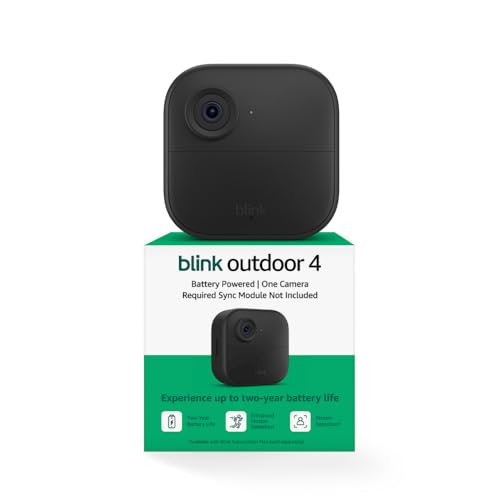
The Outdoor 4’s argument begins where every other battery camera’s ends: with the calendar. Blink’s power system — two lithium AA cells and an almost monastic approach to spending them — delivers service measured in seasons, with the maker speaking of up to two years in favourable duty and owners confirming spans that make the charging rituals of its rivals look like a hobby. For a camera above a garage door or on a garden fence, that stamina is not a specification. It is the difference between a security system and a recurring chore.
The camera around that battery is a solid citizen: weatherproof, genuinely wire-free, wide of view, with infrared night vision, two-way talk and person detection in its feature set, all coordinated by the small Sync Module indoors and viewable by voice in Alexa households. Installation is the category’s simplest story — a mount, two screws, a position chosen for the view rather than for power, because power is in its back. Renters inherit a real outdoor camera without a single permanent alteration beyond screw holes.
The ledger’s other columns are Blink’s familiar ones. The richest recording experience lives on the subscription, softened by the Sync Module’s local storage option; the picture, while perfectly serviceable, does not chase the resolution crowns of the Reolink or eufy picks; and a busy pavement will spend even this battery while flooding the owner with alerts, because stamina is not immunity from physics. Place it on a drive, a gate or a garden with judgement, and the Outdoor 4 becomes what battery cameras promise and rarely deliver: invisible infrastructure.
Buy it when the position is high, distant or numerous — three cameras on three corners, each beneath notice for a year at a time. Its value compounds per camera and per ladder not climbed, which is why it leads this guide despite rivals with sharper eyes.
- Power: 2 lithium AA cells, replaceable in seconds
- Stamina: seasons-class, the best in this guide
- Build: weatherproof, wire-free
- System: Sync Module hub, Alexa viewing
- Night vision: infrared
Strengths
- Battery life that ends the charging chore
- Installs anywhere in minutes
- Cheap to multiply across a property
Trade-offs
- Fullest recording lives on the Blink plan
- Picture is serviceable, not class-leading
- Busy scenes still drain it — placement matters
Best for: gates, drives, gardens and multi-camera properties where visits must be rare and ladders rarer.
Not suited for: a single camera over a busy frontage needing constant recording — wired power serves that duty honestly.

REOLINK Argus PT Ultra — Best pan-and-tilt battery camera
Most battery cameras stare; the Argus PT Ultra looks around. Its motorised pan and tilt sweep a yard, a drive or a smallholding from a single mount, its 4K-class sensor gives that sweep something worth seeing, and its zoom follows the interesting part — the gate, the vehicle, the figure at the fence — rather than leaving it a rumour at the frame’s edge. One of these can do the coverage work of two or three fixed cameras, and in battery economics, cameras not bought are batteries not charged.
Reolink built its name on the independence this camera embodies: footage stored locally on a memory card, smart detection of people, vehicles and animals running on the camera, and no subscription required for the camera to be wholly itself. The battery is rechargeable, and Reolink’s solar panel pairing is the natural completion — a panel in the sun stretches the Argus’s service toward the set-and-forget territory Blink owns, while adding the moving eye Blink does not offer. Night brings a choice of infrared discretion or spotlight colour, a genuinely useful fork for evidence versus deterrence.
The moving parts ask their usual tribute. Motors sip power that fixed cameras save, so a pan-happy installation on a busy view will visit the charger oftener than its specification’s quiet-scene assumptions; the unit is also the largest here, a presence on a wall rather than a secret. Owners should mount it where its sweep is unobstructed and its detections are meaningful — a yard with a gate beats a pavement with a parade.
Buy it for the wide, single-camera property: the smallholding, the big garden, the yard with one good mounting point and three directions of concern. It is the most capable battery camera in this guide, and its independence from subscriptions makes its capability cheap to keep.
- Movement: pan, tilt and zoom coverage
- Resolution: 4K-class
- Storage: microSD local, no required subscription
- Power: rechargeable, solar panel pairing available
- Detection: person, vehicle and animal, on-camera
Strengths
- One camera covers a whole yard
- Local storage, no rent for your footage
- Solar pairing stretches service enormously
Trade-offs
- Motors spend power on busy views
- Largest body here — a visible presence
- Charging visits return if solar is not fitted
Best for: yards, smallholdings and wide gardens needing one camera to watch several directions with evidence-grade detail.
Not suited for: owners wanting the absolute minimum maintenance — Blink’s stamina still owns that parish.
eufy SoloCam S340 — Best solar spotlight camera
The SoloCam S340 arrives with its power strategy included: a solar panel in the box, sized to the camera’s appetite, which in a decently sunny position converts the rechargeable battery from a chore into a formality. Beneath that strategy sits a genuinely capable camera — pan-and-tilt coverage, sharp 3K-class detail, a spotlight that gives night footage colour and intruders a moment of theatre, and eufy’s signature on-device intelligence storing everything locally, subscription-free, in the owner’s own home.
That local philosophy is the pick’s second pillar. Footage lives on the camera’s built-in storage rather than in a rented cloud, detection runs on the device, and the monthly cost of ownership is zero in perpetuity — a value argument that compounds exactly like Blink’s stamina does, in the currency of things the owner never has to do. For a sunny side wall, a garden room or a gate post with sky above it, the S340 is close to a fit-and-forget camera with a moving eye, a combination no other pick here quite assembles.
The conditions are written in its power source. A north-facing, shaded or tree-covered position starves the panel, and the camera reverts to a rechargeable that wants its cable visits — still a good camera, but no longer the effortless one. Winter at high latitudes shortens the panel’s working day exactly when the camera’s night lengthens, so owners in grey climates should expect a midwinter top-up as a seasonal ritual rather than a betrayal.
Buy it for the sunny wall and the privacy-minded household. It is the pick that treats sunlight as infrastructure and subscriptions as somebody else’s business model, and on the right wall it is the most self-sufficient camera in this guide.
- Power: rechargeable with solar panel included
- Movement: pan and tilt coverage
- Storage: built-in local, on-device AI detection
- Night: spotlight colour or infrared
- Subscription: none required
Strengths
- Solar in the box ends most charging
- Local storage and zero monthly cost
- Sharp detail with a moving eye
Trade-offs
- Shade defeats its power strategy
- Grey winters may want a top-up visit
- Panel placement constrains the mount
Best for: sunny walls, garden rooms and gates in privacy-minded, subscription-averse households.
Not suited for: shaded, north-facing or heavily wooded positions, where its panel cannot keep its promise.
Ring Stick Up Cam Battery — Best for Ring households
The Stick Up Cam Battery is less a camera than a unit of Ring coverage, placeable anywhere: stood on a shelf indoors, mounted on a wall outside, moved between the two as a household’s worries migrate. For the millions of homes whose front door already wears a Ring doorbell, that flexibility is the value — the same app, the same alert language, the same subscription stretched over one more viewpoint, with Alexa viewing on every Echo screen in the house.
As hardware it is a competent, weather-resistant battery camera with a clean 1080p-class picture, colour night vision, two-way talk and a removable battery pack whose swap — a spare pack charged indoors makes it a thirty-second errand — is the rechargeable tribe’s most civilised ritual. Ring’s detection and neighbourhood features are the ecosystem’s own flavour, valued by owners who want their cameras to participate in a street’s collective awareness rather than merely witness it privately.
The cold judgement, as with its indoor sibling in our value guide, is that Ring’s recording life is its subscription: without the plan, this is a live-view camera, and owners outside the Ring world get more recording camera for their money from the Reolink or eufy picks. Its battery stamina is respectable rather than remarkable, asking for attention on a rhythm of months in typical duty, shortened by busy views.
Buy it as what it is — the easiest possible extension of a Ring household, and a genuinely flexible camera for the renter whose positions change with their tenancies. Inside that household it is the obvious pick; outside it, it is a good camera standing in the wrong guide, and this guide says so in friendship.
- Power: removable rechargeable pack, quick swap
- Placement: freestanding or mounted, indoor or outdoor
- Picture: 1080p-class, colour night vision
- Ecosystem: Ring app, Alexa, shared home plans
- Recording: subscription-based archive
Strengths
- Extends a Ring system anywhere in minutes
- Battery swap is the class’s easiest ritual
- Moves between rooms and homes freely
Trade-offs
- Recording requires the subscription
- Stamina is respectable, not remarkable
- Little advantage outside the Ring world
Best for: Ring doorbell households adding flexible coverage, and renters whose camera positions change with their lives.
Not suited for: new buyers with no Ring gear, who should start with the Reolink, eufy or Blink paragraphs.
Wyze Battery Cam Pro — Best rechargeable value
Wyze’s value formula — flagship features at a price that embarrasses the shelf — reaches battery cameras in the Battery Cam Pro, and the specification is not shy: a sharp 2.5K-class picture, an integrated spotlight, a removable rechargeable pack, and detection assisted by radar alongside the camera’s vision, which together promise fewer false alarms and therefore fewer wasted wake-ups — battery spent on evidence rather than on foliage. For owners priced out of the premium tribe, this is the camera that refuses to feel like the compromise.
The ownership story is Wyze’s familiar double edge. Local storage on a memory card means the camera records meaningfully without a plan, in the house style this guide rewards; the optional subscription adds its polish without holding the camera hostage. The removable pack makes the charging ritual a swap when a spare is kept, and the camera’s mounting and weatherproofing suit the standard positions — eaves, posts, porches — without drama.
The edges show in stamina and polish. Its battery life in real duty is good rather than Blink-class, and a busy view will bring the charging rhythm forward accordingly; the app, carrying the whole Wyze universe, remains busier than the camera’s own simplicity deserves. Owners should also set detection zones with unusual care, because the radar’s promise is realised only when the camera is not asked to adjudicate a public pavement.
Buy it as the value rechargeable: the sharpest picture per unit of money in this guide, with a feature list that reads a class above its price. For a porch, a drive or a garden on a budget, it is the pick that makes the premium brands justify themselves — and mostly, here, they do so on stamina rather than on footage.
- Power: removable rechargeable pack
- Picture: 2.5K-class with spotlight
- Detection: radar-assisted plus vision
- Storage: microSD local, optional cloud plan
- Build: weatherproof for standard positions
Strengths
- Sharpest value picture in this guide
- Radar assistance cuts false wake-ups
- Local recording without a plan
Trade-offs
- Stamina trails the Blink’s seasons
- App carries the whole ecosystem’s clutter
- Busy views shorten its rhythm noticeably
Best for: porches, drives and gardens wanting premium footage on a value budget, with a spare-pack swap ritual.
Not suited for: distant, high or numerous positions where Blink’s stamina saves real labour.
Arlo Essential Outdoor Camera — Best polished app experience
Arlo sells the ownership experience as much as the camera, and the Essential Outdoor is its battery-powered ambassador: a clean, wire-free design with an integrated spotlight, a sharp 2K-class picture in the current generation’s specification, and an app whose alert presentation and library polish are the class’s benchmark. For owners who review footage daily — the smallholder checking stock, the parent checking the garden — that daily polish is a real feature, felt in every interaction the camera asks of them.
The system’s shape is Arlo’s: the richest experience rides on the Arlo Secure subscription, which unlocks the full archive and the smartest notifications, while the camera itself covers the essentials — live view, alerts, local options depending on the household’s hub arrangement. Battery service is respectable mid-pack stamina, rechargeable by cable, and the camera integrates gracefully with the major voice platforms for owners whose homes are already wired for conversation.
The value question must be asked plainly, because Arlo’s prices are premium and its subscription is close to structural: owners entering cold get sharper arithmetic from Wyze, longer stamina from Blink and deeper independence from Reolink. Arlo’s answer is the whole — design, app, support, ecosystem — and for the household already running Arlo cameras, or the buyer who has handled the app and refuses the others, that answer is honestly sufficient. Tribes are real in this category, and Arlo’s is the most polished.
Buy it to join or extend an Arlo household, or as the connoisseur’s battery camera where daily app pleasure outranks ledger arithmetic. It is the premium pick, included because premium polish is a legitimate thing to buy — with eyes open about the subscription that completes it.
- Power: rechargeable, cable top-up
- Picture: 2K-class with integrated spotlight
- App: the class’s polish benchmark
- Ecosystem: Arlo Secure plans, voice platforms
- Design: clean wire-free housing
Strengths
- Daily app experience leads the class
- Polished design and support ecosystem
- Strong footage with spotlight colour
Trade-offs
- Premium pricing plus near-structural plan
- Stamina is mid-pack
- Cold buyers get better arithmetic elsewhere
Best for: Arlo households extending coverage, and buyers who prize the daily app experience above the ledger.
Not suited for: value-first buyers, whose picks are Wyze, Blink and Reolink in that order of appetite.
How Do the Six Battery Cameras Compare Side by Side?
| Pick | Badge | Best for | Not suited for |
|---|---|---|---|
| Blink Outdoor 4 | Best battery life | gates, drives, gardens and multi-camera properties where visits must be rare and ladders rarer. | a single camera over a busy frontage needing constant recording — wired power serves that duty honestly. |
| REOLINK Argus PT Ultra | Best pan-and-tilt battery camera | yards, smallholdings and wide gardens needing one camera to watch several directions with evidence-grade detail. | owners wanting the absolute minimum maintenance — Blink’s stamina still owns that parish. |
| eufy SoloCam S340 | Best solar spotlight camera | sunny walls, garden rooms and gates in privacy-minded, subscription-averse households. | shaded, north-facing or heavily wooded positions, where its panel cannot keep its promise. |
| Ring Stick Up Cam Battery | Best for Ring households | Ring doorbell households adding flexible coverage, and renters whose camera positions change with their lives. | new buyers with no Ring gear, who should start with the Reolink, eufy or Blink paragraphs. |
| Wyze Battery Cam Pro | Best rechargeable value | porches, drives and gardens wanting premium footage on a value budget, with a spare-pack swap ritual. | distant, high or numerous positions where Blink’s stamina saves real labour. |
| Arlo Essential Outdoor Camera | Best polished app experience | Arlo households extending coverage, and buyers who prize the daily app experience above the ledger. | value-first buyers, whose picks are Wyze, Blink and Reolink in that order of appetite. |
How Long Should a Battery Camera Actually Last Between Charges?
Honest answers come in ranges because duty varies more than chemistry does. A quiet garden camera on lithium AAs can serve seasons; a rechargeable over a calm drive serves months; the same cameras over a busy pavement can be spent in weeks, because every wake-up, recording and upload is a withdrawal. Manufacturers’ longest claims assume the quietest lives, and owners should translate them by their own position’s traffic: count the events a day your position will honestly generate — people, vehicles, animals, weather in the detection zone — and know that the count, more than the brand, writes the calendar.
The settings are the owner’s half of the battery. Shorter recordings, event-based rather than continuous ambition, detection zones that exclude the road, person-only alerts where offered, and sensitivity tuned below the moth threshold routinely double real-world stamina on every pick here. A battery camera is therefore partly bought and partly configured, and the configuration is free — the cheapest capacity in this guide is the events you teach the camera to ignore.
Solar rewrites the question where sun allows, converting stamina from a store into a flow: a well-sited panel on a Reolink, eufy or compatible rechargeable can hold the battery near full indefinitely through the bright months and stretch the dark ones gracefully. Owners with a sunny position available should treat the panel not as an accessory but as the purchase that changes the camera’s category — from a device with a rhythm to a device with a climate.
Battery Camera or Wired Camera — How Should You Decide, Position by Position?
Decide per position, not per house, because most houses honestly need both. The position with power nearby and a constant threat — the front door of a busy street, the till of a small shop — belongs to a wired or plug-in camera that records without rationing; asking a battery camera to do continuous duty is asking it to die professionally. The position without power and with an intermittent threat — the gate, the far fence, the outbuilding — is the battery camera’s home ground, where its rationing matches the threat’s own intermittence perfectly.
Renters and the alteration-averse get a wider battery parish: positions a wired camera could serve but may not be drilled for, where the battery camera’s two screws and clean removal are worth its charging rhythm. Listed buildings, new builds under warranty and houses between moves all argue the same way. The mistake is dogma in either direction — the wired absolutist running ugly cable to a tree, the battery absolutist changing cells monthly above a socket that was there all along.
Finally, let the camera count decide the tribe. One or two battery cameras are a hobby’s maintenance; six are a route. Properties scaling beyond a couple of positions should weight Blink’s stamina and solar pairings heavily, because the owner’s time, multiplied across positions and years, is the largest cost in the entire system — larger than every camera in it combined.
How Do You Set Up a Battery Camera for a Long, Quiet Life?
Commission a battery camera at the position, not at the kitchen table. Mount it, open the live view, and walk the approach as a stranger would — checking that the detection catches a person at the distance where identification still matters, that the night picture is not blooming against a near wall, and that the zone excludes the public pavement whose traffic would spend the battery on other people’s lives. Ten minutes of this at installation is worth a month of alert archaeology later.
Set the economy before the first night: event length to the shortest that tells the story, sensitivity a notch below excitable, zones drawn tightly, and schedules respected — a camera guarding an empty office need not spend its nights adjudicating the cleaner’s Tuesday. Then note the battery’s starting date in the same phone note as the position’s name, because the second month’s stamina question — is this normal? — is only answerable against a recorded beginning.
Build the charging ritual into the property’s existing rounds: batteries with the bins, packs with the monthly meter reading, the ladder stored where the highest camera can be reached without a production. A battery camera system fails socially before it fails technically — when the ritual is a nuisance, it slips, and the camera spends its dead month above the gate it was bought to guard. Design the ritual kindly and the cameras will simply always be alive, which is the entire point of owning them.
What Mistakes Do Buyers Keep Making?
- Mounting a battery camera over a busy pavement. Traffic will spend the battery and flood the alerts until the owner mutes the camera — placement is the first battery decision.
- Buying stamina claims instead of duty maths. Your position’s daily event count writes the calendar; a quiet-scene claim is not a promise about your street.
- Skipping the solar option on a sunny wall. Where sun reaches, the panel changes the camera’s category. Where it does not, no panel will save the position — choose the camera accordingly.
- Ignoring the subscription column. Some of these cameras are complete without a plan and some are live-view ornaments without one. Know which you bought before the free trial ends.
- Forgetting winter. Cold taxes every chemistry here. A camera installed in May should be planned for January — lithium AAs and solar angles are winter decisions made in spring.
- Letting the charging ritual be a production. If reaching the camera is an event, it will be postponed. Mount within honest reach or choose the stamina that forgives the height.
What Does a Battery Camera See at Night — and What Should You Expect?
Night is where battery cameras earn or lose their keep, because the incidents that justify them keep night hours and the battery pays for every lumen of the response. Infrared night vision is the frugal classic: invisible, sip-powered, monochrome, and honest out to the distances a residential position needs. Spotlight cameras spend more — visibly, electrically — to buy colour, deterrence and identification quality, and the trade is sometimes worth it at a door and rarely worth it at a distant fence where the light illuminates weather. Choose per position: the gate gets infrared patience, the porch gets the spotlight’s theatre.
Expectations should be set by the return window, not by the brochure. Film your own position at night in the first week: walk it, read a number plate on your own drive, check where the infrared blooms against the wall you mounted on. A battery camera’s night picture is a property of its position as much as of its sensor, and a five-degree re-aim in week one is worth more than a model upgrade in month six. The owners who love their battery cameras at night are the ones who met them in the dark while change was still free.
How Do You Stop a Battery Camera From Crying Wolf?
Alert fatigue is the battery camera’s true predator — not cold, not traffic, but the owner who, after the two-hundredth notification about a spider, mutes the camera that guards their gate. Every defence is in the setup. Detection zones drawn like you mean them: the path and the gate inside, the pavement and the neighbour’s flag outside. Person-only alerting wherever the camera offers it, so the fox is recorded but does not telephone you. Sensitivity set by an evening’s experiment rather than by the factory’s optimism, because the factory does not have to sleep beside your phone.
There is a rhythm to teach the household as well: alerts are a triage, not a siren. The camera that notifies for people and records everything else quietly gives its owner a feed worth opening; the camera that notifies for everything gives its owner a reason to buy a different hobby. Review the first week’s alert history with the settings open beside it, tune once with evidence, and the camera settles into the background hum of a well-run house — present, watchful, and almost never mentioned, which is the highest state a security device can achieve.
What About Privacy — Yours, the Neighbours’ and the Law’s?
A battery camera’s freedom to mount anywhere carries a duty to aim responsibly. The law in most places draws the line where this guide’s ethics do: your camera may watch your property and the public approaches to it, and it should not be aimed into neighbours’ gardens, windows or private life. The pan-and-tilt picks make this a settings question as well as a mounting one — a sweep that crosses a neighbour’s fence is a choice, and the privacy zones most of these cameras offer exist to fence the lens as politely as a hedge fences a garden.
Your own household’s privacy deserves the same design care. Indoor-adjacent positions, cameras covering gardens where children play, microphones that hear conversations — each is a decision a household should make together rather than discover. The ecosystem picks’ recording and sharing features, and the local-storage picks’ keep-it-at-home philosophy, are partly privacy positions, and owners should choose their tribe with that in mind. A security system that makes its own household uneasy has failed at the first duty of security, which is peace of mind.
The Second Camera Problem: When One Position Is Not the Whole Story
Battery cameras multiply easily — that is their charm and their trap. The second camera usually belongs at the first camera’s blind side: the approach it cannot see, the gate its view of the drive implies but does not cover. Bought in that spirit, pairs interlock and the property’s story becomes continuous. Bought as mere multiplication, they become a charging route and an alert flood, and the system’s owner becomes its servant. The discipline is to let each camera’s footage, reviewed after a month, nominate the next position — evidence first, hardware second, exactly as our value guide prescribes for indoor systems.
Multiplication also changes the power maths in favour of the stamina tribe and solar. A route of six rechargeable cameras is a part-time job; a route of six Blink-class cameras or solar-fed Reolinks is a calendar note twice a year. Owners planning a property-wide system should therefore choose their tribe by the route they are willing to walk in February, not by the footage they admired in the shop in June — the oldest wisdom in this entire programme of guides, wearing its outdoor clothes.
What Should You Do the Week a Battery Camera Arrives?
Treat arrival week as commissioning, in the naval sense: the camera is not in service until it has been exercised. Day one is mounting and the stranger’s walk, by day and again by night. Days two and three are the alert audit — every notification classified as evidence, weather or nonsense, with zones and sensitivity adjusted at the week’s evidence rather than the hour’s irritation. By day five the owner should perform the system’s two failure drills: let the app report the battery honestly by checking its level against the calendar note made at installation, and retrieve one specific recorded moment by description, timing how long the archive takes to surrender it.
End the week by writing the ritual down — where the ladder lives, which pack is the spare, what date the next check falls on — and putting the spare cells or pack in the house if the camera’s tribe uses them. A battery camera commissioned this way joins the household’s infrastructure; one merely mounted joins its list of good intentions. The difference, compounded over years and positions, is the entire distance between a property that is watched and a property that owns cameras.
A Word for the Gate at the End of the Long Drive
Some positions deserve their own paragraph because they concentrate every difficulty in this guide: the gate at the end of a long drive is distant from power, distant from Wi-Fi, exposed to weather, and visited by exactly the vehicles its owner most wants identified. Battery cameras serve it bravely and within limits that should be faced at purchase. Wi-Fi reach is the first limit — a camera beyond the house’s signal is a recording ornament, and a mesh node, an outdoor access point or a cellular camera from a different shelf may be the honest answer. Stamina is the second: the gate’s traffic is the owner’s own, predictable and zoneable, which flatters battery life if the public road beyond is excluded from the detection zone with real care.
Owners who solve the gate — signal first, chemistry second, zones drawn like a surveyor — gain the single most valuable view a rural property can have: who arrived, when, in what, and whether they opened it. Every pick here can serve as that view within its rhythm, and the gate’s distance from the house is the purest case for the stamina tribe and for solar. It is fitting that the hardest position is also the most rewarding; fieldcraft usually arranges things that way.
How Will You Know a Battery Camera Has Earned Its Place?
By its absence from your thoughts. The camera that has earned its place is not the one whose footage you admire weekly — it is the one whose existence you remember twice a year, at a battery swap performed without resentment, and on the one evening its alert shows you the delivery driver, the fox, or the stranger whose face you were quietly glad to have. Security, properly bought, is boring; the drama belongs to the households whose systems failed socially — muted, flat, forgotten — before they ever failed technically.
Judge yours at the six-month mark by three questions. Is it alive today, without your having thought about it this month? Did its alerts stay rare enough to be read? And would you mount the same camera, in the same place, with the same chemistry, again? Three yeses mean the position is solved and the guide’s work is done. A no names its own remedy — a zone redrawn, a panel added, a tribe changed — and every remedy is cheaper than the second year of living with the wrong answer.
Choose, then, by rhythm rather than by specification: the seasons of the Blink for the far and the many, the solar self-sufficiency of the eufy for the sunny wall, the sweeping independence of the Reolink for the wide yard, the tribal ease of Ring and Arlo for their own households, and the Wyze’s sharp value for the porch that starts it all. Mount the winner where the threat actually walks, teach it what to ignore, write the ritual down, and let it disappear into the small list of things in a house that simply work. That disappearance — month after month, winter after summer — is what a battery camera is for, and every pick above was chosen because it knows how to vanish.
One Last Distinction: Watching a Place Versus Guarding It
A battery camera watches; it does not guard, and the difference keeps expectations honest. It will not stop the determined intruder, light the whole drive or summon help by itself — it will know, and it will tell you, and its evidence will outlast the event. Owners who buy watching and expect guarding feel cheated by excellent cameras; owners who buy watching as one layer — alongside locks, lights, a dog with opinions and neighbours who notice — find these six cameras to be the layer that turns suspicion into knowledge. Set the expectation correctly at purchase and the camera’s quiet competence will satisfy for years; set it wrong and no stamina, resolution or ecosystem in this guide can rescue the relationship. Buy the watching, build the other layers, and sleep the sleep of a household whose corners are quietly, continuously, competently seen — in every season, at every hour, without a wire in sight or a worry in mind.
And if you are equipping a property from nothing, sequence the purchases the way this guide sequences its thinking: one camera at the most important position first, a month of its footage and its battery behaviour second, and only then the rest of the system, bought with evidence in hand. The first camera is tuition as much as equipment — it teaches the property’s traffic, the household’s tolerance for alerts and the owner’s appetite for rituals — and a system bought after that tuition fits the life it guards in a way no single-day shopping expedition, however well reviewed, ever quite manages.
Final Recommendation
Start with the position and its power story. If visits must be rare — high, distant or numerous cameras — the Blink Outdoor 4’s seasons of stamina make it the default answer, and its footage is more than equal to the duties those positions actually have. If one camera must watch a whole yard, the Reolink Argus PT Ultra’s moving, subscription-free eye is the most capable battery camera here, and the eufy SoloCam S340 matches its independence with solar self-sufficiency on sunny walls.
Ecosystem households should extend their own tribe — Ring’s Stick Up Cam for Ring homes, Arlo’s Essential for Arlo’s — because a camera that joins the app you already open is worth more than a stranger with a sharper lens. And value hunters should take the Wyze Battery Cam Pro’s premium footage at its disruptive price, accepting a brisker charging rhythm as the fare. Every pick here spends its battery honestly; choose the spending rhythm your life already keeps.
Related guides
Frequently Asked Questions
How often will I really have to charge or change these cameras?
That depends on the position’s traffic more than on the brand. A Blink Outdoor 4 on a quiet gate can go seasons between its thirty-second battery swaps. Rechargeable models on a calm drive typically ask for a cable every few months; on a busy frontage, any of them can ask monthly. Solar pairings on sunny walls can remove the question for most of the year. Your event count per day is the number that predicts your calendar.
Can a battery camera record continuously?
Not usefully — continuous recording is a wired camera’s job, and a battery camera attempting it measures its life in days. Battery cameras are event cameras: asleep at a sip, awake for the motion that matters, back asleep before the minute is out. Owners who need an unbroken record of a position should run power to it and buy from our plug-in guides; owners whose threat is intermittent — which is most residential threats — will never miss the footage a battery camera declined to take of an empty drive.
Do battery cameras work in winter?
Yes, with chemistry-aware expectations. Cold reduces every battery’s useful output; lithium AA models like the Blink shrug it off best, rechargeable packs lose some stamina and may want a midwinter visit in harsh climates, and solar input shrinks exactly as nights lengthen. Plan the winter at installation — chemistry, panel angle, a visit pencilled for the darkest month — and winter becomes a season the system was designed for rather than the one that exposes it.
What happens when the battery dies — do I lose the footage?
Footage already recorded is safe: on the card, the camera’s storage or the cloud, depending on the model. What a dead battery loses is the future — events after the cell’s end go unseen until the swap or charge. This is why the guides’ rituals matter: a battery checked on a rhythm, a low-battery alert acted on the week it arrives rather than the month, and a spare pack or set in the house. The cameras all warn you; the failures belong to warnings ignored.
Is solar worth it for a battery security camera?
Where the panel can see real sun, it is the single best upgrade in the category — it converts a rechargeable camera from a rhythm into a fixture, and on the Reolink and eufy picks it pairs with cameras that are already subscription-free, compounding the independence. In shade it is a ornament. Judge by standing at the mount at midday in the season you are in, and be honest about trees: the panel’s sky, not the camera’s view, is what matters.
Which of these needs no subscription at all?
The Reolink Argus PT Ultra and the eufy SoloCam S340 are complete cameras with local storage and no required plan — the independence picks. The Wyze Battery Cam Pro records locally without one too, with the plan as polish. Blink and Ring build their richest recording around their subscriptions, and Arlo’s fullest experience likewise; all three are honest about it, and owners joining those tribes should price the plan as part of the camera, as our value guide teaches.
Related Guides
Compare the plug-in world in our guide to the best bang for buck security cameras, power the cameras at the fence with the best battery for game cameras, and insure the indoor plug-ins with the best backup plug-in battery for Wi-Fi cameras.


