ilcastellomenu.com is reader-supported. When you buy through links on our site, we may earn an affiliate commission.
Where to Buy
A beginning travel camera has one job that outweighs every specification: to be there. There — in the jacket pocket on the night train, in the hand at the market’s edge, awake and unembarrassing at the café table — at the moment the trip does the thing it will be remembered for. The best beginning cameras for travel are therefore judged first by their presence: size, weight, readiness and the social invisibility that lets a new photographer work in real places without performing the role of Photographer. Image quality matters enormously, but it matters second, because the finest sensor in the hotel safe photographs nothing.
Six cameras make this list, all from this site’s verified camera pool and linked accordingly. They divide the beginning traveller’s world honestly: two friendly system cameras that pack like compacts and grow like investments, a small video-leaning body that travels light and films the journey, a weather-sealed wanderer built for the trips that leave the pavement, a pocket compact with a real zoom for the traveller who wants reach without a system, and a design icon whose fixed lens has taught a generation how travel photography actually feels. Every one can be carried all day, every day, by a beginner — the entry requirement from which all other virtues descend.
A word about the word beginning, because it shapes the verdicts. These are first real cameras for travellers who may become photographers — chosen for automatics that can be trusted in a strange city’s light, for controls that teach without punishing, and for prices that leave the travel budget alive, because a beginning traveller’s scarcest resource is not image quality but the trip itself. A camera that consumes the journey’s money or courage has failed before the shutter opens.
And a word against the phone, offered respectfully, because every travel guide owes it one paragraph. The phone is a fine travel camera and a terrible travel companion: it is the map, the bank, the translator and the message home, and every photograph taken on it is taken one notification away from leaving the moment. A dedicated camera returns the trip to the traveller — one purpose, no feed, a battery that is only for looking. Beginners consistently report that the camera changed not their photographs first, but their attention. That change is this list’s true subject.
Key Takeaways
- Canon EOS R50 is the beginning traveller’s default: small, kind, superb autofocus, and a lens system the journey can grow inside.
- Presence beats specification — the camera in the jacket at the moment outranks the camera in the hotel safe, every trip, forever.
- OM SYSTEM OM-5 Mark II is the weatherproof wanderer: sealed, stabilised and sized for the trips that leave the pavement.
- Fujifilm X100VI is the teacher disguised as an icon — one fixed lens, dials that teach exposure by touch, photographs that look like memory.
- Sony ZV-1F and the G7 X Mark III are the pocket answers: zero system, zero fuss, real photographs and film from a coat pocket.
- Travel light is a system: one body, one or two lenses, one charger discipline — the kit that gets carried is the kit that gets used.
In this guide
Quick Picks
| Pick | Badge | Why it earns its place |
|---|---|---|
| Canon EOS R50 | Best overall for beginning travellers | Small, kind and quick: Canon’s friendly system body with autofocus that handles the strange city’s chaos for you. |
| Nikon Z30 | Best for travellers who film the journey | A screen-centric creator body that travels light, films long and stills well — the diary camera for the video-minded beginner. |
| OM SYSTEM OM-5 Mark II | Best for adventurous and wet journeys | Weather-sealed, stabilised like a tripod’s ghost and compact beyond its capability — the wanderer’s beginning camera. |
| Sony ZV-1F | Best pocket camera for pure simplicity | Fixed wide lens, face-first focus and zero decisions — the camera for the traveller who wants the trip, photographed, without a hobby attached. |
| Canon PowerShot G7 X Mark III | Best pocket zoom for reach | A bright zoom in a coat-pocket body: the compact that photographs the tower, the detail and the face across the square. |
| Fujifilm X100VI | Best for learning to see | The fixed-lens icon: dials that teach exposure by touch, a viewfinder with two centuries in it, and photographs that look like memory feels. |
How We Chose These Picks
Candidates were weighed in a carried bag rather than on a bench. The metrics were a traveller’s: all-day carry comfort, start-up and readiness, autofocus and exposure automatics trustworthy in unfamiliar light, battery endurance against a traveller’s charging opportunities, and the discretion of the whole object in places where a large camera changes how strangers behave. Image quality was required to clear a high bar — every pick here makes photographs a beginner can print large and treasure — but no pick was allowed to buy quality with the traveller’s presence.
Beginner fit was the second filter: guided interfaces, forgiving JPEG colour straight from the camera, and controls that a first-year owner can operate at a viewpoint with gloves, glare and a bus coming. The six survivors were then assigned their journeys — the default, the grower, the film-maker, the wanderer, the pocketeer and the purist — because beginning travellers differ more in their trips than in their talent, and the right camera is the one whose compromises fall where a particular journey never goes.

Canon EOS R50 — Best overall for beginning travellers
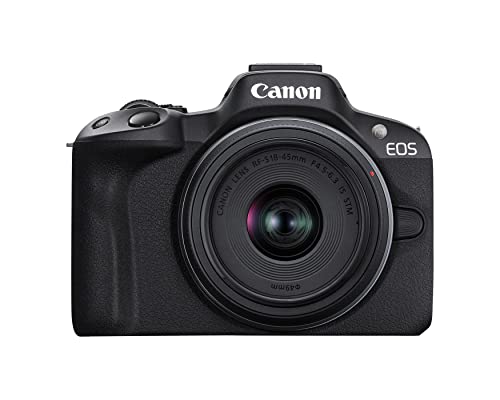
The R50 leads this guide because it is the camera a beginning traveller is most likely to be holding when the moment happens. It is small in the way that matters — a body and compact kit zoom that ride in a jacket’s cargo pocket or a day bag’s corner without negotiating for space — and it wakes, focuses and fires with the thoughtlessness a traveller needs at a viewpoint, in a market, at the instant the light breaks over the old town. Canon’s autofocus finds the face in the crowd scene and holds it; Canon’s colour makes the JPEGs look like the postcard the traveller hoped for, unedited, on the train home.
As a beginning it is mercifully guided: menus that explain themselves, a vari-angle screen for the high wall and the low café table, and stills quality that will print the trip large without apology. As a system it is a beginning rather than a cul-de-sac — RF lenses wait for the second trip’s ambitions, the fast prime for portraits in Lisbon light, the wider zoom for the mountains — so the traveller’s growing skill is never stranded by the first purchase.
Its compromises are a traveller’s usual ones: the kit lens is a starting point with a starter’s appetite for light, the body’s weather manners are fair-weather ones, and a long trip wants the second battery that every system camera in this guide honestly requires. None of these touch the central virtue, which is presence with quality — the R50 is there, awake, and good, at the moments travel is made of.
Buy it as the default beginning: the camera for the first big trip that may start a lifetime of them, bought once, carried everywhere, and grown inside rather than replaced.
- Sensor: 24.2MP APS-C
- Mount: Canon RF — grows with the traveller
- Screen: vari-angle touchscreen
- Carry: among the smallest system bodies here
- Colour: finished JPEGs straight from camera
Strengths
- Presence and quality in one small body
- Autofocus handles chaotic scenes kindly
- A system the second trip can build on
Trade-offs
- Kit lens hungers in dim interiors
- Fair-weather body — mind the rain
- Second battery is a real trip need
Best for: beginning travellers taking the first serious trip who want one camera to learn on, carry everywhere and keep.
Not suited for: travellers headed for serious weather, whose pick is the sealed OM-5 below.

Nikon Z30 — Best for travellers who film the journey
Some beginning travellers keep their diaries in motion, and the Z30 is built for their bag. Nikon’s smallest Z body deletes the viewfinder a filming traveller rarely uses and spends the savings on the journey’s real currencies: a vari-angle screen for the vlog at the viewpoint and the still at the strange angle, built-in stereo microphones for the market’s sound, and recording stamina for the long train-window meditation that other bodies interrupt. It is a camera designed by people who understood that travel video is mostly a person, a place and time to let both breathe.
As a stills camera it is better than its video-first costume suggests — Nikon’s Z lenses are superb, the compact kit zoom covers the traveller’s day from square to portrait, and the colour has the calm, slightly cool honesty that flatters architecture and weather. The body is genuinely small, the handling secure, and the whole kit disappears into a day bag in a way that keeps it present — this guide’s first commandment — on the long walking days when trips are actually photographed.
Its limits are its design’s shadow: no eye-level finder for the bright-glare stills that screens struggle with, a creator-priced lens corner smaller than Canon’s or Sony’s, and autofocus tuned for presenters rather than for sport. A beginning traveller whose journey is cathedrals, coasts and cafés will never meet those limits; a safari will introduce them rudely.
Buy it if the trip is a film with photographs, rather than the reverse — and if Nikon’s calm colour and the long, unbroken take are the diary style you recognise as your own.
- Sensor: 20.9MP-class APS-C
- Mount: Nikon Z
- Design: screen-centric, no viewfinder
- Recording: long-take stamina for travel film
- Audio: built-in stereo microphones
Strengths
- Travels light, films long
- Calm colour flatters place and weather
- Small kit vanishes into a day bag
Trade-offs
- No viewfinder for glare-bound stills
- Creator lens corner still growing
- Autofocus is presenter-paced
Best for: travellers whose diary is video — journeys filmed whole, with stills in support — in Nikon’s system.
Not suited for: stills-first travellers and wildlife journeys, served better by the R50 and OM-5.

OM SYSTEM OM-5 Mark II — Best for adventurous and wet journeys
The OM-5 Mark II is the pick for the trip that leaves the itinerary: the coastal path in October, the high valley, the fishing port at dawn, the city where the rain is a resident rather than an event. Its body is weather-sealed to a standard its rivals here do not attempt, its in-body stabilisation is the class’s marvel — hand-held photographs at shutter speeds that should be impossible, in the blue hour when travel photographs turn to gold — and its Micro Four Thirds lenses are the smallest serious optics in photography, so a two-lens travel kit weighs what other systems’ single lens does.
That size is a philosophy with consequences a beginning traveller feels daily. The OM-5’s kit rides in a coat, crosses a border unnoticed, and photographs a street without the street reorganising itself around a camera. Its computational kindnesses serve beginners specifically: Live ND for the waterfall without filters, starry-sky autofocus for the night the trip finally leaves the light pollution, and JPEG colour with a warmth travellers love. It teaches real photography — dials, craft, patience — inside a body that forgives the weather the lessons happen in.
The honest trade is sensor size: Micro Four Thirds gathers less light than the APS-C rivals, and its highest-ISO and shallowest-depth-of-field ceilings arrive sooner. In travel’s actual light — daylight, blue hour, the lit street — the difference is a rumour; in the darkest interiors it is a fact, mitigated by that extraordinary stabilisation, which buys back shutter speed exactly where travellers need it.
Buy it for the journeys with weather in them, and for the traveller who counts grams like money. It is the most capable small camera in this guide, and the one most likely to still be working, unbothered, on the tenth trip’s wettest morning.
- Sensor: Micro Four Thirds, in-body stabilised
- Build: weather-sealed to a high standard
- Lenses: the smallest serious travel optics
- Features: Live ND, starry-sky AF, computational aids
- Carry: two-lens kits at one-lens weights elsewhere
Strengths
- Sealing and stabilisation serve real journeys
- Smallest complete system in this guide
- Computational kindnesses teach and delight
Trade-offs
- Sensor ceilings arrive sooner in darkness
- Shallow-focus portraits are harder won
- A smaller system to grow within
Best for: adventurous, weather-exposed and weight-counting travellers who want a real system that vanishes into a coat.
Not suited for: low-light romantics and portraitists chasing the shallowest focus, better served by larger sensors.

Sony ZV-1F — Best pocket camera for pure simplicity
The ZV-1F is the beginning traveller’s permission slip: a camera that asks nothing. Its fixed ultra-wide lens frames the traveller and the place in one honest view — the selfie at the summit sign, the table of friends with the old town behind — its autofocus lives on faces, its defocus button borrows the professional’s blurred background without teaching a single number, and its directional microphone keeps the wind’s commentary out of the traveller’s. It lives in a pocket, starts in a breath, and cannot really be set wrong, which for many beginning travellers is not a limitation but the entire specification.
Travel reveals its specific genius: the unplanned moment. The parade that turns the corner, the grandmother laughing at the café, the light that lasts forty seconds — the ZV-1F is out, framed and filming before a system camera’s lens cap has been considered. Its stills serve the diary and the social archive happily, its 4K serves the trip film, and its price leaves the travel budget — this guide’s protected species — gloriously intact for the extra night, the better train, the second museum.
Its boundaries are the fixed lens’s physics: no reach for the distant tower or the shy wildlife, low light handled with competence rather than magic, and no second-year growth path — the traveller who catches photography seriously will graduate to a system and give this to a sibling, which is a noble second life for any camera.
Buy it when the trip matters more than the hobby, and the hobby may follow if it chooses. It is the camera most likely to be in the pocket at the moment — and in travel, as this guide opened by insisting, the moment is the whole game.
- Lens: fixed ultra-wide, traveller-framed
- Autofocus: face-first, product showcase
- Audio: directional mic, windscreen included
- Video: 4K for the trip film
- Carry: true pocket size, instant start
Strengths
- Zero decisions, always present
- Faces and places in one frame
- Price protects the travel budget
Trade-offs
- No zoom and no lens growth
- Low light is competent only
- Graduation means a second purchase
Best for: travellers who want the journey photographed without adopting photography — yet.
Not suited for: travellers already dreaming of lenses and reach, who should start with a system.

Canon PowerShot G7 X Mark III — Best pocket zoom for reach
The G7 X Mark III answers the pocket traveller’s one legitimate complaint against fixed lenses: the world will not always come closer. Its bright zoom reaches across the square to the clock tower’s face, compresses the mountain behind the village, isolates the detail — the hands, the tilework, the gull — that travel memory is actually woven from, and then retracts into a body that still disappears into a jacket. For the beginning traveller who wants one object, no system and real photographic range, it is the complete argument in a pocket.
As a camera it is a mature pleasure: a one-inch-class sensor with low-light manners the phone cannot match, Canon’s flattering colour, a tilting screen for the high wall and the low table, a microphone input for the trip film that grows ambitions, and stills that print the journey without embarrassment. It has been the travelling companion of a generation of creators for these reasons, and its price has settled into the territory where its completeness is a bargain.
Its compromises are its generation’s: autofocus that is good rather than sorcerous, 4K sessions that mind a hot climate, and a fixed lens — however versatile — that ends the growth story at its own reach. A traveller whose ambitions are already lens-shaped should buy a system; a traveller whose ambition is the trip itself will find this camera’s ceiling is located well beyond most journeys’ needs.
Buy it as the long-term pocket camera: one object, every focal length the day requires, no bag of decisions. For the beginning traveller who measures a camera in trips rather than in systems, it may be the wisest money in this guide.
- Sensor: 1-inch class
- Lens: bright zoom with real reach
- Screen: tilts for high and low angles
- Audio: microphone input for growing films
- Carry: coat-pocket body, no system
Strengths
- Reach without a lens bag
- Low-light manners beyond a phone’s
- A complete traveller in one object
Trade-offs
- Autofocus a generation behind the newest
- 4K minds hot climates
- Fixed lens ends the growth story
Best for: pocket travellers wanting range and quality with zero system — one camera for many trips.
Not suited for: travellers whose ambitions are already lens-shaped and growing.

Fujifilm X100VI — Best for learning to see
The X100VI is the guide’s romantic pick, included because a certain beginning traveller does not want a tool but a conversion. Its fixed lens — a classic reportage focal length — removes the zoom decision and replaces it with the photographer’s oldest discipline: move. Its dials put shutter, aperture and exposure compensation under the fingers where they can be learned by touch, in the street, mid-moment. Its film simulations give JPEGs the colour of memory rather than of documentation. Beginners who fall for it do not merely take travel photographs; they become, somewhere around the second city, photographers.
The camera around the romance is thoroughly serious: a high-resolution sensor with in-body stabilisation, a hybrid viewfinder that offers the optical window and the electronic truth in one eyepiece, a leaf shutter silent enough for the chapel and the café, and build quality that makes it the object travellers keep for decades. It is also, famously, desired beyond its supply — a beginning traveller should buy it when it is findable at its honest price and refuse the scalpers’ tax with the contempt it deserves, because no camera is worth beginning a journey in resentment.
Its limits are its philosophy’s price: one focal length, forever — the tower stays distant, the wildlife stays rumoured — and a price that buys a system camera and its first lens elsewhere. Video is a competent guest rather than a resident. None of this is hidden; the X100VI is the most honestly specialised camera in this guide, and its specialisation is seeing.
Buy it if the journey is also an education and the education is the point. A beginning traveller who learns on this camera learns the craft itself — position, patience, exposure, restraint — and carries those lessons into every camera they will ever own. That is a return on a purchase no specification can price.
- Sensor: 40MP-class APS-C, stabilised
- Lens: fixed classic reportage focal length
- Viewfinder: hybrid optical/electronic
- Controls: tactile dials, film simulations
- Build: an icon, made to be kept
Strengths
- Teaches photography by touch and by walking
- Photographs that look like memory
- An object travellers keep for decades
Trade-offs
- One focal length, forever
- Price buys a system elsewhere
- Desirability invites scalper pricing — refuse it
Best for: beginning travellers for whom learning to see is the journey’s second purpose.
Not suited for: travellers needing reach, zoom or a system to grow — the R50 and G7 X are their paragraphs.
How Do the Six Travel Cameras Compare Side by Side?
| Pick | Badge | Best for | Not suited for |
|---|---|---|---|
| Canon EOS R50 | Best overall for beginning travellers | beginning travellers taking the first serious trip who want one camera to learn on, carry everywhere and keep. | travellers headed for serious weather, whose pick is the sealed OM-5 below. |
| Nikon Z30 | Best for travellers who film the journey | travellers whose diary is video — journeys filmed whole, with stills in support — in Nikon’s system. | stills-first travellers and wildlife journeys, served better by the R50 and OM-5. |
| OM SYSTEM OM-5 Mark II | Best for adventurous and wet journeys | adventurous, weather-exposed and weight-counting travellers who want a real system that vanishes into a coat. | low-light romantics and portraitists chasing the shallowest focus, better served by larger sensors. |
| Sony ZV-1F | Best pocket camera for pure simplicity | travellers who want the journey photographed without adopting photography — yet. | travellers already dreaming of lenses and reach, who should start with a system. |
| Canon PowerShot G7 X Mark III | Best pocket zoom for reach | pocket travellers wanting range and quality with zero system — one camera for many trips. | travellers whose ambitions are already lens-shaped and growing. |
| Fujifilm X100VI | Best for learning to see | beginning travellers for whom learning to see is the journey’s second purpose. | travellers needing reach, zoom or a system to grow — the R50 and G7 X are their paragraphs. |
How Do You Pack a Beginning Travel Kit That Actually Gets Carried?
By weighing the day, not the trip. The kit that gets carried is the kit whose absence would be noticed by the shoulders at hour six: one body, the lens that covers the day — for most beginners the compact kit zoom or the fixed lens they chose — a second battery, a card with room for carelessness, and a strap that makes the camera ride like clothing. Everything else — the second lens for the one cathedral, the tripod for the one sunset — must argue its way into the bag against the evidence of yesterday’s shoulders, and most days it should lose.
Charging is the kit’s quiet system. One charger, one cable standard where the kit allows, a nightly ritual at the hotel that takes ninety seconds and guarantees the morning. Beginning travellers lose more photographs to a flat battery in a strange city than to every other cause combined, and the loss is always administrative rather than technical. The ritual is the remedy: camera charged while you shower, card backed up while it charges, bag packed while both happen — a small liturgy that makes the camera disappear into the journey’s rhythm.
Finally, pack for the photograph you fear losing. If the trip’s heart is a night market, the kit is the fast lens or the camera with the kindest high-ISO manners, and the wide zoom stays home without a hearing. If it is a mountain traverse, grams decide. Beginning travellers pack for the brochure; experienced ones pack for the one evening they would trade the rest of the trip to photograph properly. Choose that evening now, at the packing table, and let it edit the bag.
What Should a Beginning Traveller Photograph — Beyond the Landmarks?
The landmarks first, briefly and without shame: they are famous because they are magnificent, and the beginning traveller’s photograph of one is a rite, not a cliché. Shoot it early in the trip, in the best light you can arrange, and then put it away — because the photographs that will matter in ten years are waiting in the trip’s unlisted hours: the breakfast ritual, the wrong train’s window, the barber’s window, the travelling companions asleep in a heap of coats, the street where nothing is famous and everything is alive.
People are the second syllabus, approached with the traveller’s manners: ask where asking is the custom, smile and show the screen where it is not, and let the compact and fixed-lens picks earn their keep — a small camera at a café table is a guest, where a large one is an event. The beginning traveller who learns this diplomacy early brings home faces, and faces are what journeys are actually made of; the landmarks are merely where the faces were standing.
And keep the camera out for the journey itself — the stations, ferries, night buses and border queues that memory edits out and photographs redeem. Travel’s texture lives in its transits, and the camera that is packed away between sights misses the trip it was bought on. This is the practical meaning of this guide’s first commandment, presence: the best beginning travel camera is the one still in your hand on the ordinary afternoon, because ordinary afternoons, photographed honestly, are what a journey looks like from inside.
How Do You Set Up a Travel Camera Before the Journey?
Set the camera up for travel before the journey, in the calm of home: time and place set honestly so the archive orders itself, JPEG colour chosen and liked, the guided mode understood, the strap fitted and the bag’s pocket assigned. Learn the three controls the trip will actually use — exposure compensation for the snow and the beach, the screen’s tilt for the crowd and the table, the self-timer for the photograph the whole group is in — and let the rest of the menu wait for a rainy evening in month two. A traveller should meet a camera’s depths the way they meet a city’s: gradually, and never on the first morning.
Shoot the first day like a rehearsal, because it is one: the camera’s manners in real light, the battery’s honesty across a real day, the bag’s comfort at hour six. Adjust once, that evening — strap length, the pocket the camera lives in, the setting that surprised you — and then leave the system alone and let the trip be the subject. Beginners who reconfigure daily are studying their equipment; beginners who settle are studying the world, and only one of those is why the ticket was bought.
End each day with the ninety-second liturgy: charge, back up, glance at the day’s three best frames. The glance matters as much as the backup — it teaches tomorrow’s eye what today’s light rewarded, and it turns a trip into a photography course with the finest campus on earth. A beginning traveller who keeps the liturgy comes home with a card of photographs and a photographer’s habits; the habits are the souvenir that appreciates.
What Mistakes Do Buyers Keep Making?
- Packing for every possibility. The bag that covers every focal length stays at the hotel by day three. One lens, carried always, out-photographs four lenses carried never.
- Learning the camera on the trip. The journey is the subject, not the classroom. Home is for manuals; the road is for photographs.
- Shooting only the landmarks. The famous view is the trip’s cover, not its story. The story is in the transits, the tables and the faces.
- Letting the battery diary lapse. Flat mornings are administrative failures. The ninety-second nightly liturgy is the whole defence.
- Hiding the camera away between sights. Presence is the first commandment. The ordinary afternoon is the journey’s truth, and it will not wait to be fetched from the hotel.
- Buying the system before the first trip. One body, one lens, one journey — then let the trip’s evidence, not the shop’s lighting, choose the second lens.
What Does a Beginning Traveller’s Second Year Look Like?
It looks like evidence being spent wisely. The first trip’s archive, reviewed honestly, names the second year’s single purchase with a precision no shop can match: the wider lens for the traveller whose frames kept backing into walls, the fast prime for the one whose evenings outshone their days, the second battery and better strap for the one whose kit was right and whose logistics were not. Travellers who buy the second year from evidence build kits that look eccentric and work perfectly, because every object in them answers a photograph that actually happened.
The second year is also when the camera’s tribe declares itself. Some beginning travellers discover they were system photographers all along and deepen their mount; some discover the fixed-lens life was the destination and simplify with relief; some hand the camera to a partner or a child and begin again, one level up, with everything they now know. All three are successes, and all three were made possible by a first purchase modest enough to be outgrown without resentment. That is the deepest sense in which these six are beginning cameras: they are priced and shaped to be beginnings, and beginnings, unlike monuments, are supposed to be left behind gratefully.
How Does Each Pick Handle the Three Climates of Travel?
Travel has three climates and every camera here has a favourite. The first is the bright exterior — the square at noon, the coast, the snowfield — where every pick is happy and the beginner’s only enemy is glare on a screen, answered by the X100VI’s optical window and by the humble discipline of shading the display with a hand and a hat. The second is the golden interior — the café, the cathedral, the night market — where larger sensors and bright lenses earn their money and where the OM-5’s stabilisation performs its quiet miracle of tripod-less stillness. The third is weather itself, where the sealed OM-5 simply continues and the others go under a jacket, into a bag, or behind the traveller’s own body — workable, honourable, and a real argument for the wanderer’s pick when the itinerary is written in rain.
The beginner’s error is buying for the climate of the brochure — the noon square — and living in the other two. Trips are disproportionately golden interiors and weather; evenings are when travel is most itself. Weight your choice toward the camera whose climate matches your evenings, and the photographs will look like the trip felt, which is the only accuracy that matters in a travel archive.
What About the Photographs of the People You Travel With?
They are, in the end, the archive’s heart, and they impose their own camera requirements that no landscape specification captures: a camera quick enough for the laugh before it becomes a pose, kind enough in its colour that nobody asks for the photograph to be deleted, and unobtrusive enough that the travelling companions forget it between frames and live naturally in front of it. Every pick here was tested in the imagination against the breakfast table, and the ranking quietly reflects it — the R50’s flattering speed, the ZV-1F’s pocket discretion, the X100VI’s silent leaf shutter in the chapel of the group’s patience.
There is a craft to it that beginners can learn in one trip: photograph the companions doing the trip — reading the map wrong, asleep on the train, negotiating the menu — rather than assembled before the monument. The assembled photograph has its place, once per landmark, at the good hour; the candid archive is what the family will actually pass around in thirty years, saying the names. A beginning traveller who returns with faces has understood the assignment, whatever camera taught them.
Why Do Experienced Travellers Carry Less Camera Every Year?
Watch the veterans at the viewpoint: the kit shrinks as the eye grows, because experience teaches which photographs the traveller actually takes — and they are taken at two or three focal lengths, in the day’s real light, with a camera that was present because it weighed nothing and asked nothing. The beginner’s temptation to cover every possibility is the first stage of the disease whose cure is a single trip’s evidence. This guide’s insistence on one body and one lens is not minimalism as fashion; it is the veteran’s destination, offered to the beginner at the start, saving them the years of shoulders that usually teach it.
The second lesson veterans teach is that the camera’s social size matters as much as its physical one. A small, quiet camera is admitted to the café, the chapel, the family kitchen and the stranger’s workshop; a large one is an announcement that changes the room it enters. Beginning travellers photograph the world as it is only to the extent that the world ignores their camera — which is why so many picks here are small, and why the largest compliment a travel camera can earn is the one these six were chosen to deserve: nobody in the photographs remembers it being there.
The Travel Archive: What to Do With a Trip’s Photographs
A beginning traveller’s education completes itself at home, in the edit. The discipline is curation rather than processing: the trip’s thousand frames reduced, in the first sitting, to the hundred that tell it, and in the second to the thirty that will be printed, shared and kept where eyes actually go. Every pick here produces files that reward this kindness — honest colour that needs no rescue — because a beginner’s archive dies in the editing backlog more often than in the field, and cameras whose photographs look finished at the first glance get curated, printed and loved, while cameras whose files need work get a folder named by a year and a promise.
Print something. The single most educational object a beginning traveller can own is one large print of their best frame, because a print is honest at a distance a screen forgives, and because it converts the trip from content into inheritance. The cameras in this guide were all required to print well at generous sizes, and the beginner who hangs one photograph has set the standard the second trip will be shot to reach. Archives are built by standards, and standards are built by walls.
A Final Note on Buying the Camera at the Right Moment
Buy it before the trip, with weeks to spare — never at the airport, never the night before. The weeks are the apprenticeship this guide keeps prescribing: the camera learned at home, the liturgy practised on the dog and the street, the bag packed and repacked until its pockets are reflexes. A camera bought in haste at departure is a stranger travelling with you, and strangers, however capable, do not get handed the journey’s best moments. Bought in time, the same camera is a companion by the border — and companions, as every traveller knows, are what journeys are actually made of.
If the great trip is imminent and the camera must be chosen today, choose presence over ambition: the pick you can learn in the available evenings, carried without thought, forgiving without limit. The system can be next year’s beginning. This year’s is the trip itself, and it will not wait for a better-prepared photographer — it will simply be photographed, beautifully or barely, by the one who showed up with a camera they understood. Show up understanding yours.
One Journey, Photographed Twice: A Closing Illustration
Imagine the same week in the same coastal city, travelled by two beginners. The first carries the system she bought for its specifications: two lenses, a bag that announces itself, a camera whose depths she is still plumbing — and her archive is forty careful photographs of the famous things, taken from where the crowds stand, plus a resolve to learn the camera properly before next year. The second carries one small camera she has owned for a month and understands like a coat pocket, and her archive is four hundred frames of the city as it lived — the fish market at dawn, the companions asleep on the night ferry, the old town in the rain she did not hide from — of which thirty are wonderful and three are the best photographs she has ever taken.
Both beginners spent similar money. The difference was never the cameras’ ceilings; it was presence, familiarity and nerve, in that order — the three virtues this entire guide was organised to buy. Choose the camera that maximises them for your journey, learn it before the border, carry it into every ordinary afternoon, and the trip will do the rest, as trips have done for every traveller who ever showed up looking.
Pack light, then. One camera, understood; one lens, trusted; one ritual, nightly. Let the journey be the complicated, magnificent, unrepeatable thing it is, and let the camera be the simple thing that was there for all of it — at the dawn market, in the rain, at the table when everyone laughed at once. That is all a beginning travel camera has ever needed to be, and every pick in this guide, chosen and carried well, will be exactly that for you.
Why Beginners Should Trust the Automatic Modes on the Road
A last heresy, offered in the traveller’s defence: the automatic modes on these six cameras are excellent, and using them is not a failure of seriousness. Modern exposure and focus automatics, trained on millions of scenes, will handle the noon square and the shaded alley with a competence a beginner’s manual settings will not match for a year — and the traveller’s attention, freed from the dials, goes to the scene, the companions and the moment, which is where photographs actually come from. Learn one control at a time in the trip’s quiet hours — compensation at the beach, aperture at the portrait — and let the automatics carry the rest without apology.
The photographers whose work beginners admire use automatics constantly, in the modes that suit the moment, and save their manual attention for the decisions machines cannot make: where to stand, when to wait, what to leave out. A beginning traveller who absorbs that hierarchy early — position first, patience second, settings third — will out-photograph the technically obsessed beginner on every trip, on any camera in this guide, and will enjoy the travelling more while doing it, which is, after all, the entire point of going — that, and coming home with the photographs to prove how well it was spent, frame by honest frame, from the first morning to the last evening.
Final Recommendation
Begin with the Canon EOS R50 unless your journey argues otherwise: it is small, kind, capable and growable — the beginning traveller’s complete answer. Travellers who film their diaries should take the Nikon Z30, and those whose journeys have weather in them should take the sealed, stabilised OM SYSTEM OM-5 Mark II and stop counting grams and worries together.
The pocket travellers are served by the Sony ZV-1F’s zero-decision simplicity and the G7 X Mark III’s reaching zoom, and the romantic beginner — the one travelling to become a photographer — should find the Fujifilm X100VI at its honest price and learn to see with it for a decade. Whichever you pack, pack it light, keep it present, and let the trip, not the camera, be the complicated part.
Related guides
Frequently Asked Questions
Is a dedicated camera really better than a phone for travel?
For photographs, increasingly narrowly; for travelling, decisively. A dedicated camera is present without being a telephone — no notifications at the viewpoint, no battery shared with the map and the bank, controls and a grip made for the one job, and in these picks, image quality and low-light manners a phone works hard to imitate. Beginners report the real difference is attention: the camera makes the trip something they look at, and the photographs are the evidence of the looking.
How many lenses should a beginning traveller carry?
One, until the first trip’s evidence demands a second. The kit zoom or the fixed lens you chose covers the traveller’s day from square to portrait, and a second lens carried speculatively is weight that taxes every photograph the first lens takes. After the trip, review the frames you wished for — wider, longer, faster — and let that specific wish, in that order, choose the second lens for the second journey.
Which of these is best for a traveller on a tight budget?
The Sony ZV-1F protects the travel budget best while still being a real camera — and protecting the budget is a photographic virtue, because the extra night and the slower train are worth more photographs than any specification. Among system cameras, the Canon EOS R50 with its kit lens is the value beginning: one purchase, years of growth, and nothing else required before the first trip.
Can these cameras handle a safari or distant wildlife?
Honestly, at the edges. Travel’s distant subjects want long lenses, and the system picks here can grow them — the R50 and OM-5 with telephoto zooms become genuine wildlife tools — while the fixed-lens picks cannot, by design. A beginning traveller whose trip is a safari should say so at purchase and weight the system paragraphs heavily; a traveller whose wildlife is the gull and the harbour seal is served by every pick here.
How do I keep a camera safe while travelling?
By making it unremarkable and unleaveable: a plain strap, a bag that does not announce itself, the camera on your person in crowds and on the table’s inner side at cafés, and the nightly backup so that even a lost camera loses only itself, not the journey. Insurance for the trip’s value is a grown-up sentence to write before departure. The picks here help by size — a small camera is a concealable, carryable, always-present camera, and presence on the person is the core of every security system travellers actually keep.
What is the best first trip to learn on?
A near one, rich in the subjects you love: a long weekend in a city with markets and weather, a coast path, a festival in the next county. Near trips forgive the beginner’s packing errors, teach the liturgy cheaply, and return evidence about the kit while the evidence can still change it. Save the once-a-decade journey for the second trip, when the camera is a companion rather than a question — the photographs of the great journey deserve the photographer the small one made.
Related Guides
Prepare the rest of the journey with our guide to the best beach cameras for beginners, film it with the best beginner cameras for video, and power the kit with the best batteries for digital cameras, rechargeable picks included.


