ilcastellomenu.com is reader-supported. When you buy through links on our site, we may earn an affiliate commission.
Where to Buy
The phrase behind this guide — the best cameras for still shot and underwater purposes — bundles two honest questions into one search: which cameras take genuinely good still photographs, and which of them can go underwater and keep taking them? They deserve a straight answer, because the camera industry answers them with a fog of waterproof claims. So here is the fog cleared, in the first paragraph where it belongs. A small number of cameras are waterproof as they stand, down to stated depths, and they are the backbone of this guide. Everything else — including the finest stills cameras ever made — goes underwater inside a dedicated housing, a pressure-rated case that can cost as much as the camera, and any guide that glosses over that distinction is selling you a flooded camera. We will not: one pick below is deliberately prose-only, representing the housing route, described with its real costs and its real rewards.
Underwater stills are also a different craft from underwater video, and this guide is written for the stills shooter. Video forgives the water’s colour theft by moving; a still photograph must solve it in a single frame — light falls off, red vanishes within the first few metres, suspended particles turn a flash into a snowstorm. The cameras ranked here were judged on the stills problems: shutter response when a turtle commits to a direction, macro ability for the reef’s small citizens, flash and strobe behaviour, white balance you can set for the depth you are actually at, and seals — the whole genre stands or falls on seals — that survive a season of salt, sand and boat decks.
The list therefore divides by depth and by honesty. At the top sit cameras that swim as they are: a rugged compact built for divers, and action cameras whose waterproofing serves snorkellers, surfers and shallow reefs. Deeper and more serious work is represented by the housing route, discussed frankly. Every linked pick is available on Amazon, in the Quick Picks table and beside its review; the prose-only pick carries no link, because what it needs is a conversation with a housing maker, not a shopping cart. Read the depth and care sections before your first dive with any of them — the ocean is a wonderful studio and an unforgiving equipment room.
Key Takeaways
- The OM SYSTEM Tough TG-7 is the only pick that is a true diver’s stills camera out of the box — waterproof to real scuba depths, with macro that justifies the trip.
- The GoPro HERO13 Black serves snorkellers and surface sports best: waterproof, instant, and honest about its stills being a bonus on a video tool.
- DJI’s Osmo Action 5 Pro handles the dim, green shallows and dusk surface work with the cleanest files of the action class.
- The Insta360 X4 reframes underwater stills entirely — shoot the whole sphere now, choose the photograph later.
- The AKASO Brave 7 LE is the budget door into waterproof shooting, with a case in the story that must be told honestly.
- Serious deep stills still mean a mirrorless camera in a dedicated housing — the prose-only pick explains what that commitment really involves.
In this guide
Quick Picks
| Camera | Badge | Why it earns its place |
|---|---|---|
| OM SYSTEM Tough TG-7 | Best true underwater stills | Waterproof to scuba depths, with macro and microscope modes for reef detail. |
| GoPro HERO13 Black | Best for snorkelling and surf | Waterproof without a case, instant on, stills as a strong bonus. |
| DJI Osmo Action 5 Pro | Best in dim shallows | A larger sensor keeps green water and dusk surfaces usable. |
| Insta360 X4 | Best for reframed stills | Capture everything around you, compose the still afterwards. |
| AKASO Brave 7 LE | Best budget waterproof | An affordable way under the surface, case included in the plan. |
| A Mirrorless Camera in a Dedicated Housing | Best for serious depth | The professional route — unmatched stills, at a commitment’s price. Prose-only. |
How Did We Choose Cameras for Stills Underwater?
We began with the seal, because underwater photography’s first specification is not resolution but survival. Each candidate’s waterproof claim was read the way a diver reads it: waterproof to what depth, as the camera stands or only inside its case, with what maintenance — rinsing, O-ring care, seal replacement — the claim depends on. Cameras whose marketing implies depths their construction does not support were marked down or, where the claim only works in a case, described that way without embarrassment: a case is a legitimate tool, but the reader deserves to know it is in the photograph.
Second came the stills craft at depth. A reef does not pose. We weighted shutter response and autofocus that works through water’s murk and contrast loss, close-focus and macro ability — the underwater world rewards small subjects disproportionately, since water magnifies, crowds and hides its giants — and flash behaviour, including how each camera talks to external strobes or lights, because below a few metres the sun stops paying the colour bill and the photographer must bring the light. White-balance control that can be set manually, at depth, with gloves, counted for more than any menu of scene modes.
Third, the ownership reality: battery swaps between dives on a rocking boat, screens readable in tropical glare at the surface and in blue gloom below it, and the care regime after salt water that decides whether the camera survives its second season. The six picks that follow are the ones we would hand to stills shooters at their respective depths — with the housing route included honestly, because for the deepest and most serious work it remains, even now, the only answer there is.
Why Does Water Steal Your Colours?
Because water is a filter that charges by the metre. It absorbs the warm end of the spectrum first — reds go within a short descent, oranges and yellows follow — until the world below is rendered in the blues and greens that penetrate furthest. A photograph taken at depth with surface settings is therefore not badly exposed; it is faithfully recording a scene from which most of the rainbow has been physically removed. The stills photographer’s countermeasures are the genre’s core craft: get close, because every metre of water between lens and subject is another filter; restore colour with light you bring — a strobe returns the reds to the coral at the moment of the flash; and set white balance for the water you are in, or shoot raw and argue with the colour at home, where the argument is cheaper.
Particles levy the second tax. The sea is full of suspended life and sediment — marine snow — and a light source mounted beside the lens illuminates every flake between you and the subject, printing a blizzard over the photograph. The professional answer is geometry: strobes on arms, angled in from the sides, lighting the subject while the water column in front of the lens stays comparatively dark. This is why the housing route, with its arms and strobe systems, still owns serious underwater stills, and why the compact picks below are judged partly on how gracefully they accept a light — a tray, a handle, a small video light transforms their photographs more than any setting can.
What Are the Best Cameras for Still Shot and Underwater Purposes?
Two cameras that dive as they stand, two that rule the shallows, one budget door, and the housed professional — in ascending order of commitment.

OM SYSTEM Tough TG-7 — Best true underwater stills
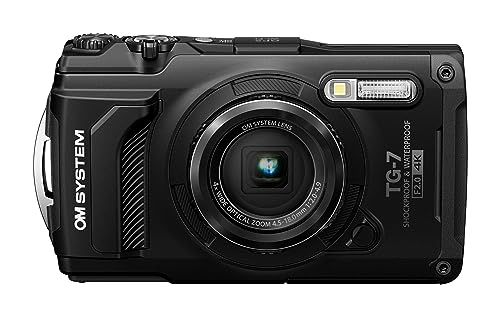
Start with the camera that needs no asterisk. The TG-7 is waterproof as it stands to depths that cover recreational scuba — not snorkelling depths, not splash resistance, but the actual working range of a diver — and it wraps that seal in a body that is also shockproof, crushproof and freezeproof, because the route to the water runs over boat decks, rocky entries and the occasional dropped weight belt. For stills shooters it is the only camera in this guide that can be carried on a dive, as a camera, with its full photographic personality available: a real zoom lens, raw files, and controls arranged for gloved, occupied hands.
Its underwater personality is specialised in ways that reveal a design team who dive. Dedicated underwater modes set the colour and flash behaviour for the blue world; a microscope mode focuses close enough to turn a nudibranch into a portrait sitting; and the macro system — including accessory lighting guides that wrap light around tiny subjects — serves the reef’s small majority, which is where underwater stills are actually won. Wide scenes it handles honestly rather than spectacularly: the small sensor and the water together ask the photographer to get close and compose tightly, which experienced underwater shooters will tell you is not a limitation but the entire technique, taught by the equipment.
The compromises are the compact camera’s eternal ones, accepted knowingly by its loyal owners. Low-light files at depth will not match a housed full-frame camera’s — nothing at this size and price can — and the photographer chasing magazine-cover wide-angle wreck shots will outgrow it toward the housing route below. Battery swaps between dives are a boat ritual to be practised dry-handed. But as the camera a diver actually owns, maintains and takes on every dive — rather than the system that sails twice a year — the TG-7 has no rival in this guide, and its owners’ portfolios are the evidence.
- Format: rugged compact, waterproof as it stands
- Depth: recreational scuba range without a housing
- Macro: microscope mode and lighting accessories
- Files: raw for colour work at home
- Build: shockproof, crushproof, freezeproof
Strengths
- A real dive camera, not a snorkel toy
- Macro that wins the reef’s small subjects
- Survives the journey to the water, too
Trade-offs
- Small sensor in deep, dim water
- Wide epics belong to housed systems
- Battery ritual between dives needs dry hands
Its characteristic photograph is a portrait of a creature most divers swim past: a cleaner shrimp in its anemone, antennae lit by the camera’s ring of light, shot at a distance where the water between lens and subject is centimetres rather than metres — colour fully present, background dissolved into blue. That discipline, closeness as colour’s price, is the first lesson of underwater stills, and the TG-7 is the finest teacher of it that fits in a BCD pocket.
Scientific and survey divers form its quiet second constituency: the same camera documents reef health, wreck details and specimen records dive after dive, because it asks for no housing ritual at the boat’s rail and its files are honest evidence. Tools that working divers trust with records tend to be tools holiday divers can trust with memories.
Best for: scuba divers shooting stills and macro on every dive. Not suited for: wide-angle wreck epics or the darkest deep work

GoPro HERO13 Black — Best for snorkelling and surf
Above the TG-7’s working depths lies the water most people actually meet: the snorkel reef, the surf break, the rock pool, the boat’s swimming platform. The HERO13 owns that bright shallows world. Waterproof without a case to depths that cover snorkelling and surface sports with room to spare, instantly awake, and operable by a mask-wearing beginner through a single button, it is the camera that gets the photograph because it was there — clipped to a wrist, mounted on a board, floating on its grip — while a more serious camera was still being assembled on the beach.
Its stills deserve an honest framing. This is a video-first instrument whose photographs are a strong secondary talent: wide, bright, sharp in the tropical shallows where light is plentiful and the water is clear, ideal for the turtle over the reef flat and the surfer inside the wave’s green room. Frame-grab thinking flatters it further — a burst of motion yields the one frame where the turtle’s flipper and the light agree. What it will not do is the diver’s considered still: no zoom to speak of, no raw-driven colour rescue at depth, no macro courtship of small things. Within the sunlit metres it was built for, none of that is a criticism; it is a description of a tool perfectly matched to its element.
Ownership is the easiest in this guide: rinse it, dry it, charge it, and the seals ask for none of the O-ring liturgy the deeper systems demand — though the lens cover and door seals still deserve the respect of a rinse and an inspection, because salt is patient. For families, snorkellers, surfers and every traveller whose underwater life happens in the bright top layer of the sea, this is the recommendation without caveats.
- Format: waterproof action camera
- Depth: snorkelling and surface sports, no case needed
- Stills: bright-water photographs and bursts
- Operation: one-button simple, mask-friendly
- Mounts: boards, wrists, grips, helmets
Strengths
- There, awake and shooting, every time
- Shallow tropical water is its home light
- Care regime a child could maintain
Trade-offs
- Stills are the second talent, honestly
- No zoom, no macro, no deep colour rescue
- Scuba depths require its protective housing
Its emblematic still is shot by accident and kept forever: a snorkeller’s first turtle, caught mid-burst as the animal banks over the reef, sun rays printed through the surface like stage lighting. A housed system might have rendered it more richly; it would also, on that morning, have been on the boat. The HERO13’s philosophy is that the best underwater camera is the one already wet, and the bright shallows keep proving it right.
Surf and paddle sports have made it their recorder for the same reason: the camera tolerates being wiped out, remounted and shot through a whole session without a dry bag ceremony. Stills from inside the wave — the green room’s brief architecture — exist as a genre largely because this class of camera made the price of failure a rinse.
Best for: snorkellers, surfers and bright shallow water. Not suited for: scuba stills at depth or considered macro work

DJI Osmo Action 5 Pro — Best in dim shallows
Not all shallow water is bright. The temperate reef under a grey sky, the kelp forest’s green gloom, the harbour wall at dusk where the octopus hunts — these are the shallows of half the world’s coastlines, and they punish small sensors. The Action 5 Pro earns its place by suffering least: its larger sensor holds detail and colour further into dim, green water than its action-camera rivals, so the snorkeller in cold seas and the freediver working a shaded reef bring home stills that need less rescue. Waterproof as it stands for the snorkel and surface range, it shares the class’s virtues — instant readiness, mounts everywhere, no housing ritual for its home depths.
Its screens, front and rear, matter more underwater than specifications suggest: a snorkeller composing at arm’s length, or checking a shot at the surface with wet eyes, can verify framing without hauling the camera to the mask. Battery endurance across a long session in cold water — cold being the other tax temperate seas levy — is a further quiet strength, and its colour rendering in green water, the hardest water to make honest, is the most forgiving here. For the stills shooter it remains a video-first tool, with the same honest framing as the GoPro: the photographs are good, the considered dive still belongs to the TG-7.
Choose between the two action cameras by water, not by brand. Tropical brightness and the deepest accessory ecosystem favour the GoPro; temperate gloom, dusk surfaces and cold sessions favour this DJI. Freedivers splitting the difference — bright reefs, deep breaths, quick descents to photograph a wreck’s top deck — will find its low-light manners the deciding vote. It is the thinking snorkeller’s camera, for seas that do not sparkle on command.
- Format: action camera, larger sensor class
- Water: temperate, green and dim shallows
- Screens: front and rear for wet-eyed checks
- Endurance: long cold sessions respected
- Depth: snorkel and surface range as it stands
Strengths
- Cleanest files in unkind water
- Framing verifiable without surfacing fully
- Cold-water battery manners
Trade-offs
- Stills remain its second language
- Accessory bench younger than GoPro’s
- True scuba work still wants a housing
Its signature still comes from a kelp forest in late afternoon: a seal materialising out of the green, close enough that the wide lens is a portrait lens, the available light — filtered through ten metres of moving canopy — rendered by the sensor as atmosphere rather than noise. Northern snorkellers wait whole seasons for that encounter; this is the action camera that does it justice when it comes.
Harbour and pier photographers, the urban branch of the tribe, use it for the dusk shift: the underside of the jetty, the crab’s evening patrol, the last swimmers leaving a lit lido. Wherever the water is shallow and the light is leaving, its sensor keeps the diary open an hour longer than its rivals’.
Best for: temperate seas, freedivers and dusk surface work. Not suited for: deep scuba stills or macro specialisation

Insta360 X4 — Best for reframed stills
The X4 proposes a heresy that underwater shooters have come to love: stop composing. A 360-degree camera records the entire sphere around it — the reef below, the turtle behind, the boat above, the buddy’s signal at the edge of vision — and the photograph is chosen afterwards, reframed from the sphere at a desk where time, unlike air, is unlimited. For stills purposes this inverts the genre’s hardest problem. Underwater, the decisive moment usually happens outside the frame you chose; the X4’s frame is everything, so the moment is always inside it, waiting to be found in the edit.
Its underwater manners suit the shallows and the snorkel trail: waterproof as it stands for the surface range, with a dedicated dive case available for those who take the idea deeper — stated plainly, as this guide insists: the case is a purchase, and its seals join your pre-dive liturgy. The reframed stills carry the 360 look — immersive, wide, occasionally surreal where the stitch line meets a close subject — and the workflow rewards a particular temperament: the shooter who enjoys the second act of photography, the evening’s archaeology through the day’s sphere, will produce images no conventional camera on the dive could have framed.
The honest costs are resolution and ritual. A reframed still is a crop of a sphere, so fine detail at distance is not its gift; marine life must come close, as with every wide underwater tool. The stitching demands a minimum distance from subjects to stay invisible, and the files are large and the editing a real session rather than a transfer. Divers who compose in the water, decisively, will call it cheating and prefer the TG-7; snorkellers, kayakers and reef guides who must watch their group and shoot simultaneously will call it the first camera designed for their actual job. Both are right, which is why it is here.
- Format: 360-degree action camera
- Method: capture the sphere, reframe the still later
- Depth: surface range sealed; dive case for deeper
- Subjects: close encounters, whole scenes
- Workflow: an editing session is part of the craft
Strengths
- The moment behind you is photographed too
- Guides and instructors can watch and shoot
- One dive yields many compositions
Trade-offs
- Reframed detail trails a dedicated stills camera
- Stitch line needs subject distance
- Deep work requires the case and its rituals
Its definitive image is a discovery made at a desk: the snorkel guide reviewing the morning’s sphere finds, behind the group she was filming, a reef shark cruising the drop-off in perfect profile — a photograph that no one took and everyone now owns. Conventional cameras record intentions; this one records the whole event and lets intention arrive later, which underwater — where attention is a safety resource — may be the more honest design.
Researchers and citizen-science divers have noticed the same property: a transect swum with the X4 archives the entire corridor, and a still of anything noticed later — a species, a lesion on coral, a lost weight pocket — can be extracted after the fact. The camera as witness, rather than as artist, is a role the underwater world has real work for.
Best for: snorkellers, guides, kayakers and whole-scene capture. Not suited for: fine distant detail or photographers who compose decisively in the water

AKASO Brave 7 LE — Best budget waterproof
Every underwater portfolio in this guide began with a first camera someone could afford to lose, and the Brave 7 LE is this generation’s version of that door. Its proposition is simple and, stated honestly, entirely respectable: waterproof shooting at a price that lets a beginner, a family or a school club get under the surface this summer rather than after two years of saving. The honesty this guide requires concerns its waterproofing’s shape: the camera’s deeper-water work happens inside its waterproof case, which is part of the kit’s plan and price — the case’s seals become part of your ritual, exactly as with the professional housings, at a friendlier scale of consequence.
Within its element — the bright shallows, the pool, the snorkel boat, the waterfall hike — its stills and video are cheerful and serviceable, the dual screens help the selfie generation frame their reef portraits, and its lightness makes it the camera that rides along on trips where a serious system would be a decision. There is a real photographic education available through it: composition, closeness, colour loss and particle discipline are all taught by bright shallow water, and they are taught identically whether the camera cost a little or a lot. Many TG-7 owners can name the budget action camera that taught them; the alumni network is the recommendation.
Its limits set its price, and buyers should hold both facts at once. Low-light water will test it quickly, build and seals ask for the case discipline to be taken seriously rather than as packaging, and the photographer who falls for the underwater world will outgrow it — which is not a failure of the camera but the definition of a door. Buy it to begin, rinse it like it matters, and let the photographs it makes argue for whatever comes next.
- Format: budget action camera
- Waterproofing: case-based for deeper water
- Screens: dual, for self-framing
- Element: bright shallows, pools, trips
- Role: the affordable first underwater camera
Strengths
- Under the surface this summer, not someday
- Teaches the genre’s real lessons cheaply
- Light enough to ride along everywhere
Trade-offs
- Case discipline is part of the deal
- Dim water exposes the budget quickly
- Built to be outgrown by the bitten
Its natural habitat is the family holiday’s best afternoon: a rock pool at low tide, a child photographing a crab with the seriousness of a naturalist, the camera passed hand to hand without a single adult flinching at its value. Photographs from that afternoon will outlive phones and be printed for grandparents. A camera that enables the afternoon is not a compromise purchase; it is the correct one, and the genre’s expensive priesthood began, almost to a person, exactly here.
Clubs and schools running their first underwater sessions reach for the same logic: a small fleet of these costs what one housed system does, and puts a camera in every student’s hands for the pool training where the craft’s habits — buoyancy, closeness, no touching — are actually formed.
Best for: beginners, families and clubs entering underwater shooting. Not suited for: dim water, deep ambitions or heirloom build expectations
A Mirrorless Camera in a Dedicated Underwater Housing — Best for serious depth
The final pick has no link, deliberately, because it is not a product but a commitment — and this guide would rather lose the click than blur what the commitment involves. Take a current full-frame or APS-C mirrorless camera — the bodies ranked elsewhere in our guides for their stills — and house it: a machined or moulded pressure-rated case, built for that exact body, with controls that reach every dial through the shell, ports that accept the lenses the work needs, and arms that carry strobes out to the sides where underwater light belongs. The result is the finest underwater stills instrument that exists: full sensor, real lenses, real flash geometry, photographs that hold a magazine cover or a competition wall.
Now the honest ledger, which housing owners recite like a catechism. The housing and ports can together cost as much as the camera inside them; the rig, dressed with arms and strobes, is a piece of luggage with its own travel negotiations; every dive is preceded by an O-ring liturgy — inspection, cleaning, a single hair or grain of sand across a seal being the difference between a dive and a disaster — and followed by rinsing, drying and maintenance that treat the system as the life-support-adjacent equipment it is. Flooding is not a risk the brochure mentions and the community never stops mentioning: it happens, to careful people, and insurance is part of the system’s true price.
Why, then, does anyone sign? Because the photographs are why. The wide wreck interior with its shafts of light held in a full-frame file; the portrait of a shark at strobe-lit closeness with the water rendered black by geometry rather than darkness; the macro work at apertures and magnifications compacts cannot reach — these are the images that define the genre publicly, and they are all made this way. The route in is usually staged: a season on the TG-7 to learn the water, a housing for a body already owned, strobes added one arm at a time. This pick is prose-only because its purchase is a relationship with housing makers, dive shops and insurers — but for the stills shooter whose ambitions have reached the end of what sealed compacts can do, it is not the expensive option. It is the only one left.
- Format: your mirrorless body in a model-specific housing
- Light: strobes on arms, proper underwater geometry
- Depth: rated housings for full recreational and beyond
- Ritual: O-ring inspection before every dive
- Cost shape: housing and ports rival the body’s price
Strengths
- The finest underwater stills obtainable
- Real lenses, real flash, full control
- Grows by ports and strobes over seasons
Trade-offs
- A luggage-class system with a liturgy
- Flooding is a when, insured against, not an if
- Total cost multiples of every other pick
Watch its owner at the boat’s bench an hour before the dive: the housing open like a surgical kit, seals inspected under a lamp, each control worked through the shell, the whole assembly lowered into the rinse tank first to watch for the betraying bubble. It looks like obsession and functions as statistics — this is how the genre’s great photographs are actually insured. The romance of underwater stills is real, but it swims behind a checklist.
The community around housings deserves mention as part of the purchase: dive shops that service seals, forums that know which port a lens truly needs, photographers who will lend a strobe arm at a resort because the fellowship of the flooded is strong. Buying into the housing world buys that fellowship too, and beginners underestimate how much of the craft it carries.
Best for: committed underwater stills photographers pursuing publication-grade work. Not suited for: casual snorkelling, tight budgets or anyone unwilling to keep the O-ring liturgy
How Do the Six Underwater Options Compare by Depth and Intent?
| Camera | Format | Waterproof truth | Best use |
|---|---|---|---|
| OM SYSTEM Tough TG-7 | Rugged compact | Sealed as it stands, scuba range | Dive stills and macro |
| GoPro HERO13 Black | Action camera | Sealed as it stands, surface range | Snorkelling and surf |
| DJI Osmo Action 5 Pro | Action camera | Sealed as it stands, surface range | Dim and temperate shallows |
| Insta360 X4 | 360 camera | Surface sealed; case for depth | Whole-scene capture |
| AKASO Brave 7 LE | Budget action | Case-based waterproofing | First underwater steps |
| A Mirrorless Camera in a Dedicated Housing | Housed system | Housing-rated, full working depths | Publication-grade stills |
The middle column is the one to read twice. Every claim in this genre is true inside its conditions; the table states the conditions. Choose the row whose conditions match the water you actually enter — not the water in the brochure, and not the water you might enter in some future year of diving you have not yet booked.
How Deep Do You Actually Need to Go?
Shallower than the marketing implies, for most photographers, most of the time. The snorkel reef lives in the first few metres, where the light is richest and the colour nearly intact; the surf, the pools and the rock pools live at the surface itself. Recreational scuba’s working range — where the TG-7 performs as it stands — covers the reefs, walls and wrecks of ordinary diving. Beyond it lie technical depths and the housed systems’ territory, entered by training rather than by shopping. The honest purchase matches the deepest water of your actual next season: buy the seal for the dives you have booked, and let a future certification, if it comes, argue for the future camera.
Depth also taxes the photograph, not just the equipment. Light fails, colour narrows to blue, air — your dive’s true currency — is spent faster while composing, and a buddy’s patience is a safety resource, not an infinite one. Many of the genre’s most loved stills are made in the bright metres near the surface, by photographers who understood that underwater, as in the mountains, the summit is rarely where the picture is. Choose the camera for the water where your subjects live, and your subjects, mostly, live in the light.
What Mistakes Ruin Underwater Stills?
Shooting from too far away leads the casualty list: the metre of water between lens and subject steals more colour and sharpness than any sensor difference in this guide, and the beginner’s distant turtle is a blue rumour while the experienced shooter’s close one is a portrait. Second is the on-camera flash fired straight ahead in particle-rich water — the snowstorm effect — cured by turning it off, moving light to the sides, or accepting available light’s blue honesty. Third is touching: the reef, the wreck’s fragile growth, the animal — a photograph that costs the subject its home or its calm is a failure regardless of its sharpness, and every camera in this guide can be operated without contact by a diver whose buoyancy is up to the genre.
The equipment mistakes are quieter and wetter. A seal closed over a hair, a case latched in a hurry on a rocking boat, a camera left in a hot rinse tank in the sun — the liturgy exists because each of these has ended cameras whose owners were, until that morning, careful people. And the final mistake is reviewing nothing: check the first frames of every session at the surface interval, because the fogged port, the wrong white balance and the strobe asleep are all cheap to fix at minute ten and tragic at the dive’s end.
How Should You Care for a Camera After Salt Water?
Salt water is a debt that collects itself if unpaid. The universal settlement is a soak and rinse in fresh water after every salt session — the camera or its case worked gently, buttons and dials turned under the water so the salt leaves the places it hides, then drying out of direct sun before any door is opened. Open a wet camera’s compartment on the boat and you import the ocean into the battery bay; the patience to dry first is the cheapest maintenance in the genre. Seals and O-rings get their own attention on the systems that have them: inspected, cleaned, lubricated as their makers direct, and replaced on schedule rather than on failure.
Between trips, store the camera dry, doors unlatched where the maker advises, out of the heat that ages seals in a car boot. And keep the habit that ties this section to all the others: a small notebook, or a note in the phone, recording each session’s depth, conditions and any insult the equipment suffered. Underwater cameras rarely die suddenly; they decline in a documented handwriting of small neglects, and the notebook is how an owner reads it in time.
How Do You Approach a Subject Without Ending the Encounter?
Slowly, from below the subject’s alarm threshold — which is a buoyancy skill before it is a photography one. The underwater stills masters share a visible trait: they arrive. Their approach is a drift rather than a chase, fins quiet, exhalation timed, the camera raised early so its appearance is part of the scenery rather than an ambush. Most reef creatures grant a close approach to a diver who behaves like weather — predictable, unhurried, uninterested in touching — and withdraw from the diver who behaves like a predator, however expensive the camera. Composition underwater is therefore mostly conducted before the camera is raised: choose the angle the light and the background bless, settle into it, and let the subject complete the photograph by trusting you.
Ethics ride on the same skill. No photograph justifies moving an animal, propping a creature for the frame, or feeding to manufacture an encounter; the genre’s competitions disqualify such images and its community remembers their makers. The cameras in this guide differ in many specifications, but they share the only one that governs this section: all of them can wait, quietly, for the honest frame. The photographer must learn to do the same.
What Does a Boat-Day Workflow Look Like for a Stills Shooter?
It begins the night before, which is the genre’s open secret. Batteries charged, cards formatted in the camera that will use them, seals inspected at a table under a good lamp rather than on a moving boat under a deadline, the rig assembled and rested in its rinse tank or a bucket to prove itself before it carries a camera’s fate to depth. On the boat, the camera lives in shade and fresh water — a rinse tank berth between dives, never baking on a hot deck — and the shooter’s checks are liturgical: port clear, strobe awake, white balance set for the planned depth, first frames reviewed at the surface interval while fixes are still free.
After the last dive the day changes tense. Nothing is opened wet; the rinse happens whole, the drying happens patiently, and only then do cards come out and files get their first backup, ideally before the boat docks, because harbours are where tired people drop things. Back home, the log is written while the day is still legible: depths, subjects, what the seals endured, what the photographer would do differently at the wreck’s stern. It sounds like administration. It is, in fact, the difference between a camera system that survives five seasons and one that survives a summer — and between a portfolio that deepens and a hobby that keeps restarting.
How Do Snorkellers Get Photographs, Not Just Records?
By borrowing the diver’s two disciplines at the surface: closeness and stillness. The snorkeller’s advantage is light — the bright metres need no strobe — and the disadvantage is position, floating on the very boundary the subjects patrol beneath. Duck-diving quietly to the subject’s level, rather than photographing down at its back from above, transforms the image from a record into a portrait; holding position with the smallest fin movements keeps both the subject and the suspended particles calm; and shooting in the morning’s angled light, before the boats stir the bay, gives the shallows a modelling that noon’s flat glare erases.
The cameras of the shallows — the action bodies and the 360 in this guide — reward one further habit: shoot generously and judge at home. A burst as the turtle passes, a sphere rolled through the whole encounter, costs nothing but card space, and the snorkeller’s real edit happens dry, warm and unhurried. Records become photographs in that edit: the frame chosen for its eye contact, its light, its one decisive gesture. The genre’s secret, at every depth, is that the camera proposes and the photographer disposes — the sea merely provides more proposals per hour than anywhere else on Earth.
Related guides
Frequently Asked Questions
Can I take my regular mirrorless camera snorkelling with a waterproof bag?
Soft pouches exist for surface and shallow use, and some photographers accept their risks for a single session — but they are not housings: controls are limited, depth ratings are minimal, and a single seal failure costs the camera. For repeated or deeper work, the honest options are the sealed cameras in this guide or a proper housing.
Why do my underwater photos come out blue?
Because the water removed the warm colours before the light reached your subject. Get closer, set a manual white balance or shoot raw for correction later, and add light of your own — a strobe or a close light restores reds at the moment of exposure in a way no editing fully can.
What depth rating do I need for scuba photography?
Match the rating to your certification and your actual dive profiles, with margin. The TG-7 covers recreational scuba depths as it stands; action cameras in this guide are surface-range unless housed; and technical depths belong to rated housings and trained divers only.
Is a 360 camera really useful for stills?
For a particular job, genuinely: guides, instructors and researchers who cannot stop to compose, and any shooter whose subject appears unpredictably. The reframed still trades fine detail for total coverage — a good trade when the alternative is missing the moment entirely.
How do I stop my lens fogging underwater?
Assemble the camera or housing in dry, cool air; avoid opening it in humid heat; let it acclimatise to the water gradually, ideally in the rinse tank before the dive. Fog is condensed humidity you sealed in yourself — the fix is in the preparation, not the dive.
Do I need a strobe for good underwater stills?
Not in the bright shallows, where closeness and white balance carry the day. As depth increases and colour vanishes, your own light becomes the difference between a blue record and a photograph — start with one small light on a tray, learn its geometry, and let your ambitions decide about the second.
Why Do Underwater Photographers Keep Coming Back?
Because no other studio rearranges itself between visits. The reef of this spring is not the reef of last autumn; the wreck settles, the garden eels change their parliament, the light through a kelp canopy in October has no equivalent in June. A stills camera that survives the water — maintained, rinsed, honestly matched to its depths — becomes a long-term witness to a place that land photography, for all its seasons, cannot match for sheer rate of change. That witness role is the deep reason the care liturgies in this guide are worth their tedium: the camera is not being preserved for a resale listing, but for a relationship with one piece of the underwater world, documented frame by frame across years.
Beginners sense this on their first good dive with a camera and misname it as enthusiasm for equipment. It is not. It is the discovery that the sea, photographed honestly — closely, patiently, without touching — returns the attention with interest, in encounters no surface life provides. Whichever pick in this guide starts that relationship for you, it will have been the right camera, whatever its specifications. The sea grades portfolios on attendance.
Final Recommendation
Divers should start — and many should finish — with the OM SYSTEM Tough TG-7: a real underwater stills camera that asks for no housing and teaches the genre’s central discipline of closeness. Snorkellers and surface sports belong to the GoPro HERO13 Black in bright water and the DJI Osmo Action 5 Pro where the sea runs green and dim; guides and whole-scene shooters will find the Insta360 X4 quietly revolutionary; and beginners testing the water should take the AKASO Brave 7 LE’s affordable door without a moment’s snobbery. When the ambition outgrows all of them — and you will know, because your portfolio will say so — the housed mirrorless route waits, with its liturgy, its luggage and its unmatched photographs. Choose by the water you actually enter, and the sea will do the rest.
And a word about the photographs themselves, since equipment talk can crowd them out. The underwater still that lasts is rarely the rarest animal or the deepest wreck; it is the familiar creature at the moment its behaviour becomes legible — the turtle’s decision, the octopus’s curiosity, the bait ball’s geometry holding for one frame. Cameras differ in how completely they disappear at that moment: the sealed compact already in your hand, the action camera awake on its grip, the housed system whose liturgy was finished an hour ago on the boat. Choose the camera whose preparation you will actually complete, every dive, without resentment — because the moment will not wait for the system you merely own, only for the one you have ready.
One practical promise before you buy: whichever camera you choose, give it a shallow, bright, unimportant first session — a pool, a rock pool, a calm bay — and practise the whole liturgy there, where a mistake costs a photograph and not a camera or a dive. Seals seated, buttons found by touch, white balance set and reset, the rinse performed afterwards as if it mattered, because the habit formed in the shallows is the one that will protect the equipment at depth. The ocean rewards rehearsed photographers with a generosity it never shows the improvisers, and the first session is where that relationship is negotiated.
The photographers whose work fills this genre’s books share one trait that no camera supplies: they returned to the same water until the water trusted them. Your first camera’s job is simply to survive long enough — and be carried often enough — for that trust to form.
Start this week, in whatever water is nearest. The reef, the river pool and the harbour wall are all in session, and the first honest underwater still you bring home — blue, close, alive — will teach you more about which pick in this guide is truly yours than another month of comparison ever could.
Related Guides
Divers moving on from here usually open the action cameras for surfing and water sports guide, our field notes on macro photography for beginners, or the salt-care walkthrough on caring for cameras in salt, sand and spray.


