ilcastellomenu.com is reader-supported. When you buy through links on our site, we may earn an affiliate commission.
Where to Buy
Searching for the best cameras for video blogs means searching for a working partner, not a showpiece. A video blog — a vlog, in the language its makers actually use — is a diary kept in public: one person, usually alone, filming their own face, their own hands and their own life, then publishing on a rhythm that forgives nothing. The camera that serves it must flip its screen toward its owner, focus on a face without being asked twice, fit a bag that already holds a life, and start fast enough that a thought can be filmed before it cools. Our general video guide ranks bodies for every purpose at once; this page narrows the field to the solo, self-filmed, publish-often craft.
That narrowing changes the winner’s podium completely. The professional bodies that dominate general rankings stay home here — too heavy to hold at arm’s length, too slow to deploy on a pavement, too precious to live on a kitchen counter among the mugs. In their place come compacts with presenter screens, pocket gimbals that walk like steadicams, and small mirrorless bodies whose creator features — product focus, tally lights, background blur at a button’s press — were designed by people who clearly film themselves for a living.
Every pick below links to Amazon from the table and its review, drawn from our verified pool for this site. A note on neighbours: readers building a channel as a business, with platform strategy and studio ambitions, will find the YouTube-focused companion guide a sharper tool. Readers here — the diarists, the travellers, the weekly storytellers filming their own lives — should stay. Your camera is in this list, and it is probably smaller than you expected.
Key Takeaways
- The DJI Osmo Pocket 3 is the easiest daily vlogging companion for walking, travelling and talking.
- Sony’s ZV-1F removes every excuse: fixed lens, flip screen, nothing to configure wrongly.
- Canon’s PowerShot G7 X Mark III remains the classic pocket vlogging compact with lovely colour.
- Sony’s ZV-E10 II is the step-up when interchangeable lenses enter the diary.
- Nikon’s Z30 suits sit-down storytellers who film at a desk or a kitchen table.
- Canon’s EOS R50 rewards vloggers whose diary is becoming a production.
In this guide
Quick Picks
| Camera | Badge | Why it earns its place |
|---|---|---|
| DJI Osmo Pocket 3 | Best everyday vlogging partner | Gimbal calm, face tracking and pocket size for filming life as it happens. |
| Sony ZV-1F | Simplest start | Wide fixed lens and presenter screen with almost nothing to learn. |
| Canon PowerShot G7 X Mark III | Classic pocket compact | Flattering colour and a proven vlogger’s layout in a tiny body. |
| Sony ZV-E10 II | Best growing room | Creator features plus a lens mount the diary can grow into. |
| Nikon Z30 | Best sit-down storyteller | Composed desk filming with long, relaxed recording manners. |
| Canon EOS R50 | Best production step-up | Real lenses and control when the blog starts casting and lighting. |
How Did We Judge Cameras for a One-Person Film Crew?
A vlogger is presenter, camera operator, sound recordist and focus puller in one body, usually while walking, cooking or thinking aloud. So our first test was the arm’s-length test: can this camera be held toward its owner, framed by its flipped screen, for the length of a genuine thought without the wrist filing a complaint? Second came face focus under real conditions — turning to point at a view, bending toward a stove, stepping from shade into noon — because a diary that drifts soft whenever life moves is a diary abandoned by October.
Third came the publishing rhythm test. Video blogs live or die on frequency, so we favoured cameras whose files drop into a phone or a laptop without ceremony, whose batteries survive a day of fragments, and whose vertical options respect the platforms where diaries now travel. Sound was scored as a soloist experiences it: the built-in microphones’ honesty in a quiet room, the ease of adding a wireless mic when wind or traffic joins the cast, and the headphone question — can the creator hear trouble before the audience does? Beauty features, slow motion and other garnish were allowed to matter only after those four tests were passed.
Why Does the Flip Screen Matter More Than the Sensor Here?
Because a vlogger who cannot see themselves is not filming; they are hoping. The turned screen is viewfinder, mirror and confidence monitor in one — it confirms the face is in frame, the background bin is out of it, the light is landing kindly, and the record light agrees that history is being kept. Every pick in this list offers that confirmation in some form, and the two that built their entire bodies around it — Sony’s creator line — treat the screen not as an accessory but as the product.
Sensor size, by contrast, negotiates. Vlogs are watched on phones, in daylight, by audiences who came for the person. A compact sensor in good light with clean sound outperforms a giant sensor filmed blind, every day of the publishing week. Where the bigger bodies in this list earn their place, it is for evenings, interiors and ambition — the diary that films after dark, or the storyteller whose audience has grown into a cinema club. Until then, the screen, the focus and the start-up speed are the specifications that decide whether today’s entry exists at all.
Which Cameras Keep a Video Blog Alive Week After Week?
Six companions follow, from the pocket gimbal that films a life in motion to the mirrorless body that films a life becoming a show.

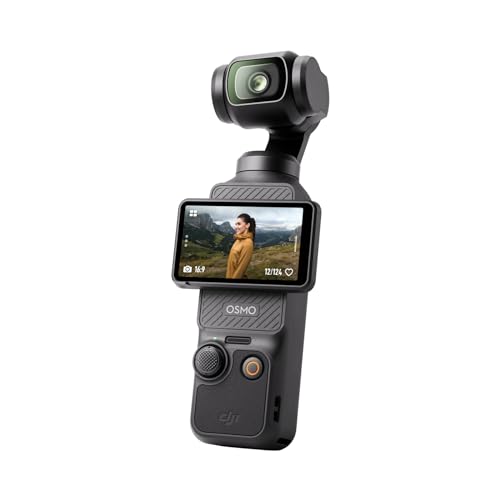
DJI Osmo Pocket 3 — Best everyday vlogging partner
Hold the Pocket 3 toward your face on a crowded street and something quietly revolutionary happens: the footage does not shake, your face stays centred, and nobody around you registers a production taking place. The gimbal irons out the walk; the tracking keeps the presenter framed while their attention is spent on their sentences; the rotating screen flips the whole diary vertical for the platforms that want it, without a menu or a mount. For the vlogger whose material is movement — markets, commutes, hikes, the school run retold — no other device in this list removes so much friction per gram.
Its working day is measured in fragments, which is how diaries actually film. Out of the pocket for the thought on the bridge, away again for the bus ride, out for the unboxing, away for lunch, out for the sunset verdict on the day. Battery life across that rhythm, topped up from any USB source, stretches further than its continuous-recording figure suggests. The wireless microphone pairing deserves its reputation: clip the transmitter, and a windy harbour wall stops sounding like a disaster film while the camera end stays pocket-sized.
Accept its fixed lens as a diary’s discipline rather than a defect. It will not zoom across a stadium or blur a background into cinema, and its low-light grace, while respectable, belongs to a smaller sensor than the mirrorless picks below. What it returns is consistency — the daily entry filmed because filming it cost eleven seconds of setup. In a craft where the missed day breaks the chain, consistency is not a feature. It is the whole game, and this is its champion.
- Format: pocket gimbal camera
- Presenter tools: face tracking, rotating screen
- Audio: wireless microphone pairing, tidy wind manners
- Carry: lives in a jacket, ready in seconds
- Rhythm: fragments all day, charged from anything
Strengths
- Walking-and-talking footage without a rig
- Films daily because starting costs nothing
- Strangers barely notice it working
Trade-offs
- Fixed lens, fixed viewpoint
- Evening footage trails mirrorless bodies
- Not the tool for a lit, staged production
Travel diaries are its masterpiece: one device crossing a continent in a coat, filming the night train, the hostel kitchen interview, the mountain reveal, with the same calm signature. Viewers binge such series for the person’s company; the Pocket’s contribution is to never once remind them a camera was involved.
New parents have quietly adopted it for the family diary nobody else sees — the pram walk narrated, the first-steps corridor tracked at floor height — because it asks for one hand and no ceremony during the exact months when both are scarce. Private vlogging is still vlogging, and its technical commandments are identical.
Best for: moving, travelling, daily-diary vloggers filming solo. Not suited for: staged studio pieces or lens-led cinematography

Sony ZV-1F — Simplest start
The ZV-1F was designed by asking a heretical question: what if a vlogging camera removed decisions instead of adding them? Its lens is fixed and wide — wide enough that a face at arm’s length shares the frame with the place behind it, which is the vlog’s native composition. Its screen flips fully toward the presenter. Its headline controls are a background-blur button for instant polish and a product mode that focuses on whatever is held toward the lens. A beginner can film a competent first entry within an hour of the box opening, and that hour includes making tea.
That simplicity is a publishing strategy. Every menu unexplored is a morning saved; every lens unchosen is a doubt that never postponed an upload. The camera’s footage is bright, friendly and stabilised electronically for the walking pieces, its microphones are among the most considerate built into any compact — a furry windscreen in the box acknowledges where vlogs actually happen — and its size invites the handbag, the glovebox and the coat, the places diaries are filmed from.
Growth is where the bill arrives, gently. The fixed lens fixes the look; the electronic stabilisation crops and prefers a steady hand; low light asks more of it than of its mirrorless cousins. Vloggers who catch the cinematography bug will outgrow it, and should sell it fondly to the next beginner rather than resent it. As the first camera of a publishing habit — the habit being the asset, the camera merely its current instrument — it has the purest design brief in this entire list.
- Format: fixed-lens creator compact
- Lens: wide, composed for arm’s-length faces
- Presenter tools: blur button, product focus mode
- Audio: directional built-ins with wind protection included
- Learning curve: an afternoon, generously counted
Strengths
- Almost impossible to set up wrongly
- The vlog composition is built into the lens
- Small enough to be present for the story
Trade-offs
- No lens changes when ambition grows
- Walking stabilisation prefers gentle pace
- Dim interiors test its smaller sensor
Student vloggers are its natural first owners: a term documented from a halls-of-residence desk, the camera propped on textbooks, the blur button supplying production value the budget could not. When such a diary finds its audience, the upgrade conversation happens with evidence — a year’s uploads proving the habit is real — which is the healthiest way any camera purchase can be justified.
Reluctant on-camera presenters benefit from its smallness too. A compact that resembles a holiday camera lowers the performance pressure that a rig creates; people talk to it the way they talk to a friend holding a phone, and diaries are built from exactly that register of honesty.
Best for: first-time vloggers wanting zero friction. Not suited for: growing productions or low-light diaries

Canon PowerShot G7 X Mark III — Classic pocket compact
Before creator cameras had their own product lines, this Canon was the vlogger’s compact — the camera a generation of diarists carried, flipped and trusted — and its formula has aged gracefully. A pocketable body, a zoom lens that runs from a proper wide view to a flattering portrait reach, colour that treats faces kindly without a grading session, and a screen that tilts up into the presenter’s eyeline. It films a day the way a good notebook takes notes: unobtrusively, legibly, in any café on earth.
The zoom is its signature difference from the fixed-lens Sony above. A vlogger can stand in one spot and gather the room, the detail and the face in three framings, which teaches composition faster than any tutorial. Its microphone input welcomes a proper mic for sit-down pieces, its live-streaming manners were ahead of their time, and its stills are strong enough that the blog’s photographs and thumbnails come from the same pocket. Autofocus, while not the face-locking sorcery of the newest Sonys, holds a presenter honestly in ordinary light.
Age shows at the edges a modern buyer should know: no headphone socket for monitoring, stabilisation that prefers a considered walk, and a battery appetite that makes a spare part of the kit rather than an accessory. None of it prevents the camera doing, today, the job it defined. For the vlogger who wants a real zoom, real colour and a body that disappears into a day, the classic remains a connoisseur’s answer rather than a compromise.
- Format: premium compact with zoom lens
- Lens: wide-to-portrait range from one position
- Screen: tilts up for presenter framing
- Audio: microphone input for sit-down pieces
- Stills: strong enough for the blog’s photography
Strengths
- Three framings without moving your feet
- Faces rendered kindly straight from camera
- A proven diary tool with no learning theatre
Trade-offs
- No headphone monitoring on board
- Spare battery is essential luggage
- Focus trails the newest creator bodies
Food vloggers filming market mornings show its range in one outing: the stall wide, the produce close, the tasting face at portrait reach, all from a camera the stallholders read as a tourist’s toy and therefore ignore. Invisibility plus versatility is a documentary combination far older than vlogging, and this little Canon packages it for a coat pocket.
Its second parish is the city break diary, where a zoom quietly replaces the lens bag a mirrorless kit would demand through airport security. Travellers filming light return with varied footage; travellers filming heavy return with a sore shoulder and one lens’s opinion of everywhere.
Best for: pocket vloggers wanting zoom range and kind colour. Not suited for: audio perfectionists or all-day filming without spares

Sony ZV-E10 II — Best growing room
Every diary reaches the entry where its maker thinks: this deserves to look better. The ZV-E10 II is built for that entry. It keeps the creator furniture — turning screen, product focus, tally light, blur control — and adds the door the compacts lock: a lens mount. Suddenly the diary can borrow a fast prime for evening pieces, a wide zoom for property tours, a long lens for the wildlife subplot, while the body stays small enough for the arm’s-length grammar the blog was founded on. It is the vlogging camera as a platform, not a verdict.
Image quality steps up in step. The oversampled picture carries detail that survives cropping a vertical from a horizontal master — the two-platform reality of modern diaries — and the focus system tracks faces, eyes and held-up products with the confidence a solo operator cannot supply manually. Battery endurance, the ancestor model’s famous weakness, has been properly addressed; a day of fragments no longer requires a pocketful of cells, though a spare remains a professional habit rather than an apology.
Stabilisation remains electronic, so walking pieces prefer the gentle, heel-first gait all vloggers eventually learn, and there is still no viewfinder for the traditionalists. Those are the honest taxes on a body this small with a mount this ambitious. For the diarist whose channel is becoming a livelihood — sponsors asking for polish, audiences arriving on televisions — the ZV-E10 II is the least disruptive upgrade imaginable: same habits, same screen, new ceiling.
- Format: APS-C mirrorless, E mount
- Creator tools: product focus, tally, blur control
- Picture: detailed enough for vertical crops
- Power: a full day of fragments per charge
- Growth: lenses from pocket money to professional
Strengths
- The diary can improve one lens at a time
- Focus trusted while presenting alone
- Compact body, grown-up footage
Trade-offs
- Walking footage needs a learned gait
- No viewfinder, by design and by consequence
- Lens spending becomes a new hobby
Craft channels illustrate the arc: a woodworker whose bench diary began on the fixed-lens Sony, whose audience doubled, whose evening build films started asking for light the compact could not gather. The ZV-E10 II with one fast prime answered without changing the channel’s visual accent — same desk, same framing, suddenly cinema in the shadows. Growth that preserves identity is the rarest upgrade kind, and audiences reward it with loyalty.
It also serves the two-camera diary elegantly: locked wide on the room while the Pocket or a phone roams, its footage cutting with Sony’s bigger bodies when a collaborator’s kit joins for special entries. A blog is a small studio pretending not to be one; this body is where the pretence becomes sustainable.
Best for: vloggers upgrading a proven diary. Not suited for: buyers wanting everything fixed and finished in one box

Nikon Z30 — Best sit-down storyteller
Not every video blog walks. A large, loyal tribe films seated: the book reviewer at her desk, the language teacher at the kitchen table, the retired engineer narrating a restoration one bench session at a time. Their camera lives on a small tripod, plugged in, framed once and trusted for months — and for that tribe the Z30’s virtues align like furniture. A turning screen for the seated presenter, clean footage at the sensitivities lamp-lit rooms demand, long relaxed recording manners, and a body whose stills remind everyone that Nikon has made cameras for a century.
The seated format forgives what walking punishes and punishes what walking forgives. Focus must hold a face through an hour of leaning, gesturing and tea-drinking without a single visible hunt, because the audience is close and the takes are long. The Z30 holds it. Audio arrives through a proper microphone input for the desk mic these presenters favour, and USB power turns the camera into an appliance — always ready when a thought is, which for a diary is a theological position as much as a technical one.
Its compromises face outward: no viewfinder, a stabilisation story that assumes the tripod it will live on, and a lens shelf smaller than Sony’s though entirely sufficient for desk distances. Handheld diarists should look up this list toward the gimbal. For the seated storyteller — the blog as a fireside, published weekly for years — the Z30 offers something rarer than features: an absence of weekly friction, the setup that disappears until only the telling remains.
- Format: APS-C mirrorless, Z mount
- Home position: tripod, desk, plugged in
- Screen: turns to the seated presenter
- Audio: microphone input for desk setups
- Temperament: calm, long-form, appliance-like
Strengths
- Hour-long pieces without focus drama
- Always-ready desk installation
- Footage flatters lamp-lit interiors
Trade-offs
- Walking pieces are not its ministry
- Lens choice trails the Sony system
- No viewfinder for outdoor stills days
Consider the weekly history essay filmed at a study desk, books colour-coded behind, the same framing for two hundred episodes. That consistency becomes the channel’s brand — subscribers read the unchanging frame as reliability — and it is built from a camera that never needed re-rigging, re-framing or forgiving. The Z30 is the patron body of such cathedrals of routine.
Language teachers add the practical footnote: the camera doubles as a superb streaming and lesson body, so the same installation serves the live class on Tuesday and the recorded diary on Friday. Equipment that holds two jobs in a small flat earns its footprint twice.
Best for: seated, desk-based video blogs and lessons. Not suited for: walking diaries or handheld travel pieces

Canon EOS R50 — Best production step-up
There is a recognisable season in a successful blog’s life when a second person appears behind the camera, a light gets its own stand, and the diary starts calling itself a show. The R50 is the body for that season. A proper mirrorless camera with Canon’s flattering colour, confident eye focus and a lens mount with a future, it films the presenter the way the compacts do — turning screen, friendly automation — while opening the door to directed pieces: interviews on the sofa, a co-host at the table, a short film smuggled into the diary’s Friday slot.
The step up is felt most in the evenings. Where compacts begin to smear and apologise, the R50’s larger sensor keeps a lamp-lit room handsome, and its focus holds a face moving between kitchen stations during a cook-along without the hunting that breaks a recipe’s spell. Canon’s colour does quiet diplomacy for skin under household bulbs, and the body’s stills performance covers the blog’s photography — the thumbnail session, the newsletter portrait — without a second camera auditioning for the job.
Size is the honest price: with a lens, this is a bag camera, not a pocket one, and the arm’s-length walk-and-talk belongs to lighter picks above. Its video endurance for very long single takes deserves the usual test before a marathon recording day. But as the instrument of a blog becoming a production — retaining the diary’s intimacy while gaining a crew’s options — the R50 is the natural graduation, bought once and grown into for years.
- Format: APS-C mirrorless, RF mount
- Colour: Canon’s kindness to faces under home light
- Focus: eyes held through movement and guests
- Production doors: interviews, co-hosts, directed pieces
- Stills: the blog’s photography from the same body
Strengths
- Evening interiors stay handsome
- Guests and movement handled confidently
- A system the show can grow inside
Trade-offs
- Bag-sized, not pocket-sized
- Marathon takes deserve a pre-test
- RF lenses add production-level costs
A couples’ renovation diary makes the case in one series: the compact years documented the purchase and the plans; the R50 years film the build — two presenters, evening sessions under work lights, reveal episodes that play on the family television like a broadcast. The audience grew with the production, and the camera that enabled the growth never had to announce itself in a single frame.
Solo diarists buy it for a different promise: headroom. Not every entry needs it, but the entries that define a channel — the announcement, the milestone, the episode a newcomer finds first — deserve the best face the blog can present. Headroom cameras are bought for the important days, and judged, correctly, on how those days look forever.
Best for: blogs graduating into produced shows. Not suited for: pocket filming or pure walk-and-talk diaries
How Do These Six Vlogging Companions Compare?
| Camera | Carry style | Signature gift | Diary type |
|---|---|---|---|
| DJI Osmo Pocket 3 | Jacket pocket | Gimbal calm | Daily movement |
| Sony ZV-1F | Coat pocket | Zero decisions | First diary |
| Canon PowerShot G7 X Mark III | Coat pocket | Zoom range | Travel and food |
| Sony ZV-E10 II | Small bag | Lens growth | Rising channel |
| Nikon Z30 | Desk resident | Long calm takes | Seated storytelling |
| Canon EOS R50 | Camera bag | Production headroom | Blog becoming a show |
Read the carry column first — it predicts usage better than any specification. A diary’s camera must live where the diary happens: in the pocket for the moving life, on the desk for the seated one, in the bag for the produced one. Mismatched carry is why capable cameras gather dust while inferior ones gather audiences.
How Should a Solo Creator Set Up a Room for a Talking-Head Entry?
Face the light, then face the camera, in that order. A window to the front-side of the presenter flatters more reliably than any filter; the camera sits at eye level on whatever stack of books achieves honesty; the background earns one minute of tidying and one object of character — a plant, a shelf, the instrument of the channel’s trade. Distance from the wall behind buys depth; a microphone near the mouth buys clarity; a test clip watched on the phone the audience will use buys the truth about all three.
Then freeze the arrangement. The seated blog’s secret asset is repeatability — the same frame greeting subscribers like a familiar room — so mark the tripod’s feet, note the lamp’s position, and let setup shrink to switching on. Creators who can be filming ninety seconds after an idea arrives publish the ideas that creators with a twenty-minute rig quietly lose. In the diary economy, setup speed is a creative feature, and every pick above was graded on it.
What Does a Sustainable Publishing Rhythm Ask of a Camera?
Forgiveness, mostly. A weekly diary survives bad hair, dull Tuesdays and one flat battery if the camera makes restarting trivial: charged from USB on the desk, files that transfer without a card-reader hunt, a screen that shows the truth before the take rather than after the upload. It also asks for storage discipline the camera cannot supply — a folder per week, a backup that happens the same evening — because the only unforgivable vlogging accident is losing the entry that cannot be lived again.
Rhythm also asks the creator to forgive the camera its ceiling. A diary filmed consistently on a compact builds a library whose value compounds; a diary paused for a season while its owner saves for a flagship builds nothing. Buy the body the current rhythm can afford, publish inside its limits with pride, and let the audience’s growth — measured, not imagined — schedule the upgrade. Every pick in this list has carried real channels; none has ever been the reason one failed to start.
Which Habits Make a Video Blog Look Amateur Within Ten Seconds?
The camera below eye level, filming up at a ceiling and a chin. The window behind the presenter, turning a face into an eclipse. The built-in microphone across a tiled kitchen, reporting the room’s echo as the main event. The walk filmed at a jog’s bounce. Audiences diagnose all four instantly and forgive them only in proportion to the presenter’s charm, which is a budget no creator should spend on fixable geometry.
The fifth habit is silence about sound: music ducking nowhere, wind swallowing sentences, a microphone bought and then left in its pouch because the built-in seemed fine on the camera’s tiny speaker. Review every entry once on headphones before publishing. Ten seconds of prevention, applied weekly, separates the diaries that feel professional from the ones that merely own professional equipment — a distinction this entire guide exists to teach.
How Do You Film a Walking Piece Without Making Viewers Seasick?
Slow down first; most vlogging nausea is pace wearing a technical disguise. Walk heel-to-toe at three-quarter speed, bend the knees into the body’s natural suspension, and hold the camera close to the chest rather than at the end of a proudly extended arm. Gimbal owners get mechanical forgiveness; compact owners choose smoother ground, shorter walking segments and cutaways that let the audience’s stomach reset — the detail shot, the view, the map consulted at a standstill.
Speak in shorter sentences while moving, and let the environment carry some of the talking: the market’s noise under a sentence about the market is atmosphere, not failure. End the walk before the thought ends, arriving at the doorway or the viewpoint for the conclusion delivered standing still, framed well, at eye level. Structure is stabilisation the audience can feel, and it costs nothing but the decision to plan the last ten seconds of every walking piece.
How Do You Keep a Diary Honest When the Camera Becomes Familiar?
A strange thing happens around the fiftieth entry: the presenter develops a camera self, a brighter tenant who performs the day’s highlights and quietly evicts its difficulties. Audiences smell the eviction before the creator does — the comments turn polite, the watch time thins — and the diaries that survive their first year are the ones that notice and correct. The correction is rarely technical. It is the entry filmed on the bad day, the failure left in with its lesson attached, the opinion revised in public. Equipment serves that honesty best by disappearing: a camera so familiar that the person in front of it forgets to be a presenter and resumes being a person.
Practical habits protect the same virtue. Film some entries with no intention of publishing, so the diary keeps a private rehearsal room where experiments cannot embarrass anyone. Keep one regular segment ruthlessly unproduced — the walk, the kettle, the desk at dawn — as a control sample of real life against which the polished entries can be measured. And review a month of entries in one sitting each season, watching for the drift toward performance the way sailors watch a compass: small corrections, made early, by someone who knows the destination is a true record rather than a flattering one.
The cameras in this guide were chosen partly for this long game. A device that stays pleasant at entry two hundred — light in the hand, quick to start, kind to an unmade-up face at 7 a.m. — defends honesty better than a rig whose ceremony encourages its owner to stage-manage the day. In the end a video blog is a promise that a life, not a production, is on the other side of the screen. The best equipment keeps that promise cheap to honour.
What Should a Vlogger Do on the Days When Nothing Happens?
Film the nothing, briefly and well. The queue, the rain, the rearranged shelf, the thought that arrived while washing up — diaries are built from the connective tissue between events, and audiences bond with a creator over the ordinary far more than over the spectacular, because the ordinary is where recognition lives. A camera that can be deployed in eleven seconds turns a nothing-day into a two-minute entry with a beginning, a small middle and a verdict, and the publishing chain survives the week intact.
Keep a private list of evergreen entries for the emptiest days: the tour of the bookshelf with one story per shelf, the recipe that never fails, the walk taken in every season, the object collection explained one piece at a time. These are not filler; filmed with the diary’s usual care, they become the entries new subscribers binge first, because they explain who this person is when nothing is happening to them. The equipment lesson hides inside the editorial one — a small, ready camera makes evergreen entries cheap to produce, so the list gets used instead of admired.
And permit the occasional honest silence. A diary that skips a day and says why, in the next entry, teaches its audience that the rhythm serves the life rather than the reverse — the exact trust on which long-running video blogs are built. Cameras wait patiently in pockets and on desks; it is one of their kindest properties, and the creators who last are the ones who learn to let them.
How Should a Video Blog Handle Guests, Family and Strangers on Camera?
With consent treated as a filming technique rather than a legal footnote. Ask before the record light, accept a no without a flicker of disappointment, and let regulars — partners, parents, the friend who becomes a co-star by accident — set the terms of their own appearances. A diary’s warmth depends on the people in it feeling like participants rather than material, and audiences can tell the difference in a single frame: the relaxed guest jokes; the conscripted one performs politeness. Every camera in this guide is small enough to lower the temperature of being filmed, which is an ethical feature as much as a practical one.
Children deserve the strictest version of the rule, applied by the adults who love them: film the family diary for the family first, publish with the child’s future reader in mind, and let an older child’s veto arrive with the force of law. Many diarists keep two archives — the public blog and the private cut — and the cameras here serve both without distinction, because a pocket device does not care which shelf its footage lands on. The discipline is editorial, and it is the making of the diaries that families remain proud of in a decade.
Strangers in public places call for the older documentary courtesies: film the scene rather than the face where the story allows, answer questions about the camera cheerfully, delete on request without debating the law of any particular pavement. A vlogger’s reputation travels ahead of them in a neighbourhood, a market, a school gate. The creators who are welcomed back with their little cameras gather better diaries than the ones who win arguments about their rights, and it is not close.
How Do You Film a Whole Day as One Coherent Entry?
Give the day a question in the morning and let the entries answer it by night. The question can be small — will the garden survive the heat, can the flat be rearranged before the guests, what does the town look like at the hour nobody films — but it turns fragments into a story with a spine, and it tells the vlogger, at every crossroads of the day, whether the camera should come out. Open the entry facing the lens with the question spoken plainly; a diary audience forgives any production value except not knowing why they are watching.
Gather connective tissue as deliberately as highlights. The walk between places, the kettle between tasks, the view from the window that explains the weather the day is arguing with — these are the shots an editor reaches for when two good scenes refuse to touch. The pocketable picks in this guide exist for exactly this gathering: a gimbal for the walk, a compact for the café table, a desk body waiting at home for the verdict. Shoot the joins while they are happening, because they cannot be manufactured in the evening.
Close the day on camera, briefly, wherever the light last finds you. A diary’s endings teach its audience how to feel about what they watched, and a presenter who delivers the verdict — the question answered, the plan survived or gloriously not — converts a sequence of clips into an episode with a shape. Then charge the camera, copy the cards, and let the day go. The rhythm of a long-running blog is mostly this: question, tissue, verdict, sleep, repeated until the archive becomes a life told back to its owner in order.
How Should a Vlogger Pack for a Trip Without Packing a Studio?
One camera that films everything adequately beats three that film specialties brilliantly, because travel diaries die at the baggage carousel of the mind — the moment a creator decides the good kit is too much trouble for a Tuesday in a strange city. Choose the body by the trip’s dominant grammar: the gimbal for walking cities, the compact zoom for family variety, the little mirrorless when evenings and interiors will carry the story. Add its charger, its spare power, one microphone answer for wind, and a pouch that lives in the day bag rather than the suitcase.
Let the destination supply the rest of the production design. Cafés provide lit interiors and ambient sound; markets provide colour and extras; trains provide the moving portraits no studio can cast. A travelling vlogger’s skill is recognising the set that already exists and placing a small camera inside it gracefully, which is why this guide’s picks are all, by rig standards, nearly invisible. The footage returns varied because the world varied, not because the bag did.
Protect the archive like a passport. Cards copied to a second device each night, the camera slept beside the bed rather than in a rental car’s boot, one cheerful test clip each morning to confirm the kit survived the journey. Trips compress a year of diary lessons into a fortnight, and the creators who return with both footage and equipment intact are the ones who treated logistics as part of the filming rather than its enemy.
How Do You Grow a Diary’s Picture Without Losing Its Voice?
Change one visible thing per season and let the audience acclimatise in public. A new camera arrives as an event the diary itself narrates — the unboxing, the first walk, the honest comparison with the old companion — so the upgrade becomes content rather than a silent rupture in the archive’s look. Keep the framing grammar constant through the change: the same desk angle, the same walk’s opening shot, the same closing verdict. Continuity of ritual carries viewers across a change of instrument the way a familiar theme carries them across a change of key.
Resist the simultaneous revolution — new camera, new room, new format, new schedule — which reads to subscribers as a different channel wearing a beloved name. The bodies in this guide were sequenced as a ladder partly for this reason: pocket to compact, compact to creator mirrorless, each step preserving the previous step’s habits while raising its ceiling. A diary that climbs the ladder slowly keeps its early audience, who feel they grew with it, and early audiences are the ballast no later success can replace.
Let the older camera retire with honours into the second angle, the partner’s hands, the desk’s permanent wide shot. Equipment with a past life in the diary carries a sentiment no new purchase can imitate, and viewers who watched a hundred entries through its lens greet its cameo like a returning character. Growth, in a video blog, is a story the audience is inside — the cameras merely take turns telling it.
What Does a Vlogger Owe the People Who Watch Every Entry?
Regularity first, because a diary’s audience organises small parts of their own routine around its appearances — the commute watch, the Sunday catch-up — and unreliability is felt as a small broken appointment. Honesty second, in the form this guide has already described: the bad day filmed, the opinion revised, the sponsored thing labelled in plain language at the moment it appears. A video blog runs on a currency of trust that platforms cannot mint, and every camera choice in this list was weighed for how cheaply it lets a creator keep those two promises.
Attention completes the debt. Answer the comments that took effort, film the follow-up a viewer asked for, remember the regulars’ names and their running jokes with the diary. None of that is camera work, yet all of it decides whether the camera work matters. The smallest bodies in this guide serve it indirectly and genuinely: a creator whose equipment costs eleven seconds to deploy has hours left over for the audience, and audiences can feel where the hours went.
Finally, a vlogger owes their viewers an ending when the ending comes — a final entry, a handover, a kept archive — rather than a silence that leaves a community refreshing an abandoned page. Diaries are relationships conducted in public, and they deserve the courtesies of one. Until that day, the compact on the desk and the gimbal in the pocket stand ready, which is all any audience has ever asked of the equipment behind a person they trust.
How Do You Restart a Diary After a Long Silence?
With one short entry that names the silence and forgives it, filmed on whatever camera is charged. Returning audiences do not need an apology essay; they need the familiar face, the familiar framing, and a sentence of truth about where the diary went. The equipment moral is the one this guide has repeated since its first page: the camera that restarts a blog is the one that asks nothing — no rig, no ceremony, no new purchase to mark the occasion — which is why the smallest picks here have carried more comebacks than any flagship.
Rebuild the rhythm at half speed for a fortnight: shorter entries, kinder subjects, the evergreen list raided without shame. A diary’s momentum is a habit wearing a schedule’s clothes, and habits return the way fitness does, through sessions too small to dread. By the third entry the old grammar is back in the hands, the comments have remembered their jokes, and the silence has become what it should always have been in a long-running diary — not a failure, just one of the seasons the archive honestly contains.
Keep the returning camera the same one that left, if it still works. Continuity of look tells the audience that the diary paused rather than ended and restarted as a stranger. Upgrades can arrive later, narrated as events, in the diary’s own good time.
Frequently Asked Questions
What is the single best camera for starting a video blog?
For movement, the DJI Osmo Pocket 3; for a seated or mixed diary, the Sony ZV-1F. Both remove setup friction, which is what actually kills new blogs — not image quality.
Do I need a separate microphone straight away?
Film three entries on the built-ins first, in your real rooms. If echo or wind is stealing sentences, a wireless or compact shotgun microphone is the highest-value purchase in vlogging.
Should a vlog be filmed vertically or horizontally?
Match the platform the diary calls home, and prefer cameras — several here — that make switching painless. Filming the master horizontally and cropping is the flexible compromise.
How long can these cameras record one talking piece?
Desk-resident picks like the Nikon Z30 handle long pieces calmly on USB power. Pocket devices suit fragments. Test your exact setup before an important long recording.
Is a flip screen really essential?
For self-filming, effectively yes. Framing, focus and confidence all depend on seeing yourself; every pick here provides that view in some form.
When should a vlogger upgrade from a compact?
When a named limitation keeps appearing in published work — evening smear, focus hunts, a lens the diary keeps wanting. The ZV-E10 II and R50 above are the two natural graduation steps.
Final Recommendation
Match the camera to the diary’s body, not its ambitions. Moving lives belong to the DJI Osmo Pocket 3; first diaries to the Sony ZV-1F; travellers who zoom to the Canon G7 X Mark III; rising channels to the Sony ZV-E10 II; seated storytellers to the Nikon Z30; and blogs becoming shows to the Canon EOS R50. Any of them, used weekly, will build a body of work that a finer camera used monthly cannot match.
And if the wider world of video calls later — a platform channel, a documentary, a production career — the general video guide in this cluster is the reference those specialised paths grow from. The diary comes first. It always did; the diary is where filmmakers are made.
Related Guides
Companion reading for diarists ready to widen the craft: the reference shelf of general video camera choices for every purpose, the platform-focused notes on building a channel around a camera, and the beginner path through learning to film video from zero.


