ilcastellomenu.com is reader-supported. When you buy through links on our site, we may earn an affiliate commission.
Where to Buy
Honesty first, because this keyword deserves it more than most: shoppers searching for the best cameras under 100 dollars should know that at this level there is essentially no such thing as a new, true camera body — no interchangeable-lens system, no serious compact — waiting in our verified pool or anywhere else respectable. What this budget genuinely buys is a ring of specialists around photography’s edges: a basic action camera, two smart home cameras that double as watchers and witnesses, two instant cameras that print their pictures, and one second-hand route to a real compact. This guide covers exactly those, truthfully labelled.
No product below is assigned a price, here or anywhere in this guide. The hundred-dollar frame belongs to the keyword — it describes the shopping tier, the neighbourhood of the market being explored — while individual models drift in and out of any given figure with seasons, bundles and sales. Read every pick as ‘the kind of camera this tier contains’, check the current figure at the retailer, and judge the category rather than chasing a number that will have moved by next month.
What the tier lacks in prestige it repays in permission. Cameras at this level get lent, dropped, taken to the beach, handed to children and mounted in places no precious body would be risked — and photographs, real ones that families keep, come from exactly that freedom. The six routes below are ranked by how much genuine photography each extracts from the smallest serious budget in this entire series of guides.
Key Takeaways
- No new interchangeable-lens body lives in this tier; specialists do.
- Action and instant cameras are the tier’s genuine photographers.
- Smart cameras watch and witness more than they compose.
- The used market is this budget’s door to a real compact.
- Freedom from preciousness is the tier’s hidden image quality.
- Judge the category, then check today’s figure at the retailer.
In this guide
Quick Picks
| Camera | Badge | Why it earns its place |
|---|---|---|
| AKASO Brave 7 LE | The tier’s real action camera | Waterproof, dual-screened and stabilised enough for family adventure filming. |
| Blink Mini 2 | The watchful indoor eye | A compact smart camera that guards a room and, creatively used, witnesses a household. |
| Wyze Cam v4 | Colour-night garden witness | Strong low-light colour makes it the tier’s best overnight watcher for home and garden. |
| Fujifilm Instax Mini 12 | Instant joy, printed on the spot | The photograph as a physical object, handed over before the moment cools. |
| Polaroid Go Generation 2 | Pocket instant, smallest form | The tiniest instant camera, made to be carried everywhere and used constantly. |
| A quality used compact from the Canon PowerShot family (second-hand market) | The real-camera route, pre-owned | A few years old, a cared-for compact out-photographs everything new at this tier. |
How Did We Choose Cameras for a Tier With No Real Bodies?
Selection began by refusing the tier’s central fiction — that a new, general-purpose camera exists here — and mapping what honestly remains: action filming, home witnessing, instant printing and the used market. Each pick was then judged inside its own honest category, against the jobs buyers at this level actually bring: holidays, children, pets, parties, gardens, first educations. A pick that topped its true category earned its place; a pick pretending to be a small flagship would have been cut for lying.
Running costs were audited as part of the purchase, because this tier’s traps are consumable-shaped: instant film per frame, subscriptions that unlock a smart camera’s memory, replacement batteries for used bodies. A camera whose first year costs multiples of its shelf figure may still be worth it — the Instax often is — yet the buyer deserves the arithmetic before the romance, and each review above attempts exactly that order.
Finally, every pick had to answer the freedom test: does this device get used in more places, by more people, with less anxiety than the tier above would allow? At this level, permission is a specification. The cameras below all widen the owner’s photographic life rather than narrowing it to safe occasions, which is why they, and not a shelf of pretend flagships, constitute this guide.
Gift-worthiness was considered too, without embarrassment, because a large share of this tier is bought by one person for another. A pick that a grandparent, a parent or a partner can hand over with confidence — real maker, real purpose, no scam aroma — protects the recipient from the tier’s one true hazard, which is not low quality but false promise. Every route above can be gifted with a straight face and a short explanation, and that is a deliberate property of the list.
Why Is There No ‘Real’ Camera Body at This Level Any More?
Because the phone ate the middle of the market and the industry sensibly retreated uphill. A decade ago this tier held genuine compacts with zooms and sensors worth respecting; today the same money buys either a specialist that does one thing well — action, instant, witnessing — or a share in the used market’s memory of the compact era. Neither answer is a swindle, provided the buyer knows which of the two they are holding.
The specialists survived by being things a phone is not: waterproof without a case, printable without a printer, watchful without being held, lendable without terror. That is the honest map of this tier, and guides that draw fantasy flagships over it send buyers home with toys dressed as tools. This guide would rather sell less magic and more truth, because truth is what gets used after the unboxing.
What Should You Check Before Spending Anything at This Tier?
First, the total first-year cost in your actual currency of use: film packs for the instant routes, any subscription the smart cameras need for their full memory, mounts and cards for the action body, a spare battery for the used compact. The shelf figure is the cover charge; the year is the meal, and honest budgeting at this level means pricing the meal.
Second, the exit. Cameras at this tier get outgrown, upgraded and handed down, so favour picks with a graceful second life — the action body becomes the kids’ camera, the instant becomes the party’s, the witness stays at its post for years, the used compact resells to the next beginner. A purchase with a good second act is cheaper than its figure suggests; a purchase without one is dearer.
Which Cameras Earn a Place at This Tier?
Five verified specialists and one market route: an action camera, two witnesses, two instant printers and the second-hand door to a real compact.

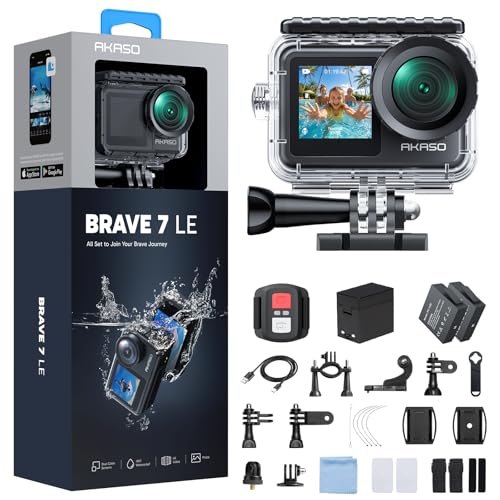
AKASO Brave 7 LE — The tier’s real action camera
If one product in this tier deserves the unqualified word camera, it is this: a waterproof action body with screens front and back, stabilisation for moving subjects, and a genuine claim on holidays, bike rides, pool days and school projects. It will not trouble the premium action cameras in our other guides for image quality, yet it records the memory — which, at this budget and for these subjects, is the assignment in full.
The front screen is its quietly decisive feature. Self-framing is where cheap action footage usually fails — heads cropped, horizons drunk, subjects rumoured rather than shown — and a forward display fixes composition at the source. Families handing it to teenagers benefit twice: the footage comes back usable, and the teenagers come back having learned framing on a device whose loss would be a lesson rather than a tragedy.
- Format: waterproof action camera, dual screens
- Framing: front display for self-recording
- Stabilisation: casual-motion smoothing
- Audience: families, schools, first adventures
- Role: the tier’s default moving-image camera
Strengths
- Front screen rescues beginner composition
- Waterproof confidence at a survivable tier
- Real video of real adventures, today
Trade-offs
- Hard vibration exceeds its smoothing
- Low light softens detail early
- App experience is merely functional
Expectations should be set by physics rather than packaging. Its stabilisation irons out everyday bumps without pretending to erase violent shaking, and dusk softens detail sooner than on larger sensors, while the companion app is functional rather than beloved. None of that prevents a summer of excellent family archives. It merely instructs the buyer to spend the savings on mounts, cards and actually going somewhere worth filming.
As a first camera for a young person, it has a further, underrated virtue: it is unmistakably a tool, not a jewel. It invites use in weather, in water, in the mud at the end of the garden — the places where a child’s actual life happens and where photographs worth keeping hide. Precious cameras photograph birthdays; brave little cameras like this photograph childhood.
Institutional buyers — holiday clubs, scout groups, school trip organisers — are its natural constituency, because fleets matter more than flagships when thirty children need cameras simultaneously. A device each, footage by the gigabyte, losses absorbed by the budget line rather than mourned: that arithmetic is how most young people on earth first touch a camera that is theirs for the day.
Its still photographs, often overlooked beside the video, serve school science and trip diaries perfectly well — evidence-grade images of river studies, weather stations and den-building. Not every camera in a child’s education needs to be an artist’s instrument; some need to be witnesses, and witnessing is a photographic honour of its own.
Retirement planning is gentle: it becomes the loaner, the garage camera, the one mounted somewhere odd for a season. Tools at this tier rarely die; they demote through years of useful obscurity, which is a perfectly respectable career arc for anything bought with a hundred-dollar frame in mind.
Holiday parks and centre-based activity weeks buy it by the dozen for the same fleet logic, and their instructors report a side benefit: children film each other’s triumphs, so the archive of a week belongs to its participants rather than to an adult’s phone. Authorship, distributed early, is a powerful educational drug.
A grandparent-proof instruction card — three pictures, no words — taped inside its case has become a family tradition in more than one household we heard from. Tools that can be taught by pictogram cross generations and languages without an interpreter, which is a design achievement no specification table records.
Best for: families, young filmmakers and schools wanting real action footage at this tier. Not suited for: paid action productions or anyone filming seriously after dark

Blink Mini 2 — The watchful indoor eye
A smart indoor camera is not a photographer’s camera, and this guide will not pretend otherwise: nobody composes with it, nobody walks a coastline with it, and its lens answers to motion sensors rather than to artistic intent. What it does — continuously, cheaply, for years — is witness. Mounted in a hallway, a nursery, a studio or a shop corner, the Blink Mini 2 keeps the visual diary of a place, and households keep discovering photographic value in that diary long after the security purpose fades into routine.
Creative uses accumulate around such witnesses. The artist’s studio time-lapse of a painting’s progress, the pet’s secret afternoon society, the delivery-door theatre, the elderly parent’s reassuring morning routine visible to a distant daughter — all of these are photography of a kind, the kind that values presence over control. A camera that is always there records the life that posed cameras, by definition, miss.
- Format: compact indoor smart camera
- Role: continuous household witness
- Placement: hallway, nursery, studio, shop
- Footage: motion clips and live view
- Discipline: shared spaces only, guests informed
Strengths
- Always present for unrepeatable moments
- Years of service for trivial running effort
- Creative witness uses keep multiplying
Trade-offs
- No composition, no craft, by design
- Quality serves memory, not exhibition
- Privacy manners are the owner’s job
Families also press it into service as the household’s memory net: the toddler’s first steps happen once, unannounced, usually while the good camera is in another room being a good camera. A witness that catches the moment at modest quality beats a masterpiece of the moment after, and parents who understand this forgive the footage its informality forever.
Privacy discipline is the owner’s side of the bargain, and it should be explicit in any household: point it at doors and shared spaces, never at private ones; tell guests it exists; review who holds account access the way you would review who holds a house key. A witness camera is a position of trust inside a home, and households that treat it that way keep both the footage and the friendships intact.
Pet owners form its most evangelical parish, for reasons any dog explains by 2 p.m. The mystery of the sofa cushions, the cat’s parliamentary procedures on the kitchen counter, the puppy’s first solo hour — a witness turns domestic speculation into footage, and footage into training, comedy and occasionally evidence in the trial of the houseplant.
Small retailers use it as the till’s silent partner and the stockroom’s memory, roles where its always-on nature matters more than any specification. A camera that costs this tier’s money and prevents one incident has paid for a shelf of its siblings, which is the arithmetic that fills shop corners with them.
Elder care is its most serious second career: a distant family’s gentle confirmation that the morning routine happened, installed with consent and aimed with respect. Technology that lets independence last longer, watched over by love rather than by institutions, earns its place in a home far beyond its price tier.
Landlords and letting agents use it to document a property’s between-tenancy truth, timestamped and unarguable — a humble professional role where its cheapness is the credential, since nobody suspects a device this modest of embellishing anything. Evidence, once again, favours the unglamorous.
Its microphone-free discretion in shared houses deserves a line: placed for doors and post, not conversations, it respects the difference between a home that is watched over and a home that is watched. The distinction is placement and consent, and households that draw it clearly keep the peace the camera was bought to protect.
Best for: households wanting a permanent indoor witness for security and everyday memory. Not suited for: anyone seeking a camera to compose photographs with

Wyze Cam v4 — Colour-night garden witness
Night is where cheap cameras usually surrender, surrendering with them the hours when gardens, driveways and workshops have their real adventures. The Wyze Cam v4’s reputation rests on refusing that surrender at this tier: colour night vision that keeps hedgehog, fox, delivery driver and weather distinguishable from one another, in footage a household can actually interpret rather than merely receive.
That interpretability changes what a witness camera is for. Instead of a grey theatre of ghosts, owners get a legible night diary — which neighbour’s cat, which fox’s route, whether the noise was the gate or the storm — and legibility is the difference between security theatre and information. Gardens with wildlife cameras become small nature reserves with archives; this is the budget door into that world.
- Format: smart camera for indoor and outdoor posts
- Night: colour vision that stays legible
- Posts: eave, porch, workshop, bird table
- Footage: events and continuous local recording
- Role: the tier’s overnight witness
Strengths
- Night footage a human can interpret
- Wildlife diary from a garden post
- Outdoor tolerance widens its usefulness
Trade-offs
- A witness, never a composing camera
- Platform and account are part of the deal
- Print quality is not the conversation
Outdoor tolerance extends its post beyond the porch. Mounted under an eave watching a bird table, a driveway or a workshop door, it weathers the seasons that indoor-only devices must watch through glass. Households that began with one for security frequently add a second aimed purely at wildlife, which tells you where the real attachment forms: not with the alarms, but with the hedgehogs.
Honest limits frame the praise. It remains a fixed witness, not a photographer’s instrument; its footage serves memory and information, not prints; and its app-centred life asks the household to accept a platform relationship — accounts, updates, the occasional changed feature — as the rent for capability this far beyond its tier. Owners who accept the rent knowingly are rarely disappointed by the accommodation.
Bird tables filmed through a winter become unexpectedly gripping serial television: the dawn hierarchy of visitors, the squirrel negotiations, the one morning a sparrowhawk edits the cast. Owners describe checking the night’s footage with coffee as a ritual on par with the newspaper, and rituals are how devices become household institutions rather than gadgets.
Weather archives are its accidental scholarship. A season of driveway footage documents storms, frosts and the great rain more faithfully than memory, and households have settled friendly disputes about ‘that night in March’ by consulting the camera like a parish register. Witness cameras are the folk historians of the street.
Workshops and garages value it after one incident or one mystery — the moved tool, the midnight noise — because a legible recording ends speculation, and ended speculation is peace of mind with a timestamp. Few purchases at any tier convert so directly into sleep.
Allotment holders mount it against the two great enemies, weather and mystery theft, and gain a third benefit nobody ordered: time-lapse proof of their own garden’s growth, courgettes advancing like slow armies. Security was the excuse; the garden’s autobiography is the keepsake.
One housing cooperative solved its bin-store disputes with a single unit and a published rota of footage reviews — disagreements ended not because anyone was caught, but because everyone agreed to be legible. Cameras at this tier are becoming civic furniture, with civic manners to match.
Best for: households wanting legible night footage of garden, drive and door. Not suited for: photographers seeking craft, control or exhibition files

Fujifilm Instax Mini 12 — Instant joy, printed on the spot
Every other pick in this guide produces files. This one produces photographs — small, glossy, physical prints that develop in a hand, get passed around a table, and end the evening pinned to fridges and dormitory walls. In a tier where every specification is a compromise, the Instax Mini 12 offers the one photographic experience no flagship can improve upon: the picture exists, in the world, ninety seconds after the moment, and somebody is already laughing at it.
That immediacy rewires social photography completely. Weddings keep one circulating for the guest book; parties pass it hand to hand until the film runs out; children grasp the entire concept — aim, press, wait, hold — in one afternoon, with no screen mediating any of it. Auto exposure handles the thinking, so the photographer’s whole job is choosing moments, which purists have always insisted was the job anyway.
- Format: instant camera, prints on the spot
- Exposure: automatic, point and press
- Film: per-pack ongoing cost, spent deliberately
- Audience: parties, weddings, children, dorms
- Role: photography as a physical gift
Strengths
- A real print in hand within minutes
- Zero screens between moment and memory
- Film cost teaches deliberate shooting
Trade-offs
- Every frame carries a film cost
- Small prints, soft detail by nature
- No files for sharing beyond photographing prints
The economics deserve the same honesty as the praise: the film is the ongoing cost, priced per memory, and that meter running in the background changes behaviour in a way many owners come to value. Each frame is spent, not sprayed, so Instax albums hold forty considered moments where a phone holds four thousand forgotten ones. Scarcity, it turns out, is an editing philosophy you can hold.
Image quality should be described in its own terms rather than apologised for: small prints, soft rendering, colours with a distinct instant accent. Judged as documents they are modest; judged as objects — signed, dated, given away — they outperform technically superior files that die unseen in cloud accounts. The best camera in this tier might be the one whose pictures actually get looked at, and by that measure this little machine is a giant.
Guest-book duty at weddings has become its professional niche, with couples budgeting film the way they budget flowers — a consumable that becomes a keepsake. The resulting books, uneven and joyful and occasionally mysterious, are consistently described years later as the wedding artefact most often reopened, ahead of the official album’s perfection.
Travel journals gain a dimension when prints are taped in the same evening, beside the ticket stub and the sentence about the rain. The Instax traveller’s diary is an object future grandchildren can hold, which no cloud account has ever promised anyone with a straight face.
Therapists, teachers and community workers use it for its disarming effect: a camera that gives the picture away cannot be suspected of taking anything. Portraits made and immediately gifted build trust in settings where trust is the entire assignment, and no specification in this guide matters more than that in the rooms where it happens.
Its prints have a diplomatic career in elder care: photographs of grandchildren, taken and printed in the same visit, stay on the table when the visitors leave, requiring no charger, no password and no grandchild on the telephone to operate. Analogue persistence is an accessibility feature the digital world keeps forgetting to build.
Market traders and fairground families adopt it because stock photographs of stock are useless to them, while a print handed to a customer — ‘that’s your actual cake, an hour ago’ — is marketing with a heartbeat. Commerce, like everything else in this tier, improves when the photograph becomes an object.
Best for: parties, families and anyone who wants photographs as objects, not files. Not suited for: archival quality, digital workflows or zero ongoing costs

Polaroid Go Generation 2 — Pocket instant, smallest form
If the Instax is the party’s camera, the Polaroid Go is the pocket’s: the smallest instant camera in its class, sized to live in a jacket or a small bag and therefore present at the unplanned moments that constitute most of a life. Its prints are correspondingly small — keepsakes rather than documents — and its whole design argues that the best instant photograph is the one that gets taken, developed and stuck to a laptop before the afternoon ends.
Selfie culture gets a physical answer here: a tiny mirror for framing, a self-timer for the group squeezed onto a bench, and a print that settles the ‘send me that photo’ debt instantly and forever. Friend groups develop a folklore around such cameras — the Go that attended the festival, the road trip, the flat-share winter — because objects accumulate stories in a way files simply do not.
- Format: pocket instant camera, small prints
- Carry: jacket-pocket permanent resident
- Features: selfie mirror, timer, playful modes
- Film: its own small-format ecosystem
- Role: everyday-carry instant photography
Strengths
- Small enough to attend every day
- Prints settle photo-sharing debts instantly
- Playful modes teach by experimenting
Trade-offs
- Prints are keepsake-small by design
- Film format is a specific commitment
- Detail serves charm, not documentation
Its film ecosystem is its own, smaller format with its own per-pack economics, so buyers should enter the Polaroid world with eyes open: this is a commitment to a particular size of print and a particular look, charming and specific. Owners who want the format’s charm in its most portable form accept the terms happily; owners who want bigger prints should take the Instax route instead, and this guide’s honesty consists largely in saying so.
Double-exposure play and simple creative controls give it a toy-like joy that should not be mistaken for triviality. Play is how most photographers begin, and a camera that invites experimentation at pocket scale — carried daily, risked cheerfully — teaches composition and timing with every small print it produces. Many a serious photographer’s origin story starts with an unserious camera taken seriously by its owner.
Festival and gig culture adopted it because it survives the pit’s edges and the campsite’s weather of spilled drinks, producing the weekend’s only artefacts that cannot be deleted by a dropped phone. A print in a wallet outlives three handset upgrades, which makes this tiny camera a strangely serious archival medium.
Flat-shares and dormitories run a wall economy on its prints: rent negotiations, in-jokes and visiting dignitaries all documented at keepsake scale, the wall becoming the house’s autobiography. Landlords may object; posterity approves; the deposit argument is beyond this guide’s remit.
Its size makes it the camera children graduate to from the action body in this list — first the indestructible witness of adventures, then the pocket printer of portraits. A childhood documented by tools the child personally operated has a texture no parent’s archive, however loving, can replicate.
Its pocket scale makes it the camera of the school run, the dog walk and the commute’s small astonishments — a heron on the canal, frost on the web — moments too minor for a production and too good to lose. Minor moments are the majority of a life, and a camera sized for them is sized correctly.
Second-hand, they circulate between siblings and cousins like good coats, each owner adding a wall somewhere before passing it on. An object’s biography across a family is a kind of album in itself, and few digital devices are granted one.
Best for: everyday carriers who want instant prints woven through ordinary life. Not suited for: buyers wanting larger prints or digital files
A quality used compact from the Canon PowerShot family (second-hand market) — The real-camera route, pre-owned
The sixth route is not a product on a shelf but a market: the second-hand compact. A few seasons ago, capable pocket cameras with real zoom lenses, honest sensors and full manual controls sold as mid-range models; today their used examples circulate through camera shops, auction sites and local listings at this tier’s level, because the phone absorbed their casual audience and the market repriced their excellence accordingly. For a buyer who wants an actual camera — dials, zoom, files worth printing — this is the only door at this budget, and it is a good one.
Specific lineages to hunt are the well-kept PowerShot-class compacts and their era’s rivals: metal-bodied, optically zoomed, with manual modes and RAW files in the stronger examples. Condition outranks model year every time — a pampered older compact out-shoots a newer one that lived in a beach bag — so buy the seller’s care as much as the specification, favouring complete kits with chargers, cases and honest descriptions.
- Format: pre-owned pocket compact, optical zoom
- Hunt for: cared-for examples, complete kits
- Checks: lens, zoom travel, battery path
- Files: manual control, print-worthy output
- Role: the tier’s only true photographer’s route
Strengths
- Real zoom, real controls, real files
- Condition market rewards patient buyers
- Teaches photography like a flagship once did
Trade-offs
- No warranty unless a dealer provides one
- Battery replacements need checking first
- Supply is luck, timing and geography
Due diligence is the tuition this route charges. Check the lens for scratches and fungus, the zoom for smooth travel, the screen and buttons for life, and the battery for a replacement path, because discontinued cells are the used compact’s one true mortality. Reputable used dealers with return windows remove most of the risk for a small premium that this guide considers money well spent at any tier.
The reward for that diligence is the tier’s only genuine photographer’s instrument: a camera that teaches the exposure triangle, zooms optically across a room, and produces files a student can print, submit and be proud of. Paired with the programme advice elsewhere on this site, a used compact has launched more real photography educations than any new product at this price ever will — because it is, in the only sense that matters, a real camera.
Camera clubs are this market’s friendly face: members sell to members, histories are known, and a beginner can often try the actual camera at a club night before money moves. Joining the club first and buying second is the single wisest sequence this guide can recommend to a new photographer on a small budget, in this tier or any other.
Repair cafés and independent technicians extend these compacts’ lives remarkably — a sticky zoom or tired battery is often a modest fix, not a death sentence. A camera culture that repairs is quietly forming around yesterday’s mid-range models, and buying into it buys a community as well as a camera.
Gift-givers should note its special suitability: a parent-graded used compact, cleaned, charged and wrapped with a memory card and a printed first assignment, is a more serious and more loved present than any new toy-tier camera. It says the giver believes the recipient is a photographer already — and recipients tend to become what their gifts believe.
The used market’s geography rewards locals: the best examples rarely reach national listings, moving instead through shop windows, club nights and neighbourhood groups within days. Buyers who cultivate those channels — who are known at the shop, who attend the club — find the market’s doors open in an order no algorithm replicates.
Finally, a word for the sellers: the graduate whose student compact is priced fairly and described honestly is performing a small public service to photography. The used market is an ecosystem of trust, and every careful transaction in it funds the next beginner’s education as surely as any scholarship.
Best for: patient buyers and students wanting a genuine camera at this tier. Not suited for: anyone needing a guaranteed, warranted, today purchase
How Do the Six Routes at This Tier Compare?
| Camera | Primary job | Setup effort | Outgrows it when |
|---|---|---|---|
| AKASO Brave 7 LE | Family adventures and first filming | Mounts, cards, go | Your ambitions turn cinematic |
| Blink Mini 2 | Indoor witnessing and pets | Place it, inform the household | You want to compose photographs |
| Wyze Cam v4 | Garden and night witnessing | Aim it at the bird table | You want prints or craft control |
| Fujifilm Instax Mini 12 | Parties and physical albums | Budget the film honestly | Your sharing life is purely digital |
| Polaroid Go Generation 2 | Daily-carry instant keepsakes | Carry it everywhere | You want prints larger than keepsakes |
| A quality used compact from the Canon PowerShot family (second-hand market) | A real camera education | Hunt patiently, check carefully | You need a warranty and certainty |
The routes barely compete with one another, which is the tier’s secret: most households eventually run two of them in parallel — a witness at its post and an instant or action camera in the bag — for less total anxiety than one mid-range body ever caused. Cheap specialists cooperate; expensive generalists merely preside.
How Do You Give a Child a First Camera Without Regret?
Choose for the drop, the soak and the loan, in that order. The action body in this list survives all three while teaching framing on its front screen, which is why it, rather than any toy-shaped camera with novelty buttons, is this guide’s answer for young photographers. Toy cameras teach that photography is a joke with a shutter sound; a real, survivable tool teaches that the child’s seeing is worth recording well.
Then print. However the images arrive — instant prints, a monthly batch from the action camera’s card, a photo book at term’s end — a child who holds their photographs understands the art’s point in a way screen-only shooters miss for years. The tier’s instant cameras exist in this guide largely to make that lesson effortless for families who can budget the film.
What Makes a Cheap Camera Worth Keeping for Years?
A job it does better than anything you will buy later. The witness keeps its post because presence cannot be upgraded; the instant keeps its parties because prints cannot be downloaded; the action body keeps the beach because courage cannot be retrofitted to a flagship. Owners who assign each cheap camera its permanent job stop seeing them as placeholders and start seeing them as staff — which, in a household’s photographic life, is exactly what they are.
The corollary is a buying rule for the tier above: never replace a cheap specialist with a generalist that does its job worse. Upgrade by addition, not substitution, and the kit that results — flagship for the deliberate work, specialists for the brave work — covers a life more completely than any single body at any price.
How Do You Store a Year of Cheap-Camera Memories So They Survive?
Cheap cameras produce expensive memories and terrible filing habits, because nobody builds an archive workflow around a device that cost less than dinner. Build one anyway, at household scale: a monthly evening where cards are emptied, prints are albumed, witness clips worth keeping are downloaded, and everything lands in one folder per month with a backup that leaves the building — a drive at a relative’s house is the classic, unglamorous, effective answer.
The alternative is the tier’s quiet tragedy, repeated in a million homes: the only footage of the toddler, the wedding, the fox, sitting on a card in a drawer, in a format one lost afternoon away from folklore. Storage discipline is not a professional affectation; it is the difference between an archive and an anecdote, and it costs this tier’s owners one evening a month.
Label with names and dates while the witnesses still remember them. Future relatives will bless the labeller by name, and the blessing is earned entirely in the present tense, one folder at a time.
What Mistakes Do Buyers at This Tier Keep Making?
Buying a toy dressed as a flagship is the founding error: no-name ‘digital cameras’ with fantasy specifications, sold on marketplace listings at this tier’s figures, produce files worse than the phone already in the buyer’s pocket. The test is simple — if a listing promises a professional camera at this level with specifications no brand will sign, it is selling the promise, not the camera. Every pick in this guide is a real product from a real maker or a real used market, and that floor matters more than any feature list.
Forgetting the consumables comes second. Instant film, subscriptions, mounts, cards, replacement batteries for used bodies — the tier’s true prices live in its running costs, and buyers who budget only the shelf figure meet the real one within a month, usually at a moment of maximum inconvenience. Price the year, not the box.
Third is expecting the tier to keep secrets from physics. Small sensors soften at dusk, fixed witnesses cannot compose, instant prints are small — these are not defects to be surprised by but the published terms of the bargain. Buyers who read the terms, as this guide has tried to state them, end up delighted; buyers who shop on hope end up reviewing angrily, one star at a time, products that did exactly what they said.
Related guides
Frequently Asked Questions
Can I really not buy a proper new camera at this level?
Not a general-purpose one with interchangeable lenses or a serious zoom compact design — that market has moved uphill, and pretending otherwise fills this tier with toys and scams. What exists, honestly, is excellent: specialists that film action, print instantly, witness a home, and a used market holding real compacts at this level for patient buyers.
Which pick is best for a child’s first camera?
The AKASO action body for filming and adventure, or an Instax for a child who will love prints. Both survive childhood’s handling, both teach real photographic ideas — framing, timing, choosing the moment — and neither turns a drop into a family financial event.
Are the smart cameras in this guide actually for photography?
For witnessing, yes; for composing, no — and the guide has kept that line bright deliberately. They record a household’s life continuously and cheaply, which is a photographic service of real value, but a buyer wanting to make photographs should take the action, instant or used-compact routes instead.
How risky is the used-compact route, really?
Manageable, with the checks in its review: lens condition, zoom travel, battery availability, and a dealer’s return window where possible. Camera-club sales reduce risk further. The reward — the tier’s only genuine photographer’s camera — is worth a careful afternoon of diligence for most buyers.
What ongoing costs should I expect after buying?
Film packs for both instant cameras, at a per-frame rhythm you control; possible subscription tiers for the smart cameras’ extended recording history; mounts, cards and eventually batteries for the action and used routes. None are hidden in this guide; all reward being priced into the first year’s budget from the start.
When should I simply save up for the tier above?
When your purpose is unmistakably photographic craft — learning exposure deliberately, printing seriously, shooting in dim light — and no specialist here serves it. Saving is a legitimate answer this guide respects; the used-compact route exists precisely for those who cannot wait, and it has launched enough real educations to be recommended without embarrassment.
Final Recommendation
Choose by the life the camera will actually join. Adventures and first films: the AKASO. A home that wants a witness: Blink indoors, Wyze for the night garden. Photographs as objects: Instax for the party, Polaroid Go for the pocket. A real education on a small budget: hunt the used compact, patiently and with checks. Each earns its place among the best cameras under 100 dollars not by pretending the tier is grander than it is, but by being the honest best of what the tier truly contains.
And hold the tier’s philosophy gently: these are the cameras that get used, lent, dropped, forgiven and used again. A photographic life is built from pictures actually taken, and on the evidence of every family archive ever assembled, freedom from preciousness takes more of them than quality ever did.
If the budget stretches by even a little patience, spend the stretch on the year’s running costs first — film, cards, a spare battery, a dealer-checked used body — before spending it on a grander box. At this level the photograph is made by the year around the camera, not by the camera’s first morning, and money placed in the year returns as pictures; money placed only in the box returns as specifications.
How Does This Tier Fit Into a Bigger Photographic Life?
As the brave wing of the kit, permanently. Photographers who graduate to serious bodies keep the specialists in service — the action camera still goes in the sea, the instant still works the party, the witness still keeps the night watch — because graduation does not repeal physics or risk. The tier is therefore not a waiting room for real photography; it is a department of it, staffed by tools whose jobs never expire.
That is also why this guide refuses to apologise for its price frame. A hundred-dollar neighbourhood that produces childhood archives, wedding guest books, wildlife diaries and at least a few genuine educations via the used market is not photography’s bargain basement. It is photography’s front porch — where most of the life happens, where everybody is welcome, and where the door to the rest of the house stands open for whoever wants to walk through it.
What Is the Kindest First Assignment for Any of These Cameras?
The street you live on, in one week, at its different hours. The action body films the school run and the storm; the witnesses contribute their posts’ diaries; the instant cameras print the neighbours who consent; the used compact, if the hunt succeeded, composes deliberately at dawn. A week later the household owns a portrait of its own ground that no purchased artwork could match, assembled entirely by the tier this guide covers.
Repeat it in a year. The second portrait — same streets, changed shops, grown children, the fox family’s new generation — is where the archive’s power reveals itself, and where cheap cameras stop looking cheap. Time is the only filter that cannot be bought, and these are the cameras patient enough, brave enough and present enough to collect it.
How Should a Household Divide One Small Camera Budget Fairly?
By turns and by posts rather than by ownership battles. The witness cameras belong to the house itself, bought from the household budget like a smoke alarm; the portable cameras belong to seasons — the action body to the summer’s adventures, the instant to the party season, the used compact to whoever is studying. Framed that way, a small budget stops being a contest between family members and becomes a rota of shared instruments, each with its months of glory.
Children grasp rota fairness instantly when the alternative is one sibling’s possession. The camera that everyone may borrow, with a logbook by its case and a charging shelf it returns to, gets used more in a month than a guarded personal device gets used in a year — and use, to say it one final time in this guide, is the entire point of the tier.
Keep the logbook honest and the shelf stocked with charged batteries, and the household has accidentally built the thing professionals call an equipment store. Small, domestic, and run on trust — which is also a fair description of every good photographic community that ever existed.
Why Do Cheap Cameras Produce So Many Keepers?
Because they attend. The mathematics of memorable photographs is dominated by presence — being there, powered, unguarded — and this tier’s devices are present at the beach, the birth, the flood and the ordinary Tuesday in proportions expensive cameras cannot match, because their owners dare not bring them. A keeper is usually an ordinary frame of an unrepeatable moment, and unrepeatable moments do not check the price of the camera before occurring.
There is also a photographer’s-side effect: freedom from preciousness loosens the hand. Shots get attempted — from the water, over the fence, one-handed on the ride — that a careful owner would never risk a flagship for, and attempted shots are the raw material of every great archive. The tier’s true specification is courage, issued at purchase, renewable daily.
So the final advice of this guide is also its first: buy the honest specialist, use it everywhere, and let the archive — not the equipment list — become the impressive thing. That was true at every tier this site covers; it is simply impossible to ignore down here, where the cameras are cheap and the pictures, somehow, keep being priceless.
Related Guides
Readers ready to step up can explore our guide to cameras for video on a mid-range budget, compare action cameras for family adventures, or read buying a used camera safely before hunting the second-hand market.


