ilcastellomenu.com is reader-supported. When you buy through links on our site, we may earn an affiliate commission.
Where to Buy
The hunt for the best digital cameras under 100 dollars starts with a confession most shopping pages bury near the bottom: the serious new digital camera, the kind with a decent sensor and a lens worth describing, has essentially vanished from this price shelf. Manufacturers walked away from the bottom of the market years ago because phones ate the casual snapshot, and what remains under a hundred dollars is a strange, mixed neighbourhood of action cameras, security cameras, instant cameras and toys wearing a camera’s name.
Rather than pretend otherwise, this guide maps that neighbourhood honestly. Four picks below are real, verified products that genuinely live near or inside the frame, each labelled with the job it actually performs — filming a trail ride, watching a hallway, printing a party photograph on the spot. Two further picks are prose-only routes, because the most truthful answers at this budget are a carefully bought secondhand compact and an old phone pressed back into service, neither of which can be represented by a single product link.
Judge every candidate by one question: what photograph, or what footage, will exist because this device was bought? A camera-shaped object that produces files nobody keeps is expensive at any figure, while a humble device matched to a real job — a child’s first album, a doorway watched overnight, a kayak trip filmed without fear — can be the best money in this entire guide. The frame is small; the honesty has to be large.
Key Takeaways
- No serious new interchangeable-lens or premium compact camera honestly lives under this ceiling.
- Action and security cameras are the genuine new residents of this shelf — buy them for those jobs.
- Instant cameras turn the budget into printed photographs immediately, with film as the running cost.
- A used compact from a known brand usually out-photographs anything new at this level.
- An old smartphone in the drawer may already be the best camera this budget can offer.
- Memory cards, film and batteries decide the true total, so count them before choosing.
In this guide
Quick Picks
| Camera or route | Badge | Why it earns its place |
|---|---|---|
| AKASO Brave 7 LE | The action route | A weather-sealed action camera that films adventures a phone should never be risked on. |
| Wyze Cam v4 | The watchful route | A home security camera whose real subject is a doorway, a driveway or a sleeping baby. |
| Blink Mini 2 | The indoor sentinel | A compact plug-in camera for rooms, pets and entry points inside the house. |
| Fujifilm Instax Mini 12 | The instant route | A point, shoot and print camera that hands over a physical photograph in minutes. |
| Secondhand Compact Camera From a Known Maker | The photographer’s route, in prose | Yesterday’s proper compacts, bought with care, still take the best stills at this level. |
| A Retired Smartphone Kept as a Camera | The zero-spend route, in prose | The handset already in a drawer often beats every new device sharing this budget. |
How Did We Decide What Belongs in a Guide With Such a Small Frame?
By refusing to grade on a curve. Each candidate had to produce something genuinely worth keeping — footage stable enough to rewatch, a print worth pinning up, a still photograph with detail a family album deserves, or a security clip clear enough to act on. Devices whose only virtue was existing at the price were cut, however camera-shaped their boxes looked on a shelf.
Linked picks come only from this site’s verified camera pool, checked model by model, and each one is presented under its true job title. You will notice no linked pick below claims to be a general-purpose photographer’s camera, because at this level that claim would be theatre. Where the honest answer is a market rather than a model — the used shelf — the pick is written in prose and the buying craft is taught instead.
Total cost shaped every judgement. A device near the top of the frame that still needs a memory card, a case and a stream of film packs is not really competing at its shelf price, so running costs are named inside each pick’s section rather than discovered by the buyer a month later. Cheap to buy and cheap to own are different products.
Finally, expectations were treated as a feature. A buyer who understands they are purchasing a specialist tool, a toy with real charm, or a secondhand gem will be delighted; the same buyer promised a miniature professional camera will feel cheated by identical hardware. This page would rather lower the promise and raise the satisfaction.
Why Did the Proper Camera Abandon This Price Shelf?
Because its customer left first. Fifteen years ago the budget compact sold by the million to people who simply wanted decent holiday photographs, and that volume let makers build real lenses and sensors down to aggressive prices. The smartphone absorbed exactly that customer, volume collapsed, and the surviving compact market retreated upmarket toward enthusiasts willing to pay for quality deliberately.
What flowed into the vacated shelf came from neighbouring categories. Action cameras got cheap because their makers chased volume among riders, skiers and travellers. Security cameras got cheap because homes wanted eyes everywhere. Instant cameras revived because a printed photograph became a novelty worth paying for. Each category is legitimate; none of them is the general-purpose stills camera the keyword imagines.
Understanding that history protects your money. When a listing at this level promises professional photography, enormous zoom and miraculous low-light powers in one breath, it is selling vocabulary rather than optics. The devices below were chosen because their promises stay inside physics — and because their owners, by and large, report getting exactly what the box described.
Which Are the Best Digital Cameras Under 100 Dollars, Honestly Sorted?
Sorted by job, the shelf makes sense at last: one action camera for adventures, two security cameras for the home, one instant camera for parties and keepsakes, and two routes — used and already-owned — for people whose real goal is still photography. Read the section matching your actual intention and let the others go; at this budget, focus is the whole strategy.

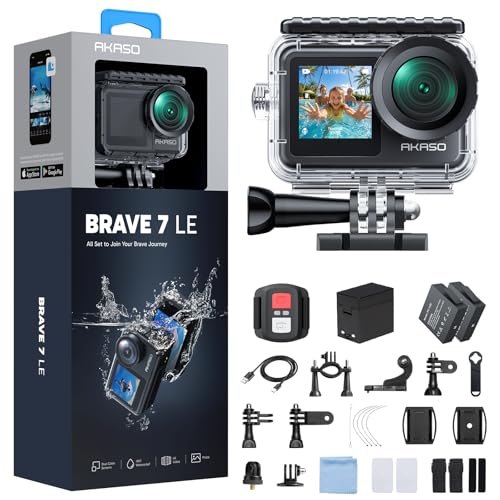
AKASO Brave 7 LE — The action route
Mount it on a helmet, a handlebar or a chest strap and the Brave 7 LE stops looking like a compromise and starts looking like the correct tool. It is a small, weather-sealed action camera built to film movement from inside the movement — bike descents, pool afternoons, muddy trail runs — in places where a phone would be one splash or one dropped grip away from an expensive afternoon. Its wide field of view swallows scenery whole, and electronic stabilisation smooths the judder that makes unwatchable footage unwatchable.
Weather sealing is the personality trait to dwell on. Rain, spray and dust are this camera’s working conditions rather than its enemies, which changes how a family films: the camera goes on the kayak, under the waterfall’s mist, onto the dog’s harness for the beach run. Dual screens help framing from both sides, and the bundled accessories in most retail packages stretch the budget further than the bare specification suggests, because mounts are where action-camera ownership quietly spends its money.
- Format: action camera, fixed ultra-wide lens
- Budget status: inside the frame, job-specific
- Build: weather-sealed body for outdoor abuse
- Screens: front and rear displays for framing
- Role: adventure footage where phones fear to go
Strengths
- Filming in weather that benches delicate devices
- Stabilised footage that survives real movement
- Accessory bundles soften the total ownership cost
Trade-offs
- Stills are souvenirs, not album centrepieces
- Ultra-wide view distorts faces at close range
- Small batteries reward carrying a spare
Who thrives with it? The rider, paddler, skier or parent-coach whose memories happen at speed and outdoors, and who has watched phone footage ruined by shake or nearly lost the phone itself to a lake. For that buyer the Brave is not the cheap option; it is the appropriate one, and its price merely happens to fit the frame that brought them to this page.
Budget the card and the case alongside it. Action footage devours storage, and a fast, genuine card from a reputable seller is part of the camera, not an optional extra. Bought together and honestly totalled, the kit still respects the spirit of the frame — and it will come home from trips that would have retired lesser devices.
Best for: outdoor and sports filming where weather, spray and knocks are guaranteed. Not suited for: anyone whose main goal is high-quality still photographs of family and travel

Wyze Cam v4 — The watchful route
Some cameras exist to remember a place rather than a moment, and the Wyze Cam v4 is this guide’s clearest example. It is a compact home security camera designed to sit on a shelf, a windowsill or a mounting point and keep patient watch over a doorway, a driveway, a garage or a child’s room, reporting motion to a phone and recording what matters. Judged as a holiday camera it makes no sense; judged as tireless household eyes, it is remarkable value inside this frame.
Clarity after dark is where this class earns or loses its keep, and the v4’s colour night capability — helped by a small built-in spotlight — separates it from the grey, ghostly footage older budget cameras produced. Two-way talk turns it from a witness into a participant: a delivery driver greeted from the office, a dog talked down from the sofa, a grandparent checked on with a voice rather than a visit. Local recording to a memory card keeps evidence without forcing a subscription conversation on day one.
- Format: home security camera, fixed wide view
- Budget status: inside the frame, job-specific
- Night work: colour night vision with spotlight help
- Audio: two-way talk through the companion app
- Role: doorways, driveways, nurseries and garages
Strengths
- Round-the-clock watching for very little money
- Colour night footage beats grey infrared ghosts
- Card recording keeps clips under your control
Trade-offs
- It is not portable, travel-friendly or hand-held
- Best features live inside the maker’s app
- Placement and Wi-Fi strength shape its results
The buyer for this pick usually arrives with a specific worry — parcels vanishing, a side gate left open, a pet alone too long — and the v4 answers worries rather than hobbies. Place it where the worry lives, aim it at the choke point every visitor must cross, and its modest price buys a kind of attention no hand-held camera can offer: continuous, patient and awake at hours when the household is not.
Think about power and placement before it arrives. A camera watching the wrong corner in beautiful clarity is still watching the wrong corner, so walk the room, find the outlet within cable reach of the view you need, and test the Wi-Fi signal at that exact spot. Ten minutes of placement craft multiplies this little camera’s worth more than any setting buried in its menus.
Best for: households wanting affordable, always-on watching over one important place. Not suited for: travellers, vloggers or anyone shopping for a take-anywhere stills camera

Blink Mini 2 — The indoor sentinel
The Blink Mini 2 is the indoor counterpart to the pick above: a small plug-in camera made to perch on a bookshelf or mount beside a door and keep a room under gentle observation. It suits the interior geography of a home — the hallway every entrance funnels through, the living room where the dog spends the day, the nursery corridor — and it speaks the language of its ecosystem, pairing with an app and, in many households, with voice assistants already running the lights.
Its appeal is quietness. There is no battery ritual because it plugs in; there is no weatherproofing theatre because it lives indoors; the design disappears into a room rather than announcing itself. Motion alerts arrive on the phone, live view opens when curiosity strikes, and two-way audio lets the owner speak into the room from elsewhere — a capability that sounds like a gimmick until the day it settles a barking dog or reassures an elderly parent who did not answer the telephone.
- Format: plug-in indoor security camera
- Budget status: inside the frame, job-specific
- Power: mains-fed, so no charging routine
- View: wide interior coverage from a shelf or mount
- Role: rooms, pets, hallways and inner doors
Strengths
- Set-and-forget operation once positioned well
- Discreet size suits ordinary living spaces
- Ecosystem pairing suits smart-home households
Trade-offs
- Indoor design limits where it can serve
- Cloud clip features may invite a subscription
- A tethered camera cannot follow the action
Choose between this and the Wyze by geography and habit. Outdoor-facing views, card recording and spotlight-assisted night colour lean one way; indoor simplicity, plug-in patience and an existing Blink or Alexa household lean the other. Neither is a failed version of the other — they are two answers to the question of which room, or which threshold, keeps you awake at night.
Privacy deserves a sentence in any indoor camera’s story. Point it at thresholds and shared spaces rather than private ones, tell the household it is there, and use its scheduling and privacy features deliberately. A camera that makes a home feel watched over should never make the people in it feel watched, and the difference lies entirely in placement and conversation.
Best for: indoor watching — pets, hallways, nurseries — inside a connected home. Not suited for: outdoor posts, travel use or buyers avoiding app-based devices entirely

Fujifilm Instax Mini 12 — The instant route
Every other pick in this guide produces a file; the Instax Mini 12 produces an object. Press the shutter at a birthday, a wedding table or a school play and a small print develops in your hand minutes later — a photograph that can be pinned, gifted, tucked into a card or stuck on a fridge before the event has even ended. In an age of galleries nobody scrolls back through, that physical immediacy is not nostalgia. It is a different and defensible answer to what a camera is for.
Operation could hardly be gentler. Twist the lens to wake it, frame through the simple viewfinder, and let automatic exposure handle the lighting decisions; a close-up mode and a small selfie mirror cover the arm’s-length portraits this camera will mostly take. The prints are credit-card sized, the colours cheerful, and the whole ritual delights children and grandparents with an equality few devices manage. Film comes in twin packs that most owners buy the way households buy coffee — regularly, and without resentment when the photographs land well.
- Format: instant camera printing on Mini film
- Budget status: inside the frame; film is the running cost
- Exposure: automatic, beginner-proof by design
- Prints: small physical photographs in minutes
- Role: parties, weddings, journals and gifts
Strengths
- Photographs become keepsakes immediately
- Almost no learning curve for any age
- Events gain a ritual guests genuinely enjoy
Trade-offs
- Every frame costs film — misses are not free
- Prints are small and softly detailed by nature
- No digital file exists unless you scan prints
Do the film arithmetic with open eyes before choosing this route. The camera fits the frame; a year of birthdays, holidays and school events will spend the frame again in film, and owners who love the format call that money well spent while owners who did not expect it call it a trap. The difference is purely foreknowledge, which this paragraph exists to provide.
As a gift, few items on this page rival it. A teenager’s first camera, a guest-book station at a wedding, a travel journal that fills with prints instead of promises — the Instax succeeds wherever the photograph’s job is to exist in the physical world. Buy it for that job and its limitations read as character; buy it expecting a digital archive and every limitation will feel like a defect.
Best for: parties, gifts, journals and anyone who wants prints, not files. Not suited for: building a digital photo library or shooting hundreds of frames freely
Secondhand Compact Camera From a Known Maker — The photographer’s route, in prose
Written in prose because the used shelf cannot be linked as a single product, this is the route for the buyer whose heart is set on real still photography. A decade of proper compacts from the big makers — models that once anchored family holidays with sharp lenses, honest sensors and optical zooms — now circulate through used dealers and marketplaces at prices this frame can hold, frequently with a case, a charger and a card in the bundle. Photographically, nothing new at this level touches them.
Shopping the shelf is a skill with a short curriculum. Favour listings that show the actual item, name its faults and accept returns. Check the lens for scratches and internal dust, fire the zoom through its range, confirm the screen and every dial work, and ask about the battery, because ageing packs are this route’s most predictable expense. A reputable used dealer’s small premium over a stranger’s listing buys grading, a returns window and peace of mind — usually the best-spent money in the whole transaction.
- Source: graded used dealers first, marketplaces carefully
- Checks: lens glass, zoom travel, screen, dials, battery
- Often included: charger, case and sometimes a card
- Image quality: the strongest stills available to this frame
- Role: family, travel and learning photography on a shoestring
Strengths
- Real lenses and sensors far beyond new rivals
- Optical zoom that digital tricks cannot imitate
- Controls that teach genuine photographic craft
Trade-offs
- Condition varies; inspection is the buyer’s job
- Batteries may need replacing sooner than hoped
- No modern wireless conveniences in older models
Which models deserve the hunt? The celebrated compacts of the last decade — the ones photography sites praised when they were new — have aged into bargains precisely because fashion moved on, not because their pictures worsened. Research two or three specific models, learn their fair prices, and then shop patiently for condition rather than chasing the first listing that appears.
Expect the first week to include small rituals: charging, formatting a card in-camera, cleaning the lens, updating settings to shoot at full quality rather than the previous owner’s defaults. Treat those rituals as the admission price of the best stills this budget can buy, and notice how quickly the camera stops feeling secondhand and starts feeling like yours.
Best for: stills photographers willing to inspect and buy carefully for real image quality. Not suited for: buyers who need a warranty, instant delivery or zero research
A Retired Smartphone Kept as a Camera — The zero-spend route, in prose
The most subversive pick in this guide costs nothing, because it is already in a drawer. The phone replaced at the last upgrade — the one with the cracked corner case and the perfectly good camera — almost certainly out-photographs every new device this frame offers, thanks to a large sensor by budget standards and computational photography that budget cameras cannot match. Factory-reset it, strip it to camera duty, and it becomes a dedicated device for children, trips and experiments.
Dedicated duty fixes the usual objections. Battery anxiety fades when the device is not also a telephone, a bank and a social life; a cheap case and a wrist strap answer the fragility worry; and handing it to a child photographer stops being a loan of your whole digital existence. Load it with a simple editing app, set its cloud backup to your household account if you want the pictures preserved, and a piece of e-waste becomes the family camera that was hiding in plain sight.
- Source: the household’s own drawer of retired handsets
- Setup: reset, update, strip to camera essentials
- Protection: inexpensive case plus a wrist strap
- Image quality: computational photography budget rivals lack
- Role: children’s camera, travel spare, experiment device
Strengths
- Costs nothing beyond a case and strap
- Familiar handling for every member of the family
- Sharing and backup already built into its nature
Trade-offs
- Battery health depends on the individual handset
- No optical zoom beyond its original specification
- It remains breakable glass, however retired
This route also reframes the whole keyword. A household that resurrects the drawer phone has freed the entire frame for something the phone cannot do — the action camera’s waterproof courage, the instant camera’s prints, the security camera’s patience. The smartest purchase under a hundred dollars is often a pairing: the free camera you already own, plus one specialist that covers its blind spot.
Before the reset, rescue what matters: photographs, messages and accounts still living on the old device deserve an hour of care. Then update its software, sign it into only what camera duty requires, and test its battery across a day out. A handset that dies by lunchtime can still serve as a home and garden camera near a charger — roles exist for every level of health.
Best for: families with a retired handset and a child, trip or project needing a camera. Not suited for: buyers with no spare phone, or anyone wanting a dedicated rugged device
How Do the Six Routes Compare Side by Side?
| Pick | What it really is | Running costs | Keepsake it produces |
|---|---|---|---|
| AKASO Brave 7 LE | Action camera | Cards and spare batteries | Filmed adventures |
| Wyze Cam v4 | Security camera | Card; optional services | Evidence and reassurance |
| Blink Mini 2 | Indoor security camera | Possible clip subscription | Room awareness |
| Fujifilm Instax Mini 12 | Instant camera | Film for every frame | Physical prints |
| Secondhand Compact Camera From a Known Maker | Used stills camera | Possible battery replacement | The best still photographs here |
| A Retired Smartphone Kept as a Camera | Repurposed handset | Case and strap only | Everyday photographs, free |
One frame, six different definitions of value. The table’s lesson is that “camera” at this price is a job title, not a single product — choose the job first and the right row chooses itself.
What Should a Buyer Actually Photograph With Each Route?
Let subjects arbitrate. The action camera belongs to motion and weather: cycling children, surf lessons, the dog’s beach day filmed from the dog. The security pair belongs to thresholds and absences — the hours the house is empty, the nights the baby sleeps, the deliveries that arrive while work keeps everyone away. The instant camera belongs to gatherings, where its prints become part of the event rather than a record filed afterwards.
Still photography, the keyword’s presumed subject, belongs to the final two rows. A used compact in decent condition will photograph a birthday, a graduation or a coastline with a richness the new devices here cannot approach, because its lens and sensor were engineered for exactly that task when its original price was several times this frame. The retired phone matches it for convenience and beats it for sharing, which is why households so often end up running both.
Notice what no route here honestly serves: the aspiring photographer wanting manual control, interchangeable lenses and room to grow as an artist. That ambition is real and respectable, and it simply does not live at this altitude — it begins on the used system-camera shelf a few hundred higher, a destination this guide’s final sections will point toward without pretending the distance is shorter than it is.
How Do You Spot the Listings That Are Selling Vocabulary Instead of Optics?
Learn the dialect of the too-good listing. It speaks in enormous numbers detached from meaning — zoom figures achieved by cropping, megapixel counts on sensors the size of a fingernail paring, night vision promised without any discussion of light. It shows renders rather than photographs of the product, reviews that praise delivery speed instead of pictures, and a brand name that appears nowhere in photography’s recorded history.
Contrast protects you. A genuine maker publishes sample images, names its sensor honestly, maintains a support page and has been reviewed by people who test cameras for a living. A used listing from a real person shows the actual scuffed item and answers questions about its history. When a listing avoids every form of specificity — no samples, no history, no accountable seller — the avoidance itself is the specification you needed.
Children’s cameras deserve a kinder version of the same scrutiny. A toy camera bought knowingly, for a five-year-old’s joy, is a fine purchase; the same device marketed as a serious photographic instrument is a small fraud. Buy toys as toys, tools as tools, and let the labels in this guide — action, security, instant, used, retired — do the honest sorting that marketplace headlines refuse to do.
How Much Do Cards, Film and Batteries Change the Real Budget?
Enough to reorder the picks, which is why this guide keeps returning to totals. The instant camera’s film is a per-photograph toll: delightful at parties, decisive across a year. The action camera’s appetite for fast cards and spare batteries can add a third again to its shelf price before the first trip ends. Security cameras sip power from the wall yet may charge rent for cloud clips, turning a one-time bargain into a small monthly habit.
The used compact hides its extra in the battery drawer — a tired pack replaced once, cheaply, and then forgotten — while the retired phone’s only toll is the case that keeps its second life from ending on a pavement. None of these costs is hidden by this guide, and none is disqualifying; they are simply the difference between the price of acquiring a camera and the price of owning one.
Do the year’s arithmetic before the day’s purchase. Write down the device, its essentials and its consumables across twelve honest months, and compare totals rather than tickets. Buyers who perform that small ceremony rarely feel ambushed later, and they frequently discover the apparently dearer route was the cheaper year.
Can a Camera at This Level Teach a Child Real Photography?
Yes, if teaching means seeing rather than settings. A child with the instant camera learns that photographs are precious because each one costs film; a child with the retired phone learns framing, patience and the delete key’s mercy; a child handed the used compact learns that a zoom ring and a steady hand change what a picture can say. Each curriculum is genuine, and each suits a different age and temperament.
What this level cannot teach is the manual triangle — aperture, shutter and sensitivity as physical dials — because none of these devices exposes it honestly. Families whose young photographer starts asking why backgrounds blur have received the signal to graduate: toward a used system camera, bought with the inspection craft described in the prose pick above, at whatever season the household budget allows.
Until that signal arrives, resist upgrading on schedule rather than on evidence. Children’s photographic joy is measured in prints on fridges and albums filled, not in equipment generations, and the camera already in their hands — however humble its shelf — is the one writing their visual childhood.
What Mistakes Do Buyers at This Price Keep Repeating?
The founding mistake is believing the headline: ordering a device that promised professional photography for pocket money and feeling personally betrayed by physics. Its cousin is buying for a fantasy use — the rugged adventure camera for a household that never leaves the garden — while the actual need, a camera for a child’s birthday season, goes unserved by every specialist on the shelf.
Skipping the running costs is the second repeat offence, usually discovered when the instant camera’s third film pack or the action camera’s second card comes due. The third is neglecting the drawer: spending the whole frame on a mediocre new device while a superior camera sleeps beside the spare chargers, unconsidered. Fourth is buying a used compact without inspection, mistaking optimism for a returns policy.
The final mistake is embarrassment, and it is the only one with no basis at all. A household filming its rides, printing its parties and photographing its children with devices matched honestly to each job has spent this small frame better than many households spend ten times it. The photograph on the fridge does not know what its camera cost, and neither does anyone who smiles at it.
How Should the Frame Be Split If Two Needs Compete?
Pair a free route with a paid specialist. The retired phone covers everyday stills at no cost, releasing the entire frame for the one job it cannot do — waterproof action filming, instant prints, overnight watching. Households that think in pairs consistently end up better equipped than households that force one device to impersonate three, because each member of the pair was chosen for excellence at a single task.
When both needs require spending, sequence them by season. The security camera bought before the holiday protects the empty house during it; the action camera bought before the ski trip earns its keep immediately; the instant camera bought the week before the wedding becomes part of the celebration. A device bought just before its season of glory feels like value from the first day, while the same device bought speculatively gathers the dust of good intentions.
And when the stills ambition outgrows every route here — as it should, eventually, for someone bitten by photography — let this frame become the deposit rather than the destination. The used system-camera shelf waits a few hundred higher with real lenses and real growth, and everything learned at this level, about subjects, light and honesty in listings, transfers upward intact.
How Do You Keep a Cheap Camera Alive for Years?
Longevity at this level is mostly housekeeping. Keep every device in a padded pouch rather than loose in a bag’s gravel trap of keys and coins; wipe lenses with a microfibre cloth instead of a sleeve, because coatings scratch quietly and every scratch taxes contrast forever; and store cameras away from bathroom steam and car-boot heat, the two climates that age electronics fastest in ordinary households.
Batteries reward rhythm. Rechargeable packs prefer regular, shallow use over long abandonment in a drawer, so a camera that sits for months deserves a charge cycle each season to keep its cells honest. The retired phone benefits most visibly from this care — a battery nursed along can serve camera duty for years after its telephone career ended, while a neglected one swells quietly toward retirement.
Cards and film have their own etiquette. Format memory cards inside the camera that will use them, replace any card that ever corrupts a file, and keep instant film away from heat and airport scanners where possible. None of this costs meaningful money; all of it is the difference between a bargain that serves a childhood and one that fails during it.
What About Photographing Water, Sport and Darkness on This Budget?
Each of the classic hard subjects has exactly one honest route here. Water belongs to the action camera, whose sealing turns pools, rain and spray from threats into settings — rinse it in fresh water after sea days, dry the seals before opening anything, and it will outlast several phones’ worth of caution. Sport belongs to the same device, because frame rates and stabilisation, not resolution, decide whether motion reads as excitement or as soup.
Darkness divides the shelf. The security cameras own the night by design, watching in colour or infrared while the household sleeps, but their night is a vigil, not a portrait session. For evening gatherings the instant camera’s flash and forgiving film produce the warm, imperfect prints people actually keep, while the retired phone’s night mode — computational, patient, surprisingly capable — handles the still scenes: the table after dinner, the street lit by shopfronts, the child asleep in the car seat.
What none of them owns is the dim, moving, faraway subject — the school play from row twelve, the match under floodlights. Naming that limit is not pessimism; it is how a buyer at this level avoids spending the frame twice, once on hope and once on the device that should have been bought second, knowingly, later.
How Should Grandparents, Gifts and School Projects Shape the Choice?
Some cameras in this guide are bought for other people, and the recipient’s patience is a specification. For grandparents, the instant camera’s single-button ritual and physical prints beat every menu-driven alternative, while a security camera watching a front path can be a family’s gift of reassurance — installed by the giver, aimed at the door, explained kindly, and never pointed at a private room.
School projects reward the retired phone and the used compact in different ways. The phone edits and submits through the apps schools already use; the compact keeps the project off the family handset entirely and teaches deliberate framing, because its screen is for composing rather than for notifications. Either way, a camera a student can carry without an adult’s anxiety about its cost is a camera that actually goes on the field trip.
Gifting etiquette completes the thought: include the consumable. Film with the instant camera, a card with the action camera, a spare battery with the used compact — the small box that turns a device into a working gift on the morning it is opened. A camera that cannot take a photograph on its first day is a promise, and promises make poor presents.
When Is the Right Answer to Save the Frame Instead?
Sometimes the honest conclusion of this entire guide is a closed wallet. If the household’s real wish is a growing photographer’s first system camera — interchangeable lenses, manual control, years of headroom — then nothing on this shelf satisfies it, and spending the frame on a placeholder teaches only disappointment. Saved, the same money becomes a third of a used system kit, or the lens that will matter most, bought a season sooner.
The test is the photograph you keep describing. If every version of it involves shallow depth, distant subjects in low light, or prints on a wall, you are describing equipment from a higher shelf, and the kindest advice is to aim there directly. If the described photographs are parties, doorways, trail days and a child’s first album, this page’s picks will make them happily and the saving instinct can stand down.
Either decision, made with eyes open, is a success of the same kind. Budgets are not moral tests; they are maps. This guide’s whole labour has been to draw this small map truthfully — the specialists in their places, the veterans honoured, the drawer checked — so that whichever road you take, you take it on purpose.
How Do You Get Sharper, Better Pictures From Humble Hardware?
Technique is the free upgrade every pick here accepts. Brace the camera against a doorframe or a table edge and dim rooms sharpen immediately; step closer instead of reaching for digital zoom, which merely enlarges softness; and tap to focus on the face that matters rather than letting the device average a scene into politeness. These habits cost nothing and improve photographs from the action camera, the compact and the retired phone alike.
Light deserves the same thrift. Turn subjects toward windows rather than standing them against bright backgrounds, shoot gatherings before the room goes fully dark, and let the instant camera’s flash work at conversational distance instead of across a hall. Budget hardware forgives generously when it is fed light, and punishes predictably when it is starved — a bargain the photographer controls entirely.
Finally, edit with mercy and keep generously. A slight crop, a straightened horizon and the discipline to keep the imperfect frame that caught the real laugh will do more for a family’s archive than any accessory sold for this shelf. The camera’s job is to be present; the photographer’s job is to notice. Presence plus noticing is ninety percent of every beloved photograph ever taken at any price.
What Should Happen to the Photographs After They Are Taken?
A picture that stays on a card is a rumour. Give every route here an exit path: the security clips that matter saved before the card loops over them, the action films copied to a computer the week they are shot, the instant prints scanned or photographed for sharing before they fade into shoeboxes, the retired phone’s gallery backed up to the household account it was signed into at setup.
Printing deserves a revival in this conversation. The instant camera prints by nature, but the other routes’ best frames gain a second life on paper — a handful of enlargements from a used compact’s holiday will out-remember a thousand scrolled files, and they cost less than one film pack. A household that prints its favourites monthly builds an archive that no dead battery or forgotten password can lock away.
Children’s work especially deserves the wall. The first album, however humble the camera, becomes family history the moment it is printed, labelled and kept — which loops back to this guide’s opening question. The best camera under this ceiling is whichever one produces photographs the household actually keeps, and keeping is a habit, not a specification.
How Does Travel Change the Calculation at This Level?
A journey rearranges every priority on this page. Luggage space shrinks, charging chances grow scarce, and the cost of losing a device mid-trip matters more than its specification sheet. The retired phone travels brilliantly because its charger, cable and habits already live in the family’s travel kit, while the action camera earns its pocket on any itinerary involving water, wheels or altitude — the days a careful device would spend wrapped in a hotel towel.
The used compact is the romantic traveller and the risky one: glorious on a city break, heartbreaking if left in a taxi. Travel with it on a strap, back up its card to a phone or a small drive each evening, and it will return photographs with a character no filter manufactures. The instant camera, meanwhile, turns travel social — prints given to hosts, fellow travellers and market stallholders become currency warmer than cash in the small economies of a journey.
Security cameras invert the travel question entirely: their job begins when the household leaves. A doorway watched from another continent, a pet checked between flights, an alert that a parcel arrived safely — for many families the most valuable travel photograph this budget buys is the one proving nothing happened at home. Pack for the trip you are taking, certainly, but consider staffing the home you are leaving, too.
Final Recommendation
Start with the drawer. If a retired phone lives there, resurrect it as the household camera and spend the frame on a specialist: the AKASO Brave 7 LE for adventures in weather, the Wyze Cam v4 or Blink Mini 2 for the threshold that worries you, or the Fujifilm Instax Mini 12 when the year’s calendar is full of gatherings worth printing. If no phone waits in reserve and still photographs are the true goal, hunt the secondhand compact shelf with patience and the inspection checklist above — it holds this budget’s best pictures by a wide margin.
What no buyer should do is order an unknown device on the strength of enormous printed numbers and hope the headline was honest. At this altitude the honest products are specialists, veterans and the already-owned — and chosen knowingly, any of them will serve a household well.
There is a particular pleasure in equipment that costs little and means much: the print from a party still on the fridge in five years, the trail film rewatched every winter, the doorway that stayed watched. Buy for one of those pleasures by name, and this smallest of camera budgets will feel, in retrospect, surprisingly well spent.
Frequently Asked Questions
Is there a genuinely good new camera for still photography under this ceiling?
Not in the traditional sense, and this guide will not pretend otherwise. New devices at this level are specialists — action, security, instant — while the strongest stills come from a carefully bought used compact or a retired smartphone. Buyers who accept that map get excellent results; buyers promised a miniature professional camera get a lesson instead.
Are the security cameras in this guide usable as everyday cameras?
No, and they are not sold here as such. They are fixed, connected watchers designed for one place and one job, brilliant at thresholds and nurseries and useless at a birthday picnic. Their presence in a camera guide reflects how the market actually fills this shelf — honestly labelled, they are among its best residents.
How much film should an Instax buyer budget for?
Enough to treat film as the camera’s fuel rather than an accessory: a twin pack for an event-heavy month is a reasonable planning unit, with more for weddings, holidays and school seasons. Owners who love the format consider it fair exchange for prints; the arithmetic in the pick’s section lets you decide before the habit forms.
What should I check first on a used compact?
The lens, because its flaws print on every frame: look for scratches, haze and internal dust, then work the zoom and every dial, fire the flash, and review a test photograph enlarged on a screen. Battery health and a returns window complete the inspection — a seller comfortable with all five checks is usually selling a sound camera.
Can the retired-phone route really beat a new budget camera?
For still photographs, usually yes. A recent retired handset combines a capable sensor with computational processing that budget cameras cannot replicate, plus instant sharing and backup. Its weaknesses are battery age and fragility, answered by camera-only duty, a case and a strap — which is why this guide treats it as a pick rather than a footnote.
Should I buy one device now or wait until I can afford a higher shelf?
Buy now when a dated event is driving the search — a trip, a wedding, a baby, a season of sport — because photographs of an event cannot be retaken with next year’s better camera. Wait when the desire is general and growing, particularly if it points toward system cameras and lenses, where a few months of saving buys a genuinely different class of tool rather than a slightly shinier version of this shelf.
Related Guides
Continue with setting up a home security camera view that actually helps, explore instant photography ideas for parties and family journals, or read inspecting a used compact camera before you pay before the secondhand hunt begins. Each takes one thread from this page — watching, printing or buying used — and follows it to the depth a small budget deserves.


