ilcastellomenu.com is reader-supported. When you buy through links on our site, we may earn an affiliate commission.
Where to Buy a Camera That Does the Thinking for You
First, the spelling — because you deserve honesty from the first paragraph: this page exists because people search for the best digital cameras for beginneers, with the extra e, and “beginneers” is simply “beginners” typed quickly by someone who had better things to do than proofread a search box. If that was you, welcome: you are exactly who this guide is for. Not the beginner who wants to learn photography — other pages on this site serve that reader, and serve them well — but the beginner who wants photographs, full stop: birthdays that come out sharp, holiday pictures that beat the ones from five years ago, a camera that can be handed to anyone at the table and returned with good pictures on it. No lessons. No homework. No vocabulary.
That is a perfectly respectable thing to want, and this guide will not try to convert you. The camera industry spent decades building machines whose automatic modes are genuinely excellent — cameras that find faces, judge light, steady shaky hands and choose their own settings with more wisdom than most owners ever develop — and then spent its marketing apologising for them, as if automation were a failure of character. It is not. It is the product. The six cameras below were chosen by one test above all others: hand the camera to a complete novice, in a badly lit room, with thirty seconds of instruction, and count how many of the first twenty photographs are keepers.
What you will not find here is homework in disguise. There are no picks that “reward learning” as their main virtue, no dials celebrated for teaching exposure, no suggestion that you will want manual control by spring. Some readers do graduate that way, and every system camera below leaves the door politely open — but the door is not the point of the house. The point is that on the first evening, at the first party, on the first holiday, the photographs are good. Everything in this guide is arranged around that evening.
Key Takeaways
- Automatic mode is the feature you are buying — judge cameras by it, not by their manual depths.
- Faces are the subject: eye and face detection matter more than any other technology here.
- The fewer decisions a camera demands, the more photographs it will actually take.
- Pocketable and instant cameras beat system cameras for readers who will never carry a bag.
- Charging by USB and sending pictures to a phone should both be effortless — test them in the shop.
- There is no shame tier in this list: every pick is a real camera adults happily use.
In this guide
Quick Picks
| Camera | Badge | Why it earns its place |
|---|---|---|
| Canon EOS R50 | The automatic system camera | A real interchangeable-lens camera whose guided auto mode explains nothing unless asked — it just delivers. |
| Sony ZV-1F | The one-button wonder | Fixed lens, huge record button, one-touch blurred backgrounds — the fewest decisions in this guide. |
| Nikon Z30 | The phone-shaped camera | Composes on a screen like the phone you already know, grips like a real camera, films beautifully. |
| Canon PowerShot G7 X Mark III | The party-proof compact | A bright lens that rescues dim rooms, in a body that fits the pocket it will live in. |
| Fujifilm Instax Mini 12 | The zero-settings camera | Twist, point, press, print: photographs as physical objects, with nothing to configure, ever. |
| Polaroid Go Generation 2 | The tiny joy camera | The smallest instant camera in the guide — a camera that gets carried because it is delightful. |
How Did We Choose Cameras for People Who Refuse Homework?
Our testing inverted the usual review. Instead of asking what each camera can do in expert hands, we asked what it does in indifferent ones: switched on in a hurry, left in full automatic for a month, pointed at children and dogs and candlelit dinners, handed to grandparents, dropped in a handbag, and expected to share its pictures with a phone without a manual being opened. Cameras whose automatic modes were secretly a trap — soft focus, timid exposure, faces missed while the camera admired the wallpaper — were cut without regard to their enthusiast reputations. In this guide, the automatic mode is not the demo. It is the product being reviewed.
The second filter was decision count. We tallied the choices each camera demands before a photograph can happen: lens on or off, mode dial to where, card formatted, battery proprietary or USB, transfer by app, cable or prayer. Every demanded decision is a small tax on a reader who has declared they will not pay it, and the taxes compound into the familiar tragedy — the good camera that stays home. The six survivors all reduce the count to something close to: charge it, carry it, press the button. The two instant cameras reduce it to: press the button.
Finally, we applied the party test as a tiebreaker, because it predicts real ownership better than any laboratory measure. At an actual gathering, does the camera get passed around or protected? Do the pictures reach phones the same evening? Does a stranger’s first frame come out well? The cameras below pass socially as well as technically, which for this reader is not a soft criterion. It is the whole game.
What Does “Automatic” Actually Do Inside a Modern Camera?
More than most people realise, and understanding it vaguely — once, here, in plain words — will make you a better owner without making you a student. When you half-press the button, the camera is holding a small committee meeting. One member looks for faces and eyes and instructs the focus to live there. Another reads the light, decides whether the scene is a portrait, a landscape, a macro flower or a dim room, and sets the exposure accordingly. A third listens for handshake and either steadies the lens, the sensor or the shutter speed to compensate. A fourth watches the highlights — the bride’s dress, the birthday candles — and protects them from blowing out to white.
The reason modern automatic photographs look so much better than the automatic photographs of fifteen years ago is that the committee got cleverer, not that the glass changed. Subject recognition is the headline: the camera no longer focuses on the nearest object like a loyal dog; it finds the person, then the person’s eye, then holds it while they move, laugh and turn away. Scene intelligence follows: the camera that knows it is looking at food, snow or a night street stops making the average-exposure errors that used to grey them all. None of this requires your participation. It requires only that you not switch it off in a fit of inherited guilt about “real photographers using manual” — a guilt this guide formally absolves you of.
One practical consequence follows. Because the automation is the product, the differences between the cameras below are differences of judgement: how a maker thinks a face should be rendered, how eagerly the camera brightens a dim room, how honestly it handles skin. Read the pick sections as character sketches of six small committees, and choose the judgement that sounds like your taste. That is a decision a beginner can make confidently, which is precisely why this guide is built around it.
Why Is the Best Camera the One That Leaves the House?
Every family owns the cautionary tale: the excellent camera, bought with love, that attended two holidays and retired to a drawer because it needed its bag, its charger, its lens decisions. The photographs it might have taken are perfect and nonexistent. Against that tale, this guide advances a blunt law for the no-homework reader: a camera’s real quality is its quality multiplied by its attendance. A modest compact at three hundred family moments outperforms a magnificent system at twelve, and the gap is not close.
Attendance is decided by friction, and friction is measurable in seconds and grams. Does the camera fit the pocket or bag you already carry? Does it switch on before the moment ends? Does it charge from the same cable as everything else in your life? Does it forgive being lent? The picks below were ranked by these questions as much as by their files — the Instax and Polaroid by their sheer carryability, the Sony by its pocket-and-button simplicity, the compacts and small systems by how little ceremony they demand. When two cameras tie on photographs, buy the one that will be there.
There is a corollary about guilt worth stating, since this reader often arrives pre-guilted by photography’s culture. A camera in a drawer is not a moral failure; it is a design mismatch, and the cure is not discipline but a different camera. If you already own the drawer tale, sell the magnificent system without shame and buy down this list toward the camera that matches your actual life. The photographers with the fullest family archives are not the most skilled people you know. They are the ones whose cameras were present, charged and uncomplicated, year after year.
Which Are the Best Digital Cameras for Beginneers Who Want It Easy?
Six committees, six temperaments: two system cameras for readers who like the idea of a “real camera” but want it on autopilot, two compacts for pockets and parties, and two instant cameras that abolish files altogether. All six assume the same reader — you, quite possibly, the one who typed the extra e and wants the photographs without the hobby.

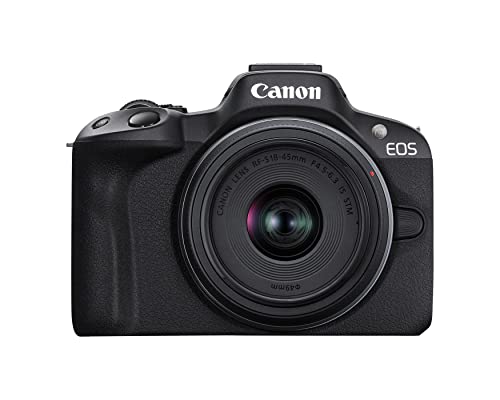
Canon EOS R50 — The automatic system camera
The R50 is the answer for the beginner who wants the real thing — a proper camera with changeable lenses and a sensor that laughs at dim rooms — on the condition that it never, ever becomes homework. In its automatic modes this Canon is a small marvel of delegation: it finds eyes, balances lamplight, and produces photographs of family life that look like a skilled friend took them. Its guided interface, uniquely, explains in plain sentences — but only if you go looking; left alone, it simply gets on with the photography, which is the correct behaviour for this reader.
The practicalities are sized for real life. The body is compact enough for a small bag, the touchscreen works the way phone habits expect, and pictures move to your phone through Canon’s app with a minimum of ceremony. The lens it arrives with covers the honest range of a family’s year — rooms, gardens, school events, holidays — so the famous lens question can be postponed indefinitely; many owners never buy a second lens and are not missing anything they would have used. When relatives borrow it, its automatic mode protects them from themselves, and when it comes back, a reset is two menu taps away.
- Format: APS-C mirrorless, Canon RF mount
- Automation: scene and eye detection, guided help on request
- Screen: fully articulating touchscreen
- Sharing: app transfer to phone for same-evening posting
- Role: the real camera that behaves like an appliance
Strengths
- Automatic photographs that flatter people in bad light
- Big-sensor quality for evenings phones cannot handle
- Friendly enough to lend to anyone at the table
Trade-offs
- Needs its small bag; it will not live in a coat pocket
- The lens mount invites future spending you may never want
- More camera than the truly commitment-free reader needs
For this guide’s reader, the R50’s killer feature is that its competence is front-loaded. Nothing must be learned before the photographs are good; the learning, if it ever happens, is a bonus the camera offers rather than a toll it charges. Families buying one camera for a household of mixed enthusiasm should start here, because it is the pick the keenest and the laziest member can both operate happily — a rarer quality than any specification on its box.
Choose it if you want the big quality jump and a camera the whole household can use. Choose smaller if the bag itself is the deal-breaker — the next picks exist for exactly that objection.
Best for: households wanting one real camera on permanent autopilot. Not suited for: pocket-only carriers

Sony ZV-1F — The one-button wonder
The ZV-1F may be the most honest camera in this guide. Sony looked at the no-homework reader and removed nearly everything: the lens never changes, the zoom is your feet, the settings are a handful of large intentions, and the two things beginners actually ask for — a blurred background for portraits and a clear face in a dim room — are each one touch away. Its prominent button starts video, its touchscreen behaves like a phone’s, and its wide view matches the framing a phone generation already sees in. Switched on for the first time, it is understood completely within a minute, and it is still understood, completely, a year later.
Do not mistake the simplicity for frailty of results. The sensor and lens combination produces photographs and clips with the polished, bright character this class of Sony is known for, faces are found and held with the maker’s best detection, and a small windscreen-topped microphone means the videos sound as clear as they look — the detail that separates watchable family footage from the mute archive. It charges by USB, lives in a coat pocket, and asks for nothing: no bag, no lens cap ceremony, no decisions at the door.
- Format: fixed-lens compact, wide view
- Controls: one-touch background blur, simple intention-based settings
- Audio: clear onboard microphone with windscreen
- Carry: coat-pocket size, USB charging
- Role: the fewest-decisions camera in the guide
Strengths
- Understood in a minute, mastered in an afternoon
- Portraits and video look polished without any technique
- Pocketable enough to attend ordinary days
Trade-offs
- No zoom reach: distant stages and sports stay distant
- Fixed lens means the camera is complete as bought — forever
- Smaller sensor than the system cameras here
Its deepest service to this reader is the removal of buyer’s remorse pathways. There is no second lens to covet, no accessory spiral, no settings rabbit hole down which an evening can vanish. The ZV-1F is a finished object, like a good kettle, and for the beginner who suspects — correctly — that their appetite is for photographs rather than photography, a finished object is the kindest possible purchase. It will simply be used, daily, without negotiation.
Buy it if your honest self-assessment is: I will press the button and nothing more. This camera was designed by people who believed you, and it shows.
Best for: absolute beginners who want video and stills with zero learning. Not suited for: distant subjects or future lens plans

Nikon Z30 — The phone-shaped camera
The Z30’s design begins from an observation the rest of the industry resisted: the beginner’s hands already know a camera — it is shaped like a phone, it composes on a screen, and it has no viewfinder because phones never did. Nikon built exactly that, then gave it the things a phone cannot have: a deep, secure grip, a large sensor that gathers real light, a lens mount for the day a different view is wanted, and video stamina for long, unbroken recordings. For the reader whose entire photographic life has been a handset, it is the dedicated camera with the shortest introduction in this guide.
In automatic hands it is a calm, competent machine. Faces are found, exposure is judged sensibly, and the screen — bright, tilting, touch-responsive — keeps composition in the language its owner already speaks. The grip deserves its own sentence, because it is the feature beginners feel without knowing its name: the camera sits in one hand like it means to stay there, which makes one-handed photographs of children, dogs and drinks steadier than any phone’s pinch-hold ever allowed. Battery behaviour suits long days out, and the tally light ends the ancient beginner’s question of whether it is recording.
- Format: APS-C mirrorless, Nikon Z mount
- Finder: none — composes on screen, phone-style
- Grip: deep and secure for one-handed use
- Video: long, comfortable recordings with tally light
- Role: the phone native’s first real camera
Strengths
- Nothing to relearn: framing works exactly as on a phone
- Real-camera light gathering for evenings and interiors
- Secure grip makes casual one-handed shots steady
Trade-offs
- Bright sunshine can make any screen a negotiation
- No in-body stabilisation; the lens and your hands share the work
- A small bag camera, not a pocket camera
The Z30 is also the diplomat of this list: it is the camera least likely to be argued with by either generation of a family. Teenagers accept it because it behaves like their world; adults accept it because it is unmistakably a real camera with a real future. Households buying across that divide — the camera that a parent buys and a teenager actually uses, or the reverse — should weigh it heavily. Shared cameras take more photographs than owned ones, and shared photographs are the family archive.
Choose it when filming matters alongside stills and when the viewfinder idea means nothing to you. It will not miss it either.
Best for: phone natives wanting real quality without new habits. Not suited for: glare-heavy outdoor purists

Canon PowerShot G7 X Mark III — The party-proof compact
The G7 X Mark III is the compact for the reader whose photographs happen where light goes to die: restaurants, living rooms at midnight, school halls, winter afternoons. Its lens is bright — genuinely, unusually bright for a pocket camera — which is the physical reason its automatic mode keeps succeeding after other cameras surrender to blur and noise. Canon pairs that lens with a sensor larger than a phone’s and colour that treats skin kindly, and wraps the whole thing in a body that fits a jacket pocket and a life with no camera bag in it.
Its party credentials are specific. The screen tilts up for the group selfie that includes the photographer; the automatic exposure handles mixed lamplight and window light without turning faces orange or grey; and the video side — a favourite of creators for years — means the birthday song and the speech are captured with clear sound through the microphone input if the household ever wants one. It asks for nothing in return beyond charging, and its menus can remain unopened for the camera’s entire life without the photographs suffering for it.
- Format: premium compact, larger-than-phone sensor
- Lens: bright zoom built for dim rooms
- Screen: tilts for group shots and selfies
- Audio: microphone input for clearer event video
- Role: the low-light pocket camera
Strengths
- Evening and indoor photographs other compacts fumble
- Pocket size with a serious sensor inside
- Group-selfie screen and creator-grade video habits
Trade-offs
- Autofocus is good, not the newest generation’s best
- Fixed lens: what you buy is the whole story
- Costs like a serious camera, so drops are felt
Consider it the quality ceiling of the no-effort class. The system cameras can out-grow it, the instant cameras out-charm it, but for the single act of producing a beautiful photograph of people in a real room, automatically, from a pocket, it is the pick the others are measured against. Readers whose lives are social and indoor — which is to say most readers — will find its strengths aimed precisely at their archive.
Buy it when the photographs you care about are people, evenings and events, and when you want the best automatic results that still fit a pocket.
Best for: social, indoor, evening photography without effort. Not suited for: the drop-prone or the zoom-hungry

Fujifilm Instax Mini 12 — The zero-settings camera
Every guide has a pick that wins by refusing the contest. The Instax Mini 12 has no menus to learn because it has no menus. You twist the lens to wake it, point it at your friends, press the button, and ninety seconds later a small physical photograph exists — warm, slightly imperfect, and already being passed around the table while the digital cameras are still asking about Wi-Fi. For the beginner whose real desire is not files but photographs, it is not the simplest option in this guide. It is the only honest one.
Its virtues compound socially. A print cannot be forgotten in a cloud, lost in a phone upgrade or buried under ten thousand screenshots; it goes on the fridge, the locker, the mirror, the birthday card. The camera’s automatic exposure handles the thinking, a selfie mirror and close-up mode handle the social geometry, and the cost-per-frame — the film — turns out to be a feature disguised as a bill: because each photograph costs something, each one is taken like it matters, and the hit rate of genuine delight per frame is the highest in this guide by a distance.
- Format: instant camera, credit-card-sized prints
- Exposure: fully automatic — no settings exist
- Features: selfie mirror, close-up mode
- Output: a physical print in about ninety seconds
- Role: the camera that produces objects, not files
Strengths
- Impossible to set wrong; confidence is total
- Prints get displayed, gifted and kept for decades
- No accounts, apps, uploads or charging rituals
Trade-offs
- Film is an ongoing cost to budget for
- Image quality is charm, not precision
- No digital copy unless a print is scanned
It is also the finest party guest in the list. Other cameras at a gathering are equipment; the Instax is entertainment, and the prints become the evening’s souvenirs in a way no shared album link has ever matched. Families routinely report it is the most-used camera in the house within a month, wielded by everyone from small children to grandparents — the broadest operating constituency in photography, achieved by having nothing to operate.
Choose it if the photographs you dream about are on walls and in wallets. Pair it later with any digital pick here if files become necessary; start here if joy is the requirement.
Best for: prints, parties and total beginners of every age. Not suited for: digital archives or distant subjects

Polaroid Go Generation 2 — The tiny joy camera
The Polaroid Go is the smallest argument in this guide: an instant camera shrunk to the size of a large bar of soap, producing small square prints with the soft, nostalgic character the Polaroid name has carried for generations. It exists for one reason — to be carried when no other camera would be. In a jacket pocket, a festival bag, a glovebox, it waits for the moments that happen between plans, and its entire interface is a button and a flash that knows its own mind. If the Instax is the party camera, the Go is the companion camera: the one that comes along.
Its photography is deliberately unpolished, and readers should choose it with eyes open. The little prints are mementos, not documents — soft, warm, occasionally surprising — and that is precisely their social function. Nobody performs for a Polaroid Go; people relax, pull faces, and treasure the result because it cannot be retaken into blandness. It offers a selfie mirror and a double-exposure trick for the playful, a rechargeable battery for the practical, and film small enough that a spare pack lives in the same pocket as the camera.
- Format: miniature instant camera, small square prints
- Controls: essentially a button — automatic everything
- Battery: rechargeable by USB
- Carry: the smallest camera in this guide
- Role: the always-along companion
Strengths
- Small enough that attendance stops being a decision
- Prints with a nostalgic character phones imitate badly
- Zero settings, zero files, zero maintenance
Trade-offs
- Prints are small and soft by design
- Film cost per frame is the highest here
- Not a camera for detail, distance or low light heroics
The Go understands something the rest of the industry keeps forgetting: for this reader, a camera’s first job is to be loved, because loved cameras get carried and carried cameras take the photographs that become the family’s mythology. It is the pick most likely to be bought as a gift, kept as a habit, and found in the photographs of other cameras — sitting on the picnic blanket, doing its small work. As a second camera for an Instax household it is redundant; as a first camera for a romantic minimalist, it is complete.
Buy it for the person — possibly you — who wants the memory, not the file, and who values the carrying above the counting of pixels.
Best for: minimalists and romantics who want prints everywhere they go. Not suited for: detail seekers or digital workflows
How Do the Six No-Homework Cameras Compare?
| Camera | Decisions demanded | Where it lives | Photographs become |
|---|---|---|---|
| Canon EOS R50 | Few — auto with optional guidance | A small bag | Files, shared by app |
| Sony ZV-1F | Almost none | A coat pocket | Files and polished clips |
| Nikon Z30 | Few — screen-led | A small bag | Files and long videos |
| Canon PowerShot G7 X Mark III | Few — auto-first | A jacket pocket | Files, strong in dim rooms |
| Fujifilm Instax Mini 12 | None at all | A shelf, then every party | Prints |
| Polaroid Go Generation 2 | None at all | Any pocket | Small prints |
Read the “decisions demanded” column as the price of admission to your own archive. For this reader, it is the most honest specification on the page.
How Do You Get Pictures From the Camera to Your Phone Without a Fuss?
Rehearse it once, at home, on the day the camera arrives — this is the only homework in this entire guide, and it takes four minutes. Install the maker’s app, pair the camera, send one photograph to the phone, and post it or send it to someone. Every digital pick here does this wirelessly, and the pairing, once established, is remembered. The beginners who share camera photographs daily are never the most technical people; they are simply the ones who did the four minutes before the holiday instead of during it, with a queue of relatives waiting.
If the app ever misbehaves — updates happen, phones change — the unglamorous backup is a small card reader that plugs into the phone. It costs little, lives in the camera bag, and converts any sharing emergency into a two-minute errand. Buy it with the camera and the whole question of transfer is settled for the camera’s lifetime, which is how this reader likes every question settled: once, cheaply, and never thought about again.
The instant cameras, of course, regard this entire section with pity. Their sharing protocol is handing the photograph to someone. If a digital copy is wanted, the print can be photographed or scanned with any phone in seconds — the analogue world’s answer to the app, and on party evidence, the faster one.
What Should You Actually Do on the First Day?
Charge it fully. Put in the card — or the film — and take the camera somewhere ordinary: the kitchen, the garden, the walk you always take. Photograph the people and animals who will fill its life, in the light your life actually has, and resist photographing test charts, brick walls or anything else the internet suggests. Then look at the pictures on the biggest screen available and notice the only thing that matters: whether the faces you love look like themselves on a good day. Every camera in this guide passes that test; the one you bought will too, and the ownership can begin.
Set the three kindnesses while the mood is fresh. Turn on the face or eye detection if it is not already on — on most of these it simply is. Set the date, so future archives sort themselves. And if the camera offers a “reset to automatic” habit — a mode dial with an honest auto position — make that position your home, the place the dial returns to after any experiment. That is the complete setup. There is no step four, and anyone who tells you otherwise is selling a course.
Finally, give the camera its home: the pocket, the hook by the door, the bag it will live in — a specific place, because cameras that live somewhere get taken, and cameras that live nowhere get forgotten. The first day’s real product is not the photographs. It is the routine that will produce ten thousand of them.
How Do You Look After a Camera You Refuse to Think About?
Minimally, and that is a complete answer rather than a lazy one. Keep it in its pocket or case so the lens stays clean by default. Wipe the lens with the soft cloth that came in the box — or a clean microfibre — when a photograph looks hazy; haziness is almost always a fingerprint, not a fault. Charge it when it asks, the way you charge everything else. Once a year, if it has a lens that comes off, let a camera shop clean the sensor while you have a coffee; the spots it removes are the grey ghosts that appear in skies, and the shop visit is the entire maintenance schedule for this class of ownership.
Two protections are worth their tiny effort. A wrist strap or neck strap, actually attached, prevents the only accident that reliably kills cameras — the drop onto something hard. And a named place at home, already established on day one, prevents the second — the camera that cannot be found in the five minutes before leaving, and so does not leave. Beyond those, this reader’s cameras need nothing but use. They are built for it, warrantied for it, and — unlike the delicate instruments of photography’s more anxious tiers — priced for it.
If something does go wrong, the order of suspects is: battery, card, lens fingerprint, and only then the camera. Swap the card before fearing the worst; most “broken” cameras in repair shops are healthy cameras with a corrupted bargain card inside them. Buy cards from reputable sellers, format them in the camera occasionally, and the reliability of the whole arrangement rises to the level of the kettle and the toaster — which is where this reader always wanted it.
How Do These Cameras Handle Children, Pets and General Chaos?
They were chosen for it, because chaos is the beginner’s true subject. The modern automatic camera’s party trick is not intelligence in the abstract; it is the specific ability to find a small face moving unpredictably through bad light and keep it sharp while the photographer is also holding a drink and a conversation. Eye detection does the finding, fast shutter judgement does the freezing, and the cameras differ mainly in how gracefully they recover when the subject bolts — the Canons and Sony here are notably stubborn trackers, which translates, in family terms, to photographs of the child rather than the child’s exit.
Pets expose a different weakness that this guide tested for: many cameras find human faces brilliantly and treat the dog as furniture. The system picks here detect animal eyes as a first-class feature, which matters more to most households than any other specification in this document — the dog is in more family photographs than any building, landscape or sunset ever will be. The compacts manage animals honourably by focusing fast and centrally; the instant cameras manage them by charm, which, for a print on the fridge, is frequently enough.
Chaos also includes the photographer. Shaky hands, one-handed grabs, the camera passed to an uncle — the automation’s stabilisation and forgiving exposure are doing quiet work in every one of those frames. The beginner who worries that their own unsteadiness disqualifies them from a real camera has it backwards: they are the customer the stabilisation was invented for, and the six committees below are all, in their different price brackets, very good at employing it.
What About Holidays — the Beginner’s Annual Examination?
The holiday is where a camera purchase is judged, because it concentrates everything: bright beaches that fool exposure meters, dim tavernas that defeat small sensors, children in pools, grandparents in shade, and a photographer who is supposed to be on holiday too. The picks divide by holiday style. The compacts and the Sony own the city break and the resort — pockets, cafés, evening streets. The system pair own the big trip, where the light is once-in-a-decade and the files deserve the sensor. The instants own the group holiday outright, because a villa with a print camera in it produces a wall of photographs by day three that no one present will ever delete.
Three holiday disciplines are worth the thirty seconds they take. Charge by night as a ritual, alongside the phone, so the camera never starts a day on yesterday’s battery. Keep the camera where the day happens — the beach bag, the table — rather than in the hotel safe being excellent. And take the obvious photograph as well as the artistic one: the sign, the menu, the hotel door, the group arranged badly on the steps. Future you is not curating an exhibition; future you is trying to remember, and the obvious photographs are the ones memory files itself under.
Finally, the holiday is where the attendance law collects its debt or pays its dividend. Every reader knows which of their past cameras failed this examination and which passed it, and the passing was never about image quality. Choose from this list the camera whose size, simplicity and charging match the holiday you actually take — not the expedition you browse — and the examination passes itself.
Why Do These Cameras Keep Ending Up in Grandparents’ Hands?
Because the no-homework camera is secretly the all-generations camera. The features that serve the absolute beginner — automatic everything, big clear screens, faces found without being asked, pictures that reach a phone without a seminar — are precisely the features that make a camera operable by the family’s oldest photographer, whose eyes and patience deserve exactly the same respect as the beginner’s. Households repeatedly discover that the camera bought for the least technical member becomes the one the most senior member borrows, then quietly adopts.
The instant cameras perform a particular magic across that divide. A grandparent who never adopted the phone’s camera roll understands a print instantly, because prints are the photography of their own youth returned with better manners. The Instax at a family gathering is operated, within the hour, by the person who claims to be hopeless with technology — a claim the camera politely disproves by having no technology visible to be hopeless with. If this guide has a sleeper recommendation, it is that: buy the instant camera “for the beginner” and watch who it actually liberates.
There is a serious point under the warmth. Photography’s value to a family is archival, and archives are built by whoever is willing to take the photographs. A camera that three generations can operate triples the number of willing photographers, and the record of a family event stops depending on one person’s battery, eyesight or presence. The beginner’s camera, chosen for its kindness, turns out to be the family’s camera — which is the strongest argument in this guide for choosing kindness deliberately rather than apologising for it.
How Much Should a Beginner Who Wants It Easy Actually Spend?
Spend on the automatic, not on the potential. In every price tier of this guide, what the extra money buys — when it is well spent — is a better committee: faster and surer face-finding, calmer behaviour in dim rooms, steadier hands forgiven, screens that stay readable in sunshine. What it should not buy is a larger warehouse of manual features to feel guilty beneath. Read price ladders with that single question — does this tier automate better, or merely offer more? — and the right rung usually identifies itself.
The tiers, in spirit, run like this. The instant cameras are the least expensive objects here and, for the print-minded, complete rather than cheap. The fixed-lens Sony is the value centre of the digital list: the fewest decisions per good photograph. The premium Canon compact costs more because its lens rescues more evenings, which for social lives is a rational purchase rather than an indulgence. The two system cameras cost the most and justify it only if the household values the big-sensor look and the lend-it-to-anyone versatility — not because a beginner “should” own a system. Plenty should not, and this guide’s affection for the little cameras is genuine.
Whatever the tier, protect the purchase with the boring accessories named in the FAQ and resist the bundle of extras retailers assemble at the till. The no-homework reader’s budget has one job: to maximise the number of good photographs per unit of thought. Spend where the automation improves, save where only the potential grows, and the camera will pay its way in kept moments long after the receipt is forgotten.
What Mistakes Do Absolute Beginners Keep Making?
Buying the camera a keen relative recommended. The keen relative means well and shops for headroom, dials and potential — the exact qualities this reader will never use, wrapped around an automatic mode treated as an afterthought. Buy for your own declared indifference to technique, using this guide’s test: twenty frames, borrowed hands, bad light, count the keepers.
Switching off the automation out of inherited guilt. Somewhere a voice — a video, a forum, a friend of a friend — insists real cameras are used manually, and a beginner obliges, and the photographs get worse for a year. That voice is selling an identity, not a result. The photographers whose work fills galleries use every mode including automatic, unashamed, whenever it serves the picture. Leave the committee in charge; it is better at its job than the guilt is at its.
And judging the camera by its first rainy Tuesday. Every camera in this guide will occasionally miss — a face at the frame’s edge, a room darker than physics — and the beginner who returns it for the next model discovers the same physics waiting there. Judge by the month’s archive instead: the parties, the evenings, the faces. If those are good — and with these six, they will be — the camera is not the problem, and there may be no problem at all.
Final Recommendation
Most readers of this page should buy the Canon EOS R50 if a small bag is acceptable — it is the biggest quality jump that still behaves like an appliance — or the Sony ZV-1F if it is not, since nothing in this guide asks less of its owner per good photograph. Choose the Nikon Z30 when filming and phone-style handling lead, the Canon G7 X Mark III when your life happens in dim, social rooms and you want the finest automatic files a pocket allows, and the Instax Mini 12 or Polaroid Go when the truth is that you want prints, parties and an end to files altogether.
And take this as the guide’s closing absolution: wanting the camera to do the work is not the beginner’s failure mode. It is the design brief that produced every camera on this page. Buy the one that matches your life, charge it, carry it, press the button — and let the extra e in “beginneers” stand as the last proofreading any of this ever required of you.
One more assurance, offered plainly because beginners ask it in a whisper: yes, you may keep the camera on automatic for the whole of its life, and yes, the photographs will still be yours. The choosing of the moment was always the photographer’s art; the arithmetic was always the machine’s job, and the machines have finally become good enough at it to say so out loud.
Frequently Asked Questions
Is it cheating to use a camera entirely on automatic?
No, and the idea deserves retiring. Automatic modes are engineered by the same people who design the manual controls, and professional photographers use them whenever the situation suits — fast events, family life, anything where the moment outranks the method. The photograph is the product. Nobody has ever loved a family picture more after learning which mode made it.
Can these cameras really beat my phone?
At noon in good light, honestly, the phone fights hard. The cameras pull away exactly where phones struggle: dim rooms, moving children, portraits with naturally soft backgrounds, zooms across a hall, and prints bigger than a postcard. If your disappointments with phone photographs cluster in those places — most people’s do — the upgrade is real and immediate.
Which is better for me, an instant camera or a digital one?
Decide by output. If the photographs you imagine are on fridges, in wallets and inside birthday cards, instant wins and nothing else is close. If they are shared in family chats, printed occasionally at size, or kept as an archive, digital wins. Many households end with one of each — the digital for the record, the instant for the room — and report it as the correct answer discovered late.
Do I need to buy anything else with the camera?
A memory card from a reputable seller for the digital picks, film for the instant ones, and a strap attached from day one. A small case helps the compacts live in real bags. That is the entire list — anyone extending it is decorating. A spare battery joins the list only if your days out regularly outlast a charge, which you will know within a month.
What if I get interested in learning photography later?
Then the two system cameras here — the Canon R50 and the Nikon Z30 — will quietly unfold manual controls you never noticed, and this site’s more studious guides will be waiting. The compacts and instants will not unfold, but they will also not be wasted: they become the household’s party and pocket cameras. Nothing in this list is a dead end; some are simply doors and others are destinations.
I typed the keyword with a typo. Is this really the right page?
Yes — the typo is how a large share of this guide’s readers arrive, and the page was written for the person behind it: someone who wants good photographs without a new hobby attached. If instead you are the beginner who wants the hobby — lessons, dials, a learning plan — the companion guides linked below will serve you better, and this page releases you to them with its blessing.
Related Guides
When curiosity stirs, continue with the best digital cameras for a beginner photographer for the structured learning path, compare the phone graduate’s guide to beginning photographers’ cameras if your skills arrived by handset, or browse cameras chosen for thirteen-year-olds when the beginner in question is rather younger than the one who typed the search.


