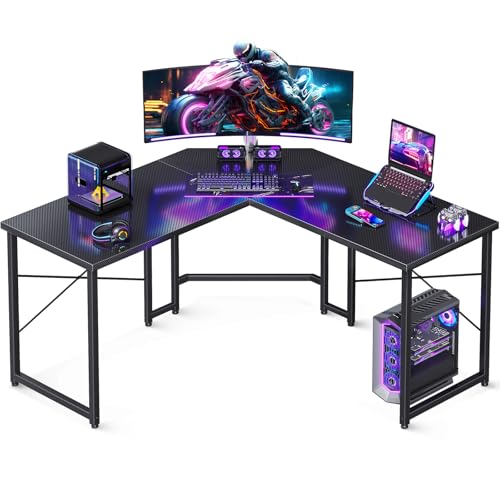
The L-shaped vs straight desk question comes down to how you actually work: one focused surface in a line, or two connected surfaces that let you spread tasks around a corner. An L-shaped desk gives you a main run plus a return — a second wing at right angles — while a straight desk keeps everything on a single run. Neither is universally better; the winner depends on your room’s shape, how many distinct work zones you genuinely use, and whether the corner will become productive space or a clutter shelf.
This comparison covers usable surface, room fit, ergonomics, cost and assembly, and ends with recommendations by work style.
Disclosure: As an Amazon Associate, ilcastellomenu.com earns from qualifying purchases. Product examples below link to Amazon, where you can check current availability and specifications; this guide itself lists no fixed prices because pricing and bundles change frequently.
Quick Verdict
Choose an L-shaped desk if you regularly work across two zones — computer plus paperwork, dual setups, a work side and a hobby side — and your room has a corner that suits it. Choose a straight desk if your work is screen-focused, your room is small or shared, you move furniture often, or you want the widest choice and the simplest assembly. If you are still sizing the room itself, How to Measure for a Desk shows how each shape’s footprint is measured, including the corner.
In this guide
Usable Surface: Area Is Not the Whole Story
An L-shaped desk offers more total surface, but surface only counts if you can reach and use it. The return wing is genuinely useful as a distinct zone: a printer and reference shelf, a writing area away from the keyboard, a second laptop, or a craft and hobby station. The deep corner itself, however, is the least reachable part of any L — plan it for low-touch items like a monitor, a lamp, or storage, not for things you grab hourly.
The straight desk's quiet advantage
Everything on a straight desk sits within one comfortable reach arc, and the surface is uniformly usable from edge to edge. For screen-centric work — one or two monitors, keyboard, notebook — a straight desk of adequate width wastes nothing. Straight desks also pair naturally with a separate drawer unit or shelf that can move with you between layouts, whereas an L commits you to its geometry.
Buyers whose work is a single large screen setup often find a deep straight desk beats a shallow L; the depth-versus-width reasoning is covered in How to Choose a Desk.
Two zones versus one bigger zone
Ask yourself whether your second zone is real. Writers who draft on paper beside a screen, streamers separating gameplay from production gear, and anyone running a work-plus-hobby corner will use the return daily. If your honest answer is ‘the return would hold a printer and some piles’, a straight desk plus a small side table delivers the same function with more flexibility.
Room Fit and Layout
L-shaped desks are corner furniture: they need a corner with usable runs on both walls, and they look and work best pushed into it. That requirement is also their efficiency — corners are often dead space in a room, and an L converts one into the workstation. Straight desks fit any wall, float in a room’s middle more gracefully, and slot between other furniture without negotiation.
In small rooms the comparison flips by layout: an L can fit a corner that a straight desk plus separate storage cannot, yet a bulky L can also dominate a small room visually and block the flexible floor space that makes small rooms livable. Small-space layouts are explored in Best Corner Desks for Small Spaces, which shows how corner designs behave when square metres are scarce.
Ergonomics and Working Posture
Both shapes can be set up ergonomically; the L adds one consideration — where you sit. Most L users anchor their chair at the corner, facing diagonally or along the main run, with the primary screen centred on their seated position. Done well, the return sits within a chair swivel rather than a lean. Done badly, the main screen ends up off to one side and the user works with a rotated neck all day.
The corner seat also changes legroom geometry: knee space at the corner is generous on many designs, but crossbars and joining frames vary, so check the underside plan. Whichever shape you choose, the setup sequence in How to Set Up Ergonomically a Desk applies unchanged — chair first, elbows as the anchor, screen centred on the sitter, not on the desk.
Cost, Assembly, and Moving
For the same materials and build standard, an L costs more than a straight desk because there is simply more of it: more desktop, more frame, more hardware. Assembly is correspondingly longer, with the added step of aligning the two runs at the corner so both tops sit flush and level — a step that rewards patience, as How to Assemble a Desk describes. Reversible designs (return on the left or right) protect you against room changes; fixed-handed designs are cheaper but commit you.
Moving house widens the gap further. A straight desk is a two-panel problem; an L is a piece of room planning that must fit the next home’s corners too. If you move often or rearrange frequently, that flexibility argument is decisive for many buyers.
Side-by-Side Summary
| Criterion | L-shaped desk | Straight desk |
|---|---|---|
| Total surface | More, split into two zones plus a deep corner | Less, but all within one reach arc |
| Best room fit | A free corner with runs on both walls | Any wall, any room, floats well |
| Second work zone | Built in — paperwork, printer, hobby side | Needs a side table or drawer unit |
| Ergonomic watch-out | Screen must centre on the sitter, not the corner | Straightforward single-axis setup |
| Cost at same build standard | Higher — more material and hardware | Lower |
| Assembly and moving | Longer; corner alignment step; handedness matters | Simplest of any desk type |
| Small rooms | Can exploit a dead corner, or dominate the room | Most flexible and compact options |
L-Shaped vs Straight Desk: Who Should Choose Which
Choose the L if your work genuinely lives in two zones and your room offers the corner: paperwork-heavy professionals, dual-computer users, streamers and creators separating performance from production, and crafters who need a permanent project surface. Purpose-built corner setups for home offices are gathered in Best L Shaped Desks for Home Office.
Choose straight if your work is screen-and-keyboard, your room is small, shared, or frequently rearranged, or you would rather spend the price difference on depth, build quality, or a monitor arm. Most single-screen and dual-screen workers lose nothing with a straight desk of the right width and depth.
The Middle Path
A straight desk plus a small mobile side table or drawer pedestal mimics the L’s second zone while keeping the freedom to reconfigure, and a corner can still be added later if the need proves real. Many people who try this discover the second zone was hypothetical — and those who do use the side table constantly have their answer for the next desk purchase.
The Corner Itself: Asset or Dead Zone?
Every L-shaped desk argument eventually becomes an argument about its corner, so it deserves direct treatment. The corner’s depth — measured diagonally — is the deepest point of any desk, which makes it the natural home for the items that benefit from depth and suffer least from distance: a large monitor (whose ideal viewing distance is greater than arm’s reach anyway), a printer, a lamp, a small shelf or riser with reference materials. Used this way, the corner is not dead at all; it is the one place a deep item can live without consuming reachable surface.
The corner fails when it becomes the default dumping ground — the pile of unfiled paper and abandoned projects that every desk attracts, given a geometrically perfect hiding place. If your work habits include a ‘to deal with later’ pile, an L gives that pile a permanent address. A straight desk, having nowhere to hide anything, forces a tidier honesty. Know which effect the corner will have on you.
Reversible, Left-Handed, and Right-Handed Designs
L-shaped desks come in three handedness flavours, and the distinction matters more than most buyers realise. A reversible design lets you mount the return on either side during assembly — the flexible choice, and the one to insist on if there is any chance the desk changes rooms. Fixed left-return and right-return designs are built asymmetrically: drawers, cable grommets, and modesty panels assume the orientation, and the desk cannot be flipped later.
Choose orientation by the room first (which corner, which wall is longer) and by your work second. Paperwork and writing usually belong on your dominant-hand side; a printer or second screen is indifferent. If the room and your habits disagree, the room wins — you can adapt a habit in a week, but the corner is where it is.
Two Desks in an L: The DIY Alternative
An L does not have to be one product. Two straight desks of matching height placed at right angles create the same geometry with total freedom of sizes — a deep main desk for the screens and a shallower side desk for paperwork, for instance — and each can be replaced, moved, or repurposed independently. The costs are aesthetic (two frames, a seam at the corner) and practical (the heights must match exactly, or the corner becomes a step that catches your keyboard hand mid-swivel).
For renters, frequent movers, and the undecided, the two-desk L is often the smartest version of the idea: it tests whether you truly use a second zone, at no commitment, with furniture that remains useful if the answer is no. Many permanent L owners started exactly this way and bought the unified desk only when the layout had proved itself.
Pricing the Shapes Honestly: Total Cost of the Corner
Compare the two shapes on total cost, not sticker cost. The L-shaped desk’s price includes its own return; the straight desk’s true price includes whatever you add to replace the return’s function — a drawer pedestal, a side table, a printer stand. Priced whole, the gap narrows considerably, and occasionally inverts: a modest straight desk plus a small pedestal can undercut a large L while remaining more flexible.
Run the same honesty in reverse on space. The L’s footprint is one number; the straight-plus-pedestal footprint is two numbers in two places, which in an awkward room can be easier to place than one rigid corner shape. Total cost and total footprint, honestly counted, are the comparison — the catalogue prices are merely where the counting starts.
Styling and the room's other furniture
A desk does not furnish a room alone, and shape interacts with everything else in it. An L commits the room’s corner and tends to become the room’s anchor: other furniture arranges around it, and the desk’s style sets the room’s tone. A straight desk is a citizen among furniture — it can sit between a bookcase and a dresser, swap walls during a spring rearrange, or leave the room entirely for a weekend guest setup.
In multi-use rooms — the bedroom-office, the living-room workstation — that citizenship has real value, and it is why interior advice for small multi-use spaces so often lands on straight desks despite the L’s surface advantage. Choose the anchor only if the room wants one.
Designing the Two Zones of an L Properly
If you choose the L, its success is decided by how deliberately you assign the zones, so here is the discipline. The main run belongs to the primary screen and keyboard, centred on your chair’s anchored position. The return belongs to one named function — paperwork, a second machine, a hobby — and only that function. The corner belongs to depth-loving, low-touch residents: the monitor if the geometry suits, the printer, the lamp, a riser with reference books.
Zone discipline and the migration problem
Zones fail by migration: paperwork creeps onto the main run, the hobby colonises the paperwork zone, and within a month the L is a straight desk with an attached storage problem. The countermeasure is physical, not moral — give each zone its own boundary object (a tray that defines the paperwork zone’s edge, a mat that defines the hobby area) and its own storage, so items have a home inside their zone rather than a frontier to cross. Review the zones monthly for the first quarter; after that the habits hold on their own.
Done well, the L’s zoning delivers the benefit its buyers actually wanted: not more surface, but separation — the ability to leave a project physically open on the return while the main run stays clean for the day’s work. That separation, unavailable at any price on a straight desk, is the L’s true product.
When the L is two desks' worth of wrong
Honesty requires the failure portrait too. The L fails when its return becomes a shelf for a printer that a stand could hold, when its corner eats the room’s only good window light, when the household’s other members experience it as a barricade, and when its owner rearranges furniture seasonally and spends each spring negotiating with a corner-shaped commitment. If your life includes frequent rearrangement, shared flexible space, or an unproven second zone, the straight desk is not the smaller choice — it is the correct one, and the two-desk L described earlier remains available the day the second zone proves itself.
Measuring Your Corner Like You Mean It
Because the L lives or dies by its corner, give that corner a dedicated measurement pass before ordering — beyond the wall runs covered elsewhere. Measure both runs from the corner itself, and check the corner’s angle with a large square or by measuring the diagonal of a metre-square marked on the floor: older rooms routinely hide corners a few degrees off square, and a rigid L will sit flush to one wall and gap at the other. Knowing the gap in advance lets you choose which wall gets the flush fit (the visible one) and plan a plant, a lamp, or a cable run to occupy the other.
Chair geometry at the corner
Finally, rehearse the sitting position with a chair and a tape outline before the desk arrives. Sit at the corner’s anchor point and check three arcs: the swivel between the main screen position and the return’s working position (should be a rotation, not a lean), the knee arc under the corner (your legs turn with the chair and need the underside clear through the whole swing), and the push-back path when you stand (the chair must exit the corner without fencing you in against the return). An L that passes the arcs is a cockpit; one that fails them is a trap with a large surface. The tape test costs an evening and answers all three.
Cables and Power: The Comparison Nobody Makes in the Showroom
The two shapes route electricity very differently, and the difference shows up within a week of ownership. A straight desk is one short run: sockets at one end, a single tray or spine, every cable travelling a metre at most. An L spreads equipment across two runs meeting at a corner, and cables must turn that corner — monitor leads from the return reaching the PC parked on the main run, chargers crossing to the far wing — so the L owner needs either a corner cable strategy, with the PC and the power strip living at the junction, or two independent power drops, one per wing, which most rooms’ socket layouts do not offer.
Plan the L’s electrics around the corner as a hub. The tower, the strip, and the tray belong at the junction, where both wings’ cables arrive by the shortest path; the moment equipment migrates to the far ends, cable lengths stretch and the corner fills with the slack. Straight-desk owners face a simpler version of the same law — everything reaches everything — which is why straight desks forgive casual setups and L desks reward planned ones. If your room’s only sockets sit at one end of the proposed L, price the cable management honestly: longer leads, a second tray, and an hour of routing are part of the L’s true cost.
Heat follows the cables. A PC exiled to the far end of an L for tidiness may end up against a wall or a radiator with its exhaust trapped, while the straight desk’s short geometry keeps the machine in open air almost by accident. Whichever shape you choose, the machine’s breathing space is a placement decision, not an accessory decision — and on an L it must be made deliberately.
Light and Windows: How Each Shape Meets the Room’s Daylight
A straight desk takes the classic advice easily: sit perpendicular to the window, light from the side, screen neither backed by glare nor facing it. An L complicates the geometry because it touches two walls, and one of its wings will almost always end up facing a window or backing onto one. The trick is to assign the wings by light: the screen belongs on the wing that sits side-on to the daylight, while the wing that faces the window takes the paperwork, the drawing, the tasks your eyes do on paper rather than on a backlit panel — where window light is a gift rather than a glare source.
In rooms where the L must wrap a corner window — common in modern flats — the corner itself becomes the brightest, pleasantest spot, and the temptation is to put the main screen there, staring out. Resist it for screen work and claim it instead for the standing, thinking, hands-busy tasks; your eyes will thank you at four in the afternoon. Straight desks in the same room take the wall beside the window and concede the view, which is why their owners sometimes report the plainer room and the better working light.
Artificial light follows the same logic. One desk lamp serves a straight desk’s single zone; an L’s two zones may each want their own, or one articulated lamp at the corner that can swing between wings — a small, satisfying arrangement that also underlines the L’s nature: it is two desks sharing a corner, and everything about it, light included, works best when planned as two desks rather than one bent one.
Two People, One Desk: Sharing an L Versus Sharing a Straight Run
Households regularly attempt to seat two workers at one desk, and the shapes differ sharply in how the experiment ends. A long straight desk seats two people side by side in identical posture, sharing one sightline and one acoustic space — workable for parallel solo work, hopeless when both are on calls, and always one elbow-negotiation away from friction. The allocation is a line down the middle, and everything shared — the printer, the lamp, the sockets — sits on the contested border.
An L gives each person a wing and a different view, which turns out to matter more than the extra surface. Facing different directions halves the call interference, separates the visual fields so each person’s clutter leaves the other’s sight, and lets one worker spread paperwork without invading the other’s keyboard zone. The corner becomes the natural shared territory — printer, reference shelf, the household’s charging point — equidistant from both chairs. For two full-time workers in one room, this is the L’s strongest argument, stronger than any single-user benefit in this comparison.
The honest costs are chairs and floor. Two chairs need two push-back zones, and an L in a corner can trap the inner worker behind the outer one’s chair. Measure the escape routes as carefully as the surface. Where the room cannot give two chairs their freedom, two separate straight desks — even small ones, even in different corners — beat one grand shared shape, because a desk you cannot leave without negotiation is a desk that owns you.
Moving House, Changing Rooms: The Adaptability Ledger
A straight desk is the most portable idea in furniture: it fits against any wall in any room you will ever rent, buy, or borrow, and its resale listing writes itself because every buyer has a wall. An L is a commitment to a geometry. It fits the corner it was bought for, fits some future corners, and in the wrong room — a door where the return wants to be, a window low on the wrong wall — it fits nothing at all, and its resale audience shrinks to buyers whose rooms rhyme with yours.
This is not an argument against the L; it is an argument for pricing its specificity. If your housing is stable for years, the L’s room-specific excellence is worth more than the straight desk’s universal adequacy, and the adaptability ledger balances. If you move often, the straight desk — or the two-desks-as-an-L arrangement covered earlier in this guide, which separates into two universally placeable straights on moving day — keeps your options liquid. Reversible L designs soften the problem by fitting left or right corners, but they cannot soften a room with no corner to give.
Weight and assembly compound the point. L desks ship as more panels, assemble as more joints, and move as more awkward pieces; a straight desk can be carried by one person and a door frame’s goodwill. Frequent movers should count not the purchase but the transitions — each move taxes the L in time, help, and the occasional chipped corner — while the settled household pays that tax once and forgets it.
Cleaning, Floors, and the Space Underneath
Ownership includes the vacuum cleaner, and here the shapes trade blows. The straight desk is one rectangle to clean under, its legs accessible from the front, its floor area reachable in a single pass; dust gathers along the wall edge and is dealt with in moments. The L creates a corner ecosystem: the junction’s underside, where two frames meet and the cables live, is the least accessible square metre in the room, and it collects dust, dropped pens, and the occasional lost earbud with gravitational reliability. A handheld vacuum and a quarterly expedition keep it civilised, but the expedition must be planned — chairs out, cables respected — in a way the straight desk never demands.
Floors wear differently too. A straight desk’s load sits in one line; an L spreads weight across a corner and can bridge a floor’s slight unevenness in a way that makes one wing’s foot hover — the seed of the wobble our wobble-fixing guide diagnoses. On carpet, the L’s larger footprint settles into the pile as one system, so levelling it is a single negotiation; on hard floors, its greater contact perimeter means more felt pads to fit and more floor to protect when it is dragged rather than lifted — and an L should never be dragged, because racking forces on a corner frame loosen joints that a straight desk’s simple rectangle shrugs off.
None of this is decisive alone. It is the kind of cost that accrues in minutes per month, invisible in a showroom and obvious in year two, which is exactly why it belongs in a comparison that aims to still be true after the novelty has worn off.
Four More Buyers: Where the Shapes Trade Wins
The accountant at tax season runs two ledgers, a calculator, and a screen, and works in a rhythm of swivel-and-reach. The L was designed by accident for this exact dance: screen and keyboard on the main run, paper on the return, the swivel replacing the stand-up-walk a straight desk imposes fifty times a day. Verdict: L, and it is not close. The sim racer or flight simmer runs the opposite geometry — one screen arc, a wheel or yoke clamped centre, pedals below — and needs depth and clamp strength on a single axis, with no use for a return except as a place for energy drinks to fall from. Verdict: a deep straight desk, every time.
The crafter who also computes — sewing machine on one zone, laptop on the other, cutting mat between — is the L’s second natural citizen, because the two activities contaminate each other on a straight desk: pins in the keyboard, fabric dust in the fans. The corner holds the shared tools. The student in a small rented room is the straight desk’s: the room must also be a bedroom and a living room, the desk must sometimes be a dining table, and a shape that monopolises a corner has spent space the student needs for everything else. Small multi-use rooms punish specialisation, and the L is a specialist.
Notice the pattern across all four: the L wins when the work itself has two distinct zones used in alternation, and loses when the work has one zone or the room has many jobs. That sentence, applied honestly to your own week, decides this comparison more reliably than any measurement in it — the measurements merely confirm what the pattern predicts.
The Upgrade Path: Growing From One Shape to the Other
Buyers often treat the shape as permanent, but both directions of travel exist and are worth planning. The straight-desk owner who outgrows one zone can add a return — a second, smaller desk or a purpose-made return unit butted at right angles — and arrive at the L’s functionality while keeping the option to separate the pieces later. The joints will not match a factory L’s finish or rigidity, and the heights must be matched deliberately, but the arrangement is reversible in a way the factory L is not, and reversibility is worth money to anyone whose rooms or work are still changing.
The L owner travelling the other way — moving to a smaller room, say — discovers whether their desk was bought wisely. Some L designs are genuinely two separable desks joined at the corner, and those owners simply unbolt and carry on. One-piece corner desktops offer no such mercy: the top must be cut, sold whole, or stored. If there is any chance your next room is smaller than this one, ask the separability question before purchase, while it is still a question and not a saw.
Either way, the shapes are chapters, not verdicts. Rooms change, work changes, and the desk that serves the current chapter well — measured honestly, zoned properly, cabled sanely — has done its job. Choose for the chapter you are in, keep the receipts and the Allen key, and let the next chapter make its own case when it arrives. Buyers still at the measuring stage will find the corner-specific method in our desk measuring walkthrough worth the ten minutes it takes.
Gaming, Streaming, and the Third Zone Problem
Gaming setups stress the shapes in a specific way: the main zone wants depth and clamp strength for wheels, flight sticks, and monitor arms, while the modern gaming desk also hosts a streaming layer — a second screen for chat, a microphone on a boom, a camera, sometimes a second machine. On a straight desk all of it queues along one edge, and the queue gets long: screens crowd the boom, the boom crowds the speakers, and the keyboard ends up wherever space remains rather than where the hands want it.
The L gives streaming its own wing, and the separation is more than tidiness. The broadcast gear lives at a fixed angle to the player, the camera’s background becomes one controlled wall instead of the whole room, and the playing zone stays uncluttered at the moments of highest intensity. Creators who record or stream seriously are among the few single users for whom the L’s second zone is not a luxury but the actual workstation, and the models in our streaming desk roundup reflect how often that layout recurs.
The counter-case is the competitive player whose setup is deliberately minimal — one screen, one keyboard, nothing else — and whose performance depends on a consistent, centred, symmetrical position they can reproduce at any desk anywhere, including a tournament’s. For that player the L’s extra territory is not neutral; it is an invitation to accumulate, and accumulation is the enemy of the reproducibility they train. Shape follows discipline: the more your setup is a system, the more the L serves it; the more it is a single honed position, the more the straight desk protects it.
Gear for This Guide
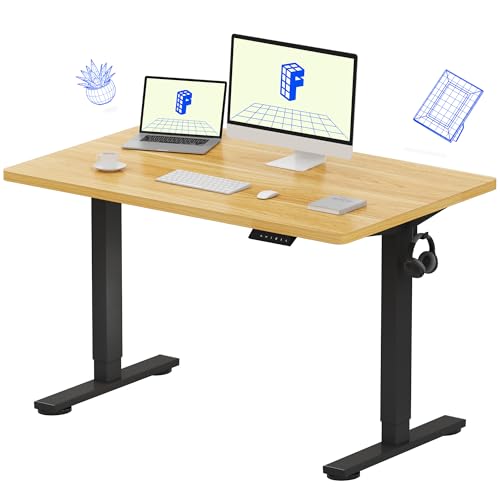
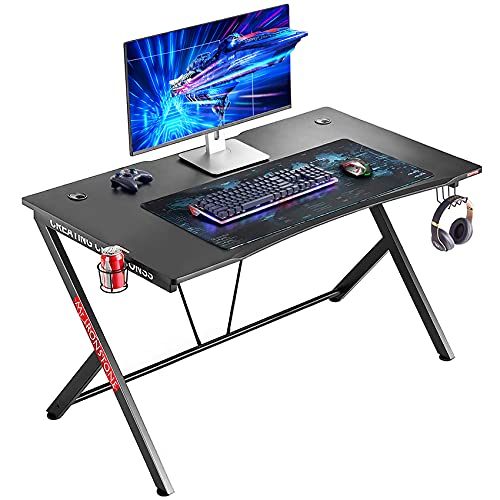
Verified examples of each shape: a deep straight gaming desk whose surface suits screen-focused work, and a 48-inch straight home-office desk as the compact benchmark an L must beat in your room plan.

Mr IRONSTONE Deep Gaming Desk
A 45.3-inch-wide, deep straight desk with cable features and accessory hooks — the kind of single-run surface that serves gamers and dual-monitor users without needing a return. Mr IRONSTONE Deep Gaming Desk — Check on Amazon

SHW Mission 48-Inch Home Office Computer Desk
A clean 48-inch straight desk; tape this footprint out in your corner first — if it already holds your setup with margin, the case for the L has to come from a genuine second zone. SHW Mission 48-Inch Home Office Computer Desk — Check on Amazon
Frequently Asked Questions
Does an L-shaped desk actually give more usable space?
More total surface, yes, but the deep corner is low-reach space best used for monitors, lamps, or storage. The genuinely usable gain is the return as a distinct second zone. If you will not use a second zone, a straight desk’s fully reachable surface can be worth more in practice.
Can an L-shaped desk work in a small room?
Sometimes better than expected, because it converts a dead corner into the workstation and can replace separate storage furniture. But measure carefully — including chair space at the corner — and beware designs whose return blocks drawers, doors, or the room’s only walkway.
Which side should the return be on?
Put the return on the side of your secondary work: paperwork usually follows your dominant hand, while a printer or second device can sit on either side. Reversible designs let you change your mind; if buying fixed-handed, choose based on the room corner first and your habits second.
Is an L-shaped desk harder to assemble?
Somewhat: there are more panels and fasteners, plus a corner-alignment step where the two tops must sit flush before final tightening. It is the same skill set as a straight desk, just more of it — allow extra time and keep joints finger-tight until the corner is aligned.
Where should the monitor go on an L-shaped desk?
Centred on you, not on the furniture. Most users sit at the corner with the main screen directly ahead along one run or angled across the corner, and the return holding secondary items within a swivel. Never accept a layout where the main screen sits permanently to one side of your chair.
Which shape is better for a bedroom office?
Usually the straight desk, because bedrooms ask furniture to share and to disappear: a straight desk can double as a dressing table, sit under a window without wrapping it, and leave the room’s corners for the wardrobe and the door’s swing. The L earns a bedroom only when the room is large enough that the corner was genuinely spare and the work genuinely has two zones — in a small bedroom an L tends to make the room feel like an office that contains a bed, rather than a bedroom that hosts a desk, and sleep usually wins that argument in the end.
Can I put an L-shaped desk in the middle of a room?
You can, and in a large room it can work beautifully — one wing becomes a room divider, and the setup gains a defined office territory. But plan for what the back of the desk shows the room: cable runs that a wall would have hidden, the unfinished rear faces some desks have, and sockets that must now be reached by a floor cable run, which needs covering for safety and sanity. Floating an L is a design decision with electrical homework attached; floating a straight desk is simpler for the same reasons, and both should be measured for the walk-around space they will consume.
Is an L-shaped desk better for dual monitors?
Not automatically. Dual monitors need width and depth on the main run, which a straight desk of the same total width provides equally; the L’s return adds a second zone, not a wider screen zone. Where the L genuinely helps a dual-screen user is in giving the non-screen work — notebook, documents, a drawing tablet — its own home instead of squeezing it between keyboard and desk edge. If your second zone is real, the L serves it; if your work is entirely on the screens, a wide straight desk is the same experience with fewer corners. Our roundup of desks for dual-monitor setups lists the widths that matter for both shapes.
Which shape holds its value better second-hand?
The straight desk, clearly. Its buyer pool is everyone with a wall, its transport is easy, and its condition is simple to judge. An L sells to a narrower audience — buyers must have the corner, the handedness, and the transport — so it typically takes longer to sell and returns less of its price, with the exception of quality reversible models from known makers, whose flexibility restores some of the audience. If resale matters to your arithmetic, count it as another point for the straight desk’s adaptability.
My room’s only corner has a radiator in it. Does that settle the question?
Very nearly. A desk wrapped around a working radiator traps heat, warms one wing’s user unevenly, and can bake a PC parked in the corner — and radiators cannot be moved for furniture. You could float the L away from the corner, but then it surrenders its space logic and keeps its costs. In that room the straight desk on the free wall is almost certainly the right answer, and the corner can take a shelf or a plant, which ask nothing of the heating system.
Can I turn a straight desk into an L later without replacing it?
Yes, and it is one of the straight desk’s quiet advantages. A second smaller desk, a return unit, or even a sturdy side table of exactly matched height can be butted against the main desk to form the second zone. The details that decide whether it feels like one desk or two are height — matched to the millimetre, shimmed if necessary — and the junction: a small gap at the corner swallows pens and annoys daily, so butt the pieces tightly and consider a bridging mat or a corner pad. The result will not have a factory L’s rigidity or finish, but it has something the factory L never will: it comes apart again the day your room or your work changes its mind.
Which shape is easier to keep tidy?
The straight desk, for a psychological reason: its single zone is fully visible from the chair, so clutter announces itself and gets cleared. An L’s far wing sits outside the working sightline and quietly becomes storage for everything without a home. Owners who zone the return deliberately and audit it weekly keep tidy Ls; everyone else should count the straight desk’s enforced honesty as a feature.
The Bottom Line
The L earns its footprint when a real second work zone exists and a corner is free; the straight desk wins on flexibility, simplicity, and value when work is screen-focused. Measure the corner, be honest about the second zone, and let those two answers decide.
Related Guides
Measure your corner, run the full choosing process, and browse corner and L-shaped roundups: