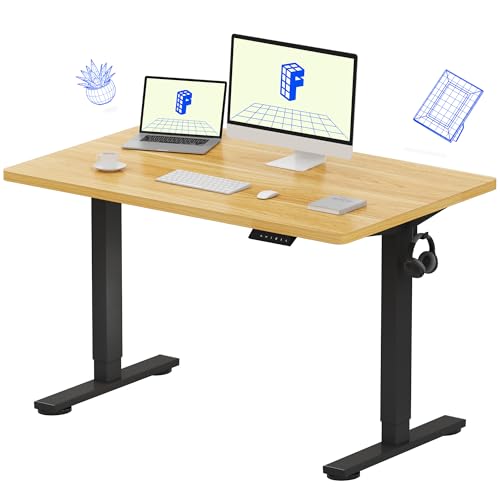
The standing desk vs regular desk decision is really a decision about posture variety and adjustability, not about which furniture category is ‘healthier’ in the abstract. A regular desk holds one fixed height; a standing desk (sit-stand desk) lets you alternate between sitting and standing and fine-tune both positions to your body. Whether that flexibility is worth its extra cost and complexity depends on how you work, how well standard desk heights fit you, and honestly, whether you will actually stand.
This comparison works through the criteria that separate the two — ergonomics, cost tiers, stability, space, and daily practicality — and ends with recommendations by user type, so you can match the desk to your habits rather than to the marketing.
Disclosure: As an Amazon Associate, ilcastellomenu.com earns from qualifying purchases. Product examples below link to Amazon, where you can check current availability and specifications; this guide itself lists no fixed prices because pricing and bundles change frequently.
Quick Verdict
Choose a standing desk if you work long hours at the desk, feel restless or stiff sitting all day, are noticeably shorter or taller than average (fixed heights fit you poorly), or share the desk between people of different heights. Choose a regular desk if standard height fits you well, your desk hours are moderate, you prize maximum stability and simplicity, or your budget tier is better spent on surface size and build quality. Neither choice fixes a bad chair or a badly placed screen — those matter independently, as How to Set Up Ergonomically a Desk explains.
In this guide
Ergonomics and Comfort Compared
The ergonomic case for a standing desk is posture change. Alternating positions spreads physical load across different muscles and joints through the day, and many people find afternoon energy and focus improve when they are not pinned to one posture. The case is often overstated, though: standing all day is its own strain, and a standing desk used only as an expensive fixed desk delivers no ergonomic benefit at all.
Height fit: the standing desk's hidden advantage
Standard regular desks cluster around one height that fits average bodies. If you are well outside the average, a fixed desk forces compromises — chair raised with feet dangling, or shoulders hunched to a low surface. An adjustable desk eliminates the compromise at both its sitting and standing heights, which for some users matters more than standing itself. The measurement method is in What is the Ideal Desk Height.
A regular desk can still be made to fit with a footrest, a keyboard tray, or risers, and for a single user whose measurements land near the standard, those fixes are entirely adequate.
What standing does not fix
Screen height, keyboard position, and chair quality behave identically on both desk types. A standing desk with a low monitor still bends your neck; a regular desk with a good arm and chair can be ergonomically excellent. Treat the desk decision and the setup decision as separate, and budget for both.
Cost and Value Tiers
Standing desks cost more than regular desks of comparable surface and finish, because motors, lifting columns, and control systems are genuinely additional hardware. Within a fixed budget, that premium is paid from somewhere: buyers often trade down on desktop material or size to afford the mechanism.
Judge value by cost per year of use. A standing desk you adjust daily for a decade is good value at a higher tier; the same desk used at one height forever is a regular desk with extra parts to fail. Manual-crank and pneumatic standing desks occupy a middle tier — the mechanism comparison in Electric vs Manual Standing Desk explains what the motor premium buys in daily convenience.
Stability and Build
A well-made regular desk is the stability benchmark: four legs or a fixed frame, no moving parts, nothing to flex. Standing desks have improved enormously, but physics remains — a desk raised to standing height on two lifting columns will exhibit more lateral movement than the same desk lowered, and cheap frames wobble noticeably at full extension, especially with heavy monitor setups.
If you type energetically, use multiple monitors, or lean on the desk, test stability at standing height specifically, and favour frames with crossbars and higher weight capacities. Wobble that develops over time on either desk type is diagnosable with How to Fix a Wobbly Desk. Regular desks also win on longevity of the mechanism: there is no motor or control box to age, though quality standing frames are rated for many years of daily cycles.
Space, Weight, and Practicality
Standing desks are heavier, arrive in more boxes, and are harder to move between rooms or homes. Their frames also impose a minimum footprint: the lifting columns and feet need their span, so the smallest standing desks are larger than the smallest regular desks. In a compact room, a simple regular desk — or a wall-mounted design — can be the only layout that works; compact options are rounded up in Best Desks for Small Spaces.
Power is another practical difference: a standing desk needs a socket within cable reach and tidy cable management that tolerates movement, with slack for full height. A regular desk’s cables are routed once and forgotten.
Side-by-Side Summary
The table compresses the comparison. Read it alongside the user-type recommendations below rather than as a scorecard — the rows matter differently to different workers.
| Criterion | Standing desk | Regular desk |
|---|---|---|
| Posture variety | Sit and stand; height fine-tuned to your body | One fixed posture; height fits or it does not |
| Height fit for non-average bodies | Excellent — dial in seated and standing heights | Poor to fair — needs footrests, trays, or risers |
| Cost tier for same size/finish | Higher — mechanism adds real hardware cost | Lower — budget goes to size and materials |
| Stability | Good seated; some flex possible at full height | Best possible — no moving parts |
| Moving parts / upkeep | Motor, control box, cables; occasional checks | Essentially none |
| Space and weight | Heavier, larger minimum footprint, needs power | Lightest and most compact options available |
| Shared-desk suitability | Excellent — presets per user | Compromise height for everyone |
Standing Desk vs Regular Desk: Who Should Choose Which
Long-hours knowledge workers who feel the afternoon slump, people whose height makes standard desks uncomfortable, and households sharing one desk between differently sized users get the most from a standing desk. Gamers and streamers with heavy multi-monitor rigs should weigh the stability row carefully and choose a heavy-duty frame if they go adjustable; setups of that kind are collected in Best Desks for Streaming.
Students, moderate-hours users, and anyone furnishing a small or temporary space usually get more from a regular desk: the savings buy a better chair or a monitor arm, both of which improve daily comfort more than a standing mechanism used twice a month. If you do go regular, the selection process in How to Choose a Desk will steer you to the right size and build.
The Hybrid Answer Many People Land On
A desktop sit-stand converter on a regular desk, or a regular desk plus a strict walking-break habit, captures part of the posture-variety benefit without replacing furniture. Converters sacrifice some surface and stability, and they raise the keyboard and screen together, which not every setup tolerates. But as a trial — ‘will I actually stand?’ — a converter or even a month of scheduled standing breaks at a high counter tells you the truth about your habits before you commit to a full standing desk.
The Evidence, Stated Carefully
What does research actually support? The consistent finding is that sit-stand desks reduce total sitting time during the workday — typically by a meaningful margin — and that users commonly report less upper-back and neck discomfort and better afternoon alertness. What the evidence does not support is the grander claim that standing desks cause significant weight loss or transform cardiovascular health on their own; the calorie difference between sitting and standing is small, and standing motionless for hours carries its own documented strains on legs and lower back.
This is why the honest framing throughout this comparison is posture variety and fit. A standing desk is a tool for changing position and for matching heights a fixed desk cannot. Judged on those terms it succeeds. Judged as a medical intervention, it was always going to disappoint — and buyers who purchase it on the modest, true claims tend to be the ones still using the feature a year later.
Running Costs and Ownership Over Years
Ownership differs quietly between the two. A regular desk’s lifetime costs are essentially zero beyond its purchase: no power draw, no parts, nothing to service. A standing desk draws a small amount of standby power, and its motor and control system have a finite service life measured in years of daily cycles — long, but finite in a way a four-legged frame’s is not. Warranties reflect this: compare the frame warranty and the electronics warranty separately on any standing desk, because they are often different lengths.
There is also a resale and reuse asymmetry. A regular desk fits almost any future room and user. A standing desk’s value concentrates in households that work at desks; when the home office closes, the regular desk becomes a table anywhere, while the standing desk remains a workstation looking for a worker. None of this argues against buying one — it argues for buying it when the use case is durable.
Trying Standing Before You Buy
The cheapest research is a fortnight of experiments. Raise your laptop on a stable stack at a kitchen counter for calls and reading tasks. Note honestly how often you choose to stand when standing is available, and for how long before you drift back to a chair. Most people discover a pattern — standing for calls and short tasks, sitting for deep focus — and that pattern predicts standing-desk satisfaction far better than enthusiasm does.
If the pattern is real, a standing desk will serve it daily. If the experiment bores you by day three, believe it, and put the budget into the best regular desk, chair, and monitor arm combination your room allows. You will have spent nothing to learn the most important fact in this entire comparison: which kind of worker you are.
The Decision for Specific Workers
Abstract criteria land differently on different jobs, so here is the comparison applied. The writer or programmer in long focus blocks: the standing desk’s value is the posture change between blocks, and electric presets make it frictionless — a strong case. The video editor with a heavy multi-monitor rig and a colourist’s need for a stable, unmoving screen: a heavy regular desk or a genuinely heavy-duty standing frame, with stability weighted above all. The student in a rented room: a regular desk, because the tenancy is temporary and the budget is not.
The call-heavy and meeting-heavy worker
People whose days are calls gain a specific benefit from standing: many people think, speak, and gesture better on their feet, and a standing desk turns every call into a natural standing interval without leaving the workstation. For this worker the standing desk often justifies itself within a month. Conversely, the craftsperson or artist whose desk is a workbench for physical materials — cutting, soldering, drawing on paper — usually needs a fixed, maximally stable surface at a task height, and a regular desk (or bench) chosen for that task beats a generalist standing frame.
The pattern across all these cases is the article’s thesis: the right answer is produced by your work’s shape, not by the category’s reputation.
What about the children and the household desk?
A household desk shared between adults and children is a special case of the shared-desk problem, with a wider height spread than any two adults present. Here the adjustable desk’s range does real work — homework at one height, adult work at another — and the regular desk’s compromise fits nobody well. If one desk must serve a whole household for years, adjustability stops being a luxury and becomes the only honest fit.
Environmental and Practical Footnotes
Two quieter considerations complete the comparison. Environmentally, the regular desk is the lighter object: fewer materials, no electronics, a service life measured in decades and a second life in any room of any house. The standing desk carries motors and control electronics whose manufacture and eventual disposal are real costs, partially repaid if its adjustability prevents the purchase of two successive fixed desks as needs change — as they do for growing children and multi-user households.
The trial-by-rental and return-window strategy
Where retailers offer generous return windows, the honest trial is the desk itself: buy the standing desk you are considering, use it with discipline for the full window — standing on a schedule, not on whims — and let the data decide. Keep the packaging until the verdict. This strategy fails only when the trial is undisciplined; a standing desk evaluated by whether you felt like standing will be returned by everyone, including the people it would have served for a decade.
Judge the trial by the metrics that matter: how many days you stood at least twice, whether afternoon stiffness changed, and whether the seated experience — height fit, stability — beats your old desk. If two of three favour the newcomer, the comparison is settled by evidence rather than by argument, which is where this article has been trying to bring you all along.
Resale, warranties, and total cost revisited
Complete the ledger with exit costs. A quality regular desk resells as furniture, to anyone, forever. A standing desk resells as equipment, to desk workers, with its remaining electronics warranty as part of its value — keep the receipt and the manual with the desk, as you should for the Allen key. Neither consideration should drive the purchase, but both belong in a comparison that claims to be complete, and both mildly favour the simpler object — as, in the end, does physics. Buy the standing desk when its two genuine advantages, posture variety and height fit, are worth real money to your actual days. That is a high bar and, for the right worker, an easy one to clear.
The Environmental Ledger, Completed
One honest footnote remains in the comparison, because furniture is also stuff in the world. A regular desk is among the most sustainable objects in a home: few materials, no electronics, decades of service, and a second life in any room. A standing desk adds motors, electronics, and a control system whose production and disposal carry real costs — costs that can be justified, and partly repaid, when its adjustability serves several users or several life stages and prevents other furniture purchases.
Buying either desk for keeps
Whichever you choose, the sustainable and economical move is the same: buy the version you will keep for a decade rather than the version you will replace in two years. For a regular desk that means solid construction and a finish you will not tire of. For a standing desk it means a frame with replaceable electronics, a warranty that separates frame from motor, and a desktop you can refinish or replace without replacing the lift. The greenest desk, like the cheapest desk over time, is the one that is never thrown away — a point in favour of deciding this comparison carefully, once, with your real habits as the evidence.
Head to Head in Real Working Days: Five Scenarios
Category comparisons settle averages; your week is not an average. Run the two desk types through the days you actually have. On a call-heavy day, the standing desk earns its keep in a way the spec sheet never mentions: standing changes your voice, your breathing, and your willingness to pace a small arc while thinking, and many call workers find the afternoon slump shorter when two of the day’s calls happen on their feet. The regular desk’s counter-argument is silence and simplicity — no motor hum in a quiet house, no handset to bump mid-sentence.
On a deep-focus writing or coding day, the contest tightens. Most people do their most precise work seated, and the standing desk’s value reduces to the breaks it makes frictionless: the ninety-second stand while a build runs or a paragraph settles, repeated a dozen times without ceremony. If your deep work already includes natural breaks — a printer in another room, a kettle, a dog — the regular desk delivers the same variety for free, and the standing premium buys little. If your focused days are unbroken four-hour immersions, the frictionless stand is the only break that will actually happen, and it is worth real money.
Gaming and creative sessions split differently again. Long, intense sessions favour the regular desk’s absolute stability — no frame flex under a racing wheel, no height memory accidentally recalled mid-match — while creators who alternate between a desk for editing and a standing position for recording, photographing products, or reviewing prints on foot often find the adjustable desk becomes the room’s workbench as well as its desk. The scenario audit is the honest version of this comparison: whichever desk wins your three commonest days wins the purchase.
The Household Factors: Children, Pets, Partners, and Noise
Desks do not live alone, and the two types behave differently in a shared home. A standing desk at full height is a shelf within a toddler’s fascination and a cat’s ambition; its moving surface will, at some point, rise with something fragile aboard or descend toward something stored underneath, which is why desks with collision detection and handset locks exist and why households with small children should treat those features as requirements rather than upgrades. A regular desk’s hazards are static and therefore easier to childproof once.
Partners sharing a room rather than a desk introduce the noise question. Electric frames are not loud, but in a quiet flat at midnight a motor’s whir carries, and a partner on calls will notice your height changes as a background event in their recordings. Manual and fixed desks are silent by construction. Conversely, a standing worker in a shared room changes the room’s sightlines — you loom in a seated partner’s peripheral vision — a small thing that some households find genuinely distracting and others never notice. Trial, where possible, settles what discussion cannot.
Pets vote too. Cats claim warm desktops regardless of type, but a cat asleep on a rising desk is a household story waiting to happen, and dogs underfoot complicate standing in ways no seated worker faces: your standing zone is exactly where a large dog prefers to lie. None of these factors appears in a comparison table, and all of them have decided real purchases. The right desk is the one that fits the household’s actual population, fur included.
Five Years of Ownership: Maintenance, Failures, and the Parts Question
A regular desk’s maintenance schedule can be written on a stamp: tighten the bolts yearly, keep the surface clean, done. Its failure modes are gradual — a loosening joint, a worn edge — and almost all are repairable with household tools. A standing desk adds a machine to the furniture: lifting columns, a control box, a handset, and cables that flex with every travel. Machines do not make the desk unreliable — quality frames run for years — but they change the ownership question from will it last to can it be serviced, and the two questions have different answers per brand.
Before buying the adjustable option, ask the unglamorous questions. Are replacement handsets and control boxes sold separately, and will they still be in five years? Is the warranty on the electronics as long as the warranty on the frame, or quietly shorter? Can the desk be operated, or at least left at a usable height, if the handset dies on a Sunday? A regular desk never asks any of this, and for some buyers — renters who move often, workers in regions with thin service networks, anyone who keeps furniture for decades — that silence is the standing desk’s true cost, larger than its purchase premium.
The counterweight is that a standing frame’s parts are increasingly standardised, and a desk that can be repaired is a desk that need not be replaced. Judge the two types by their whole decade: the regular desk’s decade is boring and cheap; the standing desk’s decade includes perhaps one parts order and a great deal of daily variety. Neither is the wrong answer. They are different ownership philosophies wearing the same desktop.
Renters, Movers, and Employers: The Contexts That Tip the Choice
How long you will stay in the room is a legitimate deciding factor. Standing desks are heavier, more awkward to move, and more likely to suffer in transit — a control box knocked loose, a column cable pinched — while a simple regular desk survives house moves with the indifference of all simple furniture. If your life currently involves a move every year or two, the regular desk’s portability is a real feature, and the standing experiment can be run cheaply with a converter or a borrowed desk until your address stabilises.
Employer arrangements tip the scales the other way. A home-office stipend or an occupational-health provision often covers an adjustable desk specifically, because employers understand it as health equipment; if your employer will fund the standing desk, the cost comparison that dominates most buyers’ thinking simply dissolves, and the remaining questions are fit and quality. Conversely, workers who must return equipment, or whose employer supplies a standard desk, may find the regular desk is not a choice at all — in which case spend your own money on the chair, the screen position, and the breaks, where the ergonomic return per unit of currency is highest anyway.
Landlords and shared houses add one more angle: a standing desk needs nothing from the building, harms no wall, and leaves no mark, which makes it a safer upgrade than many assume, while its weight on old floorboards and its footprint in a small rented room are the honest constraints. Context is not a footnote to this comparison; for many buyers it is the comparison.
Edge Cases Where the Usual Verdict Flips
Every comparison has a centre of gravity, and then there are the cases that reverse it. Pregnancy is one: a changing body, a changing centre of balance, and medical advice that often favours position variety make the adjustable desk suddenly valuable to a committed seated worker — and the same desk returns to ordinary usefulness afterwards, which cannot be said of most pregnancy purchases. Recovery from back injury cuts the other way just as sharply: some clinicians prescribe movement variety, others prescribe a specific supported seated posture and rest, and in that season the regular desk, correctly set up, is the medical device and the standing desk is a distraction. In both cases the desk follows the professional advice, not the article.
Very tall and very short users flip the verdict for a mechanical reason covered earlier in this guide but worth restating as an edge case: at the extremes of height, a regular desk’s fixed height is not approximately right, it is simply wrong, and an adjustable desk used permanently at one extreme setting is not a luxury but the only correct furniture. The standing feature is incidental; the fit is the purchase. Similarly, wheelchair users often find adjustable desks transformative for a reason rarely pictured in the marketing — the surface comes to the chair’s height and knee space exactly, and can rise to let the chair pass beneath for transfers or cleaning.
Finally, the shared-desk household flips the economics. Two users of different heights at one regular desk guarantee that at least one of them works at the wrong height every day; the same two users at an adjustable desk with memory settings each work correctly, and the premium that looked steep for one user becomes modest divided by two bodies and a decade. Count users before you count features.
A Decision Flow in Prose: Five Questions to Your Answer
Work through these in order and stop when one decides it. First: does a fixed standard height fit your body — elbows level, feet supported, screen correctable with a riser? If it clearly does not, and no chair-and-footrest combination repairs it, you need adjustability, and the only remaining question is electric or manual, which our mechanism comparison settles in detail. Second: if a fixed height does fit, do you actually change posture during your day, or do you sit down at nine and surface at five? Honest immersion argues for forced variety; natural break-takers already have it.
Third: what does your household do to desks — children, pets, shared rooms, midnight work beside a sleeping partner? Score the standing desk’s moving surface and faint motor noise against your real population. Fourth: what is your five-year context — moves, stipends, service access, the likelihood of a second user? Fifth, and only fifth: the money, comparing not the two desks but the two whole setups, since a regular desk plus an excellent chair routinely beats a standing desk plus a poor one for the same total. Most buyers who run the five questions in order find the answer arrives before the fifth — and those who reach the fifth undecided should buy the regular desk and the better chair, because seated quality is the foundation every working day stands on.
Trying Before Committing: Borrowing, Showrooms, and the Two-Week Test
Standing is a bodily experiment, and like all bodily experiments it should be run before it is funded. Borrow the experience in ascending order of commitment. A showroom gives you ten minutes: enough to feel a frame’s stability at height and a motor’s manners, not enough to learn whether your feet and back enjoy the second hour. A workplace or a friend’s desk gives you a day. A desktop converter on your existing regular desk gives you a fortnight — the first honest timescale — at a fraction of a full desk’s cost, with the regular desk still underneath if the experiment fails.
Run the fortnight properly. Stand in short bouts, build gradually, note the honest data: feet, back, concentration, and whether you are still bothering by day ten. Many people discover their answer is not standing but variety — they love the first twenty minutes of each hour and hate the sixtieth — which is precisely the pattern an adjustable desk serves and a standing-only arrangement punishes. Others discover they simply prefer sitting and do their moving away from the desk entirely, in walks and stairs, which is a complete and respectable ergonomic strategy that costs nothing.
Whichever way the test lands, you have bought information cheaply. And if it lands in favour of standing, the converter is not wasted money: it moves to a second room, a partner’s desk, or a sale listing, while your measurements and your fortnight of notes specify the full desk you now buy with unusual confidence.
What Each Desk Does to the Rest of the Room
A desk is also a piece of room planning, and the two types furnish differently. The standing desk, especially at height, is visually lighter in one way — its open frame and raised surface let the room’s floor and light run underneath — and more mechanical in another, with its columns, control box, and cable chain announcing that this furniture moves. In a room that doubles as a living space, some owners find the standing desk reads as office equipment that never quite clocks off, while a wooden regular desk can pass as a table and let the room be a room again in the evening.
The regular desk’s counter-cost is permanence of posture in the room’s geography: it invites a chair tucked in, a settled arrangement, a workstation that looks identical at nine in the morning and nine at night. For people who work where they live, that unchanging presence can blur the day’s edges; the standing desk’s daily transformation — surface up, surface down — gives the room a small ritual of beginning and ending that some households genuinely value. It is a soft factor, and soft factors decide purchases between two objects that both work.
Storage interacts too. Regular desks commonly integrate drawers and shelves; standing frames mostly cannot, because everything attached must travel and everything heavy taxes the motors. The standing owner therefore buys storage separately — a pedestal, a shelf — which is either a cost or a liberation depending on taste: separate storage can be rearranged, replaced, and left behind by the desk, while integrated storage is tidier and travels as one. Count the storage you actually need into both sides of the comparison before the headline prices are allowed to speak.
Gear for This Guide
Standing only stays comfortable with the right floor support, so the verified examples here are two anti-fatigue mats of different designs — the accessory that most determines whether a standing desk gets used standing.

Amazon Basics Anti-Fatigue Standing Mat
A flat cushioned anti-fatigue mat (20 x 36 inches) that takes the edge off standing on hard floors — the baseline accessory for any standing-desk trial. Amazon Basics Anti-Fatigue Standing Mat — Check on Amazon

Topo Not-Flat Standing Desk Mat by Ergodriven
A contoured anti-fatigue mat with calculated terrain that encourages subtle foot movement and position changes while standing, for users who find flat mats too static. Topo Not-Flat Standing Desk Mat by Ergodriven — Check on Amazon
Frequently Asked Questions
Is a standing desk actually better for your health?
The defensible claim is narrower than the marketing: alternating between sitting and standing varies posture and load through the day, and many users report less stiffness and better afternoon focus. Standing all day is not the goal and carries its own strains. The desk enables variety; your habits deliver it.
Will I really stand, or is it a novelty?
Honest self-assessment helps: people who already fidget, take calls standing, or feel restless seated tend to keep standing; people who love settling in often stop after a month. A converter trial or scheduled standing breaks at a counter can reveal your pattern before you spend on a full desk.
Are standing desks stable enough for multiple monitors?
Quality frames with adequate weight capacity handle multi-monitor setups well, especially seated. At full standing height some lateral movement is normal; heavy-duty frames and crossbars minimise it. Check capacity against your full load, including the PC if it sits on the desk.
Can a regular desk be ergonomic?
Yes — if its height fits you (or is corrected with a footrest or tray) and the screen and chair are set up properly, a regular desk can be ergonomically excellent. The standing desk’s advantage is adjustability and posture variety, not a monopoly on good ergonomics.
What if two people of different heights share one desk?
That is one of the strongest cases for a standing desk: memory presets let each user recall their seated (and standing) height in seconds. On a shared regular desk, at least one person is always compromising.
Will a standing desk help me lose weight or get fit?
Standing burns slightly more energy than sitting, but the honest figure is small — comparable to a short stroll spread across a whole day — and no desk is a fitness programme. The real benefit is musculoskeletal variety: different loads on the spine, hips, and legs, and fewer unbroken hours in one shape. If fitness is the goal, the desk that helps most is the one that makes you leave it often — for walks, stairs, and water — and a regular desk beside an active routine beats a standing desk inside a sedentary one every time.
What happens if the motor fails — is the desk useless?
Usually not. Most electric frames fail safe: the desk stays at its current height and works as a fixed desk while you wait for a handset, control box, or column to be replaced, and the commonest failures are the cheap electronic parts rather than the structure. The practical defences are buying from a maker who sells spares, keeping the desk at a usable seated height overnight if you suspect trouble, and knowing the manual override or reset procedure from the manual before you need it at a deadline.
Is a standing desk worth it for a part-time home worker?
The arithmetic weakens as the hours shrink, because the desk’s benefits accrue per hour used while its cost and complexity do not. Two days a week at home, the money usually works harder in the chair and the screen setup, with posture variety supplied by the rest of your life. The exception is the part-timer whose body has already lodged a complaint — a back that protests after two seated hours does not care that the week is part-time, and for that worker the adjustable desk can be the difference between working at home comfortably and not at all.
Can children use a standing desk safely?
With supervision and the right features, yes — and children often take to standing for homework more naturally than adults do. Choose a frame with collision detection and a handset lock, set the desk’s lower limit so small users are not tempted to ride it, and treat the moving surface with the same respect as any household machine: nothing stored underneath, no climbing, no passengers. The desk’s memory settings can even hold a child’s correct seated height and a parent’s, which makes a shared family desk genuinely workable.
Should I keep my regular desk as a second surface if I buy a standing desk?
If the room allows it, yes — the two-desk household is quietly one of the best arrangements. The standing desk becomes the computer’s home, while the regular desk takes paperwork, crafts, and the sprawling tasks that benefit from a surface that never moves and can be leaned on without mercy. Many people arrive at this by accident when a new desk arrives and the old one refuses to leave, and report that the accident improved their working life more than the purchase did.
Does a standing desk work in a very small room?
It works, with two cautions. The frame’s footprint is no larger than a regular desk’s, and the open space beneath a raised surface can make a small room feel less furnished, which many small-room owners count as a genuine benefit. The cautions are vertical and logistical: check the raised desk’s clearance against shelves, sloped ceilings, and anything wall-mounted above it, because the desk will travel into space a fixed desk never visits; and check the delivery route, because a heavy frame in a small flat is a carrying problem before it is a furniture solution. Meet those two, and small rooms are not an argument against adjustability — arguably the opposite, since a room that must serve several postures benefits from furniture that can change its own.
Which desk is kinder to a bad back?
Neither, automatically — backs respond to total daily load and variety, not to a furniture category. A regular desk inside a day of walks and breaks serves a bad back better than a standing desk inside a day of unbroken standing, which merely relocates the ache from sitting muscles to standing ones. Follow your clinician’s specific advice first, then let the desk serve it.
The Bottom Line
Standing desks sell posture variety and precise height fit; regular desks sell stability, simplicity, and value. Long hours, non-average height, or a shared desk point to standing. Moderate hours, a good standard-height fit, and a tight budget point to regular — with the savings spent on chair and screen setup, where comfort is really decided.
Related Guides
Compare the standing mechanisms next, set up whichever desk you choose ergonomically, and browse current sit-stand roundups: