ilcastellomenu.com is reader-supported. When you buy through links on our site, we may earn an affiliate commission.
Where to Buy
Every camera in this guide is available through Amazon, where you can compare bundles, cases, and memory-card options in one order. If you are hunting for the best action cameras for preteens, resist the giant accessory kits at first: a camera, a case, a card, and one good mount will teach you what your child actually uses, and the rest can follow once you know whether you have a skateboarder, a swimmer, or a backyard filmmaker on your hands.
Somewhere between nine and twelve, the family camera arrangement breaks down. Your preteen has outgrown handing your phone back after every shot, they have opinions about what they want to film — the dog, the bike jump, the pool, the cousin’s birthday, a stop-motion empire built from action figures — and they are exactly old enough to be trusted with a real camera and exactly young enough to drop it in the first week. That is the narrow, wonderful window this guide is written for.
An action camera suits this age better than almost any other kind of camera, and the reasons are practical rather than fashionable. Action cameras are built to be dropped, soaked, frozen, and sat on. They have no delicate lens to extend and snap, no viewfinder to poke, and most are waterproof before you buy a single accessory. They are also honest tools: the footage looks genuinely good, which matters because a preteen can smell a toy camera from across the room, and a camera they are embarrassed by is a camera that lives in a drawer.
The six picks below were chosen the way a parent actually shops. Durability and replaceability come first, because the camera will be tested. Simplicity comes second — big buttons, a screen they can actually see in sunlight, and recording that starts without an account, an app pairing ritual, or a parent’s phone. Image quality matters, but it ranks below both, because the best camera for a ten-year-old is the one still working in month six. And we have included two different species on purpose: four true action cameras at different levels of seriousness, one nearly indestructible stills-and-video compact for the kid who swims more than they ride, and one instant camera for the preteen whose real love is sharing prints with friends rather than editing video. One of them is the right first camera for your kid; the verdicts are written to help you tell which.
Key Takeaways
- Durability beats image quality at this age — buy the camera that survives the school bag, not the one with the longest spec sheet.
- The AKASO Brave 7 LE is the sensible first action camera: real 4K footage, a generous accessory bundle, and a price that forgives accidents.
- The GoPro HERO12 Black is the grow-into-it choice for a preteen already serious about filming.
- The OM SYSTEM Tough TG-7 needs no housing for the pool and shrugs off drops that would end other cameras.
- Instant cameras like the Instax Mini 12 are a different joy — prints for friends, no screens, no editing, no posting pressure.
- Whichever you choose, add a case, a floating grip for water use, and a conversation about what never gets filmed or shared.
In this guide
Quick Picks
| Pick | Badge | Why it fits a preteen |
|---|---|---|
| AKASO Brave 7 LE | Best First Action Camera | Real action-camera footage and a box full of mounts, at a price that survives the learning curve. |
| GoPro HERO12 Black | Best to Grow Into | A genuine flagship of the previous generation, with room for a young filmmaker’s skills to grow for years. |
| OM SYSTEM Tough TG-7 | Toughest Pick | Waterproof, crush-resistant, and drop-proof by design — no housing, no fuss, straight into the pool. |
| DJI Osmo Action 5 Pro | Easiest to Live With | Bright screens front and back, fast magnetic mounts, and battery life that outlasts a holiday day. |
| Fujifilm Instax Mini 12 | Best for Instant Sharing | Point, shoot, hand a friend a real print — the social camera with no feed attached. |
| VTech Kidizoom Action Cam | Best for the Youngest Preteens | A kid-proof starter in a waterproof case, made for small hands and big drops. |
How We Chose These Picks
We started with the drop test that life administers for free. Every pick here is either waterproof and shock-resistant in its own body or ships with a case that makes it so, because a camera that needs careful handling will not receive it from a ten-year-old at a water park. Cameras with extending lenses, delicate hinges as their main interface, or a reputation for fragility were cut early, however good their pictures.
Next we judged the first five minutes. A preteen’s camera should power on, show a legible screen outdoors, and record with one obvious button — no mandatory account creation, no pairing ceremony, no settings maze. We gave extra credit to front screens, because this generation films itself as naturally as it films the world, and to cameras whose batteries and cards a kid can swap without tools or tears. We also favored brands whose replacement parts — lens covers, doors, mounts — are cheap and findable, because the second year of ownership is where cheap cameras become expensive and good ones become bargains.
We deliberately spread the price tiers. One pick is a true budget camera, because for many families the right first camera is the one whose loss would be a lesson rather than a catastrophe. Two sit in the sensible middle. Two are flagships — included not as indulgences but because some preteens are genuinely, seriously into filming, and a camera that grows with them for four years can be better value than two successive cheap ones. And the instant camera is here because “action camera” is sometimes the wrong answer to the right question: if what your child wants is to make things with friends and hand them around, film that prints itself beats footage that needs editing every single time.
What we did not do: rank by resolution. At the screen sizes and sharing channels preteens actually use, every camera here produces footage that looks great, and the differences that matter — will it survive, will they use it, can they work it alone — have nothing to do with the number on the box.
What Makes a Camera Right for a Nine-to-Twelve-Year-Old, Specifically?
Preteens occupy a specific developmental ledge, and camera shopping goes better when you respect it. Their hands are smaller, so a camera that an adult finds compact can be a two-handed wrestling match for them — light weight and a grippy body matter more than raw dimensions. Their planning horizon is short: a camera that takes thirty seconds of setup loses to the moment, every time, so instant-on recording is not a luxury feature at this age, it is the feature. And their social world is intense and immediate, which cuts two ways — the joy of sharing is the whole point, and the risks of sharing need a parent’s framework, a topic this guide returns to below because no camera choice substitutes for it.
There is also the matter of pride. A preteen will use, care for, and show off a camera that looks and feels like the real thing — the same brand they see on a favorite skater’s helmet or a nature show’s behind-the-scenes footage. Hand them something that reads as a toy for little kids and you have bought an expensive paperweight. This is why the guide leans toward real action cameras even at the budget end: the AKASO looks, mounts, and behaves like the cameras on television, because it is one. The one exception, the Kidizoom, is aimed squarely at the youngest end of the range, where kid-proofing still outranks pride — and even there, it is a real camera in a real waterproof case, not a pretend one.
Finally, consider the ecosystem your child is entering. Mounts are the toys of the action-camera world: helmet mounts, bike mounts, chest straps, floating grips, tripods for stop-motion. A camera that speaks the standard mounting language unlocks years of birthday-present ideas and creative experiments, while an oddball camera strands its owner with the two mounts in the box. Every video pick here uses the standard ecosystem or adapts to it easily — a boring-sounding criterion that quietly decides how much fun the camera is in month eight.
What Are the Best Action Cameras for Preteens? Six Picks in Detail

AKASO Brave 7 LE — Best First Action Camera
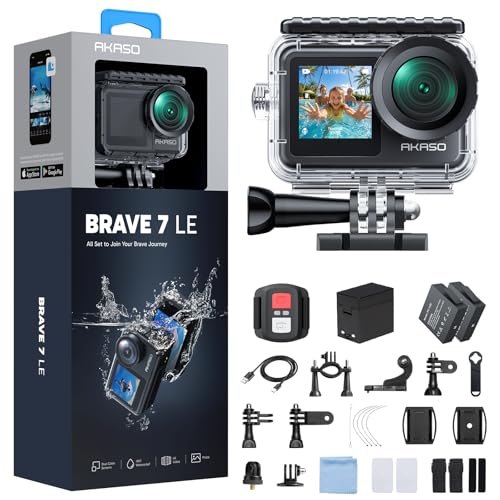
If the phrase “first action camera” describes your shopping trip, this is where to start. The Brave 7 LE records genuine 4K video with electronic stabilization, carries screens on the front and back so your preteen can frame a selfie shot without guessing, and arrives with the kind of accessory bundle that makes Christmas morning feel abundant — mounts, a remote, spare batteries, the works. Crucially, it does all of that at a budget-tier price, which changes the emotional weather around the camera entirely. A child who is terrified of breaking an expensive gift does not experiment; a child whose camera can be replaced learns to film everything, which is the entire point.
In daily life it behaves like a friendly appliance. Buttons are obvious, the menus are shallow, and the footage — let us be clear-eyed — is a clear step below the flagships in this guide: stabilization works hard on a bike but gets busy on rough trails, and dusk footage turns grainy. For a preteen’s actual uses, which are daylight, outdoors, and destined for family screens, those limits rarely bite. The body is weather-resistant and a waterproof case comes in the box for swimming and beach duty. Think of it as the camera equivalent of the bike with a few scratches already forgiven: the one they will actually ride hard. If it survives the year and the filming bug has truly bitten, it graduates to being the second camera — the risky-angle one — when a flagship eventually arrives.
- Video: 4K recording with electronic image stabilization
- Screens: front and rear displays for easy self-framing
- In the box: generous mount bundle, remote, and spare batteries typically included
- Protection: weather-resistant body plus an included waterproof case
Strengths
- A price that turns accidents into lessons instead of disasters.
- Everything needed to start filming arrives in one box.
- Simple enough for a nine-year-old to run entirely alone.
Trade-offs
- Stabilization and low-light footage trail the flagship picks.
- Needs its case on for true underwater use.
- A serious young filmmaker may outgrow it within a couple of years.
Best for: first-time owners aged nine to twelve, and any family that wants the learning to be fearless. Not suited for: a preteen already editing polished videos who will notice every quality gap.

GoPro HERO12 Black — Best to Grow Into
Some preteens do not dabble. They have a channel planned, a stop-motion series storyboarded, or a skate part they intend to film properly — and for that child, buying a camera they will outgrow by spring is the expensive option disguised as the cheap one. The HERO12 Black is the previous generation’s flagship, which in practice means excellent 5.3K video, stabilization that makes bike and ski footage look startlingly professional, and the full GoPro accessory universe: every mount, filter, and case a growing filmmaker could want already exists for it, at every price level, forever.
Because it is a generation old, it frequently sells at a friendlier tier than the newest model while giving up little that a young creator will miss — chiefly the built-in GPS and the newest lens-mod system. It is waterproof in its bare body, tough in the way GoPros have proven across a decade of abuse, and its footage edits beautifully in free software, which matters when the next stage of the hobby is learning to cut a real video. The cautions are parental rather than technical: it is valuable enough that a loss hurts, its richness of settings can overwhelm a younger nine-year-old at first, and it deserves the “sign it out, bring it back” treatment until care habits are proven. For the right kid, though, this is the camera that is still filming family holidays when they are sixteen.
- Video: 5.3K recording with a tall sensor for flexible framing and cropping
- Stabilization: flagship-grade smoothing for bikes, boards, and skis
- Ecosystem: the deepest mount and accessory catalog in the guide
- Build: waterproof without a housing; previous-generation pricing advantage
Strengths
- Years of headroom for a child whose filming ambitions are real.
- Footage quality that rewards learning to edit.
- Every accessory imaginable, at every budget, indefinitely.
Trade-offs
- Costs enough that losing it is a genuine event.
- Settings depth can swamp a younger or casual user initially.
- No built-in GPS for the location-and-speed overlays some kids love.
Best for: preteens already serious about filming, and families buying one camera to last through the teens. Not suited for: a first camera for a child whose care habits are still unproven.

OM SYSTEM Tough TG-7 — Toughest Pick
The TG-7 is the answer to a specific parental prayer: the camera that cannot be killed by a childhood. It is waterproof deep enough for snorkeling straight out of the box — no housing, no seals to check, no case to forget — and it is built to survive drops onto concrete, being crushed in a packed bag, and freezing at the ski field. For the preteen whose life happens at the pool, the beach, the creek, and the tide pools, that design brief is not a feature list; it is the whole argument. It also shoots proper still photographs with a real zoom lens, which none of the cube-shaped action cameras can claim, and its microscope-style macro mode turns backyard bugs, shells, and snowflakes into genuine wonders — a quiet superpower for the science-minded kid.
As a video camera it is very good rather than class-leading: stabilization and video polish trail the dedicated action cameras, and its chunky, serious styling reads “expedition tool” rather than “cool helmet cam,” which will matter to some kids and delight others. It has no front screen for self-framing, and it costs flagship-adjacent money, which buys toughness and optics rather than video flair. But here is the family math that sells it: this is frequently the camera that gets handed down to the next sibling still working perfectly, long after sleeker devices have met their one bad drop. For a rough-and-tumble preteen or a water-obsessed one, it may be the most economical camera in this entire guide.
- Protection: waterproof, drop-proof, crush-resistant, and freeze-proof by design
- Lens: real optical zoom plus a renowned close-up macro mode
- Photos: strong stills performance alongside solid video
- Extras: built-in sensors log location and conditions for science projects
Strengths
- Survives the childhoods that retire other cameras in a season.
- Straight into the sea or pool with zero housing ritual.
- Macro mode opens a whole second hobby of tiny worlds.
Trade-offs
- Video stabilization and polish sit a step below the action cameras.
- No front screen for self-framing.
- Serious-tool styling will not thrill every image-conscious twelve-year-old.
Best for: swimmers, snorkelers, beach and creek kids, and the reliably destructive. Not suited for: helmet-and-handlebar filming as the main event, or selfie-video creators.

DJI Osmo Action 5 Pro — Easiest to Live With
If the AKASO is the forgiving starter and the GoPro is the heirloom, the Osmo Action 5 Pro is the camera that makes daily life easiest — and for many families that is the quality that decides whether a camera gets used weekly or monthly. Its front and rear OLED screens are the brightest and clearest here, readable in the full glare of a beach afternoon, and both are touchscreens, so a preteen can change settings by tapping what they see instead of memorizing button codes. The magnetic quick-release mount is the other daily joy: click the camera from helmet to handheld grip to tripod in a second, with a satisfying snap small hands manage easily.
Then there is the battery. This camera’s endurance is in another league from its rivals, which in family terms means it survives the whole holiday excursion — the hike, the boat, the beach, the ride home — on the battery it started with, instead of dying at the waterfall. Footage quality is excellent, stabilization is confident on bikes and boards, and it is waterproof without a case. The honest debits: it sits at a flagship price, so the loss math needs a family conversation; its accessory world, while strong, is a size smaller than GoPro’s; and younger kids will need a parent to set it up thoughtfully the first time. For a responsible eleven- or twelve-year-old, or a camera the whole family shares, it is arguably the most pleasant device in this guide to own.
- Screens: bright dual OLED touchscreens, front and rear
- Battery: class-leading endurance for full-day adventures
- Mounting: magnetic quick-release for one-second swaps
- Build: waterproof without a housing, with confident stabilization
Strengths
- The easiest camera here for a kid to operate confidently in bright sun.
- Battery life that ends the mid-adventure shutdown.
- Mounting system a child can work faster than most adults.
Trade-offs
- Flagship price demands proven care habits.
- Accessory catalog is strong but smaller than GoPro’s.
- Rich features reward a parent-guided first setup.
Best for: responsible older preteens and families sharing one excellent camera. Not suited for: a first camera whose owner is still in the drops-everything phase.

Fujifilm Instax Mini 12 — Best for Instant Sharing
Not every preteen wants to make videos. Some want to make things — and hand them to people. The Instax Mini 12 is an instant camera with the friendliest possible brief: point it, press the button, and ninety seconds later a real photograph exists in the physical world, ready to be gifted, traded, taped to a locker, or slid into a birthday card. There is no screen, no editing, no account, no feed, and no audience of strangers — the entire social experience happens face to face, which for many parents is not a limitation of this camera but its finest feature.
Operation is calibrated for small hands and zero patience: automatic exposure handles the thinking, a twist of the lens turns it on, and a little selfie mirror plus close-up mode covers the two ways preteens actually use it. The prints are small and credit-card sized, the look is soft and unmistakably film, and the camera itself comes in colors that make it a possession rather than a tool. The running cost is the thing to budget with open eyes: film is a per-photo expense forever, which is either a flaw or a feature — plenty of parents find that a child who knows each shot costs something composes more thoughtfully than one spraying a thousand digital frames. It is not waterproof, not an action camera, and not trying to be. As the creative gift for the social, crafty, scrapbooking preteen, it has no rival in this guide.
- Format: instant film prints, credit-card sized, developing in about ninety seconds
- Exposure: fully automatic, with close-up and selfie modes
- Operation: twist-to-on lens, no screen, no menus, no accounts
- Running cost: film is an ongoing per-photo purchase — plan for it
Strengths
- Sharing that happens in person, as a physical object.
- The simplest operation of any camera in this guide.
- Turns photography into gifts, trades, and room decorations instantly.
Trade-offs
- Film costs accumulate with every single photograph.
- No video, no waterproofing, no action mounting.
- Print quality is charmingly soft rather than sharp.
Best for: social, crafty preteens who love making and giving things. Not suited for: video creators, swimmers, or anyone counting the cost per click.
VTech Kidizoom Action Cam — Best for the Youngest Preteens
At the young end of the preteen range — the eight- and nine-year-olds, and the kids whose belongings lead hard lives — there is an argument for one deliberate step down in seriousness. The Kidizoom Action Cam is a real little action camera wrapped in kid-proofing: it comes with a waterproof case for pool and beach duty, mounts for bikes and helmets, and a body designed to be dropped by small hands without consequence. Its video and photo quality is modest — fine for family screens and a child’s own delight, not comparable to the real action cameras above — and that modesty is precisely what makes it replaceable without a family summit.
What it gets right for this age is the experience around the filming: simple controls a young child masters in minutes, playful effects and games built in, and a price that lets a parent say “take it to the creek” without a flicker. It is sold as a prose-only pick in this guide — look for it through toy and electronics retailers — and it should be bought with clear eyes about its lifespan in your child’s affections: a camera-loving ten-year-old will outgrow it and start eyeing the AKASO or the GoPro, which is fine. Think of it as the training-wheels entry that proves whether the filming bug is real before real money follows, and as the camera the younger sibling inherits with genuine excitement rather than hand-me-down resignation.
- Design: kid-proofed body with an included waterproof case
- Mounts: bike and helmet mounts included for action filming
- Experience: simple controls with playful built-in effects
- Quality: modest video and photos, sized for family screens
Strengths
- Built for the drops and dunks of the youngest owners.
- Everything in the box, at a genuinely low-stakes price.
- A safe way to test whether the camera hobby will stick.
Trade-offs
- Image quality is a clear class below every other pick here.
- Older preteens will find it babyish sooner rather than later.
- Its mount ecosystem is its own, not the grown-up standard.
Best for: eight- and nine-year-olds and famously rough-on-things kids. Not suited for: a discerning eleven- or twelve-year-old, who will read it instantly as a little kid’s camera.
How Do the Six Compare for a Family Buyer?
| Camera | Badge | Standout trait | Watch out for |
|---|---|---|---|
| AKASO Brave 7 LE | Best First Action Camera | Value and a complete starter bundle | Busy stabilization, grainy dusk footage |
| GoPro HERO12 Black | Best to Grow Into | Flagship footage and endless accessories | Price of loss, settings depth |
| OM SYSTEM Tough TG-7 | Toughest Pick | Survives water, drops, and crushing | No front screen, video a step behind |
| DJI Osmo Action 5 Pro | Easiest to Live With | Screens, mounts, and marathon battery | Flagship price |
| Fujifilm Instax Mini 12 | Best for Instant Sharing | Real prints, zero screens or feeds | Film is a forever running cost |
| VTech Kidizoom Action Cam | Best for the Youngest Preteens | Kid-proof and low-stakes | Modest quality, outgrown quickly |
What Should Parents Set Up Before the Camera’s First Outing?
Spend twenty minutes as the camera’s first owner before handing it over. Charge it fully, format the memory card inside the camera, set the date, and choose sensible defaults — a mid-range resolution with stabilization on gives the best battery life and the most forgiving footage, and it keeps file sizes friendly for the family computer. Turn off anything that uploads automatically. Then do the physical setup: fit the case, attach a wrist strap or floating grip if water is anywhere in this child’s future, and write a name and phone number on a label inside the case, because cameras left at pools and parks come home surprisingly often when they can be identified.
Then have the talk — the short, calm, non-negotiable one. Cameras in this house are never used in bathrooms or bedrooms, never pointed at anyone who has said no, and nothing gets posted or sent anywhere without a parent seeing it first. Agree on where the footage lives and who backs it up, because a preteen’s entire creative archive on one memory card is a heartbreak waiting for a lost card. None of this needs to be heavy; kids absorb “these are the house rules for cameras” the same way they absorb rules for the stove. What matters is that the rules arrive with the camera, as part of the gift, rather than after the first incident, when they feel like punishment.
How Can a Preteen Get Better at Filming, Week by Week?
The encouraging truth is that kids improve at filming the way they improve at everything — by making lots of it and watching it back. A few habits accelerate the process noticeably. First, hold still longer than feels natural: most beginner footage is ruined by panning and zooming with excitement, and simply counting to five before moving transforms a clip. Second, get closer — to the dog, the jump, the cake — because action cameras have wide lenses that make distant subjects tiny. Third, film the boring bits on purpose: hands tying skates, the walk to the park, the dog waiting. Those in-between shots are what turn a pile of clips into a story when they sit down to edit.
Give the hobby gentle structure if your child responds to it: a one-minute video every weekend, a family holiday cut as the annual project, a stop-motion scene built over a rainy afternoon with the camera locked on a tripod. Free editing apps on a family tablet are plenty for years — titles, music, trimming — and the first time a preteen shows a finished, watchable video at dinner, the camera stops being a gadget and becomes their thing. Resist upgrading the hardware when skills plateau; at this age the plateau is always technique, and the camera they already own has more headroom than they have yet used.
Which Camera Fits Your Child’s Actual Obsession?
Start from the activity, not the aisle. The skate-and-bike kid lives on mounts: helmet, chest, handlebar — and on stabilization, because their footage is only as good as its smoothness at speed. The AKASO covers this child happily for a first year, and the HERO12 is their upgrade path, with the same mounts carrying over. The water kid — swim team, surf lessons, a family that lives at the lake — needs waterproofing without ritual, which is the TG-7’s entire personality, with the Osmo Action 5 Pro as the video-first alternative whose screen and battery suit long beach days.
The performer — the child filming skits, dances, toy reviews, and narrated adventures — cares about the front screen, decent sound in a quiet room, and a camera that works on a little tripod as happily as on a helmet. That is Osmo and GoPro territory again, with the AKASO as the starter. The maker — the child who builds, bakes, draws, and constructs — often wants time-lapse and stop-motion more than action, and every video camera here can do a simple locked-off time-lapse, while the Instax serves the maker whose medium is the physical object. And the nature kid, the one turning over rocks and following frogs, deserves a sentence of their own: hand them the TG-7 and its macro mode and stand back, because a child who can photograph a beetle’s face at enormous magnification has been given a microscope that also swims.
Notice what this exercise does: it makes the choice obvious in most households within a minute, because children are rarely ambiguous about their obsessions. Buy for the obsession that exists today, at the tier your family’s loss-tolerance allows, and let next year’s obsession make its own case.
What Do Waterproof and Tough Ratings Actually Mean for a Family?
The numbers on the box translate into daily life more simply than they appear. A camera rated waterproof to ten metres without a housing — the GoPro and DJI here — can go swimming, snorkeling at the surface, and under waterfalls, but should not be handed a scuba dive. The TG-7 goes further and shrugs off deeper snorkeling, which is why reef holidays love it. Cameras like the AKASO split the difference: the body resists splashes, rain, and snow, while true immersion waits for the included case — a perfectly workable arrangement as long as the case actually gets used, which is a habit to build on day one rather than an intention to form later.
Two practical warnings belong in every family’s head. First, waterproofing depends on doors and seals being closed and clean; a grain of sand on a battery-door seal is the classic cause of the one leak that ruins the camera and the holiday video both, so teach the ten-second seal check as part of the camera ritual. Second, after salt water, every camera here wants a rinse in fresh water and a patient dry before charging or opening — salt is patient and corrosive, and it collects its debt from the families who skip the rinse. None of this is difficult; all of it is the difference between a camera that survives three summers and one that survives three weeks.
How Should You Bundle the Gift So Day One Goes Well?
The difference between a camera that gets used on the first afternoon and one that waits a week for a missing card is entirely in the bundle. Non-negotiables: the camera, a memory card of generous size, and a case that fits the camera with its everyday mount attached — a case that requires disassembly before storage will simply stop being used. Then add the one accessory matched to the child’s element: a floating hand grip for water kids (brightly colored, so it can be spotted at the surface), a helmet or bike mount for riders, a mini tripod for makers and performers. A spare battery is a kindness; a screen-protector pack is cheap insurance; a small microfiber cloth teaches care by existing.
Charge everything before the gift is given, format the card in the camera, and — the move experienced parents swear by — pre-load nothing, but plan the first outing. A camera whose first footage is a deliberate trip to the skate park, the pool, or the woods becomes a hobby on day one; a camera unwrapped at a party and filmed at the ceiling becomes a novelty by day three. If the camera is a shared family purchase rather than a gift, the same logic holds with one addition: agree out loud whose it is on which days, because the only fights these cameras reliably cause are custody disputes between siblings who both, suddenly, are filmmakers.
Is a Second-Hand Action Camera a Smart Shortcut?
Often, yes — the used market for action cameras is one of the friendliest in consumer electronics, because last year’s flagships are excellent, owners upgrade frequently, and the cameras are tough enough that a used one is rarely a lemon. A second-hand HERO12-tier camera can put flagship footage in a preteen’s hands at a starter-camera price, which scrambles this guide’s tiers in a good way. If you shop used, inspect the three things that tell the truth: the lens (scratches there cannot be unseen in footage), the waterproof doors and seals (any grit, damage, or a door that sits crooked ends the negotiation), and the battery (a tired one is replaceable, but price it in).
Buy from sellers with returns, run a test recording the day it arrives — a minute of video, a splash test in the sink for the seals if you are confident, a full battery cycle if time allows — and factory-reset it before your child uses it, so no stranger’s footage or account lingers. The two used purchases to avoid are cameras with any sign of water intrusion (fogging under the lens, corrosion on contacts) and no-name bargains whose mounts and batteries you will never find again. A used camera from the ecosystems in this guide keeps its accessory future; that is worth more than a slightly lower price on an orphan.
How Long Will This Camera Realistically Last in Your Family?
Physically, the tough picks here are measured in years — the TG-7 in particular has the air of a camera that will be photographing grandchildren’s pool parties if the family keeps it. The more realistic limit is the interest curve and the technology’s slow march: a camera bought at ten will usually serve beautifully to fourteen or fifteen, by which time a serious young creator wants current features and a casual one has a phone. Plan the purchase as a four-year tool and every pick in this guide is defensible; the budget picks simply cap the cost if the four years turn out to be four months.
You can stretch the lifespan with two habits. Keep the camera in the family rotation rather than a drawer — a camera that comes on holidays as the designated pool-and-action shooter stays charged, updated, and loved. And let its role evolve: today’s main camera becomes tomorrow’s second angle, the risky mount, the one lent to a cousin or kept in the car. The AKASO that starts a hobby at ten is genuinely useful at thirteen as the camera that goes where the GoPro should not. Bought at the right tier and used this way, none of these purchases is really finished until the family is.
Which Mistakes Do Families Make When Buying a First Camera?
The most common is buying for the parent’s eye instead of the child’s life — choosing maximum image quality in a body that needs a housing, a careful hand, and a settings tutorial, then watching it live in a drawer because using it feels like defusing something. Second is the opposite error: buying a toy so flimsy and low-quality that the footage disappoints a kid who has seen what real cameras do, teaching them that filming is a letdown. The middle path — a real action camera at a sane tier — exists precisely because both ditches are full of returned purchases.
Third is forgetting the accessories that prevent the classic losses: no floating grip, so the camera sinks the first time it leaves a hand over water; no case, so the school bag administers the fatal scratch; no spare card, so the big day fills up by noon. Fourth is skipping the safety conversation until after something has been filmed or shared that should not have been — the talk costs ten minutes on day one and a great deal more later. And fifth is treating the camera as a test the child can fail. They will drop it, dunk it, and leave it somewhere at least once. Choose a camera whose survival does not depend on your child being a different, more careful person, and everyone gets to enjoy the year.
Final Recommendation
One last word of encouragement for the parent still hovering over the decision: the perfect first camera matters far less than the first month of using it. A modest camera that goes everywhere, films everything, and comes home to a family that watches the footage together will do more for a child’s creativity than a flagship that waits for special occasions. Buy the sensible one, plan the first outing, and let the hobby make its own arguments from there.
For most preteens, start with the AKASO Brave 7 LE: it is a real action camera at a forgiving price, with everything in the box and nothing to fear. If your child is already filming seriously and caring for their gear, skip a tier and buy the GoPro HERO12 Black once — it will serve them for years. Choose the Tough TG-7 when water and destruction are the defining features of your child’s life, the Osmo Action 5 Pro when you want the easiest daily experience and battery life that never interrupts, the Instax Mini 12 when the real desire is making and sharing physical things, and the Kidizoom when the owner is young enough that kid-proofing still beats pride. Match the camera to the child you actually have, add the case and the conversation, and get out of the way.
Related guides
- Best Cameras for Blue Irirs: 6 Open-Stream Cameras Blue Iris Actually Loves
- Best Cameras for Beginners With Flip Screen: 6 Cameras You Can Frame Yourself In
- Best Cameras for Action Pictures: Burst Speed, Tracking and Shutters That Keep Up With Sport
- Best Cameras for 9 Year Olds: Durable, Simple Cameras a Third-Grader Can Own Outright
- Best Cameras and Software for Beginner Photography: Start Shooting, Start Editing, Keep Both Simple
- Best Cameras for 1000: What a Four-Figure Budget Actually Buys in Photography
- Best Cameras for 150 Dollars: What the Smallest Serious Budget Actually Buys
- Best Backup Plug-In Battery for Wi-Fi Cameras: 6 Ways to Keep Plug-In Cameras Running in an Outage
- Best Beach Cameras for Beginners: 6 Waterproof and Tough Cameras That Come Swimming
- Best App for IP Cameras Cloud Storage: 6 Services That Keep Your Footage Safe
- Best App for Multiple IP Cameras: 6 Dashboards That Keep Every Feed in View
- Best Android App for Detecting Hidden Cameras: 6 Tools That Actually Help
- Best App for Dahua Cameras: 6 Ways to View, Play Back, and Manage a Dahua System
- Best Age for Kids to Have Cameras: A Stage-by-Stage Guide With Six Cameras From Age 4 to Teen
Frequently Asked Questions
At what age does a real action camera make sense?
For most children, somewhere between nine and eleven — old enough to understand the house rules about filming people, young enough that a durable, simple camera fits their life perfectly. Younger children are usually better served by the kid-proofed end of this guide, like the Kidizoom, while a mature ten-year-old with proven care habits can start directly on the AKASO or even the GoPro. The deciding factor is not the birthday; it is whether the child can be trusted with the rules and roughly with the object.
Should I buy my preteen a camera or just give them my old phone?
An old phone takes fine video, but it brings a browser, a messaging world, and a fragile glass slab into every pool trip and bike ride. A dedicated action camera is tougher, waterproof, distraction-free, and — not trivially — theirs. Many families also find the camera an elegant delay tactic: real creative tool now, phone later. If the phone is already part of your child’s life, the action camera still wins anywhere wet, rough, or mounted.
How much storage and how many batteries do we need?
One good memory card of generous size and a spare battery cover most preteen use; add a second card if the camera will travel on holidays where offloading is rare. Teach the weekly habit of moving footage to the family computer or drive — it protects the archive and keeps the card empty for the next adventure. The Osmo Action 5 Pro’s long battery life relaxes the spare-battery question more than any other pick here.
Is a front screen really important for kids?
For this generation, usually yes. Preteens film themselves — narrating, reacting, presenting — as naturally as they film the world, and a front screen is the difference between framing that shot and guessing at it. It is why most picks in this guide carry dual screens. The exceptions prove the rule by serving different joys: the TG-7 is about the world in front of the lens, and the Instax is about the print in the hand.
What about posting videos online?
That is a family decision that sits above any product choice, and the common safeguards are well established: private accounts where platforms allow them, a parent reviewing before anything is posted, no location details, no school identifiers, and an understanding that anything shared can travel further than intended. Many families keep preteen filming entirely offline — shared with family, screened at home — and discover the creative joy survives perfectly well without an audience of strangers. The Instax Mini 12 exists in this guide partly as the patron saint of that approach.
Can these cameras double as the family holiday camera?
Happily — and many do, which softens the purchase considerably. The TG-7 is a legitimate travel compact for anyone in the family, the GoPro and DJI shoot the pool, beach, and bike footage no phone should risk, and even the AKASO covers action days admirably. One camera riding in the family bag, owned by the preteen but borrowed by all, is often how these devices earn their keep across years rather than months. Just keep the custody agreement cheerful and explicit, and back up everyone’s footage to the same family archive.
What if my child loses interest after a month?
Then you have learned something cheaply if you started at the sensible end of this guide — and interest often returns in waves, at the next holiday, the next sport, the next cousin visit. Action cameras also moonlight happily as family cameras for trips and pool days, so a lapsed hobby rarely means a wasted purchase. This is the practical argument for the AKASO as a first step: it keeps the cost of finding out low while keeping the quality of the experience high.
How should parents handle sharing and privacy with a preteen’s first action camera?
The camera itself is the easy part; the habits around it matter more. A preteen filming friends at the pool or the skate park is creating recordings of other people’s children, and the household rule worth setting on day one is simple: we ask before we film someone up close, and we never post a clip of another child without their parents knowing. Sharing settings deserve the same attention as the gift itself. Keep uploads on a family account you supervise, turn off location tagging so a ride through the neighbourhood does not publish a map of it, and agree together which platforms — if any — the footage may reach at all. The companion apps for several cameras in this guide make quiet background uploading easy, which is precisely why the conversation has to happen before the first ride rather than after the first link circulates at school. None of this needs to dim the fun. Framed as the same courtesy the child would want from a friend with a camera, the rules become part of learning to be a decent creator — a skill that will matter long after this first rugged little camera has been outgrown.
Related Guides
When the filming bug spreads to the whole family, see best action cameras for vlogging for the next step up in creator cameras, best action cameras for surfing for the beach-and-board specialists, and best action cameras for drones for the day your young filmmaker wants to take the camera airborne.


