Standing gaming desk vs seated is not really a contest between two desks — it is a question about how much of your gaming time your body wants to spend on its feet. Seated play is the default for precision and endurance; standing play trades a little of both for movement, alertness and variety. Most players who try both land on a hybrid: a height-adjustable desk that lets the day decide. This comparison lays out the honest strengths of each mode so you can choose your setup with open eyes.
Disclosure: As an Amazon Associate, ilcastellomenu.com earns from qualifying purchases. Product links on this page may earn us a commission at no extra cost to you. Prices and availability change on Amazon, so check the product page for the current details before you buy.
Quick Verdict: Precision Sits, Energy Stands
Seated gaming wins for competitive and precision play, long sessions, racing and flight rigs, and anyone whose feet or legs object to standing still. Standing gaming wins for casual and social play, short sessions, rhythm and VR-adjacent gaming, and players who already work standing and want their leisure to match. If your desk is also your office, a height-adjustable desk that serves both modes is usually the correct purchase — the standing question becomes a daily choice instead of a permanent one.
| Criterion | Seated | Standing |
|---|---|---|
| Aim precision (mouse) | Highest — forearm supported | Slightly lower — arm floats more |
| Session endurance | Hours, with a good chair | 30–90 min for most people |
| Movement and alertness | Low unless you take breaks | High — weight shifts, steps, stretches |
| Hardware needs | Chair is the key investment | Anti-fatigue mat, footwear, monitor height range |
| Best genres | FPS, MOBA, sim, strategy marathons | Casual, party, rhythm, short-session play |
| Desk type | Any fixed desk | Fixed tall or height-adjustable |
Whichever mode you favour, the desk itself must fit the ergonomics of that mode — Gaming Desk Ergonomics Explained covers both sets of numbers, and they are not interchangeable.
In this guide
Seated Gaming: Why It Remains the Default
Mouse aim is a fine-motor skill, and fine motor skills love support: a seated player’s forearm rests, the elbow pivots from a stable base, and the whole upper body is a fixed platform. That is why essentially all competitive FPS, MOBA and RTS play is seated, and why racing and flight sims — built around fixed wheels and sticks — assume a chair. Endurance compounds the advantage: with a properly adjusted chair (see How to Adjust a Gaming Chair), a seated player can hold form for hours, with posture variety coming from recline and tilt rather than from standing up.
The seated mode’s weakness is stillness itself. Long static sessions are the habit every ergonomist warns about, and a seated-only setup makes movement something you must schedule — breaks, stretches, walks — rather than something the furniture invites. That is a manageable weakness, but it is the honest one.
Standing Gaming: What It Does Well and Where It Struggles
Standing changes your relationship with the game: you shift weight, step, lean and react with your whole body, which suits social, casual and shorter-session play beautifully. Many players report feeling more alert and less slumped during evening sessions after a sedentary workday — the novelty of standing is itself energising. Genres with gross-motor input (rhythm games, motion-controlled play, VR in a cleared space beside the desk) are natural standing territory.
The struggles are precision and fatigue. Unsupported arms fatigue faster, subtly degrading mouse control over a long session; and standing still — as opposed to walking — loads feet, knees and lower back in its own way, which is why a cushioned anti-fatigue mat and supportive footwear are equipment, not accessories, for standing play (see the gear section). Most standing gamers settle into sessions well under two hours, and many alternate: stand for casual content, sit for ranked. A desk that cannot change height forces you to choose per purchase; an adjustable one lets you choose per mood — the models in Best Standing Desks for Home Office show the format, and gaming-specific frames appear in Best Gaming Desks for Under 200 and above.
The Hybrid Answer: Height-Adjustable Desks Done Right
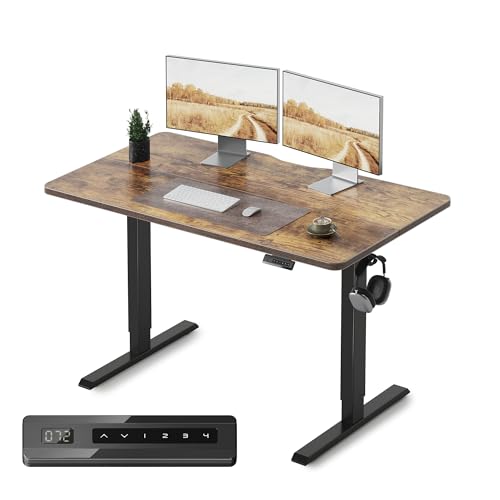
If the verdict above leaves you torn, you are the target customer for an electric height-adjustable desk: memory presets for your seated and standing heights, a frame stable at full extension, and enough width for your screens. Two practical warnings come with the format. First, stability at standing height is the spec that matters — a desk that wobbles at sitting height will sway like a mast when raised, so frame quality outranks motor speed. Second, cables: every lead between desk and floor or desk and tower must accommodate the full travel, with the sleeved slack loop described in How to Organize Cables on a Gaming Desk.
Your chair still matters in a hybrid setup — more, if anything, because seated hours remain the majority for most players. Pair the adjustable desk with the best chair you can, use standing as the variety layer, and the combination outperforms either pure mode for mixed work-and-play days. Players building the full station from scratch will find the arrangement order in How to Set Up a Gaming Desk.
Who Should Skip Standing Entirely
Be honest about the exceptions. Players with foot, knee or circulation issues that standing aggravates should take medical advice before building a standing setup, and this guide is not a substitute for it. Sim racers with bolted rigs gain nothing from standing. And anyone whose gaming is exclusively long, competitive and seated should put the standing budget into a better chair and monitor instead — the correct answer to ‘standing gaming desk vs seated’ is sometimes simply ‘seated, done properly’, with movement supplied by breaks. The desk-buying framework in How To Choose A Gaming Desk helps you spend that budget where it counts.
Building Standing Endurance: A Two-Week Ramp
Players new to standing desks often fail the experiment in week one by standing like it is a test of character: full sessions, no mat, soft socks on hard floor, then a verdict that standing is miserable. Standing is a physical practice with a learning curve, and the ramp matters. Start with the casual content — menus, deck-building, social games, shorter matches — for twenty to thirty minutes, mat underfoot and supportive shoes on.
Across two weeks, extend the standing blocks as comfort allows and notice what actually limits you: feet (mat and shoes), lower back (posture and screen height), or focus (save ranked for the chair a while longer). Most players plateau at a personal ratio — commonly somewhere between a quarter and a half of total play standing — and that plateau is the answer, not a failure to reach some prescribed number.
Keep the alternation deliberate: stand for the content that suits it, sit for the content that demands it, and let the desk’s memory presets make the switch a button press rather than a project. The habit, once built, maintains itself.
Standing Setups Beyond the Desk: Room, Floor and Neighbours
Standing play changes your room’s physics. Your head and screen sit higher, so check sightlines — a window behind the raised screen that was harmless seated can glare at standing height. Your feet occupy one spot for long stretches, so the floor there matters: hard floors want the mat, and carpet wants a firmer standing surface or a low-pile mat overlay, because sinking into pile fatigues ankles quietly.
Downstairs neighbours enter the calculation in apartments: standing players shift, step and occasionally celebrate, and a mat plus soft footwear is both comfort and diplomacy. VR-adjacent standing play needs its cleared radius checked at standing reach, not seated assumption — controllers find shelves that sitting never threatened.
None of this is burdensome; it is the standing mode’s equivalent of chair adjustment, done once and enjoyed daily. Players who skip it conclude standing is uncomfortable; players who do it conclude it is natural. The difference is twenty minutes of setup honesty.
The Evidence, Stated Carefully
Standing desks attract health claims the way monitors attract fingerprints, so this guide states the position plainly. Prolonged static sitting is associated with discomfort and worse health markers; breaking it up with standing and movement is a reasonable, low-risk response. Standing all day carries its own associations with leg and back discomfort. The defensible claim is about variety and interruption, not about any posture being medicine.
For gaming specifically, there is no credible evidence that standing improves performance outcomes, and some practical evidence — from every competitive scene on earth — that seated precision is the standard for a reason. Buy standing capability for comfort, energy and variety if those appeal to you; do not buy it as a health intervention or a performance upgrade, because it is honestly neither.
Players with existing conditions — back, hip, knee, circulation, pregnancy — should treat standing as a change to discuss with their clinician, in the same way they would a new exercise. This comparison can inform the furniture decision; it cannot inform the medical one, and it does not pretend otherwise.
What remains after the caveats is still a good product: a desk that lets you change position at a button press, serving work and play across a whole day. Variety is a modest claim, and modest claims are the ones that survive contact with your actual evenings.
Controller, Keyboard and the Standing Input Problem
Inputs behave differently standing. Keyboard and mouse work well if the desk height is truly at your standing elbow — a centimetre low and your wrists extend, a centimetre high and your shoulders climb, and both errors announce themselves within twenty minutes. This precision is the strongest argument for electric adjustment with memory presets over any fixed tall desk: your standing number is personal, and the preset remembers it exactly.
Controllers are standing’s natural input — untethered, gross-motor, forgiving of stance shifts — which is why casual and social standing sessions feel so good. Racing wheels and flight sticks are the opposite: they assume a seated geometry anchored to pedals, and no standing arrangement serves them honestly. Genre, once again, casts the deciding vote between the modes.
Voice and streaming add a small standing bonus worth naming: many people project and present better on their feet, and standing streamers often report an energy their seated selves envy. If your gaming is performance in both senses, the standing mode may be your stage — with the seated mode kept, always, for the games that demand the platform.
What Standing Players Actually Report After a Year
Talk to standing gamers a year in — not a week in, when novelty testifies — and a pattern emerges. Almost none stand for everything. Most have settled into a personal liturgy: standing for casual sessions, creative work, calls and the first gaming hour of the evening; seated for ranked, for sims, for the deep night. The adjustable desk did not convert them to standing; it gave them a second posture, which turned out to be the actual product.
They also report the desk’s other quiet dividend: the standing height became the room’s workbench — hardware swaps, cable projects and PC builds all happen at standing height, on the desk that raises to meet them. An adjustable desk is a tool beyond its two gaming modes, and owners consistently rate this accidental benefit higher than expected.
The minority reports matter too: some players sold the standing desk within the year, finding the sway, the cost and the unused motor a poor trade. Their sessions were long, competitive and seated by nature. The comparison in this guide exists so that their discovery can be yours on paper instead of on an invoice.
Fixed Tall Desks: The Third Option Nobody Should Buy Blind
Between the standard desk and the adjustable one sits the fixed standing-height desk — cheaper than electric, committed entirely to standing. For gaming it is almost always the wrong purchase: it forbids the seated mode entirely unless paired with a drafting stool, whose ergonomics for long sessions are a compromise stacked on a compromise. The players it suits are those who already know, from an adjustable desk or a workplace, that they stand happily for most of their day.
If you are tempted by the price, run the experiment first with a borrowed or improvised raised surface for two weeks — a counter, a shelf at elbow height, anything safe — and let your body file its report. Standing for an evening is a novelty; standing for a fortnight is data. The fixed desk should only ever be bought by data.
Renters of standing desks — those whose workplaces provide them — have the data already. Everyone else should treat the adjustable desk’s premium as tuition insurance: it costs more and can never be entirely wrong, because it contains the seated desk inside it.
The Final Word: Posture Is a Portfolio
Think of your postures as a portfolio rather than a position: seated focused, seated reclined, standing casual, walking to the kitchen between matches. Health and comfort live in the diversification, and furniture is just the instrument that lets you rebalance cheaply and often. Judged that way, this comparison has no loser — it has allocations, and yours should match your genres, your sessions and your body’s honest reports.
Buy the desk that gives you the most postures you will actually use, maintain the chair that serves the posture you use most, and move between them without ceremony. That is the whole verdict, and it fits on an index card — the rest of this guide was the evidence.
A Decision Framework You Can Run in Five Minutes
Score yourself quickly. Session length: mostly under ninety minutes favours standing’s case; marathons favour seated. Genre: precision-competitive favours seated; casual, social and controller play favour standing. Day job: if you sit all day at work, standing play offers genuine variety; if you stand all day at work, your gaming chair is a refuge, not a problem. Body: feet and legs that tolerate standing happily are a prerequisite no desk can substitute for.
Three or more standing answers justify prioritising an adjustable desk’s standing mode in your budget. Three or more seated answers say: buy the best seated station you can, and revisit standing when your life changes. A split verdict is the adjustable desk’s natural constituency — which is most people, most of the time.
Whichever way the framework lands, run it again in a year. Bodies, jobs and genres all change, and the correct answer to this comparison is a snapshot, not a sentence. The desk that serves the player you are becoming beats the desk that memorialises the player you were.
A Fair Trial: Running the Two-Week A/B Protocol
Most standing verdicts are filed after a single enthusiastic weekend, which is roughly as reliable as reviewing a chair after sitting in it at the shop. If you own or are trialling an adjustable desk, run the experiment properly. Week one is the control: play seated exactly as you always have, and log three things nightly — when discomfort first arrived, how the last hour felt, and your honest energy at the end. Week two introduces standing by the ramp in this guide, in the same games at the same hours, with the same log kept. The comparison that matters is week two’s log against week one’s, not standing’s novelty against sitting’s familiarity.
Control the confounders you can: same chair settings for the seated hours, same footwear and mat for the standing ones, sessions of comparable length. Note the genre of each session, because the protocol will otherwise credit standing with a strategy game’s calm or blame it for a ranked night’s tension. What you are measuring is your body’s response to posture across your real life, and real life is the laboratory — the protocol merely insists you write things down while it runs.
Read the results with the suspicion this guide applies to all ergonomic claims. If standing’s log wins on energy and loses on precision, the hybrid pattern the verdict recommends — stand for the casual content, sit for the serious — is not a compromise but your data’s actual shape. If the logs are indistinguishable, believe them: your body may be indifferent, and the desk’s value to you is the option rather than the outcome. Either way, a fortnight of notes outranks a year of other people’s certainty.
Footwear, Mats and Floors: The Standing Interface
Standing moves the body’s interface from the chair to the floor, and the floor’s side of the bargain deserves the same engineering the chair’s side gets. Footwear first: the standing player is an athlete of stillness, and their shoes are equipment. Cushioned, supportive footwear — or deliberately bare feet on a good mat — distributes the load that cheap flat soles concentrate into heels and arches within the hour. The player who concludes that standing hurts after trialling it in worn slippers on a hard floor has tested their slippers, not the posture.
The mat is the second component, and its job is subtle: not softness for its own sake, but a surface that invites micro-movement — the weight shifts, heel lifts and small steps that keep standing a living posture rather than a statue’s endurance test. A mat that is too soft exhausts the ankles by making them stabilise constantly; one that is merely a rug changes nothing. Judge a mat at minute forty, not minute four, because standing fatigue is a slow narrator and its first chapter always lies.
The floor itself completes the interface: hard floors transmit everything, carpet forgives some of it, and a floor that slopes or flexes will vote against standing all evening. Apartment players add the neighbours to the audit — standing shifts and steps carry through joists that seated play never troubled. The interface’s lesson mirrors the chair’s: the posture is only ever as good as the surface it stands on, and most failed standing experiments are failed surfaces wearing the blame.
Ownership Costs: Motors, Sway and the Service Tail
The standing desk’s long-term ledger differs from the seated one’s in kind, not just degree. A fixed desk’s moving parts number zero; an electric desk’s include motors, a control box, a handset and lifting columns that must stay in synchrony for a decade. Each is a potential failure with a price and a parts channel attached, which is why the choosing guides in this batch interrogate standing desks’ warranties by component: frame long, electronics short, and the split is the manufacturer’s own forecast of where your money will go in year six.
Sway is the ownership cost paid daily rather than eventually. Every two-column desk sways more at standing height than at seated — the physics of a longer lever — and the cost is measured in monitor wobble during animated play and in the slow loosening of everything clamped to a moving surface. Better frames tax the sway down; no frame abolishes it. The seated desk’s stillness, which the main comparison treats as a default, reveals itself in this ledger as a genuine feature that standing spends.
None of this indicts the adjustable desk; it prices it. The honest total cost of standing capability is the purchase, plus a mat and footwear that are really part of the desk, plus a probability-weighted allowance for one electronic repair across a decade, minus the value of the workbench-height utility and posture variety the desk returns daily. Run your own version of that arithmetic with your own session lengths, and the verdict framework in this guide stops being abstract: it becomes a budget with a posture attached.
Genre by Genre: Where Each Mode Actually Wins
The main comparison scores the modes generally; genres score them specifically, and the pattern is consistent enough to plan a week by.
Rhythm, fitness and movement games
Standing is not a preference here but a requirement of the content — these games are played by a moving body, and the desk’s job is to be at the right height and out of the way. The standing desk in its highest, clearest configuration is the only correct answer, and the seated mode simply abstains.
Strategy, simulation and the long calm
The hybrid’s home fixture. These sessions run longest and load the mind more than the hands, so posture variety pays its highest dividend: stand for the planning, sit for the execution, and let the desk’s travel mark the phases of the game. Seated-only players should borrow the principle through breaks; standing-only players will find the fourth hour argues the seated case better than this guide can.
Competitive shooters and precision play
Seated, as the main verdict holds — with one refinement the genre’s own players discovered: standing for the warm-up and the casual queue, seated for the ranked set, uses the standing mode as a ritual boundary between the day’s modes. The desk’s memory presets make the boundary a button press, and rituals, in competitive play, are performance equipment of a real kind.
The Social Standing Desk: Calls, Flatmates and Being Seen Standing
Standing changes how a player appears in their own home, and the social layer deserves a section because it decides real purchases. On video calls, the standing player presents differently — framed from a higher camera, visibly energised, occasionally read by colleagues as pacing or preparing to leave. Camera geometry must be re-derived for the standing position: an arm that serves both heights, a background that works from the taller angle. Players whose workdays are wall-to-wall calls should test the standing presentation deliberately rather than discovering it in front of an audience.
In shared homes, the standing desk is also furniture in motion: it rises into sightlines, its silhouette changes across the day, and its travel needs a clearance discipline the seated desk never asked of the room — nothing stored on the floor in its descent path, no cables dressed to a length that only seated height forgives. Flatmates experience your standing desk as a small lift operating in their living space, and its acceptance in the household is a design constraint as real as its load rating.
None of this argues against standing; it argues for counting the audience. A private room makes the social column vanish. A shared studio makes it a first-order criterion, occasionally the deciding one — and a comparison that pretended otherwise would be selling desks for houses nobody lives in.
Micro-Standing: The Strategy of Small Doses
Between the seated default and the standing convert sits a pattern most long-term standing players actually live: micro-standing. The dose makes the posture — ten to twenty minutes standing per hour, cued by natural boundaries rather than by a timer’s tyranny: stand for the queue and the lobby, for the strategy layer and the inventory sort, for calls and for the game’s calm countries, and sit for everything that asks your hands for precision. Across an evening the doses sum to an hour or two of standing, gathered without a single heroic block, and the fatigue curve that defeats new standing players never gets its chance.
Perch stools and leaning seats serve this pattern as genuine equipment rather than as compromise furniture: they take a share of the body’s weight while keeping the hips open and the feet working, and they suit the player whose feet, knees or circulation ration their standing strictly. Judge a perch by the same audit as any seat in this batch — stable, the right height for your desk’s standing setting, and honest about being a third posture rather than a chair substitute.
Micro-standing reframes the whole comparison’s stakes. If the realistic prize is ninety varied minutes rather than a standing marathon, then the desk that serves it need not be the flagship — a modest adjustable desk, or even a fixed desk plus a raised secondary surface for the standing doses, captures most of the benefit. The verdict framework’s five minutes should be spent pricing the pattern you will actually live, and for most players that pattern is smaller, kinder and cheaper than the one in the advertisements.
Two Bodies, One Adjustable Desk: Sharing the Heights
A standing desk in a shared household serves bodies of different heights in both modes, and its memory presets turn out to be the sharing technology the whole comparison quietly depends on. Set honestly, the desk holds a seated and a standing height per person — four numbers for a couple — and the changeover between users becomes a button press rather than a negotiation. The discipline is in the setting: each preset derived from its owner’s audit, elbows and eyes checked in both postures, rather than one partner’s heights inherited by the other with a shrug, which is how shared desks acquire a primary owner and a tenant who stands wrong.
The chair side of the sharing follows the two-preset system from this batch’s adjustment guide, and the two systems together — desk presets, chair marks — make a shared station genuinely bilateral. What sharing cannot preset away is taste: one partner may love standing and the other may find it a fad, and the desk serves both verdicts without argument, which is the hybrid’s deepest selling point in a household. A fixed desk imposes a posture on everyone; the adjustable desk merely offers, and households run better on offers.
Schedule is the final sharing variable: two players wanting the desk’s best hours is a household negotiation no furniture solves, but the standing mode softens even this — one partner standing at the desk works in a geometry that lets the other sit nearby at a side table without either station feeling like the spare. It is a small dividend, paid daily, and it belongs in the comparison for any desk that will be loved by two people.
Children and the Rising Desk: Fascination and Safety
A desk that moves is the most interesting object in any house containing a child, and the comparison is incomplete without the safety column. Modern desks carry anti-collision sensors that stop travel when the desk meets resistance, but sensors are a backstop, not a supervision policy: the standing desk in a family home should have its handset lockable or placed beyond small reach, its travel path kept clear of the chairs, toys and small persons who will inevitably colonise the space beneath it, and its cables routed so that nothing dangles at grabbing height within the desk’s descent zone.
The seated desk wins this column by being boring: it does not move, its hazards are the static ones of corners and cables that this batch covers elsewhere. Families choosing the adjustable desk are not choosing wrongly — they are choosing a desk that must be managed like the appliance it is, with the same matter-of-fact discipline a household applies to an oven: respected, locked where lockable, and never treated as a toy by anyone of any age, including adults demonstrating its travel to impressed guests with a child underneath.
There is an upside to record as well: children who grow up around a desk that fits its user at several heights absorb the ergonomics lesson physically — furniture adjusts to bodies, not the reverse — and the growing player’s own desk, when it comes, will be audited by an expert. Households have transmitted worse inheritances than posture literacy.
Chair First or Desk First: Spending One Upgrade at a Time
Players rarely buy the whole verdict at once, and the comparison’s most practical question is sequencing: with money for one upgrade this season, does the standing desk or the better chair come first? The answer follows from where your hours sit. Your seated hours are the majority in almost every real life, and they are served by the chair — so a player whose chair is failing them should buy the chair, and let the desk wait, because a standing desk used for two hours a day cannot rescue the eight seated hours a bad chair is taxing.
The exception proves by inversion: a player whose chair is already sound, whose discomfort arrives specifically as end-of-day restlessness and stiffness — the signature of stillness rather than of bad support — is the player the standing desk was invented for, and for them the desk outranks a marginal chair upgrade easily. Diagnose which complaint is yours with the honesty this batch keeps demanding: support problems live in the chair’s column of the ledger, stillness problems in the desk’s, and money spent across the wrong column buys an excellent solution to a problem you do not have.
Sequenced over years, the hybrid station assembles itself in the right order: chair, then desk, then the mat and the arm and the small change that completes each posture. The comparison’s final practical gift is patience — the modes are not rivals competing for a single purchase, but stations on one road, and most players who walk it arrive at both eventually, in the order their bodies dictated.
Standing Desk Myths, Retired One by One
The comparison attracts folklore, and retiring it is part of the verdict’s work. Myth one: standing all day is the goal. The evidence and every honest owner agree the goal is variety; the all-day stander has traded one static load for another and usually returns to the chair with sore feet and a story. Myth two: a standing desk is a fitness device. It is a posture device with a small metabolic bonus, and players who buy it as exercise equipment are disappointed on a schedule, while players who buy it as variety equipment are still using it in year three.
Myth three: sway means a cheap desk. Sway is geometry — a longer lever sways more — and while better frames reduce it, the flagship sways too at full height; the honest test is whether the sway is smooth and damped or loose and rattly, which is a quality distinction rather than a price one. Myth four: your existing chair becomes useless. The opposite is true, and the hybrid sections of this guide are built on it: the chair serves the majority posture and matters more, not less, once the desk can move.
Myth five, the subtlest: that the verdict must be permanent. Bodies change, jobs change, genres change, and the correct answer to this comparison has a review date — the framework in this guide suggests running it yearly. The player who chose seated at twenty-five and standing-hybrid at thirty-five has not contradicted themselves; they have re-run an honest audit on new evidence, which is the most this comparison, or any ergonomics advice, can ever ask.
Gear for This Guide
You do not need to buy anything to follow most of this guide, but the items below are the ones that genuinely come up again and again in this topic. Each one is a current, widely sold model rather than a placeholder pick.

FEZIBO Electric Standing Desk 48 x 24
Fezibo’s electric desk is the hybrid entry point: motorised height adjustment in a gaming-friendly footprint, letting you test standing play without abandoning your seated setup. Check on Amazon

SHW 48-Inch Electric Height Adjustable Desk
SHW’s adjustable desk adds cable management and hooks to the sit-stand formula — the cable discipline matters doubly when the desk itself moves. Check on Amazon

FEZIBO Standing Desk Mat with Anti Fatigue Bar
For the standing hours, Fezibo’s mat pairs cushioning with a balance-bar design that encourages the small weight shifts that make standing comfortable — the difference between standing play that lasts twenty minutes and standing play that lasts an evening. Check on Amazon
Frequently Asked Questions
Is standing better for gaming performance?
For precision genres, no — seated play with a supported forearm remains the performance standard. Standing can feel more alert and engaging for casual play, which is a different kind of performance.
How long can I game standing up?
Most people are comfortable for 30 to 90 minutes with a mat and good footwear, less without. Build up gradually if you are new to standing desks, and alternate with seated play.
Do I need a special monitor setup for a standing desk?
Your screen must reach eye level at standing height — a monitor arm with good height range or a tall-enough stand. On an adjustable desk the screen moves with the surface, which is the simplest solution.
Can I use my normal gaming chair with a standing desk?
With a height-adjustable desk, yes — it serves both modes. With a fixed tall desk you would need a drafting-height chair for seated breaks, which is why adjustable desks are the usual recommendation.
Does standing gaming burn more calories?
Standing burns somewhat more than sitting and encourages movement, but treat it as a comfort and variety choice rather than exercise. This guide makes no health claims beyond general comfort.
Do I need to move my monitor every time I switch between sitting and standing?
The screen must meet your eyes correctly in both postures, and there are three honest ways to achieve it: a monitor arm with enough height range and a light touch, which you reposition as part of the switch; a taller stand or riser arrangement that splits the difference, acceptable only if both postures audit well against it; or memory — accepting a slightly compromised screen in the posture you use less. What does not work is leaving the screen at seated height for standing play: a screen too low pulls the head down and quietly taxes the neck through every standing session.
How long do standing desk motors typically last, and what fails first?
In normal domestic duty the motors themselves are rarely the first failure; the handset, the control box and cable connections account for most service events, and legs falling out of synchrony is the classic mid-life symptom, usually correctable by the reset procedure. Expect the electronics to be the desk’s service tail rather than its structure, choose a maker who sells those parts, and keep the manual’s reset sequence in the desk’s paperwork — it is the standing desk’s equivalent of the chair’s Allen key.
Can I trial standing with my existing fixed desk before buying an adjustable one?
Yes, and you should — with a raised secondary surface rather than by raising the whole station: a sturdy shelf unit, a counter-height table, or a desktop riser borrowed or bought cheaply, used for the casual content across two weeks by the protocol in this guide. The trial cannot test the hybrid’s convenience, but it tests the essential question — whether your body likes standing at all — for almost nothing. A body that votes no has saved you a flagship purchase; a body that votes yes has earned the adjustable desk its budget.
Does standing help with an existing sore back?
It changes the load rather than removing it, which helps some backs and irritates others — a sore back that eases when you walk and stiffens when you sit often enjoys standing intervals, while one aggravated by standing still will not. This guide is not medical advice, and a back with a history deserves a clinician’s input before a furniture purchase is asked to treat it. What can be said safely: posture variety is the lowest-risk experiment available, it is reversible at a button press, and the two-week protocol in this guide will give you your own body’s answer with data instead of hope.
The Short Version
Seated play owns precision and endurance; standing play owns energy and variety; a stable height-adjustable desk with well-managed cables owns both. Choose by genre and session length, invest in a mat if you stand, and never let the standing trend talk you out of a good chair — most of your hours will still be in it.