ilcastellomenu.com is reader-supported. When you buy through links on our site, we may earn an affiliate commission.
Where to Buy
Honesty first, because this category demands it: the best compact film cameras for beginners are analog machines in a digital catalogue, and this guide will not pretend otherwise. Nothing below streams, syncs or charges over USB. Every pick exposes real film — instant film you watch develop in your hand, or 35mm film you hand to a lab — and that slowness is precisely the point for the beginners this page serves. People come to film to escape the thousand-frame burst, to feel a shutter mean something, and to learn exposure with their hands instead of delegating it to a screen.
The sourcing shape follows from that honesty. Two picks are current instant-film cameras that sit inside this guide’s verified link pool, so they carry links. The four 35mm classics are covered in prose, without links, because they trade on the used market where condition matters more than any listing. No digital camera has been dressed up as a film camera anywhere on this page, and no pool link has been attached to a pick it does not describe.
Beginner, in this guide, means something specific: a first film camera should forgive. It should focus for you or teach you focusing gently, meter honestly in ordinary light, survive being carried daily, and make its mistakes cheap enough to learn from. The six picks below are arranged along that forgiveness gradient, from instant film that cannot really fail, through automatic compacts, to one manual teacher for the beginner who wants the full analog education.
Key Takeaways
- Film is the product here: every pick exposes real film, instant or 35mm.
- Instant film is the gentlest first step because feedback arrives in minutes.
- Automatic 35mm compacts teach framing without punishing exposure errors.
- One fully manual SLR belongs on the list for beginners who want craft.
- Used-market condition beats model prestige when buying classic compacts.
- Budget for film and developing, not just for the camera body itself.
In this guide
Quick Picks
| Camera | Badge | Why it earns its place |
|---|---|---|
| Fujifilm Instax Mini 12 | The zero-failure first film camera | Instant film, automatic exposure and a selfie mirror make it the beginner camera that simply cannot produce an unusable first roll. |
| Polaroid Go Generation 2 | The pocketable instant | The smallest Polaroid format, genuinely pocket-sized, for beginners who will only learn film if the camera is always with them. |
| Pentax K1000 | The manual 35mm teacher | A prose-only classic: a fully mechanical SLR whose needle-and-dial metering has taught exposure to generations of beginners. |
| Canon EOS Rebel G | The automatic SLR bridge | Also prose-only: a 35mm SLR with full automation and autofocus that behaves like the digital cameras beginners already know. |
| Olympus Mju II | The weatherproof point-and-shoot | Prose-only: a sliding-clamshell compact with a sharp fixed lens and weather sealing, the connoisseur’s beginner compact. |
| Kodak Ektar H35 | The half-frame economy lesson | Prose-only: a new, simple half-frame camera that doubles every roll to seventy-two frames and halves the cost of learning. |
How Did We Choose Film Cameras a Beginner Can Actually Succeed With?
Four tests, all drawn from watching beginners quit. The first is the failure test: how badly can a first roll go wrong? Cameras were ranked by how hard they make total failure, because a beginner whose first roll returns blank or black rarely buys a second roll, and the hobby loses them at exactly the moment it should have hooked them. Instant film passes this test by design; fully manual cameras pass it only with a teacher’s patience built into the review.
The second test is feedback speed. Learning requires a loop — shoot, see, adjust — and film stretches that loop from seconds to days. Picks that shorten the loop honestly, through instant prints or through automation that lets a beginner judge framing separately from exposure, ranked above cameras that demand every skill at once. The third test is carrying reality: a compact film camera teaches only when it is carried, so size, weight and weather tolerance were weighed as learning features, not conveniences.
The fourth test is total cost of education. A cheap body fed with expensive film and pricey developing teaches slowly; a modest body on an economical format teaches fast. Half-frame economy and instant film’s predictable per-shot cost both earned their places through this test rather than through nostalgia.
Why Does Film Still Teach Beginners What Digital Cannot?
Scarcity is a curriculum. When a roll holds thirty-six frames, a beginner composes before pressing, checks the edges of the frame, and thinks about light as a material with a price. Digital’s abundance teaches selection afterwards, in the editing pile; film teaches intention beforehand, at the moment of seeing. Both skills matter, but the second is rarer, harder to acquire later, and the reason photography teachers still start students on film when they can.
Latency teaches too. Waiting a week for a lab to return scans forces a beginner to remember the shot — where they stood, what the light did, why they chose that aperture — and memory is where photographic judgement actually forms. The instant picks on this list compress that latency to minutes without removing the physical print, which is why they work as gateways rather than gimmicks: the print in the hand is a different teacher from the image on the phone.
There is also the matter of the object. A film photograph exists in the world — on a fridge, in a wallet, inside a birthday card — in a way a file rarely does. Beginners who print keep shooting; beginners whose images vanish into a camera roll drift away. Every pick below produces either a print by nature or negatives a lab returns with prints and scans, keeping the object at the centre of the hobby.
There is a subtler lesson about honesty. A film frame cannot be quietly re-shot forty times until the subject blinks correctly, nor rescued by software when the exposure missed by three stops. Beginners raised on computational photography sometimes experience that strictness as cruelty; within a few rolls most reframe it as respect — the camera believes the moment mattered, and asks the photographer to believe it too. Photographs taken under that discipline carry a visible intent that viewers feel without naming, which is why family film albums so often out-charm technically superior phone libraries.
None of this makes film superior as a technology — for sport, wildlife, journalism on deadline and a dozen other crafts, digital wins outright and this guide will not argue otherwise. Film’s claim is narrower and stronger: as a first teacher, its constraints compress years of casual digital drift into months of deliberate practice. The beginner is not buying image quality. The beginner is buying a curriculum that fits in a coat pocket.
Instant Film or 35mm: Which Should a Beginner Start On?
Start where your temperament points. The impatient learner — the one who needs to see a result today to care tomorrow — belongs on instant film, where the exposure loop closes before the picnic ends and mistakes cost one print, visibly, in front of friends who will laugh and pose again. The contemplative learner, who enjoys process and ritual, belongs on 35mm, where loading, advancing and rewinding become a small ceremony that slows the eye down.
Cost shapes the answer too. Instant film charges per frame at a rate that disciplines quickly but adds up across a summer; 35mm spreads its cost between film and lab, rewarding the beginner who finishes rolls promptly and punishing the one who lets exposed rolls age in a drawer. Neither is cheaper in the abstract — the honest comparison is cost per photograph you actually keep, and both formats can win that comparison depending on your habits.
Many beginners end up owning both, in sequence: instant first for confidence, then a 35mm compact for range, then — for some — the manual SLR when the craft itself becomes the hobby. This list is ordered roughly along that journey, and there is no shame in stopping at any station on it. A beginner who shoots instant film happily for years has not failed to graduate; they have found their format.
Which Are the Best Compact Film Cameras for Beginners, From Instant to Fully Manual?
Two linked instant cameras open the list because they are buyable new, warrantied and genuinely film. Four prose-only 35mm cameras follow, spanning the automatic compact, the automatic SLR, the half-frame economy experiment and the manual teacher. Read the badges as temperaments, not rankings.

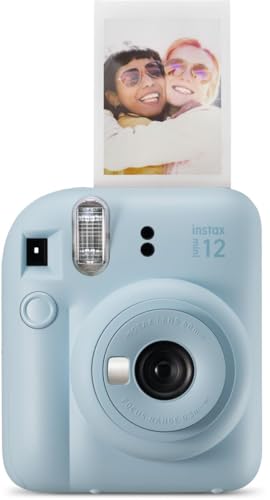
Fujifilm Instax Mini 12 — The zero-failure first film camera
The Mini 12 is engineered around a single beginner truth: the first film photograph must work. Its exposure is fully automatic, its lens twists between standard and close-up modes with the focus handled for you, and a small selfie mirror on the front acknowledges how beginners actually use a first camera. The print ejects, develops in the hand, and delivers the feedback loop this guide keeps praising — all before doubt has time to form.
What it teaches is composition and nerve. With exposure and focus delegated, the beginner’s whole attention goes to framing, distance and the social courage of asking for the picture — which are, not coincidentally, the skills that separate photographers from camera owners at every level. The credit-card-sized prints reward that attention socially: they get handed over, pinned up and kept, and a camera whose output circulates is a camera that keeps getting used.
- Format: instant film, credit-card-sized prints
- Exposure: fully automatic, no settings to ruin a shot
- Lens: two modes, standard and close-up, twist-selected
- Carry: light, rounded body that survives bags and pockets
- Role: the confidence-builder that starts the film habit
Strengths
- Essentially impossible to expose a blank frame
- Prints develop in hand, closing the learning loop fast
- New, warrantied and simple to buy film for
Trade-offs
- Prints are small and softly detailed by design
- Per-frame film cost disciplines a heavy shooter
- No manual control to grow into later
Give it to a teenager, a parent, a friend who claims they are “not a camera person”, and watch the same scene repeat: initial scepticism, one print, then a queue of people asking to be photographed. That social ignition is a real photographic feature, and no other pick in this guide lights it as reliably.
Its ceiling is equally clear. A beginner who catches the bug seriously will want larger prints, deliberate exposure and lenses that see differently, and the Mini 12 offers none of those ladders. Treat it as the doorway it is designed to be — many photographers keep one in the bag for life, long after the serious cameras arrive, because some moments want a print more than they want perfection.
Best for: absolute beginners, gifts, parties and anyone whose film habit must start with success. Not suited for: learners who already know they want manual craft and larger negatives

Polaroid Go Generation 2 — The pocketable instant
The Go is Polaroid’s format shrunk to fit the pocket of a jacket rather than the shelf of a studio, and that shrinkage is its whole beginner argument. A film camera teaches in proportion to how often it is present, and the Go is present the way a phone is present — at the café, on the walk, in the glovebox — where the larger instant cameras stay home for occasions.
Its film frames are small squares, smaller than the classic Polaroid image, and the camera asks little of its owner: charge it, load the pack, point, and let its metering decide. A self-timer and a selfie mirror cover the two ways beginners actually photograph themselves and their friends. The results carry the Polaroid colour character — soft, warm, slightly unpredictable — which flatters people and forgives the harsh midday light beginners always end up shooting in.
- Format: instant film, small square Polaroid frames
- Size: the smallest body in this guide by a wide margin
- Metering: automatic exposure with flash support
- Battery: rechargeable, unlike classic Polaroid cameras
- Role: the always-carried instant for everyday life
Strengths
- Small enough that carrying it becomes a habit
- Classic Polaroid colour character in a modern body
- Rechargeable battery removes one running cost
Trade-offs
- Frames are the smallest instant prints here
- Film packs cost more per shot than Instax film
- Low-light results lean heavily on its flash
The comparison with the Mini 12 is a genuine fork. Fujifilm’s film is cheaper per frame and its prints slightly larger in feel; Polaroid’s camera is smaller, its look more nostalgic, its ecosystem the original instant culture. Beginners choosing between them are choosing a pocket habit against a party habit, and either answer is respectable.
What the Go cannot do is grow with a serious learner — no controls open up, no second lens arrives. But judged as what it is, a film camera that disappears into daily life and returns small square artefacts of it, the Go is the most carryable honest film experience a beginner can buy new.
Best for: beginners who value carry-everywhere size and the classic Polaroid look. Not suited for: anyone wanting the largest instant prints or the cheapest cost per frame
Pentax K1000 — The manual 35mm teacher
This camera is covered in prose because it has been out of production for decades and trades entirely on the used market, where the individual copy in front of you matters more than the model name. The K1000 is the most famous teaching camera ever made: fully mechanical, fully manual, with a match-needle meter in the viewfinder and exactly three decisions to make — shutter speed, aperture, focus. Photography courses built generations of photographers on it because there is nowhere to hide.
That nakedness is the curriculum. A beginner on a K1000 learns what a stop is by being wrong about stops, learns depth of field by missing focus in public, and learns light by reading the needle against the sky. The standard lens it usually wears is honest and bright, the body is metal and repairable, and the K-mount lens ecosystem behind it is deep and inexpensive, so the teacher can grow new eyes as the student improves.
- Format: 35mm SLR, fully mechanical operation
- Metering: match-needle, battery only powers the meter
- Controls: shutter dial, aperture ring, manual focus — nothing else
- Buying: used only; condition and light seals vary by copy
- Role: the deliberate-craft education in a single body
Strengths
- Teaches exposure more honestly than any automatic
- Mechanical body keeps working when electronics would die
- Huge, affordable K-mount lens ecosystem behind it
Trade-offs
- No automation to rescue a distracted beginner
- Used copies need seal and meter checks before trusting
- Heavier than every compact in this guide
Who should choose it? The beginner who reads manuals for pleasure, who wants photography as a craft rather than a souvenir, and who accepts that the first two rolls are tuition. That beginner will emerge from a K1000 winter able to expose film on any camera ever made, which is a claim no other pick here can make.
Who should not: the beginner whose enthusiasm is fragile. The K1000’s honesty can read as hostility in the first month, and a learner discouraged early is worse off than a learner coddled by automation and curious later. Sequence matters — many K1000 owners arrived here via an automatic compact first, and that order is wisdom, not weakness.
Best for: committed learners who want the full manual education and a repairable classic. Not suited for: beginners who need early wins to stay motivated
Canon EOS Rebel G — The automatic SLR bridge
The Rebel G — sold in some markets as the EOS 300 line’s close sibling in spirit — is also a prose-only used-market pick, included because it solves the beginner’s central dilemma: how to shoot real 35mm film through interchangeable lenses without first surviving the manual era. It autofocuses, auto-exposes in a full program mode, winds and rewinds its own film, and behaves so much like a modern digital SLR that a beginner’s existing instincts transfer on day one.
Underneath the automation sits a genuine system camera. Its EF lens mount accepts a vast range of Canon lenses, its partial and evaluative metering modes reward a learner who starts asking why, and its manual mode waits patiently for the day the beginner wants the K1000’s lessons with autofocus-era ergonomics. It is the bridge between the digital present and the film past, walkable in both directions.
- Format: 35mm autofocus SLR, EF lens mount
- Exposure: full program auto plus creative modes and manual
- Handling: motorised wind and rewind, familiar SLR layout
- Buying: used only; check the grip coating and battery door
- Role: the digital-native’s gentlest route into 35mm
Strengths
- Autofocus and auto-exposure remove the beginner failure modes
- EF mount opens an enormous lens library
- Manual mode available when curiosity arrives
Trade-offs
- Plastic-era body feels less heirloom than the K1000
- Depends on batteries for everything, including existing
- Viewfinder is dimmer than the pro bodies of its era
Picture the beginner it serves: raised on phones and mirrorless cameras, curious about film’s look, unwilling to gamble a holiday on a needle meter. The Rebel G lets that person shoot a wedding weekend on film with digital-era confidence, then — rolls later — start overriding its decisions one at a time. Graduated freedom is a teaching method, and this camera embodies it.
Its used-market caveat is cosmetic as much as mechanical: the soft grip coatings of its era can turn tacky with age, and a copy that feels unpleasant will be left at home. Handle before buying where possible, budget for a lens if the copy is body-only, and the Rebel G becomes the lowest-risk serious film start in this guide.
Best for: digital-raised beginners who want real 35mm and lenses without the manual learning cliff. Not suited for: purists who want mechanical operation and metal construction
Olympus Mju II — The weatherproof point-and-shoot
The Mju II — Stylus Epic in North America — is covered in prose because it too lives on the used market now, and because its reputation has made individual copies vary wildly in price and condition. In its era it was the thinking person’s compact: a sliding clamshell that opens with a thumb-push, a fixed wide lens of genuine optical quality, autofocus and metering that rarely embarrassed their owner, and weather sealing that let it shoot in rain its rivals fled from.
For a beginner, its genius is subtraction. There is almost nothing to set: open, frame, press. Yet the photographs it returns are sharp in a way cheap compacts never managed, which matters pedagogically — a beginner can judge their framing and timing honestly when the lens is not smearing the evidence. It teaches the eye while the machinery stays invisible, the exact opposite division of labour from the K1000, and equally valid.
- Format: 35mm compact, fixed wide-angle lens
- Body: sliding clamshell, weather-sealed for rain use
- Operation: autofocus and auto-exposure, near-zero settings
- Buying: used only; fame inflates prices, patience required
- Role: the carry-anywhere compact that rewards the eye
Strengths
- Lens quality far above the point-and-shoot average
- Weather sealing suits travel and everyday carry
- Clamshell design protects the lens with no cap to lose
Trade-offs
- Fame has pushed used prices beyond its specification
- Flash fires eagerly unless deliberately overridden
- No manual control path as skills develop
The honest buying note belongs in the review itself: at sensible money, a clean Mju II is a delight; at collector money, its simpler siblings and rivals deliver most of the experience for a fraction. Beginners should set a ceiling and let copies above it go to the collectors. The camera’s lesson — that a fixed lens and a ready camera beat a system left at home — survives whichever specific compact delivers it.
Carried daily for a season, the Mju II produces the kind of film diary professionals envy: unposed, weather-ignoring, close to life. For the beginner whose ambition is a visual journal rather than a portfolio, this may be the most satisfying pick on the page.
Best for: beginners wanting a premium automatic compact for travel and daily documentary. Not suited for: bargain hunters unwilling to police inflated used prices
Kodak Ektar H35 — The half-frame economy lesson
The Ektar H35 is the rare prose-only pick that is actually sold new — it is here without a link because it sits outside this guide’s verified pool, not because it is vintage. Its idea is disarmingly simple: it photographs half a 35mm frame at a time, so a thirty-six-exposure roll returns seventy-two photographs. For a beginner, that arithmetic transforms the economics of experimentation — every idea costs half as much to test.
The camera itself is deliberately basic: a fixed-focus plastic lens, a simple exposure system with a flash for darkness, and a film advance that asks the thumb to do the work. Vertical-format frames suit the phone-shaped way beginners already see the world, and pairs of adjacent frames invite diptychs — two related moments side by side on one print — which has become the half-frame’s creative signature among younger film shooters.
- Format: half-frame 35mm, seventy-two shots per standard roll
- Lens: fixed focus, simple and forgiving at social distances
- Build: very light plastic body, pocketable and unintimidating
- Buying: sold new; film and lab costs are the real budget
- Role: the high-volume practice camera for playful learners
Strengths
- Doubles every roll, halving the cost of each experiment
- Vertical frames and diptychs encourage playful seeing
- Simple enough that nothing stands between idea and frame
Trade-offs
- Half-frame negatives show grain sooner on large prints
- Fixed focus limits close-up and low-light ambitions
- Plastic build asks for gentler treatment than metal classics
Its pedagogical trick deserves respect: beginners improve with volume reflected upon, and the H35 supplies volume at half price while its small negatives keep expectations at the diary level where learning is fun. Shoot a whole roll at one market, one party, one walk, and the contact sheet becomes a lesson in editing that a twelve-frame shooter never gets.
Graduation from the H35 is natural and painless — its owner has learned film handling, lab routines and their own taste, and can step to any full-frame pick in this guide with the habits already installed. As a first purchase it is the cheapest honest education on the page, in the only currency that matters: frames actually shot.
Best for: playful, high-volume learners and students on a film budget. Not suited for: beginners planning large exhibition prints from their first rolls
How Do the Six Beginner Film Cameras Compare Side by Side?
| Camera | Format | Automation | Beginner lesson |
|---|---|---|---|
| Fujifilm Instax Mini 12 | Instant | Full | Framing and nerve, with instant proof |
| Polaroid Go Generation 2 | Instant | Full | Daily carry and the physical print |
| Pentax K1000 | 35mm SLR | None | Exposure, focus and light itself |
| Canon EOS Rebel G | 35mm SLR | Full, overridable | Film craft at digital-era speed |
| Olympus Mju II | 35mm compact | Full | Seeing, timing and everyday documentary |
| Kodak Ektar H35 | Half-frame 35mm | Mostly | Volume, editing and playful sequences |
Read the table as a map of teaching styles: instant cameras teach the eye socially, automatics teach it quietly, the half-frame teaches it by volume, and the K1000 teaches everything at once to those who ask.
How Should a Beginner Buy a Used Film Camera Without Regret?
Condition is the whole negotiation. Ask — or check in person — whether the light seals have been replaced, because foam seals of the film era have mostly turned to tar by now and a leaky camera fogs the very rolls a beginner is learning on. Fire the shutter at every speed and listen for the lazy drag of old lubricants; advance the film lever and feel for grit; open the back and look through the lens at a bright window for fungus, which appears as delicate branching shadows and cannot be cleaned away by optimism.
Buy the seller as much as the camera. A seller who shoots film, describes faults plainly and shows recent photographs taken with the exact body is worth a premium over a cheaper stranger with an attic find. Where possible, choose a copy sold as tested with film, and put a cheap test roll through any new acquisition before trusting it with a birthday, a trip or a wedding. The test roll is tuition every used-camera buyer pays once or pays dearly.
Accessories change value quietly. A working strap, the correct battery, a lens cap and a case are worth real money across a beginner’s first year, while a famous name engraved on a battered body is worth none. Price the whole working kit, not the badge.
What Film Should a Beginner Load First, and Why?
Load the forgiving film. For 35mm, a mid-speed colour film rated around ISO 400 handles bright parks and dim cafés on the same roll, and its exposure latitude forgives the metering mistakes every beginner makes while learning. Slower films reward sunshine with finer grain but punish shade; faster specialist films solve darkness at a price in both money and grain. The first three rolls of a film life should be boring, consistent and identical, so the variable being tested is the photographer.
Black and white is the other honest starting point, and some teachers insist on it: it removes colour as a distraction, teaches light and shape directly, and in many towns it is the easiest film to have developed well — or even to develop at home later, which opens the darkroom chapter of the hobby. Instant shooters face a simpler shelf: the film made for their exact camera, bought fresh, stored cool, and shot before its date rather than hoarded past it.
Whichever film you choose, keep the box tops. Noting which film produced which look — on the fridge print, in the scan folder — builds the beginner’s private database of taste, and taste, accumulated frame by frame, is the real graduation certificate of film photography.
How Do You Actually Shoot a First Roll Well?
Begin with light, not subjects. Spend the first roll in the two hours after breakfast or before dinner, when sunlight arrives at an angle and models every face and wall kindly, and the camera’s meter — automatic or needle — has an easy job. Photograph people you know at conversational distance, objects at the distance your lens focuses happily, and one deliberate experiment per few frames: the same doorway from two positions, the same friend with and without flash.
Keep a notebook, paper or phone, with frame numbers and one-line notes. Film’s delayed feedback only teaches when memory is jogged, and the notebook is the jog. When the scans return, sit with them beside the notes and mark the three frames that worked and the single habit that caused the failures — there is almost always a single habit, usually standing too far away. The second roll exists to break that habit, which is why the second roll teaches more than the first.
Finish rolls promptly and develop them promptly. Film left in a camera for months mixes seasons, forgets its own notes and returns as archaeology rather than feedback. The beginner who shoots a roll a fortnight, every fortnight, improves faster than the beginner who saves film for occasions — occasions are performances, and learning needs rehearsals.
How Does a Beginner Learn to See Light on Film?
Film teaches light by charging for ignorance. A digital shooter can bracket a sunset into submission; a film beginner with thirty-six frames learns to stand still, watch how a window throws a rectangle across a floor, and wait until a face moves into the bright part of the room. That watching is a trainable habit, and the training drill is simple: before raising the camera, name the light out loud — where it comes from, how hard its shadows are, what it is doing to the colours of the scene. Beginners who narrate light for one whole roll start seeing it unprompted by the third.
Backlight is the classroom where the tuition gets paid. Photograph a friend between the camera and a bright window and an automatic compact will usually render a silhouette with a glowing halo, because its meter reads the window rather than the face. The fix is mechanical and learnable: step closer so the meter samples the person, use the flash as fill even in daylight, or move two paces sideways so the window becomes a side light instead of a backdrop. Each correction, discovered on a returned print, engraves itself far deeper than the same lesson read in a manual.
Overcast days deserve a defence, because beginners curse them and professionals schedule portraits by them. Cloud cover is a softbox the size of the sky: shadows soften, skin forgives, colours saturate quietly, and mid-speed film exposes evenly without the contrast battles of noon sun. A beginner’s most flattering early portraits will almost certainly happen under grey skies they initially complained about, and recognising that inversion — bad weather, good light — is a small graduation in itself.
Finally, learn the reciprocal failure nobody warns about: film that is too slow for the light simply blurs, because the camera chooses a shutter speed a hand cannot hold. When indoor frames return smeared, the lesson is not carelessness but arithmetic — brace against a doorframe, choose the faster film next time, or open the lens on the cameras that allow it. Every blurry frame is a physics lesson with a receipt attached, which is precisely why film graduates understand exposure in their bones.
Which Accessories Does a Film Beginner Genuinely Need?
Almost none, and the shortness of the honest list is a kindness to beginners drowning in accessory marketing. A strap that keeps the camera on the body rather than in a bag doubles the frames a beginner shoots; a small notebook, already prescribed in this guide, converts returned prints into lessons; a zip pouch that keeps exposed rolls separate from fresh ones prevents the heartbreaking double-exposure of a finished roll loaded twice. Those three items, costing very little, cover the real failure modes of a first film season.
Cleaning basics come next: a blower for dust, a microfibre cloth for the lens, and the discipline of using them before a roll rather than after spotting the same dust shadow on thirty-six frames. Used cameras deserve a battery check and, where the seals look crumbly, a seal replacement by a technician — a modest service that prevents the light leaks beginners mistake for artistic flare until the novelty wears off.
What beginners do not need is a system. A second lens for the Rebel G or the K1000 can wait until the first lens has produced a thousand frames and the owner can articulate exactly which photographs it prevented. Filters, tripods, motor drives and leather half-cases all have their season; buying them in the first month is shopping dressed as learning. Film’s economy rewards patience everywhere — in exposure, in developing, and in the accessory drawer most of all.
One modern accessory does earn its place: a simple light-meter app on the phone the beginner already carries. For the K1000 owner whose needle meter has died, or the compact shooter curious about what their camera decided, the app turns guesswork into a dialogue between two meters. Used as a teacher rather than a crutch, it shortens the exposure apprenticeship by months.
How Should a Beginner Keep a Film Diary That Actually Improves Their Eye?
The diary is the difference between shooting film and studying with film. Its minimum viable form fits on an index card per roll: the film stock, the camera, the dates, and three sentences after the scans return — what worked, what failed, what to change. Rolls blur together in memory within weeks; cards do not, and a beginner reviewing ten cards owns a personal textbook written in their own mistakes, which no published guide can replicate.
Contact-sheet thinking elevates the diary further. Whether the lab returns a printed sheet or the scans sit in a folder, review the whole roll in sequence rather than hunting for favourites. Sequence reveals behaviour: the five frames spent approaching a subject, the viewpoint repeated until it surrendered, the moment the light changed and the photographer did not. Beginners who study their sequences start pre-editing in the field, walking to the final viewpoint first instead of fifth, and their keepers-per-roll climb in a way gear never delivers.
Share selectively. A small circle — a class, a club, one honest friend — that sees whole rolls rather than curated singles will tell a beginner the truth about their habits, kindly and repeatedly. The film community’s culture of showing contact sheets exists because the format’s teachers understood something digital feeds forgot: improvement lives in the outtakes, and outtakes are only visible to people shown the whole roll.
Set the diary a rhythm rather than a target. One roll a fortnight, reviewed the weekend it returns, notes written before the next roll loads — that cadence builds a feedback engine that runs all year on modest money. Targets like a roll a week collapse by March; rhythms survive because they bend around busy months instead of breaking against them.
Why Do Some Beginners Quit Film, and How Do the Right Picks Prevent It?
Post-mortems of abandoned film cameras repeat four causes. The first is the blank roll — a loading error, a dead battery, a shutter that never fired — discovered after an unrepeatable event. Automation and test rolls prevent it: every pick in this guide either loads itself, warns its owner, or was chosen partly because its failure modes announce themselves before the important day rather than after it.
The second cause is cost shock, arriving with the third or fourth lab invoice. It is prevented by arithmetic done before the first purchase — the running-cost honesty this guide insists on — and by formats like half-frame and instant that let a beginner tune the hobby’s monthly burn to a level their budget absorbs without resentment. A hobby resented at invoice time is a hobby already ending.
The third cause is loneliness. Film is a minority practice, and a beginner whose friends shoot phones can feel eccentric rather than enriched. Prints are the antidote: instant photographs handed around a table recruit allies faster than any argument, and labs, clubs and online communities built around specific cameras — the K1000 and Mju II both have devoted ones — turn a solitary expense into a social identity.
The fourth cause is the comparison trap: measuring first-year film frames against the polished digital work of professionals and concluding the format, or the photographer, is broken. The diary habit defeats it by changing the comparison’s direction — this roll against your own roll from three months ago, a race every honest beginner wins. Cameras were ranked in this guide partly by how kindly they treat that first year, because the photographers who survive it rarely leave.
What Mistakes Do Film Beginners Keep Making?
Opening the back mid-roll “just to check” ruins more first rolls than every mechanical failure combined — the film is being exposed to the room, not inspected, and the frames near the door are lost. Trust the counter, trust the rewind resistance, and let the lab deliver the verdict. A related classic is shooting an entire holiday with the lens cap’s modern equivalent in place: on rangefinder-style and compact cameras, an obstructed lens or a finger over the meter window produces a roll of confident black frames.
Under-budgeting the ecosystem runs second. Beginners price the camera and forget that film, developing, scanning and postage form a monthly running cost that exceeds the body within a season. The half-frame and instant picks exist partly to manage that arithmetic, but every film shooter should enter with the running cost understood rather than discovered.
Finally, beginners blame film for digital habits. Thirty-six frames shot in ninety seconds at a single viewpoint is a digital reflex, and film punishes it with thirty-six near-identical prints. The format’s whole gift is the pause; accepting the pause is the beginner’s real first lesson, and every pick in this guide is chosen to make that pause pleasant rather than punitive.
How Do You Choose Between Two Picks When Both Feel Right?
Tie-breakers, in the order this guide trusts them. First, the carry test: hold each candidate — or its closest modern equivalent — and honestly ask which one would be in your coat on an ordinary Tuesday, because beginners learn from ordinary Tuesdays far more than from photogenic holidays. The camera that wins Tuesdays wins the year, and this single test explains the presence of two pocketable instant cameras and a clamshell compact on a list that also contains an SLR.
Second, the failure rehearsal. Imagine the worst plausible first month with each camera: the missed focus, the fogged roll, the lab invoice, the rainy day. Choose the camera whose worst month you can shrug at. A beginner who can shrug keeps shooting, and the K1000’s devotees shrug at different things than the Mini 12’s — neither group is wrong, they are simply insured against different disappointments.
Third, the exit cost. Film beginners are allowed to change their minds, and picks differ in how gracefully they release their owners. Instant cameras resell or regift painlessly; used classics in good condition hold their value among other learners; the camera bought at a fame-inflated price is the only genuinely risky exit on this page, which is why its review carries a ceiling-price warning rather than a celebration.
Fourth, and last, the community test. Search for the gatherings, forums and hashtags around each candidate and notice which conversations you want to join. A beginner absorbed into a living community around their camera receives answers, film swaps, developing help and gentle critique for free, forever. Equipment is replaceable; belonging compounds. When two cameras tie on every specification, buy the one whose people feel like yours.
Final Recommendation
For most beginners, start with the Fujifilm Instax Mini 12 if the goal is joy and confidence, or the Kodak Ektar H35 if the goal is volume and play on a budget. Both guarantee that the first month of film photography contains many finished photographs, and finished photographs are what keep beginners shooting. Graduates of either who feel the pull toward craft should take the Canon EOS Rebel G for an automated 35mm system, or the Pentax K1000 when they are ready to be taught by the needle. The Olympus Mju II rewards the patient used-market hunter with the finest automatic compact experience here, and the Polaroid Go Generation 2 remains the pick for anyone whose film camera must live in a pocket.
Whichever door you enter by, commit to the loop: shoot promptly, develop promptly, review honestly, note what the light did. Film rewards that loop like no other photographic medium, and the cameras above are simply its six friendliest entrances.
How Should a Beginner Store Film and Finished Negatives?
Unshot film lives best where it lived in the shop: cool, dry and away from radiators, car dashboards and sunny windowsills. The household refrigerator is the classic film store for rolls awaiting use within the season — sealed in their canisters or a zip bag, then allowed an hour to warm before loading so condensation never forms on the emulsion. Freezing suits long hoards, not a beginner’s working stock, and film carried daily should simply live in the camera bag’s shaded pocket rather than a glovebox that bakes by noon.
Exposed film awaiting the lab deserves more urgency than beginners give it. Heat and time soften latent images quietly, so a finished roll should travel to the lab within days, in the same cool conditions, never in the envelope on the hallway table through a hot month. Rolls shot on a trip should be developed before the next trip rather than stockpiled into a confusing archive of unknown dates — label each canister with a marker the day it leaves the camera, a five-second habit that saves hours of detective work later.
Negatives are the master copies of a film life and deserve archival respect out of proportion to their size: sleeved pages, a binder, a dry shelf away from attics and basements. Prints can be reprinted and scans rescanned only while negatives survive, and the beginner who stores them properly from roll one owns, decades later, the complete unedited record of how their eye was made. Instant prints ask for simpler care — out of direct sun, unstacked while fresh — and reward it by holding their colours for the grandchildren who will find them in a shoebox and ask who took them.
Related guides
Frequently Asked Questions
Is film photography expensive for a beginner?
It has a running cost digital lacks — film plus developing per roll — but the entry cameras here are modest, and formats like half-frame halve the per-photo cost. Budget for the rolls, not just the body, and the hobby stays predictable rather than surprising.
Can beginners still get 35mm film developed easily?
Yes. Mail-in labs and surviving local labs handle colour and black-and-white 35mm routinely, returning prints, negatives and digital scans. Turnaround is days rather than hours, which this guide treats as part of the learning design rather than a defect.
Should a beginner learn on a fully manual camera like the K1000?
Only if their motivation is sturdy. Manual operation teaches the deepest lessons, but automation teaches framing and confidence first, and many photographers learn better in that order. There is no moral hierarchy between the two routes — only sequencing that fits the learner.
What goes wrong with used film cameras most often?
Decayed light seals, sluggish shutters and tired meters lead the list, followed by corroded battery contacts. All are checkable before purchase or cheaply serviced, and a test roll through any new acquisition catches what inspection missed.
Is instant film real film photography?
Completely. Instant film is a chemical photographic process that produces a unique physical print with no digital step. Its constraints — fixed lens, automatic exposure — differ from 35mm practice, but its lessons in framing, timing and light are genuine photographic education.
How many rolls should a beginner shoot before judging their camera?
Three, minimum, on the same film stock, developed promptly and reviewed against written notes. One roll judges luck; three rolls reveal habits, and habits — not equipment — are what a beginner is actually choosing a camera to build.
Related Guides
Continue with compact viewfinder cameras judged by the finder experience, explore instant cameras for everyday carry, or read how to buy used film cameras with confidence before hunting the classics in this guide.


