Disclosure: As an Amazon Associate, ilcastellomenu.com earns from qualifying purchases. Links on this page are affiliate links; they cost you nothing extra. Prices and availability change often, so check the current Amazon listing before you buy.
Learning how to choose a cable management box is mostly learning what to measure, because every failure in this category is a measurement that was skipped. Boxes are returned because the laptop brick held the lid open, because the cables needed to leave toward the room and the exits faced the wall, because the sealed pretty container trapped heat, and because the box landed in the one damp corner of the room. This guide turns choosing into a short sequence of steps, each with the reasoning behind it, so the box that arrives is the box your setup actually described.
The decisive criteria, in order, are these: the interior your strip and bulkiest brick truly need, ventilation you will actually protect, exits that match your devices’ directions, a lid you can open in the box’s final home, a material that suits the room, and a placement that is dry and airy. Work through the steps below with your own setup in front of you, and the choice makes itself.
Key Takeaways
- Rehearse your strip, bricks and coiled slack on the floor; that arrangement is the interior you are buying.
- Ventilation is a requirement, not a style choice: a strip in a closed box traps heat.
- Map exit directions device by device before judging any box’s slot layout.
- Test the lid’s clearance in the final placement, not in the middle of the room.
- Large power bricks may not fit small boxes and run hotter when forced; size up without regret.
- The box hides cords from children and pets but is not a childproofing device, and it must live away from water.
In this guide
What You Need to Know Before Comparing
A cable management box is a lidded enclosure for a power strip, its adapters and their cable slack. It organises; it does not add sockets, shorten cables or move power. Comparing boxes before understanding your own population is the root error this guide exists to prevent, because the specifications that matter are yours, not the product’s: your strip’s shape, your largest brick, your cables’ destinations, your room’s constraints. The concepts are few and permanent. Interior fit is three-dimensional, since bricks have height as well as footprint. Heat rises and must be allowed to. Cables dislike sharp bends and pinches. And a hidden strip still has a load limit and still deserves inspection.
A closed box and a working power strip are natural opponents on one point: heat. Adapters and chargers run warm, a strip under load runs warm, and a lid slows all of that warmth down as it tries to leave. The practical answers are simple and non-negotiable. Choose a ventilated box rather than a sealed one. Leave the vents uncovered, which means no fabric, no throws and no rugs over the top, however invisible you want the thing to be. And do not overload the strip inside, because asking more of the strip asks more of the small pocket of air around it.
The alternatives clarify what a box is for. If your mess is a long run of cables, a sleeve or raceway addresses it directly and a box does not. If your mess lives under a desk and never changes, a tray hides it more completely. The box is the answer to a specific shape of problem: a power strip, a handful of adapters and a local tangle, gathered in one spot on the floor or furniture, needing to look calm and open easily. Recognising that shape in your own room is most of choosing well, and it is why so many homes end up with a box in one room and a different tool in another.
Keep that comparison in mind as you work the steps: if step one reveals a run rather than a cluster, the honest outcome of this guide is a sleeve or a tray, and that is a successful use of it. The tray method is covered in how to choose a cable management tray.
How to Choose a Cable Management Box in Seven Steps
Step One: Inventory the Population
Gather everything the box must hold: the strip, every plug and adapter that lives on it, and the cables with their slack. Note the bulkiest brick by name and treat it as the head of the household, because it will decide the size. Count the sockets in use and the directions the cables travel. This inventory takes ten minutes and replaces every guess the rest of the process would otherwise make. If the population includes a high-draw appliance, stop here and give that appliance its own outlet outside the box; the box is for the low, steady loads of desks and entertainment corners.
Step Two: Rehearse the Interior on the Floor
Arrange the inventory on the floor exactly as it would sit inside a box: strip flat, bulkiest bricks placed first with space between them, each cable’s slack coiled into its own loose loop beside its plug. Look at the footprint and the height honestly. That arrangement is the smallest interior that can work, and any box whose inside is smaller in any dimension is eliminated, however attractive its listing. Most buyers skip this step and buy by strip length alone, which is how lids come to be held open by bricks.
Step Three: Choose Ventilation Before Style
With size settled, filter by ventilation. A power strip inside a closed box traps heat, so the box must have real openings, positioned to let warm air rise and leave, and your placement must protect them. Eliminate sealed containers however beautiful, and be suspicious of designs whose only openings are the cable slots. Then commit to the owner’s half of the bargain: the top stays bare, permanently, with no fabric, throws, rugs or stacked objects over the vents.
Step Four: Map the Exits to Your Devices
List your devices and the direction each cable leaves the box: up to the desktop, along the stand to the soundbar, back to the wall socket. Now judge each candidate’s openings against that map. A box whose exits face the wall suits a desk against a wall and fails a stand in open floor. Cables should leave at gentle angles through proper openings, never pinched under the lid or bent sharply around an edge. A box that passes the size and ventilation tests can still fail here, and this is the step that catches it.
Step Five: Test the Lid Against the Placement
Decide where the box will live and test the lid’s needs against that spot. A lift-off lid needs vertical clearance, a hinged lid needs swing room, and both need your hand to reach them without moving furniture. Under a low television stand, behind a bookcase, inside a cupboard: each placement eliminates some lid designs. A box you cannot open easily will not be opened at all, and the inspection habit the product depends on will quietly die. Choose the lid your furniture allows, not the lid the photograph flatters.
Step Six: Pick the Material for the Room
Now, and only now, shop by looks. Rigid plastic is the workhorse: wipeable, precise, available in the most sizes. Wood-effect and bamboo lids suit living rooms and stands. Design-led shells earn their premium tier in open view. Fabric covers soften the object among soft furnishings and fold away when unused. In every material, feel for the quality signals: walls that do not flex, a lid that seats with intent, a base that sits flat. The finish decides whether you enjoy seeing the box; the earlier steps decided whether it works at all.
Step Seven: Check the Placement Rules and Commit
Run the final placement audit. Dry: away from sinks, baths, aquariums, kettles, bowls and every splash zone, because a box concentrates plugs where a spill can reach several at once. Airy: not sealed between furniture, vents unobstructed. Reachable: lid test passed, strip switch usable. Appropriate: in family rooms, placed with the understanding that the box hides cords from children and pets without being a childproofing device, so normal outlet care continues. A candidate and a placement that pass all seven steps will not disappoint you; the category simply does not have other surprises to offer.
Gear for This Guide
Four designs illustrate the steps, each the natural answer to a different step profile: the all-rounder for most rehearsals, the power-focused layout for brick-heavy inventories, the design-led shell for open view, and the furniture blend for living rooms. All are presented prose-only in qualitative tiers.

D-Line Cable Management Box
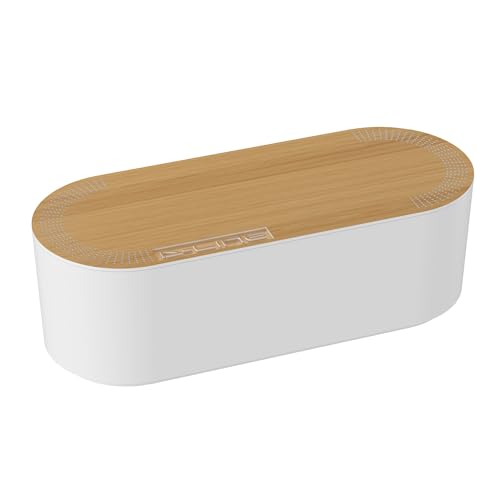
The D-Line Cable Management Box is the long-running benchmark design sold in a choice of sizes, with a neat lid and generous cable entry and exit slots at the back. In daily use its strengths show in the ordinary moments: the lid coming off without a fight when a charger changes, cables leaving in the direction they need to go, and a shell that wipes clean when the room gets its weekly dust. Treat it as a premium-leaning option in qualitative terms, the kind of purchase that makes sense when its particular balance of looks, size and simplicity matches the corner you are tidying.
Best for: a setup whose shape matches its size honestly, with the bulkiest brick measured first. Not suited for: anyone hoping to force an oversized strip and several large adapters into the smallest shell in the range, or anyone who plans to cover it with fabric and forget it, because no box in this class rewards being sealed and ignored.
NTONPOWER Cable Management Box
The NTONPOWER Cable Management Box is a box from a power-accessory brand that thinks about the strip itself, with layouts aimed at bulkier adapters. In daily use its strengths show in the ordinary moments: the lid coming off without a fight when a charger changes, cables leaving in the direction they need to go, and a shell that wipes clean when the room gets its weekly dust. Treat it as a mid option in qualitative terms, the kind of purchase that makes sense when its particular balance of looks, size and simplicity matches the corner you are tidying.
Best for: a setup whose shape matches its size honestly, with the bulkiest brick measured first. Not suited for: anyone hoping to force an oversized strip and several large adapters into the smallest shell in the range, or anyone who plans to cover it with fabric and forget it, because no box in this class rewards being sealed and ignored.
Bluelounge CableBox
The Bluelounge CableBox is the design-led original from a studio known for desk accessories, with a clean sculpted shell and a flame-retardant construction story. In daily use its strengths show in the ordinary moments: the lid coming off without a fight when a charger changes, cables leaving in the direction they need to go, and a shell that wipes clean when the room gets its weekly dust. Treat it as a premium option in qualitative terms, the kind of purchase that makes sense when its particular balance of looks, size and simplicity matches the corner you are tidying.
Best for: a setup whose shape matches its size honestly, with the bulkiest brick measured first. Not suited for: anyone hoping to force an oversized strip and several large adapters into the smallest shell in the range, or anyone who plans to cover it with fabric and forget it, because no box in this class rewards being sealed and ignored.

Changsuo Cable Management Box
The Changsuo Cable Management Box is a wood-effect and woven-look option bought as much for how it blends into living-room furniture as for what it hides. In daily use its strengths show in the ordinary moments: the lid coming off without a fight when a charger changes, cables leaving in the direction they need to go, and a shell that wipes clean when the room gets its weekly dust. Treat it as a mid option in qualitative terms, the kind of purchase that makes sense when its particular balance of looks, size and simplicity matches the corner you are tidying.
Best for: a setup whose shape matches its size honestly, with the bulkiest brick measured first. Not suited for: anyone hoping to force an oversized strip and several large adapters into the smallest shell in the range, or anyone who plans to cover it with fabric and forget it, because no box in this class rewards being sealed and ignored.
Common Mistakes
- Buying by strip length and discovering the brick’s height at the lid.
- Choosing a sealed decorative box and trapping heat around a working strip.
- Counting sockets instead of load, and quietly overloading the hidden strip.
- Ignoring exit directions until the cables are already bending at strained angles.
- Placing the box where the lid cannot open, then never inspecting inside it.
- Setting the box near water, under a sink, beside a tank, in a splash zone.
- Covering the finished box with a throw to hide it, and sealing its vents in the process.
The hidden strip invites one specific mistake: forgetting it has limits. Because you cannot see the sockets, it is easy to keep adding plugs until the box feels full and call that the capacity. Capacity is not about physical room. A strip has a total load it is built to carry, and a box full of chargers, a lamp and a monitor is a very different load from a box that has quietly acquired a space heater. Add loads up thoughtfully, keep heavy appliances on their own outlets, and let the box do the modest job it was designed for.
Large power bricks deserve their own warning. The chunky adapter blocks that come with laptops, consoles and some monitors may not fit inside a small box at all, and when they are forced in they crowd the strip, press against cables and run hotter in the confined space than they would in the open. Check fit qualitatively before you buy: think about the single bulkiest thing you own, picture it sitting on the strip, and choose the box size that swallows it without a struggle. A box that fits the strip but not the brick has solved the wrong half of the problem.
Pro Tips
Label every cable just inside the lid on setup day, while identification is free; the label habit converts every future change into seconds. Photograph your rehearsed floor arrangement before you buy, and shop with the photograph open, because memory flatters dimensions. Keep one reusable tie per cable inside the box so slack stays coiled per device rather than merging into a shared nest. And when between sizes, remember the asymmetry: a slightly large box costs a little space, while a slightly small one costs the whole purchase.
Good routing follows one principle: every cable should be able to leave the box without disturbing any other. That means exits chosen by destination, slack coiled per cable rather than in one shared tangle, and nothing trapped under the lid’s edge, where repeated closing slowly damages insulation. It also means resisting the urge to stuff: a box filled to pressure is a box whose lid lifts, whose vents block and whose contents warm each other. If the interior feels like a puzzle you had to force, the honest fix is a bigger box or a second one, not more pressure.
Where the box sits matters as much as which box you buy. Under a desk, it should sit where your feet do not kick it and where the chair’s casters never travel. Behind a television stand, it needs enough clearance that the lid can come off without moving furniture. On a desktop, it earns its footprint only if it also calms the cables on the surface, which usually means placing it at the back edge where cables naturally gather. In every location the same checks apply: air can reach it, water cannot, the lid can open, and you can reach the strip’s switch without a excavation.
Worked Examples
The Laptop Desk With the Big Brick
Inventory: a strip, a monitor plug, a phone charger, a lamp, and one very large laptop brick. The rehearsal shows the brick dominating one end. Ventilation filter passes the rigid designs. Exit map: three cables rise to the desktop, one drops to the floor socket. Verdict: the power-focused layout in the larger size, placed beside the desk leg with its top bare. The brick, not the strip, chose this box, which is exactly how the method is supposed to work. Background reading for the desk as a whole: the best cable management options for desks.
The Television Corner With Four Devices
Inventory: television, soundbar, streaming box and two consoles on one strip, bricks everywhere, all of it behind a low stand. The rehearsal is the largest of the three examples. The lid test eliminates lift-off designs, because the stand’s shelf leaves no vertical room; a front or sliding access wins. Exit map is a row along the stand. Verdict: the largest furniture-blend box with a lid the stand allows, finish matched to the stand, vents clear of the curtains that share the corner.
The Hallway Charging Station
Inventory: a small strip and a rotating cast of family phone and tablet chargers, no big bricks, heavy daily traffic. The rehearsal is tiny; the placement audit dominates instead. The spot must be dry, out of the walkway, and the lid must survive being opened by everyone in the house. Verdict: the compact all-rounder, chosen for lid manners rather than capacity, with labels inside because the population changes weekly. Our cable management box buying guide shows how this profile lands in the wider range.
A Closer Look: Living With the Box
There is a quiet psychological effect to a tidy cable corner that owners report consistently: the room feels finished. Cables are visual noise, and noise at floor level is especially tiring because it reads as disorder rather than equipment. A box removes the noise at its source. It does not make a room beautiful by itself, but it removes the one element that made the room look unfinished despite everything else being in place. For a modest, single purchase, that is an outsized return, and it explains why so many people buy a second box for another room within the year.
Consider the box’s relationship with time. Cable populations grow: a charger here, a smart speaker there, a new console at a birthday. An unmanaged strip absorbs growth as sprawl, each new cable draped over the last. A box absorbs growth as capacity, up to a point: open the lid, find the free socket, route the new cable out. That point, the full box, is also useful information, because it tells you the corner has genuinely outgrown one strip and needs a rethink rather than another layer of tangle. The box makes the state of your setup legible at a glance.
Renters develop a particular affection for these boxes, and it is easy to see why. So many cable solutions ask for screws in walls, clamps on desks or adhesive on skirting, all of which are deposits waiting to be argued about. A box asks for nothing. It sits on the floor, does its work, and leaves with you, taking the tidy corner with it and leaving the room exactly as you found it. In a first flat or a temporary posting, that combination of order and reversibility is worth more than a marginally neater fixed installation.
The box also changes how a setup survives being moved. Anyone who has relocated a desk or a television knows the ritual of the cable photograph, the handful of ties, the mysterious spare lead. With a box, the core of the setup travels as a unit: strip, bricks and short cables stay in place under the lid, and only the device ends need reconnecting at the new home. Moves, redecoration and the annual furniture shuffle all become smaller jobs. It is a benefit nobody buys the box for and everybody appreciates the first time it happens.
Think, finally, about what the box asks of you, because it is not nothing. It asks you to open it occasionally, to resist stuffing it, to keep its vents clear and its spot dry, and to remember that the strip inside still has limits even though you cannot see them. These are small asks, minutes a year, but they are the difference between a box that is a genuine improvement and a box that is a lid on a problem. Owners who make peace with that tiny maintenance contract tend to be the ones who recommend these products without hesitation.
One underrated benefit of gathering cables into a box is what it does to cleaning day. A floor with a cable nest on it gets cleaned around, which means the dustiest square of the room is precisely the one the vacuum never reaches. A box turns that square into a single object you can slide aside, clean under and slide back. The strip stays seated, the cables stay routed, and the corner returns to being a corner rather than an ecosystem. Small, domestic and genuinely valuable, this is the benefit owners mention most after the first month.
Labelling is the habit that separates a box that stays tidy from a box that slowly reverts. A small tag on each cable, just inside the lid, naming its device, turns every future change into a thirty-second job. Without labels, every unplugging is a guessing game played by tugging cables and watching which screen flickers. The box makes labelling easy because all the decision points are in one place, under one lid. Do it on the day you set the box up, while you still know which cable is which, and the system maintains itself.
Getting It Right the Second Time: Adjustments and Troubleshooting
Know when the problem is not technique
Some failures are the product telling you something: a part at the end of its life, a consumable past its best, or a task beyond the model’s design limits. If the same failure survives correct setup, fresh consumables and careful settings, stop refining your technique and inspect the hardware, or check whether the job needs a heavier-duty cable management box than the one you own. Recognising that boundary is a skill in itself. Persisting with technique fixes for a hardware problem is how an afternoon disappears, and how a basically sound product earns an unfair reputation.
Teach the second user
In a room where noise, heat or clutter quickly becomes a problem for everyone else in it, you may not be the only person who operates the cable management box, and a technique that lives only in your head is a fragile one. Once your process is stable, walk the other user through it once, then let them run it while you watch for the step where your instructions were ambiguous. Their mistakes are diagnostic gold: they show exactly which step depends on tacit knowledge you have not written down. Fix the written version, not just the user, and the whole household’s results become as consistent as your own.
Diagnose before you adjust
When a cable management box task goes wrong, the temptation is to change three things at once and hope. Resist it. Work through the likely causes in order of probability — setup, materials or media, settings, then the hardware itself — and change one variable at a time, noting what each change does. In a room where noise, heat or clutter quickly becomes a problem for everyone else in it, most failures trace back to the first two categories, which are free to fix. This ordered approach feels slower for ten minutes and saves hours across the life of the product, because you build a personal map of cause and effect instead of a pile of superstitions.
The recovery sequence for a job gone wrong
Mid-task failures with a cable management box follow a pattern worth memorising: stop safely, preserve whatever state you can, identify the earliest point where things diverged, and restart from the step before that point rather than from the beginning. Rushing a restart from zero wastes materials and often repeats the same error at the same step. If the failure damaged a consumable or a wear part, replace it before retrying; a compromised part makes the next attempt fail in a new, confusing way that sends your troubleshooting in the wrong direction entirely.
Small calibrations, repeated on schedule
Most cable management box techniques drift gradually rather than failing suddenly, which means small scheduled checks beat occasional heroic fixes. Pick the two or three quick checks relevant to your setup — alignment, cleanliness, tightness, levels, or whatever your model’s manual names — and attach them to a rhythm you already keep, such as the start of the month or the end of a big job. In a room where noise, heat or clutter quickly becomes a problem for everyone else in it, a two-minute check on schedule prevents the slow decline that owners often misread as the product wearing out, when it is really just an adjustment that was never made.
If a candidate fails this check, strike it from the list without regret and let the remaining options compete on merit.
Your future self, mid-task on a busy day, is the person this check is really for.
Keep the notes with the product’s paperwork; they become the baseline every later adjustment is judged against.
Frequently Asked Questions
How do I measure my setup for a cable management box?
Rehearse it. Lay the strip flat on the floor, place the bulkiest adapters first with space between them, and coil each cable’s slack into its own loop beside its plug. The footprint of that arrangement, plus its height at the tallest brick, is the interior you need. Compare candidates against the rehearsal, not against the strip’s length alone. If the rehearsal sits between two sizes, choose the larger; breathing room helps fit, heat and your future patience in equal measure.
Does the box material actually matter?
Functionally, less than size, ventilation and exits; experientially, more than most buyers expect. Rigid plastic routes cables most precisely and wipes clean instantly. Wood-effect and bamboo finishes disappear into living-room furniture. Fabric covers soften the object and fold away, at the cost of structure and easy cleaning. Choose the material after the functional steps have produced a shortlist, and choose it for the room the box will live in, because you will look at it far longer than you will think about it.
What if my power strip has a thick cable of its own?
The strip’s own cable needs an exit too, and thick cables bend reluctantly. Check that the candidate offers an opening generous enough for the strip cable to leave at a gentle angle toward the wall socket, without being pinched by the lid. If the strip cable exits the strip at the side rather than the end, allow for that geometry in your rehearsal. A strip and box that fight over the main cable will annoy you at every cleaning, so settle it on paper before buying.
Should I choose a box with a hinged or lift-off lid?
Let the placement decide. Lift-off lids are simple and seal evenly, but they need clear space above the box every time you open it. Hinged lids stay attached, which suits tight spots, but they need swing room behind. Sliding and front-access designs serve low television stands where neither clearance exists. Test the motion in the box’s final home before filling it; the best lid is the one you can operate without moving furniture, because that is the lid that will actually get opened.
Can I use a cable management box on carpet?
You can, with two cautions. First, a box on carpet sits lower in its own warmth, so ventilation and the no-covering rule matter even more, and a rug must never creep across the top. Second, thick pile can tilt a box and let it rock when cables are tugged, so check that it sits stably. Many owners place the box on the hard floor beside the furniture instead, or on a low shelf, keeping carpet for feet. If the box wobbles in its spot, the spot is wrong.
When should I choose a tray instead of a box?
When the mess lives under a desk, the desk is permanent, and you want the floor completely clear, a tray hides the strip more completely than any box. When the setup is rented, temporary, frequently changed or located at a television or shelf rather than a desk, the box wins on flexibility and access. The two are complements more than rivals, and our tray guides linked from this page will help you judge the desk case on its own terms before you commit to either.
Related Guides
Keep building the same calm, organised setup with these companion guides from the same desk and cable series: our cable management box review; our cable management box reviews; our cable management box buying guide; how to choose a cable management tray; cable management tray vs cable management box; the best cable management options for desks; desks chosen for cable management.