Disclosure: As an Amazon Associate, ilcastellomenu.com earns from qualifying purchases. Links on this page are affiliate links; they cost you nothing extra. Prices and availability change often, so check the current Amazon listing before you buy.
Most cable management box reviews read like a parade of near-identical plastic boxes, which is unhelpful because the boxes are not near-identical where it matters. This round-up takes the six designs households actually buy, from the D-Line Cable Management Box to the fabric-wrapped Baskiss Cable Management Box, and reviews them against the tests that decide ownership: whether your bulkiest brick fits, whether the lid behaves, whether the cables leave in useful directions, and whether the design manages heat honestly with ventilation rather than pretending the question away.
Read the six mini-reviews with your own corner in mind. There is no universal winner here, because the best box for a tidy desk, the best box for a television corner full of consoles, and the best box for a living room where looks carry the vote are three different products. What this page gives you is the reasoning to pick the right one first time, plus the limits every design in this class shares.
Key Takeaways
- Six designs cover the market’s real choices: all-rounder, design-led, value multi-pack, furniture-blending, power-focused and fabric.
- Every box in this class shares the same rules: ventilated, uncovered, dry placement, no overloaded strip.
- Large power bricks are the most common reason a well-reviewed box disappoints; size for the brick first.
- Lid quality and exit-slot placement separate the pleasant boxes from the frustrating ones more than any other detail.
- A box hides cords from children and pets but never replaces normal outlet care; lids lift by design.
In this guide
Cable Management Box Reviews: The Six Designs Worth Your Attention
Each mini-review follows the same pattern: what the design is, where it shines, and the honest limit to know before it joins your home. All six are treated as prose recommendations in qualitative tiers, entry, mid and premium, so you can weigh them without chasing numbers that date quickly.

D-Line Cable Management Box
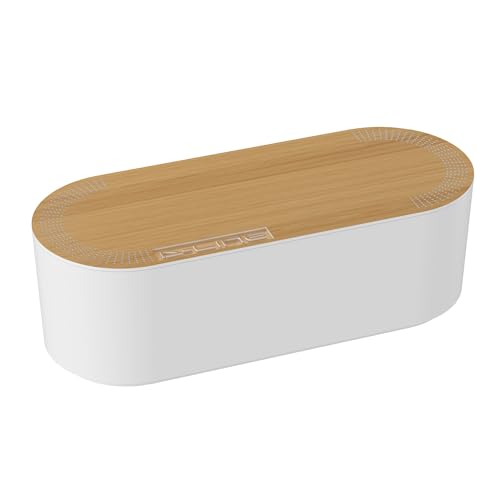
The D-Line Cable Management Box is the long-running benchmark design sold in a choice of sizes, with a neat lid and generous cable entry and exit slots at the back. In daily use its strengths show in the ordinary moments: the lid coming off without a fight when a charger changes, cables leaving in the direction they need to go, and a shell that wipes clean when the room gets its weekly dust. Treat it as a premium-leaning option in qualitative terms, the kind of purchase that makes sense when its particular balance of looks, size and simplicity matches the corner you are tidying.
Best for: a setup whose shape matches its size honestly, with the bulkiest brick measured first. Not suited for: anyone hoping to force an oversized strip and several large adapters into the smallest shell in the range, or anyone who plans to cover it with fabric and forget it, because no box in this class rewards being sealed and ignored.
Bluelounge CableBox
The Bluelounge CableBox is the design-led original from a studio known for desk accessories, with a clean sculpted shell and a flame-retardant construction story. In daily use its strengths show in the ordinary moments: the lid coming off without a fight when a charger changes, cables leaving in the direction they need to go, and a shell that wipes clean when the room gets its weekly dust. Treat it as a premium option in qualitative terms, the kind of purchase that makes sense when its particular balance of looks, size and simplicity matches the corner you are tidying.
Best for: a setup whose shape matches its size honestly, with the bulkiest brick measured first. Not suited for: anyone hoping to force an oversized strip and several large adapters into the smallest shell in the range, or anyone who plans to cover it with fabric and forget it, because no box in this class rewards being sealed and ignored.

YECAYE Cable Management Box
The YECAYE Cable Management Box is a value-focused set that often bundles more than one box, aimed at households tidying several rooms at once. In daily use its strengths show in the ordinary moments: the lid coming off without a fight when a charger changes, cables leaving in the direction they need to go, and a shell that wipes clean when the room gets its weekly dust. Treat it as a entry option in qualitative terms, the kind of purchase that makes sense when its particular balance of looks, size and simplicity matches the corner you are tidying.
Best for: a setup whose shape matches its size honestly, with the bulkiest brick measured first. Not suited for: anyone hoping to force an oversized strip and several large adapters into the smallest shell in the range, or anyone who plans to cover it with fabric and forget it, because no box in this class rewards being sealed and ignored.

Changsuo Cable Management Box
The Changsuo Cable Management Box is a wood-effect and woven-look option bought as much for how it blends into living-room furniture as for what it hides. In daily use its strengths show in the ordinary moments: the lid coming off without a fight when a charger changes, cables leaving in the direction they need to go, and a shell that wipes clean when the room gets its weekly dust. Treat it as a mid option in qualitative terms, the kind of purchase that makes sense when its particular balance of looks, size and simplicity matches the corner you are tidying.
Best for: a setup whose shape matches its size honestly, with the bulkiest brick measured first. Not suited for: anyone hoping to force an oversized strip and several large adapters into the smallest shell in the range, or anyone who plans to cover it with fabric and forget it, because no box in this class rewards being sealed and ignored.
NTONPOWER Cable Management Box
The NTONPOWER Cable Management Box is a box from a power-accessory brand that thinks about the strip itself, with layouts aimed at bulkier adapters. In daily use its strengths show in the ordinary moments: the lid coming off without a fight when a charger changes, cables leaving in the direction they need to go, and a shell that wipes clean when the room gets its weekly dust. Treat it as a mid option in qualitative terms, the kind of purchase that makes sense when its particular balance of looks, size and simplicity matches the corner you are tidying.
Best for: a setup whose shape matches its size honestly, with the bulkiest brick measured first. Not suited for: anyone hoping to force an oversized strip and several large adapters into the smallest shell in the range, or anyone who plans to cover it with fabric and forget it, because no box in this class rewards being sealed and ignored.
Baskiss Cable Management Box
The Baskiss Cable Management Box is a fabric-and-frame style cover that folds around a strip, popular where a softer look suits the room better than hard plastic. In daily use its strengths show in the ordinary moments: the lid coming off without a fight when a charger changes, cables leaving in the direction they need to go, and a shell that wipes clean when the room gets its weekly dust. Treat it as a entry-to-mid option in qualitative terms, the kind of purchase that makes sense when its particular balance of looks, size and simplicity matches the corner you are tidying.
Best for: a setup whose shape matches its size honestly, with the bulkiest brick measured first. Not suited for: anyone hoping to force an oversized strip and several large adapters into the smallest shell in the range, or anyone who plans to cover it with fabric and forget it, because no box in this class rewards being sealed and ignored.
What All Six Reviews Agree On
Treat warmth as a design constraint, not an afterthought. Everything plugged into the strip inside the box converts a little of its power into heat, and in an enclosed space that heat has fewer places to go. A ventilated box, with real openings positioned so air can move, is the sensible default, and the box should sit somewhere air can reach it rather than wedged tightly between furniture and wall. Never drape fabric over it and never let a rug creep across the top, because covering the vents defeats the one feature that makes a closed box a reasonable place for a working strip.
The hidden strip invites one specific mistake: forgetting it has limits. Because you cannot see the sockets, it is easy to keep adding plugs until the box feels full and call that the capacity. Capacity is not about physical room. A strip has a total load it is built to carry, and a box full of chargers, a lamp and a monitor is a very different load from a box that has quietly acquired a space heater. Add loads up thoughtfully, keep heavy appliances on their own outlets, and let the box do the modest job it was designed for.
Measure your problem by its biggest brick. Power bricks vary enormously, and the largest adapter you own, not the average cable, decides whether a box works in your home. A small box that closes neatly over a strip of slim phone chargers can be defeated completely by one laptop brick that holds the lid open or has to sit at a strained angle. Bricks also run warm, so a brick wedged tightly into a small box is a heat concern as well as a fit concern. Buy for the bulkiest load first and let everything smaller fall into place around it.
Performance Across the Rooms That Matter
Desks and Home Offices
Working from home made the desk cable problem permanent for many households, and the box is the least invasive fix. It asks nothing of the desk itself, works with standing desks if the cables have slack for the travel, and turns the under-desk zone from a foot-tangling hazard into clear floor. The detail that makes or breaks it at a desk is exit direction: cables for desktop devices should leave from the top or back, floor-level cables from the ends, so nothing drapes across the front where your feet and chair live.
The interior arrangement deserves more thought than it usually gets. Lay the strip in first, flat and stable. Then plug in the bulkiest adapters, spacing them so their warmth is not pooled in one corner. Coil each cable’s spare length into its own loose loop beside its plug, and use a tie or two to keep loops honest. Finally, route each cable out through the nearest opening in the direction of its device, so nothing crosses the box unnecessarily. Done this way, opening the lid months later is a calm experience: everything is where you left it, labelled by its own path.
Television and Gaming Corners
The television corner also tests a box’s discretion. It sits in a room arranged for looking at a screen, not at storage, so finishes matter here more than anywhere: a wood-effect lid or a dark shell that disappears against the stand earns its place. Ventilation matters too, because entertainment strips often carry the always-on loads of a household, the router and the streaming box that never sleep. A ventilated box, uncovered and clear of the curtains and throws that living rooms accumulate, is the version of this idea that works for years.
Parents and pet owners are some of the happiest buyers of these boxes, and fairly so: a floor that no longer offers a nest of chewable, pullable cords is a calmer floor. Keep the claim honest, though. The box hides cords; it does not childproof anything. Most lids simply rest in place or clip lightly, a determined small child can lift them, and cats have been known to treat a warm box as furniture. Use the box as one layer in a sensible room, keep the strip itself placed thoughtfully, and give the outlet the same ordinary care it would get with no box at all.
Bedrooms, Hallways and Shared Spaces
Placement is a negotiation between invisibility and access. The box you never see but also cannot open without moving a bookcase will slowly fill with whatever gets stuffed through its slots, unexamined. The box in plain sight gets maintained but has to look the part. Most households land between the two: box on the floor beside the desk leg, behind the television unit with a hand’s width of clearance, or on the shelf where the router already lives. Whichever you choose, test the lid before you fill the box. If the lid cannot come off cleanly in its final home, the home is wrong.
Placement rule, stated plainly: dry places only. A cable box gathers your plugs into one small area, which is exactly why a spill that would have wet one cable end can now reach several connections at once. Keep boxes clear of sinks, baths, aquariums, humidifiers and the splash zone under a kettle, and think twice about floor placement anywhere mops and buckets travel. On a desk, keep it away from the edge where cups get knocked. The rule costs nothing to follow and removes the one accident these products are genuinely vulnerable to.
In bedrooms and hallways the box’s job is mostly disappearance. A nightstand strip serving a lamp, a phone charger and an alarm clock is a small population, and even a compact box swallows it whole, which is where the smaller designs in this round-up earn their keep. Hallway charging stations, the family dumping ground for phones and tablets, benefit from a lidded box more than any other spot in the house, because the alternative is a permanent visible nest at ankle height that every visitor sees.
Strengths and Trade-Offs of the Class
Strengths
- Immediate, reversible order: no drilling, no clamps, no adhesive, nothing a landlord can object to.
- One lid gives access to every plug at once, which makes changes and troubleshooting calm instead of archaeological.
- Finishes now range from invisible black plastic to wood effect and fabric, so the box can match the room instead of fighting it.
- Floors become cleanable again; the box slides aside as one object and slides back.
Trade-Offs
- Heat is managed, never eliminated; a closed box always asks for ventilation and sensible loads.
- Small boxes and big bricks are natural enemies, and several designs in every range run smaller inside than they look outside.
- A hidden strip is a forgotten strip unless you build the opening-and-checking habit.
- One box tidies one spot; a whole-room cable problem still needs trays, sleeves or raceways alongside it.
How the Designs Compare With Each Other
| Design | Character | Choose it when |
|---|---|---|
| D-Line Cable Management Box | The all-rounder | You want the safe default in a size range that covers most strips |
| Bluelounge CableBox | The design-led original | The box will sit in open view and looks matter |
| YECAYE Cable Management Box | The value set | Several rooms need tidying in one weekend |
| Changsuo Cable Management Box | The furniture blend | A living room needs the box to pass as decor |
| NTONPOWER Cable Management Box | The power-focused layout | Bulky adapters dominate your strip |
| Baskiss Cable Management Box | The soft cover | A hard shell would glare against soft furnishings |
The alternatives clarify what a box is for. If your mess is a long run of cables, a sleeve or raceway addresses it directly and a box does not. If your mess lives under a desk and never changes, a tray hides it more completely. The box is the answer to a specific shape of problem: a power strip, a handful of adapters and a local tangle, gathered in one spot on the floor or furniture, needing to look calm and open easily. Recognising that shape in your own room is most of choosing well, and it is why so many homes end up with a box in one room and a different tool in another.
If the under-desk route tempts you instead, our cable management tray reviews apply the same tests beneath the desk, and cable management tray vs cable management box settles the two head to head.
Who Should Buy Which, and Who Should Skip the Class
Desk workers should start with the all-rounder or the power-focused design, sized by their laptop brick. Television households should size up and favour the designs whose exits suit a row of devices along a stand. Style-led living rooms are the natural home of the design-led and furniture-blend options, and multi-room tidiers get the most from the value set. The buying checklist never changes: strip measured, biggest brick identified, exit directions counted, ventilated design chosen, dry and airy placement planned.
Skip the whole class if your mess is a run rather than a cluster, if the only home for the box would be damp or sealed in, or if the strip in question feeds a high-draw appliance that deserves its own visible outlet. Our cable management box pros and cons page is the honest next read if you are still deciding whether the concept itself suits you.
Setup, Care and Maintenance Essentials
Whichever design you choose, the setup ritual is identical. Test the lid in the box’s final home before filling it. Seat the strip flat, place the bulkiest adapters first with breathing room between them, coil each cable’s slack separately, and route exits toward their devices so nothing crosses the box or pinches under the lid. Label cables inside the lid. Then leave the top bare: no fabric, no rug, nothing stacked on the vents, however tidy the stack looks.
Because the box hides its contents, it also hides their condition, which is why a simple cleaning rhythm matters. Dust accumulates inside any enclosure with openings, and a box on the floor collects more than most. Build the habit of opening it when you clean the room properly: power down, lid off, contents out, surfaces wiped, cables eyeballed for damage or looseness, everything back in with its slack recoiled. You are not just tidying; you are performing the inspection that a visible strip gets every time you look at it, on a schedule the box cannot prompt by itself.
Final Verdict
Across six designs, the pattern of this category is clear: the box is a solved product at every tier, and satisfaction tracks fit and placement far more than brand. Choose the design whose size swallows your bulkiest brick, whose exits match your devices, and whose finish suits the room, then honour the shared rules about heat, water and load. Do that and any of these six will repay you with a corner that stays calm. Our single-product deep dive, the cable management box review, goes further on the leading designs if you want the long version.
A Closer Look: Living With the Box
Renters develop a particular affection for these boxes, and it is easy to see why. So many cable solutions ask for screws in walls, clamps on desks or adhesive on skirting, all of which are deposits waiting to be argued about. A box asks for nothing. It sits on the floor, does its work, and leaves with you, taking the tidy corner with it and leaving the room exactly as you found it. In a first flat or a temporary posting, that combination of order and reversibility is worth more than a marginally neater fixed installation.
The box also changes how a setup survives being moved. Anyone who has relocated a desk or a television knows the ritual of the cable photograph, the handful of ties, the mysterious spare lead. With a box, the core of the setup travels as a unit: strip, bricks and short cables stay in place under the lid, and only the device ends need reconnecting at the new home. Moves, redecoration and the annual furniture shuffle all become smaller jobs. It is a benefit nobody buys the box for and everybody appreciates the first time it happens.
Think, finally, about what the box asks of you, because it is not nothing. It asks you to open it occasionally, to resist stuffing it, to keep its vents clear and its spot dry, and to remember that the strip inside still has limits even though you cannot see them. These are small asks, minutes a year, but they are the difference between a box that is a genuine improvement and a box that is a lid on a problem. Owners who make peace with that tiny maintenance contract tend to be the ones who recommend these products without hesitation.
One underrated benefit of gathering cables into a box is what it does to cleaning day. A floor with a cable nest on it gets cleaned around, which means the dustiest square of the room is precisely the one the vacuum never reaches. A box turns that square into a single object you can slide aside, clean under and slide back. The strip stays seated, the cables stay routed, and the corner returns to being a corner rather than an ecosystem. Small, domestic and genuinely valuable, this is the benefit owners mention most after the first month.
Labelling is the habit that separates a box that stays tidy from a box that slowly reverts. A small tag on each cable, just inside the lid, naming its device, turns every future change into a thirty-second job. Without labels, every unplugging is a guessing game played by tugging cables and watching which screen flickers. The box makes labelling easy because all the decision points are in one place, under one lid. Do it on the day you set the box up, while you still know which cable is which, and the system maintains itself.
There is a quiet psychological effect to a tidy cable corner that owners report consistently: the room feels finished. Cables are visual noise, and noise at floor level is especially tiring because it reads as disorder rather than equipment. A box removes the noise at its source. It does not make a room beautiful by itself, but it removes the one element that made the room look unfinished despite everything else being in place. For a modest, single purchase, that is an outsized return, and it explains why so many people buy a second box for another room within the year.
Consider the box’s relationship with time. Cable populations grow: a charger here, a smart speaker there, a new console at a birthday. An unmanaged strip absorbs growth as sprawl, each new cable draped over the last. A box absorbs growth as capacity, up to a point: open the lid, find the free socket, route the new cable out. That point, the full box, is also useful information, because it tells you the corner has genuinely outgrown one strip and needs a rethink rather than another layer of tangle. The box makes the state of your setup legible at a glance.
Renters develop a particular affection for these boxes, and it is easy to see why. So many cable solutions ask for screws in walls, clamps on desks or adhesive on skirting, all of which are deposits waiting to be argued about. A box asks for nothing. It sits on the floor, does its work, and leaves with you, taking the tidy corner with it and leaving the room exactly as you found it. In a first flat or a temporary posting, that combination of order and reversibility is worth more than a marginally neater fixed installation.
The box also changes how a setup survives being moved. Anyone who has relocated a desk or a television knows the ritual of the cable photograph, the handful of ties, the mysterious spare lead. With a box, the core of the setup travels as a unit: strip, bricks and short cables stay in place under the lid, and only the device ends need reconnecting at the new home. Moves, redecoration and the annual furniture shuffle all become smaller jobs. It is a benefit nobody buys the box for and everybody appreciates the first time it happens.
Think, finally, about what the box asks of you, because it is not nothing. It asks you to open it occasionally, to resist stuffing it, to keep its vents clear and its spot dry, and to remember that the strip inside still has limits even though you cannot see them. These are small asks, minutes a year, but they are the difference between a box that is a genuine improvement and a box that is a lid on a problem. Owners who make peace with that tiny maintenance contract tend to be the ones who recommend these products without hesitation.
One underrated benefit of gathering cables into a box is what it does to cleaning day. A floor with a cable nest on it gets cleaned around, which means the dustiest square of the room is precisely the one the vacuum never reaches. A box turns that square into a single object you can slide aside, clean under and slide back. The strip stays seated, the cables stay routed, and the corner returns to being a corner rather than an ecosystem. Small, domestic and genuinely valuable, this is the benefit owners mention most after the first month.
Labelling is the habit that separates a box that stays tidy from a box that slowly reverts. A small tag on each cable, just inside the lid, naming its device, turns every future change into a thirty-second job. Without labels, every unplugging is a guessing game played by tugging cables and watching which screen flickers. The box makes labelling easy because all the decision points are in one place, under one lid. Do it on the day you set the box up, while you still know which cable is which, and the system maintains itself.
What a Longer Look Reveals: Verification Checks and Listing Details
Reading the assessments against your own routine
These reviews were written against a general routine, and your routine is the final filter. Map each pick’s stated strengths onto your busiest realistic day with a cable management box: if a pick’s best quality serves a task you do rarely, it is not the pick for you, however strong the assessment. If a pick’s noted limitation sits in a corner of the workflow you never visit, discount it. This translation step — from review conditions to your conditions in a home where children, pets and visitors all interact with the setup — is where a good review becomes a good decision rather than a borrowed opinion.
Verify the listing, not just the product
A review can only judge the cable management box in front of it, but what arrives at your door depends on the listing you order from. Before choosing, confirm that the listing names the exact model, generation and bundle contents you think you are buying, because Desks listings often group variants under one page. When picks such as NTONPOWER Cable Management Box, Baskiss Cable Management Box and D-Line Cable Management Box are on your shortlist, run this check against each listing in turn. Check which accessories are in the box and which are sold separately, and note the seller’s returns terms while you are there. Ten minutes of listing hygiene prevents the most common review-versus-reality mismatch: a good product judged by the wrong variant.
Consistency is the quiet test
Single impressive results are easy; a good cable management box repeats them on an ordinary day, with ordinary materials, when you are in a hurry. Across the picks in this review, the models that earned their place did so by being predictable: the same setup producing the same outcome, with controls that behave identically every time. In a home where children, pets and visitors all interact with the setup, predictability is worth more than a peak performance figure you will rarely reach. When you read the individual assessments above, treat consistency comments as the highest-value signal in each one.
Fit and feel, judged honestly
Specifications can tell you a cable management box will fit; only handling tells you whether it feels right doing it. Weight distribution, control placement, surface finish and the force needed for routine adjustments all shape whether you reach for the product gladly or work around it. When picks such as NTONPOWER Cable Management Box, Baskiss Cable Management Box and D-Line Cable Management Box are on your shortlist, run this check against each listing in turn. If your shortlist comes down to two similar models, this tactile layer is usually the honest tie-breaker, and it is personal: a control layout one reviewer calls cramped, a smaller-handed owner may call perfect. Where possible, judge fit against your own hands, desk and habits, not the reviewer’s.
The detail that dates a design
Every Desks generation has a detail that quietly dates it: a port standard on its way out, a control app that has stopped receiving updates, a consumable format being phased away. When reviewing a cable management box, that detail matters because it decides how gracefully the product ages. A model built on current standards and widely stocked consumables will still be serviceable when a flashier rival is orphaned by its own ecosystem. Check the age of the design, not just its feature list, and favour the product whose supporting ecosystem is still actively maintained.
Keep the notes with the product’s paperwork; they become the baseline every later adjustment is judged against.
Write the conclusion of that check down before you order, so the decision survives contact with a tempting listing.
Frequently Asked Questions
Which cable management box is best overall?
For most households the all-rounder pattern, a rigid ventilated box in a genuine choice of sizes with a well-seated lid, is the safest answer, and the D-Line design is its best-known example. Best overall only means fewest compromises for the average corner, though. A design-led box serves a visible living-room spot better, a value set serves a whole flat better, and a power-focused layout serves a brick-heavy desk better. Match the design to your corner rather than to any crown.
Are bigger cable management boxes always better?
Bigger is safer for fit and kinder for heat, because bulky bricks sit comfortably and warm air has more room to move. But bigger is not free: the box takes more floor or desk space, looks more present in the room, and invites stuffing if its capacity far exceeds your needs. The right size is the smallest one that swallows your strip and its largest brick with the lid closing freely. That definition, not maximum size, is what to shop for.
Do these boxes work with surge protector strips?
Yes, and most households will put a surge-protecting strip inside, since the strip behind a television or under a desk is exactly the one worth protecting. The same rules apply with extra emphasis: keep the total load sensible, choose a ventilated box, and leave the vents uncovered so the strip’s warmth can escape. Check the strip fits with its plugs and any side-mounted adapters before committing, and keep the strip’s own switch reachable enough that you will actually use it.
Can a cable management box damage cables?
Only when it is used carelessly. Cables suffer when they are pinched under a lid, bent sharply at an exit, or crushed by an overfilled interior. Route each cable through a proper opening at a gentle angle, coil slack loosely rather than winding it tight, and never force a lid down onto a cable crossing its edge. Used that way, a box protects cables from the real damage sources in a room: kicks, casters, vacuum heads and pets.
How many devices can one box handle?
As many as the strip inside honestly serves, which is a question about the strip’s sockets and total load rather than about the box. In practice a desk box commonly handles a monitor, a laptop charger, a phone charger and a lamp, while a television box handles the screen, a soundbar, a streaming device and a console or two. When the lid will not close without force, or every socket is full and something still needs power, the corner has outgrown one box and one strip.
Should I choose a box or an under-desk tray?
Choose by where the mess lives. If the strip sits on the floor and the setup changes from time to time, a box is simpler, cheaper in effort and completely reversible. If the mess hangs beneath a desk and you want the floor entirely clear for cleaning and feet, a tray hides it more completely at the cost of installation. Plenty of tidy homes run a tray at the desk and a box at the television, which is usually the correct answer for both spots.
For the floor beneath the desk itself, the companion guide to mats for under desks completes the picture.
Related Guides
Keep building the same calm, organised setup with these companion guides from the same desk and cable series: our cable management box review; our cable management box buying guide; our cable management box pros and cons; how to choose a cable management tray; cable management tray vs cable management box; PC cases with strong cable management; desks for home organisation.