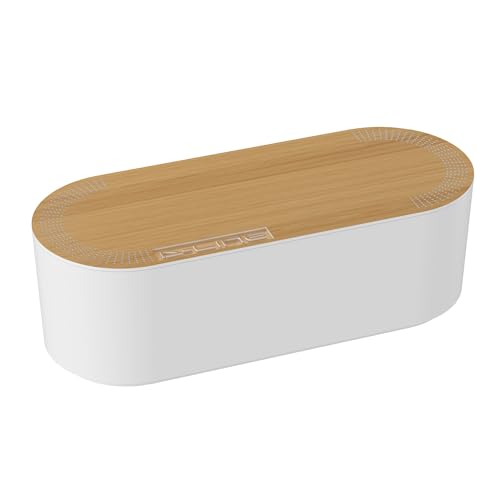
Disclosure: As an Amazon Associate, ilcastellomenu.com earns from qualifying purchases. Links on this page are affiliate links; they cost you nothing extra. Prices and availability change often, so check the current Amazon listing before you buy.
The honest way to weigh cable management box pros and cons is to refuse both sales pitches: the one that calls it a magic tidy box, and the one that calls it a plastic tub with a lid. Both contain a little truth. A cable management box genuinely transforms the worst corner of most rooms for very little effort, and it genuinely introduces a small set of responsibilities around heat, sizing and inspection that a visible strip does not ask of you. This page sets out five to seven real pros and five to seven real cons, each explained rather than merely listed, then shows what the trade-offs mean for different households.
The quick verdict: for a desk or television corner where a strip serves several devices, the pros win comfortably, provided you buy a ventilated box, size it for your bulkiest brick and keep it dry and uncovered. For a damp room, a high-draw appliance or a long cable run, the cons are not quirks to manage but signs you need a different tool. The sections below give you the evidence for both halves of that verdict.
Key Takeaways
- The biggest pro is effort-to-effect: one lidded box calms a whole corner with no tools or fixings.
- The biggest con is heat discipline: a closed box traps warmth, so ventilation and sensible loads are mandatory.
- Fit failures, usually a large power brick in a small box, cause most returns and most frustration.
- A box hides cords from children and pets, a real benefit with an honest limit: it is not a childproofing device.
- Hidden also means uninspected, unless you build the small habit of opening the box a few times a year.
- Most cons shrink dramatically with correct sizing, placement and setup; the pros do not shrink at all.
In this guide
Cable Management Box Pros and Cons: The Pros
A Whole Corner Fixed in Minutes
The defining pro is the ratio of effort to transformation. No drilling, no clamps, no measuring walls: you seat the strip, coil the slack, close the lid, and the messiest square metre of the room becomes a single calm object. Compare that with the hours a full raceway installation takes, or the permanent commitment of a mounted tray, and the box’s appeal is obvious. For renters, the pro doubles, because the improvement is completely reversible and leaves with you.
Every Plug Reachable at Once
A visible strip behind furniture is technically accessible and practically avoided. A box changes the psychology: one lid, lifted in a second, presents every plug, every brick and every cable path in front of you. Swapping a console, adding a charger or hunting a fault becomes a calm minute instead of a blind reach behind a stand. This accessibility is the pro owners underrate before buying and praise most afterwards, because it changes how willingly they maintain the setup.
Cords Hidden From Children and Pets
Removing the dangling, chewable, pullable tangle from the floor is a genuine quality-of-life pro in family homes. Cats lose their favourite forbidden toy, toddlers lose the invitation to pull, and the vacuum stops losing arguments with cables. The limit belongs in the cons as well as here: the box hides cords, it does not childproof them, and lids lift. As one layer in a sensibly arranged room, though, the reduction in temptation is real and immediate.
Protected Plugs and Calmer Cables
Inside a box, plugs are shielded from the everyday violence of a room: chair casters, kicked feet, vacuum heads, mops and the slow sideways drag of cables under tension. Connections stay seated because nothing tugs them, and cables stop migrating across the floor. The strip itself gathers less dust on its sockets, and the whole installation stays where you put it. It is the unglamorous pro that explains why a boxed setup still looks arranged a year later while an unboxed one has quietly re-sprawled.
A Room That Looks Finished
Cables at floor level read as disorder even in a tidy room, and removing them changes how the whole space feels. The box does not decorate anything; it simply deletes the visual noise at its source. In living rooms especially, where the television corner anchors the room, that deletion is worth more than the product’s modest tier suggests. Visitors stop seeing the setup and start seeing the room, which is the outcome every other cable product also promises and the box delivers most simply.
Portability and Reversibility
The box is the only cable solution that travels as a unit. Move house, rearrange the room, swap the desk: the strip, bricks and short cables stay arranged under the lid, and only the device ends need reconnecting. Nothing is screwed, glued or cut, so nothing needs making good. For students, renters, temporary postings and serial rearrangers, this pro alone can settle the question, because every rival solution charges an installation cost at each new address.
One Switch, One Habit
Gathering a corner’s devices onto one strip inside one box creates a single point of control. The strip’s switch, reached by lifting one lid, turns the whole corner off at night or on holiday, which is the kind of energy habit that survives because it is easy. An unmanaged tangle has no such moment. It is a small pro with a long tail, repeated daily for the life of the setup.
The Cons
A Closed Box Traps Heat
The most serious con, and the one to respect rather than debate. A power strip in a closed box traps heat that would otherwise escape into the room, because chargers and adapters give off warmth and the walls slow its exit. The management is well understood: choose a ventilated box, keep its openings uncovered, never drape fabric or a rug over it, and do not overload the strip. Managed, the con is a design constraint. Ignored, it is the one way this simple product can be used badly.
Large Power Bricks May Not Fit
The most common con in practice. Small boxes are defeated by the bulky adapters that laptops, consoles and monitors bring with them, and a brick forced in at a strained angle crowds cables and runs hotter in the cramped air. The con is avoidable, by measuring your bulkiest brick and sizing up, but it is unforgiving when ignored, because no arrangement of the interior rescues a box that is simply too small for its contents.
Hidden Means Uninspected
A visible strip gets inspected constantly, for free, every time you glance at it. A boxed strip gets inspected never, unless you schedule it. Dust drifts in through the slots, a plug can work slightly loose, a cable can age unnoticed. The counter-habit is cheap: open the box a few times a year, clean it, check every connection. But the con is real, because the product’s core virtue, hiding, works on problems as faithfully as it works on mess.
It Solves One Spot, Not the Room
A box tidies the cluster at the strip and does nothing for the runs that feed it: the cable crossing to the wall socket, the lead travelling to the other side of the desk, the wire along the skirting. Buyers who expect a whole-room transformation from one box will be disappointed by the stretches it cannot touch. Those stretches need sleeves, trays or raceways, which means the box is often the first purchase in a system rather than the only one.
One More Object in the Room
The box itself takes space: floor beside the desk, room behind the stand, a footprint on a shelf. In a tight corner that footprint can be genuinely awkward, and a large box bought for a large brick is a substantial object to place. It also becomes furniture in the maintenance sense, another surface to dust and another thing to move when cleaning. For minimalists in small rooms, the trade of tangle for object is not automatically a win.
The Temptation to Stuff and Cover
Success breeds the two abuses that undo it. Because the box hides things, it tempts owners to hide more things: extra chargers, a spare brick, one more plug, until the interior is a pressured nest and the strip is quietly overloaded. And because the box is visible, it tempts owners to hide the box, under a throw or a rug, sealing the vents the design depends on. Both temptations are understandable, both are the owner’s to refuse, and both belong on the honest cons list.
Not a Safety Device
Finally, the con of false confidence. A lidded box can look like protection, and it is not rated, sealed or latched as protection against anything. Lids lift, water finds its way in if the box sits in its path, and the outlet behind the box needs exactly the care it always needed. Households that understand the box as tidying get its full benefit safely. Households that mistake it for childproofing or waterproofing are leaning on a claim the product never made.
Heat is the subject every honest discussion of these boxes has to start with. A power strip inside a closed box traps heat that would otherwise drift away into the room, because the chargers and adapters plugged into that strip give off warmth as they work and the box walls slow its escape. That is why the first rule of ownership is to choose a ventilated box, with slots or openings that let warm air leave, rather than a sealed container that happens to fit. It is also why you should never cover the box with fabric, a throw or a rug, however tempting it is to hide it further: a layer over the top turns a ventilated design back into a sealed one.
Keep the box away from water sources. That sounds obvious until you map where boxes naturally land: under desks near spilled drinks, behind television stands, beside aquariums, in kitchens and bathrooms where steam and splashes are part of daily life. Electricity and water do not negotiate, and a box concentrates plugs in one place, which raises the stakes of any spill that reaches it. Place boxes on dry floors and dry shelves, route them away from sinks, fish tanks, plant watering spots and pet bowls, and if a drink ever does go over near the box, unplug first and dry everything thoroughly before it goes back into service.
What the Trade-Offs Mean for You
Desk Workers
The desk setup is the box’s home turf. Monitors, docks, chargers and lamps all converge on one strip, usually on the floor, usually visible from the door. A box placed beside the desk leg turns that convergence into a single tidy volume, and the cables from the desktop arrive together down the back edge. For renters and anyone in a temporary workspace, the appeal doubles: no drilling, no clamps, nothing attached to furniture you do not own. When the desk moves, the box moves with it, contents and all, and the new setup takes minutes to recreate.
For a desk, the pros land daily and the cons are almost all settled on day one by sizing and ventilation. This is the use case where the balance is most one-sided.
Television and Gaming Households
Entertainment corners reward a box because their cables never move. The strip behind a television stand might not be touched for a year, and in that year it gathers dust, slips sideways and slowly becomes the thing nobody wants to reach behind the furniture to fix. A box imposes order that lasts: strip seated, bricks spaced, cables leaving toward their devices, lid keeping the dust to a washable surface. When a console changes or a streaming stick arrives, the job is one lid and one free socket, not an archaeological dig.
Here the fit con bites hardest, because console bricks are the bulkiest in the house. Size up, and the remaining cons reduce to a dusting habit and an occasional inspection.
Families With Small Children and Pets
A lidded box does hide cords from children and pets, and that is a genuine benefit: dangling cables invite pulling, chewing and tripping, and a box removes most of that invitation. But be precise about what the box is not. It is not a childproofing device. Lids lift, often easily and by design, because you are meant to open them yourself without tools. A curious toddler can open many of these boxes, which means the outlet and the strip still need the normal care you would give them anywhere else in the home: sensible placement, socket covers where you use them, and supervision as the real safety system.
The cord-hiding pro is real and immediate, and the not-a-safety-device con is the one to hold alongside it. Box plus normal outlet care is a good room; box instead of normal outlet care is not.
How the Box Compares With the Alternatives
| Option | Pros against the box | Cons against the box |
|---|---|---|
| Under-desk tray | Frees the floor completely; nothing to kick | Installation, desk-dependent, harder access |
| Cable sleeve | Cheapest way to calm a run; flexible | Hides no strip, no bricks, no cluster |
| Raceway | Most finished look along walls | Permanent, slow to install, hard to change |
| No system at all | Costs nothing, inspects itself | The tangle, the dust, the daily visual noise |
A box is one tool among several, and sometimes it is not the right one. An under-desk tray carries a strip and its cables along the underside of the desk, off the floor entirely, which suits standing desks and anyone who mops often. Cable sleeves gather a run of cables into a single neat tube between two points, ideal for the stretch between a desk and a wall. Raceways and trunking fix cables along skirting boards and walls, the tidiest answer for permanent television installations. Many good setups combine tools: a tray under the desk, a box at the television, sleeves on the runs between. Choosing a box is really choosing the floor-standing, furniture-like member of that family.
The tray comparison is developed in full in cable management tray vs cable management box.
How to Buy Smart
Buying smart means aiming every purchase decision at a named con. Against the fit con: rehearse your strip and bulkiest brick on the floor and buy the size that swallows the rehearsal. Against the heat con: choose a ventilated design and plan a placement with air around it. Against the inspection con: choose a lid you can lift in the box’s final home without moving furniture. Against the stuffing con: buy the size your current setup needs, not a cavern for hypothetical future gear. Our cable management box buying guide turns each of these checks into a worked method, and PC cases with strong cable management covers the inside of the machine itself.
Setup and Care That Reduce the Cons
Routing is where a tidy box is won or lost. Cables should enter and leave through the openings the designer provided, at the back or the ends, never pinched under the lid or forced through a gap that bends them sharply. Inside the box, coil the excess length of each cable loosely and keep the coils separate, so the next time you open the lid you can lift one device out without dragging the whole nest with it. A few reusable ties inside the box transform it from a hiding place for chaos into an organised one, and the five minutes spent arranging the interior is repaid every time you change a device.
Cleaning a cable box is a small ritual with an outsized effect, because dust is the quiet enemy of everything electrical. Dust settles on the strip, drifts into the box through its slots and coats the adapters, and a dusty interior holds warmth a little more stubbornly. Every few months, switch the strip off, open the box, lift the contents out and wipe or vacuum the interior. Check each cable as it goes back in: insulation intact, plugs seated fully, nothing pinched. The whole job takes minutes, and it doubles as the regular inspection that hidden electrics otherwise never get.
Placement completes the mitigation list: dry spot, air around the box, lid test passed before filling, nothing ever stored on top. Follow those habits and the cons list shrinks to its honest core, a little space taken and a little discipline kept, while the pros list stays exactly as long as the day you bought the box.
Bottom Line
The pros are about what the box does for the room; the cons are about what the box asks of the owner. What it does is large, immediate and lasting: a calm corner, reachable plugs, cleanable floors, hidden cords. What it asks is small and specific: honest sizing, ventilation respected, loads kept sensible, a dry placement and an occasional look inside. Households willing to keep that small side of the bargain will find the balance decisively favourable. The remaining question is only whether the value clears the cost for your corner, which is exactly what is a cable management box worth it examines.
A Closer Look: Living With the Box
Consider the box’s relationship with time. Cable populations grow: a charger here, a smart speaker there, a new console at a birthday. An unmanaged strip absorbs growth as sprawl, each new cable draped over the last. A box absorbs growth as capacity, up to a point: open the lid, find the free socket, route the new cable out. That point, the full box, is also useful information, because it tells you the corner has genuinely outgrown one strip and needs a rethink rather than another layer of tangle. The box makes the state of your setup legible at a glance.
Renters develop a particular affection for these boxes, and it is easy to see why. So many cable solutions ask for screws in walls, clamps on desks or adhesive on skirting, all of which are deposits waiting to be argued about. A box asks for nothing. It sits on the floor, does its work, and leaves with you, taking the tidy corner with it and leaving the room exactly as you found it. In a first flat or a temporary posting, that combination of order and reversibility is worth more than a marginally neater fixed installation.
The box also changes how a setup survives being moved. Anyone who has relocated a desk or a television knows the ritual of the cable photograph, the handful of ties, the mysterious spare lead. With a box, the core of the setup travels as a unit: strip, bricks and short cables stay in place under the lid, and only the device ends need reconnecting at the new home. Moves, redecoration and the annual furniture shuffle all become smaller jobs. It is a benefit nobody buys the box for and everybody appreciates the first time it happens.
Think, finally, about what the box asks of you, because it is not nothing. It asks you to open it occasionally, to resist stuffing it, to keep its vents clear and its spot dry, and to remember that the strip inside still has limits even though you cannot see them. These are small asks, minutes a year, but they are the difference between a box that is a genuine improvement and a box that is a lid on a problem. Owners who make peace with that tiny maintenance contract tend to be the ones who recommend these products without hesitation.
One underrated benefit of gathering cables into a box is what it does to cleaning day. A floor with a cable nest on it gets cleaned around, which means the dustiest square of the room is precisely the one the vacuum never reaches. A box turns that square into a single object you can slide aside, clean under and slide back. The strip stays seated, the cables stay routed, and the corner returns to being a corner rather than an ecosystem. Small, domestic and genuinely valuable, this is the benefit owners mention most after the first month.
Labelling is the habit that separates a box that stays tidy from a box that slowly reverts. A small tag on each cable, just inside the lid, naming its device, turns every future change into a thirty-second job. Without labels, every unplugging is a guessing game played by tugging cables and watching which screen flickers. The box makes labelling easy because all the decision points are in one place, under one lid. Do it on the day you set the box up, while you still know which cable is which, and the system maintains itself.
There is a quiet psychological effect to a tidy cable corner that owners report consistently: the room feels finished. Cables are visual noise, and noise at floor level is especially tiring because it reads as disorder rather than equipment. A box removes the noise at its source. It does not make a room beautiful by itself, but it removes the one element that made the room look unfinished despite everything else being in place. For a modest, single purchase, that is an outsized return, and it explains why so many people buy a second box for another room within the year.
Consider the box’s relationship with time. Cable populations grow: a charger here, a smart speaker there, a new console at a birthday. An unmanaged strip absorbs growth as sprawl, each new cable draped over the last. A box absorbs growth as capacity, up to a point: open the lid, find the free socket, route the new cable out. That point, the full box, is also useful information, because it tells you the corner has genuinely outgrown one strip and needs a rethink rather than another layer of tangle. The box makes the state of your setup legible at a glance.
The Trade-Offs That Only Show Up After the First Month
The compromise candidate
Many buyers end up choosing neither the strongest nor the cheapest cable management box but the one whose weaknesses fall where they personally care least. That is a rational strategy, not a failure of research. List the cons of your final two candidates side by side and ask which set you would rather live with daily in a workspace that gets packed away and rebuilt more often than it stays in place. The product whose drawbacks sit in your blind spots will feel like the better product for years, even if a comparison table scores the other one higher on paper.
The advantage that depends on your habits
The headline advantage of a cable management box is real, but it is not automatic: it only pays out if your habits match it. Used the way it was designed, in a workspace that gets packed away and rebuilt more often than it stays in place, the strengths described earlier compound quietly — less friction, fewer workarounds, a smoother routine. Used against its grain, the same design choices become the source of the complaints in the cons column. Before deciding, be honest about which user you are on an ordinary tired weekday, not the organised version of yourself you plan to become next month.
Where the drawbacks bite hardest
The disadvantages of a cable management box are not evenly distributed across owners. They concentrate in specific situations: tight spaces, shared rooms, heavy daily loads, or workflows that change direction mid-task. If your routine involves any of those, the cons deserve double weight in your decision, because you will meet them weekly rather than rarely. Conversely, an owner whose setup avoids those situations entirely may never encounter the most-criticised weakness at all, which is why verdicts on the same cable management box can sound like descriptions of two different products.
The maintenance trade-off nobody advertises
Almost every cable management box trades purchase-day simplicity for a small ongoing maintenance obligation: cleaning, recalibrating, replacing a wear part, updating firmware or simply keeping accessories together. The trade is usually worth it, but it is not free, and it scales with how hard you use the product. In a workspace that gets packed away and rebuilt more often than it stays in place, skipped maintenance shows up first as small annoyances — a control that feels off, a result that drifts, a noise that was not there before — long before it causes a real failure. Budget the minutes, not just the money.
When the alternative is genuinely better
There are owners for whom skipping the cable management box altogether is the right call, and naming them is part of an honest pros-and-cons account. If your need is occasional, borrowed or built into something you already own, or if your space cannot give the product the conditions it needs, the alternative route avoids both the cost and the clutter. The pros only outweigh the cons when the problem the cable management box solves is a recurring one in your week. A problem you meet twice a year rarely justifies a permanent new resident in the Desks category.
How the balance shifts over a year of ownership
The pros-and-cons ledger of a cable management box is not static. In the first month, novelty inflates the pros; by the sixth month, the honest picture is about reliability, running costs and whether the product has earned a permanent place in your routine. Wear parts, consumable availability and the maker’s support responsiveness all matter more at month ten than at day ten. When you read owner feedback, weight the long-term reports accordingly: a complaint about a part that failed after a year tells you more than a first-week rave about unboxing.
Frequently Asked Questions
What is the biggest disadvantage of a cable management box?
Heat discipline. A power strip inside a closed box traps warmth, so the box must be ventilated, its openings must stay uncovered, and the strip must not be overloaded. That is a real responsibility a visible strip does not impose. It is also a well-understood one: follow those three rules and the disadvantage becomes a manageable design constraint. Ignore them, by sealing the box, covering it with fabric or stuffing it with plugs, and it becomes the product’s one genuine hazard.
Do the pros really outweigh the cons for a desk setup?
For most desk setups, yes, decisively. The pros, a calm floor, reachable plugs, protected connections and a finished look, are experienced every day. The cons are mostly settled at purchase: size for the laptop brick, choose ventilation, place the box where air reaches it. What remains is a few minutes of dusting and checking a few times a year. Few home-office purchases offer that ratio of daily benefit to occasional effort, which is why desk corners are this product’s home ground.
Is hiding cords from children a real pro or marketing?
It is a real pro with a hard limit. A box genuinely removes the dangling tangle that invites pulling and chewing, and that reduces everyday temptation for toddlers and pets. The limit is that the box is not a childproofing device: lids lift easily by design, so the strip and outlet still need normal care and sensible placement. Count the cord-hiding as a tidying benefit inside a safe room, never as the safety measure itself, and the claim is honest.
Can the cons be avoided by buying a better box?
Some can, some cannot. Better designs shrink the fit con with honest sizing and size ranges, the heat con with real ventilation, and the access con with lids that seat and lift well. No design removes the inspection habit, the one-spot limit or the space the box occupies, because those belong to the concept rather than to any model. Buy well to minimise the avoidable cons, then keep the small habits that manage the rest, as the setup section of this page describes.
Does a cable management box make cables last longer?
Generally yes, by removing the main sources of cable wear in a room. Inside a box, cables are not kicked, rolled over by casters, tugged sideways or chewed, and plugs stay seated instead of working loose. The condition is that the box itself must not become a wear source: cables should leave through proper openings at gentle angles, never pinched under the lid or bent sharply at an exit, and slack should be coiled loosely. Arranged that way, a boxed setup is gentler on cables than any open floor.
Who should not buy a cable management box at all?
Households whose cable problem is a long run rather than a local cluster, anyone whose only placement option is damp or sealed between furniture, and anyone whose strip feeds a high-draw appliance that should stay visible on its own outlet. Also, honestly, anyone who knows they will never open the box again: the inspection habit is part of the product. For those cases a tray, a sleeve, a raceway or a rethink of the setup serves better, and the alternatives table on this page points the way.
Related Guides
Keep building the same calm, organised setup with these companion guides from the same desk and cable series: our cable management box review; our cable management box reviews; our cable management box buying guide; our cable management tray review; how to choose a cable management tray; desks chosen for cable management; PC cases with strong cable management.