Disclosure: As an Amazon Associate, ilcastellomenu.com earns from qualifying purchases. Links on this page are affiliate links; they cost you nothing extra. Prices and availability change often, so check the current Amazon listing before you buy.
Is a cable management tray worth it? The honest short answer to is a cable management tray worth it is: worth it if your power strip lives on the floor, your bricks number more than one, or your desk moves up and down; not worth it if your setup is a laptop and a lamp, or your desktop is glass. Everything after this paragraph exists to help you locate your own desk on that line, because the tray is cheap in money but real in effort, and both sides of the ledger deserve a fair hearing.
Key Takeaways
- An open tray breathes, so heat escapes instead of pooling around power bricks.
- Screw mounts are firmest and permanent; clamp mounts are removable but depend on a solid desktop edge.
- A loaded tray is heavy, so fixings must bite into solid material, never a thin or hollow skin.
- One power strip in the tray, one cable to the wall: never chain two strips together.
- Keep drinks and drips away from the strip, and give every brick air on all sides.
- Worth it is a property of your cable count and desktop, not of the product alone.
In this guide
What You Actually Get
Desktop material deserves a slow, honest check before any mount is chosen. Solid wood and good quality board with a dense core hold screws well and forgive a clamp. Thin hollow-core desktops, glass tops and some lightweight honeycomb panels do not: screws find nothing to bite, and clamps concentrate force on a skin that can dent or split. If your desktop is thin or hollow, a tray may still work with a clamp spread across a reinforced edge, or the honest answer may be a floor-level solution instead. Turning the desk over, tapping along the rear edge and reading the maker’s description of the top takes ten minutes and prevents the classic failure of a loaded tray tearing free on a quiet afternoon.
One power strip in the tray is the pattern that works; two strips chained together is the pattern that causes trouble. Plugging one strip into another, sometimes called daisy chaining, concentrates load and is discouraged by fire safety guidance in plain terms. If the tray needs more sockets than one good strip offers, the honest fixes are a single larger strip that still fits the tray with air around it, or splitting the desk so that a second strip lives somewhere else entirely, such as feeding a floor-standing PC separately. Count the sockets you truly need before buying either the strip or the tray, and remember that bulky bricks can block neighbouring sockets, so the usable count is often lower than the printed count.
Dust is the slow tax on every under-desk installation. An open tray collects less dust than a closed box with a warm interior, but it still gathers a grey felt along the cables over months, especially in homes with pets or carpets. The saving grace of a tray is access: you can see the dust, reach it with a vacuum nozzle or a dry cloth, and lift cables out one at a time without dismantling anything. Build a two-minute tray check into whatever cleaning rhythm the room already has, and shake out or wipe the straps at the same time. A tray that is easy to clean stays clean; a solution that needs tools and patience quietly stops being maintained.
Heat is the subject most cable tidy advice skips, and it should not be skipped. Power bricks and power strips produce warmth in normal use, and that warmth needs somewhere to go. An open tray breathes: air moves through and around it from every side, so heat escapes instead of pooling. That openness is a genuine safety and longevity advantage over any closed container. The honest limit is that openness is not magic. A brick still needs air around its own casing, so do not wrap bricks in fabric, do not bury them under a pile of coiled cable, and do not seal a loaded tray inside a modesty panel or a closed cabinet run. Leave gaps between bricks, let the coils sit loose, and the tray stays a cool, boring place, which is exactly what you want.
The Real Costs Beyond Money
Power bricks deserve their own seating plan inside the tray. A laptop brick, a monitor brick and a USB charging brick side by side, touching, in a warm tray is the worst arrangement; the same three with a finger of air between each of them is fine for years. Alternate bricks with cable coils rather than grouping all the heat in one hot corner, keep the largest brick nearest the tray’s open side where air moves best, and never stack one brick on top of another. If a brick runs noticeably hot in normal use, give it the most open position in the tray and check it again after a week of real work rather than assuming the first day told the whole story.
Renters and anyone in temporary space should weigh removal as heavily as installation. A clamp tray leaves with you and leaves nothing behind; a screwed tray leaves small holes that may or may not matter to a deposit. There is also a middle path some owners use, screwing the tray into a separate board that itself clamps or rests under the desk, though that adds bulk and should only carry light loads. The honest advice is to match the mount to your tenure: the shorter and less certain your stay, the stronger the case for clamp mounting and for keeping the original packaging so the tray travels to the next desk intact.
Metal and wire trays and fabric or mesh trays behave differently over time. A rigid wire or steel tray holds its shape under a heavy strip, shrugs off heat, and can be wiped clean, but its edges and openings dictate where cables can enter. A softer mesh design flexes to swallow awkward brick shapes and is forgiving about entry points, but can belly downward under a concentrated load if the fixing points are far apart. Neither material is the correct one in the abstract. Heavy brick collections argue for rigidity; light charging-focused setups forgive flexibility. Match the material to the load you rehearsed on the floor, not to the tidiest photograph.
Who It Pays Off For
The Multi-Monitor Knowledge Worker
Keep liquids away from the tray and from the power strip inside it. Desks attract coffee, water bottles and the occasional knocked glass, and a tray mounted under the rear edge sits directly in the drip path of anything spilled near the back of the desk. Route the strip so its sockets face along the tray rather than straight up where a spill would land, keep drinks toward the front of the desk as a habit, and never mount a tray where a plant gets watered above it. This is not exotic caution; it is the single most practical safety habit in the whole topic, and it costs nothing beyond paying attention when you choose the tray position.
The Standing-Desk Owner
Think about the wall socket as part of the installation. The tray’s strip is only as tidy as its one supply cable, and that cable needs a socket it can reach at every desk height with slack to spare, without crossing a doorway or a heater. Sockets hidden behind heavy furniture tempt people into extension habits that defeat the whole project. If the nearest sensible socket is awkward, moving the desk a short distance or choosing the other end of the desk for the tray can solve what no accessory will. Never run the supply cable under a rug to reach a distant socket; covered cables overheat and hide damage.
The Gamer Who Swaps Gear
Future changes are certain, so design for the person who will re-open this tray, who is you in eight months with no memory of today’s logic. Leave one or two sockets free if you can. Leave one empty strap loop ready. Run cables so any single device can be removed without disturbing the rest, which usually means not threading every cable through every strap. Photograph the finished tray before you push the desk back; that photo becomes the map when something needs to change. The trays that stay tidy for years are not the ones installed most beautifully, but the ones installed most forgivingly.
Who Should Skip It
The Minimal Laptop Desk
One power strip in the tray is the pattern that works; two strips chained together is the pattern that causes trouble. Plugging one strip into another, sometimes called daisy chaining, concentrates load and is discouraged by fire safety guidance in plain terms. If the tray needs more sockets than one good strip offers, the honest fixes are a single larger strip that still fits the tray with air around it, or splitting the desk so that a second strip lives somewhere else entirely, such as feeding a floor-standing PC separately. Count the sockets you truly need before buying either the strip or the tray, and remember that bulky bricks can block neighbouring sockets, so the usable count is often lower than the printed count.
The Glass or Fragile Desktop
Dust is the slow tax on every under-desk installation. An open tray collects less dust than a closed box with a warm interior, but it still gathers a grey felt along the cables over months, especially in homes with pets or carpets. The saving grace of a tray is access: you can see the dust, reach it with a vacuum nozzle or a dry cloth, and lift cables out one at a time without dismantling anything. Build a two-minute tray check into whatever cleaning rhythm the room already has, and shake out or wipe the straps at the same time. A tray that is easy to clean stays clean; a solution that needs tools and patience quietly stops being maintained.
The About-to-Move Household
Children and pets change the risk picture under a desk. A tray lifts cables and a power strip off the floor and out of the easiest reach, which is a real improvement over a floor nest, but a determined toddler or a chewing pet can still reach an under-desk tray at the rear. Route the strip’s own cable so it cannot be pulled down in a loop, keep dangling ends out of the tray entirely, and check periodically for chewed insulation on any cable that hangs low. If the desk is in a room where a pet sleeps underneath, position the tray as high and as far back as the desk allows, and treat any damaged cable as a replace-now item, not a monitor-it item.
Strengths and Trade-Offs of Owning One
Strengths
- Daily friction disappears: cleaning, foot room and device swaps all get easier at once.
- Heat behaves, because the open structure lets bricks breathe instead of stewing.
- The system is reversible and travels, especially in clamp form, so the value is rarely stranded.
Trade-Offs
- An hour of honest fitting, measuring and routing is required to get any of the benefits.
- The mount decision is permanent-ish for screws and conditional for clamps.
- Dust and periodic checks remain your job; the tray reduces chores, it does not abolish them.
A tray interacts with cable raceways and floor trunking rather than replacing them. The tray handles the under-desk gathering; a short raceway or a simple covered run handles the one cable’s journey from tray to wall socket, especially where that journey crosses a walkway. Keeping that single run covered protects it from chair castors and shoes, and chair castors deserve respect: a castor rolling over a loose cable, repeatedly, will damage insulation long before the cable looks tired. Map the whole path from wall socket to furthest device as one system, and let each part, socket, run, tray, loop, do the job it is best at.
Alternatives to Consider
Start with what a tray actually has to hold, because that decides everything else. On a typical desk the load is one power strip, two or three chunky power bricks for a laptop and monitors, a phone charger, and a bundle of cables that each want to fall in a different direction. None of that is glamorous, and none of it is light once it is gathered in one place. A tray that looks fine empty can sag, twist or pull at its fixings once the bricks go in, which is why honest load thinking matters more than the product photo. Treat the tray as a small shelf that happens to hold electricity, and judge it the way you would judge a shelf: what it is made of, how it is fixed, and what it is fixed into.
There is a point where a tray stops being the answer. A desk with a single laptop and a lamp has almost nothing to manage, and a strap or two does the job. A desk with a desktop PC tower, three monitors, a dock, speakers, a console and charging for four handheld devices may need a tray plus a second system, perhaps a box on the desk for daily charging, rather than one heroic tray sagging under everything. Honest scoping saves money and frustration: list the devices, count the bricks, and let the count, not enthusiasm, decide how much hardware the underside of the desk really needs.
The main alternative is examined in our cable management box review, whether a cable management box is worth it and the tray versus box comparison. Broader options are rounded up in the best cable management options for desks.
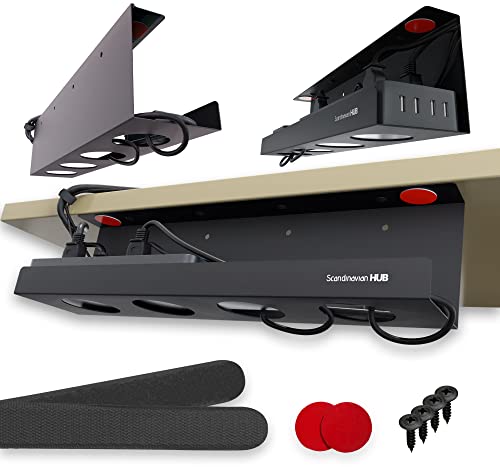
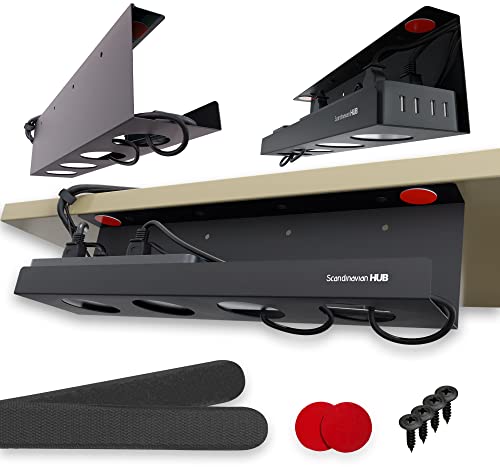
Scandinavian Hub Under Desk Cable Management Tray
The Scandinavian Hub Under Desk Cable Management Tray is a clamp-on tray aimed at people who cannot or will not drill, with a frame that grips the desktop edge. In prose terms it sits in the mid tier of this category: judge it on mount security, openness for heat, usable entry points and how forgiving it is when devices change, rather than on any single headline claim. Check the current listing before you buy, because versions and included fixings change over time.
What matters in daily use is how it behaves loaded. Seat the strip first, add bricks with air between them, then route device cables in through the nearest openings with gentle loops. A tray of this style rewards that order of work and punishes the reverse: cables first and strip last turns the interior into a knot that must be undone for every change. Owners who keep one end of the tray lighter, near the wall socket, find the single supply cable leaves cleanly without crossing the whole bundle.
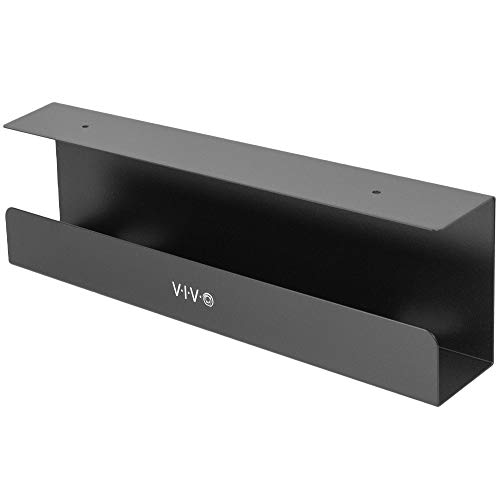
VIVO Under Desk Cable Management Tray
The VIVO Under Desk Cable Management Tray is a mesh-style under-desk tray family that leans on openness and easy cable drop-in from above. In prose terms it sits in the mid tier of this category: judge it on mount security, openness for heat, usable entry points and how forgiving it is when devices change, rather than on any single headline claim. Check the current listing before you buy, because versions and included fixings change over time.
What matters in daily use is how it behaves loaded. Seat the strip first, add bricks with air between them, then route device cables in through the nearest openings with gentle loops. A tray of this style rewards that order of work and punishes the reverse: cables first and strip last turns the interior into a knot that must be undone for every change. Owners who keep one end of the tray lighter, near the wall socket, find the single supply cable leaves cleanly without crossing the whole bundle.
How to Get the Most Value If You Buy
Finally, a tray is a reversible experiment in a way built-in desk channels are not. If the position is wrong, a clamp tray moves in minutes and a screwed tray moves in an afternoon, leaving small holes as the only evidence. That reversibility argues for starting simply: one tray, one strip, honest slack, labels, and a month of living with it before adding spines, raceways or a second tray. Systems that grow by evidence stay tidy; systems bought all at once to match a photograph usually contain one hero component and three regrets.
Future changes are certain, so design for the person who will re-open this tray, who is you in eight months with no memory of today’s logic. Leave one or two sockets free if you can. Leave one empty strap loop ready. Run cables so any single device can be removed without disturbing the rest, which usually means not threading every cable through every strap. Photograph the finished tray before you push the desk back; that photo becomes the map when something needs to change. The trays that stay tidy for years are not the ones installed most beautifully, but the ones installed most forgivingly.
Value multiplies when the choosing and fitting are done properly, so pair this verdict with how to choose a cable management tray and how to install a cable management tray, and shortlist models through the cable management tray buying guide.
The Decision Checklist
- Does your power strip currently live on the floor?
- Do you have two or more power bricks plugged in all day?
- Does your desk rise and fall, or move for cleaning?
- Can your desktop honestly accept a screw or clamp mount?
- Do you swap or add devices more than once or twice a year?
- Would a clear floor change how the room feels or cleans?
Three or more yes answers: buy the tray and fit it properly. One or two: consider straps or a small box first. Zero: skip it with a clear conscience, and spend the money where your desk actually hurts. Readers who want the product-level view can continue to our cable management tray review and cable management tray reviews, on desks such as desks that suit both gaming and work.
One More Thing Worth Knowing
Accessories beyond straps and labels should justify themselves individually. A cable spine earns its place on a standing desk where the supply cable’s journey is long and visible. A short raceway earns its place where one run crosses a walkway or a castor path. Sleeves earn their place where several cables share a visible vertical drop. What none of them should do is arrive in the same parcel as the tray on a wave of optimism, because unneeded accessories become the new clutter, stored in the tray they were meant to improve. Add one thing, live with it, and let evidence argue for the next.
There is a small ritual worth adopting on installation day: the one-week check. After seven days of real use, kneel down with a torch and look at everything. Fixings get a fingertip test for looseness, bricks get a palm test for heat, cables get a glance for tension or chafing at edges, and the clamp, if fitted, gets checked for any slow creep along the edge. Ten minutes, once, catches the entire class of problems that otherwise announce themselves months later as a fall, a flicker or a smell. Put the date in the photograph you took of the finished tray and the system is documented.
One more consideration that rarely appears in listings is how a tray behaves when the desk itself moves rooms. Desks get rotated for a window, shifted for a new chair, or carried through a doorway during a reshuffle, and every one of those moments tests the installation. Cables routed with slack and labels survive a move; cables routed at full stretch turn a simple rotation into a disconnection ceremony. If your room rearranges often, favour the clamp mount, keep the supply cable’s route simple, and take the photograph of the finished tray before the desk goes back, because after a move that photograph is the only reliable memory of what went where.
The environmental footnote is small but real. A tray is a durable, single purchase with no consumables, and it extends the working life of the cables and bricks it protects from castors, feet, dust and edge wear. Cables replaced less often are waste avoided. That does not make a tray an ecological gesture worth boasting about, but it does mean the category sits comfortably on the buy-once, buy-right side of desk spending, especially in rigid metal form that will outlast several desks and at least one complete change of devices.
Think, too, about who else uses the desk. A shared family desk, a partner’s occasional hot-desk, or a child’s homework station all argue for the most forgiving installation: labels in plain words, nothing routed under tension, the strip’s switch reachable without crawling, and a tray position that no one’s knees meet. The installer always knows the system’s logic; the second user never does. Designing for the second user is what separates a tidy installation from a merely tidy-looking one, and it costs nothing but the labelling minutes already recommended.
Consider the humble cable that is too short, because it dictates more installations than any other factor. A monitor placed at the far left with a short display cable and a brick that must sit in the tray pulls the whole layout toward it. The mature response is to let it: put that brick at the tray end nearest its monitor, and arrange the more flexible citizens around it. Fighting the short cable with tension, sharp bends or a brick dangling half out of the tray creates the one visible failure in an otherwise invisible system, and it will nag at every future change.
Sound, dust, heat, load, access: notice that none of the deciding factors in this category are visible in a product photograph. That is the deep reason reviews and guides in this niche repeat the same unglamorous checks. The photograph shows a clean line under a clean desk in an empty room; ownership is a loaded tray under your desk in your room, with your desktop material, your bricks and your habits. Every recommendation in this series is ultimately an instruction to judge the second picture, not the first, and to let measurements and rehearsals outrank imagery.
The psychology of a tidy underside is worth one honest paragraph. Nobody sees the tray during the working day, yet people consistently report that a desk with managed cables feels calmer to sit at and easier to leave at the end of the day. The effect is not magic; it is the removal of small visual debts. Every dangling cable is a tiny unfinished task the eye keeps registering, and gathering them removes the whole category at once. This is also why partial solutions disappoint out of proportion to their cost: three cables still on the floor keep issuing the same visual reminder as ten did.
One More Thing Worth Knowing
The psychology of a tidy underside is worth one honest paragraph. Nobody sees the tray during the working day, yet people consistently report that a desk with managed cables feels calmer to sit at and easier to leave at the end of the day. The effect is not magic; it is the removal of small visual debts. Every dangling cable is a tiny unfinished task the eye keeps registering, and gathering them removes the whole category at once. This is also why partial solutions disappoint out of proportion to their cost: three cables still on the floor keep issuing the same visual reminder as ten did.
Think, too, about who else uses the desk. A shared family desk, a partner’s occasional hot-desk, or a child’s homework station all argue for the most forgiving installation: labels in plain words, nothing routed under tension, the strip’s switch reachable without crawling, and a tray position that no one’s knees meet. The installer always knows the system’s logic; the second user never does. Designing for the second user is what separates a tidy installation from a merely tidy-looking one, and it costs nothing but the labelling minutes already recommended.
Accessories beyond straps and labels should justify themselves individually. A cable spine earns its place on a standing desk where the supply cable’s journey is long and visible. A short raceway earns its place where one run crosses a walkway or a castor path. Sleeves earn their place where several cables share a visible vertical drop. What none of them should do is arrive in the same parcel as the tray on a wave of optimism, because unneeded accessories become the new clutter, stored in the tray they were meant to improve. Add one thing, live with it, and let evidence argue for the next.
One more consideration that rarely appears in listings is how a tray behaves when the desk itself moves rooms. Desks get rotated for a window, shifted for a new chair, or carried through a doorway during a reshuffle, and every one of those moments tests the installation. Cables routed with slack and labels survive a move; cables routed at full stretch turn a simple rotation into a disconnection ceremony. If your room rearranges often, favour the clamp mount, keep the supply cable’s route simple, and take the photograph of the finished tray before the desk goes back, because after a move that photograph is the only reliable memory of what went where.
The environmental footnote is small but real. A tray is a durable, single purchase with no consumables, and it extends the working life of the cables and bricks it protects from castors, feet, dust and edge wear. Cables replaced less often are waste avoided. That does not make a tray an ecological gesture worth boasting about, but it does mean the category sits comfortably on the buy-once, buy-right side of desk spending, especially in rigid metal form that will outlast several desks and at least one complete change of devices.
Sound, dust, heat, load, access: notice that none of the deciding factors in this category are visible in a product photograph. That is the deep reason reviews and guides in this niche repeat the same unglamorous checks. The photograph shows a clean line under a clean desk in an empty room; ownership is a loaded tray under your desk in your room, with your desktop material, your bricks and your habits. Every recommendation in this series is ultimately an instruction to judge the second picture, not the first, and to let measurements and rehearsals outrank imagery.
There is a small ritual worth adopting on installation day: the one-week check. After seven days of real use, kneel down with a torch and look at everything. Fixings get a fingertip test for looseness, bricks get a palm test for heat, cables get a glance for tension or chafing at edges, and the clamp, if fitted, gets checked for any slow creep along the edge. Ten minutes, once, catches the entire class of problems that otherwise announce themselves months later as a fall, a flicker or a smell. Put the date in the photograph you took of the finished tray and the system is documented.
Consider the humble cable that is too short, because it dictates more installations than any other factor. A monitor placed at the far left with a short display cable and a brick that must sit in the tray pulls the whole layout toward it. The mature response is to let it: put that brick at the tray end nearest its monitor, and arrange the more flexible citizens around it. Fighting the short cable with tension, sharp bends or a brick dangling half out of the tray creates the one visible failure in an otherwise invisible system, and it will nag at every future change.
Is a Cable Management Tray Worth It: Closing Notes
Ergonomics is a quiet beneficiary of a well-placed tray. When cables leave the floor, the space under the desk returns to feet, and feet are supposed to move: stretching, resting on a footrest, shifting through the day. A strip on the floor teaches people to keep their feet still and forward, which is a small, constant postural tax. Removing the obstacle will not transform anyone’s back, and no tray should be sold as health equipment, but a clear under-desk zone removes one reason to sit rigidly. Check, when you fit the tray, that its position does not simply move the obstacle from the floor to knee height, because a tray that meets your legs has traded one ergonomic fault for another.
Cable management interacts with desk lighting and bias lighting more than people expect. LED strips and monitor light bars add thin cables and small controllers that want to live exactly where the tray is. Route lighting cables inside the tray like everything else, keep their small controllers reachable rather than buried, and remember that a controller brick, however small, follows the same air rules as a big one. A tray that absorbs the lighting runs as gracefully as the power runs is doing its job completely; a tray that leaves three thin cables dangling because they were an afterthought leaves the job visibly unfinished.
Think about sound-producing neighbours. External drives, small fans in docks, and chargers with coil whine all live happier when they are not sealed in a box and not resting directly on a resonant desktop. A tray cannot silence a whining charger, but its open, off-desk position often moves the noise source away from the surface that amplifies it. If a particular brick is audibly annoying, give it the tray position furthest from your seated ear and check whether the whine was travelling through the desk itself. This is a small, real quality-of-life detail that never appears in specifications and often decides whether an owner loves or merely tolerates a setup.
There is a right way to handle the cable of a device that leaves the desk daily, such as a laptop that travels. Its charger should live in the tray with its cable looped generously and its plug end parked at the tray’s edge, ready to grab, rather than threaded through the permanent bundle. When the laptop leaves, the charger cable’s free end should be secured so it cannot slide off the desk or dangle to the floor. When it returns, reconnecting should take seconds. Designing this one daily ritual properly matters more than the arrangement of cables that move twice a year, and many installations get the priority exactly backwards.
Humidity and room conditions deserve one practical note. A tray under a desk in a damp room, a basement office or a space near a humidifier collects the same moisture as everything else, and connectors dislike it. Keep the tray and strip away from direct humidifier output, never position a desk’s power run under a window that gets left open to rain, and include the tray in any seasonal check of the room. None of this is exotic; it is the same respect you would show any electrical fitting, applied to a fitting people tend to forget is electrical because it also holds data cables.
Consider what happens during a power cut or a tripped breaker, because the tray changes the troubleshooting geography. With the strip in the tray, there is exactly one place to check first, one switch, one supply cable and one wall socket, and that simplicity shortens every fault-finding session. Label the wall socket end of the supply cable as well as the device ends, and keep the tray’s strip switch reachable without moving furniture. When something dies mid-meeting, the difference between a labelled single power path and a floor nest behind a desk is measured in dignity as much as minutes.
A word about aesthetics from the doorway, since that is where most people judge a room. A tray does its visual work by subtraction: the eye stops at a clean desk edge and a clear floor, and never travels downward at all. That is why the category photographs so unremarkably and satisfies so consistently. If your room is judged from a sofa opposite the desk, check the view from that sofa after fitting; the rear underside may be visible from a low seat in a way it never is from standing height, and a tray positioned a little higher and further back answers that angle better.
Finally, keep the receipt and the spare fixings together in the tray itself, in a small bag taped at its lightest end. Trays outlast desks, desks outlast rooms, and the person refitting this tray in three years will be grateful for the clamp pads, the spare screws and the proof of what the thing was. It is a fittingly unglamorous end to an unglamorous subject: the best cable management is the kind you install once, document lightly, and then successfully forget for years at a time.
The worth-it calculation also changes with the price of your attention. Some people genuinely do not see under-desk mess, and for them the tray buys almost nothing they value; the honest advice is to believe them and spend elsewhere. Others feel the nest every time they sit down, and for them the tray removes a daily, low-grade irritation whose cumulative cost dwarfs the purchase within a season. Neither person is wrong. Worth-it questions in home equipment are usually temperament questions wearing a money costume, and naming that fact makes the decision easier, not harder.
There is also a trial logic available to the undecided. Because a clamp tray is reversible in minutes and resalable or returnable in most cases, the risk of testing the value proposition personally is unusually low compared with built-in furniture or a new desk. Fit it, live the month, and judge by the evidence of your own floor, your own cleaning and your own device swaps. Few purchases in the desk category offer so clean an experiment, and taking it beats another hour of reading, including reading this page.
Break-Even Thinking: Use Patterns That Justify the Purchase
The workaround you are already paying for
Most people considering a cable management tray are already solving the problem somehow — with a slower method, a borrowed tool, a workaround that costs time or produces worse results. Price that workaround in attention and frustration, not just money: how often does it interrupt you, and what does the interruption cost the rest of your day? A purchase is worth it when it retires a recurring annoyance, not when it merely upgrades a process that was already painless. If your current workaround barely bothers you, the honest verdict for you is probably to skip the purchase.
Lifespan changes the whole calculation
A cable management tray that serves for many years spreads its cost across thousands of uses; one that wears out, dates quickly or loses its supporting ecosystem does not. Judge lifespan by construction, consumable availability and how actively the maker still supports the line, rather than by optimism. This is where the picks discussed earlier differ most meaningfully for value: the model with the longer realistic service life can be the better value even when it is not the cheapest route in, because the cost per year of service is what your household actually pays.
The resale and hand-me-down exit
Value calculations usually assume you keep a cable management tray forever, but a healthy second-hand market changes the risk. Products in the Gaming Desks category that hold their appeal tend to resell or hand down easily, which means a wrong decision is recoverable rather than total. That exit value argues for buying the respected model over the obscure bargain: if your circumstances change, the known cable management tray finds a new home quickly. An ultra-cheap alternative with no following is the one that becomes pure sunk cost in a cupboard.
When waiting is the right answer
Sometimes the correct verdict is not no, but not yet. If your space, routine or budget is about to change — a move, a new job pattern, a renovation — the cable management tray that suits today’s setup may be wrong for next season’s. Waiting costs nothing and buys information: you learn whether the need survives the change. The exception is when the need is already costing you weekly in time or frustration; then waiting is itself the expensive option, and the analysis earlier in this piece applies with full force. Distinguish a stable recurring need from a temporary itch before deciding.
The one-question shortcut
If the full analysis still leaves you undecided, ask the question that cuts through it: if this cable management tray disappeared from your home after a month of use, would you replace it immediately, eventually, or not at all? People answer honestly when the purchase is framed as a loss. Immediate replacers should buy with confidence and choose the better model; eventual replacers should buy modestly; the not-at-all group has its answer too. In a workspace that gets packed away and rebuilt more often than it stays in place, that instinct, checked against the use-frequency count, settles the worth-it question more reliably than any feature comparison.
Count the uses, honestly
The worth-it question for a cable management tray is mostly a frequency question. Estimate how many times a month the product would genuinely be used in your routine — not the enthusiastic first fortnight, but month four, when the novelty has worn off. In a workspace that gets packed away and rebuilt more often than it stays in place, a cable management tray used weekly almost always justifies itself through saved time, avoided workarounds or better results, while the same product used twice a year is usually an expensive storage obligation. If your honest count is low, borrowing, hiring or using a service is the mathematically sound answer, and there is no shame in it.
Keep the notes with the product’s paperwork; they become the baseline every later adjustment is judged against.
Write the conclusion of that check down before you order, so the decision survives contact with a tempting listing.
That single habit separates owners who stay pleased with their choice from owners who quietly start shopping again within a season.
Treat it as part of the purchase itself, not as homework to do after the box arrives.
None of this requires expertise — only the willingness to check your own routine before trusting a generic recommendation.
Five honest minutes at this stage is worth more than five hours of comparison browsing.
If a candidate fails this check, strike it from the list without regret and let the remaining options compete on merit.
Your future self, mid-task on a busy day, is the person this check is really for.
Frequently Asked Questions
Is a cable management tray worth it for a laptop-only desk?
Honestly, usually not. A laptop, its charger and a lamp produce so little cable that a strap or two and a tidy coil deliver nearly all the benefit. The tray earns its money when a separate power strip, multiple bricks and several always-connected devices enter the picture. Spending on a tray for a minimal desk buys furniture for a problem you do not have.
When does a tray start paying for itself?
The turning point is the floor test: if your power strip lives on the floor, if cleaning around the desk means moving a nest, or if unplugging one device means guessing among identical plugs, the tray is already earning. Standing desks reach the point sooner, because the tray plus one supply cable replaces a bundle of cables all straining at full height.
Is a tray worth it in a rented home?
In clamp form, yes. It fits without holes, removes without evidence, and travels to the next desk, so the value is not stranded when you move. The discipline is to confirm the desktop edge suits a clamp, solid, of workable thickness, with a lip the clamp can bite, and to keep the packaging so the tray moves house as easily as you do.
What is the alternative if I skip the tray?
The realistic alternatives are a cable management box, which hides a strip on the desk or floor but traps more heat and slows access, a simple raceway for one or two runs, or disciplined straps alone for a small setup. Each is respectable in the right scope. The comparison that matters is against your actual cable count, not against a photograph of someone else’s desk.
Does a tray add any ongoing cost or effort?
Almost none. There are no consumables, no subscriptions and no moving parts. The ongoing effort is a two-minute dust wipe every month or two and a moment’s thought when a new device arrives, so its cable gets a labelled, slack loop rather than a hopeful drape. Compared with the weekly friction of a floor nest, the exchange is heavily in the tray’s favour.
Will a tray still be useful when I change desks?
A clamp tray almost certainly moves with you. A screwed tray also moves, leaving small holes behind, provided the new desk’s underside has a clear run and solid material. Because desks change less often than devices, most owners get years from one tray across several setup rearrangements, which is a large part of why the value case is strong.
Related Guides
cable management tray pros and cons