Disclosure: As an Amazon Associate, ilcastellomenu.com earns from qualifying purchases. Links on this page are affiliate links; they cost you nothing extra. Prices and availability change often, so check the current Amazon listing before you buy.
This standing desk converter review exists for one reason: a standing or sitting desk setup lives or dies on unglamorous details, and this guide works through them in the order you will actually meet them. The standing desk converter review below is based on how these products behave on real desks and floors over full working weeks, not on a first afternoon’s impressions, and it is honest about the compromises every design in this category carries.
Key Takeaways
- Match the product to the surface and desk you already own before comparing brands; fit decides more than features do.
- Every pick in this guide is prose-only for now, presented by tier, with product verification still pending, so check the current listing before you buy.
- Setup is a two-person, unhurried job for the heavy items in this category, and the first week of small adjustments decides long-term comfort.
- Honest limitations are covered for every pick, including movement at full height, edge behaviour and the floors or desks each design suits least.
The short verdict: the right standing choice is the one that fits your existing furniture, your floor or desk surface, and the way you actually work, and the sections below walk through that decision in full.
In this guide
What a Standing Desk Converter Is and Where It Fits
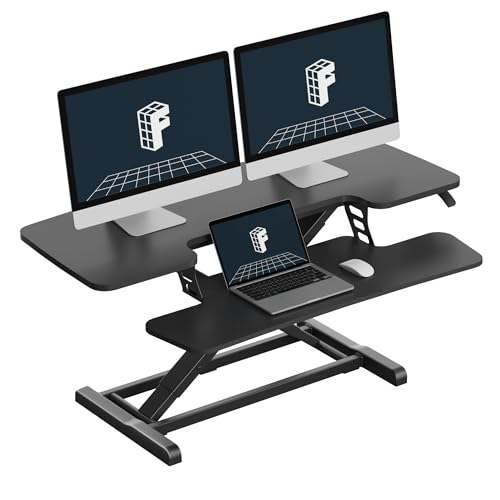
Gas-spring and spring-assisted models do most of the lifting for you, while purely manual designs ask your arms and shoulders to share the work. Most converters use either a scissor-style X lift or a straight vertical post, and the two designs feel noticeably different once a pair of monitors is loaded on top. Dual-monitor households should pay close attention to the depth of the top surface, because two screens on their own stands eat space quickly. The trade-off for all this flexibility is footprint: a converter permanently claims the middle of your desktop, whether it is raised or lowered. The keyboard tray is the part your hands live on all day, so its size, its edge finish and whether it sits slightly below the main surface matter more than the brochure suggests. A standing desk converter sits on top of the desk you already own and lifts your keyboard and screens to standing height when you pull the lift handles. Sitting height matters too, because a converter adds thickness on top of your desk even when fully lowered, which can push your keyboard higher than your chair expects. People who alternate in short bursts tend to love converters, while people who stand for whole afternoons often end up wanting a full sit-stand desk instead.
Cable slack becomes a real issue the first time you raise the platform, since every cord connected to the desk below has to travel with the lift. A converter earns its place when raising and lowering it becomes a habit rather than a project, which is why smooth, one-motion lifting matters so much. The appeal is simple: you keep the desk, the drawers and the room layout you already have, and you add the option to stand for part of the day. Converters are at their best in shared and rented spaces where replacing the whole desk is not an option.
Gas-spring and spring-assisted models do most of the lifting for you, while purely manual designs ask your arms and shoulders to share the work. Most converters use either a scissor-style X lift or a straight vertical post, and the two designs feel noticeably different once a pair of monitors is loaded on top. Dual-monitor households should pay close attention to the depth of the top surface, because two screens on their own stands eat space quickly. The trade-off for all this flexibility is footprint: a converter permanently claims the middle of your desktop, whether it is raised or lowered. The keyboard tray is the part your hands live on all day, so its size, its edge finish and whether it sits slightly below the main surface matter more than the brochure suggests. A standing desk converter sits on top of the desk you already own and lifts your keyboard and screens to standing height when you pull the lift handles. Sitting height matters too, because a converter adds thickness on top of your desk even when fully lowered, which can push your keyboard higher than your chair expects. People who alternate in short bursts tend to love converters, while people who stand for whole afternoons often end up wanting a full sit-stand desk instead. Owners usually notice this most during the first fortnight of daily use, when habits are still forming.
Small setups benefit most from gear that folds, slides or stacks, because the desk has to return to being a table at the end of the day. Keep the things you touch hourly within easy reach and let the rarely used gear live further away, which keeps the working zone calm. Comfort at a desk is mostly about neutral, unstrained positions you can hold without thinking, not about any single perfect measurement. Work through changes one at a time and live with each for a day, because adjusting everything at once leaves you unable to tell what actually helped. Light matters as much as furniture: a screen facing a bright window will fight glare no matter how good the stand or converter beneath it is. Every desk setup decision is really a chain: the desk supports the gear, the gear sets the screen height, and the screen height decides where your hands and chair need to be.
Small setups benefit most from gear that folds, slides or stacks, because the desk has to return to being a table at the end of the day. Keep the things you touch hourly within easy reach and let the rarely used gear live further away, which keeps the working zone calm. Comfort at a desk is mostly about neutral, unstrained positions you can hold without thinking, not about any single perfect measurement. Work through changes one at a time and live with each for a day, because adjusting everything at once leaves you unable to tell what actually helped. Light matters as much as furniture: a screen facing a bright window will fight glare no matter how good the stand or converter beneath it is. Every desk setup decision is really a chain: the desk supports the gear, the gear sets the screen height, and the screen height decides where your hands and chair need to be. It is a small point on paper and a surprisingly large one across a full working week.
Design, Build and Setup
Treat the unboxing as a two-person job from the start, because a converter is a heavy, awkward unit and its folded scissor frame makes it hard to grip safely alone. Route power and display cables with enough slack for full height before you raise the platform with real equipment on it. If the lift ever feels gritty, uneven or reluctant, stop using the height adjustment and inspect the mechanism rather than forcing it. Keep fingers well clear of the scissor joints and the underside of the lifting surface, since the pinch points close quickly when the platform comes down. A wobbly or hollow-core desk that flexes under a firm push is a poor foundation, and no converter can fix a weak desk below it. Lower the platform slowly and deliberately every time, guiding it with both hands rather than letting the springs drop it the last stretch. Before the first lift, check that the desk underneath is genuinely sturdy, because the converter, two monitors, a laptop and your leaning forearms all load the same desktop.
Treat the unboxing as a two-person job from the start, because a converter is a heavy, awkward unit and its folded scissor frame makes it hard to grip safely alone. Route power and display cables with enough slack for full height before you raise the platform with real equipment on it. If the lift ever feels gritty, uneven or reluctant, stop using the height adjustment and inspect the mechanism rather than forcing it. Keep fingers well clear of the scissor joints and the underside of the lifting surface, since the pinch points close quickly when the platform comes down. A wobbly or hollow-core desk that flexes under a firm push is a poor foundation, and no converter can fix a weak desk below it. Lower the platform slowly and deliberately every time, guiding it with both hands rather than letting the springs drop it the last stretch.
Treat the unboxing as a two-person job from the start, because a converter is a heavy, awkward unit and its folded scissor frame makes it hard to grip safely alone. Route power and display cables with enough slack for full height before you raise the platform with real equipment on it. If the lift ever feels gritty, uneven or reluctant, stop using the height adjustment and inspect the mechanism rather than forcing it. Keep fingers well clear of the scissor joints and the underside of the lifting surface, since the pinch points close quickly when the platform comes down. A wobbly or hollow-core desk that flexes under a firm push is a poor foundation, and no converter can fix a weak desk below it. Lower the platform slowly and deliberately every time, guiding it with both hands rather than letting the springs drop it the last stretch. Before the first lift, check that the desk underneath is genuinely sturdy, because the converter, two monitors, a laptop and your leaning forearms all load the same desktop. Readers setting up in a shared room will feel this more than those with a dedicated office corner.
Most converters use either a scissor-style X lift or a straight vertical post, and the two designs feel noticeably different once a pair of monitors is loaded on top. The trade-off for all this flexibility is footprint: a converter permanently claims the middle of your desktop, whether it is raised or lowered. A standing desk converter sits on top of the desk you already own and lifts your keyboard and screens to standing height when you pull the lift handles. Cable slack becomes a real issue the first time you raise the platform, since every cord connected to the desk below has to travel with the lift. The appeal is simple: you keep the desk, the drawers and the room layout you already have, and you add the option to stand for part of the day. Gas-spring and spring-assisted models do most of the lifting for you, while purely manual designs ask your arms and shoulders to share the work.
Sitting height matters too, because a converter adds thickness on top of your desk even when fully lowered, which can push your keyboard higher than your chair expects. Dual-monitor households should pay close attention to the depth of the top surface, because two screens on their own stands eat space quickly. People who alternate in short bursts tend to love converters, while people who stand for whole afternoons often end up wanting a full sit-stand desk instead. A converter earns its place when raising and lowering it becomes a habit rather than a project, which is why smooth, one-motion lifting matters so much. The keyboard tray is the part your hands live on all day, so its size, its edge finish and whether it sits slightly below the main surface matter more than the brochure suggests. Converters are at their best in shared and rented spaces where replacing the whole desk is not an option.
Standing Desk Converter Review: The Picks in Detail
VIVO Standing Desk Converter
The VIVO Standing Desk Converter is the name most people meet first in this category, and it earns that position by being a straightforward, widely available example of the classic scissor-lift design. The platform rises on an X-frame with spring assistance, the keyboard tray is generously sized for a full keyboard and mouse, and the whole unit arrives mostly assembled, which matters more than it sounds with a unit this heavy. In daily use it behaves like the category in miniature: easy to raise with a moderate load, calmer at mid heights than at full extension, and happiest on a desk that is solid in its own right.
Where the VIVO asks for honesty is at the top of its travel with two large monitors aboard, where a gentle sway when you type firmly is part of the deal rather than a defect. Treat it as a mid-tier, general-purpose choice for one or two screens, keep the load centred, and budget a second pair of hands for the lift out of the box and onto the desk. If your desk is deep and sturdy and your standing sessions come in bursts through the day, this is the converter shape that suits you; if you plan to stand for entire afternoons under a heavy triple-screen load, a full sit-stand desk will serve you better.

FlexiSpot Standing Desk Converter
The FlexiSpot Standing Desk Converter represents the straight-up school of design, where the surface travels vertically on posts rather than swinging out on a scissor frame. That geometry keeps your screens at the same distance from your eyes at every height, which many people prefer, and it tends to feel composed front to back while typing. FlexiSpot positions its converters as premium-tier desk equipment, and the finishing reflects that: smooth lift action, tidy edges and a keyboard tray that feels like part of the design rather than an accessory bolted on afterwards.
The considerations are the usual ones for the type. The footprint on your desk is committed whether you sit or stand, the unit is heavy enough that placement is a two-person decision you will not want to revisit, and the tray height relative to the main surface will not suit every chair and desk combination. For a single-screen or laptop-plus-monitor setup on a quality desk, it is a confident, settled choice; for a cramped desk where every inch is contested, measure twice before committing.

Mount-It Standing Desk Converter
The Mount-It Standing Desk Converter comes from a company better known for monitor mounts, and that heritage shows in how naturally its converters pair with monitor arms and VESA hardware. As an entry-to-mid-tier option it covers the fundamentals without ceremony: spring-assisted lift, a work surface sized for real monitors rather than just a laptop, and a keyboard tray that handles a standard keyboard and mouse side by side. Assembly is more involved than the most pre-assembled rivals, so set aside unhurried time and a clear floor.
Expect the honest compromises of the tier: a little more movement at full height than the premium designs, hardware that rewards careful tightening, and a finish that is tidy rather than luxurious. None of that prevents it doing the core job well for a home office that stands in sessions through the day. It suits buyers who may add a monitor arm later and want the converter and arm to speak the same mounting language, and it is a sensible way to test whether standing work suits you before investing in a full replacement desk.
Performance in Real Use
Typing and Everyday Work
Honesty about wobble matters: almost every converter moves a little at full extension, and the question is whether the movement is a faint sway or a typing problem. Scissor-lift designs tend to sway fore and aft, while straight-up designs feel steadier front to back but can rock side to side if the base is narrow. The heavier the monitor load and the higher the platform, the more any movement is amplified, so test at your real working height with your real screens. If your work is mostly typing and calls, mild movement is easy to ignore; if you draw, edit precisely or game competitively, it can become the whole story. Wobble shows up most when you type firmly, rest your wrists on the tray, or nudge the desk while reaching for something behind the monitors. Keeping the converter loaded evenly, with screens centred rather than pushed to one side, noticeably calms the platform down. Tightening every assembly bolt after the first week of use is a small habit that removes a surprising amount of play.
Honesty about wobble matters: almost every converter moves a little at full extension, and the question is whether the movement is a faint sway or a typing problem. Scissor-lift designs tend to sway fore and aft, while straight-up designs feel steadier front to back but can rock side to side if the base is narrow. The heavier the monitor load and the higher the platform, the more any movement is amplified, so test at your real working height with your real screens. If your work is mostly typing and calls, mild movement is easy to ignore; if you draw, edit precisely or game competitively, it can become the whole story. Wobble shows up most when you type firmly, rest your wrists on the tray, or nudge the desk while reaching for something behind the monitors. Keeping the converter loaded evenly, with screens centred rather than pushed to one side, noticeably calms the platform down. Tightening every assembly bolt after the first week of use is a small habit that removes a surprising amount of play. This is also where patience pays: judge the effect over several days, not a single afternoon.
Standing Sessions Through the Day
Dual-monitor households should pay close attention to the depth of the top surface, because two screens on their own stands eat space quickly. The trade-off for all this flexibility is footprint: a converter permanently claims the middle of your desktop, whether it is raised or lowered. People who alternate in short bursts tend to love converters, while people who stand for whole afternoons often end up wanting a full sit-stand desk instead. Gas-spring and spring-assisted models do most of the lifting for you, while purely manual designs ask your arms and shoulders to share the work. A standing desk converter sits on top of the desk you already own and lifts your keyboard and screens to standing height when you pull the lift handles. Cable slack becomes a real issue the first time you raise the platform, since every cord connected to the desk below has to travel with the lift.
Sitting height matters too, because a converter adds thickness on top of your desk even when fully lowered, which can push your keyboard higher than your chair expects. The appeal is simple: you keep the desk, the drawers and the room layout you already have, and you add the option to stand for part of the day. The keyboard tray is the part your hands live on all day, so its size, its edge finish and whether it sits slightly below the main surface matter more than the brochure suggests. A converter earns its place when raising and lowering it becomes a habit rather than a project, which is why smooth, one-motion lifting matters so much. Most converters use either a scissor-style X lift or a straight vertical post, and the two designs feel noticeably different once a pair of monitors is loaded on top. Converters are at their best in shared and rented spaces where replacing the whole desk is not an option.
Dual Monitors and Heavier Loads
Children find the lift handles fascinating, so teach them early that the converter is not a toy and never let them hang off the raised platform. If the lift ever feels gritty, uneven or reluctant, stop using the height adjustment and inspect the mechanism rather than forcing it. Lower the platform slowly and deliberately every time, guiding it with both hands rather than letting the springs drop it the last stretch. Keep fingers well clear of the scissor joints and the underside of the lifting surface, since the pinch points close quickly when the platform comes down. Before the first lift, check that the desk underneath is genuinely sturdy, because the converter, two monitors, a laptop and your leaning forearms all load the same desktop. A wobbly or hollow-core desk that flexes under a firm push is a poor foundation, and no converter can fix a weak desk below it. Place the converter far enough back that its feet sit fully on the desktop, with nothing overhanging the rear edge where the lift travel needs clearance.
Children find the lift handles fascinating, so teach them early that the converter is not a toy and never let them hang off the raised platform. If the lift ever feels gritty, uneven or reluctant, stop using the height adjustment and inspect the mechanism rather than forcing it. Lower the platform slowly and deliberately every time, guiding it with both hands rather than letting the springs drop it the last stretch. Keep fingers well clear of the scissor joints and the underside of the lifting surface, since the pinch points close quickly when the platform comes down. Before the first lift, check that the desk underneath is genuinely sturdy, because the converter, two monitors, a laptop and your leaning forearms all load the same desktop. A wobbly or hollow-core desk that flexes under a firm push is a poor foundation, and no converter can fix a weak desk below it. Place the converter far enough back that its feet sit fully on the desktop, with nothing overhanging the rear edge where the lift travel needs clearance. In a rented home, where permanent changes are off the table, this consideration carries extra weight.
Strengths and Trade-Offs
- Strength: you keep your existing desk, drawers and room layout while gaining a genuine sit-stand routine.
- Strength: spring-assisted lifts make height changes quick enough to become a habit rather than an event.
- Strength: converters suit rented and shared spaces where replacing furniture is not an option.
- Trade-off: some movement at full height is normal in this category and grows with heavier monitor loads.
- Trade-off: the unit permanently claims the centre of your desktop, raised or lowered.
- Trade-off: the converter is heavy, so placement is a two-person decision you will not want to repeat.
Tightening every assembly bolt after the first week of use is a small habit that removes a surprising amount of play. A monitor arm mounted to the converter raises the centre of gravity and can make a steady converter feel loose, which is worth knowing before you buy the arm. The heavier the monitor load and the higher the platform, the more any movement is amplified, so test at your real working height with your real screens. Scissor-lift designs tend to sway fore and aft, while straight-up designs feel steadier front to back but can rock side to side if the base is narrow. Wobble shows up most when you type firmly, rest your wrists on the tray, or nudge the desk while reaching for something behind the monitors. Honesty about wobble matters: almost every converter moves a little at full extension, and the question is whether the movement is a faint sway or a typing problem.
Tightening every assembly bolt after the first week of use is a small habit that removes a surprising amount of play. A monitor arm mounted to the converter raises the centre of gravity and can make a steady converter feel loose, which is worth knowing before you buy the arm. The heavier the monitor load and the higher the platform, the more any movement is amplified, so test at your real working height with your real screens. Scissor-lift designs tend to sway fore and aft, while straight-up designs feel steadier front to back but can rock side to side if the base is narrow. Wobble shows up most when you type firmly, rest your wrists on the tray, or nudge the desk while reaching for something behind the monitors. Honesty about wobble matters: almost every converter moves a little at full extension, and the question is whether the movement is a faint sway or a typing problem. If your work is mostly typing and calls, mild movement is easy to ignore; if you draw, edit precisely or game competitively, it can become the whole story. Keeping the converter loaded evenly, with screens centred rather than pushed to one side, noticeably calms the platform down.
How It Compares
Against a full sit-stand desk, a converter wins on cost, commitment and keeping your current furniture, and loses on stability, surface space and elegance. Against a fixed monitor riser, it wins on flexibility and loses on simplicity. The comparison table below is qualitative by design, because the differences that matter here are behavioural rather than numerical.
| Option | Best for | Watch out for |
|---|---|---|
| Scissor-lift converter | Wide trays and easy lifting | Fore-and-aft sway at full height |
| Straight-up converter | Consistent screen distance | Side rock if the base is narrow |
| Full sit-stand desk | All-day standing and heavy loads | Replaces your existing desk entirely |
Dual-monitor households should pay close attention to the depth of the top surface, because two screens on their own stands eat space quickly. A standing desk converter sits on top of the desk you already own and lifts your keyboard and screens to standing height when you pull the lift handles. Most converters use either a scissor-style X lift or a straight vertical post, and the two designs feel noticeably different once a pair of monitors is loaded on top. Converters are at their best in shared and rented spaces where replacing the whole desk is not an option. Gas-spring and spring-assisted models do most of the lifting for you, while purely manual designs ask your arms and shoulders to share the work. The keyboard tray is the part your hands live on all day, so its size, its edge finish and whether it sits slightly below the main surface matter more than the brochure suggests.
The appeal is simple: you keep the desk, the drawers and the room layout you already have, and you add the option to stand for part of the day. Sitting height matters too, because a converter adds thickness on top of your desk even when fully lowered, which can push your keyboard higher than your chair expects. Cable slack becomes a real issue the first time you raise the platform, since every cord connected to the desk below has to travel with the lift. A converter earns its place when raising and lowering it becomes a habit rather than a project, which is why smooth, one-motion lifting matters so much. People who alternate in short bursts tend to love converters, while people who stand for whole afternoons often end up wanting a full sit-stand desk instead. The trade-off for all this flexibility is footprint: a converter permanently claims the middle of your desktop, whether it is raised or lowered.
Who Should Buy It and Who Should Skip It
A converter earns its place when raising and lowering it becomes a habit rather than a project, which is why smooth, one-motion lifting matters so much. Converters are at their best in shared and rented spaces where replacing the whole desk is not an option. Most converters use either a scissor-style X lift or a straight vertical post, and the two designs feel noticeably different once a pair of monitors is loaded on top. Gas-spring and spring-assisted models do most of the lifting for you, while purely manual designs ask your arms and shoulders to share the work. The appeal is simple: you keep the desk, the drawers and the room layout you already have, and you add the option to stand for part of the day. Dual-monitor households should pay close attention to the depth of the top surface, because two screens on their own stands eat space quickly. The keyboard tray is the part your hands live on all day, so its size, its edge finish and whether it sits slightly below the main surface matter more than the brochure suggests. People who alternate in short bursts tend to love converters, while people who stand for whole afternoons often end up wanting a full sit-stand desk instead.
A standing desk converter sits on top of the desk you already own and lifts your keyboard and screens to standing height when you pull the lift handles. The trade-off for all this flexibility is footprint: a converter permanently claims the middle of your desktop, whether it is raised or lowered. Cable slack becomes a real issue the first time you raise the platform, since every cord connected to the desk below has to travel with the lift. Sitting height matters too, because a converter adds thickness on top of your desk even when fully lowered, which can push your keyboard higher than your chair expects.
Before you buy, run this checklist: measure your desktop depth with the converter’s footprint in mind; confirm the desk underneath is solid under a firm push; count the cables that must travel with the lift; decide where a second person will stand for the initial lift; and plan where drinks and notebooks will live once the centre of the desk is occupied.
Comfort at a desk is mostly about neutral, unstrained positions you can hold without thinking, not about any single perfect measurement. Keep the things you touch hourly within easy reach and let the rarely used gear live further away, which keeps the working zone calm. Small setups benefit most from gear that folds, slides or stacks, because the desk has to return to being a table at the end of the day. Work through changes one at a time and live with each for a day, because adjusting everything at once leaves you unable to tell what actually helped. Every desk setup decision is really a chain: the desk supports the gear, the gear sets the screen height, and the screen height decides where your hands and chair need to be. Light matters as much as furniture: a screen facing a bright window will fight glare no matter how good the stand or converter beneath it is.
Comfort at a desk is mostly about neutral, unstrained positions you can hold without thinking, not about any single perfect measurement. Keep the things you touch hourly within easy reach and let the rarely used gear live further away, which keeps the working zone calm. Small setups benefit most from gear that folds, slides or stacks, because the desk has to return to being a table at the end of the day. Work through changes one at a time and live with each for a day, because adjusting everything at once leaves you unable to tell what actually helped. Every desk setup decision is really a chain: the desk supports the gear, the gear sets the screen height, and the screen height decides where your hands and chair need to be. Light matters as much as furniture: a screen facing a bright window will fight glare no matter how good the stand or converter beneath it is. Anyone upgrading from a bare-bones setup tends to appreciate this difference first.
Setup, Care and Maintenance Essentials
If the lift begins to favour one side, clear everything off, cycle it empty a few times, and only reload it once it travels level again. Store the original packaging until you are sure the converter suits your desk, because returning a heavy unit without its box is a miserable errand. Raise and lower the platform through its full travel now and then even in weeks when you mostly sit, which keeps the springs working evenly. Check the tray and surface bolts on a monthly rhythm and snug any that have worked loose under daily raising and lowering. Keep drinks on the desk beside the converter rather than on the moving platform, since a spill at height runs straight into the mechanism. Dust the lifting surfaces weekly and wipe the scissor joints with a dry cloth, because grit in the mechanism is what turns a smooth lift into a gritty one.
If the lift begins to favour one side, clear everything off, cycle it empty a few times, and only reload it once it travels level again. Store the original packaging until you are sure the converter suits your desk, because returning a heavy unit without its box is a miserable errand. Raise and lower the platform through its full travel now and then even in weeks when you mostly sit, which keeps the springs working evenly. Check the tray and surface bolts on a monthly rhythm and snug any that have worked loose under daily raising and lowering. Keep drinks on the desk beside the converter rather than on the moving platform, since a spill at height runs straight into the mechanism. Dust the lifting surfaces weekly and wipe the scissor joints with a dry cloth, because grit in the mechanism is what turns a smooth lift into a gritty one. The effect is quiet rather than dramatic, which is exactly why it is easy to overlook in a shop.
If the lift begins to favour one side, clear everything off, cycle it empty a few times, and only reload it once it travels level again. Store the original packaging until you are sure the converter suits your desk, because returning a heavy unit without its box is a miserable errand. Raise and lower the platform through its full travel now and then even in weeks when you mostly sit, which keeps the springs working evenly. Check the tray and surface bolts on a monthly rhythm and snug any that have worked loose under daily raising and lowering. Keep drinks on the desk beside the converter rather than on the moving platform, since a spill at height runs straight into the mechanism. Dust the lifting surfaces weekly and wipe the scissor joints with a dry cloth, because grit in the mechanism is what turns a smooth lift into a gritty one. Treat it as a weekly rhythm rather than a one-off decision and it soon becomes automatic.
Place the converter far enough back that its feet sit fully on the desktop, with nothing overhanging the rear edge where the lift travel needs clearance. Route power and display cables with enough slack for full height before you raise the platform with real equipment on it. Children find the lift handles fascinating, so teach them early that the converter is not a toy and never let them hang off the raised platform. Keep the area under the descending platform clear of mugs, phone stands and stacked notebooks, which can jam the mechanism or get crushed. If the lift ever feels gritty, uneven or reluctant, stop using the height adjustment and inspect the mechanism rather than forcing it. Keep fingers well clear of the scissor joints and the underside of the lifting surface, since the pinch points close quickly when the platform comes down.
Treat the unboxing as a two-person job from the start, because a converter is a heavy, awkward unit and its folded scissor frame makes it hard to grip safely alone. A wobbly or hollow-core desk that flexes under a firm push is a poor foundation, and no converter can fix a weak desk below it. Lower the platform slowly and deliberately every time, guiding it with both hands rather than letting the springs drop it the last stretch. Before the first lift, check that the desk underneath is genuinely sturdy, because the converter, two monitors, a laptop and your leaning forearms all load the same desktop.
Final Verdict
A converter is the most practical route into standing work for most home offices, provided the desk below it is worthy and your expectations about movement at full height are honest. Choose the scissor design for tray space, the straight-up design for screen distance, keep the load centred, and give the setup a week of small adjustments before judging it. Judged that way, the category earns its place on the desk.
If your work is mostly typing and calls, mild movement is easy to ignore; if you draw, edit precisely or game competitively, it can become the whole story. Scissor-lift designs tend to sway fore and aft, while straight-up designs feel steadier front to back but can rock side to side if the base is narrow. Tightening every assembly bolt after the first week of use is a small habit that removes a surprising amount of play. Keeping the converter loaded evenly, with screens centred rather than pushed to one side, noticeably calms the platform down. Wobble shows up most when you type firmly, rest your wrists on the tray, or nudge the desk while reaching for something behind the monitors. A monitor arm mounted to the converter raises the centre of gravity and can make a steady converter feel loose, which is worth knowing before you buy the arm.
Frequently Asked Questions
Do I need a new desk to use a standing desk converter?
No, and that is the point of the category: a converter sits on the desk you already own. What the existing desk must be is sturdy, because the converter, your monitors and your leaning weight all load the same surface. Test your desk with a firm push at the edge; if it flexes or rocks noticeably while empty, it will feel worse under a raised converter, and strengthening or replacing the desk comes first.
Is some wobble at full height normal?
Yes. Every converter design moves a little at the top of its travel, and heavier monitor loads amplify the movement. A faint sway while typing is ordinary; movement that rattles screens or distracts you constantly usually means the load is off-centre, bolts need tightening, or the desk below is flexing. Work through those three causes in order before blaming the converter itself.
Can one person set up a converter alone?
It is strongly discouraged. Converters are heavy, awkward units with folding scissor frames that are hard to grip safely, and placing one precisely on a desk is exactly the moment a solo lifter loses control of it. Ask a second person to share the lift, agree the route and the landing spot first, and keep fingers clear of the scissor joints throughout.
Will a converter work with two monitors?
Most full-size converters handle two monitors well, provided the screens sit centred on the platform and the combined load stays sensible for the design. Depth is the real constraint: two screens on their own stands consume a lot of the top surface, so a monitor arm may eventually help, though an arm raises the centre of gravity and can add movement. Start with the stands, live with it, then decide.
What should I check before the first lift?
Confirm the converter’s feet sit fully on the desktop with clearance behind for the lift travel, route every cable with slack for full height, clear the space beneath the platform’s descent path, and check the desk below is stable. Then raise it empty once, watching the travel, before loading your real equipment aboard.
How do I keep the lift feeling smooth over time?
Dust the surfaces weekly, wipe grit from the scissor joints with a dry cloth, and snug the assembly bolts monthly. Keep drinks off the moving platform so spills cannot run into the mechanism, and cycle the lift through its full travel occasionally even in sitting-heavy weeks. If the lift ever feels gritty or one-sided, stop, unload it, and inspect rather than forcing it.