Gaming desk vs regular desk sounds like a marketing question, but there are real differences hiding under the branding: gaming desks are built around monitors, towers and cables, with shallower priorities for drawers and paperwork, while regular desks optimise for storage and a broader range of work. Neither is automatically better built. This comparison separates the genuine functional differences from the cosmetic ones, so you know whether the gaming label is worth paying for in your case.
Disclosure: As an Amazon Associate, ilcastellomenu.com earns from qualifying purchases. Product links on this page may earn us a commission at no extra cost to you. Prices and availability change on Amazon, so check the product page for the current details before you buy.
Quick Verdict: Same Furniture Family, Different Priorities
Choose a gaming desk if your setup is screen-heavy — multiple monitors, a tower you want displayed, lots of peripherals — and you value built-in cable management, monitor shelves and accessory hooks. Choose a regular desk if you need drawers and storage, prefer natural materials and a look that suits a shared or professional room, or if your gaming is a single laptop or console on a TV-adjacent surface. For a pure gaming station in a dedicated room, the gaming desk’s details add up; for a mixed work-and-play desk in a living space, the regular desk often wins.
| Criterion | Gaming desk | Regular desk |
|---|---|---|
| Cable management | Trays, grommets and rear channels built in | Often none; a hole at best |
| Storage | Minimal — hooks and shelves | Drawers and cabinets common |
| Monitor support | Shelves/risers sized for screens | Flat surface; add your own riser or arm |
| Surface | Wide, shallow-to-medium depth, mouse-friendly finishes | Varies; deeper writing desks common |
| Look | Angular, dark, RGB accents | Broad range, including wood and classic styles |
| Price logic | Pay for features and styling | Pay for materials and storage |
Notice that ‘build quality’ is not a row: both categories contain excellent and terrible desks. Judge the individual product’s frame and top using the criteria in How to Choose a Gaming Desk, whichever label it wears.
In this guide
Cable Management and Monitor Thinking
This is the gaming desk’s real home turf. A gaming station involves a tower, one to three monitors, powered speakers or a headset base, console docks and charging leads — a dozen cables that a regular desk leaves you to solve with aftermarket trays and clips. Gaming desks integrate the answer: rear trays, grommet holes positioned for monitors, and sometimes built-in power and USB. If you have ever priced the aftermarket parts and an afternoon of fitting them, the gaming desk’s premium partly evaporates. The target state, whichever desk you buy, is the one described in How to Organize Cables on a Gaming Desk.
Monitor shelves tell the same story. Gaming desks often include a riser that lifts screens to eye level and reclaims the surface beneath; regular desks assume a laptop or a single monitor on its stand. A monitor arm erases the difference — it fits either desk — but the gaming desk’s shelf is free and immediate, and on shallower desks it is the difference between correct and compromised viewing distance, as What is the Best Size for a Gaming Desk explains.
Storage, Work and the Shared-Room Problem
Regular desks strike back on storage and versatility. Drawers swallow controllers, cables, documents and the general sediment of a working life; a gaming desk’s open design leaves all of it visible or homeless. If the desk doubles as your work-from-home station, a regular desk with drawers and a modest cable tray added is often the more liveable tool — and it will not shout ‘gamer’ on a video call, which matters in some jobs and households.
There is also a materials gap at similar prices: regular desks more often offer wood veneer or solid wood tops that age gracefully, while gaming desks favour laminate and carbon-fibre-effect finishes tuned for mouse glide and spill resistance. Neither is wrong; they are answers to different rooms. Players whose setup lives in a bedroom or shared space should weigh this honestly — several of the cleaner designs in Best Computer Desks for Gaming are essentially regular desks that game well.
Ergonomics and Size: Less Different Than You Think
Both categories cluster around the same standard height, and both can be had in standing or adjustable forms. Gaming desks trend wider and shallower (optimised for screens and mouse room), writing desks deeper (optimised for paper and laptops), and student desks smaller in every direction. The ergonomic fundamentals — elbow height, screen distance, knee room — are identical and are covered in Gaming Desk Ergonomics Explained.
Where gaming desks do differ ergonomically is in the details around the chair: cut-outs and scalloped front edges that let you sit closer, and open legroom unobstructed by drawer pedestals, which suits the way players tuck into a station with a chair like those in Best Gaming Chairs for Long Hours. If your chair has prominent armrests, check any regular desk’s apron and drawer clearance before buying — that collision is the most common cross-category regret.
Price and Value: What the Label Costs
At entry level, gaming desks and regular desks overlap heavily in construction — engineered wood tops on steel or panel legs — and the gaming premium buys features and styling rather than strength. In the middle, the categories diverge: gaming money goes to wider surfaces, trays, shelves and lighting, while regular-desk money goes to storage and materials. At the top, both converge again on solid frames, thick tops and height adjustability, and the label matters least of all.
The value question is therefore personal arithmetic: price the regular desk plus the tray, shelf, hook and mat you would add, against the gaming desk that includes them. Whichever total is lower for the same frame quality is your answer. And if your heart is set on a regular desk’s looks, take comfort: with a monitor arm and an afternoon of cable work, it will game exactly as well.
The Decision in Practice: Three Buyer Profiles
The student in a dorm or small rental: space is measured in inches, the desk must game, study and hold life’s overflow, and budget is real. A regular desk with drawers usually wins here, because storage is the scarcest resource in the room — add a twenty-minute cable job and it games perfectly well. The gaming label’s integrated features matter less when the desk’s second job is existing in a tiny room gracefully.
The dedicated-room gamer: the desk exists for the station, the station is multi-screen, and cables number in the dozens. The gaming desk wins clearly — its tray, shelf and hooks are used at full capacity from day one, and its styling matches a room that is openly a gaming space. Storage needs are served by the room, not the desk.
The work-from-home hybrid: the desk faces clients by day and raids by night. This is the genuinely hard case, and the answer is usually a high-quality regular or sit-stand desk in a neutral finish, upgraded with a monitor arm and an under-desk tray — gaming capability added invisibly, professional face preserved. If the gaming desk tempts you here, choose its plainest-finished model and let the chair carry the personality.
Longevity and Resale: The Label’s Last Difference
Regular desks in honest materials age into furniture; gaming desks age into last generation’s aesthetic. A wood-veneer desk that games well today can serve a spare room or a child in a decade without explanation, while a carbon-fibre-and-RGB desk is committed to its identity. If you buy furniture for keeps, that trajectory matters and quietly favours the regular category at the top end.
Resale tells the same story from the other side: neutral regular desks sell to everyone, gaming desks sell to gamers — a smaller pool, but one that values the integrated features you paid for. Neither is a bad asset; they simply depreciate into different markets. Buy the desk your next five years need, and let the five after that take care of themselves.
Materials Deep Dive: What the Tops Are Really Made Of
Both categories build tops from the same short list of materials, and the material predicts more than the label does. Particleboard with a laminate or melamine face is the volume standard: light, cheap, adequately strong in short spans, and vulnerable at its edges and screw holes. MDF is denser and takes a smoother finish, at more weight. Plywood and bamboo sit a tier up in stiffness and edge durability, and solid wood tops the list for longevity and repairability — a solid top can be sanded and refinished in year ten, a laminate top can only be replaced.
Gaming desks skew toward laminate and carbon-effect faces because they are spill-proof, mouse-friendly and photograph as ‘gaming’; regular desks spread wider across the material range, including the wood options gaming lines rarely offer. If materials matter to you — for feel, for refinishing, for a room’s look — shop by material first and category second, because the categories share the same factories more often than their marketing suggests.
Edges deserve their own sentence in both categories: a top is only as durable as its edge banding, and the cheap desks of both labels fail there first, peeling where forearms and chair arms make contact. Run a thumb along the front edge of any desk you can touch before buying; your thumb is an excellent materials laboratory.
Frames repeat the pattern — steel in both, panel legs in both, marketing in both. The label on the box is the least informative sentence in the purchase; the materials list is the most.
The Verdict for People Who Move House Often
Renters and frequent movers should weight one criterion this comparison has not yet priced: transportability. Regular desks in flat-pack form disassemble and reassemble gracefully a handful of times before their fixings tire; gaming desks are similar, with the larger gaming surfaces and L-shapes suffering most in vans and stairwells. A desk that must survive five moves wants a steel frame with bolted (not cam-locked) joints and a top that travels protected.
Weight and bulk argue for the straight, modest regular desk in a mobile life — or for accepting the gaming desk as semi-disposable furniture bought per posting. There is no shame in either strategy; there is only waste in buying a decade desk for a two-year room, or a two-year desk for a decade room.
Measure the route, not just the room: door widths, stair turns and lift dimensions decide which desks can even attend your next home. The best desk in this comparison is the one that fits your life pattern — and for movers, the pattern includes the van.
The Test of Time: Which Ages Better in Your Home
Project both desks five years forward. The regular desk in honest materials has mellowed; its scratches are patina, its drawers still serve, and it can migrate to another room or another family member without explanation. The gaming desk has kept its function but its styling has dated by exactly one product cycle, and its RGB is either a retro charm or an embarrassment depending on your future taste — a variable nobody can forecast, including you.
Function ages slower than fashion in both categories, which is why this comparison keeps returning to frame, top and dimensions as the durable decisions. A buyer who chooses those well can forgive either label its styling in year five; a buyer who chose styling first forgives nothing.
If you expect to keep the desk a decade, let that horizon vote. If your horizon is a lease, a course or a couple of seasons, let the shorter horizon vote instead — the correct answer to this comparison is always indexed to time.
Hybrid Solutions Worth Knowing
The market’s most interesting desks increasingly refuse the binary: regular desks with genuine cable trays and monitor shelves, gaming desks with drawers and wood finishes, sit-stand frames sold bare for any top you own. If this comparison left you wanting a desk that does not quite exist in either category, shop the hybrids deliberately — they are manufacturers admitting the categories were always a spectrum.
The DIY hybrid is equally legitimate: a beloved regular desk plus a tray, a monitor arm and an afternoon becomes a gaming desk in every way that affects play. Conversely, a gaming desk can be civilised with a drawer unit beneath it and its lighting disabled. Furniture serves the household, not the taxonomy.
Start from your constraints — room, storage, screens, budget — and let the label fall where it falls. The players happiest with their desks, in either category, are consistently the ones who bought a specification rather than a category.
Answering for Specific Buyers, Rapidly
Single-screen laptop gamer in a shared flat: regular desk, small, with drawers — your storage need dwarfs your cable need. Dual-monitor PC gamer in a dedicated room: gaming desk, and enjoy every integrated centimetre of it. Work-from-home professional who games at night: the plainest sit-stand you can afford, plus a tray and an arm, in whichever category sells it cheapest that month.
Streamer building a set: gaming desk for the cable story and the camera-facing rear management, chosen in the plainest finish your brand allows. Parent buying for a teen’s bedroom: the regular desk with storage, because the room’s other furniture is a wardrobe and a bed and the desk must absorb a school life as well as a gaming one.
None of these verdicts is really about the label — each is about which desk’s priorities match a life. That matching, done honestly, is the entire content of this comparison; the rest was evidence.
The Environmental Ledger
One more comparison, increasingly asked: which category is kinder to the planet? The honest answer follows materials and longevity rather than labels. A solid or veneered regular desk kept for twenty years beats any desk replaced in five; a gaming desk with a steel frame and replaceable parts beats a regular desk built from the thinnest board. Longevity is the environmental variable, and it is decided by build quality and by whether the desk’s style lets you keep it.
Flat-pack furniture of both categories ships efficiently and assembles without glue or waste beyond packaging — keep the packaging out of landfill where your local recycling allows, and prefer sellers whose spare-parts support extends the desk’s life rather than its replacement cycle.
Buy once, buy repairable, keep it long: the greenest sentence in furniture applies identically under both labels, which is a fitting place for this comparison to end — with the categories agreeing.
Scenario Head-to-Heads: Paperwork, Craft and Homework
The main comparison runs the categories through gaming scenarios; run them through the desk’s other lives and the scoring moves. Paperwork and study first: the regular desk’s drawers, its surface depth for open books beside a laptop, and its generally calmer silhouette win this scenario outright, because documents need horizontal filing space that gaming desks — designed around screens and peripherals — deliberately spent on other things. A household whose desk doubles as the family office should hear that clearly: the gaming desk will game beautifully and administer badly.
Craft and making invert the verdict in an interesting way. Model-making, electronics work and drawing want a deep, wipeable, well-lit surface with tools in reach — the gaming desk’s depth discipline and cable tray serve a soldering station surprisingly well, while the regular desk’s drawers win the storage of a hundred small parts. The honest result is a draw decided by the craft: wet and messy crafts favour the gaming desk’s surfaces, parts-heavy crafts favour the regular desk’s drawers, and both beat the dining table they usually inherit.
Homework — the child’s evening shift at the family desk — votes on adjustability and forgiveness: a surface that can be cleared completely in two minutes, edges that survive chair collisions, and nothing about the desk that makes a ten-year-old’s schoolwork feel like borrowing a cockpit. Regular desks take this scenario on temperament. The pattern across all three is the comparison’s recurring lesson: the label predicts a desk’s priorities, and the scenario that matches your life should be the one holding the pen.
The Sound of the Surface: Keyboard Noise and Hollow Tops
Here is a comparison criterion no listing publishes: how the desk sounds. A keyboard on a thin, hollow-cored top over an open frame is a drum — every keystroke amplified by the surface’s resonance, every desk bump transmitted to the microphone and the room below. A solid or well-braced top over a full frame absorbs the same energy quietly. In a bedroom at midnight, in a flat with neighbours below, on a stream with a sensitive microphone, the acoustic difference between two desks of identical dimensions can be the largest quality-of-life difference between them — and it correlates only loosely with the gaming label.
Gaming desks skew toward the drum end: lightweight engineered tops, minimal frames, large unsupported spans chosen for looks and price. Regular desks skew quieter on average, because office furniture’s buyers complain about noise in reviews and gaming furniture’s buyers complain about wobble — a related but different sense. Either category can be quieted: a desk mat under the keyboard is the great silencer, decoupling switches from surface for a few percent of the desk’s price, and a crossbar or modesty panel stiffens the resonance out of many a hollow top.
Test it where you can: in a showroom, knock the top with a knuckle and type on it if a keyboard is staged. A desk that booms under a knuckle will drum under a keyboard. Add the result to your comparison as a scored row — the categories will not score it for you, and the players who stream, share walls or simply love a quiet room will find it outranks several rows that listings do publish.
Arms, Clamps and Edges: Accessory Compatibility Compared
Modern setups hang from their desks: monitor arms, microphone booms, wheel clamps, headphone hooks. The two categories present different edges to those clamps, and the difference is systematic. Gaming desks are designed expecting clamps — their rear edges are usually open, their tops thick enough at the edge to take a clamp’s jaw, and their frames leave the underside’s rear strip clear. But the same desks often add a rear cable ledge, a raised monitor shelf or a decorative rear rail exactly where a clamp wants to sit, so the gaming desk giveth with one feature and taketh with another.
Regular desks present the opposite profile: plainer edges, frequently thicker tops, and frames that may include a full modesty panel or rear drawers occupying the clamp’s territory entirely. A regular desk with a clear rear edge and an inch of solid top out-clamps most gaming desks; one with drawers across its back accepts no arm at all without a grommet mount or a freestanding stand. The category tells you the probability; only the individual desk’s edge tells you the fact.
The choosing rule generalises beyond this comparison: inventory your clamps before you inventory desks, and audit each finalist’s edges against them — rear centre for the arms, front corners for the wheel, wherever your boom lands. Accessory compatibility is a property of edges, not labels, and it is decided in millimetres that neither category’s marketing will ever quote you.
Ten Years On: Parts, Repairs and the Support Tail
Compare the categories at year ten and a quiet difference emerges: how each is supported by its maker. Regular desks come disproportionately from furniture makers with long model runs, spare feet and fixings in catalogues, and designs that a local carpenter can repair because they are built like furniture has always been built. Gaming desks come disproportionately from fast-moving ranges — this season’s model, next season’s revision — where a replacement crossbar or a matching desktop in year six may simply no longer exist in the world.
The consequence is a different failure style. The regular desk declines repairably: a drawer runner, a hinge, a refinished top. The gaming desk declines categorically: sound for years, then one proprietary part fails and the whole object is retired over a component that costs little and exists nowhere. Neither style is a scandal; they are different commercial tempos. But a buyer choosing a desk for a decade should price the tempo, and the test is the same service-tail audit this batch applies to chairs: find the parts page before you find the checkout button.
There is a mitigation available to gaming-desk buyers who love a particular model: buy the wear parts with the desk. A spare set of feet, the crossbar’s fixings, a second desktop if storage allows — a small insurance policy taken while the parts exist. It sounds excessive until the first time a ten-year desk is saved by a part bought in an afternoon a decade earlier, at which point it sounds like the cheapest wisdom in this entire comparison.
The Substitutes, Judged Honestly: Dining Tables, Workbenches and Doors on Trestles
Every desk comparison should include the desks nobody bought: the substitutes already in the house. The dining table is the strongest — a large, solid, genuinely flat surface at roughly desk height, which is why so many setups begin there. Its deficits are the desk-shaped ones: no cable management, no storage, a height set for eating rather than typing, and a tenure problem, because the table has another job and the setup is a tenant that must clear out for Sunday lunch. As a trial — live on it for a month and learn your real width and depth needs — it is the best research tool in this guide. As a permanent answer, it taxes exactly the things a desk exists to solve.
The workbench is the connoisseur’s substitute: overbuilt, vice-ready, indifferent to load, and available in depths gaming desks never reach. Its height usually needs correcting for seated play, and its aesthetics argue with most rooms, but a player with a garage-adjacent setup and a heavy sim rig may find the perfect desk wearing overalls. The door-on-trestles and the kitchen worktop offcut complete the family: flat, cheap, honest surfaces whose frames you supply yourself, with all the wobble questions that implies — the wobble guide in this batch becomes required reading the day the trestles arrive.
Judge substitutes by the same rows as the two categories — surface, storage, cables, edges, support — and they occasionally win, which is the healthiest possible outcome for a comparison to reach. The label on a desk is a bundle of decisions made by someone else. The substitutes are what happens when you make the decisions yourself, and knowing their honest scores is what turns this comparison from a shopping aid into an education.
Children at the Desk: Safety and Survival Compared
Where children share the house, the desk comparison gains a safety column, and the categories score differently than their marketing suggests. Tip-over first: a desk loaded with monitors is a lever waiting for a climbing child, and stability under eccentric load — a small person hauling themselves up by the front edge — favours the heavier, lower, drawer-based regular desk over the light, tall gaming frame. Wall-anchoring defeats the risk for either category where the tenancy allows it, and in a house with climbers it outranks every other row in this comparison.
Corners and edges come next: gaming desks favour sharp contemporary lines and thin tops whose edges meet small foreheads at exactly standing height, while regular desks more often offer the rounded, thicker edges of domestic furniture. Neither is childproof; one is child-forgiving, and a foam edge guard closes most of the remaining gap on either. Cables complete the column — the gaming desk’s managed tray keeps leads out of small hands by design, while the regular desk’s honest storage hides the strip in a drawer only if someone routes it there.
Survival runs the comparison in reverse: children are a load case of spills, impacts and felt-tip pens, and the gaming desk’s laminate surfaces and replaceable mats forgive a childhood that a veneered regular desk records permanently. Score the column by your household’s actual ages and habits — and re-score it as they grow, because the desk that was a hazard at three is a homework station at eight and a hand-me-down battlestation at thirteen.
Heaviness: When Weight Is a Feature and When It Is a Burden
Weight is the comparison’s most double-edged row. In service, mass is stability: a heavy desk resists the racking forces of animated play, anchors monitor arms without complaint, and feels — in the way that matters at hour three — immovable. Regular desks, built as furniture, usually carry more mass; gaming desks, built to a price and a shipping carton, usually carry less, and compensate with frame geometry that works until an eccentric load finds its limit. The knuckle test and the corner press from this guide’s other sections are how you audit what the spec sheet calls by a single number.
Out of service, the same mass is a tax collected at every move, every rearrangement, every delivery up a staircase. The gaming desk’s lightness — mocked in the stability paragraph — is a genuine virtue in a mobile life, and the regular desk’s solidity is a genuine liability in a third-floor flat. Neither desk knows which life you lead; the comparison can only insist that you score weight twice, once as the player who will sit at it for five years and once as the mover who will carry it twice in that span, and let the two scores argue it out honestly.
There is a middle technology worth naming: mass you can add and remove. A lighter frame stabilised by the load it carries — the tower low on a shelf, books or a subwoofer ballasting the far end — borrows the regular desk’s stability during service and returns its weight at moving time. It is not a perfect substitute for structure, but it explains why some light gaming desks feel planted in use and some heavy regular desks still wobble: stability is a system of frame, mass and load, and the label predicts only the first of the three.
Buying Each Category Used: Two Different Markets
The second-hand market treats the categories differently, and a used buyer should know which market they are in. Regular desks flood it — every office clearance and house move adds supply — so prices are soft, choice is wide, and the buyer’s inspection can be leisurely and strict: solid tops, honest frames and full sets of fixings are all findable at a fraction of new cost, because the market prices used furniture as a disposal problem rather than as goods. The gaming desk’s used market is thinner and stranger: supply is younger, condition varies wildly with the first owner’s assembly skill, and the electronics-laden models carry every expiry-date question from this comparison into the carpark with them.
Inspect by category accordingly. A used regular desk is furniture: sight the top for bow, check drawer runners and door hinges through their travel, look for the water rings and swollen board that record its life. A used gaming desk is a kit: every bolt present, the crossbar actually fitted, the frame’s joints tight, the LED and outlet features tested or priced as dead, and the assembly manual’s existence treated as part of the goods — because a gaming desk bought used will be assembled by you, from a stranger’s disassembly, and its paperwork is worth real money.
The verdict mirrors the new comparison with the prices inverted: used, the regular desk’s value case strengthens — furniture quality at disposal prices — while the gaming desk’s case depends entirely on the individual specimen’s completeness. In both markets the rule from the choosing guide holds: the ten minutes of inspection is the cheapest insurance in the transaction, and it is cheaper still when the category has told you where its bodies are buried.
The Hybrid Life, Revisited: One Desk, Two Costumes
The hardest case in the main comparison deserves a second, slower hearing: the desk that faces clients by day and raids by night. Its problem is not capability — either category can host both lives — but transformation: how completely and how quickly the desk changes costume. Score the transformation honestly. The work costume wants a clear surface, a camera-friendly backdrop, storage that swallows the gaming layer, and lighting that flatters a face. The gaming costume wants the peripherals deployed, the second screen lit, the controller docked in reach. A desk that transforms in two minutes gets transformed daily; a desk that takes twenty gets lived in as a compromise, in whichever costume was up when the effort ran out.
Regular desks transform by concealment: drawers and doors hide the gaming layer, and the desk’s own neutrality is the backdrop. Gaming desks transform by deployment: the tray and hooks keep the working layer cabled and ready, and the costume change is a matter of screens waking and a chair rolling in. Concealment wins the video call; deployment wins the evening. The hybrid buyer’s real question is which costume change they will perform a thousand times, and the honest answer is usually the one belonging to the life that pays for the desk.
Whichever category wins, borrow the other’s trick: the gaming desk gains a drawer unit or a lidded box for the work papers, the regular desk gains a cable tray and a hook so its gaming layer deploys instead of being excavated. The hybrid desk that serves a decade is almost never a pure specimen of either category — it is a desk whose owner understood the transformation problem and spent a small, deliberate effort solving it in both directions.
Gear for This Guide
You do not need to buy anything to follow most of this guide, but the items below are the ones that genuinely come up again and again in this topic. Each one is a current, widely sold model rather than a placeholder pick.

SHW Mission 48-Inch Home Office Computer Desk
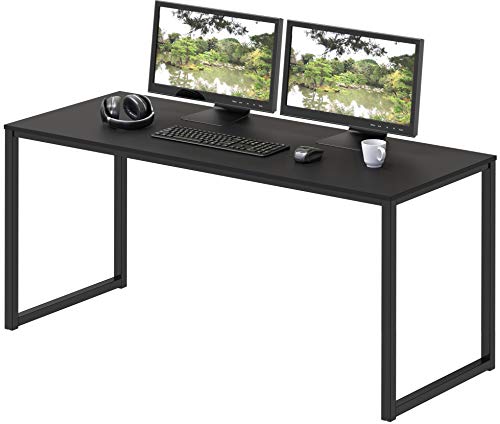
SHW’s Mission desk is the regular-desk case in point: a clean, storage-friendly home-office design that games perfectly well once you add cable management — the sensible hybrid for shared rooms. Check on Amazon

EUREKA ERGONOMIC Gaming Desk 47 Inch (K-Shaped)
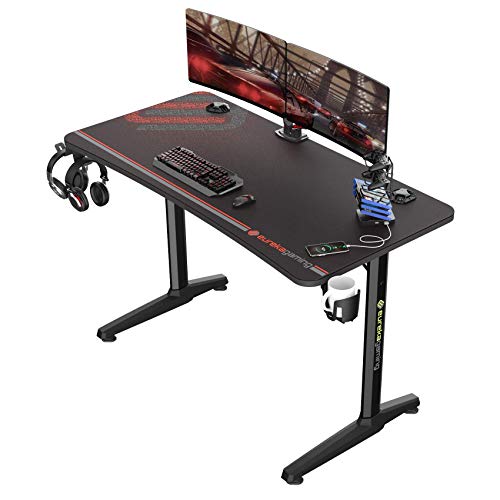
Eureka’s K-shaped gaming desk shows what the gaming label adds at the same footprint: integrated cable management, controller stand, cup holder and headphone hook, all designed in rather than bolted on. Check on Amazon
Frequently Asked Questions
Are gaming desks sturdier than regular desks?
Not as a category. Sturdiness comes from frame design and materials in both. A steel-frame regular desk outlasts a panel-leg gaming desk, and vice versa. Check the individual product’s frame and capacity.
Can I use a regular desk for a serious gaming setup?
Absolutely. Add a monitor arm or riser and an under-desk cable tray, and a regular desk supports multi-monitor gaming identically. Many streamers use large regular or studio desks for exactly this reason.
Why are gaming desks wider and shallower?
They are shaped around screens and mice rather than paper: width for multiple monitors, moderate depth because a monitor arm or shelf manages viewing distance. Deep writing desks serve handwriting and laptops better.
Do gaming desks hold more weight?
Capacities vary by model in both categories. Gaming desks are designed with towers and multiple monitors in mind, but always check the specific rating against your equipment total.
Which is better for a small room?
Whichever fits — but note gaming desks often come in compact gaming-specific sizes, while regular desks offer folding and corner options for tight spaces, like those in Best Desks For Small Spaces.
Which type is better in a rented room where I cannot drill or anchor anything?
Either can work, but weight your scoring toward stability without fixings: a desk that is rigid freestanding, since you cannot borrow the wall’s strength. Regular desks with full frames and gaming desks with proper crossbars both qualify; light frames that expect a wall behind them do not. Cable trays that clamp or adhere rather than screw keep your deposit intact, and a desk whose footprint fits without modification is worth more in a rental than a slightly better desk that needs the wall’s permission.
Are gaming desks suitable for a child to grow into as a homework desk?
A plainly styled gaming desk of standard size can serve well — its surfaces forgive spills and its cable tray keeps leads tidy — provided its height suits the child or pairs with an adjustable chair and a footrest, and its edges are guarded while the child is small. The racing-styled models with sharp trim are the exception. In practice the deciding factor is rarely the category: it is whether the desk’s height and the child’s chair can be made to fit a growing body, re-audited yearly as this batch’s measuring guides prescribe.
Does a gaming desk or a regular desk handle a very heavy tower better?
The individual frame decides, not the category: look for a full steel frame with a crossbar, a top around an inch thick, and a load rating comfortably above your whole setup — then place the tower over or near a leg rather than mid-span. In practice, heavier regular desks and the better gaming desks both pass; light gaming desks with long unsupported spans are the ones to avoid for a flagship tower, especially with arm-mounted screens adding torque at the back edge.
Which category is better for a very small desk in a box room?
Whichever individual desk fits the measured footprint with its chair zone intact — but the categories lean differently: gaming desks are offered in more genuinely compact gaming sizes, shaped around a single screen and a chair, while small regular desks are often scaled-down office furniture whose drawers steal the knee room a small setup cannot spare. In a box room, audit knee clearance and the chair’s rolling space before surface size, and remember the comparison’s recurring lesson — a compact desk with a monitor arm out-serves a larger desk whose surface is consumed by monitor feet.
Can I start with a regular desk and convert it fully to gaming later?
Yes — the conversion is a known recipe: an under-desk cable tray, a monitor arm or riser, a headphone hook and a large desk mat turn a sound regular desk into a fully capable gaming station in an afternoon, and the result often keeps the regular desk’s advantages of storage and sturdiness. What cannot be converted is a desk whose basic geometry is wrong — too shallow for your screens, too low for your knees — so choose the regular desk by the same measurements you would apply to a gaming desk, and the conversion stays an accessory purchase rather than a rescue.
Do gaming desks and regular desks use the same desk height?
Almost always, yes: both categories cluster around the same standard height of roughly twenty-nine to thirty inches, because both are built for the same population of seated bodies. The exceptions live at the edges of each range — gaming line-ups include more compact and more height-adjustable models, furniture ranges include more tall writing-desk variants — but a player choosing between categories for ergonomic reasons should compare individual desks’ heights and their own measurements, since the category averages are identical twins and the individual desks are not.
The Short Version
The gaming label buys integration — cable management, monitor thinking, hooks and shelves — while the regular desk buys storage, materials and discretion. Build quality lives in the individual product, not the category. Price the regular desk plus its add-ons against the gaming desk as-is, and let your room and your storage needs cast the deciding vote.