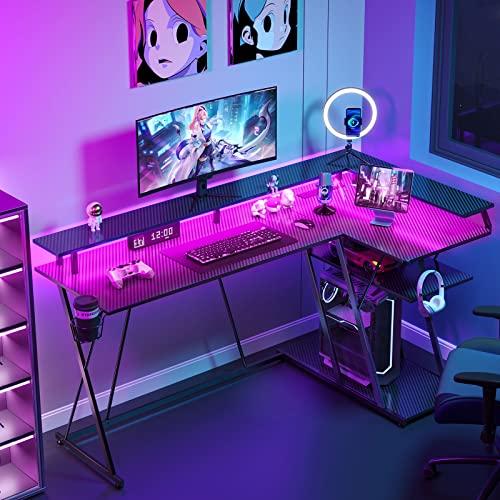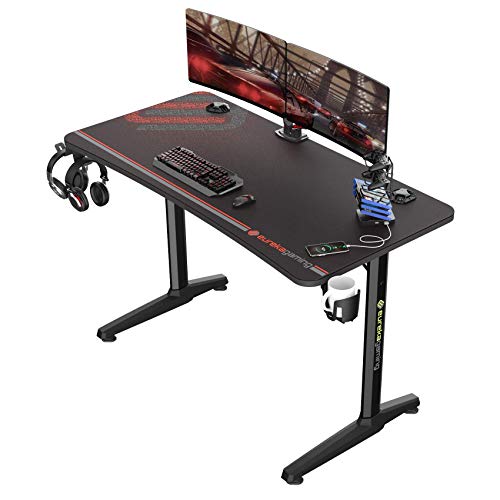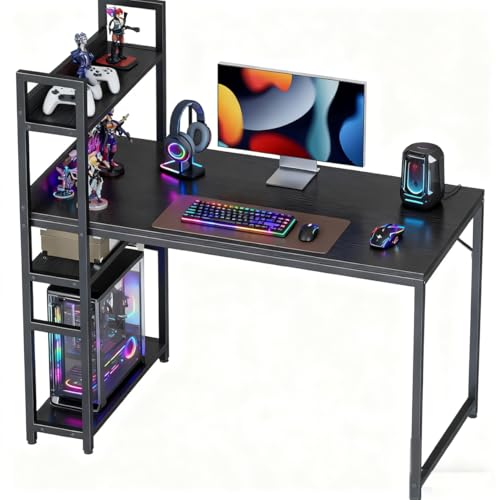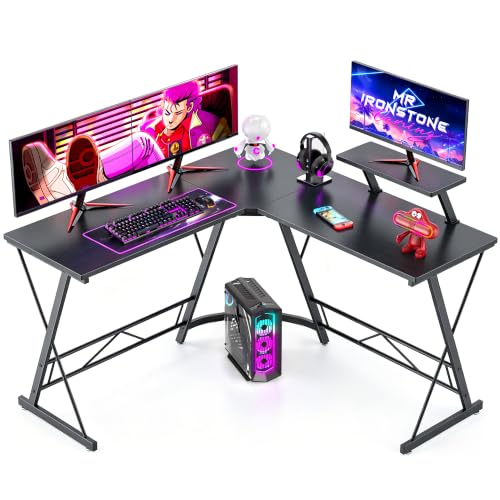
L shaped gaming desk vs straight is a decision about your room’s geometry and your second-screen habits. The L-shape turns a corner into two work zones; the straight desk puts everything on one honest line and fits anywhere. Both can host serious rigs. This comparison covers space efficiency, monitor layouts, cable runs and cost per usable inch, so you can match the shape to the room you actually have rather than the room in the product photos.
Disclosure: As an Amazon Associate, ilcastellomenu.com earns from qualifying purchases. Product links on this page may earn us a commission at no extra cost to you. Prices and availability change on Amazon, so check the product page for the current details before you buy.
Quick Verdict: Corners vs Simplicity
Choose an L-shaped desk if your setup lives in a corner, you run a second activity alongside gaming (laptop, console, streaming gear, homework), or you want your tower and peripherals off the main surface without losing them. Choose a straight desk if your room is rectangular with one obvious wall, your setup is a single focused station, or you may rearrange or move house often — straight desks are simpler to place, move and resell. Square footage is similar; what differs is how the shape spends it.
| Criterion | L-shaped | Straight |
|---|---|---|
| Best room fit | Corners, square rooms | Any wall, rectangular rooms |
| Work zones | Two distinct zones | One continuous surface |
| Monitor layouts | Main screen on one wing, secondary on the other | All screens in one line |
| Cable runs | Longer; corner junction needs planning | Short and simple |
| Chair movement | Swivel between zones | Slide along one line |
| Moving/rearranging | Bulky, sometimes handed (left/right fixed) | Easy |
If you are still at the measuring stage, What is the Best Size for a Gaming Desk helps you convert your monitor count into surface requirements before shape enters the argument, and Best Corner Desks for Gaming shows the L-shape’s close cousins.
In this guide
Space Efficiency: The Corner Dividend and Its Price
Corners are the most wasted real estate in most rooms, and an L-desk is the only furniture that truly monetises one: the return wing occupies floor that a straight desk leaves dead, while the main run keeps a normal footprint against the wall. In small rooms this can be the difference between a desk plus storage and a desk alone. The price is commitment — an L-desk fits its corner and few other places, and some models are handed, with the return fixed on one side.
Straight desks spend space more flexibly: they can centre on a wall, float in a room, pair back-to-back for two players, or shrink to a smaller wall when you move. For renters and frequent movers, that flexibility is worth real money. Measure both configurations in your room with painter’s tape on the floor before deciding; shapes feel very different at full scale than in a listing thumbnail.
Monitor Layouts and Play Positions
On an L-desk, the classic layout puts the main monitor at the corner’s inner angle or on the longer wing, with the second zone hosting a laptop, console or stream gear at a swivel’s turn. Corner-seated layouts — sitting into the angle with screens wrapping slightly — feel immersive and suit sim and strategy play, but check your knee room at the corner post and your chair’s turning circle. Wing-seated layouts treat the corner as pure bonus surface, which suits players who mostly face one way.
Straight desks keep every screen in your forward arc, which FPS and competitive players generally prefer, and make dual or triple monitor symmetry trivial. If your gaming is one screen and total focus, the L’s second zone will collect clutter, not capability. The ergonomics of both arrangements — viewing distance, head turning, chair position — are worked through in Gaming Desk Ergonomics Explained.
Cables, Towers and the Corner Junction
The L-shape’s hidden cost is cable distance: a tower on one wing and monitors on the other can stretch display cables past their comfortable length, and the corner junction is where bundles go to tangle. Plan the power strip at the corner, route each wing as its own zone, and confirm cable lengths before assembly — the full method in How to Organize Cables on a Gaming Desk applies, with the corner as the hub. Straight desks need none of this thought; everything is within a short run of everything else.
Tower placement also differs: L-desks often include a dedicated tower shelf on the return, keeping the main surface clear, while straight desks force the on-desk-or-floor choice described in How to Set Up a Gaming Desk. If your case is a showpiece with a glass panel, the L’s side wing can display it at an angle a straight desk cannot match.
Cost, Assembly and Living With the Choice
Per usable inch, L-desks usually cost a little more and take longer to assemble — two tops, a corner joint and more frame to square, per the process in How to Assemble a Gaming Desk. They also dominate a room visually; in a bedroom that is also your office and living space, that presence cuts both ways. Straight desks at the same money buy a thicker top or a better frame instead of the second wing.
Live with your actual habits for a week before deciding: count how often you would swivel to a second zone. Daily laptop-plus-gaming users, streamers with a second PC, students with books and a rig — the L earns its footprint. Everyone else is usually happier with a generous straight desk and the room’s corner given to a shelf or a plant. Your shortlist from How To Choose A Gaming Desk can include one of each shape; let the tape outline on your floor cast the final vote.
Gaming-Specific Layouts: Sim Corners and Dual-PC Streaming
Sim players are the L-shape’s secret fanbase: the corner hosts the wheel or yoke at a natural angle, pedals tuck beneath the join, and the side wing holds the button boxes, shifter and a telemetry screen without touching the main view. A straight desk can do all this in a line, but the corner’s wrap mimics a cockpit in a way a line cannot, and many racers find the immersion worth the footprint.
Dual-PC streaming setups are the other natural L application: gaming rig on the main wing facing the room’s best wall, streaming PC and its monitor on the return at a swivel, capture and audio gear at the corner hub where both cable systems meet. The swivel-between-machines workflow is exactly what the shape was born for, and cable planning at the hub — power strip at the corner, each wing its own zone — keeps two PCs’ worth of leads from becoming one indistinguishable nest.
If neither profile is yours, let that inform the decision honestly: the L’s special talents are specific, and a shape bought for talents you never use is just a bigger desk.
Measuring Your Corner Before You Commit
Corners lie. Walls meet at angles that are rarely the perfect right angle the desk assumes, baseboards steal an inch along both walls, and sockets, radiators and window sills colonise exactly the space the return wing wants. Measure the corner at desk height, not at the floor — walls bow — and check both wall runs for obstructions along the full length of each wing.
Tape the full outline, wings and chair zone included, and sit in the corner in a chair for ten minutes doing nothing but judging the space. Corners can feel enclosing in a way open walls do not; some players love the cockpit feel, others feel walled in within a week. That ten-minute sit is the cheapest possible discovery of which player you are.
Finally, confirm the delivery route: L-desks ship as long tops and frames that must navigate your hallway and door. The best corner desk in the world is worth nothing on the wrong side of a tight stairwell turn.
Two Players, One Room: Shapes for Shared Spaces
Couples and siblings gaming in one room stress shapes differently. Two straight desks along one wall create the classic shared battlestation: symmetrical, social, and simple to cable, with each player’s territory clearly fenced by their own desktop edge. The arrangement scales by adding desks, which no other shape can claim.
An L per player consumes far more room but buys each player a private second zone — for work laptops, for consoles, for the sprawl of a hobby. In a large room this is the deluxe answer; in a small one it is an eviction notice for everything else the room held. Measure with the tape method and let the room arbitrate.
The asymmetric compromise deserves a hearing: one L in the corner for the player with the second activity, one straight desk for the focused player, sharing a wall. Rooms, like players, rarely need identical equipment, and matching the shape to each player’s habits beats matching the furniture to itself.
Whatever the arrangement, agree the cable and territory rules before assembly day. Shared rooms fail socially before they fail geometrically, and a shared power and network plan — one drop point, labelled leads per player — prevents the slow border disputes that desks otherwise host.
Resale, Moves and the Shape’s Second Life
Straight desks have the easiest second lives: they become children’s desks, work desks, hallway tables — any rectangle-shaped need in any future home. Their resale audience is everyone. L-shaped desks resell to a narrower audience that must have the corner, the orientation and the size all at once, and their second life in your own home depends on the next home having the same corner logic.
This is not an argument against the L — a shape you use fully for five years has paid its way — but it belongs in the total-cost thinking alongside price and assembly. Buy the L for a room you expect to keep, and the straight desk when life is in motion. Furniture decisions are forecasts, and the honest forecast includes your own mobility.
Handedness compounds the point: a reversible L forgives a future room’s mirror-image corner, a fixed-hand one does not. If the L wins your decision, the small premium for reversibility is insurance bought at exactly the right moment — before you know which corner the future holds.
The Chair’s Vote: Movement Patterns in Both Shapes
Chairs experience shapes differently from eyes. On a straight desk, the chair slides laterally — a movement casters do well and floors forgive. At an L, the chair rotates in place, swivelling between zones, which casters also do well but which demands a clear turning circle at the corner and a floor surface that lets the chair spin without walking sideways across the room.
Players who dislike swivelling — many competitive players keep their chair’s orientation sacred — will use an L as an expensive straight desk with a shelf attached. Players who fidget, rotate and live at multiple angles find the L’s swivel natural. Your chair habits are data; consult them before the shape consults your wallet.
The corner seat itself deserves a test sit wherever possible: some players feel commandingly centred in the angle, others feel trapped by surfaces on two sides. Ten minutes in a showroom corner will tell you which tribe you belong to, and it is better learned there than after assembly.
Small Rooms Revisited: When the L Is the Space-Saver
Conventional wisdom gives small rooms to straight desks, but the arithmetic can reverse. A straight desk plus a separate storage unit plus a printer stand can consume more floor than one L whose return absorbs all three roles. If your room’s problem is many small furniture pieces rather than one big one, the L consolidates — one footprint, one cable system, one visual object.
The condition is that the return must genuinely absorb those roles at the sizes they need. A return too shallow for the printer is not consolidation; it is a shelf of regrets. Measure the second zone’s intended contents as rigorously as the main screen’s, because the L’s entire case rests on the return being useful, not merely present.
Where the L consolidates successfully, small rooms gain something beyond inches: calm. One considered object reads quieter than four improvised ones, and gaming rooms — dense with gear by nature — benefit from calm more than most.
The Shape Decision, Compressed
Compress the comparison to three questions. Does your room have a corner the desk can honestly claim, measured at desk height with its obstructions counted? Do you have a second activity — daily, not aspirational — that deserves its own surface? And do you swivel or slide? Corner yes, second activity yes, swivel yes: the L is your desk. Any two noes: buy the best straight desk your budget allows and spend the difference on its frame and your chair.
The questions work because they are about the room and the life, not the product. Shapes are answers; make sure you have asked your own questions first, and the desk — whichever letter it resembles — will fit the life it was bought for.
Budget Allocation Between the Shapes
Given the same money, the shapes spend it differently, and the buyer should know where it goes. The straight desk concentrates the budget on one surface and one frame: thicker top, better legs, money left for the chair. The L spreads the same money across two surfaces, a corner joint and more frame — each component a fraction less premium, the whole a fraction more capable.
Neither allocation is wrong, but they suit different existing investments. A player with a great chair already can let the L spread its budget; a player whose chair is also due should concentrate — straight desk, better chair — because the chair touches the body and the desk’s second wing does not. Total-station thinking beats per-item thinking every time.
And whichever shape you choose, hold back the small reserve this batch keeps recommending: the tray, the mat, the spare cables, the monitor arm’s future clamp. Shapes are bought in a day; stations are built across a season, and the reserve is what lets the season finish the job.
Standing Versions: Where the Shapes Diverge Again
Add motors and the shape comparison acquires a new axis: mechanical complexity. A straight standing desk is a mature, simple machine — two lifting columns, one top, a decade of refined designs. An L-shaped standing desk asks three columns to lift two joined tops in perfect synchrony, forever, and its corner joint must stay flush while the whole structure travels. It can be done well, and the good ones are genuinely good — but the engineering margin for wobble, sync faults and joint steps is thinner, and the price reflects the difficulty honestly.
The practical consequence for buyers: in the standing world, the L’s premium over the straight grows, and the build-quality bar for an acceptable L rises with it. A budget straight standing desk is a reasonable purchase; a budget L standing desk concentrates every compromise the category offers into the shape least able to forgive them. If your heart is set on both the corner and the motor, budget for the L as the flagship purchase it mechanically is, or sequence the ambitions — straight standing now, and let a future room earn the corner.
There is also a usage asymmetry worth knowing: standing players use a desk’s second zone less than seated ones, because standing is a focused, single-station posture for most people. The L’s return, so valuable across a seated day of varied tasks, can become a shelf that happens to rise and fall. Run the honest audit from the main comparison — how often would you swivel to the second zone — at standing height in your imagination before paying the corner’s motorised premium.
Windows, Light and Radiators: Placing Each Shape in a Real Room
Rooms have climates, and the two shapes negotiate with them differently. The corner that an L-desk claims is very often the room’s window corner — the best light in the house and the worst place in it for screens, with glare arriving from two directions across the day and a radiator beneath the sill cooking the tower that the return’s shelf so conveniently hosts. None of this forbids the corner; it prices it. The L buyer should walk the corner through a full day before committing: where is the sun at your playing hours, what lives under the window, and does the room’s heat rise exactly where your PC plans to breathe?
The straight desk’s placement problem is simpler and more flexible: one wall, one light relationship, and the freedom to slide along the wall or change walls entirely when the sun’s season turns. In rented rooms and changing lives that flexibility keeps paying small dividends for years. The L, once placed, is placed — its corner is chosen with the finality of a fitted kitchen — so the shape decision secretly includes a forecast: how long will this room, this arrangement and this life stay stable enough to deserve a permanent corner?
Measure the forecast as honestly as the corner itself. A settled household in its own home can buy the L’s permanence without flinching. A life in motion — rentals, rotations, a spare room that may become a nursery — should hear the straight desk’s flexibility as a feature with a cash value, because it is one: the desk that fits the next room is a desk you do not buy twice.
The Third Options: U-Shapes, Curves and Two Straights in an L
The comparison’s binary hides a family of alternatives worth a hearing before the verdict. The U-shaped desk — an L with a second return — serves the true multi-station player: gaming ahead, work to one side, craft or console to the other, all within a swivel. Its costs are the L’s, squared: floor space, cable distances, assembly, and a room that must be genuinely large before the U stops being a maze. For the player whose life really has three stations, nothing else does the job; for everyone else it is a monument to an imagined workflow.
The curved or cockpit desk answers a narrower question: it wraps a single station around the player, bringing every screen and control a few inches closer at the cost of the second zone entirely. Competitive and sim players who live in one posture find the geometry honest; everyone else finds a desk that does one thing and prevents several others. Judge it as a specialist tool, priced like one.
The most practical third option is two straight desks arranged as an L. It buys the corner’s second zone with the straight desk’s flexibility: the desks separate for moves, redeploy in the next room, sell individually, and can differ in height or depth where a joined L must agree with itself. Its costs are a seam at the corner that never quite matches a purpose-built joint, legs where a shared frame would be cleaner, and a slightly improvised look. For renters and the undecided, it is frequently the correct answer to this entire comparison — the L’s function on the straight desk’s terms — and it deserves to be considered a first-class option rather than a compromise.
Triple Monitors: The Layout Stress Test
Three screens stress both shapes into revealing their natures. On a straight desk, the triple array is a single wide arc: three screens in a gentle curve, all in the forward view, the classic sim and productivity wall. It demands width — the honest arithmetic from the size guide puts a triple setup at the top of the straight range or beyond — and it rewards the player with the most coherent sight picture in gaming, at the price of a desk that is essentially a monitor stand with ambitions.
On the L, the triple array splits its loyalties: two screens can hold the main wing’s forward arc while the third lives on the return as a true second station — chat, telemetry, a stream deck’s screen — glanced at by swivel rather than by eye movement alone. For streamers and sim players with data displays, that division is arguably the better ergonomics: the primary view stays tight and competitive while the secondary information sits at a natural turn of the chair. For players who want all three screens in one visual field, the L’s corner fights them, because its geometry keeps offering to divide what they want united.
The stress test’s verdict is therefore about attention, not inches: one field of view argues straight, two fields argue L, and the player’s honest answer about how they actually use a third screen — inside the game, or alongside it — settles the shape more reliably than any dimension. Count your glances for a week before you buy; the shape that matches your attention will fit your room as a consequence.
Storage Geometry: What Fits Under Each Shape
The space under a desk is storage territory, and the shapes partition it differently. The straight desk offers one clean under-zone: legs at the ends, an open span between, room for a tower, a drawer unit, your legs and the chair’s approach, all in a row that is easy to plan and easy to change. The L offers two under-zones of unequal value — the main wing’s span, as useful as any straight desk’s, and the corner’s deep triangle, which is the most awkward storage geometry in domestic furniture: too deep to reach the back of, too angled for standard units, destined in most homes to hold the tower, a tangle of cables and things that have been lost since spring.
Plan the corner’s triangle deliberately or it will plan itself as a junk dimension. Its best tenants are the ones that never need reaching: the tower on a stand, the subwoofer, the UPS — heavy, static, plugged in and forgotten. Drawer units belong under the wings where hands can use them; the corner that hosts a drawer hosts it at a swivel and a stretch, and drawers that are annoying to reach become drawers that are not opened, which is furniture’s definition of wasted money.
Cable infrastructure follows the same law, and the cable guide in this batch gives the L its own warning: the tray belongs under the main wing near the corner, the one point both wings’ cables can reach without heroics. Storage, cables and the chair’s swivel circle all compete for the same under-desk map, and the shape you choose decides the map’s difficulty. Draw it — literally, on paper, to scale — before ordering either shape, and the under-desk will serve the setup instead of surprising it.
The Second User: Guests, Partners and Borrowed Corners
Desks acquire second users — a partner who occasionally works from your station, a guest who games for a weekend, a child graduating to homework at the real desk — and the shapes receive them differently. The straight desk offers the second user a portion of a single station: workable, honest, and clearly borrowed, with the primary player’s geometry imposed on the guest’s evening. The L offers something closer to hospitality: a wing of one’s own, the return as a legitimate second seat with its own surface, its own lamp, its own dignity. Households where the second user is a regular should weigh that difference at full value.
The L’s hospitality has a price the main comparison names in other contexts: the return must be kept clear to be offerable, and a return colonised by the primary player’s overflow is not a second station but a larger first one. The discipline is the same one the setup guide prescribes for guest devices — a zone kept ready is a feature; a zone kept full is a rumour.
For the occasional second user, the straight desk plus a folding table or a laptop tray serves honestly and stores invisibly. The shape decision, like every other in this comparison, resolves to frequency: count the second user’s evenings in a year, and let the count — not the fantasy of the dinner-party battlestation — cast the vote.
Assembly Day Compared: What Each Shape Asks of Its Builder
The shapes diverge before they are ever sat at: on assembly day. The straight desk is the simplest build in this batch’s assembly guide — one top, one frame, an hour of unhurried work, and a structure whose squareness is easy to verify and easier to forgive. The L adds its defining complication at the corner joint, where two tops must meet flush, level and square simultaneously, over a frame that has more legs to level and more diagonals to check. Budget the L’s build at half again the straight’s time, with a second person genuinely useful at the joining stage rather than merely nice to have.
The joint is also where the L’s long-term character is set. A corner joint closed carelessly — tops a millimetre out of level, the seam’s fixings tightened before the alignment was judged — produces the step that catches your wrist and your mouse cable for the desk’s entire life, and the slight flex that the wobble guide in this batch will later ask you to diagnose. The straight desk has no equivalent single point of consequence; its errors distribute and mostly forgive. Builders who know their own patience should let assembly day vote: the L rewards the methodical and taxes the hurried, permanently.
Disassembly inverts the comparison’s effort in the same ratio, which the resale section prices from the money side. The L comes apart into more, longer, more awkward pieces, and its corner hardware is the set most likely to be lost, bent or left in the previous house. None of this is hidden cost exactly — it is the shape’s nature, payable in hours — but it belongs in the comparison beside the inches and the money, because hours are also a currency and assembly day spends them first.
Lighting the Two Shapes: Lamps, Bias Light and the Corner’s Glow
Light behaves differently in a corner, and the L’s lighting plan deserves its own thought. The corner is the room’s darkest geometry — two walls meeting, light arriving at an angle from everywhere — so an L station typically needs its illumination designed rather than inherited: a lamp on the return that serves the second zone without glaring into the main screens, and bias light behind the corner monitors, where the two walls give the glow a natural canvas. Done well, the corner becomes the most atmospheric seat in the house, which is part of why streamers love it: the L’s backdrop is a composed set in a way a flat wall struggles to match.
The straight desk’s lighting is simpler and more standard: one wall, one bias strip, one lamp decision, and the ergonomics guide’s contrast rules applied along a line. Its weakness is monotony — a long straight station can feel like a counter — and its strength is that every lighting product ever made assumes its geometry. The L buyer is designing; the straight buyer is shopping. Both are legitimate pleasures, but they are different ones, and the player who hates designing should hear the corner’s lighting as a project cost, not a detail.
Windows compound the difference, as the placement section notes: the L in a window corner manages light from two directions across the day, while the straight desk manages one. Budget the L’s blinds and lamp as part of its true price, and the comparison’s money rows stay honest.
The Corner’s Acoustics: Microphones and Speakers in an Angle
Corners do things to sound that flat walls do not, and players who record, stream or simply love their speakers should score the effect. A corner concentrates reflections: a microphone in an L’s angle hears the room’s echo returned from two surfaces at once, which can flatter a voice with presence or muddy it with flutter, depending on the room’s softness. Speakers placed in the corner gain bass reinforcement from the same geometry — sometimes a gift, sometimes a boom that no equaliser fully tames — and the return’s surface offers a second speaker position that straight desks cannot match for width.
The straight desk’s acoustics are the known quantity: one wall behind the screens, predictable reflections, the standard advice applying without translation. Its speakers sit in the classic triangle with the player, its microphone faces a single surface, and every acoustic treatment product assumes its shape. Once again the pattern of this whole comparison repeats in a new sense: the L offers a higher ceiling and a lower floor, the straight offers the dependable middle, and the player’s own priorities — here, whether they perform for a microphone or merely play — cast the deciding vote.
Test before committing where you can: sit in the taped corner outline from the measuring section and clap, speak, play a familiar track from a phone. Rooms announce their acoustics honestly to anyone who listens before the furniture arrives, and the corner’s announcement is the one most often skipped in the excitement of the tape outline’s fit.
How the Verdict Ages: The Shape Across a Setup’s Life
Choose either shape and you are choosing for a setup that will change around it: monitors will come and go, a second PC may arrive, work may move home or away, a partner may claim a wing. Project the shapes across those changes and their characters sharpen. The straight desk absorbs change by rearrangement — everything on it can be re-dealt like cards — but it cannot grow a second zone it does not have. The L absorbs change by assignment — a new activity gets the return, a growing setup colonises the corner — but it cannot stop being a corner when the room or the life stops wanting one.
The honest way to run the projection is to list the three most likely changes in your next three years and ask each shape how it receives them. A second monitor: both cope, the straight more simply. Working from home full-time: the L’s second zone appreciates sharply. A move to a smaller place: the straight survives it, the L may not enter the building. A child arriving: the corner becomes a homework station in one future and a hazard of cables in another, and the household’s real answer depends on ages this comparison cannot know.
What the projection teaches is that the shape decision is partly a bet on your own stability — of room, of household, of habits — and like all bets it should be sized to your certainty. High certainty earns the L’s commitment. Low certainty buys the straight’s options. The comparison cannot make the bet for you; it can only insist that you notice you are placing one.
Gear for This Guide
You do not need to buy anything to follow most of this guide, but the items below are the ones that genuinely come up again and again in this topic. Each one is a current, widely sold model rather than a placeholder pick.

Mr IRONSTONE L Shaped Gaming Desk
Mr Ironstone’s 51-inch L-desk is the shape’s standard-bearer: a corner workstation with a monitor stand on the return, sized for a main rig plus a genuine second zone. Check on Amazon

SEVEN WARRIOR L Shaped Gaming Desk with LED Lights & Power Outlets
Seven Warrior’s L-desk adds the gaming extras to the corner format — LED lighting, power outlets and hooks — for players whose second zone is a streaming or console station. Check on Amazon

SHW 48 x 48 Inch L-Shape Home Office Desk
SHW’s reversible L-desk answers the handedness problem: the return can be built on either side, and its plain office styling suits rooms that are not dedicated gaming dens. Check on Amazon
Frequently Asked Questions
Is an L-shaped desk good for FPS gaming?
Yes, provided your main monitor and mouse zone sit on one wing with full mouse room. Competitive players who want everything in one line sometimes prefer straight desks, but the L does not hinder aim if the primary zone is set up properly.
Can an L-shaped desk go against a flat wall without a corner?
It can, with one wing projecting into the room — useful as a room divider in studios, though it uses more floor than a straight desk would for the same main surface.
Are L-shaped desks reversible?
Some are, many are not. Check before buying: fixed-hand models must match your corner’s orientation. Reversible designs cost little more and survive room changes.
Which shape is better for dual monitors?
Both work. Straight desks make symmetrical dual-screen alignment simplest; L-desks shine when the second screen belongs to a second device, like a streaming laptop, rather than to the same PC.
Do L-shaped desks wobble more?
The corner joint is an extra flex point, so build quality matters more. A steel-framed L with a proper crossbar is as rigid as a straight desk; the diagnosis method in How To Fix A Wobbly Gaming Desk applies to both.
Can I add a return to my existing straight desk to make an L?
Yes, and it is one of the better routes into the shape: a second, smaller desk or a purpose-made return at the same height, butted tightly and levelled to the main desk, gives you the second zone with the straight desk’s flexibility preserved. Match heights exactly — a step of even a few millimetres at the seam will annoy you daily and catch every mouse cable — and accept that the corner will lack a joined frame’s rigidity. Many owners who trial the shape this way either commit to a true L at the next purchase or discover the return was a phase; both are valuable findings bought cheaply.
Which shape is better if my corner has the room’s only window?
Treat the window as a scored criterion rather than a bonus. An L in a window corner gives you light, a view and glare management problems on two axes, plus the radiator that usually lives beneath the sill heating your tower. A straight desk along the adjacent wall keeps one screen relationship to manage and leaves the corner free. If you play mostly in the evening, the window’s costs shrink and the L’s claim strengthens; if you play through bright afternoons, the straight desk’s single, blind-controlled wall is usually the calmer station.
Does an L-shaped desk need a bigger chair mat than a straight desk?
Yes — the mat must cover the chair’s whole working territory, and on an L that territory is an arc: the swivel between wings plus the roll-back from each. A standard rectangular mat sized for a straight desk leaves the L’s chair rolling off its edge at the turn, which the casters and the floor both notice within a month. Measure the arc your chair actually travels with the tape-outline method, and buy the mat for the territory, not for the desk’s footprint.
Is a straight desk better for a dual-PC streaming setup?
It depends where the second PC’s screens live. If the streaming PC drives screens inside your main field of view, a wide straight desk keeps the whole array in one arc and the cabling simple. If the streaming machine has its own operator’s view — a separate monitor you turn to — the L’s return is the natural second station, and many dual-PC streamers end up there. Count the second system’s screens and where your eyes go during a broadcast; the shape that matches your attention, as this guide keeps finding, is the shape that fits.
The Short Version
The L-shape buys a second zone by colonising a corner; the straight desk buys flexibility and simplicity. Tape both outlines on your floor, count how often you would truly use a second surface, and check cable lengths for the corner layout. Shape follows habit and geometry — in that order.