ilcastellomenu.com is reader-supported. When you buy through links on our site, we may earn an affiliate commission.
Where to Buy
Filming outside — yes, the search is often typed ‘filiming’, usually with cold fingers — is where cameras meet the conditions their designers only simulated. The best cameras for filming outside are therefore chosen the way outdoor people choose everything: by what survives. Rain that arrives sideways, dust that finds every seal, glare that blinds screens, cold that eats batteries and heat that cooks them — the outdoor camera’s specification sheet is written by the weather, and this guide has ranked its picks by that sheet rather than by the studio one.
The six below divide the outdoors between them honestly. Two are action cameras built to be mounted on the world’s moving, wet and falling objects. One is a genuinely tough compact that can be dropped, dunked and frozen as a matter of design. One is a weather-sealed system camera for the filmmaker whose outdoor work needs real lenses, one is a 360 camera for landscapes that refuse to fit in a frame, and one is the budget mountable that makes bravery affordable. Each verdict states its weather honestly — including the point where the sensible filmmaker goes home.
Technique matters outdoors as much as armour, and the sections after the picks treat it seriously: exposing for skies that outshine landscapes, keeping lenses clear when the world is wet, powering a cold day’s filming, and composing in light that changes by the minute. A sealed camera in careless hands still comes home with fogged, glared, unusable footage; a modest camera in practised hands comes home with the storm. This guide intends to sell you the armour and teach the practice in the same sitting.
A safety sentence that outranks every recommendation below: no shot in this guide’s imagination is worth a filmmaker. Sealed cameras extend the weather you may film in; they do not extend the weather you may stand in, and the retreat, the shelter and the abandoned summit attempt are also outdoor craft — the part of it that guarantees a next season. Film bravely, retreat cheerfully, and let the mountain keep the footage it refuses you; it will offer interest on the restraint at dawn.
Key Takeaways
- Outdoors, weather sealing is not a feature — it is the price of admission.
- Screens lie in glare; a viewfinder or a shaded hood is an outdoor necessity.
- Cold eats batteries and heat cooks cameras; power planning is outdoor craft.
- The sky is always brighter than the land — expose and compose for that argument.
- A tough camera invites the shots a precious one never attempts, and those are the shots worth having.
- Know each pick’s honest limit, and let the limit, not pride, call the day.
In this guide
Quick Picks
| Pick | Badge | Why it is here |
|---|---|---|
| OM SYSTEM Tough TG-7 | Best camera for filming in any weather | A genuinely tough compact — waterproof, crushproof, freezeproof by design — that films where other cameras are being wrapped in plastic bags. |
| GoPro HERO13 Black | Best for filming action outside | Waterproof, mountable everywhere and stabilised against the outdoors’ violence — the camera that films the descent, the wave and the trail from inside them. |
| DJI Osmo Action 5 Pro | Best outdoor action camera for finished films | Sealed, long-running and colour-disciplined — the action camera whose outdoor footage grades into expedition films without apology. |
| OM SYSTEM OM-5 Mark II | Best weather-sealed system for outdoor filmmaking | Real lenses, real sealing and stabilisation that serves handheld filming in wind — the outdoor filmmaker’s system camera that travels like a compact. |
| Insta360 X4 | Best for landscapes that will not fit in a frame | Captures the entire scene in 360 degrees, so the mountain panorama, the canyon and the summit moment are framed later — nothing outdoors escapes it. |
| AKASO Brave 7 LE | Best budget camera for risky outdoor shots | Weather-sealed, dual-screened and inexpensive enough to mount where the shot is dangerous — the outdoor camera you can afford to be brave with. |
How Did We Choose Cameras for Filming Outside?
We began with survival, audited unsentimentally. Each pick’s sealing, construction and operating temperament were weighed against the outdoors’ actual curriculum — rain, spray, dust, knocks, immersion, freezing mornings and hot still afternoons — and cameras whose weather claims were a hope rather than a design were set aside, however beautiful their studio footage. The outdoor filmmaker cannot call a timeout for the equipment’s feelings, and neither could this shortlist.
The second filter was usability in the field’s conditions: screens that can be read or worked around in glare, controls that function with gloves or wet hands, stabilisation that serves a wind-buffeted stance, and startup speed for the moment — the break in the clouds, the animal at the clearing’s edge — that outdoor filming exists to catch. Image quality was judged outdoors too: dynamic range for the sky-land argument, colour for weather’s drama, and low-light behaviour for the dawn and dusk when the outside world does its best work.
Finally we weighed carry. Outdoor filming is reached on foot, by bike, by boat and by rope, and every gram argues with the journey. The result spans the genuinely pocketable and the expedition-grade, and the verdicts are explicit about which journey each pick belongs to — because the finest outdoor camera is, as ever, the one that was actually there when the weather performed.
One bias in this guide deserves declaring, because outdoor readers will detect it anyway: we favour the camera that invites the shot. Toughness is not merely defensive in our ranking — it is an offensive weapon, the quality that sends the filmmaker into the spray, the frost and the thick of the descent where the genre’s defining footage lives. A camera can win every studio comparison in the world and still lose the outdoors by staying dry in a bag. The six above were chosen, in the end, for their willingness to get wet.
Which Six Cameras Belong Outside?
The Olympus-lineage Tough leads for abuse, the two flagship action cameras for mounted and moving work, and the OM SYSTEM body for lensed filmmaking in real weather. The Insta360 captures the whole landscape at once, and the AKASO makes the risky shot cheap. Read the limits as carefully as the seals; the outdoors grades on both.

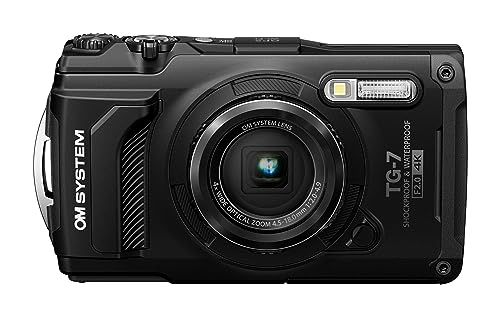
OM SYSTEM Tough TG-7 — Best camera for filming in any weather
The TG-7 is the only camera in this guide for which bad weather is not a condition but a feature list. It is built to be immersed, dropped, frozen and dusted as ordinary working events, and that construction changes the filming it makes possible: the surf line from inside the surf, the waterfall from within its spray, the blizzard from the middle of the slope, the building site and the fishing boat and the child’s mud campaign — all the places where filming outside actually gets interesting, and where every other camera here is negotiating with a rain cover.
The video it gathers in those places is honestly good: a bright lens for the gloom under canopies and weather, microscope and close modes that film the small outdoor world — the frost, the insect, the rock pool — with a specialist’s intimacy, and field sensors that log the conditions alongside the footage. For the outdoor educator, the field scientist, the adventure parent and the documentary maker whose subjects live in the wet, it is less a camera than a permission slip.
Its compromises are a small sensor’s ceilings in the deepest gloom and a stills-and-clips character that will not replace a system camera for the filmmaker’s main work. It is the second camera of expeditions and the first camera of the truly weather-committed. Judged by this guide’s founding question — what films outside, in the outside’s worst moods, without a negotiation — the TG-7 has no rival on the page, and its row is written in spray.
Learn its underwater and close modes before the trip that needs them, because the TG-7’s specialities are buried one menu deeper than a wet, cold hand wants to dig. Set the mode dial’s custom position for the day’s dominant abuse — surf, frost or site dust — and let the camera live there. Owners who prepare it so describe a particular freedom at the water’s edge: the moment arrives, the camera is already dressed for it, and the filming happens at the speed of the wave rather than at the speed of the settings.
- Waterproof, crushproof and freezeproof construction
- Bright lens for gloom and canopy shade
- Close-up and microscope filming modes
- Field sensors logging conditions
- Compact body for pockets and packs
Strengths
- Films where other cameras hide
- Close outdoor world filmed superbly
- Survives the journey as well as the shoot
Trade-offs
- Small sensor ceilings in deep gloom
- Not a main system camera
- Controls are compact-camera sized
Best for: surfers, field educators, adventure families and wet-weather documentarians.
Not suited for: filmmakers needing interchangeable lenses as their main tool.

GoPro HERO13 Black — Best for filming action outside
Outdoor filming’s most imitated shots are the HERO13’s home address: the descent filmed from the helmet, the wave from the board, the trail from the chest, the summit approach from the pole. It is waterproof without a case for the depths recreational filming visits, stabilised against terrain that would shake a rig apart, and small enough to be mounted where the action is rather than where the audience stands. For the participant-filmmaker — the rider, paddler, skier and climber whose film is the doing itself — it remains the default instrument of the entire outdoor genre.
The outdoor details are properly engineered: voice control for gloved and occupied hands, quick capture for the moment that announces itself without warning, lens accessories for the fisheye’s correction or embrace, and a mount ecosystem that has solved, somewhere in its catalogue, almost every attachment problem the outdoors invents. Its footage cuts happily into expedition films beside bigger cameras, especially when shot with the edit’s colour in mind.
Heat on still, hot days and battery appetite on the longest descents are its standing outdoor taxes, and its fixed lens frames the world widely whether the world wants it or not. Neither dents its position. If your outdoor filming is made of motion, water and altitude — the participatory outdoors — the HERO13 is the camera this guide hands you first, with the single instruction to mount it well and go.
Mount it for the return journey as carefully as for the ascent: outdoor films are disproportionately made of descents, homeward rivers and the light of the day’s second half, and the camera that was packed away after the summit misses the half of the story with the best colour in it. Keep one mount on the pack’s strap all day, charged battery rotating at lunch, and the HERO becomes the expedition’s diary rather than its stunt department — a promotion its footage richly rewards.
- Waterproof body without a case
- Class-leading stabilisation for terrain
- Voice control and quick capture
- Lens accessories for varied looks
- The deepest mount ecosystem outdoors
Strengths
- Films the action from inside it
- Survives water, mud and impact
- Instant readiness for unannounced moments
Trade-offs
- Heat and batteries on long hot days
- Fixed wide lens sets the framing
- Low light capable rather than miraculous
Best for: riders, paddlers, skiers, climbers and action documentarians.
Not suited for: landscape filmmakers needing lenses and deliberation.

DJI Osmo Action 5 Pro — Best outdoor action camera for finished films
The Action 5 Pro is the action camera for the outdoor filmmaker who edits seriously. Its sealing and toughness match the genre’s demands, its stabilisation composes the trail, the river and the descent, and its colour science — kin to DJI’s aerial cameras — lets a day’s outdoor footage, ground and sky together, grade into one film with a consistency the expedition editor will bless. Battery endurance across a long day’s filming completes the professional picture: the camera that is still awake at the golden hour is the camera the film gets made on.
Field usability is thoroughly thought through: screens that serve in bright conditions from either side of the camera, a form that mounts across the outdoor catalogue, and low-light behaviour improved enough to hold the dawn start and the dusk finish that outdoor schedules are built around. For the bikepacker, the trail documentarian and the travel filmmaker whose days are long and whose pack is finite, it is the most complete single action camera in this guide.
Its compromises mirror its rival’s — the fixed lens’s terms, an ecosystem a season younger — plus the honest note that its advantages compound for filmmakers who grade and edit, and matter less to those who post raw clips. Choose it when the outdoor footage is destined for a finished film; its whole design is that destination, weatherproofed.
Shoot the expedition as one production from the first morning: a single colour discipline, a naming habit for cards by day and place, and the pans and wides gathered deliberately at each camp for the edit’s geography. The Action 5’s endurance and consistency exist for exactly that treatment, and editors receiving a disciplined DJI archive describe the rare pleasure of an outdoor film that assembles itself. The camera supplies the stamina; the filmmaker supplies the system; the mountains, as usual, supply everything else.
- Sealed, rugged action body
- Stabilisation for terrain and vehicles
- Colour kinship with DJI aerial footage
- Long recording endurance
- Dual screens for field framing
Strengths
- Expedition days filmed on one charge discipline
- Footage grades into serious films
- Dawn and dusk held respectably
Trade-offs
- Fixed lens dictates the look
- Mount ecosystem younger than GoPro’s
- Advantages compound for editors, not clippers
Best for: expedition, bikepacking and travel filmmakers who edit.
Not suited for: casual clippers wanting the simplest path to a post.

OM SYSTEM OM-5 Mark II — Best weather-sealed system for outdoor filmmaking
When outdoor filming needs the grammar only lenses provide — the compressed telephoto storm over the ridge, the shallow-focus portrait at the fire, the wide interior of the bothy — the OM-5 Mark II is the system that can come. Its sealing is the genuine article, proven across the wettest photographic tradition in the industry, its stabilisation keeps handheld footage composed when the wind is using the filmmaker as a sail, and its lenses deliver the full focal range at weights that leave the pack’s majority for food, shelter and the journey’s other necessities.
The computational toolkit serves the outdoor film specifically: live graduated effects for the sky-land argument at sunset, composite modes for night skies and waterfalls, and high-resolution stills for the production’s photographs. Paired with a weather-sealed zoom, it is a one-lens expedition department; paired with the fast primes, it films faces at dusk with a quality no action camera approaches. This is the camera for the filmmaker whose outdoors is a subject, not a backdrop.
Its costs are the smaller sensor’s low-light ceiling and menus that reward the filmmaker who configures before the trail. It will not survive immersion like the TG-7 or mount like the action cameras, and it should not be asked to. Within the lensed, deliberate, weather-committed filmmaking it was built for, the OM-5 Mark II is the most complete outdoor system in this guide — and the one whose footage will still be impressing editors when the trip is a decade old.
Choose the expedition’s lens pair in advance and defend the choice against the pack’s temptations: one sealed zoom for the day’s unknowns and one fast prime for the evenings covers nearly every outdoor film ever outlined, at a weight that leaves the filmmaker a mountaineer rather than a porter. The OM-5’s whole design philosophy is that restraint, and owners who honour it return with footage; owners who pack the whole shelf return with a story about their shoulders. The outdoors grades kit lists as harshly as it grades cameras.
- Weather-sealed body and lens system
- Stabilisation for wind-buffeted handheld work
- Full focal range in travel weights
- Computational modes for skies and nights
- Microphone input for field sound
Strengths
- Real filmmaking grammar in real weather
- Reach and portrait lenses that travel
- Stabilisation composed in wind
Trade-offs
- Low-light ceiling of the format
- Not immersion-proof like the Tough
- Menus reward pre-trail configuration
Best for: expedition filmmakers, landscape documentarians and outdoor storytellers.
Not suited for: immersion sports and mounted action work.

Insta360 X4 — Best for landscapes that will not fit in a frame
The outdoors’ oldest filming problem is that the subject is everywhere: the summit panorama, the canyon’s both walls, the group spread around the fire with the mountains behind every shoulder. The X4 dissolves the problem by recording all of it, always, and letting the filmmaker choose the framing in the edit — the pan across the ridge, the tilt from boots to peaks, the moment turned toward whichever companion laughed. For landscape and journey filming, that omniscience is a genuine revolution in a pocket-sized, waterproof body.
The reframing workflow suits the journey’s rhythm: film generously in the field, where decisions are expensive, and compose in the evening, where they are cheap. The invisible-stick effect places the camera apparently in mid-air above the trail; horizon lock keeps the world level on terrain that never is; and the footage’s resolution in this generation supports the extracted frames at the sizes travel films are watched. Groups, in particular, will find their summit moments finally contain everyone, including the camera’s owner.
Its costs are the editing stage it obliges, large files for the pack’s storage budget, and extracted detail that trails a dedicated lens at the pixel level. Low light asks the usual respect. For the filmmaker whose outdoors is vast, social and unrepeatable — the trek, the expedition, the journey with friends — the X4 captures what no aimed camera can promise: that nothing important happened outside the frame, because there was no outside.
Protect the twin lenses like the budget depends on them — because outdoors, it does. The exposed domes that gather the world are the first surfaces a rucksack strap, a rock or a careless glove will find, and a scratched sphere taxes every frame of the day. Guards on for every transit, the case on the belt rather than in the pack’s depths, and a two-second dome check before each capture: three habits that separate the X4’s expedition veterans from its cautionary tales. The world is worth recording whole; keep the eyes that record it clean.
- Full 360-degree capture
- Reframing in post for pans and tilts
- Invisible selfie-stick effect
- Horizon lock for rough terrain
- Waterproof, pocketable body
Strengths
- Nothing outdoors escapes the frame
- Summit and group moments include everyone
- Composition decided in the evening’s calm
Trade-offs
- Reframing workflow is obligatory
- Large files tax storage
- Extracted detail trails dedicated lenses
Best for: trekkers, expedition groups and landscape filmmakers.
Not suited for: shooters who hate editing on principle.

AKASO Brave 7 LE — Best budget camera for risky outdoor shots
Outdoor filming’s best shots are frequently its most dangerous — dangerous for the camera, that is: the mount at the waterfall’s base, the hull’s waterline, the bike’s fork in the rock garden. The Brave 7 LE exists so those shots can be attempted without a flagship’s ransom riding on the mount. It is weather-sealed, stabilised respectably, equipped with front and rear screens for framing in odd positions, and priced so that its loss would be a story rather than a catastrophe. Bravery, in outdoor filming, is a budget line, and this is the camera that funds it.
It also serves as the expedition’s second and third angle: the camera at the far bank, under the vehicle, on the spare helmet, gathering the cutaways that make outdoor films feel produced. In good light — the outdoors’ most common gift — its footage sits happily in the travel and social edits most outdoor filmmakers actually publish, and its accessory bundles mean the mounts arrive with the camera rather than after it.
No honest guide promotes it past its station: low light softens it, rough vibration tests its stabilisation beyond the leaders’, and its colours ask the editor for help. But the question its row answers is the one every outdoor filmmaker asks at the risky moment — what can I afford to put there — and the Brave 7 LE answers it better than anything else in this guide. Buy it to be brave; let the flagships stay dry until the shot is proven.
Keep a field log of its mounts and survivals — the waterfall base, the hull line, the fork in the rock garden — because the Brave’s real product is knowledge: which risks outdoor footage can actually take, learned at a price that permits the learning. Productions that graduate to flagship cameras afterwards spend that knowledge for years, mounting bravely and wisely in proportions no amount of insurance could teach. The little camera’s footage may date; its education does not, and education is the only outdoor equipment that weighs nothing.
- Weather-sealed body with case options
- Front and rear framing screens
- Electronic stabilisation for mounts
- Accessory bundles commonly included
- Good-light footage for travel edits
Strengths
- Cheap enough for the dangerous mount
- Dual screens frame odd positions
- Second-angle value on expeditions
Trade-offs
- Low light and extreme vibration expose it
- Colours need editorial help
- Polish trails the leaders
Best for: risky mounts, second angles and budget outdoor starts.
Not suited for: main-camera duty on a once-in-a-lifetime expedition.
How Do You Expose for the Sky-Land Argument?
Every outdoor frame contains the same negotiation: the sky arrives several stops brighter than the land it illuminates, and the camera must be told which party the film is about. For most outdoor filming, the answer is the land and the people on it — expose for them, let the sky go bright with dignity, and compose so the blown region reads as light rather than as loss. When the sky is the subject — the storm, the sunset, the aurora’s green arithmetic — expose for it without apology and let the land become the silhouette it wants to be. Indecision between the two is the only real error, and it is visible in every frame that commits it.
The tools help where they can: graduated effects, in-camera or filtered, darken the sky during the exposure itself; the OM SYSTEM’s live version makes the adjustment visible as you compose, which teaches the judgement faster than any tutorial. Bracketing serves the static landscape; the moving outdoor subject — the rider against the sunset — must be served by a decision, made before the moment, about which half of the world the film is keeping.
Review the day’s footage with the argument in mind and your eye recalibrates within a week: you will begin seeing outdoor scenes as two exposures sharing a frame, and placing your subjects in the half you have chosen. That seeing, more than any dynamic range figure in this guide, is what separates outdoor footage that looks like the place from footage that looks like a photograph of the weather being too much. The cameras above supply the range; the filmmaker supplies the verdict.
How Do You Keep Lenses Clear and Cameras Alive in Bad Weather?
Water on the front element ruins more outdoor footage than water in the camera ever will, so the first discipline is the wipe: a microfibre cloth in a dry, known pocket, used between shots rather than during them, and a hood or a hand shading the lens from the rain’s direct line between wipes. Sealed cameras forgive the weather; they do not forgive a droplet sitting in the centre of every frame like a second, unwanted subject. Check the front element the way pilots check instruments — by habit, briefly, before every important sequence.
Condensation is the quieter enemy, striking when a cold camera meets warm damp air — the tent morning, the return to the heated hut. The defence is patience and a sealed bag: let the camera acclimatise inside a closed bag or case so the moisture condenses on the container rather than in the lens. Fogged internals end filming days; a twenty-minute wait in a plastic bag has saved more expeditions than any specification in this guide, and the trick costs exactly one bag.
Cold and heat manage the day’s other end. Batteries live warm against the body and rotate through the camera; cards and spares stay dry in the pack’s heart; and in hot still weather, cameras rest in shade between sequences, because a cooked sensor’s noise and a shutdown at the summit are both scheduling failures disguised as equipment failures. The outdoors rewards the filmmaker who treats these rituals as part of the craft rather than as fuss — they are, on the evidence of every expedition archive, most of the craft.
How Should You Compose Outdoor Film in Changing Light?
Scout with the light’s timetable, not your own. Outdoor light is a schedule — the valley’s shadow line, the coast’s clearing hour, the forest’s brief noon — and the filmmaker who learns a location’s timetable in the first day films the remaining days like a local. The cameras here reward that knowledge with their readiness: quick starts for the break in the clouds, stabilisation for the wind that accompanies the best drama, and colour that holds its character as the light swings from glare to gloom within a single sequence.
Compose in layers the way the land is built: a foreground that gives the feet a place, a middle where the subject lives, a background that supplies the scale. Outdoor footage without layers looks like a photograph of a place; with them, it looks like being in one. The wide lenses of the action cameras and the X4’s sphere both serve the layered habit naturally, while the system camera’s lenses let the filmmaker compress the layers for the telephoto drama of ridge behind ridge — choose the geometry per story, and let the land’s own architecture make the decision with you.
Finally, film the weather as a character rather than as a problem: the approaching front, the mist’s behaviour in the valley, the light after rain when the world is washed and shining. Audiences for outdoor film are connoisseurs of exactly those transitions, and the sealed cameras in this guide exist so the filmmaker can stay out in them. The amateur goes in when the weather turns; the outdoor filmmaker checks the seals, wipes the lens, and rolls.
What Power and Storage Plan Does an Outdoor Day Need?
Plan power backwards from the cold and the distance. Assume batteries will deliver less than their room-temperature promise — substantially less in frost — and carry the day’s filming in warm pockets: the working battery, its replacement warming, and a third forgiving the day’s ambitions. Solar and pack-based charging serve the multi-day journey, but the single day’s discipline is simpler and stricter: nothing films on a battery that started the morning as a stranger, and every battery’s state is known before the trail steepens.
Storage obeys the same pessimism. Outdoor days produce footage in bursts of weather and wonder, and the card that fills at the summit’s golden minute is a planning failure, not bad luck. Carry more than the estimate, format in the camera that will use the card, and treat the evening’s backup — two copies, one on the person, one in the pack — as the day’s final shot, without which the day is not finished. Expeditions have lost more films to the journey home than to the journey out.
Build the kit check into the departure ritual: camera, seals inspected, cloth in its pocket, batteries counted warm, cards counted empty, the risky mount’s straps audited. Five minutes at the trailhead is the cheapest insurance in outdoor filmmaking, and the cameras in this guide — tough as they are — all assume an owner who performs it. The outdoors forgives weather, terrain and even error; it does not forgive the unforced omission, because it charges for those at the furthest point from help.
How Do You Film Wildlife and Weather Without Becoming Their Story?
Patience and distance are the wildlife filmmaker’s whole technique, and the equipment serves them in that order. Settle before the light, let the place forget you, and let the sealed, quiet cameras in this guide do their work from a hide, a shoreline or a patient crouch — the telephoto reach of the OM SYSTEM, the TG-7’s unthreatening smallness at the rock pool, the action camera planted and left as an unblinking witness where regulations and ethics allow. The footage that results has the wild’s own tempo, which no amount of chasing has ever improved.
Weather filming obeys the same humility at larger scale: position for the front’s arrival rather than pursuing it, protect the retreat before the drama, and let the sealed camera stare at what no sensible person stands in. The storm’s best footage is made at its edges, by filmmakers who planned the leaving before the arriving. Human safety is not a production value and never trades against one; the outdoors has cancelled better filmmakers’ schedules than yours, and the correct response is a warm drink and the dawn attempt.
Both crafts share the closing ritual: review the day with gratitude for what the place permitted, log the conditions beside the footage, and leave the location’s inhabitants and weather to their own evening. Outdoor filming at its best is a guest’s art — the cameras above are simply the politest, toughest guests the genre has yet produced, and the wild, like any good host, rewards the guests who know how to behave.
What Does an Outdoor Filming Day Look Like When It Goes Well?
It starts in the dark, with the kit check performed by headlamp and the batteries already warm from the sleeping bag’s foot. The first location is reached before the light, the camera acclimatised rather than fogged, and the dawn sequence — the mist, the first colour, the world’s animals about their first business — is filmed by someone whose equipment was ready an hour before the world was. Outdoor filming’s glamour is entirely front-loaded into preparation, and the day’s remaining hours are spent collecting the interest on it.
The middle of the day belongs to the journey’s grammar: the trail, the river and the road filmed in passing by the mounted and pocket cameras, the interviews and details gathered when the light rests at noon, the risky shots attempted while energy and weather allow. The sealed bodies earn their keep invisibly — no bagging for the shower, no anxiety at the ford — and the filmmaker’s attention stays where it belongs, on the place and the story, because the equipment has stopped asking questions.
The day closes with the summit or the shore at the good hour, the power plan arriving at the golden minute with charge to spare, and the evening’s backup performed in the tent with the day’s footage already reviewed in highlights. Nothing about such a day is luck. It is the compound interest of every ritual in this guide, paid out in the only currency outdoor filming mints: footage of the world’s best hours, captured by the camera that was there, sealed, charged and ready.
How Do You Choose Between Tough, Action and System for Your Outdoors?
Interrogate your last year of outdoor days rather than your next year’s ambitions. Count the immersions, the mounts, the long lenses and the dawns honestly: the year that was mostly wet and vertical belongs to the tough and action cameras; the year of ridges, portraits and deliberate landscapes belongs to the system; the year of journeys with companions belongs, increasingly, to the 360’s omniscience. Equipment bought for the honest count gets used weekly; equipment bought for the imagined year gets photographed for resale listings, and the outdoors can always tell the difference.
Then handle the finalists with the journey’s gloves on — literally, if your outdoors is a cold one — because controls that fail a gloved hand fail the whole expedition regardless of their specifications. Check the screen in real glare, the startup in real haste, the mount with real straps. Outdoor buying is the branch of photography where the shop test matters least and the field test matters most, which is why rental and borrowed weekends have saved more outdoor budgets than any review, this one included.
Buy, finally, for the pair rather than the one: the survivor and the specialist, the camera that cannot die and the camera that makes the film beautiful, sharing one journey’s bag between them. Almost every working outdoor kit in this guide’s research resolved into such a marriage — TG-7 with OM-5, HERO with DJI, X4 with anything — and the marriages outlast the honeymoons of single flagship purchases by years. The outdoors is a long relationship; equip it like one.
How Do the Six Compare for Outdoor Filming?
Compare by exposure to the elements: the TG-7 for immersion and abuse, the action flagships for mounted motion, the OM SYSTEM for lensed filmmaking in weather, the X4 for the whole landscape at once, and the AKASO for the shot you cannot afford to lose a flagship on. Most outdoor kits pair a survivor with a specialist from this table.
| Pick | Badge | At a glance |
|---|---|---|
| OM SYSTEM Tough TG-7 | Best camera for filming in any weather | True tough camera; films in rain, surf, dust and frost by design. |
| GoPro HERO13 Black | Best for filming action outside | Mounted outdoor witness; the descent, wave and trail filmed from inside. |
| DJI Osmo Action 5 Pro | Best outdoor action camera for finished films | Finished-film action camera; endurance and colour for expeditions. |
| OM SYSTEM OM-5 Mark II | Best weather-sealed system for outdoor filmmaking | Sealed system camera; lensed outdoor filmmaking that travels light. |
| Insta360 X4 | Best for landscapes that will not fit in a frame | 360 landscape camera; the whole scene captured, framing decided later. |
| AKASO Brave 7 LE | Best budget camera for risky outdoor shots | Budget bravery; the risky outdoor shot at a survivable price. |
What Mistakes Ruin Outdoor Footage Most Often?
Trusting the screen in glare is the founding error: the preview that looks moody and perfect at noon is, on the evening’s monitor, a stop and a half too dark with the subject’s face in shadow. Outdoor filmmakers expose by the histogram and the zebras, shade the screen with a hand or a hood, and treat the viewfinder — where the camera offers one — as the honest instrument it is. The sun is a liar with excellent production values; do not let it grade your film.
The second mistake is filming the weather’s drama with a holiday’s power plan: one battery, optimism, and a card shared with last month’s birthday. Cold, altitude and long approaches all tax the same reserves, and the outdoor day always runs longer than its plan because the light’s best performance is scheduled last. The power section’s pessimism is not anxiety but arithmetic, and the filmmakers whose summit footage exists are the ones who did it at the trailhead.
The third mistake is staying safe with the camera while the story happens in the weather: the storm filmed from the hut doorway, the surf from the dry sand, the blizzard from the lodge window. Sealed cameras exist to abolish exactly that timidity, within the limits of human safety, which always outranks footage. Wipe the lens, check the seals, and go and stand in it — carefully, briefly, and with the retreat planned — because the outdoors’ best film is never made from indoors.
A fourth mistake is forgetting that the filmmaker is also outdoors: the camera sealed, the operator soaked; the batteries warm, the hands too cold to work them. Dress the human with the same seriousness as the equipment — gloves that can operate controls, layers that survive the stationary hour wildlife demands — because the finest outdoor camera in this guide still requires a functioning person behind it, and the mountain grades the whole system, flesh included, without appeal.
Final Recommendation
If one camera must be named for filming outside in all its moods, the OM SYSTEM Tough TG-7 is the survivor: the camera that films in the weather rather than about it. Action participants should take the GoPro HERO13 Black, filmmakers who edit expeditions the DJI Osmo Action 5 Pro, and lensed storytellers the OM SYSTEM OM-5 Mark II — with the Insta360 X4 for the landscapes that refuse framing and the AKASO Brave 7 LE riding wherever the shot is braver than the budget.
Whichever you carry, perform the rituals: seals checked, cloth pocketed, batteries warm, sky exposed for on purpose. The outdoors will do the rest — it has been waiting, in weather and wonderful light, for a camera that could stay out in it. Now it has six to choose from, and so do you.
Dress yourself as carefully as you seal the camera, and the pair of you will still be filming when the light does its evening performance.
Take the dawn attempt this week, whatever your local outdoors offers — a frosty field, a wet pier, a windy hill above the town — and film it with the rituals running. The footage will tell you more about which row of the table is yours than another hour of comparison ever could.
Trust the telling. The outdoors is the most honest reviewer in photography, and its verdict arrives already graded in weather and light.
Read it, pack accordingly, and go back out while the season is still offering.
Seasons are short, light is shorter, and the sealed camera by the door is the whole argument.
Take it out before the argument is settled by the weather closing in.
In, in this genre, is merely where the timid footage comes from.
Yours is waiting outside, in the weather, where it always was.
Go and meet it with a dry cloth, a warm battery and a sealed camera.
That small kit, faithfully carried, has made more great outdoor film than any flagship.
Carry it out the door tonight and prove the old sentence true again.
Related guides
- Best Cameras for High Humidity: Sealed and Rugged Picks for Tropical Air
- Best Cameras for House Outside: Outdoor Coverage with Honest Indoor Boundaries
- Best Cameras for Filming Macro: 6 Picks for Tiny Subjects on Video
Frequently Asked Questions
What does ‘filiming outside’ mean — is this the right guide?
It is the common misspelling of ‘filming outside’, usually typed on a phone with cold hands, and yes — this guide covers cameras for outdoor video: weather-sealed, tough and action cameras ranked by survival, field usability and outdoor image quality. If your filming is indoors or studio-based, our other guides will serve you better; if it involves weather, terrain, water or altitude, you are home.
How waterproof do I actually need an outdoor camera to be?
Match the seal to the water you will honestly meet. Rain and spray ask for weather sealing, which the OM-5 system and the action cameras provide. Immersion — surf, snorkelling, the waterfall’s base — asks for the genuine article: the TG-7’s construction or an action camera’s rated depth, in a case where the design requires one. The expensive error is assuming a splash rating covers a dunking; the cheap error is buying immersion armour for a camera that will only ever see drizzle.
Why do my outdoor videos look washed out at noon?
Because noon light is the outdoors’ harshest argument: a sky many stops brighter than the land, colour flattened by overhead sun, and screens lying about all of it in the glare. Film in the day’s better hours when the story allows — morning and evening light model the land instead of flattening it — expose for the subject with the histogram’s help, and consider the graduated tools in this guide for the scenes that must be shot at midday. The washed-out noon is a lighting condition, not a camera defect, and it is scheduled, so it can be planned around.
Can one camera do both outdoor video and everyday family filming?
Yes — the OM-5 Mark II in this guide is a complete everyday system that happens to be sealed for expeditions, and the action cameras serve family adventures happily, though their wide lenses flatter landscapes more than faces. The TG-7 is the specialist: peerless in weather, a compromise at the birthday table. Most outdoor households run a system camera for life and an action or tough camera for the elements, which is why this guide’s table is built to be paired from.
How do I stop my lens fogging when I come back indoors?
Seal the camera in a bag or case before you enter the warmth, and let it acclimatise inside the sealed container so condensation forms on the bag rather than in the lens. Resist wiping a fogged element — patience clears it safely in tens of minutes, while a cloth on a cold, damp lens spreads the problem. The same ritual in reverse protects the camera going out into frost. It is the oldest trick in the outdoor photographer’s book, and it has saved more filming days than any product in this guide.
Is a 360 camera practical for a hiking film, or a gimmick?
Practical, for the journey’s specific problems: the group that includes the filmmaker, the panorama that will not fit, the moment that happens behind the aimed camera. The X4’s reframing converts those into the film’s best sequences, at the cost of an editing stage and generous storage. Solo filmmakers who hate post-production will find it a gimmick in their own hands; groups and landscape storytellers will find it the only camera that was facing everywhere the day happened. The honest answer is that it is a tool whose practicality is decided by the editor, not the mountain.
Related Guides
The outdoors continues in our companion guides for neighbouring terrain: best action cameras for travel best cameras for hiking best waterproof cameras for snorkeling


