Disclosure: As an Amazon Associate, ilcastellomenu.com earns from qualifying purchases. Product examples below link to Amazon, where you can check current availability and specifications; this guide itself lists no fixed prices because pricing and bundles change frequently.
The lightweight vs heavy gaming mouse question is really a question about physics and fatigue: a lighter mouse starts and stops moving with less effort, which favours fast, low-sensitivity aiming, while a heavier mouse carries momentum that smooths movement and can feel steadier for high-sensitivity and non-gaming use. Neither is objectively better — but the difference is large enough that choosing the wrong end of the scale for your grip and games is a genuine handicap.
This guide compares the two camps by the criteria that matter in play — flick speed, stopping control, fatigue, tracking steadiness and build — then maps weight classes to genres and grips so you can place yourself on the scale with confidence. If you are also deciding on a connection type, read this alongside Wired vs Wireless Gaming Mouse, because battery weight is part of that decision too.
Lightweight vs Heavy Gaming Mouse: The Quick Verdict
Choose light — roughly under 70 grams — if you play shooters with low sensitivity, aim with your arm, lift and reposition constantly, or have ever finished a session with a tired forearm. Choose a midweight mouse, around 80–100 grams, if you want one mouse for everything, play mixed genres, or find ultralight shells feel insubstantial and skittish. Choose heavy — over 100 grams, or a mouse with addable weights — if you play at high sensitivity with small movements, prefer momentum and stability over agility, play MMOs where extra buttons matter more than flick speed, or simply like a dense, planted feel.
Notice that the verdict is organised by how you play, not by what is fashionable. Ultralight design is the current trend and the marketing is loud, but trends describe what is selling, not what your hand needs. The sections below give you the reasoning to resist both hype and nostalgia.
In this guide
Flick Speed, Stopping and Control
A lighter mouse accelerates with less force, so the start of a flick is quicker and — just as important — it stops with less opposing force, which reduces the overshoot-and-correct wobble at the end of fast movements. For low-sensitivity players making repeated 30–50 centimetre swipes, that reduced effort compounds across a session. This is the core mechanical case for light mice, and it is real: less mass is less work, every single movement, thousands of times an evening.
The heavy mouse’s counter-argument is inertia as a stabiliser. Mass resists small disturbances, so high-sensitivity players — whose tiny movements translate to large cursor travel — often find a heavier mouse smooths out hand tremor and micro-jitter that a light mouse faithfully transmits. Tracking a moving target at high DPI can genuinely feel calmer with some weight behind it. Which effect matters more depends on your sensitivity: the lower you play, the more the light mouse’s case wins; the higher you play, the more respectable the heavy case becomes. Your grip mediates this too, as How to Grip a Gaming Mouse details — fingertip players feel weight changes most, palm players least.
Fatigue, Comfort and Long Sessions
Fatigue is where weight stops being preference and becomes health-adjacent. Repeatedly accelerating and braking a heavy mouse with a claw or fingertip grip loads the fingers and forearm, and players who switch down in weight frequently report that a familiar ache simply stops appearing. If your sessions run three hours or more, or you play daily, weight deserves to be weighted heavily in your decision — a pun the entire category has earned. Test honestly with the full-session method in How to Test a Gaming Mouse rather than a five-minute desk trial.
Light is not automatically comfortable, though. Some players grip a very light mouse harder to feel in control of it, trading arm fatigue for hand tension. Shell size and shape dominate comfort; a light mouse that is too small for your hand will tire you faster than a heavier one that fits. Treat weight and fit as a pair: first find shapes that suit your grip and hand size — Best Gaming Mouse for Big Hands and Best Gaming Mouse for Small Hands organise exactly that search — then choose the lightest weight within the shapes that fit.
Build, Features and the Adjustable Middle Ground
Historically, heavy mice carried more features: extra buttons, tilt wheels, adjustable weight systems. The G502 in the gear section is the classic example, shipping with removable weights so the owner can tune the balance personally — an honest admission that this debate has no universal answer. Ultralight mice achieve their numbers by subtraction: honeycomb shells or thin-wall construction, minimal lighting, fewer buttons. Modern designs have narrowed the feature gap, but if you want many buttons and light weight simultaneously, expect to pay for the engineering that delivers both.
| Weight class | Typical feel | Suits | Examples of play style |
|---|---|---|---|
| Ultralight (under 60 g) | Almost disappears in the hand | Low-sensitivity FPS, fingertip and claw grips | Large arm swipes, constant repositioning |
| Light (60–79 g) | Agile but present | Most competitive play | Mixed wrist and arm aiming |
| Midweight (80–99 g) | Balanced, versatile | Mixed genres, one-mouse setups | Moderate sensitivity, varied games |
| Heavy (100 g and up) | Planted, momentum-rich | High sensitivity, MMO and desktop use | Small movements, many buttons |
Adjustable-weight mice deserve special mention as the undecided player’s hedge: start with all weights removed, play a week, add mass gradually and keep notes. Many owners discover their preference sits one step from an extreme rather than at it. Balance matters alongside total weight — a mouse that is nose-heavy or tail-heavy feels wrong at any number — and removable weights let you shift balance as well as mass, something no fixed mouse offers.
Matching Weight to Your Games and Setup
Genre by genre: tactical and arena shooters reward light; MOBAs and RTS sit comfortably in the middle, where click volume matters more than swipe effort; MMOs reward buttons and tolerate heavy; simulation and strategy titles barely care. Your pad plays a supporting role — high-friction control pads add effective resistance that pairs well with light mice, while slick speed pads plus a heavy mouse can feel like steering on ice. And revisit the question when your sensitivity changes: players who lower their DPI after reading How to Set DPI on a Gaming Mouse often find their weight preference drops with it, because lower sensitivity means larger, more frequent movements.
Final advice: borrow before you buy if you can, respect the return window if you cannot, and judge weight at the end of a long session rather than the start. The mouse that feels exciting for five minutes and exhausting by hour three is the wrong mouse, whatever it weighs.
Where the Weight Sits: Balance and Its Quiet Influence
Two mice at identical weight can feel completely different because mass distribution steers the mouse as surely as mass itself. A nose-heavy mouse resists the start of wrist flicks and feels planted at the front; a tail-heavy mouse pivots eagerly around the palm and can feel twitchy in the same hand. Sensor position compounds the effect, since the mouse rotates around your grip, not around its centre. This is why specifications alone cannot settle the weight question and why a mouse that ‘should’ suit you on paper sometimes does not: you are not holding a number, you are holding a distribution.
Adjustable-weight systems earn a second mention here because their real gift is balance tuning, not mass: moving weights fore and aft changes the pivot character of the mouse in ways players describe as ‘faster’ or ‘calmer’ without the scale moving much at all. If you own such a system, experiment with placement before amount. And if a fixed mouse feels almost right, know that even small additions — a grip tape layer, a different cable with a bungee taking its pull — shift the felt balance at the margins, sometimes enough to close the gap.
Weight and Aim Style: The Sensitivity Interaction in Detail
The weight decision is inseparable from the sensitivity decision, and thinking of them as one system prevents the classic mismatch: an ultralight mouse at very high sensitivity, where the hand’s every tremor is amplified by both choices at once, or a heavy mouse at very low sensitivity, where every swipe is labour. The coherent pairings are light-with-low, where big calm movements meet a mouse that starts and stops willingly, and heavier-with-high, where small movements meet a mouse whose inertia edits out the noise. The middle of both scales pairs with everything, which is precisely why it is the middle.
When you change one, re-audit the other. Players who drop their DPI substantially — a common improvement project — often report their mouse ‘suddenly feels heavy’, and they are right in the only sense that matters: the workload per match rose, and the mouse’s mass is where workload lives. Conversely, a player who lightens their mouse may find their old sensitivity now feels skittish and benefit from lowering it slightly into the newly available control. Treat grip, DPI and weight as a triangle: move one corner and the other two shift, so adjust deliberately, one corner at a time, with a week between moves.
A Two-Week Trial Protocol for the Genuinely Undecided
If you have access to two mice of different weights — yours and a borrowed one, or a new purchase inside its return window — run a structured trial rather than vibes. Week one on the lighter mouse: play your normal titles, keep sensitivity constant for the first three days, then allow one adjustment. Note three things nightly: end-of-session forearm tiredness, how often you overshoot flicks, and how controlled slow tracking feels. Week two repeats identically on the heavier mouse. The comparison that matters is not which felt exciting on day one — novelty always wins day one — but which felt invisible by day five, because the right weight disappears from your attention and the wrong one keeps introducing itself.
Players without a second mouse can simulate the direction of travel: adhesive-backed weights inside or under a mouse you own (fitted carefully, away from the sensor and feet) approximate a heavier future, and removing a wired mouse’s cable drag with a bungee approximates part of the light-wireless feel. Simulations are imperfect, but they are free, and they beat buying on a forum’s conviction. Your hands, given two honest weeks, will tell you your weight class more reliably than any reviewer can.
Three Players at Three Points on the Scale
Cases make the scale concrete. Player one is a low-sensitivity tactical shooter competitor whose pad covers half the desk and whose aim is all forearm. On a heavy, button-rich mouse, their flicks arrive tired by the third map and their repositioning lifts strain a wrist that works all day. Moving to an ultralight shell does not change their sensitivity, their grip or their game — it removes a tax from every one of the thousands of movements a match contains, and the end-of-session freshness is the difference they report. For this player, light is not a preference; it is ergonomics.
Player two is an MMO raider and all-day desktop user on the same machine, playing at high sensitivity from the wrist. Their heavy mouse’s dozen buttons run the rotation, its mass steadies a cursor that would otherwise tremble at their DPI, and their longest sessions produce no fatigue because the movements are small. Hand them an ultralight and they describe it as ‘nervous’ — the mouse transmits every micro-motion their style generates. For this player, heavy is not nostalgia; it is the correct physics for small, dense, high-gain movement.
Player three plays everything — shooters on weekends, strategy at night, work all day — and owns one mouse. The midweight band exists for this player, and their verdict after testing both ends is the least dramatic and the most common: the extremes each won their specialty and lost the rest of the week. The generalisable lesson is that weight loyalty is usually library loyalty in disguise. Audit your games and your sensitivity honestly, and the scale stops being a debate and becomes a description of you.
The Physics Underneath the Preference
Strip away marketing and the weight question is a question about inertia. A heavier mouse resists changes in motion: it needs more force to start moving, more force to stop, and it smooths out small involuntary inputs — tremor, desk vibration, the micro-corrections of a tired hand — because those inputs are too weak to move its mass. A lighter mouse answers every input, including the ones you did not mean to send. Neither behaviour is accuracy in itself; they are two different filters placed between your hand and the cursor, and the right filter depends on how noisy your hand’s signal is.
Starting force is where most players actually feel weight. The first millimetre of a movement — breaking static friction and overcoming inertia together — decides how delicate a mouse feels when tracking slowly. Heavy mice feel calm at this boundary; light mice feel eager. At the other end of the movement, stopping is inertia’s second act: a heavy mouse carries momentum that your hand must absorb, which is why heavy-mouse players develop a braking habit, beginning their stops early, while light-mouse players can flick and halt almost in the same gesture.
Sustained movement tells a third story. In long tracking engagements — holding a beam on a moving target — weight mostly disappears once the mouse is moving, and friction from the pad dominates the feel. This is why weight debates rage among flick-heavy shooter players and barely register among tracking-heavy players: the genres load different phases of the movement, and weight lives in the start and the stop, not the cruise.
Your pad is a silent partner in all of this. A fast, hard pad lowers friction until inertia is nearly the whole feel, exaggerating weight differences. A slow cloth pad adds enough friction to mask modest weight gaps entirely. Players who changed pads and suddenly found their mouse ‘too light’ or ‘too heavy’ were feeling the friction term of the equation change while the mass stayed the same.
Aim Styles and Sensitivity: Matching Mass to Method
Low-sensitivity arm aiming is the natural home of the lighter mouse. The movements are large, the accelerations are high, and the stops are frequent; every gram is lifted, swung and braked hundreds of times a match by the shoulder and forearm. Removing mass from that system is removing fatigue from the exact muscles doing the work, which is why the competitive FPS scene’s migration to light mice was led by low-sensitivity players and not, as folklore has it, by fashion.
High-sensitivity wrist aiming reverses the logic. Movements are tiny, travel is short, and the enemy is overshoot: the cursor that sails past the target because nothing in the system resisted. Here a heavier mouse’s inertia acts as a governor, and its smoothing of tremor matters because high sensitivity amplifies tremor into visible cursor shake. The wrist player on an ultralight mouse often describes the cursor as ‘nervous’ — an accurate report of an unfiltered signal.
Hybrid aimers — most real players — should weight the decision by their failure mode, not their highlight reel. If your misses are overshoots and shaky holds, mass is your friend. If your misses are late arrivals and an aching forearm, mass is your problem. Diagnose the miss honestly and the weight question answers itself; shop by highlight moments and you will buy the mouse your best five seconds wanted and your average five hours hates.
Genre-hopping players sit in the genuinely hard seat. The practical compromise is a mid-weight mouse and a per-game sensitivity arrangement, accepting that neither game gets its theoretical optimum. The alternative — two mice, one per genre — sounds indulgent until you price it against the hours involved; players with thousands of hours split between a tactical shooter and an arena title are not being precious by owning a tool per job.
The Body’s Vote: Wrists, Forearms and Cumulative Load
Weight debates usually argue about aim and ignore the invoice, which arrives in the forearm. Every flick is work, and work is mass times distance times repetitions. A heavier mouse played at low sensitivity is the maximum-load combination in gaming: the most mass moved through the longest distances the most times. Players who develop forearm fatigue, wrist soreness or a burning sensation along the top of the forearm should audit this combination before blaming posture, because it is the single most common mechanical overload in the hobby.
The relationship is not one-directional, though. An ultralight mouse can increase load of a different kind: stabilisation work. With little inertia to steady the cursor, your hand supplies the steadiness, maintaining a low level of grip and finger tension through every second of play. Players prone to cramping or who already grip too hard sometimes find a moderate mouse more restful than a feather, precisely because the mass lets their hand relax between movements. Our guide on how to grip a gaming mouse covers the tension side of this trade in detail.
Age and history vote too. A wrist with an old injury, a job that already loads the forearm, or simply a decade more of mileage all shift the sensible answer toward less load: lighter mouse, or the same mouse at a sensitivity that shortens travel. There is no virtue in the setup that hurts. The best players in five years will be the ones whose hands still work, and load management is how hands keep working.
Treat new pain as data, not weakness. If a weight change coincides with new symptoms, that is the cleanest experiment gaming ever offers you: revert for a week and see if the symptom follows the variable. Bodies report honestly when you change one thing at a time.
Adjustable Weight Systems and the Middle of the Road
Removable weight systems promise to dissolve this whole comparison, and they half-deliver. Their genuine value is diagnostic: a new owner can spend a week at each configuration and learn their own preference from experience instead of arguments, which is worth more than the hardware itself. As a permanent arrangement they are weaker, because the added mass sits in fixed positions chosen by the designer, and balance — as the main article notes — matters as much as the total. Ten grams in the tail teaches you something different from ten grams under the sensor.
There is also a psychological wrinkle: adjustable systems invite endless fiddling, and fiddling is the enemy of the consistency aim is built on. The healthiest pattern is a deliberate trial — a fixed period at each weight, a decision, then removal of the unused weights to a drawer where they cannot tempt you mid-slump. A slump is a training problem wearing a hardware costume, and the player who re-weights their mouse after every bad match is treating costumes.
For the genuinely undecided, the middle of the road is a defensible permanent address rather than a failure to commit. A mouse in the moderate band, played at a moderate sensitivity, serves the widest range of genres and grips acceptably, and acceptably-everywhere beats perfectly-somewhere for players whose gaming diet is varied. Specialisation is for specialists; know which one you are before paying its costs.
Testing Weight Honestly: A Protocol That Defeats Novelty
Every weight change feels revelatory for three days, because novelty sharpens attention and attention improves performance. A protocol that defeats this illusion takes two weeks. Spend the first three days simply adapting — no judgements recorded. Then run identical aim-trainer routines on days four through seven and log the scores. Switch back to your original weight for three days of re-adaptation, then log the same routines again. Compare the logged blocks, not your memories of them, and weight the second block of each configuration more heavily, because it is the one with novelty fully drained.
Log the body’s data alongside the scores: forearm fatigue at session’s end, any wrist complaints, how the last hour of a long session felt compared with the first. A weight that wins the trainer by two percent and costs you a sore forearm by hour three has lost the real test. The scoreboard that matters is the one your whole playing life keeps, not the one a benchmark prints.
Change nothing else during the trial — same pad, same sensitivity in centimetres per 360, same games where possible. Weight trials fail as experiments when sensitivity drifts along with mass, because then two variables moved and the log cannot separate them. This discipline is tedious and is also the entire difference between knowing your preference and having a feeling about it.
If the trial ends in a statistical tie, choose by comfort and fatigue, and stop re-litigating. A tie means the variable does not matter much for your hand and your games, which is itself valuable knowledge: it frees your future buying decisions to be made on shape, buttons and reliability, where real differences live.
Weight Myths, Examined One at a Time
The loudest myth is that lighter is simply the modern, correct answer and heavy mice are legacy hardware for people who have not updated their opinions. The truth is narrower: light mice suit the currently dominant competitive style — low sensitivity, arm aiming, flick-heavy shooters — and that style’s visibility makes its equipment look universal. Players outside that style who adopt ultralight mice on the strength of the narrative frequently get worse and blame their hands. Equipment trends describe a population’s average; your desk is a sample of one.
The second myth inverts the first: that heavy mice are more accurate because they feel steadier. Steadiness at rest is not accuracy in motion. A heavy mouse resists your intentional corrections as faithfully as it resists your tremor, and in fast tracking that resistance reads as lag between hand and cursor. The steadiness is real but it is a trade, not a gift, and it is only a good trade when your errors are the kind that inertia fixes.
The third myth is that weight is the main thing separating good mice from bad. Within any sane range, shape fit outweighs weight, button quality outweighs weight, and feet condition outweighs weight on any given Tuesday. Weight is the most marketable variable — a single number that fits in a headline — which is exactly why it absorbs attention out of proportion to its rank among the things that decide whether a mouse suits you.
The final myth is personal: that your preference is a fact about mice rather than a fact about your current sensitivity, grip and games. Preferences migrate when those change. The player who swore by heavy mice at high sensitivity and the player who swears by light mice at low sensitivity are often the same person photographed five years apart. Hold your preference with confidence for buying purposes and with humility for arguing purposes.
Children, New Players and Special Cases
Young and new players change the weight answer in a specific way: their hands are smaller, their grip strength is still developing, and their sessions are supervised by adults who would prefer the equipment to survive. A mid-weight, durable mouse suits a learning player better than a fragile-feathered specialist tool, because early skill development is about consistency of the whole setup, and because a lighter touch is learned more easily when the equipment is not demanding adult grip strength to control it.
Players returning from injury, or managing conditions that affect hand strength and steadiness, sit at the other special case. For weakened grip, a lighter mouse reduces the force budget of every movement; for tremor, a heavier one filters the noise. These are opposite prescriptions from the same principle — match the mass to the hand’s actual signal and strength — and they illustrate why no universal recommendation survives contact with real bodies. When in doubt, the two-week trial protocol in this guide, run with medical comfort as the primary metric, decides better than any review.
Shared family mice default to the middle for a reason. A moderate weight in a moderate shape is nobody’s optimum and everybody’s workable, and for a household purchase that is the correct optimisation target. Save the specialised extremes for the desk that belongs to one player and one game.
How Weight Interacts With Your Pad, Feet and Desk
Weight never acts alone, and the cheapest weight experiments change its partners instead of the mouse. Mouse feet are the first partner: worn, scratchy feet raise friction until a light mouse feels like a heavy one being dragged through sand, which is why any weight judgement made on old feet is unreliable. Fit fresh feet — or at least clean the current set thoroughly — before concluding anything about mass. Our guide on how to clean a gaming mouse covers feet care as part of the routine, and it has rescued more ‘too heavy’ mice than any purchase.
The pad is the second partner, and swapping pads is a legitimate weight strategy. Moving from a control cloth pad to a faster surface reduces the effort of every movement, which players experience as the mouse getting lighter, even though the scale disagrees. Conversely, a player who loves an ultralight mouse but finds it skittish can add a slower pad and recover the calm they wanted from mass, without surrendering the light mouse’s easy starts. Friction and inertia are partially interchangeable currencies; spend whichever is cheaper to change.
Desk height and chair position complete the system by deciding which muscles supply the force. A setup that forces wrist-only movement makes any weight feel heavier, because the smallest muscles are doing the lifting. Before concluding that a mouse is too heavy for you, confirm that your arm is actually allowed to help move it. Ergonomics first, verdicts second.
A Brief History of How the Market Swung
Mouse weight has a fashion cycle, and knowing it inoculates you against the current one. The early gaming era prized heft: mice shipped with adjustable weight cartridges as a premium feature, and a solid, dense mouse signalled quality the way a heavy camera lens does. Players added grams on purpose, chasing the planted, deliberate feel that the games of the time — slower, lower-sensitivity, often played on small hard pads — genuinely rewarded.
The swing began when competitive shooters sped up and sensitivities dropped. Arm aiming at large scales punished mass, sensors became good enough that shell weight was the remaining frontier, and manufacturers discovered that holes and thin walls could take a mouse to weights that would have seemed absurd a decade earlier. The ultralight era was a real engineering response to a real style of play — and then it became a marketing default applied to everyone, including players whose style never asked for it.
The market is now quietly re-balancing: mid-weight mice with premium positioning have returned, adjustable systems survive in sensible forms, and reviewers have started asking ‘light for whom?’ instead of treating grams as a score. That re-balancing is the mature phase of the cycle, and it is good news for buyers, because it means the shelves now honestly serve both ends. Your job is only to know which end is yours — which is a question about your hand and your games, and no market cycle can answer it for you.
Gear for This Guide
The examples below come from our verified product pool and illustrate the product classes discussed in this guide. They are examples, not a ranked list — use the criteria in this article to judge any model, including newer revisions.

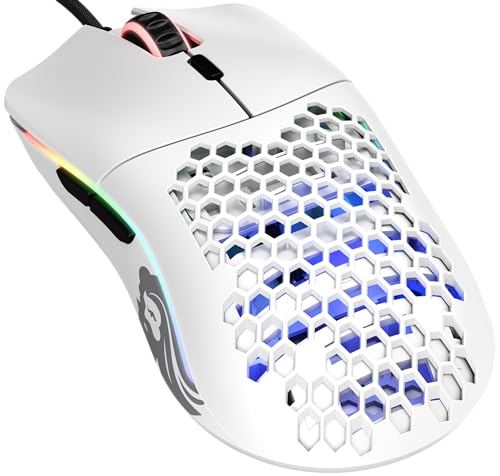
GLORIOUS Model O Gaming Mouse
The ultralight archetype: a honeycomb shell at a featherweight class, built for low-sensitivity swiping and fingertip or claw control. GLORIOUS Model O Gaming Mouse — Check on Amazon

Logitech G502 HERO Wired Gaming Mouse
The adjustable counter-example: a substantial shell with removable weights included, so you can experiment across the mid-to-heavy range with one mouse. Logitech G502 HERO Wired Gaming Mouse — Check on Amazon

Logitech G305 LIGHTSPEED Wireless Gaming Mouse
Sits in the versatile light-middle despite carrying a battery — evidence that wireless and reasonably light are no longer a contradiction. Logitech G305 LIGHTSPEED Wireless Gaming Mouse — Check on Amazon
Frequently Asked Questions
How much does a gaming mouse usually weigh?
Current gaming mice span roughly from under 50 grams for extreme ultralights to around 120 grams for feature-heavy models with weights installed. Most players end up happiest somewhere in the 60–95 gram middle once they test honestly.
Are honeycomb shells durable?
Well-made honeycomb shells are stronger than they look and survive normal play for years, but they do admit dust and crumbs into the interior, which makes the cleaning routine more relevant. Solid thin-wall ultralights avoid that trade-off at similar weights.
Will a lighter mouse improve my aim?
It reduces the effort of starting and stopping movement, which many low-sensitivity players experience as cleaner flicks and less fatigue. It will not fix sensitivity choices, grip problems or inconsistent practice — weight is one variable in a system.
Why do some mice include extra weights?
Because preference varies and balance is personal. Removable weights let you tune both total mass and front-to-back balance, and they make a mouse a safe purchase when you genuinely do not know your preference yet.
Is a heavy mouse bad for my wrist?
A heavy mouse used with large arm movements at low sensitivity increases workload on the arm and shoulder; used with small high-sensitivity movements it is unproblematic for most people. Pain is a signal to change something — weight, grip, sensitivity or posture — not to endure.
Does mouse weight affect tracking accuracy?
Not the sensor’s accuracy — that is independent of mass. Weight affects your accuracy: how cleanly you can start, stop and hold a movement. It is a human-factors variable, which is why the answer is personal rather than universal.
Bottom line: light mice reduce work and favour low-sensitivity aiming; heavy mice add stability and features for high-sensitivity and button-rich play. Match weight to your grip, sensitivity and session length — and judge it in hour three, not minute five.
How light is too light?
When the mouse starts moving in response to inputs you did not intend — cable tugs, desk bumps, your own tremor — it is too light for your setup, whatever the number on the scale says. For most players that threshold arrives somewhere in the ultralight class, but it depends on sensitivity and pad speed. The test is behavioural, not numerical: if your cursor feels nervous at rest and your stops overshoot, you have crossed your line.
Can I make my current mouse feel lighter without buying a new one?
Partially. A faster pad reduces the friction component of the effort, fresh mouse feet restore glide, and a modest sensitivity increase shortens the distances your hand travels, which reduces total work even at the same mass. None of these change the inertia itself, but together they can move a borderline mouse into comfortable territory and are all cheaper experiments than a replacement.
Do professional players all use lightweight mice now?
The competitive shooter scene leans heavily toward light mice, but it is a lean, not a law, and it reflects that scene’s low-sensitivity arm-aiming style more than a universal truth. Other genres and styles remain spread across the range. Copying the pros’ weight without their sensitivity, grip and genre imports the least important part of their setup.
Is a heavier mouse better for people with shaky hands?
Often, yes. Extra mass filters tremor mechanically, smoothing the cursor without any software smoothing or added latency. Players with noticeable hand tremor frequently find a moderate-to-heavy mouse at a moderate sensitivity calmer than any ultralight. It is one of the clearest cases where the unfashionable side of this comparison is simply the right tool.
Does mouse weight affect the scroll wheel and buttons too?
Indirectly. On a very light mouse, a stiff middle click or heavy side button can physically shift the mouse when pressed, which players feel as imprecision. Heavier mice absorb those presses without moving. When testing any mouse, press every button at playing speed and watch whether the shell stays put — the lighter the mouse, the more this test matters.
Will switching to a lighter mouse improve my aim immediately?
Expect the opposite for the first several sessions: your stops will overshoot and your tracking will feel twitchy while your hand recalibrates the force it applies. Judge the change after the two-week protocol in this guide, not after the first evening. Players who abandon light mice on day one and players who declare them miraculous on day one are making the same mistake at opposite ends.
Is mouse weight more important than mouse shape?
No. A well-fitting shape at a slightly wrong weight will serve you better than a perfect weight in a shape your hand fights, because shape decides where your fingers land, how your grip loads, and whether you can reach every button — the foundations weight merely modulates. Shortlist by shape, then choose weight within the shortlist, and you have the priorities in the order your hand experiences them.
Does a lighter mouse wear out its feet faster?
Not inherently — feet wear is driven by distance travelled and pad abrasiveness, not by the grams above them. In practice, though, light-mouse players tend to run lower sensitivities and therefore travel more distance per match, so their feet accumulate wear faster in calendar terms. The mouse is not more fragile; it is simply being driven further. Budget feet as a consumable either way, and replace them when glide turns scratchy rather than by the calendar.
Should beginners start light or heavy?
Beginners should start in the middle, for a developmental reason: a moderate mouse lets a new player discover their natural sensitivity and grip without the equipment amplifying either overshoot or fatigue while those habits form. Extremes teach compensations. Once a player’s style has declared itself — usually after a few months of regular play — the weight can follow the style, and by then the player will know which problem they are solving.
Can grip tape or added accessories change where a mouse sits in this comparison?
At the margins, yes. Grip tape adds a gram or two and a great deal of security, which can make a light mouse feel more controlled without meaningful mass. A heavier cable or a drag-heavy bungee setup can make a mid-weight wired mouse feel heavier in motion than its scale weight suggests. Judge weight as the mouse behaves in your hand on your pad, with your accessories, because the scale measures only the starting point of that system.
How do I know my current mouse’s weight without a scale?
Kitchen scales work fine, and so does the manufacturer’s specification if you add a few grams for a cable’s resting portion on a wired model. But the more useful measurement is comparative: if you are trialling a change, what matters is the difference between your current mouse and the candidate, and your hand is a surprisingly good difference detector across a ten-gram gap when you alternate them in the same session. Weigh precisely when logging a formal trial; otherwise, trust the alternation test.
Does weight matter for non-shooter games?
Less dramatically, but it does not vanish. Strategy and simulation players make long, relaxed movements where fatigue over hours is the main weight cost, which argues mildly for lighter. Creative professionals doing precision pointer work often prefer the calm of moderate mass. The shooters dominate this debate because their movements are extreme in speed and repetition; other genres inherit a gentler version of the same physics.
Related Guides
Keep exploring with these guides and roundups from the same Gaming Mouse collection: