Disclosure: As an Amazon Associate, ilcastellomenu.com earns from qualifying purchases. Links on this page are affiliate links; they cost you nothing extra. Prices and availability change often, so check the current Amazon listing before you buy.
Reading wifi antenna reviews can feel like reading weather reports for different planets: one reviewer swears a tall whip transformed a farmhouse, the next calls the same style of antenna a waste of money in a city flat. Both are usually telling the truth, because an antenna’s results are inseparable from the building, the router position and the direction of need around it. This roundup-style review cuts through that confusion by evaluating the main antenna designs the way owners actually live with them: what each design does well, where each one fails, which representative models embody the design honestly, and how to match a design to your home before any money moves.
Key Takeaways
- Judge every antenna by design class first and brand second; the class decides what is possible, the brand decides how well it is executed.
- Omnidirectional whips are the safe generalists, directional panels are the specialists, and magnetic-base antennas are the rescue tool for badly placed computers.
- Dual-band support matters only if your network uses both bands; a single-band bargain on a dual-band network is half an antenna.
- Connector accuracy is the whole ballgame: a perfect antenna on the wrong connector is a paperweight.
- Outdoor designs belong in a different seriousness class, with weather sealing, safe installation in dry calm weather, and professional help for masts and grounding.
The short verdict across these wifi antenna reviews: most households that need an antenna at all need one of two things, a sound dual-band omni upgrade for a router doing its best from a bad corner, or a magnetic-base antenna to rescue a desktop from its own shadow. Directional panels are superb but narrower tools, and outdoor yagis are projects, not purchases. The sections below evaluate each class in turn, name the representative models worth shortlisting, and end with the matching exercise that decides which class belongs in your home.
In this guide
Wifi Antenna Reviews: The Design Classes, Judged
Every antenna in these reviews belongs to one of a handful of design classes, and the class predicts the experience far more reliably than any brand claim. Omnidirectional antennas radiate in a full circle around their axis, like light from a bare bulb, and they suit a source that must serve every direction. Directional antennas behave like a torch, spending their energy in a beam and suiting one known target. Between those poles sit paddles, panels, whips of various heights, magnetic-base remotes, grids and yagis, but the underlying trade never changes: total radiated energy is conserved, so every design is a decision about where signal is spent and where it is withheld. Reviews that ignore this and rank antennas on a single ladder of goodness mislead; the honest ranking is by fit.
It also helps to understand why two owners can report opposite results from the same antenna. Radio inside a home reflects off walls, appliances and metalwork, arriving at a laptop by several paths at once, and small changes in position can move a seat from a dead patch to a strong one. An antenna that concentrates energy down a hallway will review brilliantly in a long flat and terribly in an open-plan loft where the need is all around. This is why the evaluations below are organised by scenario, and why our companion wifi antenna buying guide begins with floor plans rather than products.
Omnidirectional Whips and Paddles in Daily Use
The classic screw-on whip is the default antenna of home networking, and the upgraded versions in this class earn their keep through build and proportion rather than exotic claims. A taller, well-hinged dual-band whip stands clear of the router’s own body, holds its vertical position, and spreads a cleaner, flatter circle of coverage across one floor. In a small or medium home with the router near one end, that tidier circle translates into steadier far-room performance, especially on the band that struggles most with distance. The paddle variant, a flat blade that rotates on its mount, offers similar behaviour with a lower profile that suits wall-mounted or shelf-hidden routers.
Living with a whip upgrade is uneventful, which is praise: nothing to configure, nothing to maintain, and results that simply become the new normal. The honest limitations are equally plain. No omni whip reaches a distant outbuilding, fixes a congested band, or helps a floor above as much as it helps its own floor, because its flattened pattern deliberately spends less energy upward and downward. Owners in multi-storey homes often do better arranging several antennas at complementary angles, a trick the better routers support, than hunting for one heroic whip. Judge this class by hinge quality, honest dual-band support and connector accuracy, and it will rarely disappoint within its remit.
Directional Panels in Daily Use
A directional panel looks like a small flat tile and behaves like a lens: mount or stand it facing the territory that matters, and it concentrates the conversation in that direction while quieting the rest. Indoors, panels excel along hallways, across long open rooms, and through the specific wall between a router and a study. Outdoors in weather-rated form, they are the standard tool for feeding a garden building or bridging to a nearby structure. The experience of living with one is defined by aim: a panel rewards ten minutes of patient adjustment, testing the target seat while a helper nudges the angle, and it punishes the set-and-forget owner whose panel ends up addressing a bookcase.
The trade-offs deserve emphasis because panel marketing rarely mentions them. Coverage behind and beside a panel is genuinely reduced, so a panel on a router that must also serve rooms behind it can solve one complaint by creating another. Panels are also less forgiving of change: rearrange the room, move the desk, and the aim wants revisiting. None of this diminishes the class; it defines its owner. If your need has a direction and that direction is stable, a panel is frequently the single most effective antenna purchase available. If your need is everywhere, the panel is the wrong shape of help, and the mesh discussion in wifi routers built for distance will serve you better.
Magnetic-Base and Desktop Antennas in Daily Use
The magnetic-base antenna is the quiet hero of these reviews. It separates the radiating element from the device with a length of cable, and the base sticks to any steel surface: a desktop case, a filing cabinet, a shelf bracket. That separation solves the most underdiagnosed problem in home wifi, the receiving device entombed beneath a desk with its stubby antennas shadowed by metal on every side. Moving the element a modest distance upward and outward routinely transforms a desktop’s connection more than any router-side change could, because the bottleneck was never the router’s voice; it was the computer’s ears, buried in a canyon.
Daily life with a magnetic-base antenna is simple, with two disciplines. Keep the cable run as short and direct as the placement allows, since long thin cable quietly taxes the signal travelling through it, and coil any excess loosely rather than in a tight bundle. Choose the mounting spot by testing, not guessing: the top of the case, the side of a cabinet and the edge of a high shelf can perform very differently, and the best spot is the one where the element can see, in radio terms, toward the router with the least metal in between. Owners of all-in-one PCs, small-form desktops and older adapters with external ports benefit most; owners whose devices lack an external antenna port cannot use the class at all, which is worth confirming before ordering.
Outdoor Panels and Yagis in Daily Use
Outdoor antennas are reviewed here with deliberate gravity, because they leave the realm of desk accessories and enter the realm of installation work. Weather-rated panels and yagis feed outbuildings, cover yards and workshops, and bridge between structures across farms and smallholdings, and in those roles they are unmatched. Their housings are sealed systems, their mounts are engineered for wind, and their cables are heavier, outdoor-grade runs that must be routed and sealed with care. A well-installed outdoor link, once aligned, is a set-and-forget utility that owners praise for years.
The gravity is about how that installation happens. No part of an outdoor antenna project belongs in storms or wet weather, and roof or mast work demands proper ladder safety as a matter of principle: firm ground, a sound ladder, three points of contact, no overreaching. Antennas and coax must be kept away from overhead power lines, and a mast must never be installed where, if it fell, it could touch a power line. The mast’s grounding and lightning protection are a professional’s job, full stop; budget for that professional when you budget for the antenna. Sealing every outdoor connector against weather is likewise non-negotiable, since water in a feedline is the classic slow failure of this class. Owners unwilling to meet those terms should choose an indoor solution or a different technology, and this review series will not pretend otherwise.
The Shortlist: Representative Models Reviewed

Alfa Network APA-M25 Directional Panel
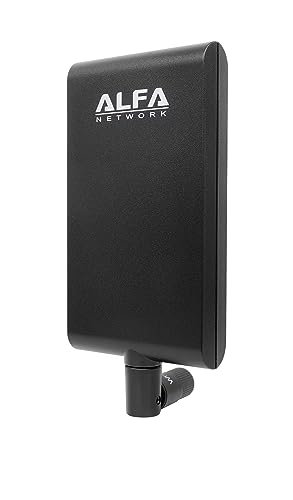
As the representative directional panel at a premium tier, the Alfa Network APA-M25 earns its shortlist place through focus and dual-band manners. Aimed down a hallway or across a yard it produces the firmest single-direction links in this roundup, and its flat form mounts discreetly where a yagi would shout. It asks for aim and for a stable target, and it gives little to rooms behind it. Best for: one stubborn direction, indoors or in a sheltered outdoor spot with proper sealing. Not suited for: serving a whole home from one point. Full reasoning in our single-product treatment, the wifi antenna review.

Alfa Network ARS-N19M Magnetic Mount Omni
The Alfa Network ARS-N19M represents the magnetic-mount omnidirectional class at a mid tier: a capable omni element on a magnetic base with a cable run that frees it from the back of a machine. It is the shortlist’s problem-solver for adapters and desktops in poor positions, and for temporary setups, workbenches and test benches where the antenna must move with the job. Its omni pattern makes it more forgiving than a panel when the layout is unsettled. Best for: receiver-side rescue and flexible placement. Not suited for: permanent weather-exposed mounting.

TP-Link TL-ANT2408CL Indoor Omni Whip
The TP-Link TL-ANT2408CL is the roundup’s entry-tier benchmark whip: a straightforward hinged omni that improves on bundled stubs through stature and build rather than promises. On a compatible router at one end of a modest home it tidies coverage in every direction, and it is the lowest-risk first step in the whole category. Expect an increment, not a transformation, and check the connector against your device with particular care since this class spans several router generations. Best for: small homes and cautious first upgrades. Not suited for: outbuildings or multi-floor heroics.
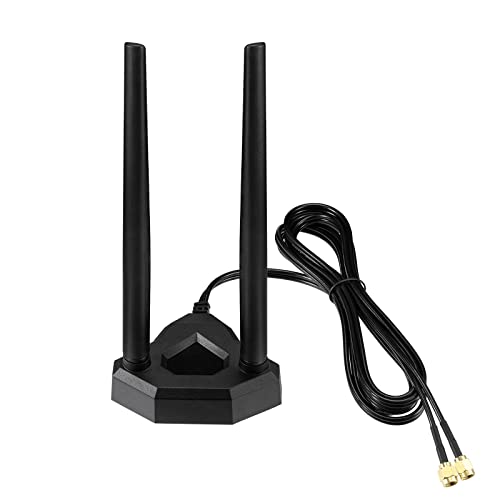
Eightwood Dual Band WiFi Antenna With Magnetic Base
The Eightwood dual band magnetic-base antenna makes the shortlist as the desktop owner’s favourite at a mid tier. Its element escapes the under-desk canyon that defeats so many supplied antennas, and its dual-band support matches modern adapters and routers without fuss. In side-by-side living, owners who place it thoughtfully report the most noticeable before-and-after difference of any model here, because their starting geometry was the worst. Keep its cable short and its base on real steel for the magnet to earn its name. Best for: desktops and small-form PCs. Not suited for: devices without an external antenna port.

Bingfu Dual Band WiFi Antenna Pair
The Bingfu dual band pair represents the replacement class at an entry tier: honest dual-band whips sold two at a time for the large population of routers, adapters and similar devices whose original antennas were lost, snapped or never impressive. The pair format matters, because dual-antenna devices want matched antennas, and replacing one of two with a dissimilar model can unbalance the pair. As restoration and mild improvement they are easy to recommend; as a strategy for reaching a distant building they are the wrong tool. Best for: like-for-like replacement on dual-antenna gear. Not suited for: directional or outdoor work.
TP-Link TL-ANT2414A Outdoor Directional Panel
The TP-Link TL-ANT2414A stands for the weather-rated outdoor panel class at a premium tier: a sealed directional panel built to live on an exterior wall and feed a yard, workshop or outbuilding along a clear line of sight. Its performance case is strong and its installation case is strict, and both halves matter. Buy it only with a plan that includes weather-sealed connectors, a mounting position with total clearance from overhead power lines, dry calm installation weather, proper ladder safety, and a professional for any mast work, grounding and lightning protection. Best for: house-to-outbuilding links. Not suited for: casual or improvised installation.
How to Match a Design to Your Home
Work through the matching exercise in order and the right class usually names itself. First, locate the problem: one room, one device, one direction, or everywhere. One room in a known direction suggests a panel or a repositioned omni; one device suggests working at the device end with a magnetic base; everywhere suggests leaving antennas alone and reading about mesh or wired access points instead. Second, audit the positions: where the router must live, where the antenna element could physically sit, and what metal, masonry and water stand between. Third, confirm the mechanics: connector family and gender, band support, and port availability on every device involved. Fourth, grade your installation appetite honestly, especially outdoors. Only then look at models, and let the shortlist above be filtered by the answers rather than by enthusiasm.
Two worked examples show the exercise in action. A flat with the router by the front door and a study at the far end of a hallway resolves to a directional panel on the router or a tall omni as the gentler option, judged over a week of evenings. A home office with a desktop under a desk resolves to a magnetic-base antenna at the computer, the cheapest and largest win available, with the router untouched. A farmhouse feeding a barn resolves to an outdoor panel pair and a professional installer. Notice that none of the three answers began with a product name; each began with a floor plan. That ordering is the entire secret these reviews exist to teach, and how to choose a wifi antenna turns it into a formal step-by-step method.
Strengths and Trade-Offs Across the Classes
Strengths
- Every class is passive, silent and configuration-free; differences are geometry and build, not software.
- The category spans entry to premium tiers, so the honest fix for a given problem is rarely the expensive one.
- Receiver-side options mean many problems can be solved at the device, without touching a shared household router.
Trade-Offs
- No class escapes the conservation law: gain in one direction or plane is always paid for somewhere else.
- Compatibility is fragmented across connectors and generations, so returns for wrong orders are a category ritual.
- Outdoor classes import real installation risk and professional costs that desk-class marketing never mentions.
Final Verdict
Across these wifi antenna reviews, the pattern is consistent: the design class is the decision, the model is the detail. Omnidirectional whips serve the generalist, panels serve the focused, magnetic bases rescue the buried desktop, and outdoor panels serve the determined, properly supported project. Match the class to a floor plan and a problem stated in one sentence, verify the connector like your purchase depends on it, because it does, and respect the outdoor safety rules absolutely. Do that, and the reviews written by future owners of these antennas tend to read very well indeed. For the balance sheet of the category as a whole, continue to wifi antenna pros and cons, and placement wisdom, covered in our router location guide, helps every class.
Field Notes: What Living With Each Class Teaches
Reviews written after a weekend differ from reviews written after a season, and the differences cluster by class. Omni whip owners report the least eventful ownership in networking: the antenna disappears into the furniture and is remembered only when a hinge eventually slackens. That uneventfulness is the class’s real score, because a generalist antenna should be boring. Panel owners report a two-phase ownership: an adjustment phase, sometimes stretching over the first fortnight as aim is refined and the household learns which seats the panel has favoured and which it has quietly taxed, followed by long stability. The lesson the field notes teach is to reserve judgement on a panel until the adjustment phase is honestly finished, including testing the rooms behind it, and to expect one rearrangement of furniture in the first year to trigger a re-aim that owners should treat as normal maintenance rather than failure.
Magnetic-base owners report the strongest emotions in the category, because their starting point was the worst: a desktop that dropped mid-call for a year, fixed by relocating an element less than the length of an arm. Their field notes emphasise placement sensitivity over product differences; the same antenna on the case top and on the cabinet side can live like two different products, and the owners who auditioned positions systematically are the ones writing the glowing reviews. Outdoor owners report the most adult relationship with their equipment: pride in a link that shrugs off weather, tempered by respect for the seasonal inspection ritual and by the knowledge that sealing, not electronics, is what they are really maintaining. Across all classes, the reviews that age best are the ones that described a layout, a problem and a method; the ones that age worst named a product and a superlative and nothing else.
How These Reviews Were Judged: A Note on Method
The evaluations in this roundup weight criteria in the order owners feel them over a year. First, fit: does the class’s pattern match the scenario it claims to serve, because no build quality rescues a wrong shape. Second, honesty of specification: connector stated plainly, bands stated plainly, environment rated without ambiguity. Third, mechanics: hinges that hold, bases that grip, housings that seal, because antennas fail mechanically long before they fail electrically. Fourth, the ownership tail: cable discipline required, re-aiming expected, inspection burden carried. Headline performance ranks last, deliberately, because in this category performance is a consequence of the first four in any given home, and a reviewer who leads with it is measuring their own house and calling it yours.
The Wrong-Order Problem, and What It Teaches
Spend time with owner forums and a pattern emerges: a large share of antenna returns are not defective products but mismatched purchases, dominated by the mirror-image connector mistake, followed by indoor antennas bought for outdoor hopes and directional patterns bought for everywhere problems. The teaching value of the wrong-order problem is that every one of its causes is knowable before purchase, from documentation and a floor-plan walk, which is why this roundup repeats its verification liturgy in every class section. Sellers contribute to the problem with photographs that hide connector gender and copy that promises universality; the roundup’s shortlist was filtered for listings that state their mechanics plainly, and readers should apply the same filter ruthlessly to anything beyond it.
Buying Second-Hand and Reusing Antennas
Antennas are among the safest second-hand purchases in technology because they are passive: no battery to be exhausted, no firmware to be abandoned, no account to be locked. A used panel or whip that passes a physical inspection, sound hinge, clean connector threads, uncracked housing, is very likely to perform as it did when new. The exceptions are outdoor units, whose sealing and cable may have aged invisibly, and any antenna whose connector history includes being forced onto a wrong port, which can deform the centre contact. Reuse across your own upgrades is equally sound: a good magnetic base or panel commonly serves two or three generations of routers and adapters, which is part of why the mid and premium tiers in this category repay their cost more reliably than their modest prices suggest.
Scenario Clinics: Six Homes, Six Verdicts
The Railway Flat
A long, narrow flat with the router at the front door and bedrooms strung along a single hallway is the panel’s home turf, and owners in this layout write the most satisfied directional reviews in the category. The beam and the building agree with each other. The verdict from the field is to aim once, test the far bedroom across a week, and also test the kitchen behind the router, because the flat’s one predictable complaint is the room the panel turned its back on. Where that complaint matters, owners split the difference: a panel for the hallway and the router’s remaining omni handling the near rooms, a mixed arrangement that multi-antenna routers support gracefully and that this roundup endorses for the layout.
The Masonry House
Thick-walled houses generate the roundup’s most humbling reviews, because stone and brick tax every class impartially. Omni upgrades help within the router’s own room and the adjacent one; panels push one corridor of relief through a doorway’s line of sight; nothing radiates through three masonry walls with dignity. The owners who end satisfied are the ones who accepted the building’s verdict early and used antennas as auxiliaries: a wired access point or mesh node placed beyond the worst wall, with an antenna solving the last room’s geometry from there. The roundup’s verdict for masonry is therefore a routing decision, not a product decision, and it is recorded here so that buyers in old houses can skip the quarter of experimentation that the field notes show most of them currently endure.
The Home Office Professional
For the owner whose income travels over video calls, the reviews converge on stability engineering rather than speed. The winning setups in the field notes share a shape: the work machine’s reception fixed first, usually with a magnetic-base antenna that removes the desk from the equation; the router’s contribution second, usually orientation and height rather than replacement; and a directional favour along the office’s route third, if the layout offers one. These owners test with the actual call application at the actual meeting hour and keep notes like engineers, and their reviews are the roundup’s most reliable documents. Their collective advice is blunt: fix your own end of the link first, because it is the end you control completely.
The Rural Smallholding
Rural reviews read differently from all others because distance replaces density as the governing problem and the outdoor classes stop being optional. The satisfied owners describe a recognisable project shape: a survey of the line of sight between house and outbuilding, panels at both ends, cable runs planned like plumbing, connectors sealed like the weather was personal, and a professional owning the mast, its grounding and its lightning protection. The dissatisfied reviews describe the same geography attempted as a purchase rather than a project. The roundup draws the obvious conclusion and states it as a rule of the category: outdoors, the installation is the product, and the antenna is merely its most visible component.
The Rented Room and the Shared House
Renters and sharers review antennas through the lens of permission: nothing drilled, nothing permanent, nothing that rearranges a shared router’s behaviour for everyone else. Their winning class is predictably the receiver-side one, the magnetic base at their own machine, followed by modest omni experiments conducted with housemates’ consent and judged at hours when the house is awake. Their field notes add a social protocol this roundup is happy to endorse: announce the experiment, keep the original antennas labelled, and restore everything instantly if a housemate’s room pays for your improvement, because a directional favour in a shared house is a negotiation, not a setting.
The Growing Smart Home
Households accumulating connected devices, plugs, cameras, speakers and sensors scattered to the edges of the plan, discover a different antenna question: not one loud conversation but dozens of quiet ones at the margins. Their reviews favour the generalist classes and honest placement over directional heroics, because a sensor in the garage and a camera at the gate need the doughnut, not the beam. Where a single far device is critical, a camera watching a driveway, for instance, owners do well with a targeted panel serving that device while the omni pattern continues to serve the crowd. The roundup’s verdict is that smart homes should buy coverage character first and treat directional antennas as scalpels for individual devices, a reversal of the stubborn-room logic that governs simpler households.
Across the six clinics, the pattern that this entire roundup exists to demonstrate repeats without exception: the verdict follows the building and the problem statement, and the product follows the verdict. Owners who began with a scenario chose well and reviewed calmly. Owners who began with a product spent the review period negotiating with their own floor plan. The clinics are offered as a shortcut: find your scenario, borrow its verdict, and let the shortlist be filtered by a story that resembles your own rather than by the loudest claim on a listing page.
The Classes, One Year On: A Durability Audit
A roundup that only judges first impressions misleads, so this section audits each class against a year of ordinary life. Omni whips age the most gracefully of any class: their failure mode is a hinge that slowly surrenders, announced by a drooping element that any owner can spot and most can forgive, and their electronics, having none, cannot obsolesce. Paddles share this grace with the addition of a rotating mount that can loosen; a yearly check and a gentle reseat is the entire maintenance contract. Panels indoors age almost invisibly, their only enemy being the household’s own rearrangements, which quietly invalidate an aim that was perfect for last year’s furniture. Magnetic bases age at their cable and their magnet: the cable’s strain relief fatigues where it leaves the base if it is repeatedly flexed, and the magnet’s grip is only ever as good as the surface it is offered, which is why the class rewards owners who settle on a position rather than auditioning forever. Outdoor panels and yagis age at their sealing and their mounts, on the seasonal rhythm the installation guide in this cluster describes, and their audit is the only one in this section that involves weather, ladders and professionals. The pattern across classes is consistent enough to state as a roundup law: antennas do not wear out electronically; they are undone mechanically, environmentally or by rearrangement, and every one of those undoings is either preventable or cheaply reversible by an owner who knows it is coming.
What the Roundup Would Buy With Its Own Money
Roundups are often asked to drop the balance and confess, so here is the confession, with the reasoning attached. For a general household with a healthy router and one vague complaint, the roundup’s own money buys position experiments first and then the entry-tier omni class, because the probability-weighted outcome is best there and the downside is a small, returnable experiment. For a household with a desktop, the money buys the magnetic base before anything else in the entire category, because no other purchase in home networking so reliably converts a daily irritation into a non-event. For a hallway flat, the money buys the panel, aimed once with a helper and judged across a fortnight. For the outbuilding, the money buys the outdoor class only as a project, with the professional’s invoice welcomed as part of the product rather than resented as an extra. Notice what the confession never buys: the highest headline gain, the longest whip, the listing with the most exclamation. A year of field notes purchases restraint, and this roundup passes the restraint on as its most valuable finding.
How to Write the Review the Next Owner Needs
This roundup ends with an invitation, because the evidence base for antennas is written by owners and most of it is unusable. If you buy any antenna in these pages, write the review you needed and could not find. State your building in one line: construction, storeys, the router’s fixed position. State your problem in one sentence with its place named. State the connector you verified and how. State the positions you auditioned and the one that won. State your judging window and your worst-hour test, and report the rooms the choice taxed as faithfully as the room it rescued. Six sentences of that kind are worth more to the next owner than six paragraphs of enthusiasm, and a category whose reviews read like that would stop being confusing within a year. The confusion this roundup set out to cut through is not manufactured by antennas; it is manufactured by evidence without context, and every reader who buys from these pages is now equipped to manufacture something better.
One more pattern from the field notes deserves recording before the verdict, because it surprised even this roundup: the frequency with which the winning installation was the second one tried. Owners auditioned the obvious position, measured honestly, moved the element a modest distance, and watched the link settle. The lesson is not that first instincts are bad but that antenna work is iterative by nature, and the products and classes that accommodate iteration, hinged whips that hold new angles, magnetic bases that audition surfaces, panels whose aim can be refined in small increments, accumulate satisfied owners faster than rigid designs of theoretically superior pattern. When two candidates in a class seem equal on paper, choose the one that invites adjustment. In a category governed by the particular geometry of your particular walls, adjustability is not a convenience feature. It is the performance feature, and the field notes prove it on every page.
A Brief History of the Whip on the Router
The replaceable antenna exists because early wireless equipment was built by engineers who assumed owners would adapt it, and the threaded port on the back of a router is a surviving artefact of that assumption. Over generations, the industry has drifted toward sealed designs, internal antennas and finished objects that ask nothing of their owners, and the drift has genuine virtues: consistency, compactness, one less thing to snap off in a move. But something was traded away, and this roundup’s existence is evidence of the trade: the sealed object cannot be reshaped when the building disagrees with it. The classes reviewed here persist because buildings keep disagreeing, in hallways and barns and under desks, and because a small population of owners prefers equipment that can be argued with. If your router still offers ports, it is offering you a conversation with your own floor plan that newer sealed designs have politely ended. This roundup recommends having the conversation while the ports are still there to have it with.
That history also explains the category’s odd emotional register, in which owners speak of antennas with an affection rarely granted to networking equipment. An antenna is one of the last purely mechanical negotiations left in a digital system: no account, no update, no interface, just shaped metal, position and patience, rewarded by physics in full view of the person who did the work. The reviews collected in these pages, the calm ones and the furious ones alike, are really reports from that negotiation. Read them that way and even the furious ones become useful, because a negotiation that failed tells you exactly where the other party, the building, refused to move. The roundup’s final service is to wish its readers successful negotiations, and to remind them that the building always keeps its side of the bargain, which is more than can be said for most of the technology inside it.
If this roundup has a single sentence to be remembered by, it is that the class is the decision and the model is the detail, and it bears one final repetition in the plainest form the field notes allow. Owners do not live with specifications; they live with shapes of coverage in particular rooms, with hinges and magnets and seals, with a link that either holds the evening call or does not. Choose the shape that matches the room, verify the fitting that matches the device, respect the installation the setting demands, and the model, whichever honest model embodies that shape, will review well in the only review that finally matters, the one your household writes by living with it. The roundup thanks the owners whose field notes, calm and furious alike, taught it everything in these pages, and it returns their lessons in the hope that the next season of reviews will be calmer, more specific, and full of layouts.
A very last field note, offered without a heading because it belongs to every section equally: the owners in these pages who fared worst almost always fared worst quickly, in a hurry to finish, while the owners who fared best share a tempo, an evening of testing here, a fortnight of patience there, a season of light attention outdoors. Antennas reward tempo more than they reward budget, and a roundup that has weighed every class in the category can think of no more useful closing gift than that observation, pressed into the reader’s hand like a note for the road.
Postscript: the roundup will be updated in spirit whenever the field notes change, and the field notes change whenever a reader runs an honest experiment and writes it down with its layout attached. Consider this page, then, less a verdict delivered than a conversation opened, between the buildings that have already negotiated with these antennas and the buildings about to. May your negotiation be brief, your aim be true, and your review, when you write it, be the one the next owner needed.
Reading the Listings Closely: What to Verify Model by Model
Verify the listing, not just the product
A review can only judge the wifi antenna in front of it, but what arrives at your door depends on the listing you order from. Before choosing, confirm that the listing names the exact model, generation and bundle contents you think you are buying, because Routers listings often group variants under one page. When picks such as TP-Link TL-ANT2408CL, Eightwood Dual Band WiFi Antenna and Bingfu Dual Band WiFi Antenna are on your shortlist, run this check against each listing in turn. Check which accessories are in the box and which are sold separately, and note the seller’s returns terms while you are there. Ten minutes of listing hygiene prevents the most common review-versus-reality mismatch: a good product judged by the wrong variant.
Consistency is the quiet test
Single impressive results are easy; a good wifi antenna repeats them on an ordinary day, with ordinary materials, when you are in a hurry. Across the picks in this review, the models that earned their place did so by being predictable: the same setup producing the same outcome, with controls that behave identically every time. In a home where children, pets and visitors all interact with the setup, predictability is worth more than a peak performance figure you will rarely reach. When you read the individual assessments above, treat consistency comments as the highest-value signal in each one.
Fit and feel, judged honestly
Specifications can tell you a wifi antenna will fit; only handling tells you whether it feels right doing it. Weight distribution, control placement, surface finish and the force needed for routine adjustments all shape whether you reach for the product gladly or work around it. When picks such as TP-Link TL-ANT2408CL, Eightwood Dual Band WiFi Antenna and Bingfu Dual Band WiFi Antenna are on your shortlist, run this check against each listing in turn. If your shortlist comes down to two similar models, this tactile layer is usually the honest tie-breaker, and it is personal: a control layout one reviewer calls cramped, a smaller-handed owner may call perfect. Where possible, judge fit against your own hands, desk and habits, not the reviewer’s.
The detail that dates a design
Every Routers generation has a detail that quietly dates it: a port standard on its way out, a control app that has stopped receiving updates, a consumable format being phased away. When reviewing a wifi antenna, that detail matters because it decides how gracefully the product ages. A model built on current standards and widely stocked consumables will still be serviceable when a flashier rival is orphaned by its own ecosystem. Check the age of the design, not just its feature list, and favour the product whose supporting ecosystem is still actively maintained.
What the box should contain — and what it should not need
Unboxing is a small but telling review checkpoint for a wifi antenna: the essentials for the first session should be in the box, the instructions should match the actual unit, and nothing vital should depend on an immediate second purchase. If a pick requires an accessory to perform its core job, that dependency is flagged in its assessment above, because it changes both the real cost and the first-day experience. Equally, beware bundles padded with extras you will never use; in a home where children, pets and visitors all interact with the setup, unused bundle clutter is a cost paid in storage, not a bonus.
Reading the assessments against your own routine
These reviews were written against a general routine, and your routine is the final filter. Map each pick’s stated strengths onto your busiest realistic day with a wifi antenna: if a pick’s best quality serves a task you do rarely, it is not the pick for you, however strong the assessment. If a pick’s noted limitation sits in a corner of the workflow you never visit, discount it. This translation step — from review conditions to your conditions in a home where children, pets and visitors all interact with the setup — is where a good review becomes a good decision rather than a borrowed opinion.
That single habit separates owners who stay pleased with their choice from owners who quietly start shopping again within a season.
Treat it as part of the purchase itself, not as homework to do after the box arrives.
Frequently Asked Questions
Why do reviews of the same antenna disagree so much?
Because an antenna’s result is a property of the whole setup, not the product alone. The same panel that transforms a long flat does nothing for an open loft, and the same whip that firms up a bungalow disappoints in a three-storey house. Reviewers also test at different distances, on different bands and with different routers. Read reviews for the scenario that matches yours, weight those written about similar buildings, and treat any review without a described layout as entertainment rather than evidence.
Which antenna class is best for gaming?
The class that stabilises your specific link, because gaming cares about consistency more than peak speed. For a gaming desktop, that is usually a magnetic-base antenna that lifts the element out from behind the case; for a console in one known room, a directional panel aimed from the router can help. Wired Ethernet still beats every antenna where it is practical, and no antenna fixes a congested band or a struggling plan during peak hours.
Are tall whip antennas better than short ones?
Taller whips generally radiate a flatter, further-reaching pattern across their own floor, which reads as better in most single-storey tests. The same flatness sends less energy to other floors, so in a multi-storey home a tall whip can be a downgrade for the bedroom above the router. Height is a shaping choice. Match it to the shape of your home, and prefer a well-built hinge over raw height, since a drooping tall antenna performs worse than an upright short one.
Can I mix antenna types on one router?
On multi-antenna routers, mixing is sometimes useful and sometimes unhelpful. Routers use their antennas cooperatively, and wildly mismatched elements can unbalance that cooperation, while complementary orientation of matched antennas often evens out coverage between directions or floors. The safe experiments are positional: angles and placement of the antennas you have. Swapping in a single directional among omnis is a legitimate targeted trick on some models, but expect to judge it by testing rather than by theory.
What should I check before trusting an antenna listing?
Four things: the connector family and gender stated in plain terms, the bands supported, the intended environment (indoor listings should never be mounted outside), and whether the description explains its radiation pattern honestly. Listings that promise to boost any signal, multiply speeds or replace a mesh system are telling you to leave. A sober listing that names its pattern, its connector and its limits is the one written by a seller who expects the antenna to be kept.
When should I stop reading antenna reviews and buy something else?
When your problem is everywhere rather than somewhere, when speed tests beside the router are already poor, or when the device you need to help has no external antenna port. Those three situations point to a mesh system, a router or plan upgrade, or a wired access point respectively. Antennas are a superb answer to a geometry problem; recognising that your problem is not geometry is the most valuable conclusion a review roundup can give you.
Related Guides
Keep reading with these companion guides from the same cluster and the wider networking library: the single-product wifi antenna review; wifi antenna pros and cons in full; how to install a wifi antenna safely; wifi routers for a house full of devices; long-range routers for the home.