Disclosure: As an Amazon Associate, ilcastellomenu.com earns from qualifying purchases. Links on this page are affiliate links; they cost you nothing extra. Prices and availability change often, so check the current Amazon listing before you buy.
So, is a cable management box worth it for your home? The short answer is that a cable management box is worth it if you have a power strip serving several devices in one visible place, you are willing to size it honestly for your bulkiest adapter, and you will keep its vents uncovered and its placement dry. It is not worth it if your cable problem is a long run rather than a local cluster, if the only spot for it is damp or sealed in, or if you want a set-and-forget product that never asks to be opened again. Everything below is the evidence behind those two sentences.
Worth-it questions are really questions about what you get, what it costs you beyond money, and who you are. This page takes those in order: the real value a box delivers, the non-money costs it quietly charges, the households it pays off for, the ones it does not, and a checklist that turns the whole argument into a decision you can make in two minutes.
Key Takeaways
- Worth it, for most desk and television corners, because the daily benefit is large and the effort is a single afternoon at most.
- The value is order, access and calm, not features: one lid between you and every plug you own in that corner.
- The real costs are space, a little discipline about heat and load, and a few minutes of inspection a few times a year.
- It pays off fastest for desk workers, television households, renters and families who want cords off the floor.
- It does not pay off for long cable runs, damp placements or high-draw appliances; those need different answers.
- Sizing for the bulkiest power brick is the single decision that decides whether the purchase feels worth it.
In this guide
Is a Cable Management Box Worth It: What You Actually Get
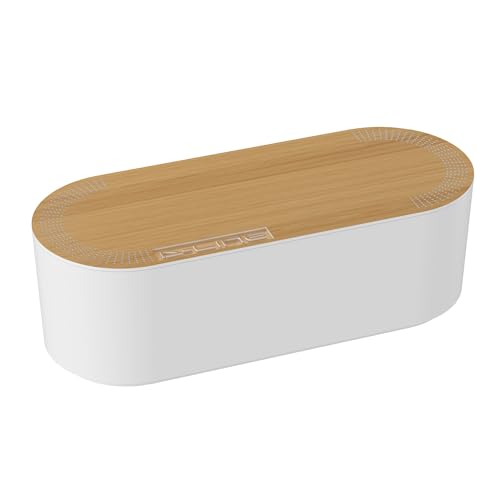
What you actually get is a corner that stops arguing with you. The strip, its bricks and the coiled slack of every cable live inside one lidded object, and the floor or shelf around it returns to being floor or shelf. That sounds cosmetic until you live with it: the vacuum runs unimpeded, the chair casters travel freely, your feet stop finding cables, and the room’s most disordered square metre becomes its most organised. Owners consistently report that the room feels finished in a way it did not before, despite nothing else changing.
You also get access, which is the under-sold half of the value. Every plug in the corner sits under one lid, reachable in a second, visible at a glance, labelled by its own routing if you spent the extra minutes at setup. Adding a device, swapping a console, finding which brick belongs to which gadget: all become calm, short jobs. An unmanaged strip offers the same sockets in theory and denies them in practice, hidden behind furniture in a dusty tangle nobody volunteers to explore.
Working from home made the desk cable problem permanent for many households, and the box is the least invasive fix. It asks nothing of the desk itself, works with standing desks if the cables have slack for the travel, and turns the under-desk zone from a foot-tangling hazard into clear floor. The detail that makes or breaks it at a desk is exit direction: cables for desktop devices should leave from the top or back, floor-level cables from the ends, so nothing drapes across the front where your feet and chair live.
The television corner also tests a box’s discretion. It sits in a room arranged for looking at a screen, not at storage, so finishes matter here more than anywhere: a wood-effect lid or a dark shell that disappears against the stand earns its place. Ventilation matters too, because entertainment strips often carry the always-on loads of a household, the router and the streaming box that never sleep. A ventilated box, uncovered and clear of the curtains and throws that living rooms accumulate, is the version of this idea that works for years.
The Real Costs Beyond Money
The money cost sits in qualitative tiers, entry to premium depending on size, material and finish, and it is modest as home purchases go. The real costs are the others. Space: the box occupies floor, shelf or desk room permanently, and a large box for a large brick is a presence. Attention: a hidden strip must be inspected on purpose, a few times a year, because it no longer catches your eye. Discipline: the strip’s load limit still applies invisibly, the vents must stay uncovered, and the box must not become a general hiding place for spare chargers and forgotten adapters.
There is also a learning cost, small but real, paid once. Your first setup teaches you how your own cable population behaves: which brick runs warm, which cable is shorter than you thought, which exit direction each device wants. That lesson is exactly what makes the second room easy, and it is why so many owners buy again. But a buyer who skips the lesson, stuffing the box and forcing the lid, pays the cost without collecting the value, and usually concludes wrongly that the product was not worth it.
Treat warmth as a design constraint, not an afterthought. Everything plugged into the strip inside the box converts a little of its power into heat, and in an enclosed space that heat has fewer places to go. A ventilated box, with real openings positioned so air can move, is the sensible default, and the box should sit somewhere air can reach it rather than wedged tightly between furniture and wall. Never drape fabric over it and never let a rug creep across the top, because covering the vents defeats the one feature that makes a closed box a reasonable place for a working strip.
Do not overload the strip that lives in the box. A strip is rated for a total load, and the fact that its sockets are hidden does not change what those sockets can safely carry. Desk and entertainment loads, which are mostly chargers, lamps, monitors and consoles, sit comfortably within sensible limits when you add them up honestly. The trouble starts when a heater, a kettle or another hungry appliance gets plugged into the hidden strip because a socket looked free. Keep the box for the low, steady loads it was bought to tidy, and give heavy appliances their own visible outlet.
Who It Pays Off For
The Home Office Worker
At a desk, the box solves the problem every home office knows: the strip on the floor collecting chargers for a laptop, a phone, a lamp and a monitor, with cables draping from the desktop like vines. A box at the desk’s foot gathers that population into one calm object, and the desktop cables drop behind the desk into it in a single bundle. The improvement is partly visual and partly practical, because a floor you can vacuum without negotiating a cable nest is a floor that gets vacuumed, and a strip you can reach by lifting one lid gets switched off at night more often.
The desk worker collects the value daily: a calm floor, a reachable strip, a workspace that looks professional on camera and feels professional off it. For this household the question barely survives contact with the first week.
The Television and Gaming Household
Behind the television is the box’s second great stage. A television, a soundbar, a streaming box, a console or two and perhaps a router all drink from one strip in the dustiest, least-visited corner of the room. A box there does more than tidy: it gives that whole population one home, so adding or swapping a device means opening one lid instead of reaching blindly behind furniture. Measure the corner honestly, because entertainment strips carry more and bigger bricks than desk strips, and the box that serves a television usually needs to be the larger size in any range.
Entertainment corners concentrate the most devices, the bulkiest bricks and the thickest dust. A box sized for that population pays off in access alone the first time a console changes, and in calm every day before and after.
The Renter and the Rearranger
Renters cannot drill, clamp or glue their way to tidy cables, and rearrangers undo fixed solutions every season. The box asks nothing of the walls and travels as a unit when the room changes, so its value survives every move. For these households the alternatives are not merely worse; they are often not permitted at all, which makes the worth-it calculation the easiest of all.
The Family That Wants Cords Off the Floor
Parents and pet owners are some of the happiest buyers of these boxes, and fairly so: a floor that no longer offers a nest of chewable, pullable cords is a calmer floor. Keep the claim honest, though. The box hides cords; it does not childproof anything. Most lids simply rest in place or clip lightly, a determined small child can lift them, and cats have been known to treat a warm box as furniture. Use the box as one layer in a sensible room, keep the strip itself placed thoughtfully, and give the outlet the same ordinary care it would get with no box at all.
For this household the value includes peace of mind of the modest, honest kind: fewer temptations at ankle height, a floor that can be cleaned properly, and cables out of the chewing zone, alongside normal outlet care that continues as before.
Who Should Skip It
Skip it if your mess is a journey, not a destination. A cable that travels from a desk to a distant socket needs a sleeve or a raceway, and a box at either end will not neaten the middle. Skip it if the strip in question feeds a heater or another high-draw appliance, which deserves its own visible outlet and your occasional attention. Skip it if the only available placement is damp, splash-prone or sealed between furniture with no airflow, because those placements fight the product’s basic requirements.
And skip it, honestly, if you know the lid will never be lifted again. The box’s bargain is a few minutes of inspection a few times a year in exchange for daily order. A buyer unwilling to pay those minutes is buying a lid for a problem rather than a solution to it, and the money is better kept. Our cable management box pros and cons page lays out that bargain in its starkest form.
Strengths and Trade-Offs of Owning One
Strengths
- Daily, visible order in the corner that was the room’s worst, achieved in one short setup.
- Instant access to every plug, which quietly improves every future change and fault hunt.
- Portability: the tidy corner survives moves and rearrangements because nothing is fixed down.
Trade-Offs
- A permanent footprint in the room, sized by your bulkiest brick rather than your wishes.
- Heat and load discipline for as long as you own it: ventilated, uncovered, never overloaded.
- An inspection habit you must keep on purpose, because hidden electrics do not prompt you.
Alternatives to Consider
Compare the box honestly with its cousins before you buy. Trays mount under desks and keep everything off the floor, but they ask for screws or clamps and a desk that suits them. Sleeves are cheap and flexible for cable runs, yet they hide nothing bulky, so bricks and strips still need a home. Raceways give the most finished look along walls, at the cost of permanence. The box wins where the mess is a strip plus bricks on the floor or a shelf, where you want access without tools, and where the setup changes often enough that fixed solutions would fight you.
The tray deserves its own moment in a worth-it discussion, because under a desk it can be the better value despite the installation: the floor ends up completely clear. Our cable management tray review and is a cable management tray worth it run the same argument for the tray, and many households conclude that the desk deserves a tray while the television deserves a box, which is not indecision but correct matching of tool to spot.
How to Get the Most Value If You Buy
Value is maximised at setup and protected by habit. At setup: rehearse the strip and bricks on the floor, buy the size that swallows the rehearsal, route exits toward devices, coil slack per cable, and label everything inside the lid while you know what is what. In the first week, notice which loads run warm and rearrange once if needed; that single adjustment is the difference between a box that is merely tidy and one that is also cool and calm. Afterwards, the habits are the cheap ones from the costs section: vents bare, loads sensible, placement dry, lid lifted a few times a year.
The interior arrangement deserves more thought than it usually gets. Lay the strip in first, flat and stable. Then plug in the bulkiest adapters, spacing them so their warmth is not pooled in one corner. Coil each cable’s spare length into its own loose loop beside its plug, and use a tie or two to keep loops honest. Finally, route each cable out through the nearest opening in the direction of its device, so nothing crosses the box unnecessarily. Done this way, opening the lid months later is a calm experience: everything is where you left it, labelled by its own path.
Because the box hides its contents, it also hides their condition, which is why a simple cleaning rhythm matters. Dust accumulates inside any enclosure with openings, and a box on the floor collects more than most. Build the habit of opening it when you clean the room properly: power down, lid off, contents out, surfaces wiped, cables eyeballed for damage or looseness, everything back in with its slack recoiled. You are not just tidying; you are performing the inspection that a visible strip gets every time you look at it, on a schedule the box cannot prompt by itself.
The Decision Checklist
- Is there one strip serving three or more devices in a visible place? Yes points to buying.
- Can you name your bulkiest power brick, and does a box size exist that swallows it without force?
- Is there a dry placement with air around it, where the lid can open without moving furniture?
- Will you keep the top bare and the strip’s load sensible, permanently?
- Will you open the box a few times a year to clean and check it?
- Is your problem a cluster at the strip, rather than a run between two points?
Five or six yes answers: buy, and buy the honest size. Three or four: the value is real but conditional, so fix the condition first, usually placement or sizing. Two or fewer: your problem is a different shape, and the alternatives section above is your better next step. Readers who land on buying will find the selection method in how to choose a cable management box and the picks compared in our cable management box reviews.
A Closer Look: Living With the Box
Think, finally, about what the box asks of you, because it is not nothing. It asks you to open it occasionally, to resist stuffing it, to keep its vents clear and its spot dry, and to remember that the strip inside still has limits even though you cannot see them. These are small asks, minutes a year, but they are the difference between a box that is a genuine improvement and a box that is a lid on a problem. Owners who make peace with that tiny maintenance contract tend to be the ones who recommend these products without hesitation.
One underrated benefit of gathering cables into a box is what it does to cleaning day. A floor with a cable nest on it gets cleaned around, which means the dustiest square of the room is precisely the one the vacuum never reaches. A box turns that square into a single object you can slide aside, clean under and slide back. The strip stays seated, the cables stay routed, and the corner returns to being a corner rather than an ecosystem. Small, domestic and genuinely valuable, this is the benefit owners mention most after the first month.
Labelling is the habit that separates a box that stays tidy from a box that slowly reverts. A small tag on each cable, just inside the lid, naming its device, turns every future change into a thirty-second job. Without labels, every unplugging is a guessing game played by tugging cables and watching which screen flickers. The box makes labelling easy because all the decision points are in one place, under one lid. Do it on the day you set the box up, while you still know which cable is which, and the system maintains itself.
There is a quiet psychological effect to a tidy cable corner that owners report consistently: the room feels finished. Cables are visual noise, and noise at floor level is especially tiring because it reads as disorder rather than equipment. A box removes the noise at its source. It does not make a room beautiful by itself, but it removes the one element that made the room look unfinished despite everything else being in place. For a modest, single purchase, that is an outsized return, and it explains why so many people buy a second box for another room within the year.
Consider the box’s relationship with time. Cable populations grow: a charger here, a smart speaker there, a new console at a birthday. An unmanaged strip absorbs growth as sprawl, each new cable draped over the last. A box absorbs growth as capacity, up to a point: open the lid, find the free socket, route the new cable out. That point, the full box, is also useful information, because it tells you the corner has genuinely outgrown one strip and needs a rethink rather than another layer of tangle. The box makes the state of your setup legible at a glance.
Renters develop a particular affection for these boxes, and it is easy to see why. So many cable solutions ask for screws in walls, clamps on desks or adhesive on skirting, all of which are deposits waiting to be argued about. A box asks for nothing. It sits on the floor, does its work, and leaves with you, taking the tidy corner with it and leaving the room exactly as you found it. In a first flat or a temporary posting, that combination of order and reversibility is worth more than a marginally neater fixed installation.
The box also changes how a setup survives being moved. Anyone who has relocated a desk or a television knows the ritual of the cable photograph, the handful of ties, the mysterious spare lead. With a box, the core of the setup travels as a unit: strip, bricks and short cables stay in place under the lid, and only the device ends need reconnecting at the new home. Moves, redecoration and the annual furniture shuffle all become smaller jobs. It is a benefit nobody buys the box for and everybody appreciates the first time it happens.
Think, finally, about what the box asks of you, because it is not nothing. It asks you to open it occasionally, to resist stuffing it, to keep its vents clear and its spot dry, and to remember that the strip inside still has limits even though you cannot see them. These are small asks, minutes a year, but they are the difference between a box that is a genuine improvement and a box that is a lid on a problem. Owners who make peace with that tiny maintenance contract tend to be the ones who recommend these products without hesitation.
One underrated benefit of gathering cables into a box is what it does to cleaning day. A floor with a cable nest on it gets cleaned around, which means the dustiest square of the room is precisely the one the vacuum never reaches. A box turns that square into a single object you can slide aside, clean under and slide back. The strip stays seated, the cables stay routed, and the corner returns to being a corner rather than an ecosystem. Small, domestic and genuinely valuable, this is the benefit owners mention most after the first month.
Labelling is the habit that separates a box that stays tidy from a box that slowly reverts. A small tag on each cable, just inside the lid, naming its device, turns every future change into a thirty-second job. Without labels, every unplugging is a guessing game played by tugging cables and watching which screen flickers. The box makes labelling easy because all the decision points are in one place, under one lid. Do it on the day you set the box up, while you still know which cable is which, and the system maintains itself.
There is a quiet psychological effect to a tidy cable corner that owners report consistently: the room feels finished. Cables are visual noise, and noise at floor level is especially tiring because it reads as disorder rather than equipment. A box removes the noise at its source. It does not make a room beautiful by itself, but it removes the one element that made the room look unfinished despite everything else being in place. For a modest, single purchase, that is an outsized return, and it explains why so many people buy a second box for another room within the year.
The Value Test: How Often You Use It Decides Everything
Count the uses, honestly
The worth-it question for a cable management box is mostly a frequency question. Estimate how many times a month the product would genuinely be used in your routine — not the enthusiastic first fortnight, but month four, when the novelty has worn off. In a household where the gear gets used hard on weekends and barely touched midweek, a cable management box used weekly almost always justifies itself through saved time, avoided workarounds or better results, while the same product used twice a year is usually an expensive storage obligation. If your honest count is low, borrowing, hiring or using a service is the mathematically sound answer, and there is no shame in it.
The workaround you are already paying for
Most people considering a cable management box are already solving the problem somehow — with a slower method, a borrowed tool, a workaround that costs time or produces worse results. Price that workaround in attention and frustration, not just money: how often does it interrupt you, and what does the interruption cost the rest of your day? A purchase is worth it when it retires a recurring annoyance, not when it merely upgrades a process that was already painless. If your current workaround barely bothers you, the honest verdict for you is probably to skip the purchase.
Lifespan changes the whole calculation
A cable management box that serves for many years spreads its cost across thousands of uses; one that wears out, dates quickly or loses its supporting ecosystem does not. Judge lifespan by construction, consumable availability and how actively the maker still supports the line, rather than by optimism. This is where the picks discussed earlier differ most meaningfully for value: the model with the longer realistic service life can be the better value even when it is not the cheapest route in, because the cost per year of service is what your household actually pays.
The resale and hand-me-down exit
Value calculations usually assume you keep a cable management box forever, but a healthy second-hand market changes the risk. Products in the Desks category that hold their appeal tend to resell or hand down easily, which means a wrong decision is recoverable rather than total. That exit value argues for buying the respected model over the obscure bargain: if your circumstances change, the known cable management box finds a new home quickly. An ultra-cheap alternative with no following is the one that becomes pure sunk cost in a cupboard.
When waiting is the right answer
Sometimes the correct verdict is not no, but not yet. If your space, routine or budget is about to change — a move, a new job pattern, a renovation — the cable management box that suits today’s setup may be wrong for next season’s. Waiting costs nothing and buys information: you learn whether the need survives the change. The exception is when the need is already costing you weekly in time or frustration; then waiting is itself the expensive option, and the analysis earlier in this piece applies with full force. Distinguish a stable recurring need from a temporary itch before deciding.
The one-question shortcut
If the full analysis still leaves you undecided, ask the question that cuts through it: if this cable management box disappeared from your home after a month of use, would you replace it immediately, eventually, or not at all? People answer honestly when the purchase is framed as a loss. Immediate replacers should buy with confidence and choose the better model; eventual replacers should buy modestly; the not-at-all group has its answer too. In a household where the gear gets used hard on weekends and barely touched midweek, that instinct, checked against the use-frequency count, settles the worth-it question more reliably than any feature comparison.
Frequently Asked Questions
Is a cable management box worth it for a small desk?
Usually yes, because small desks suffer most from cable sprawl: there is no spare surface for a tangle to be invisible on, and the floor beneath is part of the room you see. A compact box sized for a laptop brick and a couple of chargers calms the whole workstation. The condition is honest sizing; a small desk often pairs with a large laptop brick, so rehearse the fit before buying and let the brick, not the desk’s size, choose the box.
How long does a cable management box last?
A rigid box has no moving parts to wear out beyond its lid, so its life is measured in years and usually ends by outgrowing rather than breaking: the setup gains devices until a larger box makes sense. Fabric covers age faster, softening and gathering dust in their weave. Longevity is helped by the same habits that help everything else in this category: keep it dry, keep it uncovered, do not force the lid, and clean the interior a few times a year.
Is it worth paying more for a design-led box?
It is worth it when the box will live in open view, in a living room or on a desktop, where you will look at it every day for years. The functional job is identical across tiers, so the premium buys finish, form and a lid that feels considered, which are real qualities in a visible object. Under a desk or behind a stand, the premium buys nothing you will ever see, and a mid-tier all-rounder is the smarter spend. Match the tier to the visibility, not to anxiety.
Can a cable management box save energy?
Indirectly, a little. The box itself uses no power, but gathering a corner’s devices onto one strip with one reachable switch makes the turn-it-all-off habit easy at night and on holiday, and easy habits are the ones that survive. Standby loads on a television corner are modest individually and real collectively. Credit the box with enabling the habit rather than with saving anything by itself, and keep the claim as honest as the product deserves.
What if I buy one and my brick does not fit?
First, rearrange before concluding: bricks placed along the strip rather than across it, and slack coiled beside rather than beneath, rescue more fits than expected. If the lid still will not close without force, the box is the wrong size, and the correct move is the larger size, not pressure on the lid and not leaving the brick outside as a permanent exception. This is the most common disappointment in the category, and it is why this page repeats the rehearsal advice: measure the population, not the strip.
Is a box or a tray better value under a desk?
The box is better value in effort and flexibility: no installation, instant access, and it moves when the desk moves. The tray is better value in outcome when the desk is permanent: the floor ends up completely clear and nothing can be kicked. Standing desks tilt the answer toward trays with generous cable slack, while rented and temporary desks tilt it firmly toward boxes. Many households run one of each in different rooms, which usually means both were worth it.
For the floor beneath the desk itself, the companion guide to mats for under desks completes the picture.
Related Guides
Keep building the same calm, organised setup with these companion guides from the same desk and cable series: our cable management box review; our cable management box reviews; our cable management box buying guide; our cable management tray review; cable management tray vs cable management box; desks for home organisation; USB hubs for external hard drives.