ilcastellomenu.com is reader-supported. When you buy through links on our site, we may earn an affiliate commission.
Where to Buy
If the camera is a gift — and a remarkable share of them are — buy it early enough to charge it, fit the card, and film the cat for thirty seconds before wrapping it. A camcorder that works out of the box on the day it is given is a gift; one that needs an evening of setup first is a homework assignment wearing ribbon.
Amazon and the major electronics retailers stock everything in this guide, and the camcorder shelf is a calmer place than it was a decade ago — fewer models, each more honest about its job. If you are choosing the best camcorder cameras for baby filming, be clear about the job first, because it is a specific one: this is the camera for the first year and the years that follow it — the first steps across the living room, the birthday candle negotiations, the grandparents’ visit, the ordinary Tuesday bath-time theatre that turns out, in retrospect, to have been the whole treasure. It is not a baby monitor, and nothing in this guide watches a sleeping child or makes any claim about a child’s health; it is a camera for a parent who wants to film a childhood properly, with both hands free to be in it.
There is also a division-of-labour argument that experienced parents make: the phone stays the camera of fragments — the photograph at the café, the ten-second clip for the group chat — while the camcorder becomes the camera of record, the one whose card holds the events whole and whose files are transferred, backed up, and kept. Two tools, two tempers, and the childhood gets both the spontaneity and the archive. That is the arrangement this guide quietly assumes, and it is why none of the six picks is asked to replace a phone — only to relieve it of a duty it was never designed to carry for eighteen years.
Why a camcorder at all, in the age of the phone? Because the phone is also the messages, the doorbell, the work email, and the low-battery warning — and because filming a childhood on it means the childhood lives in the same device that gets replaced, dropped, and scrolled past. A dedicated camcorder offers what the phone cannot: a proper zoom that crosses a school hall without turning faces to porridge, stabilisation built for walking backwards in front of a toddler, a battery that treats a whole birthday party as a warm-up, and a shape designed to be held one-handed for an hour by a person whose other hand is holding a small person’s hand. Parents who buy one rarely describe it as a camera purchase. They describe it as the decision to take the filming seriously while there is still time for it to matter.
The six picks divide into the classic camcorders — Panasonic and Sony and Canon machines built for exactly this life — and two modern alternatives from this site’s verified pool that many parents now choose instead: a pocket gimbal camera and a creator compact. Each review is honest about which philosophy it serves. What unites them is the test that matters: can a sleep-deprived parent, one-handed, in mediocre living-room light, capture the moment the first time — because childhood, unlike every other subject in photography, does not do retakes.
Key Takeaways
- The best camcorder cameras for baby filming are chosen for one-handed ease, honest low-light manners, and zooms that cross a room or a school hall.
- The Panasonic HC-V180K is the classic answer: light, long-zoomed, and priced for real family budgets.
- Stabilisation matters more than resolution — you will film walking backwards more than you will ever film a landscape.
- The DJI Osmo Pocket 3 is the modern alternative: gimbal-smooth and tiny, for parents who live on the move.
- These are cameras for filming family life, not monitors — supervision is a parent’s job, never a product’s.
- Two picks are pool-verified and linked; the four classic camcorders are prose-only recommendations.
In this guide
Quick Picks
| Pick | Badge | Why parents reach for it |
|---|---|---|
| Panasonic HC-V180K | Best Overall | The dependable family camcorder: huge zoom, kind weight, and a price that leaves room for the party itself. |
| Sony HDR-CX405 | Best Compact | Sony’s small, steady Handycam with the picture quality that made the line famous. |
| Canon VIXIA HF R800 | Best Zoom Value | A long, stabilised reach for school halls and sports days, from Canon’s family line. |
| DJI Osmo Pocket 3 | Best Modern Alternative | A gimbal in your pocket that tracks a toddler’s chaos with unnatural calm. |
| Panasonic HC-VX981K | Best 4K Camcorder | Sharper files for the family archive, with Panasonic’s family handling intact. |
| Sony ZV-1F | Best for Sharing Parents | The creator compact for parents who post the milestones as beautifully as they film them. |
How Did We Choose These Picks?
We also refused, deliberately, to judge any of them as surveillance or monitoring equipment, because that is a different product category with different rules — and because the moments these cameras exist for are the ones a parent is present in, laughing, usually just out of frame. The guide’s whole standard flows from that presence.
We judged these cameras as parents actually use them, which meant weighting the unglamorous virtues in an unglamorous order. First, the grab-and-shoot test: from a shelf or a changing bag to recording, one-handed, in under a few seconds — because the first steps do not announce themselves, and a camera that needs a menu before it needs a moment is a camera that films second steps. Second, stabilisation for the parental gait, which is a backwards walk with a crouch in it, performed while making encouraging noises. Third, indoor light behaviour, since childhood happens disproportionately in living rooms at dusk, and a camera that falls apart above base sensitivity films a grainy childhood.
Zoom came fourth, and it is a family specification rather than a wildlife one: the distance from the back of a school hall to a small face on a stage, or across a sports field to a first goal, is the unit in which family zooms are measured. Battery endurance and recording media followed — a camera that dies during the party or fills its card during the holiday is a story told at other parents’ expense. Finally, we favoured machines whose files move easily to phones and computers, because a film that cannot be sent to the grandparents the same evening is a film half-finished.
A sourcing note: the two pool-verified picks carry links under their exact pool names. The four classic camcorders are not in this site’s verified pool for the Cameras topic and are presented as prose-only recommendations, described from their established characteristics. Nothing in this guide is a monitoring or health product, and no claim of that kind is made for any pick.
Which Camcorders Film a Baby’s First Years Best?
Panasonic HC-V180K — Best Overall
The V180 is the camcorder equivalent of the family estate car: unglamorous in the brochure, beloved in the driveway, and engineered around the actual shape of the life it serves. It is light enough to hold one-handed for the length of a school play, its zoom is long enough to find a face from the back row, and its stabilisation — Panasonic’s hybrid system — has spent generations being tuned for exactly the backwards-walking, crouching, one-handed filming that parenthood consists of. The battery treats a full event as a light workout, and the whole machine starts fast enough to catch the moment that made you reach for it.
Indoor performance is the honest middle of the class: living-room light at dusk produces warm, watchable footage rather than a cinematographer’s demo reel, and that is the correct priority, because the first year’s archive is judged by the moments in it, not by the noise floor. The touchscreen and menus assume a distracted operator and forgive one. A flip-out screen that rotates lets a parent film at waist height — the child’s eye level, where the world actually happens — without kneeling on every floor in the county.
It is the camera we would buy for the job with our own money, and the one we would hand to a new parent without a briefing. Everything about it says that Panasonic has been listening to families for a very long time.
- Form: compact traditional camcorder, one-handed grip
- Zoom: long optical reach for halls and fields
- Stabilisation: hybrid optical and electronic system
- Screen: rotating touchscreen for low-angle filming
- Battery: endurance sized for full events
Strengths
- The most parent-shaped camera in this guide.
- Zoom and stabilisation tuned for family distances and gaits.
- Starts fast and forgives a distracted operator.
Trade-offs
- Indoor footage is warm and watchable rather than pristine.
- Files are HD-class rather than the sharpest available.
- No creator frills for parents who also publish.
Best for: most families, most of childhood, one purchase.
Not suited for: parents building a public channel from day one.
Sony HDR-CX405 — Best Compact
Sony’s Handycam line carries decades of living-room credibility, and the CX405 is its compact standard-bearer: a small, light machine with stabilisation that owners describe with the word “floating,” a good Zeiss-badged lens, and picture quality in ordinary light that reminds you why Sony’s sensors anchor half the industry. For the parent who wants the camcorder virtues — zoom, endurance, one-handed ease — in the smallest respectable package, this is the natural stop.
Its low-light manners are a shade more composed than the Panasonic’s at the class’s typical sensitivities, and its colours flatter skin, which in this subject category is not a trivial virtue: the archive is ninety percent faces. The flip screen and simple controls keep the parental learning curve at an afternoon. Against the V180 it gives a little ground in zoom reach and in price kindness, and takes it back in compactness and finish.
Families already living in Sony’s ecosystem — cameras, televisions, a household fluency in its menus — will find the CX405 the path of least resistance to a well-filmed childhood.
- Form: the most compact traditional camcorder here
- Lens: Zeiss-badged zoom with strong stabilisation
- Picture: composed low-light behaviour, kind skin tones
- Screen: flip-out for flexible angles
- Handling: simple, quick, parent-proof menus
Strengths
- Small and light without surrendering the camcorder virtues.
- Stabilisation that makes handheld footage serene.
- Faces — the whole subject — are rendered kindly.
Trade-offs
- Zoom reach a step behind the Panasonic pair.
- Price sits above the class’s floor.
- Media and battery are Sony-flavoured purchases.
Best for: parents who want the classic camcorder, minimised.
Not suited for: back-of-the-hall zoom specialists on a tight budget.
Canon VIXIA HF R800 — Best Zoom Value
The R800’s argument is reach at a family price. Canon’s VIXIA line has served the school-hall constituency for years, and this model’s long, stabilised zoom exists for the geography of parenthood: the seat you actually got, which is never the seat the brochure assumed. From the back of the hall, the R800 finds the small face in the third row of the choir and holds it steady, and on the sports field it follows a first match without the footage dissolving into the digital mush that phone zooms produce at the same distance.
The rest of the machine is honest family equipment: a comfortable grip, a flip screen, recording to removable cards, and battery manners sized for an event rather than a day. Its indoor footage is competent rather than class-leading, and its build speaks of value engineering in the plastics rather than in the optics, which is the correct place to economise. Parents upgrading from phone filming will feel the transformation most at distance — which is, not coincidentally, where phone filming fails most completely.
As the child grows and the venues grow with them — bigger halls, longer fields, further stages — the R800’s reach grows in value. It is the camcorder bought for the baby that justifies itself at the graduation.
- Form: traditional camcorder, comfortable grip
- Zoom: long stabilised optical reach — its headline
- Recording: removable card media
- Screen: flip-out touchscreen
- Role: the distance specialist for halls and fields
Strengths
- Reach that turns the back row into a filming position.
- Family pricing for a genuine optical zoom.
- Simple, durable, event-sized endurance.
Trade-offs
- Indoor quality is competent rather than leading.
- Finish prioritises price over luxury.
- Less compact than the Sony for bag carry.
Best for: parents whose filming life happens at the back of halls.
Not suited for: minimalists who want the smallest possible machine.

DJI Osmo Pocket 3 — Best Modern Alternative
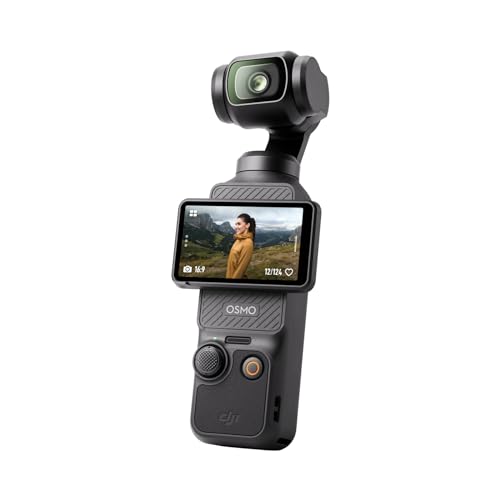
The Pocket 3 is what happened when the camcorder’s job was reimagined by drone engineers: a camera on a three-axis gimbal, the size of a chocolate bar, that floats through the chaos of family life with a steadiness no wrist can match. For filming a toddler — a subject who moves like weather and demands the camera move with them — the gimbal is not a luxury; it is the difference between footage and a suggestion. Its face tracking follows a small subject around a room with patient intelligence, and its low-light performance, from a sensor larger than any classic camcorder’s here, gives evening living rooms a clarity the traditional machines cannot reach.
The trade is the camcorder’s founding virtue: zoom. The Pocket 3’s view is wide and fixed in spirit — it films the room, the garden, the walk, beautifully, and it cannot cross a school hall to a face. Parents solve this by being where parents mostly are: close. The childhood archive shot on a Pocket is immersive and near, all eye-level and in-the-middle-of-it, and families who live in motion — travel, outdoors, the daily expedition — often find it the truest record of how the years actually felt.
It is the modern answer, and for the close-up years it may be the best one. Pair it in spirit with a zoom camcorder later, when the halls arrive, and the two philosophies cover a childhood between them.
- Form: pocket gimbal camera, one-hand everything
- Stabilisation: mechanical three-axis gimbal
- Tracking: active subject and face tracking
- Sensor: large for its class, strong in low light
- Screen: rotating touchscreen built into the handle
Strengths
- Unnaturally smooth footage of a moving childhood.
- Best low-light picture in this guide.
- Tiny enough to be present for everything.
Trade-offs
- No real zoom — the hall problem is unsolved.
- A precision instrument among toys and spills; handle with a parent’s care.
- Battery is built in, so endurance planning differs.
Best for: the close-up years — babies, toddlers, and families in motion.
Not suited for: filming stages and sports fields from the seats.
Panasonic HC-VX981K — Best 4K Camcorder
The VX981K is the V180’s philosophy with a sharper pencil: a 4K sensor and recording pipeline inside the same family-shaped machine, for parents who think about the archive’s future — the wall-sized screen of 2035, the crop you will want from a wide shot of the whole party, the detail that lets a frame of video become a printed photograph. Its in-camera cropping tricks, a Panasonic speciality in this line, let you derive a composed close-up from the wide 4K frame, which is a genuinely parental feature: film the whole scene now, find the perfect framing later, when you are less sleep-deprived.
Handling keeps the family faith — flip screen, forgiving menus, stabilisation tuned for the backwards walk — and the picture in good light is a clear class above the HD machines. Indoors, the smaller pixels ask a little more of the light, and the honest verdict is that its advantage is a daylight and good-light advantage. Battery and card appetites grow with the resolution, as physics insists.
Buy it if the archive matters as an archive — if you are the family’s historian by temperament and intend the films to be watched, cropped, and printed for decades. That reader exists in every family, and this is their camcorder.
- Form: traditional camcorder with 4K recording
- Picture: sharpest files among the classic camcorders here
- Tools: in-camera cropping from the 4K frame
- Stabilisation: family-tuned hybrid system
- Screen: flip-out touchscreen
Strengths
- An archive-grade picture in a parent-shaped machine.
- Crop-later flexibility suits distracted filming.
- Good-light quality clearly leads the classic pack.
Trade-offs
- Low-light edge is smaller than the resolution edge.
- Larger files demand larger cards and storage discipline.
- Costs more than the HD workhorses.
Best for: family historians building a decades-long archive.
Not suited for: parents who mostly film indoors at night on a budget.

Sony ZV-1F — Best for Sharing Parents
Some parents film for the family group chat, the grandparents’ feed, and a small public audience that grows with the child — and for them the camera’s second job, sharing, matters as much as its first. The ZV-1F was designed for creators and fits that parent exactly: a wide lens that frames a parent-and-baby two-shot at arm’s length, flattering colour and skin rendering out of the camera, a microphone arrangement that respects voices, and phone transfer that makes the evening post a two-minute task rather than a project.
As a pure camcorder it concedes the traditional ground: no long zoom, a compact’s battery rhythm, and stabilisation that is electronic rather than a gimbal’s grace. What it returns is presence — it is small enough to live in the bag that already goes everywhere, and its footage looks like the polished family content its buyers actually publish. The first-steps video filmed on it will be the one the extended family watches, because it will be the one that gets sent.
Choose it when the audience is part of the point. The childhood it records will be the best-lit, best-sounding, most-shared version of the six archives in this guide.
- Form: creator compact with wide fixed lens
- Framing: arm’s-length two-shots, parent and baby together
- Audio: voice-forward microphone design
- Sharing: fast phone transfer and creator colour modes
- Stabilisation: electronic, walk-and-talk capable
Strengths
- Made for the parent who publishes the milestones.
- Flattering faces and voices straight out of camera.
- Small enough to be the camera that is always there.
Trade-offs
- No zoom for halls and stages.
- Battery life follows compact, not camcorder, rules.
- Less stabilisation authority than the Pocket 3’s gimbal.
Best for: sharing-first parents and family creators.
Not suited for: the back-of-the-hall filming life.
How Do the Six Picks Compare?
| Pick | Zoom | Stabilisation | Strongest suit |
|---|---|---|---|
| Panasonic HC-V180K | Long | Hybrid | All-round family duty |
| Sony HDR-CX405 | Moderate | Optical, floating feel | Compact quality |
| Canon VIXIA HF R800 | Longest value | Optical | Halls and fields |
| DJI Osmo Pocket 3 | Minimal | 3-axis gimbal | Moving, close-up years |
| Panasonic HC-VX981K | Moderate | Hybrid | 4K archive |
| Sony ZV-1F | Wide fixed | Electronic | Sharing and publishing |
The table’s dividing line is distance. The classic camcorders own the far half of family life — halls, fields, stages — while the Pocket 3 and the ZV-1F own the near half: the room, the walk, the arm’s-length world where babies actually live. Most childhoods contain both halves, which is why so many families end up, across the years, with one of each philosophy.
What Should You Look for in a Camcorder for Filming a Baby?
Begin with the first five seconds. The camera must wake and record almost as fast as you can raise it, because the developmental milestones are unrepeatable and unannounced — nobody’s first steps were scheduled. Judge every candidate by that grab test before any specification. Next, stabilisation for your actual gait and grip: one hand, walking backwards, possibly holding a rail or a sibling. Then indoor light, because the honest geography of early childhood is the living room at dusk, the kitchen at breakfast, the hall with the curtains drawn — a camera that stays composed in that light films the real childhood rather than only its outdoor trailer.
Zoom is the fourth criterion and should be optical, because the school-hall distance is measured in faces, and digital zoom spends resolution the archive will miss. Battery and media are the fifth: an event-length battery and cards you can afford to fill and file, because the discipline of the archive — shoot, transfer, back up, clear — only survives if the media economics allow it. Finally, sound deserves a sentence of respect: first words are audio events. A camera whose microphone honours a small voice in a room — and which can accept an external microphone for the stage years — protects the half of the archive your ears will reach for first.
How Do You Film a Baby’s First Years Well?
Get down. The single transformation available to every parent with any camera in this guide is altitude: film from the child’s eye level and the footage stops looking like surveillance and starts looking like memory. The flip screens on the classic camcorders and the Pocket’s gimbal exist to make that posture sustainable — camera low, parent comfortable, world at the height it is actually lived. Film the ordinary with the same respect as the milestones: the breakfast negotiations and the buggy walks are the texture the adult child will actually ache for, and they cannot be staged later.
Keep clips short and frequent rather than long and rare; a childhood documented in twenty-second pieces is an archive that gets watched. Say the date and the place aloud at the start of important clips — a habit that sounds quaint and becomes priceless metadata in a decade. And appear in the films yourself: hand the camera to a partner, a grandparent, the Pocket’s tracking on a small tripod — because the archive’s most common tragedy is a parent who exists only as a voice behind the lens, and the child who inherits the films will look for your face first.
What Mistakes Do Parents Make When Filming a Baby?
The first is filming only the milestones, which produces an archive of ceremonies and none of the life between them — the life being, in retrospect, the point. The second is the phone-battery tragedy in camcorder form: arriving at the event with a half-charged camera and a nearly full card, because the machine lived in a drawer since the last event. Charge and clear as a ritual the night before anything that matters. The third is zooming constantly; the parental zoom, in and out like breathing, makes footage unwatchable, and the cure is to set the frame, hold it, and let the child move within it.
Fourth is the un-backed-up archive — a year of irreplaceable film on one card in one camera in one bag. Transfer weekly, keep two copies in two places, and treat the rule as seriously as any other safety rule in the house. And fifth, the subtlest: filming through the childhood instead of being in it. The camera should come out for minutes, not for the whole afternoon. The best family films were made by parents who put the camera down — a discipline every pick in this guide, being quick to wake, is designed to permit.
Final Recommendation
And if the budget will stretch to exactly one accessory beyond the camera itself, let it be the spare battery rather than anything cleverer. Every other failure in family filming can be improvised around; a flat battery at the candle moment cannot, and the spare — charged, in the bag, forgotten until the day it saves the archive — is the highest-value object mentioned anywhere in this guide.
For most families the Panasonic HC-V180K remains the answer this keyword has always had: light, long-zoomed, forgiving, and priced like it understands the household budget it joins. Choose the Sony CX405 for the same virtues in miniature, the Canon R800 when the halls are deep and the budget is not, and the VX981K when the archive is a life’s work. Choose the DJI Osmo Pocket 3 if your family’s life is motion and closeness, and the Sony ZV-1F if the films are made to be shared the same evening. Whichever you choose, charge it the night before, get down to eye level, and film the ordinary Tuesdays. They are the treasure. The milestones are just the Tuesdays with better lighting.
Which Camera Suits Which Stage of Childhood?
Childhood changes the filming problem faster than any other subject, and the honest guide maps cameras to stages. The newborn months are close, quiet, and indoor: the camera works at arm’s length in lamplight, filming a subject who moves slowly and sleeps through most of the production. That is the Pocket 3’s and the ZV-1F’s native light — large-enough sensors, kind faces, no zoom required because the whole world is one room. The crawling and toddling years add motion and vertical ambition: the subject crosses rooms, climbs, and falls photogenically, and stabilisation becomes the archive’s author — the Pocket’s gimbal for the chaser, the classic camcorders’ hybrid systems for the parent filming from the sofa’s end.
The preschool and early school years introduce the venue: the hall, the stage, the sports field, the swimming gala’s far end. Distance arrives in the family’s filming life and never leaves, and this is the moment the classic camcorders — the V180’s all-round competence, the R800’s reach — justify every gram of their unfashionable shape. Families who began with a Pocket often keep it for the close work and add the zoom machine for the venues, which is why this guide presents the two philosophies as partners rather than rivals. The later years — performances, matches, ceremonies, the long approach of graduation — belong to reach and archive quality together, the R800’s and VX981K’s combined brief. Buy for the stage you are in, with one eye on the stage that is visibly next, and the camera will never feel like a mistake; it will feel like a chapter.
What About Sound — First Words and School Hall Acoustics?
Half of the early archive is audio wearing a picture’s clothes. First words, first sentences, the mispronunciations the family will quote for thirty years — these are sound recordings with visual accompaniment, and they deserve a camera whose microphone treats a small voice in a room as the main event. The classic camcorders record honest room audio and accept, in several models, the discipline of getting closer as the primary technique — sound obeys distance more ruthlessly than light does, and the parent’s feet are the best microphone accessory ever made. The ZV-1F’s voice-forward design earns its badge partly here, and the Pocket 3’s audio, especially with its maker’s wireless microphone ecosystem, serves the narrating parent best of all.
The school hall is the opposite problem: too much sound, all of it echo. No camera in this guide defeats a hall’s acoustics, and the honest techniques are positional — sit nearer the front for the performance years, accept the room’s voice as part of the record — and editorial: the concert film is for the picture of your child in the third row, and the soundtrack is the school’s, not theirs. Save your audio standards for the living room, where the treasures are actually recorded.
How Do Grandparents and the Wider Family Fit the Choice?
Every baby camera has a shadow audience: the grandparents, the overseas relatives, the family archive’s future readers. Their needs shape real decisions. File compatibility and easy transfer — the ZV-1F’s phone pipeline, the Pocket’s app — decide whether the films actually travel or merely exist, and a camera whose footage reaches the family the same evening will be loved out of proportion to its specifications. Simplicity at the filming end matters too, because the archive’s best supplementary cameraman is often a grandparent with the machine for the weekend; the V180’s forgiving menus are, in this light, a distribution strategy.
There is also the gift dimension: a large fraction of these cameras are bought by grandparents for new parents, and the giving has a correct form. Buy the simple, complete, ready machine — the V180 or the CX405 — with a card and a charged battery in the box, rather than the enthusiast’s project camera that requires accessories and study. The gift that films the first week is worth ten that await configuration, because the first week does not repeat, and the giver will be repaid in footage within days.
How Long Will a Family Camcorder Serve?
A childhood, comfortably. The classic camcorders are mechanically simple, their media is standard, and their failure modes are mostly batteries tiring after years — replaceable, on the Panasonic and Canon lines, without ceremony. The modern pair ask different longevity questions: the Pocket’s built-in battery and precision gimbal reward careful handling, and the ZV-1F’s compact ecosystem ages with the creator market’s support. None of the six is a purchase for a season; all are purchases for the era between the first steps and the school gates, and most will still be working, in a drawer, when the graduation needs a camera and the family historian smiles.
Care is minimal and mostly archival: store the camera charged-ish rather than dead, keep it from the worst of the toy box’s impacts, and — the real longevity discipline — keep the footage migrating. Formats outlive cameras only if someone moves the files; the family’s historian, whoever they turn out to be, inherits that duty with the archive itself.
What Does a Sensible Family Filming Kit Look Like Around the Camera?
Short, because the camera bag of a young family is already a logistics operation. A second battery, bought with the camera, is the one non-negotiable — events do not pause for charging, and the spare converts battery anxiety into a non-subject for a decade. A card large enough for a holiday, plus the habit of a second card in the bag, covers the media. A small case that fits the camera and nothing else encourages the camera’s presence, which is the kit’s whole purpose; elaborate bags encourage leaving it at home. For the hall years, an inexpensive monopod or a mini tripod for the seat-back moments steadies the long zoom more cheaply than any camera upgrade, and for the Pocket, a small tripod unlocks the tracked, parent-in-frame filming that saves the archive from the invisible-parent tragedy.
Everything else — lights, microphones, elaborate rigs — should be bought against a named recurring problem rather than a general aspiration. The family filming kit succeeds by being small enough to come along, and every accessory should be interrogated at the door of the bag: will you be carried to a hundred ordinary afternoons? The battery and the card say yes without thinking. Let the rest audition.
How Do You Share Films Without Turning Childhood Into Content?
A word of proportion that belongs in an honest guide. The cameras here can feed a family group chat, a private archive, or a public channel, and the choice among those is the family’s alone — but the filming habits differ, and it is worth deciding early which household you are. The private archive films generously and shares selectively, favouring the cameras’ ease over their polish. The sharing family — the ZV-1F’s people — films with an audience’s kindness in mind: shorter clips, faces lit, names and places spoken for relatives far away. The public creator family adds consent’s long view: the child in the films will one day be a teenager with opinions about their published toddlerhood, and the parents who film with that reader in mind make calmer decisions in the present.
None of this is a camera specification, and all of it affects which camera serves you. Buy the machine that matches the household’s actual sharing life, and the question of whether the childhood was documented “enough” dissolves — it was documented as yours, which is the only standard the grown child will apply.
The First Month With the Camera — A Small Curriculum
Week one: film everything badly and review it honestly. Learn where the record button falls under your thumb, how the zoom behaves at its extremes, and what your living room’s light does to the picture at dusk — knowledge that must be in your hands before it is needed in your heart. Week two: practise the disciplines — the night-before charge, the eye-level crouch, the spoken date at a clip’s start, the weekly transfer. Week three: film one ordinary day entire, in short clips, and watch it whole; this is the exercise that teaches a parent what their archive is actually for, and it reliably changes what gets filmed afterwards. Week four: hand the camera to someone else and be filmed. The archive needs you in it, and the habit of surrendering the camera is easier to build in the first month than in the fifth year.
By the end of the month the camera stops being a purchase and becomes a member of the household with a job. That is the true delivery date of every pick in this guide, and it arrives at the same time regardless of which badge is on the box — which is why the choosing, in the end, matters less than the starting.
What Changes When There Are Siblings, Twins, or a Whole Crew?
Multi-child households rewrite the filming brief in two ways. The subject count multiplies and so does the chaos per frame, which rewards the wide, steady, forgiving cameras — the Pocket 3’s room-filling calm, the V180’s stabilised breadth — over any machine that demands composition. And the operator’s availability divides: the parent filming a second child has a first child in the other hand’s jurisdiction, which makes the grab-and-shoot test and one-handed everything not a convenience but the entire specification. Twins add their own clause — the milestones arrive in stereo and refuse to repeat for the camera — and the families who film them best are the ones whose camera was already rolling for the ordinary minutes when the extraordinary ones happened.
The archive also gains a fairness duty the single-child household never faces: film them even. The second child’s archive is proverbially thinner than the first’s, not from lesser love but from divided hands, and the parents who notice the imbalance in the toddler years and correct it — deliberately, with the camera’s help — are repaid in the teenage years, when the ledgers are audited with great seriousness. A camera that is quick, present, and undemanding is, in a busy house, an instrument of justice as much as of memory.
Why Do Families Abandon Camcorders — and How Does This Guide Prevent It?
The abandoned camcorder is a recognisable artefact: bought with love before the birth, used heroically for a month, and entombed in a drawer by the first winter, its footage un-transferred and its battery slowly dying. The autopsy is always the same trio — friction, friction, friction. It lived in the wrong place, its files required a ceremony to reach a phone, and its battery was flat at the two moments that mattered. The picks and the habits in this guide are chosen against exactly that autopsy: cameras that wake fast and forgive, files that move to phones the same evening, a charging ritual tied to the night before events, and storage in the bag that already leaves the house rather than in a cupboard of good intentions.
If you recognise a previous camera purchase in that autopsy, buy simpler this time — the V180 over the VX981K, presence over specifications — because the archive does not care which badge filmed it. It cares that something did, on the ordinary Tuesday, with the light as it was. That is the standard this entire guide is written to serve.
The Gift-Buyer’s Shortcut and the Second-Hand Question
For the relative buying this weekend, the decision compresses kindly. New parents, first camera, unknown technical appetite: the Panasonic V180K, with a card and a spare battery in the parcel, ready to film within five minutes of unwrapping. Parents who live on their phones and share everything: the ZV-1F, which speaks their language natively. Parents in motion — travellers, walkers, the outdoors by default: the Pocket 3, with a small case, because its gimbal is the one delicate thing in this guide. In every case, include the media and the spare battery in the gift; a camera that cannot record on the day it is given is a promissory note, and babies do not honour those.
Second-hand deserves its sentence too: classic camcorders are durable, unfashionable, and therefore cheap used, and a clean V180-generation machine from a reputable dealer is one of the great bargains in family technology. Check the zoom’s smoothness, the screen’s hinges, and the battery’s honesty, buy a new card of your own, and the savings can fund the archive’s storage for years. The modern pair, with their batteries and precision parts, are better bought new unless the price truly argues otherwise.
What Will You Thank Yourself for Filming?
Ask parents of grown children what the archive’s crown jewels turned out to be, and the answer is never the ceremony. It is the kitchen in the morning light with a toddler conducting breakfast; the walk to the shop that took forty minutes because everything on the pavement required investigation; the small voice explaining, at length and with total confidence, how the moon works. None of it was an event. All of it was filmed, when it was filmed, by a camera that happened to be charged, near, and quick — which is to say, by the virtues this guide has ranked above every specification since its first paragraph.
So the final buying advice is really scheduling advice: whichever of the six you choose, let it arrive before the next ordinary week, not before the next big occasion. The occasions will film themselves adequately on anything. The ordinary week is the one that needs the right camera, ready, in the bag by the door — and it is the week, twenty years from now, that somebody will watch with their whole heart.
Related guides
- Best Cameras for Filming Concerts: 6 Picks for Stages, Clubs and Arena Shows
- Best Cameras for Filming Podcasts: 6 Picks for Studios, Desks and Two-Shots
- Best Cameras for Filming Skiing: 6 Picks for Powder, Park and Follow-Cams
- Best Cameras for Filming Outside: 6 Rugged Picks for Outdoor Video
- Best Cameras for Doing Movies: 6 Picks for Your First Real Films
- Best Cameras for a Computer Show: 6 Picks for Filming Booths, Demos and Interviews
- Best Cameras for Conductors: 6 Picks for Filming the Podium and the Orchestra
Frequently Asked Questions
Why not just use my phone to film my baby?
You can, and everyone does for the daily fragments. A camcorder earns its place for the events and the archive: optical zoom across a hall, stabilisation for the parental backwards walk, a battery that outlasts the party, and a dedicated home for footage that will not be lost when a phone is replaced. Most families end up using both — phone for the fragments, camcorder for the record.
Is a camcorder the same as a baby monitor?
No, and the distinction matters. Everything in this guide is a camera for filming family life — moments a parent is present for and chooses to record. A monitor is a different product for watching over a sleeping child, with its own considerations, and none of these picks is sold or suitable as a substitute for parental supervision in any situation.
What matters more for baby videos, resolution or stabilisation?
Stabilisation, by a distance. You will film moving — backwards, crouching, one-handed — far more than you will film from a tripod, and a steady HD picture is watched with pleasure while a shaky sharper one is endured. Resolution earns its keep later, in the archive years, which is why the 4K Panasonic is a historian’s pick rather than everyone’s.
How do I film first steps without missing them?
Keep the camera charged, card-cleared, and within reach during the wobbly weeks — readiness is the whole technique. Film the practice sessions generously; the steps will arrive inside an ordinary attempt, and the camera that was already rolling for the cruising along the sofa will be rolling for the crossing of the room. Short, frequent clips beat one vigilant hour.
Can these cameras film in a dim living room?
Yes, with gradations. The Pocket 3’s larger sensor leads the group indoors; the classic camcorders produce warm, watchable footage in ordinary lamplight and soften as the room darkens. Help any of them by filming near the light rather than across it, and by accepting the evening’s look as part of the record — real childhood was not lit like a studio, and the films are better for admitting it.
When is the best time to buy the camera?
Before the baby, if the decision is already made — the first fortnight is no time to be comparing menus, and the camera that is charged and familiar when the baby comes home films the homecoming. Failing that, now: the milestones do not wait for a sale season, and the difference between the best and second-best week to buy is measured in moments that only occur once. A previous-generation or used classic, bought today, beats a flagship bought after the first steps on every metric the archive recognises.
How should I store years of baby videos?
Transfer off the card weekly during the heavy filming years, name files or folders by date and occasion while you still remember them, and keep two copies in two places — a drive at home and a cloud or a second drive elsewhere. The archive’s enemies are not time but single points of failure, and the discipline costs ten minutes a week against a lifetime’s evidence.
Related Guides
One closing thought for the parent reading this at 3 a.m. with a baby asleep on one arm: the camera decision feels large tonight because everything about this year feels large. It is, in truth, one of the kindest purchases on the new-parent list — the only one whose value appreciates every single year it is kept, compounding quietly in a drawer of drives until the day a grown child asks what they were like, and the answer is not a description but a film. Buy the one that will be ready. Then be in the films.
Family filming grows with the family. See also our guide to the best beginner cameras for video, the best action cameras for vlogging for the years of motion ahead, and our roundup of the best affordable cameras for photos and videos.


